

|
시장보고서
상품코드
2066639
아프리카의 배터리 시장 : 점유율 분석, 업계 동향과 통계, 성장 예측(2026-2031년)Africa Battery - Market Share Analysis, Industry Trends & Statistics, Growth Forecasts (2026 - 2031) |
||||||
 Mordor Intelligence
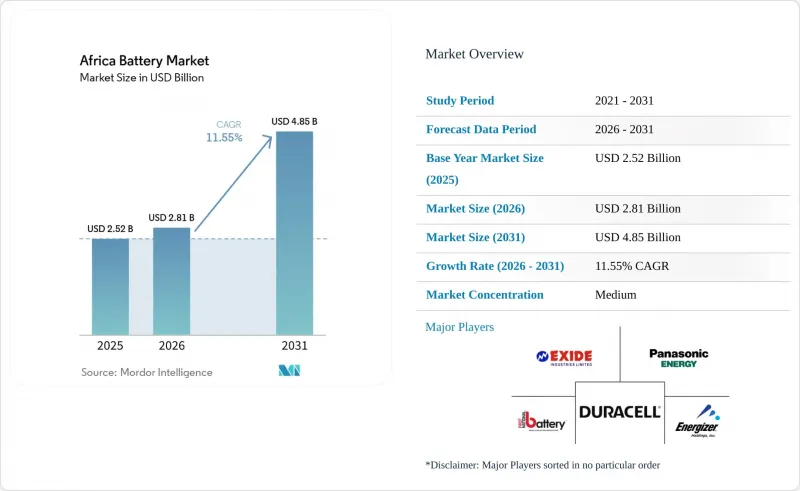
Mordor Intelligence에 의하면, 아프리카 배터리 시장 규모는 2025년에 25억 2,000만 달러로 평가되었고 2026년 28억 1,000만 달러에서 2031년까지 48억 5,000만 달러에 이를 것으로 예측되며, 예측 기간(2026-2031년) CAGR은 11.55%를 나타낼 전망입니다.
본 보고서는 배터리 유형(1차 전지 및 2차 전지), 기술(납산, 리튬이온, 니켈수소, 니켈카드뮴, 나트륨-황, 전고체, 흐름 전지 및 신흥 화학 계열), 용도(자동차, 산업용, 휴대용, 전동 공구, SLI 및 기타 용도), 그리고 지역(남아프리카, 이집트, 케냐, 나이지리아, 모로코, 에티오피아 및 아프리카의 기타 지역)별로 분류되어 있습니다.
아프리카 배터리 시장 동향과 인사이트
리튬 이온 배터리 가격 하락
2024년, 전 세계 배터리 팩 가격은 1kWh당 115달러까지 하락했으며, 중국에서는 1kWh당 94달러까지 떨어졌습니다. 이로 인해 아프리카의 통신탑 및 마이크로그리드 분야에서 드디어 디젤 발전기 가격보다 낮은 수준에 도달했습니다. MTN이나 Airtel 등의 사업자들은 최대 10년간 사용 가능한 리튬이온 시스템을 도입해 거점을 개조하고 있으며, 이를 통해 총 소유 비용을 약 30% 절감하고, 유지보수를 위한 출장 횟수를 대폭 줄이고 있습니다. 남아프리카공화국과 이집트의 전력 회사들은 현재 태양광 발전소와 몇 시간 단위의 에너지 저장 시스템을 결합하여 운영하고 있습니다. 그 대표적인 사례가 바로 저녁 시간대의 피크 수요에 대응하기 위해 1,140 MWh 규모의 배터리를 통합한 540 MW 규모의 켄하르트(Kenhardt) 프로젝트입니다. 모로코에 설립된 중국의 양극재·음극재 공장은 공급망 비용을 더욱 절감하여 합리적인 가격을 실현하는 선순환을 만들어내고 있습니다.
Off-grid형 태양광 발전 + BESS 도입이 급증하고 있습니다.
전력망 확장이 여전히 경제성이 떨어지는 지역에서는 독립형 태양광 발전과 에너지 저장 시스템을 결합한 마이크로그리드가 급속히 보급되고 있습니다. 에티오피아는 4-8시간의 축전 용량을 갖춘 태양광 발전 시스템을 활용하여, 2030년까지 Off-grid 전기화율을 35%로 높이는 것을 목표로 하고 있습니다. 이집트, 보츠와나, 잠비아도 동일한 모델을 채택하여, 다자간 은행으로부터 축전 시스템의 현금 흐름을 대출 대상으로 인정받아 자금을 조달하고 있습니다. 통신 사업자와 농업용 콜드체인 사업자는 가동 시간 연장을 통해 초기 투자 증가를 정당화할 수 있으며, 이는 농촌 지역의 에너지 접근성 향상과 경제 활동 촉진으로 이어지고 있습니다.
원자재 공급의 병목 현상
콩고민주공화국(DRC)의 ‘30% 가공 규정’으로 인해 코발트 출하가 정체되어 4-6주간의 지연이 발생했으며, 이로 인해 아시아 구매자들의 도착 비용이 12% 증가했습니다. 짐바브웨에서는 철도의 수송 능력이 리튬 수출의 걸림돌이 되고 있어, 호주의 동종 업체에 비해 운임이 2배나 높습니다. 한편, 남아프리카의 망간 광산 업체들은 철도의 신뢰성이 낮기 때문에 광석을 트럭으로 운송하고 있습니다. 전 세계 공급량의 약 20%를 차지하는 소규모 채굴을 통해 생산된 코발트는 현재 EU의 실사(due diligence) 법에 따라 규정 준수 측면에서 불투명한 상황에 놓여 있으며, 구매자들은 법적 위험과 평판 위험에 노출되어 있습니다.
부문별 분석
2차 전지는 2025년 매출의 86.5%를 차지하고 있으며, 연평균 성장률(CAGR) 12.1%에 힘입어 그 우위는 더욱 공고해질 전망입니다. 자동차 및 산업 분야의 고객들은 충전식 배터리의 낮은 수명 주기 비용을 높이 평가하고 있으며, 고충전 사이클이 요구되는 용도에서는 리튬 이온 배터리가 납산 배터리를 대체하고 있습니다. 1차 전지는 주로 저전력 소비 기기에서 13.5%의 시장 점유율을 유지하고 있습니다. 아프리카의 재충전식 배터리 시장 규모는 2031년까지 40억 달러를 넘어설 것으로 예상되며, 그 성장의 대부분은 리튬 이온 배터리가 차지할 것으로 전망됩니다.
케냐와 남아프리카공화국에서 생산자책임확대제도(EPR)에 따른 수수료가 인상됨에 따라, 아프리카 배터리 시장에서 1차 전지의 점유율은 계속 줄어들 것으로 전망됩니다. First National Battery와 같은 납 재활용 업체들은 원자재의 96%를 회수하고 있지만, 리튬 이온 배터리 재활용은 여전히 제한적인 수준이며, 이는 투자 기회를 시사합니다. Gotion사의 모로코 공장은 납기 기간을 단축하고 환율 변동 위험을 헤지함으로써, 구매자들의 재충전식 배터리로의 전환을 더욱 촉진할 것입니다.
기타 혜택:
- 엑셀 형식 시장 예측(ME) 시트
- 3개월간의 애널리스트 지원
자주 묻는 질문
목차
제1장 서론
제2장 조사 방법
제3장 주요 요약
제4장 시장 구도
제5장 시장 규모와 성장 예측
제6장 경쟁 구도
제7장 시장 기회와 향후 전망
JHS 26.06.29According to Mordor Intelligence, the africa battery market size was valued at USD 2.52 billion in 2025 and is estimated to grow from USD 2.81 billion in 2026 to reach USD 4.85 billion by 2031, at a CAGR of 11.55% during the forecast period (2026-2031).
This report is Segmented by Battery Type (Primary Batteries and Secondary Batteries), Technology (Lead-Acid, Li-Ion, Nickel-Metal Hydride, Nickel-Cadmium, Sodium-Sulfur, Solid-State, Flow Battery, and Emerging Chemistries), Application (Automotive, Industrial, Portable, Power Tools, SLI, and Other Applications), and Geography (South Africa, Egypt, Kenya, Nigeria, Morocco, Ethiopia, and Rest of Africa).
Africa Battery Market Trends and Insights
Declining Lithium-Ion Prices
Global pack prices slipped to USD 115 per kWh in 2024 and to USD 94 per kWh in China, finally undercutting diesel gensets for African telecom towers and microgrids. Operators such as MTN and Airtel retrofit sites with lithium-ion systems that last up to 10 years, trimming the total cost of ownership by about 30% and slashing maintenance trips. South African and Egyptian utilities now pair multi-hour storage with solar farms, exemplified by the 540 MW Kenhardt project that integrates 1,140 MWh of batteries to meet evening peaks. Chinese cathode and anode plants opening in Morocco further compress supply-chain costs, creating a virtuous circle of affordability.
Surge in Off-Grid Solar + BESS Deployments
Off-grid solar-plus-storage microgrids are proliferating where extending grids remains uneconomic. Ethiopia targets 35% off-grid electrification by 2030 using solar arrays with 4-8 hour battery reserves. Egypt, Botswana, and Zambia adopted similar models, securing debt from multilateral banks that now view storage cash flows as bankable. Telecom and agricultural cold-chain operators gain uptime improvements that justify higher upfront spend, advancing rural energy access and economic activity.
Raw-Material Supply Bottlenecks
The DRC's 30% processing rule idled cobalt shipments, adding 4-6 week delays and 12% to Asian buyers' landed costs. Zimbabwe's rail capacity caps lithium exports, doubling freight versus Australian peers, while South African manganese miners truck ore because of rail unreliability. Artisanal cobalt, roughly 20% of global supply, now sits in compliance limbo under the EU due diligence law, exposing buyers to legal and reputational risk.
Other drivers and restraints analyzed in the detailed report include:
- Government Incentives for Local Battery Manufacturing
- Rapid Electrification of Two-/Three-Wheelers
- Counterfeit / Low-Quality Battery Influx
For complete list of drivers and restraints, kindly check the Table Of Contents.
Segment Analysis
Secondary batteries delivered 86.5% of 2025 revenues, and their 12.1% CAGR is set to reinforce that dominance. Automotive and industrial clients value rechargeability's lower lifetime cost, while lithium-ion replaces lead-acid in high-cycle roles. Primary cells cling to a 13.5% share mainly in low-drain devices. The Africa battery market size for secondary chemistries is projected to eclipse USD 4 billion by 2031, with lithium-ion securing most gains.
The Africa battery market share of primary cells will keep shrinking as extended producer responsibility fees rise in Kenya and South Africa. Lead recyclers such as First National Battery recover 96% of materials, yet lithium-ion recycling remains scarce, signaling an investment opportunity. Gotion's Moroccan plant will shorten delivery times and hedge currency swings, further tilting buyers toward rechargeables.
List of Companies Covered in this Report:
- CATL
- BYD Co. Ltd.
- Panasonic Energy
- Duracell Inc.
- Energizer Holdings Inc.
- Exide Industries Ltd.
- First National Battery (Metair)
- Solar MD
- Uganda Batteries Ltd.
- Chloride Exide Kenya Ltd.
- Luminous Power Technologies
- Murata Manufacturing Co. Ltd.
- East Penn Manufacturing
- EnerSys
- GS Yuasa Corp.
- Gotion High-Tech
- BSL Battery
- Felicity Solar
- Orbit Batteries
- Saft (TotalEnergies)
Additional Benefits:
- The market estimate (ME) sheet in Excel format
- 3 months of analyst support
TABLE OF CONTENTS
1 Introduction
- 1.1 Study Assumptions & Market Definition
- 1.2 Scope of the Study
2 Research Methodology
3 Executive Summary
4 Market Landscape
- 4.1 Market Overview
- 4.2 Market Drivers
- 4.2.1 Declining lithium-ion prices
- 4.2.2 Surge in off-grid solar + BESS deployments
- 4.2.3 Government incentives for local battery manufacturing
- 4.2.4 Rapid electrification of two-/three-wheelers
- 4.2.5 Telecom-tower retrofit cycle
- 4.2.6 Chinese-backed lithium-processing build-out
- 4.3 Market Restraints
- 4.3.1 Raw-material supply bottlenecks
- 4.3.2 Patchy grid & charging infrastructure
- 4.3.3 Counterfeit/low-quality battery influx
- 4.3.4 Policy fragmentation & weak enforcement
- 4.4 Supply-Chain Analysis
- 4.5 Regulatory Landscape
- 4.6 Technological Outlook
- 4.7 Porter's Five Forces
- 4.7.1 Bargaining Power of Suppliers
- 4.7.2 Bargaining Power of Buyers
- 4.7.3 Threat of New Entrants
- 4.7.4 Threat of Substitutes
- 4.7.5 Competitive Rivalry
5 Market Size & Growth Forecasts
- 5.1 By Battery Type
- 5.1.1 Primary Batteries
- 5.1.2 Secondary Batteries
- 5.2 By Technology
- 5.2.1 Lead-acid
- 5.2.2 Li-ion
- 5.2.3 Nickel-metal hydride
- 5.2.4 Nickel-cadmium
- 5.2.5 Sodium-sulfur
- 5.2.6 Solid-state
- 5.2.7 Flow Battery
- 5.2.8 Emerging chemistries
- 5.3 By Application
- 5.3.1 Automotive (HEV, PHEV, and EV)
- 5.3.2 Industrial (Motive, Stationary (Telecom, UPS, ESS), etc.)
- 5.3.3 Portable (Consumer Electronics, etc.)
- 5.3.4 Power Tools
- 5.3.5 SLI
- 5.3.6 Other Applications
- 5.4 By Geography
- 5.4.1 South Africa
- 5.4.2 Egypt
- 5.4.3 Kenya
- 5.4.4 Nigeria
- 5.4.5 Morocco
- 5.4.6 Ethiopia
- 5.4.7 Rest of Africa
6 Competitive Landscape
- 6.1 Market Concentration
- 6.2 Strategic Moves (M&A, Partnerships, PPAs)
- 6.3 Market Share Analysis (Market Rank/Share for key companies)
- 6.4 Company Profiles (includes Global level Overview, Market level overview, Core Segments, Financials as available, Strategic Information, Products & Services, and Recent Developments)
- 6.4.1 CATL
- 6.4.2 BYD Co. Ltd.
- 6.4.3 Panasonic Energy
- 6.4.4 Duracell Inc.
- 6.4.5 Energizer Holdings Inc.
- 6.4.6 Exide Industries Ltd.
- 6.4.7 First National Battery (Metair)
- 6.4.8 Solar MD
- 6.4.9 Uganda Batteries Ltd.
- 6.4.10 Chloride Exide Kenya Ltd.
- 6.4.11 Luminous Power Technologies
- 6.4.12 Murata Manufacturing Co. Ltd.
- 6.4.13 East Penn Manufacturing
- 6.4.14 EnerSys
- 6.4.15 GS Yuasa Corp.
- 6.4.16 Gotion High-Tech
- 6.4.17 BSL Battery
- 6.4.18 Felicity Solar
- 6.4.19 Orbit Batteries
- 6.4.20 Saft (TotalEnergies)
7 Market Opportunities & Future Outlook
- 7.1 White-Space & Unmet-Need Assessment


