
|
시장보고서
상품코드
2066642
가속도 센서 및 요율 센서 : 시장 점유율 분석, 업계 동향 및 통계, 성장 예측(2026-2031년)Acceleration And Yaw Rate Sensors - Market Share Analysis, Industry Trends & Statistics, Growth Forecasts (2026 - 2031) |
||||||
 Mordor Intelligence
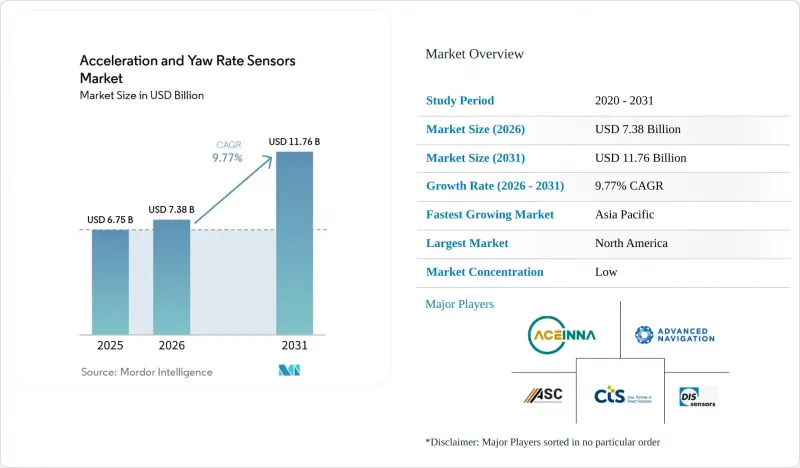
Mordor Intelligence에 의하면, 가속도 센서 및 요율 센서 시장 규모는 2025년 67억 5,000만 달러로 평가되었습니다. 2026년에는 73억 8,000만 달러로 확대되어 2026년부터 2031년에 걸쳐 CAGR 9.77%로 성장을 지속하여, 2031년에는 117억 6,000만 달러에 이를 것으로 예측됩니다.
본 보고서는 센서 유형(마이크로 기계식 센서, 압전 센서 등), 판매 채널(OEM 순정 부품, 애프터마켓용 교체 부품), 최종 용도(자동차(승용차, 소형 상용차, 대형 상용차, 오프로드 차량), 항공우주 및 방위 등) 및 지역별로 분류되어 있습니다. 시장 전망은 금액(달러) 기준으로 제시되어 있습니다.
세계의 가속도 센서 및 요율 센서 시장 동향 및 인사이트
전자식 안정성 제어(ESC) 및 첨단 운전자 보조 시스템(ADAS)의 보급 확대
전자식 안정성 제어(ESC)는 여전히 요율 센서의 주요 용도로, 모든 차량 등급에 널리 탑재되어 있기 때문에 가속도 센서 및 요율 센서 시장에 있어 여전히 신뢰할 수 있는 수요 하한선 역할을 하고 있습니다. 미국의 안전 규정에 따르면 경차에 ESC 장착이 의무화되어 있으며, 관련 요건은 대형 차량으로도 확대 적용되고 있습니다. 이에 따라 요율 감지는 선택 사항이 아닌, 차량 제어의 핵심 기능으로 자리매김하고 있습니다. FMVSS 제127호에 따르면, 경차에 AEB(자동 긴급 제동 장치)를 장착하는 것이 의무화되었으며, 최종 준수 기한은 2029년 9월로 정해져 있습니다. 이로 인해, 보다 신속한 제동 판단을 지원하는 센서의 조달 주기가 수년 단위로 형성되고 있습니다. 이는 AEB 보정 시 기존의 ESC만 사용하는 구성보다 더 높은 정밀도의 요 레이트 및 횡가속도 신호가 필요하기 때문에 중요한 의미를 지닙니다. 따라서 각 OEM 업체들은 단순히 저가형 유닛을 추가하는 대신, 더 고성능의 센서로 전환하고 있습니다. 이러한 사양의 변화로 인해, 이미 센서 탑재율이 높은 성숙한 차량 부문에서도 센서의 부가가치가 높아지고 있습니다.
전기자동차 및 하이브리드차의 승차감 및 차체 제어에 사용되는 센서 탑재량 증가
전기자동차 및 하이브리드차의 플랫폼은 승차감, 차체, 토크 제어 기능이 고속 관성 피드백에 의존하고 있기 때문에 가속도 센서 및 요율 센서 시장에 새로운 수요층을 창출하고 있습니다. 이러한 차량의 경우, 토크 벡터링과 서스펜션의 동작을 실시간으로 연동하는 경우가 많으며, 양산 시스템에서는 100Hz 이상의 IMU 갱신 속도가 요구됩니다. 2026년 1월 『Actuators』지에 게재된 연구에 따르면, 차체 탑재형 IMU, 바퀴 가속도 센서, 바퀴 속도 센서를 활용한 도로 예측형 세미액티브 서스펜션 전략은 실용적인 센서의 한계 조건 하에서도 뛰어난 승차감과 핸들링 성능을 유지하는 것으로 나타났습니다. 이 결과는 OEM 각사가 비용 절감을 위해 센서 노드를 줄이는 대신, 전기자동차(EV)의 서스펜션 ECU 내에 다축 관성 센서를 추가하는 보다 광범위한 추세를 뒷받침하는 것입니다. 파나소닉 인더스트리의 ‘EWTS5G’ 6-in-1 디바이스 역시, 공급업체가 3축 가속도계와 3축 자이로스코프를 소형 MEMS 패키지에 통합하여 ASIL D까지 지원함을 보여주고 있습니다. EV의 패키징 제약이 더욱 엄격해지는 가운데, 더 작은 설치 면적에서 더 많은 센싱 기능을 제공하는 공급업체는 차세대 플랫폼으로 나아가는 길을 더욱 확실하게 확보할 수 있을 것입니다.
장기간에 걸친 자동차용 인증 및 ASIL 검증 주기
가속도 센서 및 요율 센서 시장에서 자동차용 장치는 OEM이 플랫폼 프로그램에 채택하기 전에 신뢰성 인증과 기능 안전 심사를 모두 통과해야 합니다. 이 과정은 대개 18-36개월에 걸쳐 진행되며, 센서 집적 회로 내의 각 안전 메커니즘에 대한 증거가 요구됩니다. ASIL D 레벨에서는 부담이 더욱 커지며, 공급업체는 -40°C에서 125°C에 이르는 전체 작동 온도 범위에서 99%를 초과하는 고장 감지 커버리지를 입증해야 합니다. 보쉬 세미컨덕터스는 SMI980을 ASIL D 등급의 자동차용 제품으로 포지셔닝하고 있는 반면, TDK 인벤센스는 IAM-20685HP를 ISO 26262 : 2018의 ASIL B 요건에 부합하는 제품으로 포지셔닝하고 있습니다. 이 예시들은 모두 설계 채택이 시작되기 전, 수익화 단계에 이르기 전까지의 개발 과정에 얼마나 많은 노력이 필요한지를 보여줍니다. 소규모 전문 벤더는 외부 파운드리 업체에 의존하는 경우, 고객의 설계 동결 기한과 긴 검증 주기를 조율해야 한다는 추가적인 난관에 직면하게 됩니다. 이러한 타이밍의 불일치로 인해, 새로운 센싱 아키텍처가 기술적 준비 상태를 실제 매출로 전환하는 속도가 늦어지게 됩니다.
부문별 분석
2025년, 가속도 센서 및 요율 센서 시장 규모의 63.56%를 마이크로기계식 센서가 차지했으며, 이에 따라 MEMS는 자동차 안전 및 제어 용도 전반에 걸쳐 여전히 압도적인 출하량 1위 자리를 유지하고 있습니다. 이러한 입지는 수년에 걸친 웨이퍼 수준의 공정 개선, 배치 생산 규모, 그리고 ESC, 에어백, ADAS 제어 장치와의 긴밀한 통합에 힘입은 것입니다. 보쉬 세미컨덕터스, ST마이크로일렉트로닉스, TDK 인벤센스의 제품 라인업은 이러한 도입 실적을 반영하고 있으며, ASIL B부터 ASIL D에 이르는 자동차 등급의 MEMS 제품군과, 저G 환경에서의 쾌적성 감지부터 고G 환경에서의 충돌 감지에 이르는 가속도계를 아우르고 있습니다. 정전용량식 센서는 특히 관성 항법이나 구조 시험 분야와 같이 스케일보다 고해상도와 저잡음이 중시되는 상황에서 여전히 유용한 위치를 차지하고 있습니다. 공진형 MEMS 및 서모파일 방식을 포함한 기타 아키텍처는 가속도 센서 및 요율 센서 업계에서 보다 제한적인 산업용 측정 용도로 활용되고 있습니다.
압전 센서는 가속도 센서 및 요율 센서 시장에서 가장 빠르게 성장하고 있는 유형으로, 2026년부터 2031년까지 연평균 성장률(CAGR) 10.13%를 나타낼 것으로 전망됩니다. 그 주요 장점은 뛰어난 고주파 진동 성능에 있으며, 이는 많은 표준 대역폭 범위의 상한을 초과하면 정전용량형 MEMS 설계의 효율성이 떨어지는 영역입니다. 2025년 7월 키스트러(Kistler)사가 출시한 ‘KiVibe Miniature’는 PiezoStar 결정 기술과 맞춤형 ASIC 전자 회로를 결합함으로써, 3축 IEPE 감지 기능을 무게 0.9g의 6×6mm 패키지에 탑재할 수 있음을 보여주었습니다. 이 제품의 적용 분야는 질량과 신호 품질이 모두 중요한 위성 구조 시험, PCB 진동 해석 및 경량 항공우주 플랫폼에 적합합니다. 가속도 센서 및 요율 센서 시장의 이 분야에서 조달 요건으로 ISO 16063 시리즈가 점점 더 주목받고 있으며, 이는 첨단 시험 환경에서 특수 압전 솔루션에 대한 수요를 뒷받침하고 있습니다.
지역별 분석
2025년 북미는 가속도 센서 및 요율 센서 시장 점유율의 40.45%를 차지했습니다. 이는 엄격한 연방 안전 기준과 전술적 차원의 관성 성능을 중시하는 국방 조달 체계에 기반을 두고 있습니다. 미국에서는 ESC 요건, 향후 AEB(자동 긴급 제동) 대응을 위한 노력, 그리고 높은 동적 범위의 감지가 필요한 방위 프로그램이 복합적으로 작용하고 있어, 이 지역에서는 프리미엄 사양의 제품이 계속해서 주류를 이루고 있습니다. VectorNav사는 2026년 3월, 고G 임무 프로파일에 대응하기 위해 Tactical 시리즈 전체에 90G 및 250G 가속도계 측정 범위와 4000°/초의 자이로스코프 기능을 도입하여 해당 시장에서의 입지를 강화했습니다. 캐나다에서의 자율주행차 시험 활동과 멕시코 자동차 제조 분야의 역할 역시 해당 지역 전체의 가속도 센서 및 요율 센서 시장을 더욱 견인하고 있습니다.
아시아태평양은 가속도 센서 및 요율 센서 시장에서 가장 빠르게 성장하고 있는 지역으로, 2026년부터 2031년까지 연평균 성장률(CAGR)이 10.41%를 나타낼 것으로 전망됩니다. 중국의 전기자동차 생산 규모 확대와 스마트카 형식 인증을 위한 움직임에 따라, 각 OEM 업체들은 지능형 커넥티드 비클(ICV) 프로그램을 위해 현지 조달 및 수입을 통한 관성 센서 솔루션 조달을 서둘러야 하는 상황에 놓여 있습니다. MEMSIC Semiconductor사의 ESC, 전자식 주차 브레이크, 액티브 서스펜션용 제품 포트폴리오는 자동차 생산 대수 증가에 따라 국내 공급 기반이 더욱 탄탄해지고 있음을 보여주고 있습니다. 일본은 정밀 제조 분야에서 여전히 중요한 위치를 차지하고 있으며, 파나소닉 인더스트리의 EWTS5G는 현지 공급업체들이 어떻게 소형 집적화와 자동차 안전 요건을 양립시키고 있는지를 잘 보여줍니다. 한국, 인도, 아세안(ASEAN) 국가들에서는 Tier 1 자동차 제조업체의 생산, 이륜차 시장의 확대, 상용차 생산, 그리고 전자 부품의 현지화를 통해 수요가 서서히 증가하고 있습니다.
유럽은 가속도 센서 및 요율 센서 시장에서 구조적으로 중요한 위치를 계속 차지하고 있습니다. 이는 독일의 각 OEM 업체들이 진화하는 ADAS 평가 요건에 대응하기 위해 차량 1대당 센서 탑재 수를 계속 늘리고 있기 때문입니다. 영국, 프랑스, 이탈리아, 스페인 역시 제품 안전 기준의 조화, 전기자동차의 보급, 그리고 산업 분야에서의 물류 로봇 도입 확대를 통해 수요를 뒷받침하고 있습니다. 남미 시장 규모는 작지만, 브라질의 자동차 생산과 아르헨티나의 농업 기계 산업이 관성 센서 채택을 위한 확실한 수요 기반을 형성하고 있습니다. 아프리카와 중동은 지역별로는 가장 초기 단계에 있으며, 초기 수요는 걸프협력회의(GCC)의 스마트 모빌리티 및 인프라 투자와 관련된 자율 주행 검사 로봇 및 물류 로봇에 집중되어 있습니다. IEC 60812 및 ISO 26262와 같은 규정 준수 체계가 유럽 및 GCC 시장 전반의 조달 조건에 포함되는 사례가 늘어나고 있으며, 이에 따라 모든 공급업체에 대한 품질 최저 기준이 높아지고 있습니다.
기타 혜택 :
- 엑셀 형식 시장 예측(ME) 시트
- 3개월간의 애널리스트 지원
자주 묻는 질문
목차
제1장 서론
제2장 조사 방법
제3장 주요 요약
제4장 시장 구도
제5장 시장 규모 및 성장 예측
제6장 경쟁 구도
제7장 시장 기회 및 향후 전망
KTH 26.06.29According to Mordor Intelligence, the acceleration and yaw rate sensors market size is expected to grow from USD 6.75 billion in 2025 to USD 7.38 billion in 2026 and is forecast to reach USD 11.76 billion by 2031 at 9.77% CAGR over 2026-2031.
This report is Segmented by Sensor Type (Micromechanical Sensors, Piezoelectric Sensors, and More), Sales Channel (OEM Fitment, and Aftermarket Replacement), End-Use Application (Automotive [Passenger Cars, Light Commercial Vehicles, Heavy Commercial Vehicles, and Off-Highway Vehicles], Aerospace and Defense, and More), and Geography. The Market Forecasts are Provided in Terms of Value (USD).
Global Acceleration And Yaw Rate Sensors Market Trends and Insights
Rising Penetration of Electronic Stability Control and ADAS
Electronic stability control remains the base application for yaw rate sensors, and its wide fitment across vehicle classes still acts as a dependable volume floor for the acceleration and yaw rate sensors market. U.S. safety rules require ESC across light vehicles and extend related requirements to heavy vehicles, which keeps yaw sensing tied to core vehicle control functions rather than optional features. FMVSS No. 127 added mandatory AEB for light vehicles with a final compliance deadline in September 2029, which creates a multi-year sourcing cycle for sensors that support faster braking decisions. That matters because AEB calibration needs yaw rate and lateral acceleration signals with tighter fidelity than older ESC-only layouts. OEMs, therefore, move toward better-performing sensors instead of simply adding more low-cost units. This specification shift raises content value even in mature vehicle categories where unit penetration is already high.
Higher Sensor Content in Electric and Hybrid Vehicle Ride and Body Control
Electric and hybrid platforms add a second demand layer for the acceleration and yaw rate sensors market because ride, body, and torque control functions depend on fast inertial feedback. These vehicles often coordinate torque vectoring and suspension behavior in real time, and that raises the need for IMU update rates of 100Hz or more in production systems. A January 2026 study in Actuators showed that a road-preview semi-active suspension strategy using a body-mounted IMU, wheel acceleration sensors, and wheel-speed sensors maintained strong ride and handling performance under practical sensor limits. That result supports a wider pattern in which OEMs add multi-axis inertial sensing inside EV suspension ECUs instead of removing sensor nodes for cost control. Panasonic Industry's EWTS5G 6-in-1 device also shows how suppliers are combining 3-axis accelerometers and 3-axis gyroscopes in a compact MEMS package with support up to ASIL D. As EV packaging constraints tighten, suppliers that deliver more sensing functions in smaller footprints gain a clearer path into next-generation platforms.
Lengthy Automotive Qualification and ASIL Validation Cycles
Automotive-grade devices in the acceleration and yaw rate sensors market must pass both reliability qualification and functional safety review before OEMs accept them into a platform program. This process often runs for 18 to 36 months and requires evidence for each safety mechanism inside the sensor integrated circuit. The burden grows further at ASIL D, where suppliers must show fault detection coverage above 99% across operating temperatures from -40 °C to 125 °C. Bosch Semiconductors positions its SMI980 for ASIL D automotive applications, while TDK InvenSense positions the IAM-20685HP to ISO 26262:2018 ASIL B requirements, and both examples show how much pre-revenue development effort is needed before design-in can begin. Smaller specialist vendors face an added hurdle when they depend on outside foundries and must match customer design-freeze dates with long validation cycles. That timing mismatch slows the pace at which newer sensing architectures can convert technical readiness into booked revenue.
Other drivers and restraints analyzed in the detailed report include:
- Adoption of Inertial Sensing in Industrial Robotics and Autonomous Mobile Platforms
- Tighter 2026 Safety Assessment Protocols and Functional Safety Requirements
- Price Pressure from Sensor Commoditization in High-Volume Platforms
For complete list of drivers and restraints, kindly check the Table Of Contents.
Segment Analysis
Micromechanical sensors held 63.56% of the acceleration and yaw rate sensors market size in 2025, which keeps MEMS as the clear volume leader across automotive safety and control applications. That position rests on long-running wafer-level process gains, batch manufacturing scale, and deep integration into ESC, airbag, and ADAS control units. The product breadth of Bosch Semiconductors, STMicroelectronics, and TDK InvenSense reflects that installed base, with automotive-grade MEMS lines spanning ASIL B to ASIL D and accelerometer ranges from low-g comfort sensing to high-g crash detection. Capacitive sensors continue to hold a useful position where high resolution and low noise matter more than scale, especially in inertial navigation and structural testing tasks. Other architectures, including resonant MEMS and thermopile-based formats, serve narrower industrial measurement roles inside the acceleration and yaw rate sensors industry.
Piezoelectric sensors are the fastest-growing type in the acceleration and yaw rate sensors market, with a projected 10.13% CAGR from 2026 to 2031. Their main advantage is strong high-frequency vibration performance, an area where capacitive MEMS designs become less effective above the upper end of many standard bandwidth ranges. Kistler's KiVibe Miniature launch in July 2025 showed how PiezoStar crystal technology and custom ASIC electronics can fit triaxial IEPE sensing into a 6 X 6 mm package that weighs 0.9 g. That product direction fits satellite structural testing, PCB vibration analysis, and lightweight aerospace platforms where both mass and signal quality matter. The ISO 16063 family is increasingly visible in procurement language for this part of the acceleration and yaw rate sensors market, which supports demand for specialized piezoelectric solutions in advanced test environments.
Geography Analysis
North America held 40.45% of the acceleration and yaw rate sensors market share in 2025, supported by dense federal safety mandates and a defense procurement base that values tactical-grade inertial performance. The United States combines ESC requirements, future AEB compliance work, and defense programs that demand high dynamic range sensing, which keeps the regional mix weighted toward premium specifications. VectorNav reinforced that positioning in March 2026 by introducing 90G and 250G accelerometer ranges and 4000°/sec gyroscope capability across its Tactical Series for high-G mission profiles. Canada's autonomous vehicle testing activity and Mexico's role in automotive manufacturing add further support to the acceleration and yaw rate sensors market across the region.
Asia-Pacific is the fastest-growing region in the acceleration and yaw rate sensors market, with a 10.41% CAGR from 2026 to 2031. China's scale in EV production and its smart-vehicle homologation direction are pushing OEMs to source both local and imported inertial sensing solutions for intelligent connected vehicle programs. MEMSIC Semiconductor's portfolio for ESC, electronic parking brake, and active suspension shows that domestic supply depth is rising alongside vehicle production volume. Japan remains important for precision manufacturing, and Panasonic Industry's EWTS5G reflects how local suppliers pair compact integration with automotive safety requirements. South Korea, India, and ASEAN are adding incremental demand through tier-1 automotive manufacturing, two-wheeler expansion, commercial vehicle production, and electronics localization.
Europe remains structurally significant in the acceleration and yaw rate sensors market because Germany's OEM base continues to raise per-vehicle sensing content in response to evolving ADAS evaluation requirements. The United Kingdom, France, Italy, and Spain also support demand through product safety alignment, EV adoption, and rising logistics robot deployment across industrial settings. South America is smaller, but Brazil's automotive production and Argentina's agricultural machinery base still create a credible demand floor for inertial sensing adoption. The Middle East and Africa are the earliest-stage regional tier, and initial demand is centered on autonomous inspection and logistics robots tied to Gulf Cooperation Council investment in smart mobility and infrastructure. Compliance frameworks such as IEC 60812 and ISO 26262 are increasingly written into procurement language across Europe and GCC markets, which raises the minimum quality bar for all suppliers.
- ACEINNA Inc.
- Advanced Navigation Pty Ltd.
- ASC GmbH
- CTS Corporation
- DIS Sensors B.V.
- Diversified Technical Systems, Inc.
- Exail SAS
- Gladiator Technologies, Inc.
- InnaLabs Ltd
- Jewell Instruments LLC
- Kistler Instrumente AG
- MEMSIC Semiconductor Co., Ltd.
- OxTS Limited
- Safran Colibrys SA
- Safran Sensing Technologies Norway AS
- SBG Systems S.A.S.
- Silicon Sensing Systems Limited
- Tronics Microsystems SA
- VectorNav Technologies, LLC
- Xsens Technologies B.V.
Additional Benefits:
- The market estimate (ME) sheet in Excel format
- 3 months of analyst support
TABLE OF CONTENTS
1 INTRODUCTION
- 1.1 Study Assumptions and Market Definition
- 1.2 Scope of the Study
2 RESEARCH METHODOLOGY
3 EXECUTIVE SUMMARY
4 MARKET LANDSCAPE
- 4.1 Market Overview
- 4.2 Market Drivers
- 4.2.1 Rising Penetration of Electronic Stability Control and ADAS
- 4.2.2 Higher Sensor Content in Electric and Hybrid Vehicle Ride and Body Control
- 4.2.3 Tighter 2026 Safety Assessment Protocols and Functional Safety Requirements
- 4.2.4 Adoption of Inertial Sensing in Industrial Robotics and Autonomous Mobile Platforms
- 4.2.5 Growing Motion Sensing Content in Software-Defined Vehicle Chassis Architectures
- 4.2.6 Expansion of Combined IMU Use in GNSS-Denied Vehicle Localization
- 4.3 Market Restraints
- 4.3.1 Lengthy Automotive Qualification and ASIL Validation Cycles
- 4.3.2 Price Pressure From Sensor Commoditization in High-Volume Platforms
- 4.3.3 MEMS and ASIC Capacity Bottlenecks for Automotive-Grade Supply
- 4.3.4 Calibration, Cybersecurity, and Redundancy Burdens in Safety-Critical Integration
- 4.4 Industry Value Chain Analysis
- 4.5 Regulatory Landscape
- 4.6 Technological Outlook
- 4.7 Porter's Five Forces Analysis
- 4.7.1 Bargaining Power of Suppliers
- 4.7.2 Bargaining Power of Buyers
- 4.7.3 Threat of New Entrants
- 4.7.4 Threat of Substitutes
- 4.7.5 Intensity of Competitive Rivalry
- 4.8 Assessment of Macroeconomic Trends on the Market
5 MARKET SIZE AND GROWTH FORECASTS (VALUE)
- 5.1 By Sensor Type
- 5.1.1 Micromechanical Sensors
- 5.1.2 Piezoelectric Sensors
- 5.1.3 Capacitive Sensors
- 5.1.4 Other Sensor Types
- 5.2 By Sales Channel
- 5.2.1 OEM Fitment
- 5.2.2 Aftermarket Replacement
- 5.3 By End-Use Application
- 5.3.1 Automotive
- 5.3.1.1 Passenger Cars
- 5.3.1.2 Light Commercial Vehicles
- 5.3.1.3 Heavy Commercial Vehicles
- 5.3.1.4 Off-Highway Vehicles
- 5.3.2 Aerospace and Defense
- 5.3.3 Industrial and Robotics
- 5.3.4 Consumer Electronics
- 5.3.5 Other End-Use Applications
- 5.3.1 Automotive
- 5.4 By Geography
- 5.4.1 North America
- 5.4.1.1 United States
- 5.4.1.2 Canada
- 5.4.1.3 Mexico
- 5.4.2 South America
- 5.4.2.1 Brazil
- 5.4.2.2 Argentina
- 5.4.2.3 Rest of South America
- 5.4.3 Europe
- 5.4.3.1 Germany
- 5.4.3.2 United Kingdom
- 5.4.3.3 France
- 5.4.3.4 Italy
- 5.4.3.5 Spain
- 5.4.3.6 Rest of Europe
- 5.4.4 Asia-Pacific
- 5.4.4.1 China
- 5.4.4.2 Japan
- 5.4.4.3 India
- 5.4.4.4 South Korea
- 5.4.4.5 ASEAN
- 5.4.4.6 Rest of Asia-Pacific
- 5.4.5 Middle East and Africa
- 5.4.5.1 Middle East
- 5.4.5.1.1 Saudi Arabia
- 5.4.5.1.2 United Arab Emirates
- 5.4.5.1.3 Turkey
- 5.4.5.1.4 Rest of the Middle East
- 5.4.5.2 Africa
- 5.4.5.2.1 South Africa
- 5.4.5.2.2 Nigeria
- 5.4.5.2.3 Rest of Africa
- 5.4.5.1 Middle East
- 5.4.1 North America
6 COMPETITIVE LANDSCAPE
- 6.1 Market Concentration
- 6.2 Strategic Moves
- 6.3 Market Share Analysis
- 6.4 Company Profiles (includes Global level Overview, Market level overview, Core Segments, Financials as available, Strategic Information, Market Rank/Share for key companies, Products and Services, and Recent Developments)
- 6.4.1 ACEINNA Inc.
- 6.4.2 Advanced Navigation Pty Ltd.
- 6.4.3 ASC GmbH
- 6.4.4 CTS Corporation
- 6.4.5 DIS Sensors B.V.
- 6.4.6 Diversified Technical Systems, Inc.
- 6.4.7 Exail SAS
- 6.4.8 Gladiator Technologies, Inc.
- 6.4.9 InnaLabs Ltd
- 6.4.10 Jewell Instruments LLC
- 6.4.11 Kistler Instrumente AG
- 6.4.12 MEMSIC Semiconductor Co., Ltd.
- 6.4.13 OxTS Limited
- 6.4.14 Safran Colibrys SA
- 6.4.15 Safran Sensing Technologies Norway AS
- 6.4.16 SBG Systems S.A.S.
- 6.4.17 Silicon Sensing Systems Limited
- 6.4.18 Tronics Microsystems SA
- 6.4.19 VectorNav Technologies, LLC
- 6.4.20 Xsens Technologies B.V.
7 MARKET OPPORTUNITIES AND FUTURE OUTLOOK
- 7.1 White-space and Unmet-Need Assessment