

|
시장보고서
상품코드
2066722
북미의 가정용 에너지 관리 시스템(HEMS) 시장 : 시장 점유율 분석, 업계 동향 및 통계, 성장 예측(2026-2031년)North America Home Energy Management System (HEMS) - Market Share Analysis, Industry Trends & Statistics, Growth Forecasts (2026 - 2031) |
||||||
 Mordor Intelligence
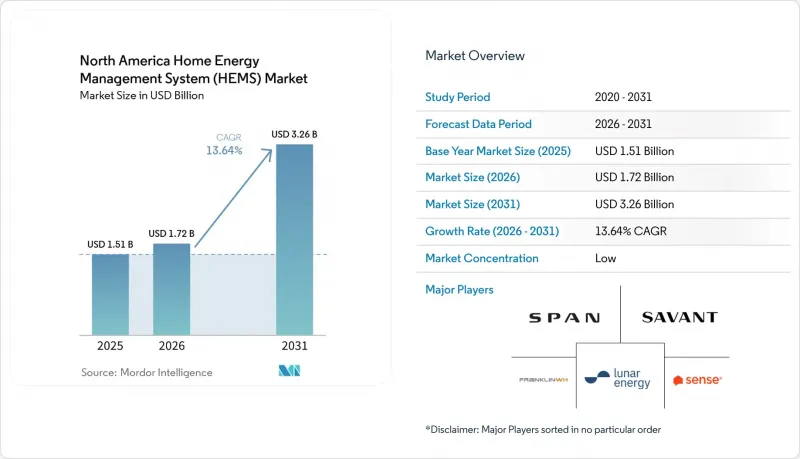
Mordor Intelligence에 의하면, 북미의 가정용 에너지 관리 시스템(HEMS) 시장 규모는 2025년 15억 1,000만 달러로 평가되었고, 2026년에는 17억 2,000만 달러로 추정되고, 2026-2031년 CAGR 13.64%로 성장을 지속할 전망이며, 2031년에는 32억 6,000만 달러에 이를 것으로 예측됩니다.
본 보고서는 구성 요소별(하드웨어(스마트 미터, 스마트 온도 조절기, 에너지 저장 시스템 등), 소프트웨어, 서비스), 통신 기술별(ZigBee, Wi-Fi, Z-Wave 등), 최종 사용자별(주거용, 상업용), 배포 방식별(클라우드 호스팅형 플랫폼, 온프레미스/로컬 게이트웨이), 국가별로 분류되어 있습니다. 시장 전망은 금액(달러) 기준으로 제시되어 있습니다.
북미의 가정용 에너지 관리 시스템(HEMS) 시장 동향 및 인사이트
실시간 제어를 뒷받침하는 스마트 계량기와 AMI의 보급
스마트 계량기의 보급이 확대됨에 따라, 가정의 에너지 관리는 단순한 사용 현황의 가시화에서 실시간 기기 제어로 전환되고 있습니다. 북미의 가정용 에너지 관리 시스템(HEMS) 시장에서 이것이 중요한 이유는 AMI 데이터가 플랫폼에 가정의 소비 현황에 관한 지속적인 신호를 제공함으로써, 이를 통해 자동 스케줄링, 부하 세분화 및 요금제 대응이 가능해지기 때문입니다. 전력 회사가 청구 업무 중심의 인프라에서 그리드 에지 인텔리전스로 전환함에 따라, 계량기 데이터를 해석하여 이를 가전제품 수준의 의사 결정으로 전환할 수 있는 소프트웨어의 가치도 높아지고 있습니다. 이러한 변화로 인해 도입 장벽도 낮아집니다. 왜냐하면 일부 가정에서는 집 안에 새로운 센서 장비를 추가로 설치하지 않고도 에너지에 관한 더 나은 인사이트를 얻을 수 있게 되기 때문입니다. 북미의 가정용 에너지 관리 시스템 시장은 이러한 진입 장벽의 완화로 인해 혜택을 보고 있습니다. 이는 플랫폼 공급업체나 전력회사가 주도하는 프로그램의 경우, 대상 고객 기반을 확대할 수 있기 때문입니다. 또한, 기존의 전력망을 실용적인 가정 내 오케스트레이션 계층으로 전환할 수 있는 전력 회사, 소프트웨어 개발자, 기기 공급업체 간의 파트너십의 중요성도 더욱 커지고 있습니다.
태양광 발전 + 전력 저장 및 가정용 전기 제품의 보급
태양광 발전 및 에너지 저장 시스템의 보급은 북미 가정용 에너지 관리 시스템 시장에서 가장 뚜렷한 수요 요인 중 하나입니다. 이는 여러 에너지 자산을 보유한 가구의 경우, 수동적인 모니터링이 아닌 능동적인 조정이 필요하기 때문입니다. 미국의 가정용 에너지 저장 시장은 2025년에 전년 대비 51% 성장했으며, 2019년 이후 누적 설치량은 50GW 및 144GWh를 넘어섰습니다. 이로 인해 가정용 에너지 제어 소프트웨어와 연동할 수 있는 도입 기반이 대폭 확대되었습니다. 해당 보고서에 따르면, 미국에서는 2026-2031년 500GWh 규모의 에너지 저장 시스템이 도입될 것으로 예상되며, 이에 따라 예측 기간 동안 가정용 에너지 플랫폼을 위한 새로운 통합 지점이 지속적으로 창출될 것으로 보입니다. 실용적인 관점에서 볼 때, 새로운 배터리 시스템이 도입될 때마다 가정 내 충전, 백업 우선순위, 자가 소비 및 시간대에 따른 부하 이동을 최적화할 수 있는 소프트웨어의 가치가 높아집니다. 이것이 바로 북미 가정용 에너지 관리 시스템(HEMS) 시장이 온도 조절기, 스마트 패널, 에너지 저장 시스템 및 연결된 부하가 하나의 협력적인 에너지 시스템으로 기능하는 ‘풀스택 오케스트레이션’으로 나아가고 있는 이유입니다. 가전제품의 보급과 주택의 전기화 개조가 진행됨에 따라, 가정 내에 더욱 유연한 부하가 도입되면서 전력 흐름이 복잡해짐에 따라 이러한 수요는 더욱 높아지고 있습니다.
높은 초기 시스템 및 설치 비용
높은 초기 시스템 비용은 북미 가정용 에너지 관리 시스템 시장의 보급에 있어 여전히 가장 큰 걸림돌로 남아 있습니다. 스마트 패널, 축전지, 온도 조절기, 소프트웨어, 전기차 충전 설비를 포함한 완벽하게 통합된 주택용 시스템은 보조금 적용 전 단계에서 15,000-3만 5,000달러가 들 수 있어, 많은 중산층 가구가 도입을 보류하고 있습니다. 또한, 회로 수준의 제어나 전기 배선 재구성에는 대개 훈련을 받은 전기 기술자나 플랫폼별 시운전이 필요하기 때문에 설치 비용도 비용 증가의 한 요인이 되고 있습니다. 이러한 비용 문제는 공동주택이나 보조금 제도 도입이 지연되고 있는 시장, 혹은 전력회사의 지원이 제한적인 시장에서 더욱 심각합니다. 또한, 각 가구가 우선 온도 조절기나 태양광 발전만 포함된 시스템을 선택하고, 자금 조달이나 보조금 상황이 개선될 때까지 그 밖의 에너지 관련 설비 도입을 미룰 가능성이 있기 때문에 제품 구성에도 영향을 미치고 있습니다. 서비스 기반의 자금 조달이나 저비용 도입 모델이 더 널리 보급되기 전까지는 북미 HEMS 시장에서 소비자의 관심에서 실제 설치 완료에 이르기까지의 전환이 계속해서 지연되는 상황이 이어질 것입니다.
부문별 분석
2025년, 하드웨어는 북미 가정용 에너지 관리 시스템 시장 점유율의 64.56%를 차지했으며, 이는 시스템 총 지출에서 물리적 장비가 여전히 큰 비중을 차지하고 있음을 반영합니다. 스마트 온도 조절기는 에너지 절약을 위한 명확한 방향을 제시하고, 향후 더 광범위한 가정용 제어 시스템과 연동할 수 있기 때문에 여전히 가장 일반적인 첫걸음으로 자리 잡고 있습니다. 또한, 북미의 가정용 에너지 관리 시스템 시장에서는 협업형 에너지 관리에 필요한 물리적 제어 및 감지 계층을 구축하기 위해 스마트 배전반, 에너지 저장 시스템, 스마트 플러그 및 실내 디스플레이에 대한 의존도도 계속되고 있습니다. 2025년 미국의 주택용 전기 요금 인상은 특히 피크 시간대의 전력 사용량을 보다 적극적으로 관리하려는 가구에서 하드웨어 중심 수요 조절의 필요성을 더욱 부각시켰습니다. SPAN사는 2025년 2월, 브레이커 공간을 25-50% 확대한 ‘SPAN Panel MAIN 40+MID’ 및 ‘SPAN Panel MLO 48’을 출시하며 하드웨어의 경쟁력을 한층 더 강화했습니다. 동시에, 전전기식 주택에서 400암페어로의 전력 공급 업그레이드 비용을 절감할 수 있다는 점을 제품의 주요 장점으로 내세웠습니다.
소프트웨어는 북미 가정용 에너지 관리 시스템(HEMS) 시장에서 가장 빠르게 성장하고 있는 분야로, 2026-2031년 연평균 성장률(CAGR) 14.89%를 나타낼 것으로 전망됩니다. 이러한 성장은 AI를 활용한 부하 예측, 요금제 최적화, 배터리 제어 로직, 그리고 일회성 기기 판매가 아닌 정기적인 플랫폼 이용료로의 전환을 반영한 것입니다. 북미 가정용 에너지 관리 시스템 시장에서 소프트웨어 시장 규모는 주거용 에너지 저장 시스템의 도입 대수 증가에 힘입어 성장하고 있습니다. 이에 따라 발전, 전력 저장 및 유연한 부하 조절이 실시간으로 필요한 주택의 수가 늘어나고 있습니다. Enphase는 2026년 2월, IQ9 및 IQ8 마이크로 인버터를 기반으로 한 소규모 상업용 시스템을 위해 ‘Power Control’ 소프트웨어를 도입함으로써, 기존 하드웨어 기반 위에서 소프트웨어가 어떻게 경제성을 향상시킬 수 있는지 보여줌으로써 이러한 방향성을 한층 더 강화했습니다. 또한, 도입되는 자산 기반이 복잡해짐에 따라 다중 벤더 통합, 시운전, 모니터링 및 전력사 프로그램에 대한 체계적인 참여에는 전문적인 지원이 필요하기 때문에 서비스 분야도 확대되고 있습니다.
Wi-Fi는 2025년 매출의 38.76%를 차지했으며, 기존의 가정용 광대역 네트워크에 자연스럽게 통합될 수 있기 때문에 북미 가정용 에너지 관리 시스템 시장에서 여전히 가장 큰 통신 계층으로 자리 잡고 있습니다. Wi-Fi는 대부분의 가정에서 별도의 통신 백본 없이도 클라우드 연결형 대시보드, 원격 설정, 소프트웨어 업데이트 및 고대역폭 데이터 교환을 지원합니다. ZigBee는 저전력 메시 통신이 여전히 대규모 분산형 기기 도입에 적합하기 때문에 전력 회사와 연계된 환경이나 계량기 주변 환경에서 계속해서 중요한 역할을 수행하고 있습니다. 블루투스는 특히 간단한 콘센트급 장치나 휴대용 기기의 구성에서 단거리 설정 및 제어에 여전히 유용합니다. HomePlug는 배선 상태나 건축자재의 영향으로 인해 오래된 주택 내 무선 연결의 신뢰성이 저하된 경우 등, 특정 개조 사례에서 여전히 활용되고 있습니다.
Z-Wave는 가장 빠르게 성장하고 있는 통신 프로토콜로, 2026-2031년 연평균 성장률(CAGR) 14.21%를 나타낼 것으로 예측되며, 배터리 구동 방식의 멀티 센서 환경에서 뛰어난 성능을 발휘하고 있습니다. 커넥티비티 스탠다드 얼라이언스(CSA)는 2025년 11월에 Matter 1.5를 출시했습니다. 이번 업데이트에서는 ‘전기 요금’ 디바이스 유형이 추가되었을 뿐만 아니라, 프로토콜 간에 가격 및 에너지 데이터를 보다 일관성 있게 공유할 수 있도록 폭넓은 지원이 강화되었습니다. 상호 운용성 덕분에 개별 가정이 단일한 폐쇄형 통신 스택을 선택할 수밖에 없는 위험이 완화되므로, 이는 북미 가정용 에너지 관리 시스템 시장에 있어 중요한 의미를 지닙니다. 또한, Wi-Fi가 광대역 클라우드 처리를 담당하고, Z-Wave가 에지에서 저전력 센싱 및 제어를 지원하는 등 실용적인 공존 모델도 가능하게 합니다. 2026년 3월에 출시된 Matter 1.5.1에서는 크로스 플랫폼 환경에서의 기기 작동이 더욱 개선되었으며, 보다 원활한 멀티 기기 호환성 실현을 위한 노력이 강화되었습니다.
기타 혜택 :
- 엑셀 형식 시장 예측(ME) 시트
- 3개월간의 애널리스트 지원
자주 묻는 질문
목차
제1장 서론
제2장 조사 방법
제3장 주요 요약
제4장 시장 구도
제5장 시장 규모 및 성장 예측
제6장 경쟁 구도
제7장 시장 기회 및 향후 전망
AJY 26.06.30According to Mordor Intelligence, the north america home energy management system (HEMS) market size is expected to grow from USD 1.51 billion in 2025 to USD 1.72 billion in 2026 and is forecast to reach USD 3.26 billion by 2031 at 13.64% CAGR over 2026-2031.
This report is Segmented by Component (Hardware (Smart Meters, Smart Thermostats, Energy Storage Systems, and More), Software, Services), Communication Technology (ZigBee, Wi-Fi, Z-Wave, and More), End-User (Residential, Commercial), Deployment Mode (Cloud-Hosted Platforms, On-Premises / Local Gateway), and Country. The Market Forecasts are Provided in Terms of Value (USD).
North America Home Energy Management System (HEMS) Market Trends and Insights
Smart Meter and AMI Saturation Supporting Real-Time Control
Smart meter saturation is pushing household energy management away from simple usage visibility and toward real-time device control. In the North America home energy management system (HEMS) market, this matters because AMI data gives platforms a constant stream of household consumption signals that can support automated scheduling, load disaggregation, and tariff response. As utilities move from billing-focused infrastructure to grid-edge intelligence, the value of software that can interpret meter data and translate it into appliance-level decisions rises with it. This shift also lowers the friction of adoption because some households can receive better energy insight without adding a full set of new sensing hardware inside the home. The North America home energy management system market benefits from that lower entry barrier because it expands the addressable base for platform vendors and utility-led programs. It also strengthens the case for partnerships between utilities, software developers, and device providers that can turn existing grid infrastructure into a practical household orchestration layer.
Solar-Plus-Storage and Home Electrification Adoption
Solar-plus-storage adoption is one of the clearest demand anchors for the North America home energy management system market because households with multiple energy assets need active coordination rather than passive monitoring. The US residential storage segment grew 51% year over year in 2025, and cumulative deployments since 2019 exceeded 50GW and 144GWh, which materially expanded the installed base that can be paired with household energy control software. The same report indicates the United States is expected to deploy 500GWh of storage from 2026 to 2031, which keeps creating new integration points for home energy platforms over the forecast period. In practical terms, each new battery system raises the value of software that can optimize charging, backup priority, self-consumption, and time-based load shifting inside the home. This is why the North America home energy management system (HEMS) market is moving closer to full-stack orchestration, where thermostats, smart panels, storage systems, and connected loads operate as one coordinated energy system. The adoption of electric appliances and home electrification upgrades further deepens this need because household power flows become more complex as more flexible loads enter the home.
High Upfront System and Installation Costs
High upfront system cost remains the clearest barrier to mass adoption in the North America home energy management system market. A fully integrated residential setup that includes a smart panel, battery storage, thermostat, software, and EV charging can require USD 15,000 to USD 35,000 before rebates, which keeps many middle-income households on the sidelines. Installation also adds cost because circuit-level control and electrical reconfiguration often require trained electricians and platform-specific commissioning. This cost issue is more severe in multi-family settings and in markets where rebate rollout is slower or utility support is limited. It also affects product mix because households may choose a thermostat or a solar-only setup first, then delay the rest of the energy stack until financing or rebates improve. Until service-based financing and lower-cost deployment models scale more broadly, the North America HEMS market will continue to face slower conversion from consumer interest to completed installations.
Other drivers and restraints analyzed in the detailed report include:
- Utility Time-Of-Use and Dynamic Pricing Expansion
- IRA-Linked Whole-Home Rebate Stacking Improving HEMS Payback
- Cybersecurity and Household Data Privacy Concerns
For complete list of drivers and restraints, kindly check the Table Of Contents.
Segment Analysis
Hardware held 64.56% of the North America home energy management system market share in 2025, which reflects the still heavy role of physical equipment in total system spending. Smart thermostats remain the most common first step because they offer a visible path to energy savings and can connect later to a broader household control stack. The North America home energy management system market also continues to rely on smart electrical panels, energy storage systems, smart plugs, and in-home displays to create the physical control and sensing layer required for coordinated energy management. Rising US residential electricity prices in 2025 reinforced the need for hardware-led demand control, especially for households looking to manage peak usage more actively. SPAN strengthened that hardware case in February 2025 when it launched the SPAN Panel MAIN 40+MID and SPAN Panel MLO 48 with 25-50% more breaker spaces, while also positioning the products around avoiding 400-ampere service upgrade costs in all-electric homes.
Software is the fastest-growing component in the North America home energy management system (HEMS) market, with a 14.89% CAGR expected from 2026 to 2031. That expansion reflects the move toward AI-based load forecasting, tariff optimization, battery dispatch logic, and recurring platform subscriptions rather than one-time device revenue. The North America home energy management system market size for software is gaining support from the rising installed base of residential storage, which creates a larger pool of homes that need real-time orchestration across generation, storage, and flexible loads. Enphase reinforced this direction in February 2026 when it introduced Power Control software for IQ9 and IQ8 microinverter-based small commercial systems, showing how software can improve economics on top of an existing hardware base. Services are also expanding because multi-vendor integration, commissioning, monitoring, and managed participation in utility programs require specialized support as the installed asset base becomes more complex.
Wi-Fi accounted for 38.76% of revenue in 2025 and remained the largest communication layer in the North America home energy management system market because it fits naturally into existing home broadband networks. It supports cloud-connected dashboards, remote configuration, software updates, and high-bandwidth data exchange without requiring a separate communication backbone in most homes. ZigBee continues to matter in utility-linked and meter-adjacent environments because low-power mesh communication still suits large distributed device deployments. Bluetooth maintains relevance for short-range setup and control, especially in simpler outlet-level or portable device configurations. HomePlug still serves certain retrofit cases where wiring conditions or building materials reduce the reliability of wireless links inside older homes.
Z-Wave is the fastest-growing communication protocol, with a 14.21% CAGR projected for 2026 to 2031, and it benefits from strong performance in battery-powered, multi-sensor environments. The Connectivity Standards Alliance released Matter 1.5 in November 2025, and the update added an Electrical Energy Tariff device type along with broader support that helps devices share pricing and energy data more consistently across protocols. That matters for the North America home energy management system market because interoperability reduces the risk that any one household must choose a single closed communication stack. It also allows a practical coexistence model where Wi-Fi handles high-bandwidth cloud tasks while Z-Wave supports low-power sensing and control at the edge. Matter 1.5.1, released in March 2026, further improved cross-platform device behavior and reinforced the push toward smoother multi-device compatibility.
List of Companies Covered in this Report:
- SPAN.io, Inc.
- Savant Systems, Inc.
- FranklinWH Energy Storage Inc.
- Lunar Energy, Inc.
- Sense Labs, Inc.
- Emporia Corp
- Lumin Systems, Inc.
- ecobee Inc.
- sonnen GmbH
- Resideo Technologies, Inc.
- Itron, Inc.
- Generac Holdings, Inc.
- ChargePoint Holdings, Inc.
- Sigenergy Technology Co., Ltd.
- EcoFlow Technology Inc.
- Anker Innovations Technology Co., Ltd.
- Enphase Energy, Inc.
- SolarEdge Technologies, Inc.
- AutoGrid, Inc.
- OhmConnect, Inc.
Additional Benefits:
- The market estimate (ME) sheet in Excel format
- 3 months of analyst support
TABLE OF CONTENTS
1 INTRODUCTION
- 1.1 Study Assumptions and Market Definition
- 1.2 Scope of the Study
2 RESEARCH METHODOLOGY
3 EXECUTIVE SUMMARY
4 MARKET LANDSCAPE
- 4.1 Market Overview
- 4.2 Market Drivers
- 4.2.1 Smart Meter and AMI Saturation Supporting Real-Time Control
- 4.2.2 Utility Time-of-Use and Dynamic Pricing Expansion
- 4.2.3 Solar-Plus-Storage and Home Electrification Adoption
- 4.2.4 Insurance and Resiliency Demand for Backup-Oriented Energy Orchestration
- 4.2.5 IRA-Linked Whole-Home Rebate Stacking Improving HEMS Payback
- 4.2.6 Matter 1.5 and Utility Signal Standardization Lowering Integration Friction
- 4.3 Market Restraints
- 4.3.1 High Upfront System and Installation Costs
- 4.3.2 Cybersecurity and Household Data Privacy Concerns
- 4.3.3 Installer Commissioning Complexity Across Multi-Vendor Home Energy Assets
- 4.3.4 Tariff and Program Volatility Weakening Consumer ROI Confidence
- 4.4 Industry Value Chain Analysis
- 4.5 Regulatory Landscape
- 4.6 Technological Outlook
- 4.7 Porter's Five Forces Analysis
- 4.7.1 Bargaining Power of Suppliers
- 4.7.2 Bargaining Power of Buyers
- 4.7.3 Threat of New Entrants
- 4.7.4 Threat of Substitutes
- 4.7.5 Intensity of Competitive Rivalry
- 4.8 Assessment of Macroeconomic Trends on the Market
5 MARKET SIZE AND GROWTH FORECASTS (VALUE)
- 5.1 By Component
- 5.1.1 Hardware
- 5.1.1.1 Smart Meters
- 5.1.1.2 Smart Thermostats
- 5.1.1.3 Energy Storage Systems
- 5.1.1.4 Smart Plugs and Outlets
- 5.1.1.5 In-Home Displays (IHDs)
- 5.1.1.6 Other Hardwares
- 5.1.2 Software
- 5.1.3 Services
- 5.1.1 Hardware
- 5.2 By Communication Technology
- 5.2.1 ZigBee
- 5.2.2 Wi-Fi
- 5.2.3 Z-Wave
- 5.2.4 Bluetooth
- 5.2.5 HomePlug
- 5.2.6 Other Communication Technologies
- 5.3 By End-User
- 5.3.1 Residential
- 5.3.1.1 Single-Family Homes
- 5.3.1.2 Multi-Family Housing
- 5.3.2 Commercial
- 5.3.2.1 Small Office / Home Office
- 5.3.2.2 Retail and Hospitality
- 5.3.1 Residential
- 5.4 By Deployment Mode
- 5.4.1 Cloud-Hosted Platforms
- 5.4.2 On-Premises / Local Gateway
- 5.5 By Country
- 5.5.1 United States
- 5.5.2 Canada
- 5.5.3 Mexico
6 COMPETITIVE LANDSCAPE
- 6.1 Market Concentration
- 6.2 Strategic Moves
- 6.3 Market Share Analysis
- 6.4 Company Profiles (includes Global level Overview, Market level overview, Core Segments, Financials as available, Strategic Information, Market Rank/Share for key companies, Products and Services, and Recent Developments)
- 6.4.1 SPAN.io, Inc.
- 6.4.2 Savant Systems, Inc.
- 6.4.3 FranklinWH Energy Storage Inc.
- 6.4.4 Lunar Energy, Inc.
- 6.4.5 Sense Labs, Inc.
- 6.4.6 Emporia Corp
- 6.4.7 Lumin Systems, Inc.
- 6.4.8 ecobee Inc.
- 6.4.9 sonnen GmbH
- 6.4.10 Resideo Technologies, Inc.
- 6.4.11 Itron, Inc.
- 6.4.12 Generac Holdings, Inc.
- 6.4.13 ChargePoint Holdings, Inc.
- 6.4.14 Sigenergy Technology Co., Ltd.
- 6.4.15 EcoFlow Technology Inc.
- 6.4.16 Anker Innovations Technology Co., Ltd.
- 6.4.17 Enphase Energy, Inc.
- 6.4.18 SolarEdge Technologies, Inc.
- 6.4.19 AutoGrid, Inc.
- 6.4.20 OhmConnect, Inc.
7 MARKET OPPORTUNITIES AND FUTURE OUTLOOK
- 7.1 White-Space and Unmet-Need Assessment


