|
시장보고서
상품코드
2066733
미국의 산업용 센서 시장 : 시장 점유율 분석, 업계 동향 및 통계, 성장 예측(2026-2031년)United States Industrial Sensors - Market Share Analysis, Industry Trends & Statistics, Growth Forecasts (2026 - 2031) |
||||||
 Mordor Intelligence
Mordor Intelligence에 의하면, 미국의 산업용 센서 시장 규모는 2025년에 176억 6,000만 달러로 평가되었고, 2026년 188억 9,000만 달러로 추정되고, 2031년까지 265억 2,000만 달러로 확대될 전망이며, 2026-2031년 CAGR 6.93%로 성장한다고 추정되고 있습니다.
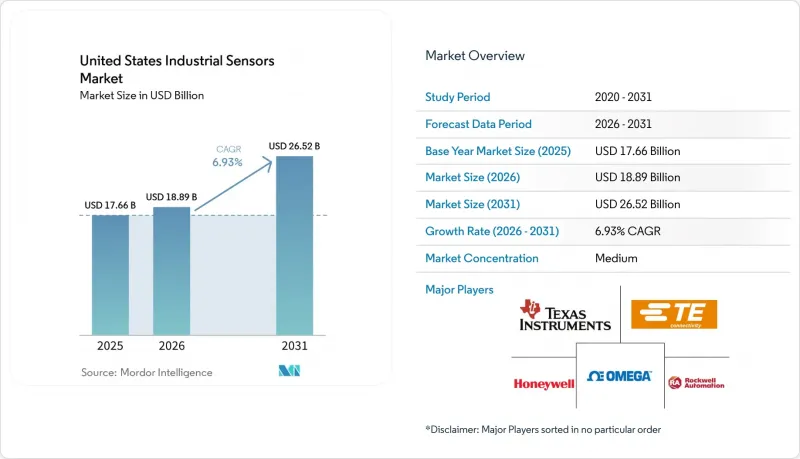
본 보고서는 연결 방식별(유선 솔루션 및 무선 솔루션), 센서 유형별(압력 센서, 유량 센서, 온도 센서, 레벨 센서 등) 및 최종 사용자 산업별(석유 및 가스, 화학제품 및 석유화학제품, 상하수도, 식품 및 음료, 발전, 자동차 등)로 분류되어 있습니다. 시장 전망은 금액(달러) 기준으로 제시되어 있습니다.
미국의 산업용 센서 시장 동향 및 인사이트
디스크리트 산업 및 공정 산업에서의 IIoT 도입 급증
각 제조업체는 예상치 못한 가동 중단 시간이나 불량률을 최소화하는 실시간 분석을 실현하기 위해 생산 공정의 모든 단계에 센서를 탑재하고 있습니다. 프라이빗 5G 도입을 통해 진동, 온도, 비전 센서에서 10밀리초 미만의 지연 시간이 입증되었으며, 자동차 조립 라인 및 CNC 가공 라인에서의 무선 성능이 확인되었습니다. 식품 가공업체는 LoRaWAN 게이트웨이를 사용하여 위생용 온도 및 유량 센서에서 수집된 데이터를 백홀로 전송함으로써 배선 작업을 60% 줄였습니다. 엣지 게이트웨이는 현재 OPC UA와 연동하여 시간 의존성이 높은 네트워크 처리를 수행하고 있으며, 이전에는 유선 시스템으로만 제한되었던 폐루프 제어가 가능해졌습니다. 그 결과, 미국의 산업용 센서 시장에서는 기존 시설(브라운필드)과 신규 시설(그린필드) 모두에서 센서 그리드의 고밀도화와 장착률 향상이 나타나고 있습니다.
청정 에너지 인프라에 대한 설비 투자 증가
미국 에너지부의 ‘Speed to Power’ 이니셔티브에 따라 계통 연계까지 소요되는 기간이 절반으로 단축되면서, 풍력 터빈의 피치 제어 시스템에 사용되는 차압 센서와 계통 연계형 인버터 내부의 전류 센서에 대한 수요가 증가하고 있습니다. 2025년에는 4,400만 달러 규모의 연방 정부 지출이 첨단 계량 시스템 및 변전소 자동화에 할당될 예정이며, 이 두 분야 모두 온도 센서와 부분 방전 센서에 의존하고 있습니다. 해상 풍력 발전 개발 사업자는 NFPA 70 제500조에 따라, 클래스 I 디비전 1 환경에 적합한 본질안전형 압력·유량 측정 기기를 지정하고 있습니다. 2025년에 15GW 용량이 추가되는 배터리 저장 프로젝트에서는 UL 9540A 규격을 충족하기 위해 열폭주 감지가 의무화되어 있습니다. 따라서 청정 에너지의 성장에 힘입어 미국의 산업용 센서 시장은 자산 가동률 향상과 규제 준수를 뒷받침하는 가스, 전류, 진동 감지 기술로 전환되고 있습니다.
특수 MEMS 칩공급 변동이 지속되고 있습니다.
2024년 하반기에는 자동차용 피에조 저항식 압력 다이 및 정전용량식 가속도계의 리드타임이 26주를 초과하여, 개조 프로그램의 지연을 초래했습니다. 인피니언의 ‘XENSIV’와 보쉬 센서테크의 ‘BMI’ 제품군은 가장 엄격한 할당 제한에 직면했습니다. CHIPS법에 따라 자금을 지원받은 국내 파운드리 업체들은 생산을 확대하고 있지만, 적어도 2028년까지는 아시아의 생산 능력을 따라잡을 것으로 예상되지 않아 공급 리스크는 여전히 높은 수준을 유지하고 있습니다. SOI 및 압전 소자를 활용한 대체품으로의 전환이나 재설계를 통한 이중 조달은 비반복적인 엔지니어링 비용을 증가시켜, 미국 산업용 센서 시장의 단기적인 성장을 둔화시키고 있습니다.
부문별 분석
유선 솔루션은 4-20 mA 및 HART 루프에 대한 수십 년간의 투자를 바탕으로, 2025년 미국 산업용 센서 시장 점유율의 73.82%를 차지했습니다. 이러한 장치들은 NFPA 85 및 API 670에서 의무화하고 있는 5밀리초 미만의 셧다운 작업에 있어 여전히 필수적인 요소입니다. 그러나 프라이빗 5G, LoRaWAN 및 Ethernet-APL의 도입을 배경으로, 무선 노드는 2031년까지 연평균 성장률(CAGR) 8.45%를 기록하며 성장할 것으로 전망됩니다. 신규 건설되는 반도체 팹에서는 클린룸의 유연성을 유지하기 위해 무선 백홀을 통해 수천 개의 IO-Link 온도 센서가 도입된 반면, Ethernet-APL은 탄화수소 구역에서의 본질 안전 규격 준수를 지원합니다. 미국의 산업용 센서 시장은 유선 루프가 안전 기능을 담당하고, 무선 계층이 진단 기능을 추가하는 하이브리드 아키텍처로 수렴하고 있습니다.
자동차 공장에서의 사설 셀룰러 시범 도입 사례에 따르면, 케이블 설치 작업을 줄임으로써 설치 예산을 40% 절감할 수 있는 것으로 나타났으며, 이는 이산 제조 산업에서 무선 기술을 도입해야 할 설득력 있는 근거가 되고 있습니다. 반면, 기존 화학 플랜트의 경우 주파수 대역 라이선스나 게이트웨이 하드웨어 비용 때문에 무선 기술의 가치 제안이 희석되곤 하므로, 유선 방식의 개조가 계속 유지되는 경우가 많습니다. 에머슨(Emerson)이나 하네웰(Honeywell)과 같은 공급업체들은 현재 유선 및 무선 데이터 스트림을 모두 통합하는 통합 자산 관리 제품군을 제공하고 있으며, 이는 하이브리드 연결이 미국 산업용 센서 시장의 다음 성장 단계를 어떻게 뒷받침할지 보여주고 있습니다.
기타 혜택 :
- 엑셀 형식 시장 예측(ME) 시트
- 3개월간의 애널리스트 지원
자주 묻는 질문
목차
제1장 서론
제2장 조사 방법
제3장 주요 요약
제4장 시장 구도
제5장 시장 규모 및 성장 예측
제6장 경쟁 구도
제7장 시장 기회 및 향후 전망
AJY 26.06.30According to Mordor Intelligence, the united states industrial sensors market size was valued at USD 17.66 billion in 2025 and is estimated to grow from USD 18.89 billion in 2026 to USD 26.52 billion by 2031, growing at a CAGR of 6.93% from 2026 to 2031.
This report is Segmented by Connectivity (Wired Solutions, and Wireless Solutions), Sensor Type (Pressure Sensors, Flow Sensors, Temperature Sensors, Level Sensors, and More), and End-User Industry (Oil and Gas, Chemicals and Petrochemicals, Water and Wastewater, Food and Beverage, Power Generation, Automotive, and More). The Market Forecasts are Provided in Terms of Value (USD).
United States Industrial Sensors Market Trends and Insights
Surge in IIoT Adoption Across Discrete and Process Industries
Manufacturers are embedding sensors at every production node to enable real-time analytics that minimize unplanned downtime and scrap rates. Private 5G deployments demonstrate sub-10 millisecond latency for vibration, temperature, and vision sensors, validating wireless performance on automotive assembly and CNC machining lines. Food processors have reduced cabling work by 60% using LoRaWAN gateways to backhaul data from hygienic temperature and flow sensors. Edge gateways now run time-sensitive networking in concert with OPC UA, allowing closed-loop control that was previously limited to wired systems. As a result, the United States industrial sensors market is witnessing denser sensor grids and higher attach rates in both brownfield and greenfield facilities.
Rising Capital Expenditure on Clean-Energy Infrastructure
The Department of Energy's Speed to Power initiative halves interconnection timelines, spurring demand for differential pressure sensors in wind-turbine pitch systems and current sensors inside grid-tied inverters. A USD 44 million federal outlay in 2025 targeted advanced metering and substation automation, both of which rely on temperature and partial-discharge sensors. Offshore wind developers specify intrinsically safe pressure and flow devices rated for Class I Division 1 environments under NFPA 70 Article 500.Battery storage projects, which added 15 GW in 2025, mandate thermal-runaway detection to meet UL 9540A standards. Clean-energy growth, therefore, tilts the United States industrial sensors market toward gas, current, and vibration sensing technologies that support asset availability and regulatory compliance.
Persistent Chip-Supply Volatility for Specialty MEMS Dies
Lead times for automotive-grade piezoresistive pressure dies and capacitive accelerometers extended beyond 26 weeks in late 2024, delaying retrofit programs. Infineon's XENSIV and Bosch Sensortec's BMI families faced the steepest allocation constraints. Domestic foundries funded by the CHIPS Act are ramping up production but are not expected to match Asian manufacturing capacity until at least 2028, keeping supply risks elevated. Dual sourcing and redesigns around SOI and piezoelectric alternatives increase non-recurring engineering costs, tempering near-term growth of the United States industrial sensors market.
Other drivers and restraints analyzed in the detailed report include:
- Expansion of the United States Semiconductor Fabs Driving Sensor Demand
- Acceleration of Predictive-Maintenance Programs Post-2025
- Cybersecurity Risks Inhibiting Wireless Sensor Roll-Outs
For complete list of drivers and restraints, kindly check the Table Of Contents.
Segment Analysis
Wired solutions captured 73.82% of the United States industrial sensors market share in 2025 due to decades-long investment in 4-20 mA and HART loops. They remain indispensable for sub-5 millisecond shutdown tasks mandated by NFPA 85 and API 670. However, wireless nodes are forecast to grow at an 8.45% CAGR through 2031 on the back of private 5G, LoRaWAN, and Ethernet-APL adoption. Greenfield semiconductor fabs deploy thousands of IO-Link temperature sensors over wireless backhaul to preserve cleanroom flexibility, while Ethernet-APL supports intrinsic-safety compliance in hydrocarbon zones. The USAindustrial sensors market is converging toward hybrid architectures in which wired loops handle safety functions and wireless layers add diagnostics.
Private cellular pilots at automotive plants show that reducing cable pulls can lower installation budgets by 40%, creating a compelling case for wireless deployment in discrete manufacturing. Conversely, brownfield chemical sites often retain wired retrofits because spectrum licenses and gateway hardware dilute the wireless value proposition. Vendors such as Emerson and Honeywell now offer unified asset-management suites that aggregate both wired and wireless data streams, demonstrating how hybrid connectivity will underpin the next growth phase of the US industrial sensors market.
List of Companies Covered in this Report:
- ABB Ltd
- Analog Devices, Inc.
- Banner Engineering Corp.
- Bosch Sensortec GmbH
- Endress+Hauser AG
- Emerson Electric Co.
- Honeywell International Inc.
- IFM Efector, Inc.
- Infineon Technologies AG
- Keyence Corporation of America
- Omega Engineering Inc.
- Omron Corporation
- Pepperl+Fuchs, Inc.
- Rockwell Automation, Inc.
- Sensata Technologies, Inc.
- Sick AG
- TE Connectivity Ltd.
- Texas Instruments Incorporated
- The Krohne Group
- Vega Grieshaber KG
- Yokogawa Electric Corporation
Additional Benefits:
- The market estimate (ME) sheet in Excel format
- 3 months of analyst support
TABLE OF CONTENTS
1 INTRODUCTION
- 1.1 Study Assumptions and Market Definition
- 1.2 Scope of the Study
2 RESEARCH METHODOLOGY
3 EXECUTIVE SUMMARY
4 MARKET LANDSCAPE
- 4.1 Market Overview
- 4.2 Market Drivers
- 4.2.1 Surge in IIoT Adoption Across Discrete and Process Industries
- 4.2.2 Rising Capital Expenditure on Clean-Energy Infrastructure
- 4.2.3 Expansion of the United States Semiconductor Fabs Driving Sensor Demand in Advanced Manufacturing
- 4.2.4 Acceleration of Predictive-Maintenance Programs Post-2025
- 4.2.5 Federal Incentives for Reshoring Critical Industries
- 4.2.6 Growth of Hydrogen Economy Requiring Novel Pressure and Gas Sensors
- 4.3 Market Restraints
- 4.3.1 Persistent Chip-Supply Volatility for Specialty MEMS Dies
- 4.3.2 Cyber-Security Risks Inhibiting Wireless Sensor Roll-Outs
- 4.3.3 High Total Cost of Ownership for Intrinsically Safe Sensors in Explosive Zones
- 4.3.4 Standards Fragmentation Across Industrial Communications Protocols
- 4.4 Industry Value Chain Analysis
- 4.5 Regulatory Landscape
- 4.6 Technological Outlook
- 4.7 Porter's Five Forces Analysis
- 4.7.1 Bargaining Power of Suppliers
- 4.7.2 Bargaining Power of Buyers
- 4.7.3 Threat of New Entrants
- 4.7.4 Threat of Substitutes
- 4.7.5 Intensity of Competitive Rivalry
- 4.8 Impact of Macroeconomic Factors on the Market
5 MARKET SIZE AND GROWTH FORECASTS (VALUE)
- 5.1 By Connectivity
- 5.1.1 Wired Solutions
- 5.1.2 Wireless Solutions
- 5.2 By Sensor Type
- 5.2.1 Pressure Sensors
- 5.2.2 Flow Sensors
- 5.2.3 Temperature Sensors
- 5.2.4 Level Sensors
- 5.2.5 Gas Sensors
- 5.2.6 Proximity and Photoelectric Sensors
- 5.2.7 Vibration Sensors
- 5.2.8 Other Types of Sensors
- 5.3 By End-User Industry
- 5.3.1 Oil and Gas
- 5.3.2 Chemicals and Petrochemicals
- 5.3.3 Water and Wastewater
- 5.3.4 Food and Beverage
- 5.3.5 Power Generation
- 5.3.6 Automotive
- 5.3.7 Pharmaceutical and Life Sciences
- 5.3.8 Aerospace and Defense
- 5.3.9 Other End-User Industries
6 COMPETITIVE LANDSCAPE
- 6.1 Market Concentration
- 6.2 Strategic Moves
- 6.3 Market Share Analysis
- 6.4 Company Profiles (includes Global level Overview, Market level overview, Core Segments, Financials as available, Strategic Information, Market Rank/Share for key companies, Products and Services, and Recent Developments)
- 6.4.1 ABB Ltd
- 6.4.2 Analog Devices, Inc.
- 6.4.3 Banner Engineering Corp.
- 6.4.4 Bosch Sensortec GmbH
- 6.4.5 Endress+Hauser AG
- 6.4.6 Emerson Electric Co.
- 6.4.7 Honeywell International Inc.
- 6.4.8 IFM Efector, Inc.
- 6.4.9 Infineon Technologies AG
- 6.4.10 Keyence Corporation of America
- 6.4.11 Omega Engineering Inc.
- 6.4.12 Omron Corporation
- 6.4.13 Pepperl+Fuchs, Inc.
- 6.4.14 Rockwell Automation, Inc.
- 6.4.15 Sensata Technologies, Inc.
- 6.4.16 Sick AG
- 6.4.17 TE Connectivity Ltd.
- 6.4.18 Texas Instruments Incorporated
- 6.4.19 The Krohne Group
- 6.4.20 Vega Grieshaber KG
- 6.4.21 Yokogawa Electric Corporation
7 MARKET OPPORTUNITIES AND FUTURE OUTLOOK
- 7.1 White-space and Unmet-Need Assessment