

|
시장보고서
상품코드
2066758
바이오의약품 CMO 및 CRO : 시장 점유율 분석, 업계 동향 및 통계, 성장 예측(2026-2031년)Biopharmaceutical CMO And CRO - Market Share Analysis, Industry Trends & Statistics, Growth Forecasts (2026 - 2031) |
||||||
 Mordor Intelligence
Mordor Intelligence에 의하면, 바이오의약품 CMO 및 CRO 시장 규모는 2025년에 413억 2,000만 달러로 평가되었습니다. 2026년에 433억 4,000만 달러에 달하고, 2031년까지 586억 4,000만 달러에 이를 것으로 예측되며, 2026년부터 2031년에 걸쳐 CAGR 6.23%로 성장할 전망입니다.
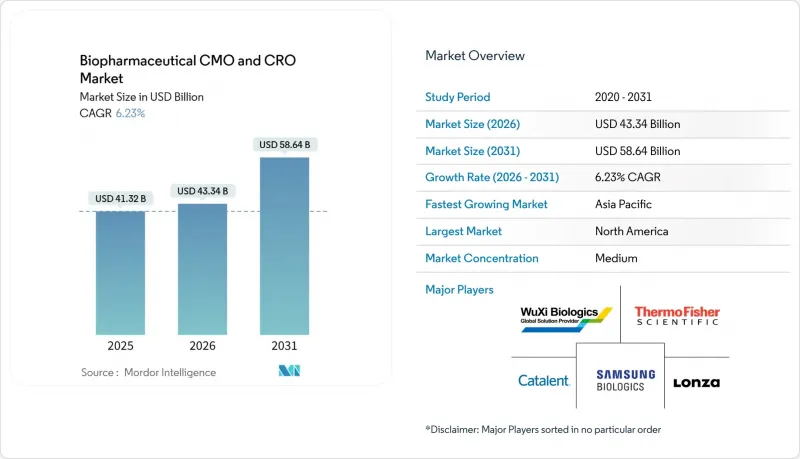
본 보고서는 서비스 유형(수탁 제조 기관(CMO) 등), 생물학적 제제의 유형(단일클론 항체 등), 생산 시스템(포유류 발현 시스템 등), 사업 규모(전임상·임상 등), 최종 사용자(중소규모 바이오의약품 기업 등), 지역(북미 등)별로 분류되어 있습니다. 시장 전망은 금액(달러) 기준으로 제시되어 있습니다.
세계의 바이오의약품 CMO 및 CRO 시장 동향 및 인사이트
확대되고 있는 바이오의약품 및 바이오시밀러 파이프라인
FDA는 간소화된 호환성 규정에 따라 2024년에 59개의 신약과 2025년에 추가로 18개의 바이오시밀러를 승인했으며, 분석 및 공정 개발 업무를 외부 파트너에게 위탁하는 움직임이 확대되고 있습니다. 단일클론 항체 파이프라인은 전년 대비 18% 증가했으며, 복합제 제조 노하우가 필요한 희귀질환용 병용 요법으로 확대되고 있습니다. 세포 및 유전자 치료 프로그램은 전 세계적으로 2,000건을 넘어섰으며, 그중 약 80%는 후기 임상시험 단계에 진입하기 위해 초기 과정의 최적화를 CDMO에 위탁하고 있습니다. WHO는 현재 성숙도 수준 3 이상인 34개 국가 당국을 목록에 포함하고 있으며, 바이오시밀러의 주요 임상시험을 수행할 수 있는 지역이 확대되고 있습니다. 인도의 백신 자급률이 99%에 달하고, 중국도 약 90%에 이르렀기 때문에 현지 CDMO 기업들은 바이오시밀러 기술 이전 프로젝트에서 비용과 속도 양면에서 경쟁력을 갖출 수 있게 되었습니다.
아웃소싱의 변화 : 저분자에서 고분자로
2024년에는 저분자 API의 아웃소싱 비율이 87%에 달하며, 사실상 정점에 도달했습니다. 한편, 바이오의약품 원료의약품(API)의 아웃소싱 비율은 61%에 그치고 있으며, 이는 각 스폰서사가 시급히 메워야 할 구조적인 여지가 있음을 시사합니다. 완제품(Finished-dose)의 외주 비율은 61%에 달했으나, 지난 10년간의 평균은 50%였습니다. 이는 혁신 기업들이 수익성이 높은 치료 분야에 사내 생산 라인을 재활용하고 있기 때문입니다. 한 대형 바이오제약 기업은 미국 내 공장에 3,700억 달러를 투자하겠다고 약속했으나, 그 지출의 대부분을 자체 개발한 원료의약품 자산에 할당하고, 제제 및 임상용 공급품은 외부 파트너에게 위탁하고 있습니다. 릴리사가 35억 달러를 투자한 펜실베이니아주 거점, 노보노르디스크사가 41억 달러를 투자한 클레이턴 공장 등의 시설은 혁신 기업들이 대량 생산을 위한 상업용 자산을 사내에 유지하면서 초기 단계의 프로그램이나 틈새 시장용 프로그램을 외부에 위탁하고 있음을 보여줍니다. 일회용 기술을 통해 CDMO는 며칠 이내에 제품을 전환할 수 있게 되었으며, 대규모 배치 이하의 양이라도 고분자 화합물의 위탁 생산을 경제적으로 수행할 수 있게 되었습니다.
바이러스 벡터 생산 능력의 병목 현상
GMP 기준을 준수하는 AAV(아데노연관바이러스) 슬롯의 리드타임은 12-18개월에 달하기 때문에 스폰서는 1상 단계에서 미리 예약을 완료해야 하며, 프로그램이 중단될 경우 취소 위약금을 부담할 수밖에 없습니다. 2023년부터 시행되고 있는 EU GMP 부속서 1에서는 아이솔레이터를 이용한 무균 처리와 실시간 미립자 추적이 의무화되어, 설비 투자에 대한 부담이 커지고 있습니다. 롯데바이오로직스가 33억 달러를 투자해 건설한 송도의 항체-약물 복합체(ADC) 제조 거점은 자본의 이동을 보여주는 사례이지만, 벡터 제조 시설에는 맞춤형 공조 시스템과 폐기물 중화 설비가 필요하며, 이를 사후에 도입하는 것은 쉽지 않습니다. 2024년에는 2,000건 이상의 CGT 프로그램이 진행 중이었으나, 자가 유래 CAR-T 요법을 대규모로 생산할 수 있는 공장은 극히 소수에 불과하여 구조적인 불일치가 발생하고 있습니다. FDA는 2024년에 561건, 2025년에는 600건 이상의 양식 483을 발행했는데, 그중 상당수는 무균 관리상의 미비 사항과 관련되어 있어, 생산 능력 확대를 지연시키는 품질상의 장벽이 부각되었습니다.
부문별 분석
CMO는 2025년 매출의 57.24%를 차지했으며, 스폰서들이 감가상각 대상인 사내 설비에 자금을 투자하기보다는 자산 집약적인 원료의약품 제조 업무를 외부에 위탁하는 것을 선호하는 경향이 뚜렷이 드러나고 있습니다. 그렇긴 하지만, 성장성을 고려하면 바이오의약품 분야에서 CMO와 CRO 시장 점유율 우위는 달라집니다. 후기 임상시험 프로토콜이 복잡해짐에 따라 분산형 임상시험의 도입이 확대됨에 따라, CRO의 매출은 2031년까지 10.42% 증가할 것으로 전망됩니다. 동 기간 동안, 제조와 관련된 바이오의약품 CMO 및 CRO 시장 규모는 꾸준히 확대될 것으로 보이지만, 상대적인 성장률은 데이터 집약형 임상시험 서비스에 뒤처질 것으로 보입니다. ICON사의 155억 달러 규모의 수주 잔고(그 중 절반은 12개월 이내에 납품 예정)는 아웃소싱 예산이 안정적임을 보여주는 반면, IQVIA가 2026년에 베링거 인겔하임과 제휴한 것은 CRO가 리얼 월드 에비던스 및 규제 전략 분야로 진출하고 있음을 보여줍니다.
각 후원사는 여전히 생산 능력 확보에 있어 CMO에 의존하고 있습니다. 전 세계 포유류 세포 배양 생산 능력은 2024년 약 6,750 kL에서 2028년까지 9,000 kL 가까이 증가할 것으로 예상되며, CMO 시장 점유율도 28%에서 약 40%로 상승할 전망입니다. 삼성바이오로직스의 784 kL 규모 인천 캠퍼스 등 단일 거점의 거대 시설은 원료의약품 제조와 충전·완제 공정을 모두 제공함으로써 기술 이전 과정에서 발생하는 마찰을 줄이고 있습니다. 업계 전문가들은 CMO가 여전히 매출의 대부분을 차지할 것으로 예상하고 있지만, AI를 활용한 환자 매칭과 피험자 등록 기간을 두 자릿수만큼 단축하는 실시간 데이터 수집에 힘입어 CRO의 매출 증가율은 CMO를 상회할 것으로 전망됩니다.
혁신적인 기업들이 희귀질환 및 고도의 기술력이 요구되는 병용 요법으로 사업을 확대하는 가운데, 단일클론 항체는 2025년 매출의 44.57%를 차지했습니다. 이 부문의 절대적인 성장에 힘입어 바이오의약품 CMO 및 CRO 시장의 최소 규모는 확보되고 있지만, 2,000건 이상의 진행 중인 프로그램과 전임상 단계 최적화 과정에서 CDMO의 광범위한 참여에 힘입어 세포· 유전자 치료 분야가 9.37%라는 가장 높은 연평균 성장률(CAGR)을 기록하고 있습니다. 팬데믹 이후 백신 생산량은 정상화되었지만, 과점적인 시장 점유율 덕분에 이익률은 여전히 매력적인 수준을 유지하고 있습니다. 2023년 매출액의 85%를 상위 10개 제조업체가 차지했습니다.
CagriSema 등의 GLP-1 병용 요법을 배경으로 재조합 단백질 시장이 급속히 확대되고 있으며, 2029년까지 매출액이 150억 달러에 달할 것으로 예측됩니다. 이에 따라 프리필드 주사기 전용 충전 및 마무리 라인에 대한 수요가 증가하고 있습니다. 항체-약물 복합체(ADC) 시장은 연평균 성장률(CAGR) 약 20%로 성장하고 있지만, 생산 능력 부족 문제가 여전히 지속되고 있어 삼성과 롯데는 전용 시설에 40억 달러 이상을 투자하기로 결정했습니다. 후원 기업들은 CGT 아웃소싱을 위험 완화 방안으로 보고 있습니다. 리드타임, 규제 당국의 면밀한 검토, 그리고 맞춤형 분석 요건 등으로 인해 사내에서 ‘자체 개발할지, 외부에 위탁할지’에 대한 경제성 판단이 어려워지고 있으며, 이는 CDMO에 지속적인 성장의 원동력이 되고 있습니다.
지역별 분석
북미는 2025년 매출의 37.81%를 차지했으며, 그 배경에는 미국의 혁신적인 파이프라인 확충과 신속한 IND(신약 임상시험 신청) 처리 절차가 있습니다. 3,700억 달러를 넘는 공장 건설 투자 발표는 릴리(Lilly)사의 펜실베이니아주 35억 달러 규모 건설 프로젝트부터 노보노르디스크(Novo Nordisk)사의 41억 달러 규모 GLP-1 시설에 이르기까지, 해당 지역의 바이오 제조 분야에서의 우위를 입증하고 있습니다. 삼성바이오로직스가 GSK의 록빌 공장을 2억 8,000만 달러에 인수함으로써 6만 리터의 생산 능력과 500명의 직원을 확보하게 되었으며, 이는 고객과의 근접성을 추구하며 아시아의 CDMO 기업이 미국 시장에 진출하는 한 사례로 꼽히고 있습니다. 캐나다와 멕시코는 자유무역협정의 틀 안에서 틈새 시장에서의 충전·마무리 및 근해 공급의 역할을 담당하고 있습니다.
유럽에서는 바이오시밀러에 대한 심도 있는 노하우뿐만 아니라, ADC 및 자가 유래 세포를 전문으로 하는 중견 CDMO 기업들이 활발히 활동하고 있습니다. 부속서 1을 준수하는 것은 비용 부담을 가중시키지만, 동시에 품질 측면에서의 경쟁 우위(모트)도 형성하고 있습니다. 투자 사례로는 후지필름 디오신스의 9억 2,800만 달러 규모의 덴마크 확장 프로젝트와 바이오엔테크의 18억 유로 규모의 마인츠 mRNA 허브 등이 있습니다. 유럽의 바이오의약품 CMO 및 CRO 시장 규모는 기존 대형 제약사와 전문 바이오테크 기업 양측으로부터의 균형 잡힌 수요에 힘입어 성장하고 있습니다.
아시아태평양은 2031년까지 연평균 성장률(CAGR)이 8.33%로, 가장 빠르게 성장하고 있는 지역입니다. 삼성바이오로직스의 784 kL 규모 캠퍼스와 우시바이오로직스가 14억 달러를 투자한 싱가포르 거점은 유럽 및 미국의 동종 업계 경쟁사들과 기술적으로 어깨를 나란히 하고 있음을 보여줍니다. 중국은 전 세계 임상시험의 40%를 차지하고 있지만, 데이터의 무결성에 대한 우려로 인해 일부 중요한 임상시험은 해외에서 진행되고 있습니다. 인도의 백신 자급률이 99%에 달하고, 아라겐사가 2025년에 방갈로르에서 가동을 시작할 예정이라는 점은 국내 생산 능력이 점차 향상되고 있음을 보여줍니다. 호주와 한국은 초기 승인 절차가 간소화되어 있어, 이 지역의 성장세를 더욱 뒷받침하고 있습니다.
중동 및 아프리카 및 남미는 여전히 신흥 시장입니다. 아프리카는 의약품의 70% 이상을 수입에 의존하고 있으며, 주로 규제의 파편화로 인해 생산 라인 가동률은 30-60%에 그치고 있습니다. 라틴아메리카는 연구 환경 지표에서 59%의 점수를 기록했으며, 칠레와 코스타리카가 선두를 달리고 있지만, 아시아의 기준치와는 여전히 한 차원 다른 격차가 있습니다. 단기적인 성장은 규제 조화와 목표 지향적인 인재 육성에 달려 있습니다.
기타 혜택 :
- 엑셀 형식 시장 예측(ME) 시트
- 3개월간의 애널리스트 지원
자주 묻는 질문
목차
제1장 서론
제2장 조사 방법
제3장 주요 요약
제4장 시장 구도
제5장 시장 규모 및 성장 예측
제6장 경쟁 구도
제7장 시장 기회 및 향후 전망
KTH 26.06.29According to Mordor Intelligence, the biopharmaceutical cMO and cRO market size is projected to be USD 41.32 billion in 2025, USD 43.34 billion in 2026, and reach USD 58.64 billion by 2031, growing at a CAGR of 6.23% from 2026 to 2031.
This report is Segmented by Service Type (Contract Manufacturing Organisations, and More), Biologic Type (Monoclonal Antibodies, and More), Source System (Mammalian Expression, and More), Scale of Operation (Pre-Clinical & Clinical, and More), End User (Small & Mid-Size Biopharma, and More), and Geography (North America, and More). The Market Forecasts are Provided in Terms of Value (USD).
Global Biopharmaceutical CMO And CRO Market Trends and Insights
Expanding Biologics And Biosimilars Pipeline
The FDA cleared 59 novel drugs in 2024 and another 18 biosimilars in 2025 under streamlined interchangeability rules, pulling analytical and process-development work toward external partners. Monoclonal-antibody pipelines climbed 18% year-on-year, extending into rare-disease combinations that require co-formulation know-how. Cell and gene therapy programs surpassed 2,000 globally, with roughly 80% already contracting CDMOs for early process optimisation to secure late-stage slots. WHO now lists 34 national authorities at Maturity Level 3 or higher, broadening where pivotal biosimilar studies can run. India's vaccine self-sufficiency hit 99%, and China reached roughly 90%, enabling local CDMOs to compete on both cost and speed for biosimilar tech-transfer projects.
Outsourcing Shift From Small To Large Molecules
Small-molecule API outsourcing hit 87% in 2024, essentially topping out, whereas biologics API outsourcing lagged at 61%, pointing to a structural headroom sponsors are rushing to close. Finished-dose outsourcing reached 61% versus a decade average of 50% as innovators reuse in-house lines for high-margin modalities. Large biopharma pledged USD 370 billion in U.S. plants yet earmarked most of that spend for proprietary drug-substance assets, leaving drug-product and clinical supplies to external partners. Facilities such as Lilly's USD 3.5 billion Pennsylvania site and Novo Nordisk's USD 4.1 billion Clayton plant show innovators keeping high-volume commercial assets internal while outsourcing early and niche programs. Single-use technology now allows CDMOs to flip between products within days, making large-molecule contract production economical at sub-large-batch volumes.
Viral-Vector Capacity Bottlenecks
Lead times run 12-18 months for GMP AAV slots, forcing sponsors to pre-book during Phase I and absorb cancellation penalties if programs falter. EU GMP Annex 1, in force since 2023, mandates isolator-based aseptic processing and real-time particulate tracking, raising capex hurdles. Lotte Biologics' USD 3.3 billion Songdo antibody-drug conjugate site shows the capital shift, yet vector suites need bespoke air handling and waste neutralisation that cannot be retrofitted easily. More than 2,000 CGT programs were active in 2024, but only a handful of plants can scale autologous CAR-T therapies, creating a structural mismatch. FDA issued 561 Form 483s in 2024 and over 600 in 2025, many tied to aseptic deviations, underscoring quality barriers that slow capacity growth.
Other drivers and restraints analyzed in the detailed report include:
- Cost & Time Pressure On Late-Stage Trials
- Single-Use Bioprocessing Economics
- Regulatory Harmonisation Gaps
For complete list of drivers and restraints, kindly check the Table Of Contents.
Segment Analysis
CMOs captured 57.24% of 2025 turnover, underscoring sponsor preference to outsource asset-heavy drug-substance work instead of funding depreciating capacity in-house. The biopharmaceutical CMO and CRO market share advantage nevertheless shifts when growth is considered: CRO revenue is set to climb 10.42% through 2031 as late-phase protocol complexity drives decentralised-trial adoption. Over the same horizon, the biopharmaceutical CMO and CRO market size tied to manufacturing expands steadily but cedes relative growth to data-rich study services. ICON's USD 15.5 billion backlog, with half deliverable in 12 months, signals stable outsource budgets, while IQVIA's 2026 collaboration with Boehringer Ingelheim shows CROs moving into real-world evidence and regulatory strategy.
Sponsors still rely on CMOs for capacity insurance: global mammalian-cell capacity is forecast to rise from about 6,750 kL in 2024 to close to 9,000 kL by 2028, and CMO share climbs from 28% to roughly 40%. Single-site giants such as Samsung Biologics' 784 kL Incheon campus provide both drug-substance and fill-finish, reducing tech-transfer friction. Industry watchers expect CMOs to keep majority revenue, yet CROs will outpace them in percentage terms, driven by AI-enabled patient matching and real-time data capture that trims enrolment timelines by double digits.
Monoclonal antibodies held 44.57% of 2025 revenue as innovators expand into rare diseases and combination regimens needing co-formulation finesse. The segment's absolute expansion secures the biopharmaceutical CMO and CRO market size floor; however, cell and gene therapies clock the fastest 9.37% CAGR, buoyed by over 2,000 active programs and widespread CDMO engagement during preclinical optimisation. Vaccine volumes normalised post-pandemic, but oligopolistic share keeps margins attractive: the top 10 producers controlled 85% of 2023 value.
Recombinant proteins surge on the back of GLP-1 combinations such as CagriSema, forecast for USD 15 billion sales by 2029, pressuring fill-finish lines tailored to prefilled syringes. Antibody-drug conjugates grow near 20% CAGR, yet capacity shortages endure, prompting Samsung and Lotte to earmark over USD 4 billion for dedicated suites. Sponsors view CGT outsourcing as risk mitigation; lead times, regulatory scrutiny, and bespoke analytics challenge internal build-or-buy economics, handing CDMOs a durable growth lever.
Geography Analysis
North America held 37.81% of 2025 revenue, anchored by the United States' dense innovator pipelines and rapid IND processing. More than USD 370 billion in announced plant spend underlines the region's biomanufacturing primacy, from Lilly's USD 3.5 billion Pennsylvania build to Novo Nordisk's USD 4.1 billion GLP-1 facility. Samsung Biologics' USD 280 million acquisition of GSK's Rockville plant granted 60,000 L of capacity and 500 staff, exemplifying Asian CDMOs entering the U.S. for proximity to clients. Canada and Mexico contribute niche fill-finish and near-shore supply roles under free-trade frameworks.
Europe combines deep biosimilar know-how with mid-tier CDMOs specialising in ADCs and autologous cells. Annex 1 compliance raises cost bars but also forms a quality moat. Investments include Fujifilm Diosynth's USD 928 million Denmark expansion and BioNTech's EUR 1.8 billion Mainz mRNA hub. The biopharmaceutical CMO and CRO market size in Europe benefits from balanced demand across incumbent big pharma and specialty biotechs.
Asia-Pacific is the fastest-growing region at 8.33% CAGR through 2031. Samsung Biologics' 784 kL campus and WuXi Biologics' USD 1.4 billion Singapore site evidence technical parity with Western peers. China accounts for 40% of global clinical trials, yet data-integrity questions keep some pivotal studies abroad. India's 99% vaccine self-sufficiency and Aragen's 2025 Bangalore launch illustrate rising domestic capability. Australia and South Korea round out regional momentum with streamlined early-phase pathways.
Middle East & Africa and South America remain emerging. Africa imports over 70% of its medicines and runs production lines at 30-60% utilisation mainly due to fragmented regulation. Latin America scores 59% on research-climate metrics; Chile and Costa Rica lead but still trail Asian benchmarks by orders of magnitude. Near-term uplift hinges on harmonised regulation and targeted workforce development.
- Abbvie
- AGC Biologics
- Baxter
- Biocon Biologics Ltd.
- Boehringer Ingelheim BioXcellence
- Catalent
- Charles River
- Cytovance Biologics
- Eurofins
- FUJIFILM
- ICON
- IQVIA
- Laboratory Corporation of America Holdings (Labcorp Drug Development)
- Lonza Group
- Merck
- Parexel International
- Porton Pharma Solutions
- Recipharm
- Samsung Bioepis
- Samsung Biologics Co., Ltd.
- SGS
- Syneos Health
- Thermo Fisher Scientific
- Wuxi Biologics
Additional Benefits:
- The market estimate (ME) sheet in Excel format
- 3 months of analyst support
TABLE OF CONTENTS
1 Introduction
- 1.1 Study Assumptions & Market Definition
- 1.2 Scope of the Study
2 Research Methodology
3 Executive Summary
4 Market Landscape
- 4.1 Market Overview
- 4.2 Market Drivers
- 4.2.1 Expanding Biologics and Biosimilars Pipeline
- 4.2.2 Increasing Small-Molecule to Large-Molecule Outsourcing Shift
- 4.2.3 Cost & Time Pressures on Late-Stage Clinical Programs
- 4.2.4 Single-Use Bioprocessing Economics
- 4.2.5 Demand for Rapid Surge Capacity (Pandemic Readiness)
- 4.2.6 Venture-Backed "Virtual Biotech" Operating Model Growth
- 4.3 Market Restraints
- 4.3.1 Capacity Bottlenecks for Viral-Vector Manufacturing
- 4.3.2 Regulatory Harmonisation Gaps Across Regions
- 4.3.3 Rising Energy-Input Costs for Large-Scale Biologics Plants
- 4.3.4 Talent Scarcity in Advanced Therapy Manufacturing
- 4.4 Value / Supply-Chain Analysis
- 4.5 Regulatory Landscape
- 4.6 Technological Outlook
- 4.7 Porter's Five Forces Analysis
- 4.7.1 Threat of New Entrants
- 4.7.2 Bargaining Power of Suppliers
- 4.7.3 Bargaining Power of Buyers
- 4.7.4 Threat of Substitutes
- 4.7.5 Intensity of Competitive Rivalry
5 Market Size & Growth Forecasts (Value in USD)
- 5.1 By Service Type
- 5.1.1 Contract Manufacturing Organisations (CMO)
- 5.1.2 Contract Research Organisations (CRO)
- 5.2 By Biologic Type
- 5.2.1 Monoclonal Antibodies
- 5.2.2 Vaccines
- 5.2.3 Cell & Gene Therapies
- 5.2.4 Recombinant Proteins
- 5.2.5 Others
- 5.3 By Source System
- 5.3.1 Mammalian Expression
- 5.3.2 Microbial Expression
- 5.3.3 Other Expression Systems
- 5.4 By Scale of Operation
- 5.4.1 Pre-clinical & Clinical
- 5.4.2 Commercial
- 5.5 By End User
- 5.5.1 Small & Mid-size Biopharma
- 5.5.2 Large Biopharma
- 5.6 By Geography
- 5.6.1 North America
- 5.6.1.1 United States
- 5.6.1.2 Canada
- 5.6.1.3 Mexico
- 5.6.2 Europe
- 5.6.2.1 Germany
- 5.6.2.2 France
- 5.6.2.3 United Kingdom
- 5.6.2.4 Italy
- 5.6.2.5 Spain
- 5.6.2.6 Rest of Europe
- 5.6.3 Asia-Pacific
- 5.6.3.1 China
- 5.6.3.2 Japan
- 5.6.3.3 India
- 5.6.3.4 South Korea
- 5.6.3.5 Australia
- 5.6.3.6 Rest of Asia-Pacific
- 5.6.4 Middle East & Africa
- 5.6.4.1 GCC
- 5.6.4.2 South Africa
- 5.6.4.3 Rest of Middle East & Africa
- 5.6.5 South America
- 5.6.5.1 Brazil
- 5.6.5.2 Argentina
- 5.6.5.3 Rest of South America
- 5.6.1 North America
6 Competitive Landscape
- 6.1 Market Concentration
- 6.2 Market Share Analysis
- 6.3 Company Profiles (includes Global level Overview, Market level overview, Core Segments, Financials as available, Strategic Information, Market Rank/Share for key companies, Products and Services, and Recent Developments)
- 6.3.1 AbbVie
- 6.3.2 AGC Biologics
- 6.3.3 Baxter
- 6.3.4 Biocon Biologics Ltd.
- 6.3.5 Boehringer Ingelheim BioXcellence
- 6.3.6 Catalent Inc.
- 6.3.7 Charles River Laboratories International Inc.
- 6.3.8 Cytovance Biologics
- 6.3.9 Eurofins Scientific SE
- 6.3.10 Fujifilm Diosynth Biotechnologies
- 6.3.11 ICON plc
- 6.3.12 IQVIA Holdings Inc.
- 6.3.13 Laboratory Corporation of America Holdings (Labcorp Drug Development)
- 6.3.14 Lonza Group AG
- 6.3.15 Merck KGaA
- 6.3.16 Parexel International Corporation
- 6.3.17 Porton Pharma Solutions
- 6.3.18 Recipharm AB
- 6.3.19 Samsung Bioepis
- 6.3.20 Samsung Biologics Co., Ltd.
- 6.3.21 SGS SA
- 6.3.22 Syneos Health Inc.
- 6.3.23 Thermo Fisher Scientific Inc.
- 6.3.24 WuXi Biologics
7 Market Opportunities & Future Outlook
- 7.1 White-space & Unmet-Need Assessment


