

|
시장보고서
상품코드
2072502
내식성 수지 : 시장 점유율 분석, 업계 동향 및 통계, 성장 예측(2026-2031년)Corrosion-resistant Resin - Market Share Analysis, Industry Trends & Statistics, Growth Forecasts (2026 - 2031) |
||||||
 Mordor Intelligence
Mordor Intelligence에 의하면, 2026년 내식성 수지 시장 규모는 111억 1,000만 달러로 추정되고 2025년 105억 6,000만 달러에서 확대해, 2031년에는 143억 3,000만 달러에 이를 것으로 예측됩니다.
2026년부터 2031년까지의 연평균 성장률(CAGR)은 5.22%가 될 것으로 전망됩니다.
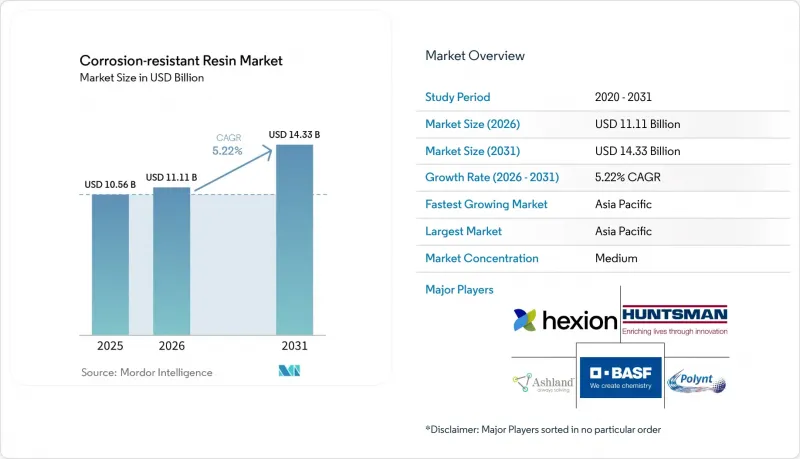
본 보고서는 수지 유형(에폭시, 비닐 에스테르, 폴리에스테르, 폴리우레탄, 기타), 용도(복합재료, 코팅, 기타), 최종 사용자 산업(자동차 및 운송, 인프라, 선박, 석유 및 가스, 기타), 지역(아시아태평양, 북미, 유럽, 남미, 중동 및 아프리카)별로 분류되어 있습니다. 시장 전망은 금액(달러) 기준으로 제시되어 있습니다.
세계의 내식성 수지 시장 동향 및 분석
에폭시 수지에 대한 수요 증가
에폭시 수지는 나노 실리카를 충전한 매트릭스가 더 뛰어난 차단 성능과 더 긴 유지보수 주기를 실현하고 있기 때문에 부식 관리 방식을 지속적으로 재정의하고 있습니다. 형광 기능을 갖춘 코팅을 통해 미세한 균열을 육안으로 감지할 수 있으므로, 점검 기회가 제한적인 해양 플랫폼의 예방적 유지보수를 지원하고 있습니다. 규제 당국이 지속가능성에 중점을 두고 있는 만큼, 기존의 기계적 특성을 유지하면서 탄소 발자국을 줄이는 식물성 오일 유래 에폭시 수지의 상업적 활용이 촉진되고 있습니다. 온도가 급격히 상승함에 따라 억제제가 방출되도록 하는 자가 복구 기술 덕분에, 에폭시 수지는 차세대 보호 시스템의 주력 소재로서 그 입지를 더욱 공고히 하고 있습니다. 이러한 발전들이 결합되어 중공업 분야의 최종 사용자에게 자산 가동 시간을 향상시키고 총 소유 비용(TCO)을 절감하고 있습니다.
석유 및 가스 파이프라인의 부식 관련 CAPEX(자본 지출) 및 OPEX(운영비) 증가
파이프라인 사업자들은 연간 약 13억 7,200만 달러의 부식 비용을 감당해야 하는 실정에 놓여 있으며, 이로 인해 비금속 파이프 네트워크와 수지 함량이 높은 첨단 라이너의 도입이 촉진되고 있습니다. 아람코는 사막 및 해양 환경에서 스위트 가스로 인한 부식을 줄이기 위해 이미 1만 km가 넘는 강화 열가소성 파이프를 설치했습니다. 198.33 MPa 및 352.25°C의 지하 조건에 대응하는 새로운 수지 시스템을 통해 심부 저류층의 시추가 가능해졌을 뿐만 아니라, 튜빙 고장으로 인한 가동 중단 시간도 단축되었습니다. 응답면법을 활용한 부식 모델링을 통해 엔지니어는 현장의 염화물 및 CO₂ 농도에 맞추어 수지를 선정할 수 있으며, 이를 통해 수명 주기 비용 절감과 안전성 향상을 실현하고 있습니다. 이러한 경제적 이점이 대형 에너지 기업들의 고성능 내식성 수지 솔루션에 대한 지속적인 구매를 뒷받침하고 있습니다.
REACH 및 TSCA에 따른 비스페놀 A의 재분류
유럽에서 비스페놀 A(BPA)의 일일 허용 섭취량이 대폭 하향 조정되고, 미국이 아시아산 에폭시 수지 수입품에 반덤핑 관세를 부과함에 따라, 배합 개발자들은 비스페놀 A(BPA)를 포함하지 않는 화학 조성으로 전환할 수밖에 없는 상황에 처해 있습니다. 현재, 샤윈 윌리엄스(Sherwin-Williams)와 PPG 인더스트리즈(PPG Industries)는 비스페놀 A(BPA)가 포함되지 않은 용기용 라이닝을 판매하고 있으며, 한편 로켓(Rocket)사의 이소소르비드계 경화제는 내분비 교란 물질에 대한 우려 없이 내화학성을 유지하고 있습니다. 전환 기간 중 공급 불안으로 인해 생산 비용이 상승함에 따라, 항공우주 분야 및 식품 접촉 용도의 신제품 인증 절차가 지연될 가능성이 있습니다.
부문별 분석
2025년, 에폭시 부문은 내식성 수지 시장 점유율의 42.38%를 차지했습니다. 이는 접착 강도, 화학적 비활성, 그리고 해양, 석유 및 가스, 인프라 프로젝트에서의 적용 가능성에 힘입은 것입니다. 비스실란계 개질제를 배합한 에폭시계 배합물은 현재 염수 분무 시험 후 자가 복구율이 90% 이상을 달성하여, 해상 설비의 유지보수 주기를 연장하고 있습니다. 폴리우레탄의 연평균 성장률(CAGR) 5.74%는 이 소재의 빠른 경화 속도를 반영한 것으로, 이로 인해 블레이드의 사이클 타임이 단축되고 금형에 묶여 있는 자본이 감소함에 따라 100m급 풍력 발전용 블레이드에 대한 사용이 확대되고 있습니다. 비닐 에스테르는 그 에스테르 결합이 기존의 폴리에스테르를 부식시키는 산이나 용제에 내성을 가지고 있기 때문에 화학 탱크 제조 분야에서 확고한 입지를 유지하고 있습니다.
신규 스마트 수지 플랫폼에는 초기 단계의 균열을 가시화하는 형광 추적제와 온도 반응형 억제제 방출 기능이 통합되어 있어, 정유시설 운영업체가 예기치 못한 가동 중단 시간을 최대 25%까지 줄일 수 있는 예측 유지보수 프로그램을 뒷받침하고 있습니다. 이러한 발전 덕분에, 대체 화학물질이 성능 격차 해소를 서두르는 와중에도 에폭시 수지의 프리미엄 지위는 더욱 공고해지고 있습니다.
지역별 분석
아시아태평양은 2025년 내식성 수지 시장 매출의 38.21%를 차지했으며, 2031년까지 연평균 성장률(CAGR) 6.35%로 성장할 것으로 전망되어, 이 분야의 주도적 입지를 공고히 하고 있습니다. 중국에서는 연간 30GW를 넘는 신규 풍력 발전 설비가 도입되고 있으며, 이는 블레이드 및 나셀용 유리섬유 에폭시 수지의 대량 소비를 이끌고 있습니다. 인도의 수탁 제조 분야에서 키네코 엑셀사가 베스타스사의 탄소섬유 플랭크 인증을 획득한 점이 주목받고 있으며, 이는 첨단 복합재료 분야에서 현지 부가가치 향상을 보여주는 사례입니다. 대만의 스완코사는 지역 해상 풍력 발전 프로젝트에 필요한 자재의 50% 이상을 공급하고 있으며, 이는 공급망의 높은 성숙도를 반영하고 있습니다.
북미는 기술 혁신과 무역 정책을 통해 수요를 확보하고 있습니다. 미국이 특정 아시아산 에폭시 수지의 수입에 부과하고 있는 반덤핑 관세는 국내 기업을 보호하고 생산 능력 확대를 촉진함으로써, 방위 및 인프라 용도의 안정적인 공급을 확보하고 있습니다. 엑슨모빌과 맥라린 컴포지트(McLaren Composites)가 체결한 폴리올레핀계 열경화성 수지에 관한 제휴는 인장 성능을 유지하면서 저탄소 대체 소재를 추진하려는 해당 지역의 노력을 여실히 보여주고 있습니다. BASF는 이미 100% 재생 가능 전력을 사용하는 코팅 공장을 운영하고 있으며, 처리량을 유지하면서 스코프 2 배출량을 감축하고 있습니다.
유럽은 지속가능성과 규제 측면에서의 리더십을 최우선으로 삼고 있으며, 엄격한 화학물질 등록·평가·허가·제한(REACH) 체계 하에서 BPA가 포함되지 않은 에폭시 수지 및 바이오 유래 중간체의 신속한 상용화가 진행되고 있습니다. 중동 및 아프리카에서는 부식 방지 제품을 목적으로 하는 사다라사의 ‘“PlasChem Park”등의 현지화 계획을 통해 성장이 가속화되고 있는 한편, 스트라타 솔베이(Strata Solvay)사의 프리프레그 제조 시설 덕분에 아랍에미리트는 항공우주 소재 공급 거점으로서의 입지를 확고히 하고 있습니다. 남미에서는 산업화와 항만 현대화로 인해 수지 수요가 완만하게 유지되고 있지만, 이 지역은 복합재료에 대한 전문 지식 면에서 뒤처져 있어 주요 중간재에 대해서는 여전히 수입에 의존하고 있습니다.
기타 혜택 :
- 엑셀 형식 시장 예측(ME) 시트
- 3개월간의 애널리스트 지원
자주 묻는 질문
목차
제1장 서론
제2장 조사 방법
제3장 주요 요약
제4장 시장 구도
제5장 시장 규모 및 성장 예측
제6장 경쟁 구도
제7장 시장 기회 및 향후 전망
KTH 26.07.03According to Mordor Intelligence, the corrosion-resistant resin market size in 2026 is estimated at USD 11.11 Billion, growing from 2025 value of USD 10.56 Billion with 2031 projections showing USD 14.33 Billion, growing at 5.22% CAGR over 2026-2031.
This report is Segmented by Resin Type (Epoxy, Vinyl Ester, Polyester, Polyurethane, and Others), Application (Composites, Coatings, and Others), End-User Industry (Automotive and Transportation, Infrastructure, Marine, Oil and Gas, and More), and Geography (Asia-Pacific, North America, Europe, South America, and Middle East and Africa). The Market Forecasts are Provided in Terms of Value (USD).
Global Corrosion-resistant Resin Market Trends and Insights
Increasing Demand for Epoxy Resins
Epoxy resins continue to redefine corrosion management because nano-silica-filled matrices are delivering higher barrier performance and longer service intervals. Fluorescence-enabled coatings allow visual detection of microcracks, supporting proactive maintenance on offshore platforms where inspection windows are limited . Regulators' focus on sustainability is catalyzing commercial roll-out of vegetable-oil-derived epoxies that match incumbent mechanical properties while lowering carbon footprints. Self-healing chemistries that trigger inhibitor release in response to temperature spikes are further positioning epoxies as the workhorse for next-generation protective systems. Collectively, these advances boost asset uptime and compress total cost of ownership for heavy-industry end-users.
Rising Corrosion-related CAPEX (Capital Expenditures) and OPEX (Operational Expenditures) in Oil & Gas Pipelines
Pipeline operators confront corrosion costs of roughly USD 1.372 Billion annually, prompting adoption of nonmetallic pipe networks and advanced resin-rich liners. Aramco has already installed over 10,000 km of reinforced thermoplastic pipe to mitigate sweet-gas corrosion in desert and offshore environments. New resin systems qualified for 198.33 MPa and 352.25°C downhole conditions are unlocking deep-reservoir completions while reducing downtime linked to tubing failures. Response-surface corrosion modelling lets engineers tailor resin selection to local chloride and CO2 levels, lowering lifecycle spend and enhancing safety metrics. These economics underpin sustained purchasing of high-performance corrosion-resistant resin market solutions by energy majors.
REACH and TSCA Re-classification of Bisphenol-a
Europe's sharp reduction of Bisphenol-A (BPA) tolerable daily intake and the United States' antidumping levies on Asian epoxy imports are forcing formulators to pivot toward Bisphenol A (BPA)-free chemistries. Sherwin-Williams and PPG Industries, Inc. now market non-Bisphenol A (BPA) container linings, while Roquette's isosorbide-based hardeners preserve chemical resistance without endocrine-disruption concerns . Supply uncertainty during the transition period elevates production costs and may slow qualification cycles for new aerospace and food-contact applications.
Other drivers and restraints analyzed in the detailed report include:
- Lightweighting Trend in Wind-blade Composites
- Mainstream Shift to Water-borne Vinyl-ester Systems in Marine
- Volatile MDI Prices
For complete list of drivers and restraints, kindly check the Table Of Contents.
Segment Analysis
The epoxy segment commanded 42.38% of the Corrosion-resistant Resin market share in 2025, anchored by its bonding strength, chemical inertness, and adaptability across marine, oil and gas, and infrastructure projects. Epoxy-based formulations infused with bis-silane modifiers now achieve self-healing rates above 90% after salt-spray exposure, extending maintenance intervals for offshore installations. Polyurethane's 5.74% CAGR reflects its rapid curing, which cuts blade cycle times and lowers capital tied up in molds, propelling its use in 100-m class wind blades. Vinyl esters retain a foothold in chemical-tank fabrication because their ester linkage tolerates acids and solvents that attack conventional polyesters.
Emerging smart-resin platforms integrate fluorescent tracers for early-stage crack visibility and temperature-responsive inhibitor release, supporting predictive maintenance programs that slash unplanned downtime by up to 25% for refinery operators. These advances reinforce epoxy's premium positioning even as alternative chemistries race to close performance gaps.
Complete Report Scope:
- By Resin Type
- Epoxy
- Vinyl Ester
- Polyester
- Polyurethane
- Others
- By Application
- Composites
- Coatings
- Others (Adhesives & Linings)
- By End-User Industry
- Automotive and Transportation
- Food and Beverage
- Industrial
- Infrastructure
- Marine
- Oil and Gas
- Other End-user Industries
- By Geography
- Asia-Pacific
- China
- Japan
- India
- South Korea
- ASEAN Countries
- Rest of Asia-Pacific
- North America
- United States
- Canada
- Mexico
- Europe
- Germany
- United Kingdom
- France
- Italy
- Spain
- Russia
- NORDIC Countries
- Rest of Europe
- South America
- Brazil
- Argentina
- Rest of South America
- Middle East and Africa
- Saudi Arabia
- South Africa
- Rest of Middle East and Africa
- Asia-Pacific
Geography Analysis
Asia Pacific accounted for 38.21% of the Corrosion-resistant Resin market revenue in 2025 and is projected to expand at a 6.35% CAGR to 2031, cementing its leadership position. China's annual installation of over 30 GW of new wind capacity drives bulk consumption of glass-fiber-epoxy resins for blades and nacelles. India's contract manufacturing, highlighted by Kineco Exel's qualification for Vestas carbon-fiber planks, signals rising local value-addition in advanced composites. Taiwan's Swancor supplies more than 50% of material input for regional offshore wind projects, reflecting supply-chain maturation.
North America captures demand through technological innovation and trade policy. United States antidumping duties on certain Asian epoxy imports shield domestic players and encourage capacity expansions, ensuring a secure supply for defense and infrastructure applications. ExxonMobil's collaboration with McClarin Composites on polyolefin-based thermosets underscores the region's push for lower-carbon alternatives that maintain tensile performance. BASF already operates coating plants on 100% renewable electricity, reducing scope-2 emissions while holding throughput steady.
Europe prioritizes sustainability and regulatory leadership, prompting rapid commercialisation of BPA-free epoxies and bio-attributed intermediates under stringent Registration, Evaluation, Authorization, and Restriction of Chemicals (REACH) frameworks. Middle East and Africa accelerate through localization plans such as Sadara's PlasChem Park, geared toward anticorrosion products, while Strata-Solvay's prepreg facility positions the United Arab Emirates as an aerospace material supplier. South America's industrialization and port upgrades sustain moderate resin demand, yet the region trails in composite expertise and remains import-reliant for key intermediates.
- Aditya Birla Chemicals
- AOC Resins
- Ashland Inc.
- BASF SE
- DIC Corporation
- Guangdong Yinyang Environment-Friendly New Materials Co., Ltd.
- Hexion Inc.
- Huntsman Corporation
- Olin Corporation
- Polynt-Reichhold Group
- Resonac
- Scott Bader Co. Ltd.
- Sino Polymer Co. Ltd.
- Sir Industriale
Additional Benefits:
- The market estimate (ME) sheet in Excel format
- 3 months of analyst support
TABLE OF CONTENTS
1 Introduction
- 1.1 Study Assumptions & Market Definition
- 1.2 Scope of the Study
2 Research Methodology
3 Executive Summary
4 Market Landscape
- 4.1 Market Overview
- 4.2 Market Drivers
- 4.2.1 Increasing Demand for Epoxy Resins
- 4.2.2 Rising Corrosion-related CAPEX (Capital Expenditures) and OPEX (Operational Expenditures) in Oil & Gas Pipelines
- 4.2.3 Light-weighting Trend in Wind-blade Composites
- 4.2.4 Mainstream Shift to Water-borne Vinyl-ester Systems in Marine
- 4.2.5 Localized Resin Blenders Emerging Around Middle-east Tank-farm Clusters
- 4.3 Market Restraints
- 4.3.1 REACH and TSCA Re-classification of Bisphenol-a
- 4.3.2 Volatile MDI Prices
- 4.3.3 Lack of Skilled Composite Fabricators in the Middle East and Africa
- 4.4 Value Chain Analysis
- 4.5 Porter's Five Forces
- 4.5.1 Bargaining Power of Suppliers
- 4.5.2 Bargaining Power of Buyers
- 4.5.3 Threat of New Entrants
- 4.5.4 Threat of Substitutes
- 4.5.5 Degree of Competition
5 Market Size & Growth Forecasts (Value)
- 5.1 By Resin Type
- 5.1.1 Epoxy
- 5.1.2 Vinyl Ester
- 5.1.3 Polyester
- 5.1.4 Polyurethane
- 5.1.5 Others
- 5.2 By Application
- 5.2.1 Composites
- 5.2.2 Coatings
- 5.2.3 Others (Adhesives & Linings)
- 5.3 By End-User Industry
- 5.3.1 Automotive and Transportation
- 5.3.2 Food and Beverage
- 5.3.3 Industrial
- 5.3.4 Infrastructure
- 5.3.5 Marine
- 5.3.6 Oil and Gas
- 5.3.7 Other End-user Industries
- 5.4 By Geography
- 5.4.1 Asia-Pacific
- 5.4.1.1 China
- 5.4.1.2 Japan
- 5.4.1.3 India
- 5.4.1.4 South Korea
- 5.4.1.5 ASEAN Countries
- 5.4.1.6 Rest of Asia-Pacific
- 5.4.2 North America
- 5.4.2.1 United States
- 5.4.2.2 Canada
- 5.4.2.3 Mexico
- 5.4.3 Europe
- 5.4.3.1 Germany
- 5.4.3.2 United Kingdom
- 5.4.3.3 France
- 5.4.3.4 Italy
- 5.4.3.5 Spain
- 5.4.3.6 Russia
- 5.4.3.7 NORDIC Countries
- 5.4.3.8 Rest of Europe
- 5.4.4 South America
- 5.4.4.1 Brazil
- 5.4.4.2 Argentina
- 5.4.4.3 Rest of South America
- 5.4.5 Middle East and Africa
- 5.4.5.1 Saudi Arabia
- 5.4.5.2 South Africa
- 5.4.5.3 Rest of Middle East and Africa
- 5.4.1 Asia-Pacific
6 Competitive Landscape
- 6.1 Market Concentration
- 6.2 Strategic Moves
- 6.3 Market Share(%)/ Ranking Analysis
- 6.4 Company Profiles (includes Global Overview, Market Level Overview, Core Segments, Financials, Strategic Info, Market Rank/Share, Products & Services, Recent Developments)
- 6.4.1 Aditya Birla Chemicals
- 6.4.2 AOC Resins
- 6.4.3 Ashland Inc.
- 6.4.4 BASF SE
- 6.4.5 DIC Corporation
- 6.4.6 Guangdong Yinyang Environment-Friendly New Materials Co., Ltd.
- 6.4.7 Hexion Inc.
- 6.4.8 Huntsman Corporation
- 6.4.9 Olin Corporation
- 6.4.10 Polynt-Reichhold Group
- 6.4.11 Resonac
- 6.4.12 Scott Bader Co. Ltd.
- 6.4.13 Sino Polymer Co. Ltd.
- 6.4.14 Sir Industriale
7 Market Opportunities & Future Outlook
- 7.1 White-space & Unmet-Need Assessment
- 7.2 Integration of Nanotechnology into Resin Formulations


