

|
시장보고서
상품코드
2072577
마이크로 및 나노 PLC : 시장 점유율 분석, 업계 동향 및 통계, 성장 예측(2026-2031년)Micro And Nano PLC - Market Share Analysis, Industry Trends & Statistics, Growth Forecasts (2026 - 2031) |
||||||
 Mordor Intelligence
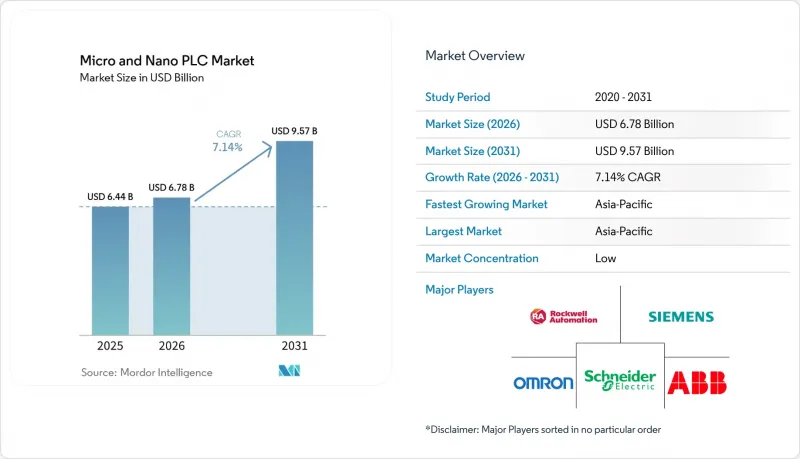
Mordor Intelligence에 의하면, 마이크로 및 나노 PLC 시장 규모는 2025년 64억 4,000만 달러로 평가되었습니다. 2026년에는 67억 8,000만 달러로 확대되어 2026년부터 2031년에 걸쳐 CAGR 7.14%로 성장을 지속하여, 2031년에는 95억 7,000만 달러에 이를 것으로 예측됩니다.
본 보고서는 제품 크기(나노 PLC 및 마이크로 PLC), 제공 형태(하드웨어, 소프트웨어, 서비스), 아키텍처(고정형/통합형 및 모듈형), 최종 사용자 산업(자동차 및 운송, 식품 및 음료, 전력 및 에너지, 화학, 제약, 금속 및 광업, 반도체 및 전자 등), 그리고 지역별로 분류되어 있습니다. 시장 전망은 금액(달러) 기준으로 제시되어 있습니다.
세계의 마이크로 및 나노 PLC 시장 동향 및 인사이트
아시아태평양의 중소기업을 위한 공장 자동화
아시아태평양은 자동화 수요가 대형 산업 시설에 집중되지 않고 소규모 공장으로 더욱 깊이 확산되고 있기 때문에 마이크로 및 나노 PLC 시장에서 여전히 가장 큰 수요 원천으로 자리 잡고 있습니다. 이러한 변화의 대표적인 예로, 저비용 로직, 신속한 시운전 및 운영자 교육의 용이성을 필요로 하는 중소규모 기계 제조업체들의 소형 컨트롤러 활용 확대가 꼽힙니다. 일본에서는 키엔스의 ‘KV Nano’나 JTEKT의 ‘TOYOPUC-Nano’와 같이 정평이 나 있는 소형 컨트롤러 제품군이, 높은 사이클 수와 높은 정밀도가 요구되는 OEM 환경을 위해 얼마나 컴팩트하게 설계되었는지를 보여주고 있으며, 이는 인근 아시아 국가들의 시스템 통합사업자 및 장비 공급업체들에게도 계속해서 영향을 미치고 있습니다. JEMA의 2025년 사용자 조사에서도 일본의 정밀 가공 및 전자기기 OEM 분야에서 내구성이 뛰어난 PLC가 채택되고 있는 것으로 지적되었으며, 이는 소형 제어 시스템에 대한 투자가 지역 전체로 확산되고 있음을 뒷받침하고 있습니다. 그 결과, 아시아태평양의 마이크로 및 나노 PLC 시장에서는 초기 하드웨어 가격뿐만 아니라 소프트웨어 숙련도, 서비스 지원, 생태계와의 호환성 등의 측면에서도 경쟁이 치열해지고 있습니다.
컴팩트 컨트롤러에서의 IIoT 및 엣지 연결
마이크로 및 나노 PLC 시장은 결정론적 기계 로직과 로컬 데이터 전송을 동일한 소형 유닛 내에서 처리할 수 있게 된 컨트롤러 덕분에 혜택을 보고 있습니다. 이를 통해 부품 목록(BOM)이 축소되고 캐비닛 설계가 간소화되며, 별도의 엣지 게이트웨이를 추가하지 않고도 기본적인 분석 기능이 필요한 운영자의 설치 시간이 단축됩니다. 2025년 9월 전 세계에 출시된 오므론의 ‘Sysmac-Edge DX1 데이터 플로우 컨트롤러’는 생산을 중단하지 않고도 현장의 여러 PLC 브랜드에서 코드 작성 없이 데이터를 수집할 수 있게 한다는 점에서 이러한 방향성을 잘 보여주고 있습니다. 또한, NTT와 도시바는 IOWN APN을 통한 클라우드 PLC 구성을 실증하여, 제조 테스트에서 300km 거리에서 20ms의 제어 주기를 달성했습니다. 이는 향후 로컬의 소형 노드와 원격 소프트웨어 기능이 점점 더 긴밀하게 연계될 것이라는 전망을 뒷받침하는 것입니다. 이러한 변화로 인해 마이크로 및 나노 PLC 시장의 표준 기능 세트가 향상되고 있습니다. 이는 이더넷 연결, 프로토콜의 유연성, 그리고 프로그래밍 가능한 엣지 로직이 더 이상 하이엔드 구성에만 국한되지 않게 되었기 때문입니다.
미드레인지 PLC의 성능 한계
마이크로 및 나노 PLC 시장에서 가장 뚜렷한 구조적 한계는 용도이 고밀도 I/O, 동기 모션 또는 더 복잡한 배치 환경으로 전환될 때 나타나는 처리 능력의 상한선입니다. 컴팩트 컨트롤러는 많은 단일 기계에서 충분히 제 기능을 발휘하지만, 사용자가 더 광범위한 제어 범위, 더 정교한 모션 기능, 혹은 더 폭넓은 네이티브 프로세스 기능을 필요로 하는 경우에는 여전히 한계가 있습니다. 록웰 오토메이션(Rockwell Automation)의 Vreugdenhil Dairy Foods 사례는 플랜트의 복잡성이 소형 장치의 실질적인 처리 용량을 초과하기 때문에 여전히 상위 제어 플랫폼이 필요한 대규모 통합 생산 환경의 한 예를 보여줍니다. 이는 엔트리 레벨 중급 컨트롤러의 성능이 향상되는 한편, 가격도 상위 마이크로 티어 제품에 가까워지고 있기 때문에 마이크로 및 나노 PLC 시장에서 중요한 의미를 지닙니다. 각 벤더들이 대체품에 대응하기 위해 안전 기능, 모션 기능 또는 고급 소프트웨어 기능을 추가함에 따라 비용이 상승하게 되어, 컴팩트 컨트롤러를 당초 매력적으로 만들었던 크기 면에서의 우위를 잃을 위험이 있습니다.
부문별 분석
2025년, 마이크로 PLC는 전 세계 마이크로 및 나노 PLC 시장 점유율의 61.23%를 차지하며, 소형 산업용 제어 기기 부문 전체에서 1위를 유지했습니다. 이러한 강점은 포장 기계, 컨베이어, HVAC 패널, 펌프 시스템, 소형 공작기계 등에 적합한 균형 잡힌 기능 세트에 있으며, 구매자를 더 비용이 많이 드는 모듈형 플랫폼으로 몰아넣지 않고도 대응할 수 있다는 점에 있습니다. 마이크로 및 나노 PLC 시장에서 이러한 중간적 위치는 여전히 가치가 있습니다. 많은 OEM 제조업체들은 스마트 릴레이가 제공할 수 있는 것 이상의 로직 기능이나 연결성을 필요로 하는 반면, 본격적인 중급 PLC 아키텍처까지는 필요로 하지 않기 때문입니다. 2025년 10월에 출시된 록웰 오토메이션의 ‘Allen-Bradley Micro820 L20E’는 EtherNet/IP Class 1 메시징, USB-C 시운전 인터페이스, 그리고 FactoryTalk Design Workbench와의 호환성을 갖추고 있어 이러한 방향성을 반영하고 있습니다. 마이크로 PLC의 위상은 실용적인 적용 사례를 통해서도 입증되고 있습니다. 예를 들어, 록웰의 식물성 단백질 마이크로도징 사례에서는 소형 제어 시스템이 서보 구동 방식의 식품 가공 장비에서 투여 정밀도를 유지하는 데 기여했습니다.
나노 PLC는 2031년까지 연평균 성장률(CAGR) 7.91%를 나타낼 것으로 예측되며, 마이크로 및 나노 PLC 시장 내에서 가장 두드러진 성장세를 보이는 분야입니다. 이러한 추세는 캐비닛 공간이 극히 제한적인 경우나, 임베디드 제어 및 고도로 국소화된 제어 작업에서 여전히 결정론적 로직을 필요로 하는 사용자들 사이에서 가장 두드러지게 나타납니다. 키엔스의 ‘KV Nano’ 시리즈는 초고속 처리 능력과 내장 네트워크 기능을 극히 소형화된 폼 팩터에 통합한 플랫폼인 만큼, 그 가치 제안이 확대되고 있음을 보여줍니다. JTEKT의 TOYOPUC-Nano 시리즈는 대형 하드웨어 없이도 정밀성을 중시하는 OEM의 요구 사항을 충족할 수 있어, 콤팩트하고 기계 전용 제어 설계의 유효성을 다시 한번 입증하고 있습니다. 이는 마이크로 PLC가 여전히 더 광범위한 도입 기반을 차지하고 있음에도 불구하고, 마이크로 및 나노 PLC 시장에서 소형 폼 팩터 컨트롤러와 대형 콤팩트 PLC 사이에 기존에 존재하던 기능 격차가 실제로 줄어들고 있음을 의미합니다.
2025년 전 세계 마이크로 및 나노 PLC 시장 규모 중 하드웨어가 69.38%를 차지해, 컨트롤러 판매가 여전히 수익 기반의 주축임을 알 수 있습니다. 이러한 상황은 공장 자동화가 자본 집약적인 특성을 가지고 있음을 반영하며, 물리적 장치, I/O 및 관련 제어 하드웨어가 구매 결정 시 여전히 최우선 고려 사항임을 보여줍니다. 또한, 구매자들이 브랜드의 생태계를 도입하기 전에 여전히 내구성, 통신 지원, 기존 시스템과의 호환성을 중요하게 여기고 있기 때문에 마이크로 및 나노 PLC 시장에서도 하드웨어 계층은 여전히 핵심적인 역할을 수행하고 있습니다. 록웰 오토메이션은 2025년 10월, 소형 컨트롤러 플랫폼에 강력한 연결성과 간소화된 시운전 기능을 추가한 ‘Micro820 L20E’를 출시하며, 이 하드웨어 중심 모델을 한층 더 강화했습니다. 그렇긴 하지만, 기계의 수명 주기 전반에 걸친 의사결정 과정에서 소프트웨어 및 서비스의 중요성이 커짐에 따라, 하드웨어 중심의 우위는 점차 위축되고 있습니다.
소프트웨어 시장은 2031년까지 연평균 성장률(CAGR) 7.87%를 나타낼 것으로 예측되며, 마이크로 및 나노 PLC 시장에서 가장 빠르게 확대될 서비스 부문이 될 전망입니다. 그 원동력은 라이선싱 수익뿐만 아니라, 프로그래밍 도구, 문제 해결 플랫폼, 시각화 기능 및 엔지니어링 워크플로가 사용자를 벤더의 생태계에 정착시키는 데 기여하는 역할이기도 합니다. 2025년 10월 록웰 오토메이션이 출시한 ‘FactoryTalk Design Workbench’가 바로 그 대표적인 예입니다. 이 회사는 Micro800 사용자를 위한 무료 프로그래밍 및 문제 해결 환경을 직접적인 수익 창출 제품이 아닌, 고객 유지와 사용 편의성을 높이는 도구로 자리매김했기 때문입니다. 또한, 2026년에 베크호프가 발표한 ‘TwinCAT PLC++’ 역시 개발 속도, 지속성, 그리고 최신 소프트웨어 워크플로우와의 호환성이 컨트롤러 하드웨어 그 자체를 넘어서는 구매 결정을 어떻게 형성하고 있는지를 여실히 보여주고 있습니다. 이러한 추세가 심화됨에 따라, 마이크로 및 나노 PLC 업계에서는 소형 제어 시스템의 설계, 업데이트 및 장기적인 유지보수를 보다 용이하게 수행할 수 있는 공급업체가 점점 더 높은 평가를 받게 될 것입니다.
지역별 분석
아시아태평양은 2025년 전 세계 마이크로 및 나노 PLC 시장 규모의 46.34%를 차지했으며, 2031년까지 연평균 성장률(CAGR) 7.71%를 나타낼 것으로 예측됩니다. 이로써 해당 지역은 가장 규모가 크고 가장 빠르게 성장하는 지역으로서의 위상을 확고히 하고 있습니다. 이러한 이중 역할은 산업 자동화 분야에서는 이례적인 것으로, 제조 활동의 집중, 중소기업에서의 자동화 확대, 그리고 전자, 자동차, 기계 제조에 걸친 폭넓은 수요가 복합적으로 작용하여 나타난 현상입니다. 아시아태평양의 마이크로 및 나노 PLC 시장은 국내외 다양한 공급업체 선택의 혜택을 누리고 있으며, 이를 통해 구매자는 가격, 기능, 서비스에 대한 요구를 보다 정확하게 충족시킬 수 있습니다. 일본은 여전히 중요한 참고 시장으로 남아 있습니다. JEMA의 2025년 PLC 사용자 조사에 따르면, 소형 컨트롤러가 모션 시스템 및 비전 시스템과 긴밀하게 통합되는 정밀 가공 및 전자기기 분야에서 도입이 지속되고 있는 것으로 나타났습니다. 또한, NTT와 도시바가 2025년에 실시한 클라우드 PLC 시험을 통해 로컬 제어와 원격 디지털 기능을 결합하기 위한 실용적인 방안이 제시됨에 따라, 해당 지역은 소프트웨어 연동형 소형 자동화의 다음 단계를 향해 유리한 입지를 확보하고 있습니다.
북미와 유럽은 마이크로 및 나노 PLC 시장의 두 번째 주요 수요 기반을 형성하고 있지만, 그 성장 양상은 신규 도입량에만 기인하는 것이 아니라, 교체, 규정 준수, 현대화에 의해 더 크게 좌우되고 있습니다. 북미에서는 식품 가공, 자동차, 전자기기 제조 등 각 분야에서 여전히 컴팩트 제어에 의존하고 있으며, 이러한 분야에서는 기계 수준의 신뢰성과 손쉬운 통합이 큰 가치를 제공합니다. 유럽에서는 2024년 12월에 ‘사이버 복원력법’이 시행됨에 따라, 보안이 강화된 컨트롤러로 업데이트하는 것이 특히 중요해지고 있습니다. 이 법에 따르면, 2026년 9월부터 취약점 보고 의무가, 2027년 12월부터는 보다 광범위한 제품 요건이 적용됩니다. 이 규제 일정은 보안 부팅, 안전한 업데이트 경로 또는 문서화된 보안 프로세스가 없는 구형 기기의 업그레이드를 촉진함으로써 마이크로 및 나노 PLC 시장을 뒷받침하고 있습니다. 또한, 유럽 시장에서의 조달에서는 IEC 62443을 준수하는 부품의 보안이 더욱 중요시되고 있으며, 이에 따라 산업용 고객에게 서비스를 제공하는 공급업체에 대한 인증 기준이 강화되고 있습니다.
남미, 중동 및 아프리카는 매출 규모 면에서는 여전히 작지만, 마이크로 및 나노 PLC 시장에 중요한 성장의 발판을 제공합니다. 남미에서는 식품 가공, 농업 관련 사업, 광업 분야에서 외딴 지역이나 네트워크 환경이 제한된 장소에서도 안정적으로 작동하는 소형 제어 장치에 대한 수요가 생겨나고 있습니다. 중동에서는 산업의 다각화와 인프라 관련 제조 활동을 통해 새로운 자동화 수요가 발생하고 있습니다. 한편, 아프리카에서는 광업, 식품 가공, 경공업 분야에서 소규모 자동화 시스템의 도입이 초기 단계에 있습니다. 이러한 지역은 마이크로 및 나노 PLC 시장에 특히 중요한데, 고정형 및 통합형 플랫폼은 더 복잡한 아키텍처에 필요한 엔지니어링 부담을 수반하지 않으면서도 유용한 자동화를 실현할 수 있는 경우가 많기 때문입니다.
기타 혜택 :
- 엑셀 형식 시장 예측(ME) 시트
- 3개월간의 애널리스트 지원
자주 묻는 질문
목차
제1장 서론
제2장 조사 방법
제3장 주요 요약
제4장 시장 구도
제5장 시장 규모 및 성장 예측
제6장 경쟁 구도
제7장 시장 기회 및 향후 전망
KTH 26.07.03According to Mordor Intelligence, the micro and nano PLC market size is expected to grow from USD 6.44 billion in 2025 to USD 6.78 billion in 2026 and is forecast to reach USD 9.57 billion by 2031 at 7.14% CAGR over 2026-2031.
This report is Segmented by Product Size (Nano PLC, and Micro PLC), Offering (Hardware, Software, and Services), Architecture (Fixed/Integrated, and Modular), End-User Industry (Automotive and Transportation, Food and Beverage, Power and Energy, Chemicals, Pharmaceuticals, Metals and Mining, Semiconductors and Electronics, and More), and Geography. The Market Forecasts are Provided in Terms of Value (USD).
Global Micro And Nano PLC Market Trends and Insights
SME Factory Automation in Asia-Pacific
Asia-Pacific remains the strongest volume engine for the micro and nano PLC market because automation demand is spreading deeper into smaller factories rather than staying concentrated in large industrial sites. A visible part of this shift is the wider use of compact controllers by small and mid-sized machine builders that need low-cost logic, faster commissioning, and easier operator training. In Japan, established compact controller lines such as Keyence KV Nano and JTEKT TOYOPUC-Nano show how tightly packaged products are being built for high-cycle and precision-oriented OEM environments, which continues to influence neighboring Asian integrators and equipment suppliers. JEMA's 2025 user survey also points to durable PLC adoption across precision machining and electronics equipment OEM applications in Japan, which supports the broader regional case for compact control investment. As a result, the micro and nano PLC market in Asia-Pacific is becoming more competitive on software familiarity, service support, and ecosystem fit, not only on upfront hardware pricing.
IIoT and Edge Connectivity in Compact Controllers
The micro and nano PLC market is gaining from controllers that now handle deterministic machine logic and local data movement in the same compact unit. This reduces the bill of materials, simplifies cabinet design, and shortens installation time for operators who want basic analytics without adding a separate edge gateway. Omron's Sysmac-Edge DX1 Data Flow Controller, launched globally in September 2025, illustrates this direction because it enables no-code data collection from multiple PLC brands on the shop floor without stopping production. NTT and Toshiba also demonstrated a cloud PLC configuration over IOWN APN that achieved a 20 ms control cycle across 300 km in a manufacturing test, which supports the view that local compact nodes and remote software functions will increasingly work together. That shift is raising the baseline feature set in the micro and nano PLC market because Ethernet connectivity, protocol flexibility, and programmable edge logic are no longer limited to premium configurations.
Performance Ceiling Versus Mid-Range PLCs
The clearest structural limit on the micro and nano PLC market is the processing ceiling that appears when applications move into high-density I/O, synchronized motion, or more complex batch environments. Compact controllers work well in many standalone machines, but they still lose ground when users need a larger control scope, deeper motion capability, or broader native process functions. Rockwell Automation's Vreugdenhil Dairy Foods case shows the kind of large-scale, integrated production setting where higher-tier control platforms remain necessary because plant complexity extends beyond the practical headroom of compact devices. This matters in the micro and nano PLC market because entry-level mid-range controllers are becoming more capable while also moving closer in price to upper micro-tier products. As vendors add safety, motion, or advanced software functions to defend against substitution, they risk raising cost and weakening the size advantage that made compact controllers attractive in the first place.
Other drivers and restraints analyzed in the detailed report include:
- Demand for Space-Saving Integrated Control in OEM Machines
- Semiconductor and Electronics Capacity Additions
- Brownfield Integration and Commissioning Costs
For complete list of drivers and restraints, kindly check the Table Of Contents.
Segment Analysis
Micro PLCs held 61.23% of the global micro and nano PLC market share in 2025, which kept them in the leading position across compact industrial control. Their advantage came from a balanced feature set that fits packaging machinery, conveyors, HVAC panels, pump systems, and small machine tools without pushing buyers into higher-cost modular platforms. In the micro and nano PLC market, this middle ground remains valuable because many OEMs need more logic and connectivity than a smart relay can provide, but they do not need full mid-range PLC architecture. Rockwell Automation's Allen-Bradley Micro820 L20E, launched in October 2025, reflects that direction with EtherNet/IP Class 1 messaging, a USB-C commissioning interface, and compatibility with FactoryTalk Design Workbench. The micro PLC position is also supported by practical application depth, including Rockwell's plant-protein microdosing case, where compact control helped maintain dosing accuracy in servo-driven food processing equipment.
Nano PLCs are projected to grow at a 7.91% CAGR through 2031, making them the fastest-moving part of the micro and nano PLC market. Their momentum is strongest where cabinet space is extremely limited and where users still need deterministic logic in embedded or highly localized control tasks. Keyence's KV Nano line shows how that value proposition is broadening, because the platform combines ultra-fast processing with built-in networking in a very small form factor. JTEKT's TOYOPUC-Nano series further supports the case for compact, machine-specific control designs that can serve precision-oriented OEM requirements without oversized hardware. This means the micro and nano PLC market is seeing a real narrowing of the historical capability gap between small-form-factor controllers and larger compact PLCs, even though micro PLCs still hold the broader installed base.
Hardware captured 69.38% of the global micro and nano PLC market size in 2025, which shows that controller sales still anchor the revenue base. That position reflects the capital-heavy nature of factory automation, where physical devices, I/O, and related control hardware remain the first purchase decision. The hardware layer also remains central in the micro and nano PLC market because buyers still weigh durability, communication support, and installed compatibility before they commit to a brand ecosystem. Rockwell Automation reinforced that hardware-led model in October 2025 with the Micro820 L20E launch, which added stronger connectivity and simpler commissioning to a compact controller platform. Even so, the hardware lead is gradually being pressured as software and services become more important in ongoing machine lifecycle decisions.
Software is forecast to grow at a 7.87% CAGR through 2031, making it the faster-expanding offering layer within the micro and nano PLC market. The driver is not only licensing revenue, but also the role of programming tools, troubleshooting platforms, visualization functions, and engineering workflows in locking users into a vendor ecosystem. Rockwell Automation's FactoryTalk Design Workbench launch in October 2025 is a strong example because the company positioned a free programming and troubleshooting environment for Micro800 users as a retention and ease-of-use tool rather than a direct monetization product. Beckhoff's TwinCAT PLC++ recognition in 2026 also highlights how development speed, continuity, and modern software workflow alignment are shaping buying decisions beyond controller hardware alone. As this pattern deepens, the micro and nano PLC industry will increasingly reward suppliers that can make compact control easier to engineer, update, and maintain over time.
Complete Report Scope:
- By Product Size
- Nano PLC
- Micro PLC
- By Offering
- Hardware
- Software
- Services
- By Architecture
- Fixed / Integrated
- Modular
- By End-User Industry
- Automotive and Transportation
- Food and Beverage
- Oil and Gas
- Power and Energy
- Chemicals
- Pharmaceuticals
- Metals and Mining
- Water and Wastewater
- Semiconductors and Electronics
- Other End-User Industries
- By Geography
- North America
- United States
- Canada
- Mexico
- South America
- Brazil
- Argentina
- Rest of South America
- Europe
- Germany
- United Kingdom
- France
- Italy
- Spain
- Rest of Europe
- Asia-Pacific
- China
- Japan
- India
- South Korea
- ASEAN
- Rest of Asia-Pacific
- Middle East and Africa
- Middle East
- Saudi Arabia
- United Arab Emirates
- Turkey
- Rest of the Middle East
- Africa
- South Africa
- Nigeria
- Rest of Africa
- Middle East
- North America
Geography Analysis
Asia-Pacific accounted for 46.34% of the global micro and nano PLC market size in 2025 and is expected to post a 7.71% CAGR through 2031, which gives it both the largest and fastest-growing regional position. This dual role is unusual in industrial automation and reflects a combination of dense manufacturing activity, rising SME automation, and broad demand across electronics, automotive, and machinery production. The micro and nano PLC market in Asia-Pacific also benefits from a wide range of local and international supplier options, which helps buyers match price, features, and service needs more closely. Japan remains an important reference market because JEMA's 2025 PLC user survey shows continued adoption in precision machining and electronics equipment segments, where compact controllers integrate closely with motion and vision systems. The region is also well positioned for the next stage of software-linked compact automation because NTT and Toshiba's 2025 cloud PLC test pointed to practical pathways for combining local control and remote digital functions.
North America and Europe form the second major demand base for the micro and nano PLC market, but their growth pattern is shaped more by replacement, compliance, and modernization than by greenfield volume alone. North America continues to rely on compact control in food processing, automotive, and electronics manufacturing, where machine-level reliability and easier integration carry a high value. Europe is becoming especially important in secure controller replacement because the Cyber Resilience Act entered into force in December 2024, with vulnerability reporting obligations applying from September 2026 and broader product requirements applying from December 2027. That regulatory calendar supports the micro and nano PLC market by encouraging upgrades away from legacy devices that lack Secure Boot, secure update paths, or documented security processes. European procurement is also placing greater weight on IEC 62443-aligned component security, which raises the qualification threshold for vendors serving industrial accounts.
South America, the Middle East, and Africa remain smaller in revenue terms, but they offer an important expansion path for the micro and nano PLC market. In South America, food processing, agribusiness, and mining create demand for compact control that can operate reliably in remote or network-limited environments. The Middle East is adding greenfield automation demand through industrial diversification and infrastructure-linked manufacturing activity, while Africa is seeing earlier-stage compact automation adoption in mining, food processing, and light manufacturing. These regions are especially relevant to the micro and nano PLC market because fixed and integrated platforms can often deliver useful automation without the engineering overhead that more complex architectures require.
- Rockwell Automation, Inc.
- Siemens AG
- Omron Corporation
- Schneider Electric SE
- ABB Ltd.
- Mitsubishi Electric Corporation
- Keyence Corporation
- IDEC Corporation
- Beckhoff Automation GmbH & Co. KG
- B&R Industrial Automation GmbH
- Emerson Electric Co.
- Eaton Corporation Plc
- WAGO Kontakttechnik GmbH & Co. KG
- LS Electric Co., Ltd.
- Delta Electronics, Inc.
- Fuji Electric Co., Ltd.
- Yokogawa Electric Corporation
- Phoenix Contact GmbH & Co. KG
- Toshiba Corporation
- Hitachi, Ltd.
Additional Benefits:
- The market estimate (ME) sheet in Excel format
- 3 months of analyst support
TABLE OF CONTENTS
1 INTRODUCTION
- 1.1 Study Assumptions and Market Definition
- 1.2 Scope of the Study
2 RESEARCH METHODOLOGY
3 EXECUTIVE SUMMARY
4 MARKET LANDSCAPE
- 4.1 Market Overview
- 4.2 Market Drivers
- 4.2.1 SME Factory Automation in Asia-Pacific
- 4.2.2 Demand for Space-Saving Integrated Control in OEM Machines
- 4.2.3 IIoT and Edge Connectivity in Compact Controllers
- 4.2.4 Semiconductor and Electronics Capacity Additions
- 4.2.5 Cyber-Ready Controller Replacement Cycle in Europe
- 4.2.6 Electrified Mobile and Off-Highway Equipment Controls
- 4.3 Market Restraints
- 4.3.1 Performance Ceiling Versus Mid-Range PLCs
- 4.3.2 Brownfield Integration and Commissioning Costs
- 4.3.3 CRA and IEC 62443 Compliance Burden on Smaller Vendors
- 4.3.4 Edge Controller and Industrial MCU Substitution
- 4.4 Industry Value Chain Analysis
- 4.5 Regulatory Landscape
- 4.6 Technological Outlook
- 4.7 Porter's Five Forces Analysis
- 4.7.1 Bargaining Power of Suppliers
- 4.7.2 Bargaining Power of Buyers
- 4.7.3 Threat of New Entrants
- 4.7.4 Threat of Substitutes
- 4.7.5 Intensity of Competitive Rivalry
- 4.8 Assessment of Macroeconomic Trends on the Market
5 MARKET SIZE AND GROWTH FORECASTS (VALUE)
- 5.1 By Product Size
- 5.1.1 Nano PLC
- 5.1.2 Micro PLC
- 5.2 By Offering
- 5.2.1 Hardware
- 5.2.2 Software
- 5.2.3 Services
- 5.3 By Architecture
- 5.3.1 Fixed / Integrated
- 5.3.2 Modular
- 5.4 By End-User Industry
- 5.4.1 Automotive and Transportation
- 5.4.2 Food and Beverage
- 5.4.3 Oil and Gas
- 5.4.4 Power and Energy
- 5.4.5 Chemicals
- 5.4.6 Pharmaceuticals
- 5.4.7 Metals and Mining
- 5.4.8 Water and Wastewater
- 5.4.9 Semiconductors and Electronics
- 5.4.10 Other End-User Industries
- 5.5 By Geography
- 5.5.1 North America
- 5.5.1.1 United States
- 5.5.1.2 Canada
- 5.5.1.3 Mexico
- 5.5.2 South America
- 5.5.2.1 Brazil
- 5.5.2.2 Argentina
- 5.5.2.3 Rest of South America
- 5.5.3 Europe
- 5.5.3.1 Germany
- 5.5.3.2 United Kingdom
- 5.5.3.3 France
- 5.5.3.4 Italy
- 5.5.3.5 Spain
- 5.5.3.6 Rest of Europe
- 5.5.4 Asia-Pacific
- 5.5.4.1 China
- 5.5.4.2 Japan
- 5.5.4.3 India
- 5.5.4.4 South Korea
- 5.5.4.5 ASEAN
- 5.5.4.6 Rest of Asia-Pacific
- 5.5.5 Middle East and Africa
- 5.5.5.1 Middle East
- 5.5.5.1.1 Saudi Arabia
- 5.5.5.1.2 United Arab Emirates
- 5.5.5.1.3 Turkey
- 5.5.5.1.4 Rest of the Middle East
- 5.5.5.2 Africa
- 5.5.5.2.1 South Africa
- 5.5.5.2.2 Nigeria
- 5.5.5.2.3 Rest of Africa
- 5.5.5.1 Middle East
- 5.5.1 North America
6 COMPETITIVE LANDSCAPE
- 6.1 Market Concentration
- 6.2 Strategic Moves
- 6.3 Market Share Analysis
- 6.4 Company Profiles (includes Global level Overview, Market level overview, Core Segments, Financials as available, Strategic Information, Market Rank/Share for key companies, Products and Services, and Recent Developments)
- 6.4.1 Rockwell Automation, Inc.
- 6.4.2 Siemens AG
- 6.4.3 Omron Corporation
- 6.4.4 Schneider Electric SE
- 6.4.5 ABB Ltd.
- 6.4.6 Mitsubishi Electric Corporation
- 6.4.7 Keyence Corporation
- 6.4.8 IDEC Corporation
- 6.4.9 Beckhoff Automation GmbH & Co. KG
- 6.4.10 B&R Industrial Automation GmbH
- 6.4.11 Emerson Electric Co.
- 6.4.12 Eaton Corporation Plc
- 6.4.13 WAGO Kontakttechnik GmbH & Co. KG
- 6.4.14 LS Electric Co., Ltd.
- 6.4.15 Delta Electronics, Inc.
- 6.4.16 Fuji Electric Co., Ltd.
- 6.4.17 Yokogawa Electric Corporation
- 6.4.18 Phoenix Contact GmbH & Co. KG
- 6.4.19 Toshiba Corporation
- 6.4.20 Hitachi, Ltd.
7 MARKET OPPORTUNITIES AND FUTURE OUTLOOK
- 7.1 White-space and Unmet-Need Assessment


