
|
시장보고서
상품코드
2072593
비분산 적외선(NDIR) : 시장 점유율 분석, 업계 동향 및 통계, 성장 예측(2026-2031년)Non-Dispersive Infrared (NDIR) - Market Share Analysis, Industry Trends & Statistics, Growth Forecasts (2026 - 2031) |
||||||
 Mordor Intelligence
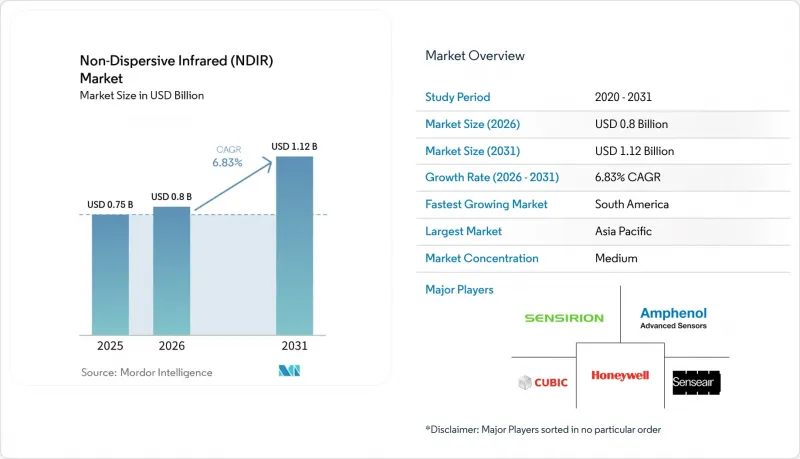
Mordor Intelligence에 의하면, 비분산 적외선(NDIR) 시장 규모는 2025년 7억 5,000만 달러로 평가되었습니다. 2026년 8억 달러에서 2031년까지 11억 2,000만 달러로 확대되며 2026-2031년까지 연평균 복합 성장률(CAGR)은 6.83%를 나타낼 전망입니다.
본 보고서는 제품 유형(고정형/벽걸이형 모듈, 산업용 공정 분석 장치, 기타), 감지 가스(이산화탄소(CO2), 탄화수소(CH4, C3H8), 기타), 최종 이용 산업(HVAC 및 빌딩 자동화, 산업 안전 및 공정, 기타), 플랫폼(PCB 실장형 칩 센서, 기타), 지역별로 분류되어 있습니다. 시장 전망은 금액(달러) 기준으로 제시되어 있습니다.
세계의 비분산 적외선(NDIR) 시장 동향 및 인사이트
상업용 빌딩의 실내 공기질(IAQ) 규제 강화
교육위원회, 보건부, 그린빌딩 협의회는 환기 지표로서 상시 CO2 감지 시스템 도입에 발맞추어 나가고 있습니다. 캘리포니아주의 AB 2232 법에 따르면, 교실 내에서 ±75 ppm의 정확도를 가진 장치를 사용하고 연 1회 검증을 실시해야 하며, 이와 유사한 법안이 미국 내 다른 7개 주에서도 제정되고 있습니다. 중국은 2023년에 실내 이산화탄소 허용 상한치를 800 ppm으로 낮췄으며, 이에 따라 약 300억 m²의 바닥 면적에 걸친 개보수 공사가 추진되고 있습니다. 시장 수요는 지난 5년 동안 드리프트를 ±50 ppm 이내로 억제하는 자동 베이스라인 보정 기능을 갖춘 모듈로 이동하고 있습니다. Matter 규격에 기반한 자가 복구형 메쉬 네트워크를 추진하는 업체들은 독자 사양의 게이트웨이를 활용함으로써 개보수 공사 입찰에서 수주에 성공하고 있습니다.
자동차 및 산업 배출 기준의 강화
유로 7 및 EPA 티어 4 기준에 따라 모니터링 대상이 배기관에서 차량 내부 공기 및 공장 배기관까지 확대되었습니다. 자동차 제조업체들은 현재 배터리 소모와 탑승자의 쾌적성 사이의 균형을 맞추기 위해 전기차의 HVAC 루프에 NDIR CO2 센서를 탑재하고 있습니다. 산업 부문에서는 새로운 메탄 배출 상한치에 따라 0.40 kg h-1의 감도 기준으로 분기별 누출 검사가 의무화됨에 따라, 기존에 페리스타를 사용하던 휴대용 분석 장치의 교체 주기가 시작되고 있습니다. ±200 ppm의 정확도를 저해하지 않으면서 -40°C-+80°C의 작동 범위를 인증받을 수 있는 공급업체는 Tier 1 시스템 통합사업자와 다년간공급 계약을 체결하고 있습니다.
가격 하락과 센서의 상품화
선전을 거점으로 하는 대규모 제조업체를 필두로, 기본형 5,000ppm CO2 모듈의 평균 판매 가격은 2025년에 20달러 아래로 떨어졌습니다. 서유럽 기업들의 매출총이익률이 20%대 초반까지 축소됨에 따라, 펌웨어를 통한 분석 기능이나 교정 서비스를 구독형 서비스로 묶어 제공하는 움직임이 가속화되고 있습니다. RESET 및 Title 24 인증은 기업용 입찰에서 여전히 차별화 요인으로 작용하고 있으며, 이로 인해 프리미엄 모델은 두 자릿수 가격 차이를 유지하고 있지만, 소비자용 IoT 구매자들은 압도적으로 최저 비용으로 규격을 준수하는 옵션을 선택하고 있습니다.
부문별 분석
시설 관리자들이 예측 유지보수 기능을 추구한 결과, 스마트하고 연결 가능한 유닛의 성장세가 가속화되어 예측 기간 동안 연평균 성장률(CAGR)은 7.31%를 기록했습니다. 2025년에는 고정형 및 벽걸이형 모듈이 비분산 적외선(NDIR) 시장의 38.00%를 차지하며 주류를 이루었으나, 클라우드 지원 모델은 기준 성장률을 꾸준히 상회하는 매출을 기록하고 있는 유일한 카테고리입니다. 이러한 모델의 무선 펌웨어 업데이트를 통해 기술자의 방문 횟수가 줄어들었으며, Thread 네트워크를 도입함으로써 계약업체가 설치하는 리피터의 수를 30% 줄일 수 있게 되었습니다. 휴대용 분석 장비는 여전히 산업 안전 감사에서 중요한 역할을 하고 있으며, 특히 SIL2 인증을 획득하고 정유시설의 턴어라운드 일정에 대응할 수 있는 모델이 주목받고 있습니다. 산업용 랙형 분석 장치는 ISO 14064의 준수 요건을 충족하는 방폭 인클로저의 이점을 누리고 있어, 석유화학 메가사이트에서 없어서는 안 될 존재가 되었습니다.
각 벤더사는 하드웨어, 보정, 대시보드를 월정액 요금 하나로 통합한 ‘ 센서-어-서비스(SaaS)”계약으로 무게중심을 옮기고 있습니다. 센시리온의 Wi-Fi 지원 모델 ‘ SCD43”는 자동 규정 준수 보고서가 WELL 및 Title 24 규정의 적용 하에서 업무 처리를 어떻게 간소화하는지를 보여줍니다. Matter의 상호운용성 덕분에 벤더 종속성이 해소되어, 전용 설치 업체가 아닌 지역 전기 기술자가 개조 작업을 수행할 수 있게 되었습니다. 휴대용 기기에는 1주일 동안 사용하기에 충분한 충전식 리튬 이온 배터리가 기본으로 장착되어, 기존 기기의 사용 시간과 관련된 불만이 해소되었습니다. 산업용 분석 장치는 엣지 AI를 활용하여 오염을 조기에 감지함으로써, 수백만 개에 달하는 생산량 손실로 이어지는 예기치 못한 가동 중단을 방지하고 있습니다.
2025년, 이산화탄소는 매출의 46.00%를 차지하며 여전히 주력 부문이었으나, 그 성장률은 비분산 적외선(NDIR) 시장 전체의 평균 수준에서 정체되었습니다. 한편, 연평균 성장률(CAGR) 7.78%를 기록하며 성장하고 있는 냉매 감지 부문은 현재, F-가스 규제와 키가리 협정의 기한 준수를 위해 필요한 투자 자금을 확보하고 있습니다. 이 부문에서는 R-1234yf를 수증기에서 분리하기 위해 협대역 광학 시스템이 필요하며, 설계의 복잡성은 높아지지만 프리미엄 가격 책정이 가능해집니다. 탄화수소용 모듈은 촉매식 페리스터에서 NDIR로 전환되고 있으며, 스파크가 허용되지 않는 고농도 H₂S 환경에서 보다 안전한 대안이 되고 있습니다. 의료용 가스 모니터는 수술실에서 ISO 80601의 요건을 충족하며, 규모는 작지만 수익성이 높은 틈새 시장으로, ±0.3 vol-%의 정확도가 요구됩니다.
Honeywell의 이중 파장 탄화수소 센서는 습도로 인한 오차를 실시간으로 보정하여, 5,000ppm 범위 내에서 ±5%의 정확도를 실현하고 있습니다. 온실 운영자는 상대 습도 95%의 환경에서도 측정값을 ±50 ppm 이내로 유지할 수 있는 2만 ppm 범위의 모듈을 구입하고 있습니다. 석유 생산 업체의 경우, 해양 개발에서 총 비용의 상당 부분을 물류비가 차지하기 때문에 분기별 교정 가스가 필요 없는 장비라면 정가가 비싸더라도 수용할 수 있습니다. 마취 가스 측정 기기는 사이드스트림 샘플링 방식에서 기도에 직접 부착되는 메인스트림 센서 방식으로 점차 전환되고 있으며, 소아 수술을 복잡하게 만들던 측정 지연 문제가 해소되고 있습니다.
지역별 분석
중국이 실내 이산화탄소 상한치를 800ppm으로 낮춘 데 따라, 300억 m²에 달하는 사무실과 쇼핑몰에서 잇달아 개보수 공사가 진행된 결과, 2025년 매출의 42.80%를 아시아태평양이 차지했습니다. 인도의 “스마트 시티 미션"라고 일본 개정 학교 건축 기준에 따르면, 모두 환기 제어 장치에 NDIR을 표준으로 장착하고 있어 기본적인 수요가 보장되고 있습니다. 한국과 호주는 ASHRAE 62.1을 준수하고 있어, 해외산 센서의 승인이 용이해졌으며, 다국적 부동산 관리 회사들에게 입찰 절차가 통일되어 있습니다.
연평균 성장률(CAGR) 7.88%의 성장이 예상되는 중동에서는 “비전 2030”의 친환경 건축 관련 법규와, 실내 CO2 농도가 800 ppm을 초과할 경우 규정 위반으로 간주하는 ESTIDAMA Pearl 시스템의 도입이 호재로 작용하고 있습니다. 카타르에서 개최되는 2022년 월드컵을 위해 건설된 경기장에는 1만 개 이상의 센서가 탑재되어 있으며, 50°C의 기후 조건에서도 그 실용성이 입증되어 공항이나 쇼핑몰 등에서도 유사한 사례가 확산되고 있습니다. 사우디아라비아의 산업용 메탄 인벤토리 프로그램에서는 현재 정유시설의 배기탑에 NDIR 센서 설치를 의무화하고 있어, 교정 서비스를 통한 지속적인 수익원이 확보되고 있습니다. 이집트의 “새로운 행정 수도”에서는 다운타운 중심부 180만 m²에 걸쳐 LEED 골드 인증이 의무화되어 있으며, 각 타워에서는 모든 공조 장치에 CO₂ 센서를 설치해야 합니다.
2025년 기준으로 북미와 유럽을 합친 비분산 적외선(NDIR) 시장 점유율은 약 40%를 차지했습니다. 캘리포니아주의 교실 관련 법률과 EU의 ‘건축물의 에너지 성능에 관한 규정(EPBD)”의 개정에 따라 지속적인 모니터링이 의무화되면서, 학교, 호텔, 요양 시설에서 개보수 열풍이 일고 있습니다. 미국의 연방 세제 혜택에 따라 센서 도입 비용의 3분의 1이 환급되므로, 중급 호텔의 투자 회수 모델이 개선되고 있습니다. 독일은 작업장의 CO2 농도 상한선을 3,000ppm으로 낮추고, 공장에 설비 업그레이드를 촉구하고 있습니다. 영국에서는 겨울철 검사 결과 60%가 기준을 충족하지 못한 것으로 밝혀짐에 따라, 교실의 이산화탄소 농도를 1,500ppm 이하로 유지할 것을 권장하고 있으며, 이로 인해 약 30만 대 분량 수요 기회가 창출되고 있습니다. 남미와 아프리카는 아직 초기 단계이지만, 브라질에서는 교정 기준 제정이 진행 중이며, 남아프리카에서는 심부 광산에 CO2 센서 설치를 의무화하는 방안이 검토되고 있어, 향후 성장 가능성을 시사하고 있습니다.
기타 혜택
- 엑셀 형식 시장 예측(ME) 시트
- 3개월간의 애널리스트 지원
자주 묻는 질문
목차
제1장 서론
제2장 조사 방법
제3장 주요 요약
제4장 시장 구도
제5장 시장 규모 및 성장 예측
제6장 경쟁 구도
제7장 시장 기회 및 향후 전망
KTH 26.07.07According to Mordor Intelligence, the non-Dispersive infrared market size is projected to expand from USD 0.75 billion in 2025 and USD 0.80 billion in 2026 to USD 1.12 billion by 2031, registering a CAGR of 6.83% between 2026 and 2031.
This report is Segmented by Product Type (Fixed/Wall-Mount Modules, Industrial Process Analyzers, and More), Gas Detected (Carbon Dioxide (CO2), Hydrocarbons (CH4, C3H8), and More), End-Use Industry (HVAC and Building Automation, Industrial Safety and Process, and More), Platform (PCB-Mount Chip Sensors, and More), and Geography. The Market Forecasts are Provided in Terms of Value (USD).
Global Non-Dispersive Infrared (NDIR) Market Trends and Insights
Intensifying IAQ Regulation in Commercial Buildings
School boards, ministries of health, and green-building councils are converging on permanent CO2 sensing as a proxy for ventilation. California's AB 2232 requires classrooms to use devices with +-75 ppm accuracy and requires yearly verification, and similar statutes are emerging in seven other US states. China lowered the permissible indoor CO2 ceiling to 800 ppm in 2023, driving retrofits across roughly 30 billion m2 of floor space. Market preference is shifting toward modules with automatic baseline correction that hold drift below +-50 ppm across five years. Vendors promoting self-healing mesh networks under the Matter standard are winning retrofit bids by avoiding proprietary gateways.
Stricter Automotive and Industrial Emission Norms
Euro 7 and EPA Tier 4 standards extend monitoring from tailpipes to cabin air and factory stacks. Automakers now embed NDIR CO2 sensors in electric-vehicle HVAC loops to balance battery drain with occupant comfort. On the industrial side, new methane caps require quarterly leak checks at 0.40 kg h-1 sensitivity, opening a replacement cycle for portable analyzers that previously used pellistors. Suppliers that can certify to the -40 °C to +80 °C operating range without sacrificing +-200 ppm accuracy are securing multi-year supply agreements with Tier 1 system integrators.
Price Erosion and Sensor Commoditization
Average selling prices for basic 5 000 ppm CO2 modules dropped below USD 20 in 2025, led by large-scale producers in Shenzhen.Gross margins for Western firms tightened to low-20% territory, encouraging them to bundle firmware analytics and calibration services as subscription offerings. RESET and Title 24 certifications remain differentiators in enterprise bids, allowing premium models to keep double-digit price deltas, yet consumer IoT buyers overwhelmingly select the least-cost-compliant option.
Other drivers and restraints analyzed in the detailed report include:
- Accelerated HVAC Automation and Smart Thermostat Uptake
- Edge-AI NDIR Modules Enabling On-Sensor Analytics
- Performance Drift in Harsh Temperature and Humidity
For complete list of drivers and restraints, kindly check the Table Of Contents.
Segment Analysis
Smart and connected units gained momentum, with a CAGR of 7.31% over the forecast period, as facility managers pursued predictive maintenance capabilities. Although fixed and wall-mount modules dominated the Non-Dispersive Infrared market share at 38.00% in 2025, cloud-ready models are the only category consistently outselling the baseline growth rate. Their wireless firmware updates curb technician visits, and Thread networking lets contractors install 30% fewer repeaters. Portable analyzers retain relevance for occupational safety audits, especially models certified to SIL2 that meet refinery turnaround schedules. Industrial rack analyzers benefit from explosion-proof enclosures that meet ISO 14064 compliance requirements, making them a staple of petrochemical megasites.
Vendors are pivoting toward sensor-as-a-service agreements that bundle hardware, calibration, and dashboards for one monthly fee. Sensirion's Wi-Fi-enabled SCD43 illustrates how automatic compliance reports reduce paperwork under WELL and Title 24 rules. Matter interoperability has ended vendor lock-in, opening retrofit work to local electricians rather than proprietary installers. Portable devices now ship with rechargeable lithium-ion packs that last a full workweek, solving past runtime complaints. Industrial analyzers leverage edge AI to detect fouling early and prevent unplanned shutdowns that cost millions in lost throughput.
Carbon dioxide held the revenue anchor at 46.00% in 2025, yet growth stalled near the overall Non-Dispersive Infrared market average. Refrigerant sensing, growing at 7.78% CAGR, now captures capital allocated to comply with F-Gas and Kigali deadlines. The segment requires narrow-bandpass optics to separate R-1234yf from water vapor, adding design complexity but opening premium pricing. Hydrocarbon modules are moving from catalytic pellistors to NDIR, a safer option in high-H2S fields where sparks are unacceptable. Medical-gas monitors meet ISO 80601 mandates in operating rooms, a small but margin-rich niche that requires +-0.3 vol-% accuracy.
Honeywell's dual-wavelength hydrocarbon sensor compensates for humidity error in real time, achieving +-5% precision across 5 000 ppm. Greenhouse operators are buying 20 000 ppm-range modules that keep readings within +-50 ppm despite 95% relative humidity. Oil producers accept higher list prices if a device negates the need for quarterly calibration gas, because logistics dominate total cost offshore. Anesthetic-gas instruments are drifting away from sidestream sampling toward mainstream sensors mounted directly in the airway, eliminating lag that complicates pediatric procedures.
Complete Report Scope:
- By Product Type
- Fixed/Wall-Mount Modules
- Portable/Handheld Devices
- Smart/Connected NDIR Sensors
- Industrial Process Analyzers
- By Gas Detected
- Carbon Dioxide (CO2)
- Hydrocarbons (CH4, C3H8)
- Refrigerants (HFCs, HFOs)
- Anesthetic and Medical Gases
- By End-Use Industry
- HVAC and Building Automation
- Industrial Safety and Process
- Automotive and Transportation
- Healthcare and Life-Science
- Food and Agriculture
- By Platform
- PCB-Mount Chip Sensors
- Module-Level Sensors
- Complete Analyzer Systems
- By Geography
- North America
- United States
- Canada
- Mexico
- Europe
- Germany
- United Kingdom
- France
- Russia
- Rest of Europe
- Asia-Pacific
- China
- Japan
- India
- South Korea
- Australia
- Rest of Asia-Pacific
- Middle East
- Saudi Arabia
- United Arab Emirates
- Rest of Middle East
- Africa
- South Africa
- Egypt
- Rest of Africa
- South America
- Brazil
- Argentina
- Rest of South America
- North America
Geography Analysis
Asia-Pacific delivered 42.80% of 2025 revenue after China cut indoor CO2 limits to 800 ppm, triggering retrofits across 30 billion m2 of offices and malls. India's Smart Cities Mission and Japan's updated school codes both hard-wire NDIR into ventilation controllers, guaranteeing baseline demand. South Korea and Australia align with ASHRAE 62.1, easing foreign sensor approvals and unifying tender processes for multinational property managers.
The Middle East, forecast to grow at a 7.88% CAGR, benefits from Vision 2030 green-building decrees and the ESTIDAMA Pearl system, which classifies indoor CO2 levels above 800 ppm as a compliance breach. Stadiums built for the 2022 World Cup in Qatar embedded more than 10 000 sensors, demonstrating their viability in 50 °C climates and spurring airports and malls to follow suit. Saudi Arabia's industrial methane inventory program now mandates NDIR on refinery stacks, stitching a recurring revenue stream for calibration services. Egypt's New Administrative Capital orders LEED Gold across 1.8 million m2 of downtown core, each tower specifying CO2 sensors on every air-handling unit.
North America and Europe together represented roughly 40% of the NDIR market in 2025. California's classroom law and the EU Energy Performance of Buildings recast both stipulate continuous monitoring, creating retrofit waves in schools, hotels, and care homes. US federal tax incentives can rebate one-third of sensor project costs, lifting payback models for mid-tier hotels. Germany lowered workplace CO2 limits to 3 000 ppm, nudging factories to upgrade. The UK recommended sub-1 500 ppm classrooms after winter tests showed 60% non-compliance, adding an estimated 300 000-unit opportunity. South America and Africa are early-stage, yet Brazil is drafting calibration norms, while South Africa weighs mandatory CO2 sensing in deep mines, hinting at future upside.
- Senseair AB
- Sensirion AG
- Cubic Sensor and Instrument Co., Ltd.
- Dynament Limited
- Gas Sensing Solutions Ltd.
- ELT SENSOR Corp.
- Zhengzhou Winsen Electronics Technology Co., Ltd.
- Figaro Engineering Inc.
- Amphenol Advanced Sensors (Telaire)
- Honeywell International Inc.
- Vaisala Oyj
- Edinburgh Instruments Ltd.
- CO2Meter, Inc.
- AlphaSense Inc.
- Heitronics Infrarot Messtechnik GmbH
- Alphasense Ltd.
- InfraTec GmbH Infrarotsensorik und Messtechnik
- NevadaNano, Inc.
- City Technology Ltd.
- Sick AG
Additional Benefits:
- The market estimate (ME) sheet in Excel format
- 3 months of analyst support
TABLE OF CONTENTS
1 INTRODUCTION
- 1.1 Study Assumptions and Market Definition
- 1.2 Scope of the Study
2 RESEARCH METHODOLOGY
3 EXECUTIVE SUMMARY
4 MARKET LANDSCAPE
- 4.1 Market Overview
- 4.2 Market Drivers
- 4.2.1 Intensifying IAQ Regulation in Commercial Buildings
- 4.2.2 Stricter Automotive and Industrial Emission Norms
- 4.2.3 Accelerated HVAC Automation and Smart Thermostat Uptake
- 4.2.4 Edge-AI NDIR Modules Enabling On-Sensor Analytics
- 4.2.5 Carbon Pricing Driving Continuous Methane Monitoring at Oil & Gas Wellheads
- 4.2.6 Bluetooth 5.3's Higher Power Budgets Allowing Multi-Gas NDIR in Consumer Wearables
- 4.3 Market Restraints
- 4.3.1 Price Erosion and Sensor Commoditisation
- 4.3.2 Performance Drift in Harsh Temperature/Humidity
- 4.3.3 Helium Shortage Impacting Calibration Gas Supply
- 4.3.4 Growing Adoption of Long-Wave TDLAS and Photo-Acoustic Techniques
- 4.4 Industry Value Chain Analysis
- 4.5 Regulatory Landscape
- 4.6 Technological Outlook
- 4.7 Impact of Macroeconomic Factors on the Market
- 4.8 Porter's Five Forces Analysis
- 4.8.1 Bargaining Power of Suppliers
- 4.8.2 Bargaining Power of Buyers
- 4.8.3 Threat of New Entrants
- 4.8.4 Threat of Substitutes
- 4.8.5 Competitive Rivalry
5 MARKET SIZE AND GROWTH FORECASTS (VALUE)
- 5.1 By Product Type
- 5.1.1 Fixed/Wall-Mount Modules
- 5.1.2 Portable/Handheld Devices
- 5.1.3 Smart/Connected NDIR Sensors
- 5.1.4 Industrial Process Analyzers
- 5.2 By Gas Detected
- 5.2.1 Carbon Dioxide (CO2)
- 5.2.2 Hydrocarbons (CH4, C3H8)
- 5.2.3 Refrigerants (HFCs, HFOs)
- 5.2.4 Anesthetic and Medical Gases
- 5.3 By End-Use Industry
- 5.3.1 HVAC and Building Automation
- 5.3.2 Industrial Safety and Process
- 5.3.3 Automotive and Transportation
- 5.3.4 Healthcare and Life-Science
- 5.3.5 Food and Agriculture
- 5.4 By Platform
- 5.4.1 PCB-Mount Chip Sensors
- 5.4.2 Module-Level Sensors
- 5.4.3 Complete Analyzer Systems
- 5.5 By Geography
- 5.5.1 North America
- 5.5.1.1 United States
- 5.5.1.2 Canada
- 5.5.1.3 Mexico
- 5.5.2 Europe
- 5.5.2.1 Germany
- 5.5.2.2 United Kingdom
- 5.5.2.3 France
- 5.5.2.4 Russia
- 5.5.2.5 Rest of Europe
- 5.5.3 Asia-Pacific
- 5.5.3.1 China
- 5.5.3.2 Japan
- 5.5.3.3 India
- 5.5.3.4 South Korea
- 5.5.3.5 Australia
- 5.5.3.6 Rest of Asia-Pacific
- 5.5.4 Middle East
- 5.5.4.1 Saudi Arabia
- 5.5.4.2 United Arab Emirates
- 5.5.4.3 Rest of Middle East
- 5.5.5 Africa
- 5.5.5.1 South Africa
- 5.5.5.2 Egypt
- 5.5.5.3 Rest of Africa
- 5.5.6 South America
- 5.5.6.1 Brazil
- 5.5.6.2 Argentina
- 5.5.6.3 Rest of South America
- 5.5.1 North America
6 COMPETITIVE LANDSCAPE
- 6.1 Market Concentration
- 6.2 Strategic Moves
- 6.3 Market Share Analysis
- 6.4 Company Profiles (includes Global Level Overview, Market Level Overview, Core Segments, Financials as available, Strategic Information, Market Rank/Share, Products and Services, Recent Developments)
- 6.4.1 Senseair AB
- 6.4.2 Sensirion AG
- 6.4.3 Cubic Sensor and Instrument Co., Ltd.
- 6.4.4 Dynament Limited
- 6.4.5 Gas Sensing Solutions Ltd.
- 6.4.6 ELT SENSOR Corp.
- 6.4.7 Zhengzhou Winsen Electronics Technology Co., Ltd.
- 6.4.8 Figaro Engineering Inc.
- 6.4.9 Amphenol Advanced Sensors (Telaire)
- 6.4.10 Honeywell International Inc.
- 6.4.11 Vaisala Oyj
- 6.4.12 Edinburgh Instruments Ltd.
- 6.4.13 CO2Meter, Inc.
- 6.4.14 AlphaSense Inc.
- 6.4.15 Heitronics Infrarot Messtechnik GmbH
- 6.4.16 Alphasense Ltd.
- 6.4.17 InfraTec GmbH Infrarotsensorik und Messtechnik
- 6.4.18 NevadaNano, Inc.
- 6.4.19 City Technology Ltd.
- 6.4.20 Sick AG
7 MARKET OPPORTUNITIES AND FUTURE OUTLOOK
- 7.1 White-Space and Unmet-Need Assessment