
|
시장보고서
상품코드
2072613
단거리 방공 시스템(SHORAD) 시장 : 시장 점유율 분석, 업계 동향 및 통계, 성장 예측(2025-2030년)Short-Range Air Defense System (SHORAD) - Market Share Analysis, Industry Trends & Statistics, Growth Forecasts (2025 - 2030) |
||||||
 Mordor Intelligence
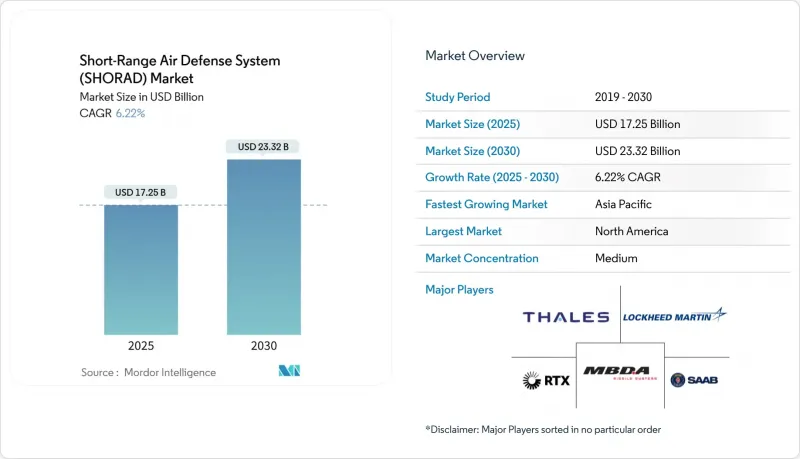
Mordor Intelligence에 의하면, 단거리 방공 시스템(SHORAD) 시장 규모는 2025년에 172억 5,000만 달러로 평가되었고, 2030년까지 233억 2,000만 달러에 이를 것으로 예측됩니다.
이는 연평균 성장률(CAGR) 6.22%를 나타내며, 방위 기관들이 대량이자 저비용의 항공 위협을 격퇴할 수 있는 다층적이고 비용 대비 효과가 높은 방공 아키텍처로 전환하고 있음을 뒷받침합니다.
본 보고서는 사거리별(초단거리 및 단거리), 플랫폼별(육상, 해상, 항공), 기동성 및 배치 형태별(고정식, 기타), 유도 기술별(레이더 유도, 기타), 최종 사용자별(군사, 국토 안보), 지역별(북미, 유럽, 기타)로 분류되어 있습니다. 시장 전망은 금액(달러) 기준으로 제시되어 있습니다.
세계의 단거리 방공 시스템(SHORAD) 시장 동향 및 분석
드론과 회전식 탄약으로 인한 위협이 급증함에 따라 기동형 SHORAD의 조달 확대가 가속화되고 있습니다.
전파 방해 상황에서도 항법이 가능하며, 자율적으로 표적의 우선순위를 결정할 수 있는 러시아의 AI 지원형 '샤헤드' 드론 파생형은 고정식 방어 시스템의 취약점을 드러내어, 각국 군이 전자전, 포병, 미사일, 레이저를 단일 트럭 탑재형 시스템으로 통합한 이동식 SHORAD의 조달을 우선시할 수밖에 없게 만들었습니다. 미국의 M-SHORAD와 노르웨이의 NOMADS 프로그램의 전개가 가속화되고 있는 것은 그 시급성을 여실히 보여주고 있으며, 예정된 마일스톤보다 앞서 유럽 부대에 차량을 배치하기 위해 인수 검사가 단축되고 있습니다. 교리 개편에서는 현재 이동 사격 전술과 분산형 센서 노드를 활용한 포화 공격에 대한 대응이 강조되고 있으며, 이를 통해 산업계는 차체를 재설계할 필요 없이 새로운 레이더나 이펙터 포드를 탑재할 수 있는 '플러그 앤 플레이'형 아키텍처의 설계를 촉진하고 있습니다. 경제성 측면에서도 이러한 민첩성이 유리하게 작용합니다. 15만 달러짜리 미사일이 아니라 12달러짜리 레이저 조준으로 2,000달러짜리 드론을 요격하면, 탄약 비축량을 유지할 수 있을 뿐만 아니라 운용 및 지원 비용도 절감할 수 있습니다. 그 결과, 과거에는 10년에 달하던 조달 주기가 3년에서 5년의 단기 주기로 단축되어, 신속한 시제품 완성 및 단계적 업그레이드가 가능한 공급업체에 이점을 가져다주고 있습니다.
방위 예산을 활성화하기 위한 현대화 로드맵
M-SHORAD에 대한 미국의 단계적 접근 방식, 즉 기관포와 스팅거로 구성된 체계에서 스팅거와 헬파이어를 결합한 하이브리드 체계로의 전환은 단기적인 성능 저하에도 불구하고 명확한 로드맵이 어떻게 지속적인 발주와 예산 한도를 유지하는지를 보여주고 있습니다. 유럽의 ESSI와 5억 유로(5억 8,673만 달러) 규모의 탄약 생산 촉진책은 장기적인 수요의 확실성을 한층 더 공고히 하며, 2차 공급업체들이 SHORAD 시장에 공급할 새로운 추진제 라인 및 인증된 탄두 케이스에 대한 투자를 가능하게 하고 있습니다. 각국 정부는 납기 엄수를 위해 옵션 한도를 통한 인센티브를 제공하는 다년 계약 체계를 승인하고 있으며, 이를 통해 자금 조달의 변동을 억제하고, 계약업체의 인센티브가 즉각 대응 태세라는 목표와 일치하도록 하고 있습니다. 나토(NATO) 회원국 5개국에서 라이네메탈 사가 제조한 '스카이 레인저 30'의 표준화는 공통 예비 부품 및 훈련 체계를 통해 비용 절감을 실현하고 있습니다. 그 결과, 소규모 동맹국이라도 일회성 개발 비용을 전액 부담하지 않고도 고도의 능력을 합리적인 가격에 활용할 수 있게 됩니다.
예산 상한선 내에서 발생하는 높은 조달 및 수명 주기 비용
방위 예산이 정체된 상황으로 인해 각국 국방부는 상충되는 요구 사항들 사이에서 우선순위를 정할 수밖에 없게 되었습니다. 또한 분석가들은 고강도 작전이 지속될 경우, 현재 미국의 미사일 재고가 1주일 이내에 고갈될 것이라고 경고하고 있으며, 이러한 압박이 고성능 요격 미사일의 조달을 억제하고 자금을 저비용 대안으로 전환하는 요인이 되고 있습니다. 유럽 각국의 재무부 역시 탄약 생산에 대한 투자와 즉각적인 전개 능력의 부족 사이에서 양자택일의 기로에 놓여 있으며, 다른 현대화 계획을 희생하지 않으면서도 단거리 방공 시스템의 산업 프로그램이 충분히 신속하게 확대될 수 있을지에 대한 의문이 제기되고 있습니다. 수명 주기 비용, 교육, 예비 부품, 정비 공장 수준의 유지보수 비용은 초기 구매 가격의 3배에 달하는 경우가 많아, 자금 사정이 어려운 구매자들이 최첨단 솔루션을 발주하는 것을 주저하게 만들고 있습니다. 각 OEM 기업들은 지출 곡선을 평탄화하기 위해 성능 기반 물류 계약이나 구독형 소프트웨어 업데이트를 도입하고 있지만, 벤더 종속을 우려하는 조달 담당자들 사이에서는 여전히 회의적인 시각이 남아 있습니다.
부문별 분석
2024년, 단거리 배터리는 SHORAD 시장 점유율의 61.40%를 차지했습니다. 이는 기동여단용으로 최적화된 미사일·포병 하이브리드 시스템에 대한 수십 년에 걸친 투자를 반영한 것입니다. 그럼에도 불구하고, 보병 부대가 5km 이하의 사정권 내에서 쿼드콥터나 회전익 탄약의 침투를 저지할 수 있는 기동성이 뛰어난 휴대형 방어 시스템을 요구하고 있기 때문에 초단거리 시스템 시장은 2030년까지 연평균 성장률(CAGR) 8.45%로 성장을 지속하고, 있습니다. 인도의 20.5kg짜리 VSHORADS 시제기는 시속 400m/s로 비행하는 드론에 대해 높은 살상 능력을 발휘하며, 대형 미사일과의 성능 격차를 메우는 경량 듀얼 밴드 탐색기의 유효성을 입증했습니다. 이에 따라 VSHORADS 단거리 방공 시스템 시장 규모는 특수부대에 그치지 않고, 특히 공중 우위를 놓고 경쟁이 벌어지는 지역의 일반 대대까지 확대되고 있습니다.
이러한 급증은 여단 차원의 방어망에만 의존하는 것이 아니라, 각 소대가 스스로 방어를 수행하도록 요구하는 분산형 작전으로의 교리적 전환에 기인합니다. 소프트 런치 모터 덕분에 후방으로 향하는 폭발 바람이 줄어들어 밀폐된 공간에서도 발사가 가능해짐에 따라, 도시 작전 수행 능력이 향상되었고, 대상인 단거리 방공 시스템 시장은 더욱 확대되고 있습니다. 한편, SHORAD의 기존 제조업체들은 근접 신관식 항공 폭파탄과 AI 화기 관제를 통합함으로써, 스웜 공격에 대한 격파 확률을 확보하고 그 존재 의의를 유지하고 있습니다. 사정거리 등급의 경계가 모호해짐에 따라, 육군이 리스트 스트랩형 VSHORADS와 트럭 탑재형 SHORAD를 결합한 하이브리드 방식의 조달 패턴이 등장했으며, 이는 통합 병과 이념을 반영한 것으로 보입니다.
2024년 매출액 중 지상 전개형이 64.68%를 차지했으며, 이는 부대의 행군 대열, 기지, 병참 기지를 방어해야 하는 지속적인 수요를 뒷받침하고 있습니다. 한편, 회전익기나 UAV(무인항공기)에 포드형 발사 장치를 탑재해 수송 부대 전방에서 방어권을 확대하는 공중 기반 솔루션은 연평균 7.81%의 성장률을 보이고 있습니다. 콘스버그사의 'NOMADS' 공수 가능한 발사 장치는 경량 다목적 헬리콥터의 제한된 갑판 공간을 보완하기 위해, 항공 센서의 유도를 받아 지상 발사형 마이크로 미사일을 원격으로 발사하는 방식을 채택하고 있어, 영역을 초월한 시너지 효과를 보여주고 있습니다.
해상 기반 프로그램은 통합 비용과 함상 전력 제약으로 인해 신중한 전개가 불가피하지만, 일본의 구축함급 레이저는 메가와트급 발전기가 보급된다면 가까운 시일 내에 상황이 호전될 조짐이 보일 것임을 시사하고 있습니다. 항공 기동성을 추구함에 따라 공급업체들은 복합재로 제작된 캐니스터와 GaN 레이더를 활용해 경량화를 도모하고 있으며, 이러한 혁신 기술은 지상형 시스템에도 적용되면서 단거리 시스템 산업에서 각 플랫폼 간의 상호 의존 관계가 점점 더 강화되고 있습니다.
지역별 분석
2024년에는 북미가 34.90%의 점유율로 1위를 차지했으며, 그 원동력은 미 육군이 유럽과 인도-태평양 지역에 M-SHORAD 대대를 더욱 빠르게 배치한 것이었습니다. NORAD(북미 항공우주방위사령부)의 현대화 자금을 통해 캐나다가 스팅어 미사일의 예비 탄약과 이동식 발사대를 조달하는 데 박차를 가하는 한편, 멕시코는 국경 인프라용 대드론 재머 어레이 도입을 검토하고 있습니다. 국내의 막대한 연구개발비를 바탕으로 지향성 에너지 무기의 시제품 개발이 진행되고 있으며, 파워팩의 고밀도화에 따라 지역 주요 기업들이 2세대 레이저 모듈 수출에 주력할 수 있는 체제가 점차 갖춰지고 있습니다. 그러나 특수강이나 고체 로켓 모터공급 병목 현상이, 양국 간 공급 기반 구축을 위한 노력이 구체화되지 않는 한, 향후 생산량을 제한할 가능성이 있습니다.
아시아태평양은 인도의 국산 VSHORADS 도입, 일본의 함재 레이저 배치, 한국의 M-SAM 수출 급증에 힘입어 2030년까지 연평균 성장률(CAGR) 7.57%로 가장 높은 성장세를 보이고 있습니다. 분쟁 중인 공역을 둘러싼 지역적 긴장은 금수 조치의 위험을 헤지하기 위해 미국, 이스라엘 및 국내 시스템을 결합한 다원 조달 전략을 촉진하고 있습니다. 호주의 'LAND 19' 7B 단계에서는 공동 요격 네트워크의 설계가 추진되고 있어, 데이터 링크 공급업체에게 비즈니스 기회가 창출되고 있습니다." 열대 군도에서 히말라야 고원에 이르기까지 다양한 기후 조건이 존재하기 때문에 플랫폼은 극심한 온도 변화를 견딜 수 있어야 하며, 이 전장 특유의 견고한 설계가 요구됩니다.
유럽에서는 ESSI(유럽 안보 및 안보 역량)의 협력적 체계와 라인메탈사의 '스카이 레인저'의 납품을 통해 견조한 수요가 유지되고 있으며, 2027년까지 NATO 회원국 5개국에서 총 50대의 차량을 배치하는 것을 목표로 하고 있습니다. EU의 탄약 생산 장려 정책에 힘입어 추진제 생산 라인 확장이 가속화되면서, 외부 공급업체에 대한 의존도를 낮추는 지역적 자립성이 강화되고 있습니다. 우크라이나 작전 경험을 통해 얻은 교훈을 바탕으로, 영국이 '스토머'의 후속 기종을 모색하는 등, 즉시 투입이 가능하고 실적이 입증된 플랫폼을 우선시하는 잠정적인 조달이 진행되고 있습니다. 북유럽 국가들은 비용을 분산하고 표준화된 유지관리 체제를 확보하기 위해 공동 조달을 추진하고 있으며, 이로 인해 유럽 대륙의 단거리 방공 시스템 시장의 장기적인 성장이 뒷받침되고 있습니다.
기타 혜택
- 엑셀 형식 시장 예측(ME) 시트
- 3개월간의 애널리스트 지원
자주 묻는 질문
목차
제1장 서론
제2장 조사 방법
제3장 주요 요약
제4장 시장 구도
제5장 시장 규모 및 성장 예측
제6장 경쟁 구도
제7장 시장 기회 및 향후 전망
AJY 26.07.07According to Mordor Intelligence, the short-range air defense system (SHORAD) market size stood at USD 17.25 billion in 2025 and is forecasted to reach USD 23.32 billion by 2030, reflecting a 6.22% CAGR that underscores defense agencies' pivot toward layered, cost-effective air-defense architectures capable of defeating high-volume, low-cost aerial threats.
This report is Segmented by Range (Very Short Range and Short Range), Platform (Land-Based, Sea-Based, and Air-Based), Mobility and Deployment (Stationary/Fixed-Site, and More), Guidance Technology (Radar-Guided, and More), End User (Military and Homeland Security), and Geography (North America, Europe, and More). The Market Forecasts are Provided in Terms of Value (USD).
Global Short-Range Air Defense System (SHORAD) Market Trends and Insights
Surge in Drone and Loitering-Munition Threats Expanding Mobile SHORAD Procurement
Russia's AI-assisted Shahed drone variants, able to navigate under jamming and autonomously prioritize targets, have exposed vulnerabilities in static defenses and compelled armies to prioritize mobile SHORAD market procurements that blend electronic warfare, guns, missiles, and lasers into a single, truck-borne package. Accelerated fielding of the US M-SHORAD and Norwegian NOMADS programs exemplifies the urgency, with acceptance trials truncated to place vehicles in European units ahead of scheduled milestones. Doctrinal updates now emphasize shoot-on-the-move tactics and distributed sensor nodes to counter saturation attacks, incentivizing industry to design plug-and-play architectures that accept new radars or effector pods without hull redesign. The economics favor this agility; intercepting a USD 2,000 drone with a USD 12 laser shot versus a USD 150,000 missile preserves magazine depth and reduces operations-and-support costs. Consequently, procurement cycles that once spanned a decade now compress into three- to five-year bursts, benefiting suppliers capable of rapid prototype maturation and spiral upgrades.
Modernization Roadmaps Unlocking Defense Budgets
The US incremental approach to M-SHORAD, moving from gun-and-Stinger loadouts toward Stinger-HELLFIRE hybrids, demonstrates how defined roadmaps sustain recurring orders and budget lines regardless of near-term performance setbacks. Europe's ESSI and EUR 500 million (USD 586.73 million) ammunition-production stimulus further cements long-run demand certainty, allowing tier-two contractors to invest in new propellant lines and qualified warhead casings that feed the SHORAD market. Governments endorse multiyear frameworks that reward on-time delivery with option tranches, reducing funding volatility and aligning contractor incentives with readiness targets. Standardization on Rheinmetall Skyranger 30 among five NATO nations illustrates cost savings through common spares and training pipelines. As a result, even smaller allies gain affordable access to advanced capabilities without bearing full non-recurring engineering expenses.
High Acquisition and Lifecycle Cost Amid Budget Ceilings
Flat defense toplines force ministries to prioritize across competing needs, and analysts warn that sustained high-intensity operations would exhaust current US missile inventories within one week, a pressure that curtails procurement of premium interceptors and channels money toward lower-cost options. European treasuries likewise juggle ammunition-production investments against immediately deployable capability gaps, prompting questions over whether short-range air defense systems industry programs can scale fast enough without cannibalizing other modernization plans. Lifecycle costs, training, spares, and depot-level maintenance often triple initial purchase prices, discouraging cash-constrained buyers from ordering state-of-the-art solutions. OEMs respond with performance-based logistics contracts and subscription-style software updates to flatten expenditure curves, yet skepticism persists among acquisition officers wary of vendor lock-in.
Other drivers and restraints analyzed in the detailed report include:
- Networked C2/Sensor-Fusion Boosting SHORAD Effectiveness
- Counter-UAS Layer Now Mandatory in Layered Air-Defense Architectures
- Multi-Sensor Integration Complexity Causing Schedule Overruns
For complete list of drivers and restraints, kindly check the Table Of Contents.
Segment Analysis
Short-range batteries captured 61.40% of the SHORAD market share in 2024, reflecting decades-old investments in missile-gun hybrids optimized for maneuver brigades. Nevertheless, very short-range systems post an 8.45% CAGR through 2030 as infantry units demand agile, man-portable defenses that negate quadcopter and loitering-munition penetrations at sub-5 km envelopes. India's 20.5 kg VSHORADS prototype proved lethal against 400 m/s drones, validating lightweight dual-band seekers that close the performance gap with larger missiles. The short-range air defense system market size for VSHORADS thus expands beyond special forces to regular battalions, especially where air dominance is contested.
The surge stems from doctrinal emphasis on distributed operations requiring every platoon to self-protect rather than rely solely on brigade-level umbrellas. As soft-launch motors reduce back-blast and allow firing from enclosures, urban-operation suitability rises, further widening the addressable short-range air defense system market. Meanwhile, SHORAD incumbents preserve relevance by integrating proximity-fused airburst rounds and AI fire control, ensuring kill probability against swarms. Convergence between range classes will likely create hybrid procurement patterns where armies blend wrist-strap VSHORADS with truck-mounted SHORAD, mirroring combined-arms philosophy.
Land configurations commanded 64.68% of 2024 revenue, testifying to the enduring requirement to shield columns, bases, and depots. Yet air-based solutions grow 7.81% annually as rotary-wing and UAV carriers host podded launchers, extending protective bubbles ahead of convoys. Kongsberg's NOMADS air-transportable launcher offsets the limited deck space on light utility helicopters by using remote, ground-launched micro-missiles cued from airborne sensors, illustrating cross-domain synergy.
Sea-based programs move cautiously due to integration costs and shipboard power constraints, though Japan's destroyer-class lasers signal a coming upturn once megawatt-class generators proliferate. Air-mobility drives suppliers to reduce weight via composite canisters and GaN radars, innovations that feed back into land variants, making platform lines increasingly interdependent within the short-range systems industry.
Complete Report Scope:
- By Range
- Very Short Range (VSHORAD)
- Short Range (SHORAD)
- By Platform
- Land-Based
- Sea-Based
- Air-Based
- By Mobility and Deployment
- Stationary/Fixed-Site
- Vehicle-Mounted Mobile
- Man-Portable (MANPADS)
- By Guidance Technology
- Radar-Guided
- Electro-Optical/Infrared (EO/IR)
- Command Link/Beam-Rider
- Other
- By End User
- Military
- Homeland Security
- By Geography
- North America
- United States
- Canada
- Mexico
- Europe
- United Kingdom
- France
- Germany
- Russia
- Rest of Europe
- Asia-Pacific
- China
- India
- Japan
- South Korea
- Rest of Asia-Pacific
- South America
- Brazil
- Rest of South America
- Middle East and Africa
- Middle East
- Saudi Arabia
- United Arab Emirates
- Turkey
- Rest of Middle East
- Africa
- South Africa
- Rest of Africa
- Middle East
- North America
Geography Analysis
North America led with a 34.90% share in 2024, anchored by the US Army's accelerated fielding of M-SHORAD battalions to Europe and the Indo-Pacific. NORAD modernization funds buoy Canadian procurement of Stinger reloads and mobile launchers, while Mexico explores anti-drone jammer arrays for border infrastructure. High domestic R&D outlays nurture directed-energy prototypes, positioning regional primes to export second-generation laser modules as power-pack densities improve. However, specialty steel and solid-rocket motor bottlenecks may dampen future output unless bilateral supply-base initiatives materialize.
Asia-Pacific registers the fastest 7.57% CAGR through 2030, driven by India's indigenous VSHORADS rollout, Japan's shipboard laser deployments, and South Korea's M-SAM export surge. Regional tension over contested airspace stimulates multisource procurement strategies, blending US, Israeli, and domestic systems to hedge embargo risks. Australia's LAND 19 Phase 7B boosts joint intercept-network design, creating opportunities for data-link suppliers. With diverse climates from tropical archipelagos to Himalayan plateaus, platforms must tolerate temperature extremes, encouraging ruggedized designs unique to this theater.
Europe maintains robust demand through coordinated ESSI frameworks and Rheinmetall Skyranger deliveries, targeting 50-vehicle fleets among five NATO members by 2027. The EU's ammunition-production incentive accelerates propellant line expansion, strengthening regional autonomy from external suppliers. Operational lessons from Ukraine propel interim buys such as the UK's search for a Stormer replacement that favor available, proven platforms. Nordic countries pursue joint acquisitions to spread costs and ensure standard sustainment pipelines, reinforcing long-term growth for the continent's short-range air defense systems market.
- RTX Corporation
- Lockheed Martin Corporation
- MBDA
- Thales Group
- Saab AB
- Rheinmetall AG
- Diehl Stiftung & Co. KG
- Leonardo S.p.A.
- Kongsberg Gruppen ASA
- Northrop Grumman Corporation
- Rafael Advanced Defense Systems Ltd.
- General Dynamics Land Systems (General Dynamics Corporation)
- Bharat Dynamics Limited
- ASELSAN A.S.
- HENSOLDT AG
- Elbit Systems Ltd.
Additional Benefits:
- The market estimate (ME) sheet in Excel format
- 3 months of analyst support
TABLE OF CONTENTS
1 INTRODUCTION
- 1.1 Study Assumptions and Market Definition
- 1.2 Scope of the Study
2 RESEARCH METHODOLOGY
3 EXECUTIVE SUMMARY
4 MARKET LANDSCAPE
- 4.1 Market Overview
- 4.2 Market Drivers
- 4.2.1 Surge in drone and loitering-munition threats expanding mobile SHORAD procurement
- 4.2.2 Modernization roadmaps (e.g., M-SHORAD, European ESSI) unlocking budgets
- 4.2.3 Networked C2/sensor-fusion boosting SHORAD effectiveness
- 4.2.4 Counter-UAS layer now mandatory in layered air-defense architectures
- 4.2.5 Modular gun-missile turrets enabling affordable legacy-vehicle upgrades
- 4.2.6 Directed energy interceptors lowering cost-per-kill and sustainment load
- 4.3 Market Restraints
- 4.3.1 High acquisition and lifecycle cost amid budget ceilings
- 4.3.2 Multi-sensor integration complexity causing schedule overruns
- 4.3.3 Export-control/ITAR barriers throttling technology transfer
- 4.3.4 Shortage of trained SHORAD crews delaying operational readiness
- 4.4 Value Chain Analysis
- 4.5 Regulatory Landscape
- 4.6 Technological Outlook
- 4.7 Porter's Five Forces Analysis
- 4.7.1 Threat of New Entrants
- 4.7.2 Bargaining Power of Suppliers
- 4.7.3 Bargaining Power of Buyers
- 4.7.4 Threat of Substitutes
- 4.7.5 Intensity of Competitive Rivalry
5 MARKET SIZE AND GROWTH FORECASTS (VALUE)
- 5.1 By Range
- 5.1.1 Very Short Range (VSHORAD)
- 5.1.2 Short Range (SHORAD)
- 5.2 By Platform
- 5.2.1 Land-Based
- 5.2.2 Sea-Based
- 5.2.3 Air-Based
- 5.3 By Mobility and Deployment
- 5.3.1 Stationary/Fixed-Site
- 5.3.2 Vehicle-Mounted Mobile
- 5.3.3 Man-Portable (MANPADS)
- 5.4 By Guidance Technology
- 5.4.1 Radar-Guided
- 5.4.2 Electro-Optical/Infrared (EO/IR)
- 5.4.3 Command Link/Beam-Rider
- 5.4.4 Other
- 5.5 By End User
- 5.5.1 Military
- 5.5.2 Homeland Security
- 5.6 By Geography
- 5.6.1 North America
- 5.6.1.1 United States
- 5.6.1.2 Canada
- 5.6.1.3 Mexico
- 5.6.2 Europe
- 5.6.2.1 United Kingdom
- 5.6.2.2 France
- 5.6.2.3 Germany
- 5.6.2.4 Russia
- 5.6.2.5 Rest of Europe
- 5.6.3 Asia-Pacific
- 5.6.3.1 China
- 5.6.3.2 India
- 5.6.3.3 Japan
- 5.6.3.4 South Korea
- 5.6.3.5 Rest of Asia-Pacific
- 5.6.4 South America
- 5.6.4.1 Brazil
- 5.6.4.2 Rest of South America
- 5.6.5 Middle East and Africa
- 5.6.5.1 Middle East
- 5.6.5.1.1 Saudi Arabia
- 5.6.5.1.2 United Arab Emirates
- 5.6.5.1.3 Turkey
- 5.6.5.1.4 Rest of Middle East
- 5.6.5.2 Africa
- 5.6.5.2.1 South Africa
- 5.6.5.2.2 Rest of Africa
- 5.6.5.1 Middle East
- 5.6.1 North America
6 COMPETITIVE LANDSCAPE
- 6.1 Market Concentration
- 6.2 Strategic Moves
- 6.3 Market Share Analysis
- 6.4 Company Profiles (includes Global level Overview, Market level overview, Core Segments, Financials as available, Strategic Information, Market Rank/Share for key companies, Products and Services, and Recent Developments)
- 6.4.1 RTX Corporation
- 6.4.2 Lockheed Martin Corporation
- 6.4.3 MBDA
- 6.4.4 Thales Group
- 6.4.5 Saab AB
- 6.4.6 Rheinmetall AG
- 6.4.7 Diehl Stiftung & Co. KG
- 6.4.8 Leonardo S.p.A.
- 6.4.9 Kongsberg Gruppen ASA
- 6.4.10 Northrop Grumman Corporation
- 6.4.11 Rafael Advanced Defense Systems Ltd.
- 6.4.12 General Dynamics Land Systems (General Dynamics Corporation)
- 6.4.13 Bharat Dynamics Limited
- 6.4.14 ASELSAN A.S.
- 6.4.15 HENSOLDT AG
- 6.4.16 Elbit Systems Ltd.
7 MARKET OPPORTUNITIES AND FUTURE OUTLOOK
- 7.1 White-space and Unmet-Need Assessment