

|
시장보고서
상품코드
2072622
산업 및 제조 TIC 시장 : 시장 점유율 분석, 업계 동향 및 통계, 성장 예측(2026-2031년)Industrial and Manufacturing TIC - Market Share Analysis, Industry Trends & Statistics, Growth Forecasts (2026 - 2031) |
||||||
 Mordor Intelligence
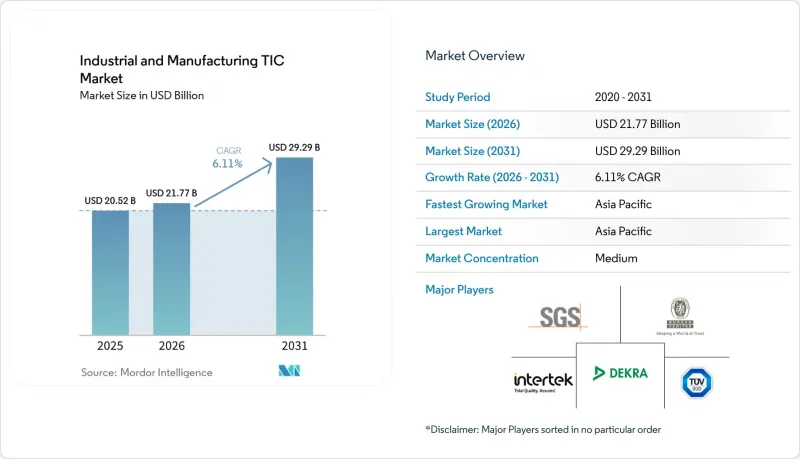
Mordor Intelligence에 의하면, 산업 및 제조 TIC 시장 규모는 2025년 205억 2,000만 달러로 평가되었고, 2026년에는 217억 7,000만 달러로 추정되고, 2031년까지 292억 9,000만 달러에 이를 것으로 예상되며, 2026-2031년 CAGR 6.11%로 성장할 전망입니다.
본 보고서는 서비스 유형별(테스트, 검사, 인증), 조달 형태별(사내 수행, 외부 위탁), 서비스 제공 형태별(온사이트, 오프사이트 및 실험실, 원격 및 디지털), 지역별(북미, 유럽, 아시아태평양, 중동 및 아프리카, 남미)로 분류되어 있습니다. 시장 전망은 금액(달러) 기준으로 제시되어 있습니다.
세계의 산업 및 제조 TIC 시장 동향 및 인사이트
전 세계 제품 안전 및 공정 규정 준수 규제의 강화
적합성 평가의 의무화는 산업 공급망 전반에 걸쳐 표준으로 자리 잡고 있으며, 이러한 변화는 산업 및 제조 TIC 시장에 있어 여전히 가장 큰 구조적 수요 요인으로 작용하고 있습니다. EU의 '지속 가능한 제품을 위한 친환경 설계 규정'은 라이프사이클 검증에 대한 기대를 높여주었습니다. 한편, WTO의 '무역 기술 장벽(TBT)' 프레임워크는 수출업체에게 여러 관할 구역에 걸친 인증의 가치를 높여주는 상호인정협정을 지속적으로 지원하고 있습니다. 이러한 변화는 자동차 및 산업용 제어 부문에서 두드러지게 나타납니다. 여기서는 ISO 26262나 IEC 61508과 같은 규격이 고도로 전자 제어되는 유닛에 의존하는 소프트웨어를 많이 사용하는 시스템이나 안전 기능에 적용됨에 따라, 이에 따른 독립적인 평가의 필요성이 높아지고 있습니다. 한때는 사내 검증에 크게 의존하던 독일과 일본의 Tier 1 공급업체들도, 안전 무결성 수준(SIL) 관련 부품 및 관련 문서 패키지에 대해 감사인이 독립적인 검증을 요구할 경우, 인증을 받은 제3자 기관을 활용하고 있습니다. 이러한 의무가 OEM에서 부품 공급업체로 하류로 이전됨에 따라, 산업 및 제조 TIC(기술적 적합성 확인) 시장은 더욱 폭넓은 고객 기반과 더 대규모의 지속적인 업무량을 확보하고 있습니다. 이것이 바로 인증된 테스트 및 검증 서비스가 초기 규정 준수 구매자보다 공급망의 더 깊은 단계까지 점차 확산되고 있는 이유입니다.
인더스트리 4.0과 커넥티드 기계에 대한 검증 요구
IIoT 센서, 자율형 로봇, 엣지 컴퓨팅 컨트롤러의 보급으로 인해, 기존 검사소 프로토콜로는 충분히 대응할 수 없는 검증 업무가 발생하고 있습니다. 현재 커넥티드 기계에는 전자기 호환성 검사, 기계적 안전성 점검, 사이버 보안 평가, 프로토콜 상호운용성 검토, 실제 가동 조건 하에서의 신뢰성 검증이 필요하며, 이로 인해 검사 시간과 검사 기관의 요건 모두 확대되고 있습니다. OPC 재단은 2026년 3월, OPC UA 버전 1.03에 대한 지원을 2026년 말로 종료한다고 발표했습니다. 이에 따라 제조업체는 인증된 상호운용성을 유지하기 위해 버전 1.05를 기반으로 한 검증을 수행해야 합니다. 이러한 프로토콜 전환은 재인증 수요를 창출하여, 산업 및 제조 TIC 시장에서 보다 지속 가능한 서비스 모델을 뒷받침하게 될 것입니다. MISTRAS 그룹은 2026년 5월, 2026년 연간 매출 전망치를 7억 3,000만-7억 5,000만 달러로 재확인했습니다. 한편, 이 회사의 항공우주 및 방위 부문 매출은 2026년 1분기에 전년 동기 대비 35.5% 증가했으며, 이는 디지털 통합 장비에 대한 복잡한 검증 작업에 대한 수요가 증가하고 있음을 시사합니다. 디지털 자산 운용 사업자들이 일회성 검사 이벤트가 아닌 지속적인 상태 가시화를 점점 더 요구하게 됨에 따라, 분석과 물리적 검사를 결합한 서비스 제공업체는 이러한 예산을 확보하는 데 있어 더 유리한 입장에 있습니다.
중소 제조업체가 여러 기준을 준수하는 데 드는 높은 비용
국내 및 국제적인 규정 준수 제도가 중복되어 있어, 대기업에 비해 중소 제조업체의 부담이 커서 산업 및 제조 부문의 TIC 시장 진출이 제한되고 있습니다. 북미, 유럽, 아시아태평양에 판매되는 단일 제품이라 하더라도, 여전히 지역별 인증 절차, 서류 작성, 갱신 주기가 필요한 경우가 있으며, 이로 인해 비용과 지연이 모두 발생합니다. ISO/IEC 17050에 따른 자체 선언 방식은 규제 대상인 많은 범주에서 여전히 지정된 제3자 기관이 필요하기 때문에 부분적인 완화 수준에 그칩니다. 즉, 비용이 가장 높은 부문은 소규모 수출업체에게 여전히 유연성이 가장 낮은 부문이 되는 경향이 있습니다. 단일 계약 하에 여러 시장용 프로그램을 묶어 제공할 수 있는 TIC 공급업체는 이러한 마찰을 완화할 수 있지만, 근본적인 수요 제약으로 인해 산업 및 제조 부문의 TIC 시장 전반에 걸친 보급은 여전히 더딘 상태입니다.
부문별 분석
2025년, 산업 및 제조 TIC 시장에서 검사는 60.81%의 점유율을 유지했으며, 서비스 유형별 전체를 통틀어 여전히 확실한 수익의 주축이 되었습니다. 검사 범위는 구조 재료의 파괴 기계 검사부터 용접부의 비파괴 검사, 제어 시스템의 전자기 호환성(EMC) 점검, 커넥티드 기기의 펌웨어 검증에 이르기까지 매우 광범위합니다. 이러한 광범위한 적용 범위로 인해 산업 및 제조 TIC 시장은 검사와 밀접하게 연결되어 있습니다. 이는 거의 모든 제품 개발 및 생산 단계에서 성능, 안전성, 신뢰성 기준이 충족되고 있다는 증거가 여전히 필요하기 때문입니다. 검사는 자본 집약적 부문에서 산업 사업자들이 가동 중인 자산의 건전성 평가, 플랜트 감사, 공장 점검을 지속적으로 필요로 하고 있기 때문에 여전히 서비스 유형별 순위에서 2위를 차지하고 있습니다. 인증 사업의 매출 규모는 비교적 작았으나, 서비스 구성이 일회성 검증에서 지속적인 보증 프로그램으로 전환됨에 따라 2031년까지 연평균 성장률(CAGR) 6.25%로 성장할 것으로 전망됩니다. SGS는 세계 최초로 ISO/IEC 42001 AI 경영시스템 인증을 획득한 기관이 되었으며, AI 보증이 일회성 자문 업무에 그치지 않고 지속적이고 인증 가능한 서비스 라인으로 전환되고 있음을 보여주었습니다.
지속가능성 보고서, 디지털 제품 여권 프레임워크, 에너지 관리 시스템, AI 거버넌스 요건 등이 제조 업무 전반에 새로운 감사 범위를 창출함에 따라, 인증의 길은 점차 넓어지고 있습니다. 뷰로 베리타스는 자사의 산업 제품 인증 서비스가 2025 회계연도 전체와 2026년 1분기 모두에서 높은 한 자릿수대의 유기적 매출 성장을 달성했다고 밝혔으며, 철도 시스템 평가와 압력 용기 인증이 가장 큰 기여 요인 중 하나라고 전했습니다. 이러한 추세는 새로운 보증 범주가 지속적 수요를 창출하고 있다는 점에서 산업 및 제조 TIC 시장이 더 이상 기존의 안전 인증에만 의해 주도되고 있는 것은 아니라는 견해를 뒷받침하고 있습니다. 따라서 검사는 여전히 산업 및 제조 TIC 시장에서 가장 큰 비중을 차지하고 있지만, 자가 선언의 여지가 줄어들고 공식적인 제3자 기관이 제공하는 증거의 가치가 높아짐에 따라 인증은 꾸준히 입지를 다지고 있습니다. 바로 이러한 균형 덕분에 주요 공급업체들이 검사소 인프라와 고부가가치 인증 포트폴리오 모두에 지속적으로 투자하고 있는 것입니다.
지역별 분석
아시아태평양은 2025년에 산업 및 제조 TIC 시장 점유율의 45.63%를 차지한 것으로 평가되었으며, 2031년까지 연평균 성장률(CAGR) 6.94%로 확대될 것으로 전망되어, 가장 규모가 크고 가장 빠르게 성장하는 지역 블록이 될 것입니다. 국내 생산 증가, 국가 기준의 강화, 수출 관련 규정 준수 요건이 아시아태평양의 산업 및 제조 TIC 시장을 뒷받침하고 있습니다. 중국에서는 CCC 제도와 GB 규격의 지속적인 개정을 통해 강제 인증 대상 제품의 범위가 계속 확대되고 있으며, 정기적인 검사 및 인증에 대한 수요가 유지되고 있습니다. 인도에서는 BIS 인증과 전자기기, 의약품, 첨단 화학 분야에서의 생산 연계형 인센티브 프로그램을 통해 새로운 수요가 창출되고 있습니다. 이는 제조업의 성장을 공식적인 규정 준수 요건과 연계하는 것입니다. 인터텍은 2026년 4월, 아메다바드에 위치한 태양광 발전(PV) 검사소의 자산을 인수하여, 인도의 제조업 및 재생에너지 확대 목표에 부합하는 ISO 17025 인증은 물론 BIS 및 IECEE CB 스킴 인증을 획득한 시설을 설립했습니다.
일본은 정밀 제조 및 전자 산업의 기반을 통해 안정적인 수요를 제공하고 있으며, 품질 요건과 확립된 규격 체계가 공식적인 TIC 지출을 지속적으로 뒷받침하고 있습니다. 한국도 기계 및 에너지 관련 장비에 대한 강제적 적합성 평가 요건이 확대됨에 따라 성장세를 이어가고 있으며, 산업 및 제조 부문의 TIC 시장에서 지역적 역할을 더욱 공고히 하고 있습니다. 유럽은 여전히 규제가 가장 엄격한 지역이며, CE 마킹, REACH, RoHS, 그리고 새로 도입되는 기계 및 사이버 보안 관련 의무로 인해 구조적으로 반복적인 인증 주기가 형성되어 있습니다. 독일은 첨단 엔지니어링 기반과 DEKRA, TUV SUD, TUV Rheinland, TUV NORD와 같은 주요 TIC 본사가 위치한 점을 겸비하고 있다는 점에서 여전히 두드러지며, 이들 기관은 모두 국내 및 국경 간 인증 활동을 지원하고 있습니다. 북미는 전자, 의료기기, 첨단 산업 시스템 분야의 리쇼어링으로 인해 여러 주와 다양한 규격에 걸친 규정 준수 업무가 증가하고 있어, 산업 및 제조 TIC 시장에 있어 여전히 핵심적인 수익 지역으로 자리 잡고 있습니다. SGS는 2026년 1월 ATS 인수를 통해 북미에서의 입지를 대폭 강화했으며, 산업 검사 분야의 폭넓은 역량을 바탕으로 경쟁하는 지역 전문 업체들에 대한 규모 면에서의 진입 장벽을 높였습니다.
중동 및 아프리카와 남미는 여전히 규모는 작지만, 성장세가 두드러지는 산업 및 제조 TIC 시장을 형성하고 있습니다. 사우디아라비아와 아랍에미리트는 산업 다각화 프로그램의 일환으로 강제 적합성 평가 제도를 확대하고 있는 반면, 남아프리카공화국과 이집트는 외국 인증 기관에 대한 의존도를 점진적으로 줄여나갈 수 있는 국내 인증 역량을 구축하고 있습니다. 남미에서는 브라질이 INMETRO를 통해 강제 인증 범위를 지속적으로 확대하고 있으며, 아르헨티나에서는 공식적인 제조 활동의 확대에 따라 산업 안전 검사 수요가 증가하고 있습니다. 이러한 지역에서는 규제 인프라와 인증 네트워크가 성숙되기까지 시간이 걸리기 때문에 장기적인 비즈니스 기회가 기대되지만, 공급망의 다양화와 현지 조달 정책에 힘입어 산업 및 제조 TIC 시장 수요 기반은 꾸준히 확대되고 있습니다.
기타 혜택
- 엑셀 형식 시장 예측(ME) 시트
- 3개월간의 애널리스트 지원
자주 묻는 질문
목차
제1장 서론
제2장 조사 방법
제3장 주요 요약
제4장 시장 구도
제5장 시장 규모 및 성장 예측
제6장 경쟁 구도
제7장 시장 기회 및 향후 전망
AJY 26.07.07According to Mordor Intelligence, the industrial and manufacturing TIC Market size is expected to increase from USD 20.52 billion in 2025 to USD 21.77 billion in 2026 and reach USD 29.29 billion by 2031, growing at a CAGR of 6.11% over 2026-2031.
This report is Segmented by Service Type (Testing, Inspection, and Certification), Sourcing Type (In-House, and Outsourced), Mode of Service Delivery (On-Site, Off-site/Laboratory, and Remote/Digital), and Geography (North America, Europe, Asia-Pacific, Middle East, Africa, and South America). The Market Forecasts are Provided in Terms of Value (USD).
Global Industrial and Manufacturing TIC Market Trends and Insights
Tightening Global Product Safety and Process Compliance Rules
Mandatory conformity assessment has become the baseline across industrial supply chains, and that shift remains the largest structural demand driver for the industrial and manufacturing TIC market. The EU Ecodesign for Sustainable Products Regulation widened lifecycle verification expectations, while the WTO Technical Barriers to Trade framework continues to support mutual recognition arrangements that increase the value of multi-jurisdiction credentials for exporters. The change is visible in automotive and industrial controls, where standards such as ISO 26262 and IEC 61508 are now applied to software-heavy systems and safety functions that depend on advanced electronic control units, thereby expanding the need for independent assessment. Tier-one suppliers in Germany and Japan that once relied more heavily on internal verification now engage accredited third parties when auditors require independent confirmation for safety-integrity-level components and related documentation packages. As these obligations move from OEMs down to component suppliers, the industrial and manufacturing TIC market gains a wider customer base and a larger recurring workload. This is why certified inspection and validation services are reaching deeper into the supply chain than the original compliance buyer.
Industry 4.0 and Connected Machinery Validation Needs
The spread of IIoT sensors, autonomous robotics, and edge-computing controllers has created a validation workload that older laboratory protocols were not built to handle. Connected machinery now needs electromagnetic compatibility tests, mechanical safety checks, cybersecurity assessments, protocol interoperability reviews, and reliability validation under live operating conditions, which extends both testing time and laboratory requirements. The OPC Foundation stated in March 2026 that support for OPC UA version 1.03 will end by year-end 2026, requiring manufacturers to validate against version 1.05 to maintain certified interoperability. That kind of protocol transition creates repeat recertification demand and supports a more continuous service model inside the industrial and manufacturing TIC market. MISTRAS Group reaffirmed full-year 2026 revenue guidance of USD 730 million to USD 750 million in May 2026, while its aerospace and defense segment revenue rose 35.5% year over year in Q1 2026, which points to stronger demand for complex validation work in digitally integrated equipment. Providers that combine analytics with physical inspection are better positioned to win these budgets, as digital asset operators increasingly seek ongoing condition visibility rather than isolated test events.
High Multi-Standard Compliance Cost for Small and Mid-Sized Manufacturers
Overlapping national and international compliance systems create a heavier burden for small and mid-sized manufacturers than for larger firms, limiting their full participation in the industrial and manufacturing TIC market. A single product sold into North America, Europe, and Asia-Pacific may still require separate certification routes, documentation, and renewal cycles, which adds both cost and delay. The self-declaration route under ISO/IEC 17050 provides only partial relief, as many regulated categories still require a designated third party. That means the highest-cost categories often remain the least flexible ones for smaller exporters. TIC providers that can bundle multi-market programs under a single contract can reduce this friction, but the underlying demand constraint still slows broader adoption across the industrial and manufacturing TIC market.
Other drivers and restraints analyzed in the detailed report include:
- EU Machinery Regulation Cybersecurity and AI Conformity Burden
- Rising Outsourcing of Specialist TIC by Mid-Sized Manufacturers
- Shortage of Qualified Inspectors and Advanced Lab Talent
For complete list of drivers and restraints, kindly check the Table Of Contents.
Segment Analysis
Testing retained a 60.81% share of the industrial and manufacturing testing, inspection, and certification (TIC) market in 2025, which kept it as the clear revenue anchor across service types. Testing covers a broad range of work, from destructive mechanical tests on structural materials to non-destructive testing of welds, electromagnetic compatibility checks on control systems, and firmware validation on connected equipment. That breadth keeps the industrial and manufacturing TIC market closely tied to testing, as nearly every product development and production stage still requires evidence that performance, safety, and reliability standards are met. Inspection remained the second-largest service type because industrial operators continue to require in-service asset integrity reviews, plant audits, and factory checks across capital-intensive sectors. Certification was smaller by revenue, but it is projected to grow at a 6.25% CAGR through 2031 as the service mix shifts toward recurring assurance programs rather than single-event validation. SGS became the first organization globally to receive ISO/IEC 42001 AI management system certification, demonstrating that AI assurance is moving toward a recurring, certifiable service line rather than remaining a one-time advisory exercise.
The certification path is widening because sustainability reporting, digital product passport frameworks, energy management systems, and AI governance requirements now create new audit scopes across manufacturing operations. Bureau Veritas stated that its industrial products certification services delivered high single-digit organic revenue growth in both full-year 2025 and Q1 2026, with railway systems assessment and pressure vessel certification among the strongest contributors. That pattern supports the view that the industrial and manufacturing TIC market is no longer driven solely by legacy safety certification, as newer assurance categories are generating fresh, recurring demand. Testing, therefore, remains the largest part of the industrial and manufacturing TIC market, while certification is steadily gaining ground as self-declaration routes narrow and formal third-party evidence becomes more valuable. This balance explains why leading providers continue to invest in both laboratory infrastructure and higher-value certification portfolios.
Complete Report Scope:
- By Service Type
- Testing
- Inspection
- Certification
- By Sourcing Type
- In-house
- Outsourced
- By Mode of Service Delivery
- On-site
- Off-site / Laboratory
- Remote / Digital
- By Geography
- North America
- United States
- Canada
- Mexico
- Europe
- United Kingdom
- Germany
- France
- Italy
- Rest of Europe
- Asia-Pacific
- China
- Japan
- India
- South Korea
- Rest of Asia-Pacific
- Middle East
- Saudi Arabia
- United Arab Emirates
- Turkey
- Rest of Middle East
- Africa
- South Africa
- Egypt
- Rest of Africa
- South America
- Brazil
- Argentina
- Rest of South America
- North America
Geography Analysis
Asia-Pacific held 45.63% of the industrial and manufacturing TIC market share in 2025 and is expected to expand at a 6.94% CAGR through 2031, making it both the largest and fastest-growing regional block. Rising domestic production, stricter national standards, and export-linked compliance needs support the industrial and manufacturing TIC market in Asia-Pacific. China continues to expand the scope of products subject to mandatory certification through the CCC system and ongoing updates to GB standards, sustaining recurring testing and certification demand. India is adding new demand through BIS certification and through production-linked incentive programs in electronics, pharmaceuticals, and advanced chemistry cells that tie manufacturing growth to formal compliance requirements. Intertek acquired the assets of a solar PV laboratory in Ahmedabad in April 2026, creating an ISO 17025-accredited facility with BIS and IECEE CB Scheme accreditations that align with India's manufacturing and renewable build-out goals.
Japan provides a stable demand through its precision manufacturing and electronics base, where quality requirements and established standards frameworks continue to support formal TIC spending. South Korea is also gaining momentum as mandatory conformity assessment requirements expand for machinery and energy-related equipment, further strengthening the regional role of the industrial and manufacturing TIC market. Europe remains the most regulation-dense region, with CE marking, REACH, RoHS, and incoming machinery and cybersecurity obligations creating a structurally recurring certification cycle. Germany continues to stand out because it combines a deep engineering base with leading TIC headquarters such as DEKRA, TUV SUD, TUV Rheinland, and TUV NORD, all of which support both domestic and cross-border certification activity. North America remains a core revenue region for the industrial and manufacturing TIC market because reshoring in electronics, medical devices, and advanced industrial systems is adding multi-state and multi-standard compliance work. SGS strengthened its North American position materially through the ATS acquisition in January 2026, which raised the scale threshold for regional specialists competing in industrial testing and inspection breadth.
The Middle East, Africa, and South America still represent smaller but developing parts of the industrial and manufacturing TIC market. Saudi Arabia and the United Arab Emirates are expanding mandatory conformity systems as part of industrial diversification programs, while South Africa and Egypt are building national accreditation capacity that should gradually reduce reliance on foreign-accredited bodies. In South America, Brazil continues to expand the scope of compulsory certification through INMETRO, while Argentina's demand for industrial safety inspections is growing alongside formal manufacturing activity. These regions offer a longer-cycle opportunity because regulatory infrastructure and accreditation networks need time to mature, but supply chain diversification and local-content policies are steadily improving the demand base for the industrial and manufacturing TIC market.
- SGS SA
- Bureau Veritas SA
- Intertek Group plc
- DEKRA SE
- TUV SUD AG
- Applus Services, S.A.
- Kiwa N.V.
- TUV Rheinland AG
- LRQA Group Limited
- Element Materials Technology Group Limited
- MISTRAS Group, Inc.
- RINA S.p.A.
- TUV NORD AG
- TUV AUSTRIA HOLDING AG
- DNV Group AS
- Cotecna Inspection SA
- CSA Group Testing & Certification Inc.
- Centre Testing International Group Co., Ltd.
- UL Solutions Inc.
- Socotec Group
- GRG Metrology & Test Group Co., Ltd.
- BSI Group Holdings UK Ltd.
Additional Benefits:
- The market estimate (ME) sheet in Excel format
- 3 months of analyst support
TABLE OF CONTENTS
1 INTRODUCTION
- 1.1 Study Assumptions and Market Definition
- 1.2 Scope of the Study
2 RESEARCH METHODOLOGY
3 EXECUTIVE SUMMARY
4 MARKET LANDSCAPE
- 4.1 Market Overview
- 4.2 Market Drivers
- 4.2.1 Tightening Global Product Safety and Process Compliance Rules
- 4.2.2 Rising Outsourcing of Specialist TIC by Mid-Sized Manufacturers
- 4.2.3 Industry 4.0 and Connected Machinery Validation Needs
- 4.2.4 Sustainability and Circular Economy Certification Demand
- 4.2.5 EU Machinery Regulation Cybersecurity and AI Conformity Burden
- 4.2.6 Carbon and Product Passport Verification Demand in Industrial Supply Chains
- 4.3 Market Restraints
- 4.3.1 High Multi-Standard Compliance Cost for Small and Mid-Sized Manufacturers
- 4.3.2 Shortage of Qualified Inspectors and Advanced Lab Talent
- 4.3.3 Fragmented Acceptance of Remote and Hybrid Inspections Across Accreditation Regimes
- 4.3.4 Liability and Data Integrity Risk in Connected-Asset Testing
- 4.4 Industry Value-Chain Analysis
- 4.5 Regulatory Landscape
- 4.6 Technological Outlook
- 4.7 Impact of Macroeconomic Factors on the Market
- 4.8 Porter's Five Forces Analysis
- 4.8.1 Threat of New Entrants
- 4.8.2 Bargaining Power of Suppliers
- 4.8.3 Bargaining Power of Buyers
- 4.8.4 Threat of Substitutes
- 4.8.5 Competitive Rivalry
5 MARKET SIZE AND GROWTH FORECASTS (VALUE)
- 5.1 By Service Type
- 5.1.1 Testing
- 5.1.2 Inspection
- 5.1.3 Certification
- 5.2 By Sourcing Type
- 5.2.1 In-house
- 5.2.2 Outsourced
- 5.3 By Mode of Service Delivery
- 5.3.1 On-site
- 5.3.2 Off-site / Laboratory
- 5.3.3 Remote / Digital
- 5.4 By Geography
- 5.4.1 North America
- 5.4.1.1 United States
- 5.4.1.2 Canada
- 5.4.1.3 Mexico
- 5.4.2 Europe
- 5.4.2.1 United Kingdom
- 5.4.2.2 Germany
- 5.4.2.3 France
- 5.4.2.4 Italy
- 5.4.2.5 Rest of Europe
- 5.4.3 Asia-Pacific
- 5.4.3.1 China
- 5.4.3.2 Japan
- 5.4.3.3 India
- 5.4.3.4 South Korea
- 5.4.3.5 Rest of Asia-Pacific
- 5.4.4 Middle East
- 5.4.4.1 Saudi Arabia
- 5.4.4.2 United Arab Emirates
- 5.4.4.3 Turkey
- 5.4.4.4 Rest of Middle East
- 5.4.5 Africa
- 5.4.5.1 South Africa
- 5.4.5.2 Egypt
- 5.4.5.3 Rest of Africa
- 5.4.6 South America
- 5.4.6.1 Brazil
- 5.4.6.2 Argentina
- 5.4.6.3 Rest of South America
- 5.4.1 North America
6 COMPETITIVE LANDSCAPE
- 6.1 Market Concentration
- 6.2 Strategic Moves
- 6.3 Market Share Analysis
- 6.4 Company Profiles (includes Global Level Overview, Market Level Overview, Core Segments, Financials as available, Strategic Information, Market Rank/Share, Products and Services, Recent Developments)
- 6.4.1 SGS SA
- 6.4.2 Bureau Veritas SA
- 6.4.3 Intertek Group plc
- 6.4.4 DEKRA SE
- 6.4.5 TUV SUD AG
- 6.4.6 Applus Services, S.A.
- 6.4.7 Kiwa N.V.
- 6.4.8 TUV Rheinland AG
- 6.4.9 LRQA Group Limited
- 6.4.10 Element Materials Technology Group Limited
- 6.4.11 MISTRAS Group, Inc.
- 6.4.12 RINA S.p.A.
- 6.4.13 TUV NORD AG
- 6.4.14 TUV AUSTRIA HOLDING AG
- 6.4.15 DNV Group AS
- 6.4.16 Cotecna Inspection SA
- 6.4.17 CSA Group Testing & Certification Inc.
- 6.4.18 Centre Testing International Group Co., Ltd.
- 6.4.19 UL Solutions Inc.
- 6.4.20 Socotec Group
- 6.4.21 GRG Metrology & Test Group Co., Ltd.
- 6.4.22 BSI Group Holdings UK Ltd.
7 MARKET OPPORTUNITIES AND FUTURE OUTLOOK
- 7.1 White-Space and Unmet-Need Assessment


