

|
시장보고서
상품코드
2072632
몰입형 트레이닝 시장 : 시장 점유율 분석, 업계 동향 및 통계, 성장 예측(2026-2031년)Immersive Training - Market Share Analysis, Industry Trends & Statistics, Growth Forecasts (2026 - 2031) |
||||||
 Mordor Intelligence
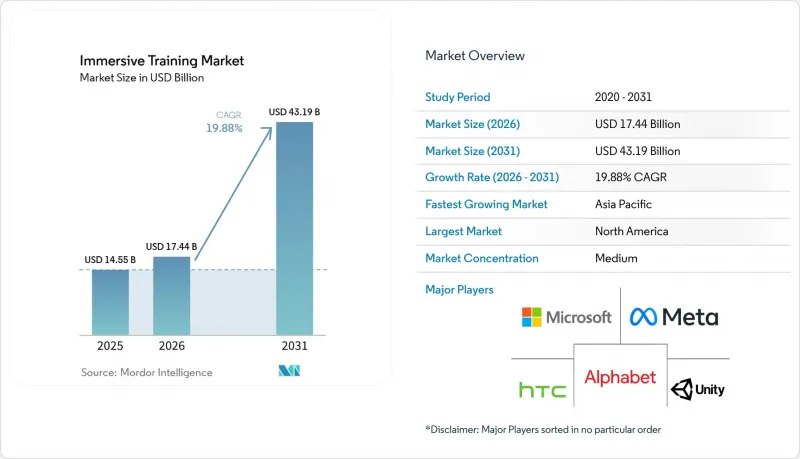
Mordor Intelligence에 의하면, 몰입형 트레이닝 시장 규모는 2026년 174억 4,000만 달러로 추정되고, 2025년 145억 5,000만 달러에서 성장하여 2031년에는 431억 9,000만 달러에 이를 것으로 예측됩니다.
2026-2031년 연평균 성장률(CAGR)은 19.88%가 될 것으로 전망됩니다.
본 보고서는 구성 요소별(하드웨어, 소프트웨어, 서비스), 기술별(VR, AR, MR, XR, 360도 동영상), 산업 부문별(의료, 항공우주 및 방위, 제조, 기타), 도입 형태별(온프레미스, 클라우드 기반), 용도별(시뮬레이션 기반 학습, 기타), 지역별로 분류되어 있습니다. 시장 전망은 금액(달러) 기준으로 제시되어 있습니다.
세계의 몰입형 훈련 시장 동향 및 인사이트
XR을 활용한 원격 근무자의 역량 강화에 대한 기업의 도입 동향
기업들은 학습 관리 시스템에 XR 모듈을 통합함으로써, 원격지에 있는 직원들에게 출장이나 강의실 준비 없이도 실전적인 교육을 제공합니다. 대기업에 따르면, 강사 주도형 모델과 비교했을 때 직원 1인당 교육 비용이 최대 40% 절감되었다고 합니다. 하이브리드 근무 방침에 따라 몰입형 세션을 일반 소비자용 헤드셋, 노트북 또는 모바일 기기에서 실행할 수 있게 되어 도입 장벽이 낮아짐에 따라, 프로그램의 규모 확대가 가속화되고 있습니다. 표준화된 디지털 컨텐츠를 통해 각 거점 간의 기술 수준이 균일하게 유지되며, 관리자는 분석 대시보드를 통해 역량을 실시간으로 추적할 수 있습니다. 이러한 장점 덕분에 몰입형 교육 시장은 일상적인 인재 개발 예산 범위 내에서 주류로 자리 잡고 있습니다.
디지털 트윈을 활용한 시뮬레이션 훈련을 통한 비용 절감
디지털 트윈은 복잡한 설비나 위험한 환경을 재현해 주므로, 직원들은 생산 라인을 중단하지 않고도 학습할 수 있습니다. 자동차 및 전자기기 공장에서는 실습 대신 시뮬레이션을 도입한 결과, 신입 사원 교육 기간 중 기계 가동 중단이 60% 감소했습니다. 가상 공간에서의 반복 연습을 통해 소모품 비용을 절감할 수 있을 뿐만 아니라, 직원의 부상 위험도 줄일 수 있습니다. 실시간 센서 데이터를 통합함으로써 시나리오가 현재의 가동 상황을 정확하게 반영하고, 지도 내용의 관련성을 유지합니다. 기업들은 일반적으로 18개월 이내에 투자 회수를 달성하고 있으며, 이것이 몰입형 훈련 시장의 지속적인 성장을 뒷받침하고 있습니다.
다중 사용자 환경 구축에 따른 고액의 초기 하드웨어 투자
룸 스케일 트레이닝 스위트 한 세트의 비용은 5만-50만 달러에 달하고, 중소기업의 예산을 압박하고 있습니다. 3년 주기의 하드웨어 교체 주기는 지속적인 지출을 초래하며, 추적 장비와 같은 시설 개조는 도입 과정을 더욱 복잡하게 만듭니다. 클라우드 스트리밍을 통해 자본 부담은 일부 경감되지만, 특정 지역의 네트워크 지연이나 대역폭 제한으로 인해 여전히 온프레미스형 장비가 필요하기 때문에 비용을 중시하는 구매자층 사이에서는 몰입형 훈련 시장의 보급이 더딘 양상을 보이고 있습니다.
부문별 분석
기업들이 전문적인 컨텐츠와의 통합이야말로 교육 효과를 높이는 열쇠라는 점을 인식함에 따라, 서비스 매출은 연평균 성장률(CAGR) 21.75%로 증가하며 하드웨어 및 소프트웨어 매출을 앞지르고 있습니다. 2025년에도 하드웨어는 여전히 몰입형 훈련 시장 점유율의 51.68%를 차지했지만, 기업들은 시나리오 설계, 도입 컨설팅, 지속적인 지원에 예산을 할당하고 있습니다. 맞춤형 모듈의 가격은 정확도, 복잡성, 규제 요건에 따라 10만 달러에서 100만 달러 사이입니다. 정기적인 유지보수 비용과 컨텐츠 업데이트 비용을 고려할 때, 서비스에 기인한 몰입형 훈련 시장 규모는 2028년 이후 하드웨어 시장을 추월할 것으로 예측됩니다.
컨텐츠 제작 스튜디오는 클린룸 내 반도체 제조 절차나 비상 대응 훈련 등 산업별 특화된 시나리오에 대한 롱테일 수요의 혜택을 누리고 있습니다. 분석 및 성과 대시보드용 관리형 서비스는 새로운 수익원이 되고 있습니다. 기업들은 여전히 저작 도구나 학습 관리 시스템과의 연동 기능을 필요로 하고 있어 소프트웨어에 대한 수요는 견조한 추세를 보이고 있지만, 플랫폼의 상품화가 진행됨에 따라 그 상대적 점유율은 하락하고 있습니다. 전반적으로, 몰입형 훈련 시장은 단순히 장비를 조달하는 단계에서 종합적이고 성과 중심의 서비스 계약으로 지속적으로 전환되고 있습니다.
기업들이 VR, AR, 혼합현실(MR) 기능을 모두 지원하는 단일 툴체인을 요구하는 가운데, 확장현실(XR) 플랫폼 시장은 연평균 성장률(CAGR) 20.54%를 기록하며 성장하고 있습니다. 2025년에는 외과 수술 및 항공 분야에서 높은 몰입감을 요구하는 추세에 힘입어, 가상현실이 몰입형 훈련 시장 규모의 37.74%를 차지한 것으로 평가되었습니다. 그러나 업무 중 안내 용도로는 AR 오버레이의 인기가 높아지고 있는 반면, 혼합현실(MR)은 복잡한 유지보수 작업을 위해 공간적으로 정확한 홀로그램을 표시하고 있습니다. 통합형 XR 엔진은 통합에 따른 오버헤드를 줄여주며, 개별 스택과 비교했을 때 총 도입 비용을 최대 25% 절감합니다.
360도 동영상은 인터랙티브 시뮬레이션을 도입하는 데 주저하는 조직에게 여전히 진입점 역할을 하며, 인터랙티브 기능을 희생하는 대신 개발 비용을 낮출 수 있습니다. AI 기반의 적응형 컨텐츠가 등장하기 시작하면서, 생체 인증 피드백을 바탕으로 난이도를 조정하고 있습니다. 헤드셋 기능이 통합되고 라이선싱 모델이 간소화됨에 따라, 몰입형 훈련 시장은 하드웨어에 구애받지 않고 이용 사례 간에 유연하게 전환할 수 있는 플랫폼 독립적인 XR 런타임을 중심으로 통합되어 가고 있습니다.
지역별 분석
북미는 얼리 어답터의 존재, 성숙한 클라우드 인프라, 미국 국방부의 12억 달러 규모의 몰입형 이니셔티브 등 정부 예산 배분 덕분에 2025년 매출의 38.62%를 차지했습니다. 광대역 보급률이 높기 때문에 기업은 지연을 최소화하면서 다중 사용자 세션을 스트리밍할 수 있습니다. 캐나다의 일부 주에서는 VR을 활용한 외과 수술 검증이 의무화되어 있으며, 멕시코의 자동차 공장에서는 조립 교육에 XR이 활용되고 있습니다. 기존 기업 소프트웨어 생태계와의 통합을 통해 대규모 구매자의 진입 장벽이 낮아지면서, 북미는 몰입형 교육 시장의 선두를 계속 유지하고 있습니다.
아시아태평양은 2031년까지의 연평균 성장률(CAGR)이 21.12%로 가장 높은 성장세를 기록할 전망입니다. 중국의 제조업체들은 정부의 디지털화 보조금 지원을 바탕으로 디지털 트윈을 도입하여 가동 중단 시간과 품질 결함을 줄이고 있습니다. 일본의 자동차 제조업체들은 정밀한 토크 조정 작업에 혼합현실(MR)을 도입하고 있으며, 한국의 반도체 제조 공장에서는 서브미크론 리소그래피 장비의 유지보수 시 AR 오버레이를 활용하고 있습니다. 인도의 IT 서비스 산업은 저비용 개발 인력을 활용하여 전 세계 고객에게 비용 대비 효과가 높은 몰입형 컨텐츠를 제공합니다. 5G의 급속한 보급과 크로스보더 클라우드의 확대로 인해, 기존 연결 방식의 장벽이 해소되면서 몰입형 교육 시장 솔루션의 보다 광범위한 도입이 가능해졌습니다.
유럽에서는 조직 차원의 표준화된 역량 검증을 촉진하는 엄격한 안전 및 데이터 개인정보 보호 규제의 뒷받침에 힘입어 꾸준한 진전이 나타나고 있습니다. 독일의 '인더스트리 4.0' 구상에서는 XR과 실시간 생산 데이터를 융합하고 있으며, 한편 영국의 국민보건서비스(NHS)에서는 VR을 활용한 돌봄 의무 프로그램의 실험이 진행되고 있습니다. 프랑스의 항공우주 클러스터에서는 조종사의 전환 기간을 단축하기 위해 햅틱 기능을 갖춘 비행 갑판 시뮬레이터를 도입하고 있습니다. GDPR(EU 개인정보보호규정)(일반 데이터 보호 규정)의 영향으로 플랫폼 설계에서는 기기 내 암호화 및 익명화된 분석이 우선시되고 있으며, 이러한 규정 준수에 대한 집중이 개인정보 보호가 중시되는 부문에서 유럽 공급업체들이 유리한 계약을 체결하는 기반이 되고 있습니다. 이러한 지역별 동향이 맞물리면서, 몰입형 훈련 시장에는 균형 잡힌 세계적 전망이 펼쳐지고 있습니다.
기타 혜택
- 엑셀 형식 시장 예측(ME) 시트
- 3개월간의 애널리스트 지원
자주 묻는 질문
목차
제1장 서론
제2장 조사 방법
제3장 주요 요약
제4장 시장 구도
제5장 시장 규모 및 성장 예측
제6장 경쟁 구도
제7장 시장 기회 및 향후 전망
AJY 26.07.07According to Mordor Intelligence, immersive training market size in 2026 is estimated at USD 17.44 billion, growing from 2025 value of USD 14.55 billion with 2031 projections showing USD 43.19 billion, growing at 19.88% CAGR over 2026-2031.
This report is Segmented by Component (Hardware, Software, and Services), Technology (VR, AR, MR, XR, and 360-Degree Video), Industry Verticals (Healthcare, Aerospace and Defense, Manufacturing, and More), Deployment Mode (On-Premises, and Cloud-Based), Application (Simulation-Based Learning, and More), and Geography. The Market Forecasts are Provided in Terms of Value (USD).
Global Immersive Training Market Trends and Insights
Enterprise Adoption of XR-Based Remote Workforce Upskilling
Enterprises embed XR modules into learning management systems to give dispersed staff hands-on practice without travel or classroom setup. Large employers report up to 40% reductions in per-employee training expense versus instructor-led models. Hybrid work policies accelerate program scale because immersive sessions run on consumer-grade headsets, laptops, or mobiles, lifting adoption barriers. Standardized digital content keeps skill quality uniform across sites, and analytics dashboards let managers track competence in real time. These benefits push the immersive training market toward mainstream use within routine workforce development budgets.
Cost Reduction Through Digital-Twin Simulated Training
Digital twins recreate complex equipment and hazardous environments, so staff learn without shutting down production lines. Automotive and electronics factories record 60% fewer machine stoppages during onboarding cycles when simulations replace real-world practice. Repetition in virtual space eliminates consumable materials costs and mitigates worker injury risk. Integrating live sensor data ensures scenarios mirror current operating conditions, keeping instruction relevant. Enterprises typically realize payback inside 18 months, feeding sustained growth in the immersive training market.
High Upfront Hardware CapEx for Multi-User Installations
Complete room-scale training suites cost between USD 50,000 and USD 500,000, straining budgets of small enterprises. Hardware refresh cycles every three years add repeat expense, while facility retrofits such as tracking rigs increase complexity. Cloud streaming mitigates some capital load, yet network latency and bandwidth limits in certain regions still necessitate on-premises gear, slowing the immersive training market rollout among cost-sensitive buyers.
Other drivers and restraints analyzed in the detailed report include:
- Regulatory Push for Surgical Competence Validation via VR
- Cloud Streaming of Immersive Content Enabling BYOD Training
- Persistent Motion Sickness and User Comfort Issues
For complete list of drivers and restraints, kindly check the Table Of Contents.
Segment Analysis
Services revenue grows at 21.75% CAGR, outpacing hardware and software as enterprises realize that expert content and integration drive training impact. In 2025, hardware still controlled 51.68% of immersive training market share, but enterprises redirect budgets toward scenario design, deployment consulting, and ongoing support. Custom modules range from USD 100,000 to USD 1 million depending on fidelity, complexity, and regulatory requirements. The immersive training market size attributable to services is projected to overtake hardware after 2028, given recurring maintenance and content refresh fees.
Content creation studios benefit from long-tail demand for vertical-specific scenarios such as clean-room semiconductor procedures or emergency response drills. Managed services for analytics and performance dashboards add incremental revenue streams. Software retains steady demand because enterprises still require authoring tools and learning management connectors, yet its relative share declines as platform commoditization sets in. Overall, the immersive training market continues a pivot from device procurement toward holistic outcome-oriented service engagements.
Extended reality platforms grow at 20.54% CAGR as enterprises seek single toolchains that handle VR, AR, and mixed reality functions. Virtual reality owns 37.74% of the immersive training market size in 2025 owing to high-immersion requirements in surgery and aviation. However, AR overlays gain popularity for on-the-job guidance, while mixed reality provides spatially precise holograms for complex maintenance tasks. Unified XR engines reduce integration overhead, cutting total deployment cost by up to 25% when compared with discrete stacks.
360-degree video remains a gateway for organizations hesitant about interactable simulations, offering lower development overhead at the expense of interactivity. AI-driven adaptive content begins to surface, tailoring difficulty based on biometric feedback. As headset capabilities converge and licensing models simplify, the immersive training market aligns around agnostic XR runtimes that can flex between use cases without hardware lock-in.
Complete Report Scope:
- By Component
- Hardware
- VR Headsets
- AR Glasses
- Haptic Feedback Devices
- Motion Sensors and Trackers
- Wearables and Accessories
- Software
- Learning Management Systems (LMS)
- Simulation Software
- Content Management Systems
- Customized Training Content
- Services
- Content Development
- Integration and Deployment
- Support and Maintenance
- Consulting and Training Services
- Hardware
- By Technology
- Virtual Reality (VR)
- Augmented Reality (AR)
- Mixed Reality (MR)
- Extended Reality (XR)
- 360-Degree Video Training
- Others Technology (AI-Enabled Immersive Platforms, Haptic Simulations)
- By Industry Vertical Use
- Healthcare
- Surgical Training
- Patient Care Simulations
- Aerospace and Defense
- Combat Simulations
- Mission Planning
- Manufacturing
- Equipment Training
- Safety Drills
- Automotive
- Education and Academia
- Media and Entertainment
- Retail and E-commerce
- Corporate / Enterprise Training
- Other Automotive Uses (Energy, Construction, Logistics)
- Healthcare
- By Deployment Mode
- On-Premises Deployment
- Cloud-Based Deployment
- By Application
- Simulation-Based Learning
- Interactive Learning
- Virtual Instructor-Led Training (VILT)
- Gamification
- Soft Skills Training
- Technical Skills Training
- Compliance Training
- By Geography
- North America
- United States
- Canada
- Mexico
- Europe
- United Kingdom
- Germany
- France
- Italy
- Rest of Europe
- Asia-Pacific
- China
- Japan
- India
- South Korea
- Rest of Asia-Pacific
- Middle East
- Israel
- Saudi Arabia
- United Arab Emirates
- Turkey
- Rest of Middle East
- Africa
- South Africa
- Egypt
- Rest of Africa
- South America
- Brazil
- Argentina
- Rest of South America
- North America
Geography Analysis
North America generated 38.62% of 2025 revenues thanks to early adopters, mature cloud infrastructure, and government budget allocations such as the U.S. Department of Defense USD 1.2 billion immersive initiative. High broadband penetration lets enterprises stream multi-user sessions with minimal latency. Canada mandates VR surgical validation in select provinces, while Mexico's automotive plants use XR for assembly training. Integration with established enterprise software ecosystems lowers friction for large buyers, keeping North America at the forefront of the immersive training market.
Asia-Pacific records the fastest CAGR at 21.12% through 2031. Chinese manufacturers, supported by state digitization subsidies, deploy digital twins to cut downtime and quality defects. Japanese automakers integrate mixed reality into precision torque procedures, and South Korean semiconductor fabs rely on AR overlays during sub-micron lithography maintenance. India's IT services sector supplies cost-effective immersive content to global clients, leveraging low-cost development talent. Rapid 5G rollout and cross-border cloud expansions remove historical connectivity hurdles, enabling broader uptake of immersive training market solutions.
Europe experiences steady progress, driven by stringent safety and data privacy regulations that push organizations toward standardized competency validation. Germany's Industry 4.0 agenda merges XR with real-time production data, while the United Kingdom NHS experiments with VR duty-of-care programs. France's aerospace cluster adopts haptic flight deck simulators to shorten pilot conversion times. GDPR influences platform design to prioritize on-device encryption and anonymized analytics, and this compliance focus positions European vendors for premium contracts in privacy-sensitive domains. Collectively, regional dynamics create a balanced global outlook for the immersive training market.
- Microsoft Corporation
- Meta Platforms, Inc.
- Alphabet Inc. (Google LLC)
- HTC Corporation
- Samsung Electronics Co., Ltd.
- Lenovo Group Limited
- Unity Technologies, Inc.
- PTC Inc.
- Dassault Systemes SE
- CAE Inc.
- Boeing Company
- Lockheed Martin Corporation
- BAE Systems plc
- Honeywell International Inc.
- Siemens AG
- IBM Corporation
- VirtaMed AG
- Strivr Labs, Inc.
- EON Reality, Inc.
- Axon Enterprise, Inc. (Focal X)
Additional Benefits:
- The market estimate (ME) sheet in Excel format
- 3 months of analyst support
TABLE OF CONTENTS
1 INTRODUCTION
- 1.1 Study Assumptions and Market Definition
- 1.2 Scope of the Study
2 RESEARCH METHODOLOGY
3 EXECUTIVE SUMMARY
4 MARKET LANDSCAPE
- 4.1 Market Overview
- 4.2 Market Drivers
- 4.2.1 Enterprise Adoption of XR-Based Remote Workforce Upskilling
- 4.2.2 Cost Reduction Through Digital-Twin Simulated Training
- 4.2.3 Regulatory Push for Surgical Competence Validation Via VR
- 4.2.4 Rise of Defense Metaverse Funding Pipelines
- 4.2.5 Cloud Streaming of Immersive Content Enabling BYOD Training
- 4.2.6 Neuroadaptive Feedback Enhancing Learning Retention Metrics
- 4.3 Market Restraints
- 4.3.1 High Upfront Hardware CapEx for Multi-User Installations
- 4.3.2 Persistent Motion Sickness and User Comfort Issues
- 4.3.3 Data Privacy Concerns in Biometric Telemetry Capture
- 4.3.4 Lack of Instructional Design Standards for Immersive Assessments
- 4.4 Value-Chain Analysis
- 4.5 Regulatory Landscape
- 4.6 Technological Outlook
- 4.7 Porter's Five Forces Analysis
- 4.7.1 Threat of New Entrants
- 4.7.2 Bargaining Power of Suppliers
- 4.7.3 Bargaining Power of Buyers
- 4.7.4 Threat of Substitutes
- 4.7.5 Competitive Rivalry
5 MARKET SIZE AND GROWTH FORECASTS (VALUE)
- 5.1 By Component
- 5.1.1 Hardware
- 5.1.1.1 VR Headsets
- 5.1.1.2 AR Glasses
- 5.1.1.3 Haptic Feedback Devices
- 5.1.1.4 Motion Sensors and Trackers
- 5.1.1.5 Wearables and Accessories
- 5.1.2 Software
- 5.1.2.1 Learning Management Systems (LMS)
- 5.1.2.2 Simulation Software
- 5.1.2.3 Content Management Systems
- 5.1.2.4 Customized Training Content
- 5.1.3 Services
- 5.1.3.1 Content Development
- 5.1.3.2 Integration and Deployment
- 5.1.3.3 Support and Maintenance
- 5.1.3.4 Consulting and Training Services
- 5.1.1 Hardware
- 5.2 By Technology
- 5.2.1 Virtual Reality (VR)
- 5.2.2 Augmented Reality (AR)
- 5.2.3 Mixed Reality (MR)
- 5.2.4 Extended Reality (XR)
- 5.2.5 360-Degree Video Training
- 5.2.6 Others Technology (AI-Enabled Immersive Platforms, Haptic Simulations)
- 5.3 By Industry Vertical Use
- 5.3.1 Healthcare
- 5.3.1.1 Surgical Training
- 5.3.1.2 Patient Care Simulations
- 5.3.2 Aerospace and Defense
- 5.3.2.1 Combat Simulations
- 5.3.2.2 Mission Planning
- 5.3.3 Manufacturing
- 5.3.3.1 Equipment Training
- 5.3.3.2 Safety Drills
- 5.3.4 Automotive
- 5.3.5 Education and Academia
- 5.3.6 Media and Entertainment
- 5.3.7 Retail and E-commerce
- 5.3.8 Corporate / Enterprise Training
- 5.3.9 Other Automotive Uses (Energy, Construction, Logistics)
- 5.3.1 Healthcare
- 5.4 By Deployment Mode
- 5.4.1 On-Premises Deployment
- 5.4.2 Cloud-Based Deployment
- 5.5 By Application
- 5.5.1 Simulation-Based Learning
- 5.5.2 Interactive Learning
- 5.5.3 Virtual Instructor-Led Training (VILT)
- 5.5.4 Gamification
- 5.5.5 Soft Skills Training
- 5.5.6 Technical Skills Training
- 5.5.7 Compliance Training
- 5.6 By Geography
- 5.6.1 North America
- 5.6.1.1 United States
- 5.6.1.2 Canada
- 5.6.1.3 Mexico
- 5.6.2 Europe
- 5.6.2.1 United Kingdom
- 5.6.2.2 Germany
- 5.6.2.3 France
- 5.6.2.4 Italy
- 5.6.2.5 Rest of Europe
- 5.6.3 Asia-Pacific
- 5.6.3.1 China
- 5.6.3.2 Japan
- 5.6.3.3 India
- 5.6.3.4 South Korea
- 5.6.3.5 Rest of Asia-Pacific
- 5.6.4 Middle East
- 5.6.4.1 Israel
- 5.6.4.2 Saudi Arabia
- 5.6.4.3 United Arab Emirates
- 5.6.4.4 Turkey
- 5.6.4.5 Rest of Middle East
- 5.6.5 Africa
- 5.6.5.1 South Africa
- 5.6.5.2 Egypt
- 5.6.5.3 Rest of Africa
- 5.6.6 South America
- 5.6.6.1 Brazil
- 5.6.6.2 Argentina
- 5.6.6.3 Rest of South America
- 5.6.1 North America
6 COMPETITIVE LANDSCAPE
- 6.1 Market Concentration
- 6.2 Strategic Moves
- 6.3 Market Share Analysis
- 6.4 Company Profiles (includes Global level Overview, Market level overview, Core Segments, Financials as available, Strategic Information, Market Rank/Share for key companies, Products and Services, and Recent Developments)
- 6.4.1 Microsoft Corporation
- 6.4.2 Meta Platforms, Inc.
- 6.4.3 Alphabet Inc. (Google LLC)
- 6.4.4 HTC Corporation
- 6.4.5 Samsung Electronics Co., Ltd.
- 6.4.6 Lenovo Group Limited
- 6.4.7 Unity Technologies, Inc.
- 6.4.8 PTC Inc.
- 6.4.9 Dassault Systemes SE
- 6.4.10 CAE Inc.
- 6.4.11 Boeing Company
- 6.4.12 Lockheed Martin Corporation
- 6.4.13 BAE Systems plc
- 6.4.14 Honeywell International Inc.
- 6.4.15 Siemens AG
- 6.4.16 IBM Corporation
- 6.4.17 VirtaMed AG
- 6.4.18 Strivr Labs, Inc.
- 6.4.19 EON Reality, Inc.
- 6.4.20 Axon Enterprise, Inc. (Focal X)
7 MARKET OPPORTUNITIES AND FUTURE OUTLOOK
- 7.1 White-Space and Unmet-Need Assessment


