

|
시장보고서
상품코드
2072661
미국의 코어 뱅킹 소프트웨어 시장 : 시장 점유율 분석, 업계 동향 및 통계, 성장 예측(2026-2031년)United States Core Banking Software - Market Share Analysis, Industry Trends & Statistics, Growth Forecasts (2026 - 2031) |
||||||
 Mordor Intelligence
Mordor Intelligence에 의하면, 미국의 코어 뱅킹 소프트웨어 시장 규모는 2025년에 58억 8,000만 달러로 평가되었고, 2026년 66억 9,000만 달러로 평가되었고, 2031년까지 132억 4,000만 달러에 이를 것으로 예측되며, 2026-2031년 예측 기간 CAGR은 14.63%를 나타낼 전망입니다.
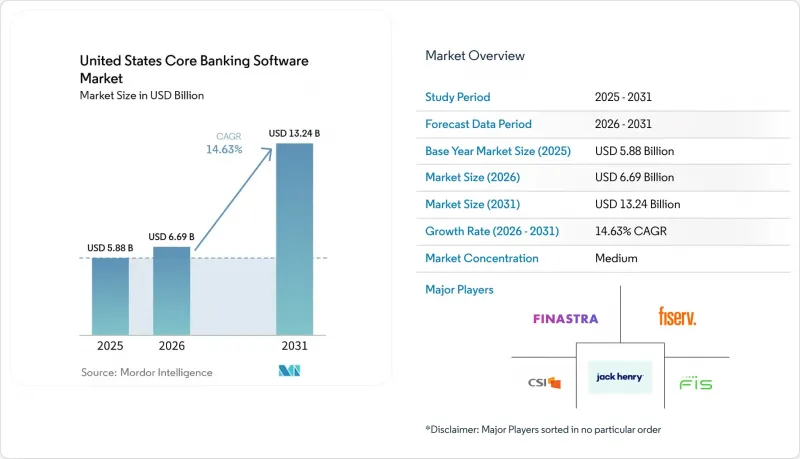
본 보고서는 구성 요소별(솔루션 및 서비스), 도입 형태별(클라우드, 온프레미스, 하이브리드), 최종 사용자별(은행, 비은행 금융기관, 기타(핀테크 기업 및 결제 기관))로 분류되어 있습니다. 시장 전망은 금액(달러) 기준으로 제시되어 있습니다.
미국의 코어 뱅킹 소프트웨어 시장 동향 및 인사이트
클라우드 네이티브로의 전환이 비용 절감과 릴리스 주기 단축을 가져오고 있습니다.
클라우드 네이티브 아키텍처 덕분에 릴리스 주기가 분기 단위에서 수주 단위로 단축되었으며, 이러한 속도의 차이는 여전히 모놀리식 핵심 시스템을 운영하고 있는 은행들에게 상업적인 불리함으로 작용하고 있습니다. 미국 은행은 2026년 5월, 약 140만 개 기업을 지원하는 결제 처리, 자산 운용 및 상업 은행 업무 용도 분야에서 AWS와의 제휴를 확대했습니다. 이는 현대화가 더 이상 주변 시스템에 그치지 않고, 미션 크리티컬한 워크로드까지 확대되고 있음을 보여줍니다. 피플스 은행은 2025년 9월, 최신 클라우드 네이티브 코어로의 전환을 완료했습니다. 예정보다 하루 빨리 작업을 완료하고, 24시간 이내에 1만 9,000명 이상의 고객을 온라인 뱅킹에 재등록시켰습니다. 이는 지역 금융기관이 업무에 미치는 영향을 최소화하며 전환을 실행한 구체적인 사례가 되었습니다. 이러한 사례들은 클라우드 전환이 더 이상 시범 사업에 국한되지 않음을 보여줍니다. 전국 규모의 금융기관이든 지역 금융기관이든, 클라우드 전환을 통해 운영 모델과 제공 일정을 새롭게 정비하고 있기 때문입니다. 또한, 종량제 기반 인프라는 오랫동안 운영되어 온 메인프레임 환경에 존재하던 과도한 고정 비용을 절감함으로써 비용 구조를 혁신합니다. 미국의 코어 뱅킹 소프트웨어 시장에서는 출시 기간 단축과 비용 가시성 제고가 결합됨에 따라, 전환 시기는 단순한 백오피스 차원의 기술적 결정 사항이 아니라 경쟁 전략의 일환으로 자리매김하고 있습니다.
FedNow와 RTP 도입이 실시간 코어 시스템의 업그레이드 촉진
실시간 결제의 성장은 많은 시스템 업데이트 예산에서 예상했던 것보다 빠른 속도로 진행되고 있으며, 거래 수신 및 전송의 실시간화 과정에서 발생하는 격차가 배치 처리 중심의 핵심 설계의 약점을 드러내고 있습니다. FedNow는 2025년에 8,500억 달러 이상을 처리했으며, 2026년 4월까지 네트워크에 참여한 금융기관 수는 약 1,700곳에 달했습니다. 이는 규모가 서로 다른 은행들에서 업무 기준이 얼마나 급속히 변화했는지를 보여줍니다. 또한, RTP 네트워크는 2025년 2월 거래 한도를 100만 달러에서 1,000만 달러로 상향 조정함으로써, 실시간 원장 가시화와 신속한 대조가 필요한 상업 및 재무 분야의 활용 사례를 확대했습니다. 메트로폴리탄 커머셜 뱅크는 2026년 2월, 기존 ACH 메인프레임의 운영을 종료하고 Finzly사의 클라우드 네이티브 및 API 우선 결제 플랫폼으로 전환했습니다. 이는 완전한 폐지가 가능하며, 하이브리드 방식의 잠정 조치만이 유일한 해결책은 아니라는 점을 보여줍니다. 실시간 결제 처리량이 증가함에 따라, 여전히 일괄 처리를 통한 원장 갱신에 의존하고 있는 은행들은 결제 처리, 예외 처리 및 고객 대응 측면에서 운영상의 부담이 커지고 있습니다. 미국의 코어 뱅킹 소프트웨어 시장에서 실시간 대응 준비 상황은 단순한 결제 시스템의 업그레이드가 아니라, 코어 시스템 교체 시기와 밀접하게 연계되어 있습니다.
지역 은행의 전환 위험과 레거시 시스템 통합의 복잡성
이전 위험이 가장 심각한 곳은 자산 규모가 10억 달러에서 500억 달러인 지역 금융기관입니다. 이러한 금융기관에서는 업무의 복잡성이 높은 반면, IT 규모는 여전히 제한적입니다. 2025년 업계 조사에 따르면, 은행의 35%가 자사의 핵심 프로세서에 불만을 가지고 있으며, 19%는 다음 업데이트 시기에 시스템을 교체할 가능성이 높은 것으로 나타났습니다. 이는 실행이 어려운 상황에서도 환승 수요가 존재함을 보여줍니다. 과제는 대개 핵심 시스템 그 자체를 넘어선 곳에 있습니다. 왜냐하면 은행은 시스템 전환을 실시하기 전에, 결제, 재무, 컴플라이언스, 카드, 디지털 채널에 걸쳐 있는 30-50개, 혹은 그 이상의 주변 시스템을 재매핑해야 하는 경우가 많기 때문입니다. 또한, 레거시 환경에는 수년에 걸쳐 문서화되지 않은 데이터 변환이 축적되어 있으며, 이러한 문제는 일정이 이미 촉박한 검증의 마지막 단계에서 드러나는 경우가 많습니다. 병행 운영 기간을 늘리면 운영 위험을 줄일 수 있지만, 그 대신 마이그레이션 프로젝트의 비용과 관리상의 부담이 증가하고, 사내의 피로감도 커집니다. 미국의 코어 뱅킹 소프트웨어 시장에서는 현대화가 가져다주는 장기적인 이점이 이미 분명해졌음에도 불구하고, 이러한 사정으로 인해 많은 지역 은행들이 여전히 신중한 태도를 고수하고 있습니다.
부문별 분석
2025년, 솔루션은 미국 코어 뱅킹 소프트웨어 시장 점유율의 61.89%를 차지했으며, 이에 따라 소프트웨어 구독 및 플랫폼 라이선스는 공급업체와 구매자 모두에게 계속해서 가장 큰 수익 기반이 되었습니다. 미국 코어 뱅킹 소프트웨어 시장 규모 전망에 따르면, 서비스 부문은 2026-2031년 연평균 성장률(CAGR) 14.98%로 확대될 것으로 예상되며, 이에 따라 배송 업무가 가장 빠르게 성장하는 수익원이 되고 있습니다. 이러한 구성 비율은 은행들이 여전히 플랫폼 자체에 막대한 예산을 투입하고 있는 반면, 마이그레이션, 통합, 테스트 및 제어 설계를 안전하게 수행하기 위해 외부 지원을 점점 더 필요로 하고 있음을 보여줍니다. 수요 압박은 단일 업무 흐름에서만 발생하는 것이 아닙니다. API 공개, 데이터 매핑, 결제 시스템 통합, 규정 준수 준비는 대부분의 경우 동일한 시스템 업데이트 프로그램 내에서 병행하여 이루어지기 때문입니다. 그 결과, 구현 역량은 미국 코어 뱅킹 소프트웨어 시장 전체에서 계약 시기, 공급업체 선정 및 전환 순서를 좌우하는 제약 요인으로 작용하고 있습니다.
또한, 벤더와 파트너들이 핵심 시스템을 중심으로 관리형 마이그레이션, 클라우드 운영, AI 워크플로우 지원 등을 추가함에 따라 서비스 계층도 지속적인 수익원으로 자리 잡고 있습니다. 이러한 변화로 인해 플랫폼 도입이 완료되면 관계가 종료되는 것이 아니라, 본격적인 운영 이후에도 관계가 지속되므로 서비스 제공의 경제성이 향상됩니다. 게다가 서비스 제공의 수준이 속도뿐만 아니라 운영의 안정성과 감사 대응 준비 상황에도 영향을 미치게 되면서, 구매자가 공급업체의 품질을 평가하는 방식도 변화하고 있습니다. 미국의 코어 뱅킹 소프트웨어 업계에서는 금융 기관들이 자문, 통합, 운영 등 서로 다른 팀 간의 업무 인계를 최소화하고자 하기 때문에 인증된 플랫폼에 대한 전문 지식의 가치가 높아지고 있습니다. 이에 따라 솔루션이 여전히 지출의 대부분을 차지하는 한편, 서비스는 현대화로 인해 발생하는 운영상의 요구를 흡수하는 부문으로서의 입지를 공고히 하고 있습니다.
기타 혜택 :
- 엑셀 형식 시장 예측(ME) 시트
- 3개월간의 애널리스트 지원
자주 묻는 질문
목차
제1장 서론
제2장 조사 방법
제3장 주요 요약
제4장 시장 구도
제5장 시장 규모 및 성장 예측
제6장 경쟁 구도
제7장 시장 기회 및 향후 전망
AJY 26.07.03According to Mordor Intelligence, the united states core banking software market size was valued at USD 5.88 billion in 2025 and estimated to grow from USD 6.69 billion in 2026 to reach USD 13.24 billion by 2031, at a CAGR of 14.63% during the forecast period 2026-2031.
This report is Segmented by Component (Solutions, and Services), Deployment Mode (Cloud, On-Premises, and Hybrid), and End-User (Banks, Non-Bank Financial Institutions, and More (FinTechs and Payment Institutions)). The Market Forecasts are Provided in Terms of Value (USD).
United States Core Banking Software Market Trends and Insights
Cloud-Native Migration Lowering Cost And Release Cycles
Cloud-native architectures are reducing release cycles from quarters to weeks, and that speed gap is turning into a commercial disadvantage for banks still running monolithic cores. U.S. Bank expanded its collaboration with AWS in May 2026 across payment processing, wealth management, and commercial banking applications that support approximately 1.4 million businesses, showing that modernization now spans mission-critical workloads rather than side systems. PeoplesBank completed its move to a modern cloud-native core in September 2025, finished a day ahead of schedule, and re-enrolled more than 19,000 customers in online banking within 24 hours, which gave community institutions a live example of low-disruption conversion execution. These cases show that cloud migration is no longer limited to pilot programs, because both national and community institutions are using it to reset operating models and delivery timelines. Consumption-based infrastructure also changes the cost equation by reducing the fixed overprovisioning that sat inside long-lived mainframe environments. In the United States core banking software market, that combination of faster releases and cleaner cost visibility is making migration timing part of competitive planning rather than a back-office technology decision.
FedNow And RTP Adoption Driving Real-Time Core Upgrades
Real-time payment growth is moving faster than many replacement budgets expected, and the gap between receiving transactions and sending them in real time is exposing weaknesses in batch-oriented core designs. FedNow processed more than USD 850 billion in 2025 and the network had reached around 1,700 financial institutions by April 2026, which shows how quickly the operating baseline has shifted for banks of different sizes. The RTP network also raised its transaction cap from USD 1 million to USD 10 million in February 2025, widening commercial and treasury use cases that require immediate ledger visibility and faster reconciliation. Metropolitan Commercial Bank completed the retirement of its legacy ACH mainframe in February 2026 and moved to Finzly's cloud-native, API-first payment platform, which showed that full decommission is possible and that hybrid workarounds are not the only path. As instant payment throughput rises, banks that still rely on batch-ledger updates face rising operating strain in payments, exception handling, and customer-facing service response. In the US core banking software market, the market keeps real-time readiness tied closely to core replacement timing rather than to standalone payments upgrades.
Conversion Risk And Legacy Integration Complexity At Regional Banks
Conversion risk is most acute at regional institutions in the USD 1 billion to USD 50 billion asset range, where operating complexity is high but IT scale is still limited. A 2025 industry survey found that 35% of banks were dissatisfied with their core processor and 19% were likely to convert at the next renewal date, which shows that demand to switch exists even when execution remains difficult. The challenge usually sits beyond the core itself, because banks often have to remap 30 to 50 or more ancillary systems across payments, treasury, compliance, cards, and digital channels before a cutover can happen. Legacy environments also carry years of undocumented data transformations, and those issues often appear late in validation when timelines are already tight. Longer parallel runs can reduce operational risk, but they also increase program cost, control overhead, and internal fatigue during migration. In the United States core banking software market, that keeps many regional banks cautious even when the long-term case for modernization is already clear.
Other drivers and restraints analyzed in the detailed report include:
- Agentic AI Programs Requiring Event-Driven Core Data
- Mainframe Talent Attrition Accelerating Core Renewal
- Vendor Lock-In And Long Renewal Cycles Slowing Switching
For complete list of drivers and restraints, kindly check the Table Of Contents.
Segment Analysis
Solutions held 61.89% of the United States core banking software market share in 2025, which kept software subscriptions and platform licenses as the largest revenue base for vendors and buyers. Within the US core banking software market size outlook, services are projected to expand at a 14.98% CAGR through 2026-2031, which makes delivery work the faster-growing revenue stream. This mix shows that banks still commit large budgets to the platform itself, but they increasingly need outside help to execute conversion, integration, testing, and control design safely. The demand pressure does not come from one workstream alone, because API exposure, data mapping, payments integration, and compliance preparation often run together during the same replacement program. As a result, implementation capacity has become a constraint that shapes deal timing, vendor selection, and migration sequencing across the US core banking software market.
The services layer is also becoming more recurring as vendors and partners add managed migration, cloud operations, and AI workflow support around the core. That shift improves the economics of service delivery because the relationship continues after go-live instead of ending once the platform is installed. It also changes how buyers assess vendor quality, since delivery depth now affects not only speed but also operating stability and examination readiness. In the United States core banking software industry, certified platform expertise is becoming more valuable because institutions want fewer handoffs across separate advisory, integration, and operations teams. This leaves services positioned as the segment that absorbs the execution demands created by modernization, even while solutions remain the larger base of spending.
Complete Report Scope:
- By Component
- Solutions
- Services
- By Deployment Mode
- Cloud
- On-Premises
- Hybrid
- By End-User
- Banks
- Non-Bank Financial Institutions
- Other End-users (FinTechs, Payment Institutions)
List of Companies Covered in this Report:
- Fiserv, Inc.
- Jack Henry & Associates, Inc.
- Fidelity National Information Services, Inc.
- Finastra Group Holdings Limited
- Oracle Corporation
- Temenos AG
- Computer Services, Inc.
- Tata Consultancy Services Limited
- EdgeVerve Systems Limited
- Intellect Design Arena Limited
- Nymbus, Inc.
- Corelation, Inc.
- Q2 Holdings, Inc.
- nCino, Inc.
- Mambu GmbH
- Thought Machine Group Limited
- Corelation, Inc.
- ACI Worldwide, Inc.
- Finzly, Inc.
- Finxact, Inc.
Additional Benefits:
- The market estimate (ME) sheet in Excel format
- 3 months of analyst support
TABLE OF CONTENTS
1 INTRODUCTION
- 1.1 Study Assumptions and Market Definition
- 1.2 Scope of the Study
2 RESEARCH METHODOLOGY
3 EXECUTIVE SUMMARY
4 MARKET LANDSCAPE
- 4.1 Market Overview
- 4.2 Market Drivers
- 4.2.1 FedNow and RTP Adoption Driving Real-Time Core Upgrades
- 4.2.2 Cloud-Native Migration Lowering Cost and Release Cycles
- 4.2.3 Mainframe Talent Attrition Accelerating Core Renewal
- 4.2.4 Open Banking and API Ecosystem Expansion
- 4.2.5 Sponsor-Bank Program Controls Pulling Payments Closer to the Core
- 4.2.6 Agentic AI Programs Requiring Event-Driven Core Data
- 4.3 Market Restraints
- 4.3.1 Conversion Risk and Legacy Integration Complexity at Regional Banks
- 4.3.2 Vendor Lock-In and Long Renewal Cycles Slowing Switching
- 4.3.3 Third-Party and Fourth-Party Scrutiny Raising Due-Diligence Burden
- 4.3.4 Cyber-Resilience and Severe-Outage Recovery Requirements Increasing Migration Scope
- 4.4 Industry Value Chain Analysis
- 4.5 Regulatory Landscape
- 4.6 Technological Outlook
- 4.7 Porter's Five Forces Analysis
- 4.7.1 Threat of New Entrants
- 4.7.2 Bargaining Power of Buyers
- 4.7.3 Bargaining Power of Suppliers
- 4.7.4 Threat of Substitutes
- 4.7.5 Intensity of Competitive Rivalry
- 4.8 Impact of Macroeconomic Factors on the Market
5 MARKET SIZE AND GROWTH FORECASTS (VALUE)
- 5.1 By Component
- 5.1.1 Solutions
- 5.1.2 Services
- 5.2 By Deployment Mode
- 5.2.1 Cloud
- 5.2.2 On-Premises
- 5.2.3 Hybrid
- 5.3 By End-User
- 5.3.1 Banks
- 5.3.2 Non-Bank Financial Institutions
- 5.3.3 Other End-users (FinTechs, Payment Institutions)
6 COMPETITIVE LANDSCAPE
- 6.1 Market Concentration
- 6.2 Strategic Moves
- 6.3 Market Share Analysis
- 6.4 Company Profiles (includes Global Level Overview, Market Level Overview, Core Segments, Financials as available, Strategic Information, Market Rank/Share, Products and Services, Recent Developments)
- 6.4.1 Fiserv, Inc.
- 6.4.2 Jack Henry & Associates, Inc.
- 6.4.3 Fidelity National Information Services, Inc.
- 6.4.4 Finastra Group Holdings Limited
- 6.4.5 Oracle Corporation
- 6.4.6 Temenos AG
- 6.4.7 Computer Services, Inc.
- 6.4.8 Tata Consultancy Services Limited
- 6.4.9 EdgeVerve Systems Limited
- 6.4.10 Intellect Design Arena Limited
- 6.4.11 Nymbus, Inc.
- 6.4.12 Corelation, Inc.
- 6.4.13 Q2 Holdings, Inc.
- 6.4.14 nCino, Inc.
- 6.4.15 Mambu GmbH
- 6.4.16 Thought Machine Group Limited
- 6.4.17 Corelation, Inc.
- 6.4.18 ACI Worldwide, Inc.
- 6.4.19 Finzly, Inc.
- 6.4.20 Finxact, Inc.
7 MARKET OPPORTUNITIES AND FUTURE OUTLOOK
- 7.1 White-Space and Unmet-Need Assessment


