|
시장보고서
상품코드
2072672
미국의 제대혈 은행 서비스 시장 : 시장 점유율 분석, 업계 동향 및 통계, 성장 예측(2026-2031년)U.S. Cord Blood Banking Services - Market Share Analysis, Industry Trends & Statistics, Growth Forecasts (2026 - 2031) |
||||||
 Mordor Intelligence
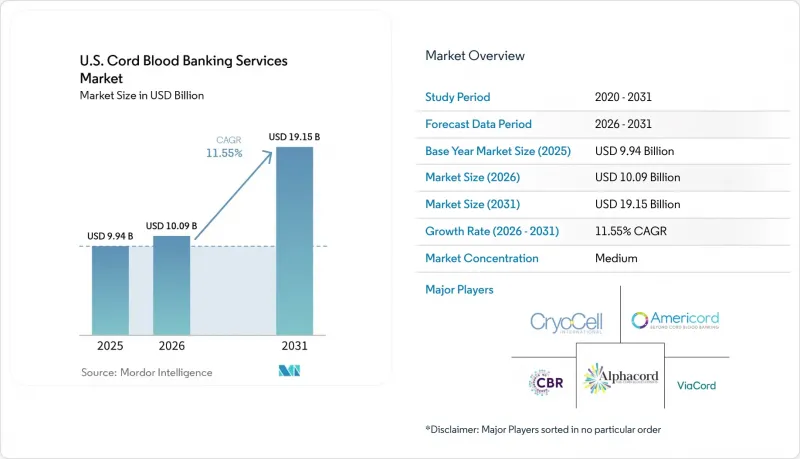
Mordor Intelligence에 의하면, 미국의 제대혈 은행 서비스 시장 규모는 2025년에 99억 4,000만 달러로 평가되었고, 2026년에 100억 9,000만 달러로 추정되고, 2031년까지 191억 5,000만 달러에 이를 것으로 예측되며, 2026-2031년 CAGR 11.55%로 성장할 전망입니다.
본 보고서는 뱅크 유형별(민간, 공공), 서비스 유형별(채취 및 물류, 처리 및 검사, 동결보존, 추출 및 제공), 보존 재료별(제대혈, 제대 조직, 태반 조직), 용도별(암, 혈액 질환, 대사성 질환, 기타), 최종 용도별(병원, 이식 센터, 연구 기관, 가정 보관), 지역별(미국)로 분류되어 있습니다. 예상치는 금액(달러)으로 표시되어 있습니다.
미국의 제대혈 은행 서비스 시장 동향 및 인사이트
신생아 줄기세포 보존에 대한 인식 제고
신생아 줄기세포 보존에 대한 인지도는 인종, 언어, 소득 수준에 따라 크게 다르며, 이는 수요가 교육 및 신뢰 구축 노력과 밀접한 관련이 있음을 보여줍니다. 2025년 조사 결과, 스페인어를 사용하는 히스패닉계 임산부 중 제대혈 은행에 대해 알고 있는 사람은 불과 31.4%에 불과했으며, 70%는 그 목적을 이해하지 못하고 있는 것으로 밝혀졌습니다. 또한, 같은 조사에서 응답자의 91.3%가 '지식 부족'을 장벽으로 꼽았으며, 63%가 불신을 나타냈고, 20%가 제공에 대한 불안을 느끼고 있는 것으로 밝혀졌습니다. 이는 등록자 수 증가를 촉진하는 데 있어, 대상을 좁혀 진행하는 홍보 활동의 중요성을 여실히 보여주고 있습니다. 미국에서 중요성이 커지고 있는 출생 코호트인 히스패닉계 가족은 여전히 이용률이 낮으며, 수요가 높음에도 불구하고 공급량이 부족한 실정입니다.
혈액 질환 및 면역 질환에서의 이식 활용 확대
제대혈은 과거에는 백혈병 치료에 중점을 두었으나, 현재는 보다 광범위한 혈액 질환 및 면역 질환의 치료에 활용되고 있습니다. C.W. 빌 영 조혈세포 이식 프로그램은 2025 회계연도에 8,400건 이상의 비혈연자 간 조혈세포 이식을 주선함으로써, 미국 내 비혈연자 기증자 이식의 규모를 입증했습니다. 2026년 4월, FDA는 수혈 의존성 재생불량성 빈혈 환자를 대상으로 한 제대혈 유래 치료제 'CK0801'의 2상 임상시험에 대해 Cellenkos사에 승인을 부여했습니다. 2024년 1상 임상시험 결과는 유망한 성과를 보여주었으며, 상당수의 환자가 건강 관련 주요 지표를 달성했습니다. 또한, 프레드 해치는 2026년 4월, 혼합 제대혈 이식을 받은 환자의 1년 생존율이 96%였다고 보고했으며, 중증 이식편 대 숙주 질환 사례는 확인되지 않았습니다. 이러한 발전은 이식 및 새로운 치료법에서 제대혈의 역할이 점점 더 중요해지고 있음을 뒷받침하고 있습니다.
민간 제대혈 은행의 고액 본인 부담금
미국에서는 민간 제대혈 은행의 높은 비용 때문에 가족들이 제대혈 보관 서비스를 이용하는 데 큰 제약이 따르고 있습니다. 소비자는 채취 및 처리 비용으로 1,500-3,000달러를 부담해야 하며, 연간 보관료는 150-300달러 정도입니다. 20년 동안 제대혈 보관 비용만 해도 총액이 4,000달러를 넘으며, 제대혈과 조직 보관을 합치면 8,000달러를 넘는 경우도 있습니다. 이러한 비용은 다양한 자원에서 혜택을 받을 가능성이 있는 저소득 가구와 가족들에게 불균형적인 영향을 미치고 있습니다. 지불 체계의 간소화, 혜택의 명확화, 그리고 HSA(건강 저축 계좌) 및 FSA(유연 지출 계좌) 이용 자격을 강조함으로써, 민간 은행은 가입자 수 감소를 억제할 수 있을 것입니다.
부문별 분석
2025년, 민간 은행은 미국 제대혈 은행 서비스 시장 점유율의 56.35%를 차지했습니다. 이는 공적 은행에 비해 임상적 우위라기보다는 축적된 등록자 기반에 힘입은 결과입니다. 민간 은행은 구독형 보관 서비스, 강력한 소비자 대상 브랜딩, 그리고 가족 관계를 통한 채취·처리·장기 보관의 수익화로부터 혜택을 보고 있습니다.
공공 제대혈 은행은 2031년까지 연평균 성장률(CAGR) 11.95%를 기록하며 성장할 것으로 예상되며, 미국 제대혈 은행 시장에서 가장 빠르게 성장하는 부문이 될 전망입니다. 이러한 성장은 HRSA(미국 보건자원서비스국)와의 계약 갱신, 이식 센터의 공공 재고에 대한 의존도, 그리고 유전적 다양성이 풍부한 유닛에 대한 수요에 힘입어 이루어지고 있습니다. FDA(미국 식품의약국) 및 주 차원의 인허가 등 규제 요건은 가족형 저장 서비스와 공공 프로그램을 모두 관리하는 하이브리드 사업자에게 유리하게 작용하여, 다양한 채널에 대응하면서 수익률을 최적화할 수 있게 해줍니다.
2025년 기준으로, 미국의 제대혈 은행 서비스 시장의 66.76%를 극저온 보존 및 모니터링이 차지하고 있으며, 이는 민간 은행을 지탱하는 장기 요금 모델을 반영하고 있습니다. 보관 서비스는 지속적인 수익을 창출하여 검사 업무의 자금원이 되고, 관련 서비스의 교차 판매를 촉진하고 있습니다. 효율적인 채취와 물류는 여전히 중요하지만, 품질과 활용도를 높이는 서비스로 중점이 옮겨가고 있습니다.
처리 및 검사 분야는 검증된 세포 회수율, 생존율 및 출시 준비 상태에 대한 수요에 힘입어 2031년까지 연평균 성장률(CAGR) 12.25%를 나타낼 것으로 예측됩니다. Cryo-Cell International사의 'PrepaCyte-CB' 플랫폼은 세포 회수율 향상을 중시하고 있으며, 이식 활용 확대와 임상시험 프로그램 증가에 따라 회수 및 공급 서비스에 대한 수요도 증가할 것으로 전망됩니다. 이러한 변화로 인해 저장 단위당 수익이 향상되고, 저장 용량보다 검사실의 처리 능력이 우선시되게 됩니다.
기타 혜택 :
- 엑셀 형식 시장 예측(ME) 시트
- 3개월간의 애널리스트 지원
자주 묻는 질문
목차
제1장 서론
제2장 조사 방법
제3장 주요 요약
제4장 시장 구도
제5장 시장 규모 및 성장 예측
제6장 경쟁 구도
제7장 시장 기회 및 향후 전망
AJY 26.07.03According to Mordor Intelligence, the u.S. cord blood banking services market size is projected to be USD 9.94 billion in 2025, USD 10.09 billion in 2026, and reach USD 19.15 billion by 2031, growing at a CAGR of 11.55% from 2026 to 2031.
This report is Segmented by Bank Type (Private, Public), Service Type (Collection & Logistics, Processing & Testing, Cryo Storage, Retrieval & Release), Stored Material (Cord Blood, Cord Tissue, Placental Tissue), Application (Cancers, Blood Disorders, Metabolic Disorders, Others), End Use (Hospitals, Transplant Centers, Research Institutes, Home Storage), & Geography (US). Forecasts in Value (USD).
U.S. Cord Blood Banking Services Market Trends and Insights
Rising Awareness Of Newborn Stem-Cell Preservation
Awareness of newborn stem cell preservation varies significantly across racial, linguistic, and income demographics, indicating that demand is closely tied to education and trust-building efforts. A 2025 study highlighted that only 31.4% of Spanish-speaking pregnant Hispanic women were aware of cord blood banking, with 70% lacking understanding of its purpose. The study also noted that 91.3% of respondents cited lack of knowledge as a barrier, 63% expressed distrust, and 20% had fears about donation. This highlights the importance of targeted outreach in driving enrollment growth. Hispanic families, a significant and growing birth cohort in the United States, remain underrepresented, leading to reduced supply despite high demand.
Broader Transplant Use Across Hematologic And Immune Disorders
Cord blood is increasingly being utilized for a broader range of hematologic and immune disorders, moving beyond its traditional focus on leukemia. The C.W. Bill Young Cell Transplantation Program facilitated over 8,400 unrelated hematopoietic cell transplants in fiscal year 2025, demonstrating the scale of unrelated donor transplantation in the United States. In April 2026, the FDA approved Cellenkos for a Phase 2 trial of CK0801, a cord blood-derived therapy targeting transfusion-dependent aplastic anemia patients. Phase 1 results from 2024 showed promising outcomes, with a significant percentage of patients achieving health milestones.] Additionally, Fred Hutch reported a 96% one-year survival rate in April 2026 for patients using a pooled cord blood transplant, with no severe graft versus host disease cases observed. These developments reinforce the growing role of cord blood in transplants and emerging therapies.
High Private Banking Out-Of-Pocket Cost
In the United States, high private banking costs significantly limit family enrollment in cord blood banking services. Consumers face charges between USD 1,500 and USD 3,000 for collection and processing, with annual storage fees ranging from USD 150 to USD 300. Over 20 years, total costs can exceed USD 4,000 for cord blood storage alone and USD 8,000 for combined cord blood and tissue storage. These expenses disproportionately affect lower-income households and families who could benefit from diverse inventories. Simplifying payment structures, clarifying benefits, and emphasizing HSA or FSA eligibility can help private banks reduce enrollment drop-offs.
Other drivers and restraints analyzed in the detailed report include:
- Demand For Cord-Blood-Derived Starting Material In Cell Therapy Manufacturing
- Federal Support For Public Inventory And Donor Diversity
- Alternative Donor Pathways Reducing Cord-Blood Transplant Share
For complete list of drivers and restraints, kindly check the Table Of Contents.
Segment Analysis
In 2025, private banking held 56.35% of the United States cord blood banking services market share, driven by an accumulated enrolled base rather than clinical superiority over public banking. Private banks benefit from subscription-based storage, strong consumer branding, and monetization of collection, processing, and long-term storage through family relationships.
Public banking is projected to grow at an 11.95% CAGR through 2031, making it the faster-growing segment in the United States cord blood banking market. Growth is driven by HRSA contract renewals, transplant center reliance on public inventory, and demand for genetically diverse units. Regulatory requirements, including FDA and state-level licensing, favor hybrid operators managing both family storage and public programs, enabling them to optimize margins while serving diverse channels.
Cryogenic storage and monitoring accounted for 66.76% of the United States cord blood banking services market in 2025, reflecting the long-term fee model sustaining private banking. Storage generates recurring revenue, funds laboratory operations, and supports cross-selling of related services. Efficient collection and logistics remain critical, though the focus is shifting toward services enhancing quality and usability.
Processing and testing is expected to grow at a 12.25% CAGR through 2031, driven by demand for validated cell recovery, viability, and release readiness. Platforms like Cryo-Cell International's PrepaCyte-CB emphasize improved cell recovery, while retrieval and release services are set to rise with increased transplant use and investigational programs. This shift enhances revenue per stored unit and prioritizes laboratory capabilities over storage capacity.
Complete Report Scope:
- By Bank Type
- Private Banking
- Public Banking
- By Service Type
- Collection & Logistics
- Processing & Testing
- Cryogenic Storage & Monitoring
- Retrieval & Release Services
- By Stored Material
- Cord Blood
- Cord Tissue
- Placental Tissue
- By Application
- Cancers
- Blood Disorders
- Metabolic Disorders
- Others
- By End Use
- Hospitals & Clinics
- Specialty Transplant Centers
- Research Institutes
- Home Storage Users
List of Companies Covered in this Report:
- AlphaCord, LLC
- Americord Registry
- Anja Health
- Bloodworks Northwest
- Carolinas Cord Blood Bank at Duke University Medical Center
- CBR Systems, Inc.
- Cleveland Cord Blood Center
- ClinImmune Cell & Gene Therapy
- Cord for Life
- Cryo-Cell International, Inc.
- FamilyCord
- Gift of Life Marrow Registry
- Lifebank
- LifeSouth Community Blood Centers
- MD Anderson Cord Blood Bank
- National Cord Blood Program
- StemCyte
- Upstate Cord Blood Bank
- ViaCord
- Vitalant Cord Blood Services
Additional Benefits:
- The market estimate (ME) sheet in Excel format
- 3 months of analyst support
TABLE OF CONTENTS
1 Introduction
- 1.1 Study Assumptions & Market Definition
- 1.2 Scope of the Study
2 Research Methodology
3 Executive Summary
4 Market Landscape
- 4.1 Market Overview
- 4.2 Market Drivers
- 4.2.1 Rising Awareness of Newborn Stem-Cell Preservation
- 4.2.2 Broader Transplant Use Across Hematologic and Immune Disorders
- 4.2.3 Improvements in Cryopreservation and Cell-Recovery Workflows
- 4.2.4 Federal Support for Public Inventory and Donor Diversity
- 4.2.5 Demand for Cord-Blood-Derived Starting Material in Cell Therapy Manufacturing
- 4.2.6 Minority-Match Gap Increasing Value of Diverse Banked Inventories
- 4.3 Market Restraints
- 4.3.1 High Private Banking Out-of-Pocket Cost
- 4.3.2 Stringent FDA and State Compliance Burden
- 4.3.3 Weak Public-Bank Unit Economics
- 4.3.4 Alternative Donor Pathways Reducing Cord-Blood Transplant Share
- 4.4 Value / Supply-Chain Analysis
- 4.5 Regulatory Landscape
- 4.6 Technological Outlook
- 4.7 Porter's Five Forces Analysis
- 4.7.1 Threat of New Entrants
- 4.7.2 Bargaining Power of Suppliers
- 4.7.3 Bargaining Power of Buyers
- 4.7.4 Threat of Substitutes
- 4.7.5 Competitive Rivalry
5 Market Size & Growth Forecasts (Value, USD)
- 5.1 By Bank Type
- 5.1.1 Private Banking
- 5.1.2 Public Banking
- 5.2 By Service Type
- 5.2.1 Collection & Logistics
- 5.2.2 Processing & Testing
- 5.2.3 Cryogenic Storage & Monitoring
- 5.2.4 Retrieval & Release Services
- 5.3 By Stored Material
- 5.3.1 Cord Blood
- 5.3.2 Cord Tissue
- 5.3.3 Placental Tissue
- 5.4 By Application
- 5.4.1 Cancers
- 5.4.2 Blood Disorders
- 5.4.3 Metabolic Disorders
- 5.4.4 Others
- 5.5 By End Use
- 5.5.1 Hospitals & Clinics
- 5.5.2 Specialty Transplant Centers
- 5.5.3 Research Institutes
- 5.5.4 Home Storage Users
6 Competitive Landscape
- 6.1 Market Concentration
- 6.2 Market Share Analysis
- 6.3 Company Profiles (includes Global level Overview, Market level overview, Core Segments, Financials as available, Strategic Information, Market Rank/Share for key companies, Products & Services, and Recent Developments)
- 6.3.1 AlphaCord, LLC
- 6.3.2 Americord Registry
- 6.3.3 Anja Health
- 6.3.4 Bloodworks Northwest
- 6.3.5 Carolinas Cord Blood Bank at Duke University Medical Center
- 6.3.6 CBR Systems, Inc.
- 6.3.7 Cleveland Cord Blood Center
- 6.3.8 ClinImmune Cell & Gene Therapy
- 6.3.9 Cord for Life
- 6.3.10 Cryo-Cell International, Inc.
- 6.3.11 FamilyCord
- 6.3.12 Gift of Life Marrow Registry
- 6.3.13 Lifebank
- 6.3.14 LifeSouth Community Blood Centers
- 6.3.15 MD Anderson Cord Blood Bank
- 6.3.16 National Cord Blood Program
- 6.3.17 StemCyte
- 6.3.18 Upstate Cord Blood Bank
- 6.3.19 ViaCord
- 6.3.20 Vitalant Cord Blood Services
7 Market Opportunities & Future Outlook
- 7.1 White-space & Unmet-need Assessment