|
시장보고서
상품코드
2072679
HR 공유 서비스 소프트웨어 시장 : 시장 점유율 분석, 업계 동향 및 통계, 성장 예측(2026-2031년)HR Shared Services Software - Market Share Analysis, Industry Trends & Statistics, Growth Forecasts (2026 - 2031) |
||||||
 Mordor Intelligence
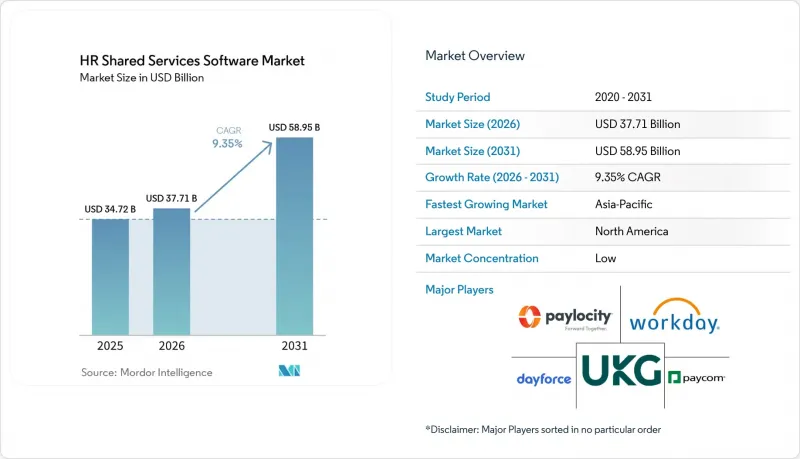
Mordor Intelligence에 의하면, HR 공유 서비스 소프트웨어 시장 규모는 2025년 347억 2,000만 달러로 평가되었고, 2026년에는 377억 1,000만 달러로 추정되고, 2031년까지 589억 5,000만 달러에 이를 것으로 예상되며, 2026-2031년 CAGR 9.35%로 성장할 전망입니다.
본 보고서는 배포 모델별(클라우드 기반, 온프레미스형, 하이브리드형), 기업 규모별(대기업 등), 용도별(핵심 HR 및 직원 셀프 서비스, 사례 관리 및 티켓 관리 등), 최종 사용자 산업 분야별(은행, 금융서비스 및 보험(BFSI), 헬스케어 및 생명과학, 정보기술 및 통신 등), 지역별로 분류되어 있습니다. 시장 전망은 금액(달러) 기준으로 제시되어 있습니다.
세계의 HR 공유 서비스 소프트웨어 시장 동향 및 인사이트
AI를 활용한 사례 해결 및 지식 검색을 통해 Tier-0로의 우회 경로가 가속화되고 있습니다.
HR 공유 서비스 소프트웨어 시장에서 가장 큰 변화는 자문형 AI에서 인간의 개입 없이 사례를 해결할 수 있는 에이전트형 AI로의 전환입니다. Oracle은 2026년 4월, 정책 계층, 승인 흐름, 직원 기록을 아우르며 작동하고, 엔드투엔드 방식으로 작업을 완료할 수 있는 협업형 AI 에이전트를 도입한 '인사 분야를 위한 Fusion Agentic 용도'를 발표했습니다. ServiceNow 역시 2025년 12월에 HRSD 릴리스를 확장하여, 티어 0 문의 및 중요 케이스의 라우팅에 '검색 강화 생성(Retrieval-Augmented Generation)'을 활용하는 에이전트형 워크플로를 도입했습니다. 케이스 처리율이 상승함에 따라 공유 서비스 센터의 비용 구조는 개선되고, 더 많은 인사 담당자가 직원 관계 및 자문 업무로 업무를 전환할 수 있게 됩니다. 이로 인해 대규모 사례 처리 능력을 입증하지 못하는 플랫폼의 경우, HR 공유 서비스 소프트웨어 시장에서 ROI 달성 기준이 더욱 높아지고 있습니다.
직원 셀프 서비스에 대한 기대감의 확대가 플랫폼 아키텍처를 재구축하게 했습니다.
HR 공유 서비스에 대한 직원들의 기대는 극적으로 변화하고 있습니다. 2026년까지 직원들은 단순한 비밀번호 재설정이나 급여 명세서 다운로드 이상의 서비스를 요구하게 될 것입니다. 그들은 출산 휴가 종료 후 남은 휴가 일수 재계산, 직위 변경 시 주식 부여 확인, 인생의 중요한 사건 이후 복리후생 갱신 등 복잡하고 다단계에 걸친 요청 사항을 인사 담당자의 개입 없이 포털을 통해 처리할 수 있기를 기대하고 있습니다. 마이크로소프트는 Copilot을 기반으로 구축된 '직원 셀프 서비스 에이전트'를 통해 이러한 변화를 부각시켰습니다. 이 솔루션은 인사, IT, 캠퍼스 서비스를 단일한 전사적 경험으로 통합하여, 티켓 수 감소라는 측정 가능한 성과를 가져왔습니다. 기업의 HR-AI 예산은 온보딩 자동화, 인사 문서 작성, AI 지원 워크플로우와 같은 활용 사례에 힘입어 2026년에는 160만 달러로 급증했으며, 2023년 대비 10배로 확대되었습니다. 한편, SHRM은 현장 직원과 데스크리스 근로자가 전 세계 노동력의 80%를 차지하고 있음을 강조했습니다. 이에 따라 각 벤더사는 브라우저 전용 포털이 아닌, 모바일 우선, 생체 인증, SMS를 통한 접속이 가능한 지원 체계를 우선시하게 되었습니다.
데이터 개인정보 보호 및 기밀성이 높은 직원 기록의 유출이 도입 위험을 높입니다.
HR 공유 서비스 플랫폼은 급여, 건강, 징계, 이민, 성과 관련 데이터를 단일 시스템으로 통합함에 따라 HR 공유 서비스 소프트웨어 시장의 위험 프로파일이 높아지고 있습니다. 이러한 집중화로 인해 공격 대상이 확대될 뿐만 아니라, 구매자에게는 규정 준수 측면에서의 부담도 더욱 커지게 됩니다. CMS Law 트래커에 따르면, 직원 데이터와 관련된 과징금은 191건으로, 총액 3억 6,080만 7,141유로(3억 8,970만 달러)에 달하며, 2026년 유럽 데이터 보호 위원회(EDPB)의 공동 조치로 인해 고용주의 투명성에 대한 관심이 더욱 높아지고 있습니다. 또한, 이탈리아 데이터 보호 당국은 2026년, Slack 기반의 스트레스 감지 도구에 대해 경고를 발령하며, 데이터 유출이 확인되지 않았더라도 향후 GDPR(EU 개인정보보호규정) 제9조를 위반할 위험이 있다고 지적했습니다. 그 결과, 법무, 개인정보 보호, 보안 각 팀이 계약 체결 전에 ISO 27001, DPIA 및 하도급업체에 관한 증빙 자료를 요구하게 되면서, HR 공유 서비스 소프트웨어 시장의 조달 주기가 길어지고 있습니다.
부문별 분석
2025년, HR 공유 서비스 소프트웨어 시장에서 클라우드 기반 솔루션의 도입 비중이 66.12%를 차지했으며, 기업의 HR 업무에서 표준적인 선택지로 자리 잡고 있습니다. 기업들은 특히 AI, 자동화, 에이전트형 서비스 도구 분야에서 기능 업데이트가 신속하게 이루어지기 때문에 계속해서 클라우드를 선호하고 있습니다. 하이브리드 차량 도입은 여전히 가장 빠르게 성장하는 모델이며, 2031년까지 연평균 성장률(CAGR) 11.75%로 성장할 것으로 전망됩니다. 이러한 경향은 클라우드에서 철수하기보다는 데이터 저장 장소나 감사 요건에 대한 현실적인 대응을 반영한 것입니다.
조직들이 워크로드를 클라우드 환경과 온프레미스 환경으로 분산함에 따라, 하이브리드 배포용 HR 공유 서비스 소프트웨어 시장은 2031년까지 연평균 성장률(CAGR) 11.75%로 확대될 것으로 전망됩니다. 규제가 엄격한 환경에서는 급여 계산 및 신원 확인 데이터가 대개 사내 인프라에 남아 있는 반면, 서비스 제공, 분석 및 AI 기능은 클라우드 계층으로 이전됩니다. 이러한 조합은 기밀성이 높은 직원 기록을 퍼블릭 클라우드 환경으로 완전히 이전할 수 없는 업계나 국가에서 점점 더 보편화되고 있습니다. 온프레미스 구축은 레거시 ERP와의 연동 및 라이선스 갱신 주기의 장기화로 인해 전환 결정이 지연되면서, 신규 프로젝트에서 계속해서 점유율이 하락하고 있습니다. 그 결과, HR 공유 서비스 소프트웨어 시장은 더욱 성숙한 단계에 접어들었으며, 도입 전략은 워크로드의 기밀성이나 거버넌스 요구 사항에 따라 점점 더 좌우되고 있습니다.
2025년 HR 공유 서비스 소프트웨어 시장 매출액 중 대기업이 62.50%를 차지했습니다. 이러한 경쟁력은 공유 서비스 센터의 규모의 경제, 통합된 SLA 관리, 그리고 여러 국가에 걸친 급여 계산 조정을 반영한 것입니다. 이러한 조직은 매우 많은 직원과 수많은 법인을 대상으로 소프트웨어 비용을 분산시킬 수 있습니다. 또한, 플랫폼을 선정할 때에는 다국어 지원, 규정 준수 수준, 그리고 워크플로우의 폭을 더욱 중시하고 있습니다.
중견 기업은 2031년까지 연평균 성장률(CAGR) 12.31%를 기록하며 성장할 것으로 예상되며, 이 부문에서 가장 빠르게 성장하는 구매자 그룹이 될 전망입니다. 클라우드 제공과 모듈식 가격 책정 덕분에, 그동안 엔터프라이즈급 도입 비용을 감당하기 어려웠던 기업들도 이제 사례 관리, 문서 처리, 분석 기능을 활용할 수 있게 되었습니다. 이러한 인수 기업 중 상당수는 첫 인수나 국제적인 사업 확장을 계기로 HR 공유 서비스 소프트웨어 시장에 진출하고 있습니다. 즉, 해체해야 할 구식 공유 서비스 인프라가 거의 없는 경우가 많습니다. 따라서 기존 벤더와 신흥 벤더 모두에게 매력적인 그린필드 사업 기회가 되고 있습니다. ISG의 조사에 따르면, 84%의 조직이 2년 이내에 인사 소싱 모델을 변경할 계획을 세우고 있으며, 사내 공유 서비스의 확대가 주요 촉진요인으로 꼽히고 있습니다.
지역별 분석
2025년, 북미는 HR 공유 서비스 소프트웨어 시장의 42.00%를 차지했으며, 해당 지역 1위 자리를 유지했습니다. 이 지역은 대기업의 풍부한 예산, 성숙한 공유 서비스 센터 모델, 그리고 밀집된 소프트웨어 벤더 기반이라는 장점을 갖추고 있습니다. 또한, 구매 활동 측면에서도 SaaS를 통한 조달, 직원 지원을 위한 AI 주도형 워크플로우의 신속한 도입이 선호되고 있습니다. 노동력과 관련된 AI 법이 제정된 미국의 각 주에서는 많은 인사 담당자들이 해당 규정을 인지하지 못하고 있었습니다. 이것이 바로 구매자들이 플랫폼 측에 더 강력한 규정 준수 대책을 요구하고 있는 이유 중 하나입니다. 캐나다에서는 주마다 다른 급여 계산 및 휴가 관련 규정과 퀘벡주의 이중언어 업무 환경에 대한 요구로 인해 상황이 더욱 복잡해지고 있으며, 이것이 엔터프라이즈급 시스템에 대한 수요를 뒷받침하고 있습니다.
유럽은 HR 공유 서비스 소프트웨어 시장에서 여전히 2위 지역 시장을 차지하고 있습니다. GDPR(EU 개인정보보호규정) 및 EU AI법에 따라, 해당 지역에서 사용되는 모든 HR 플랫폼에 대해 거버넌스, 감사 가능성, 투명성에 관한 최소 기준이 강화되었습니다. 협조적인 집행 조치를 통해, 직원 데이터 처리와 관련하여 고용주의 투명성 의무에 대한 감독이 강화되고 있습니다. 독일과 영국이 해당 지역 수요를 뒷받침하고 있으며, 2026년 4월 6일부터 시행되는 영국의 휴가 수당 기록 보관 규정은 문서 관리 모듈에 대한 단기적인 수요를 촉발시켰습니다. 남미 시장은 여전히 규모가 작지만, 브라질과 아르헨티나에서는 규정 준수를 충족하는 지역 맞춤형 인사 데이터 플랫폼을 원하는 다국적 기업들의 관심이 높아지고 있습니다.
아시아태평양은 2031년까지 연평균 성장률(CAGR) 14.25%를 나타낼 것으로 예측되며, 이는 HR 공유 서비스 소프트웨어 시장에서 지역별 가장 빠른 성장 속도입니다. 이러한 성장은 인도의 IT 인재 채용 기반 확대, 중국의 제조업 인력 디지털화, 그리고 동남아시아 전역의 의료 분야 인사 부문의 현대화에 힘입어 이루어지고 있습니다. 조사에 따르면, 해당 지역의 기업 중 75%가 이미 인사 부서에서 AI를 활용하고 있으며, 63%는 2026년에 AI 관련 예산이 증가할 것으로 예상하고 있지만, 기업 전체 차원에서 AI를 본격적으로 도입할 준비가 되어 있다고 응답한 곳은 고작 11%에 그쳤습니다. 사우디아라비아와 아랍에미리트(UAE)가 주도하는 중동 및 아프리카 일부 지역(특히 남아프리카공화국과 나이지리아)에서는 대기업의 확장, 다국적 기업의 자회사, 규정 준수 대응이 가능한 인사 인프라에 대한 수요와 연계되어 여전히 초기 단계의 비즈니스 기회가 존재하고 있습니다.
기타 혜택 :
- 엑셀 형식 시장 예측(ME) 시트
- 3개월간의 애널리스트 지원
자주 묻는 질문
목차
제1장 서론
제2장 조사 방법
제3장 주요 요약
제4장 시장 구도
제5장 시장 규모 및 성장 예측
제6장 경쟁 구도
제7장 시장 기회 및 향후 전망
AJY 26.07.03According to Mordor Intelligence, the HR shared services software market size is expected to increase from USD 34.72 billion in 2025 to USD 37.71 billion in 2026 and reach USD 58.95 billion by 2031, growing at a CAGR of 9.35% over 2026-2031.
This report is Segmented by Deployment Model (Cloud-Based, On-Premise, and Hybrid), Enterprise Size (Large Enterprises, and More), Application (Core HR and Employee Self-Service; Case Management and Ticketing, and More), End-User Industry (BFSI, Healthcare and Life Sciences, Information Technology and Telecom, and More), and Geography. The Market Forecasts are Provided in Terms of Value (USD).
Global HR Shared Services Software Market Trends and Insights
AI-Enabled Case Resolution and Knowledge Retrieval Accelerates Tier-0 Deflection
The biggest shift in the HR shared services software market is the move from advisory AI to agentic AI that can resolve cases without human escalation. Oracle introduced Fusion Agentic Applications for HR in April 2026, using coordinated AI agents that can work across policy hierarchies, approval flows, and employee records to complete actions end to end. ServiceNow also extended its HRSD release in December 2025 with agentic flows that use retrieval-augmented generation for tier-0 queries and critical case routing. As deflection rates rise, the cost base of shared service centers falls, allowing more HR staff to shift into employee relations and advisory work. That is lifting the ROI bar in the HR shared services software market for platforms that cannot prove case resolution at scale.
Expansion of Employee Self-Service Expectations Reshapes Platform Architecture
Employee expectations in HR shared services have evolved dramatically. By 2026, employees want far more than simple password resets or pay-stub downloads; they expect portals to handle complex multi-step requests, such as recalculating leave after maternity return, confirming equity grants during role changes, and updating benefits after life events, without HR desk intervention. Microsoft highlighted this shift with its Employee Self-Service Agent, built on Copilot, which unified HR, IT, and campus services into a single enterprise-wide experience, resulting in measurable ticket deflection. Enterprise HR-AI budgets surged to USD 1.6 million in 2026, a tenfold increase from 2023, driven by use cases such as onboarding automation, HR document creation, and AI-assisted workflows. Meanwhile, SHRM emphasized that frontline and deskless workers make up 80% of the global workforce, prompting vendors to prioritize mobile-first, biometric-authenticated, and SMS-accessible support layers rather than browser-only portals.
Data Privacy and Sensitive Employee Record Exposure Elevates Deployment Risk
HR shared services platforms consolidate salary, health, disciplinary, immigration, and performance data in a single system, which increases the risk profile of the HR shared services software market. That concentration creates both a larger attack surface and a more serious compliance burden for buyers. The CMS Law tracker recorded 191 employee-data fines totaling EUR 360,807,141 (USD 389.7 million), and the 2026 coordinated action from the EDPB has tightened attention on employer transparency. Italy's data protection authority also issued a warning in 2026 regarding a Slack-based stress-detection tool, citing a risk of future GDPR Article 9 violations even without a confirmed breach. As a result, procurement cycles in the HR shared services software market are taking longer, as legal, privacy, and security teams require ISO 27001, DPIA, and sub-processor evidence before signing contracts.
Other drivers and restraints analyzed in the detailed report include:
- Centralization of Multi-Country HR Operations Creates Demand For Unified Platforms
- Rising Compliance Burden Across Payroll, Leave, and Employee Documentation Drives Platform Adoption
- Integration Friction Across HRIS, Payroll, Identity, and Document Systems Delays Value Realization
For complete list of drivers and restraints, kindly check the Table Of Contents.
Segment Analysis
Cloud-based deployment accounted for 66.12% of the HR shared services software market in 2025, making it the standard choice across enterprise HR operations. Enterprises continue to favor cloud because feature updates arrive faster there, especially for AI, automation, and agentic service tools. Hybrid deployment remains the fastest-growing model and is projected to grow at 11.75% through 2031. That pattern reflects a practical response to data-residency and audit needs rather than a retreat from cloud.
The HR shared services software market for hybrid deployment is projected to expand at a 11.75% CAGR through 2031 as organizations split workloads across cloud and on-premises environments. In regulated settings, payroll and identity data often stay in private infrastructure while service delivery, analytics, and AI capabilities move into cloud layers. This mix is becoming more common in sectors and countries where sensitive employee records cannot be fully migrated to public cloud environments. On-premise deployments continue to lose ground in new projects because legacy ERP links and long license cycles slow migration decisions. The result is a more mature HR shared services software market, where deployment choices are increasingly driven by workload sensitivity and governance needs.
Large enterprises accounted for 62.50% of 2025 revenue in the HR shared services software market. That lead reflects the scale economics of shared service centers, centralized SLA management, and multi-country payroll orchestration. These organizations can spread software spending across very large employee populations and many legal entities. They also place greater weight on multilingual support, depth of compliance, and breadth of workflow when selecting platforms.
Medium-sized enterprises are projected to grow at 12.31% CAGR through 2031, making them the fastest-growing buyer group in this segmentation. Cloud delivery and modular pricing are opening access to case management, document handling, and analytics for firms that previously could not justify the costs of enterprise-grade deployment. Many of these buyers are entering the HR shared services software market during their first acquisition or international expansion, which means they often have little legacy shared services infrastructure to unwind. That makes them attractive greenfield opportunities for incumbent and challenger vendors alike. ISG found that 84% of organizations planned to change their HR sourcing model within 2 years, with the expansion of internal shared services identified as a major lever
Complete Report Scope:
- By Deployment Model
- Cloud-Based
- On-Premise
- Hybrid
- By End User Enterprise Size
- Large Enterprises
- Medium-Sized Enterprises
- By Application
- Core HR and Employee Self-Service
- Case Management and Ticketing
- Workflow Automation and Employee Journeys
- Document Management and E-Signature
- Workforce Analytics and Reporting
- Payroll and Benefits Support
- Talent and Learning Support
- By End-user Industry
- BFSI
- Healthcare and Life Sciences
- Information Technology and Telecom
- Retail and E-commerce
- Industrial Manufacturing
- Government and Public Sector
- Other End-user Industries
- By Geography
- North America
- United States
- Canada
- Mexico
- South America
- Brazil
- Argentina
- Rest of South America
- Europe
- Germany
- United Kingdom
- France
- Italy
- Spain
- Russia
- Netherlands
- Rest of Europe
- Asia-Pacific
- China
- Japan
- India
- South Korea
- Australia and New Zealand
- Rest of Asia-Pacific
- Middle East
- Saudi Arabia
- United Arab Emirates
- Rest of Middle East
- Africa
- South Africa
- Nigeria
- Rest of Africa
- North America
Geography Analysis
North America held 42.00% of the HR shared services software market in 2025, maintaining the region's lead. The region benefits from large enterprise budgets, mature shared service center models, and a dense software vendor base. Buying behavior also favors SaaS procurement and faster deployment of AI-led workflows in employee support. Many HR professionals in the US states with workforce-related AI laws were unaware of those rules, which helps explain why buyers want stronger compliance guardrails in their platforms. Canada adds another layer of complexity through province-level payroll and leave rules and bilingual workplace needs in Quebec, which supports demand for enterprise-grade systems.
Europe remained the second-largest regional market for HR shared services software. GDPR and the EU AI Act have raised the minimum standard for governance, auditability, and transparency across HR platforms used in the region. Coordinated enforcement actions have increased scrutiny of employer transparency obligations in employee data processing. Germany and the United Kingdom anchor regional demand, and the UK's holiday pay recordkeeping rules, effective April 6, 2026, created a near-term trigger for document management modules. South America remains smaller, but Brazil and Argentina are seeing increased interest from multinationals seeking compliant regional HR data platforms.
Asia-Pacific is projected to grow at 14.25% CAGR through 2031, the fastest regional pace in the HR shared services software market. Growth is being supported by India's expanding IT hiring base, the digitization of China's manufacturing workforce, and healthcare HR modernization across Southeast Asia. Surveys show that 75% of organizations in the region were already using AI in HR, and 63% expected AI budgets to rise in 2026, although only 11% felt fully prepared to scale AI across the enterprise. The Middle East, led by Saudi Arabia and the UAE, and parts of Africa, especially South Africa and Nigeria, remain earlier-stage opportunities tied to conglomerate expansion, multinational subsidiaries, and demand for compliance-ready HR infrastructure.
- Workday, Inc.
- UKG Inc.
- Dayforce, Inc.
- Paycom Software, Inc.
- Paylocity Holding Corporation
- BambooHR LLC
- HiBob Ltd.
- Darwinbox Digital Solutions Private Limited
- Cezanne HR Limited
- Neocase Software
- Rippling People Center Inc.
- Factorial HR, S.L.
- SAP SuccessFactors
- Zalaris ASA
- Ramco Systems Limited
- Servicenow
- Deel Inc.
- PayFit SAS
- Paychex, Inc.
- Neocase Software
Additional Benefits:
- The market estimate (ME) sheet in Excel format
- 3 months of analyst support
TABLE OF CONTENTS
1 INTRODUCTION
- 1.1 Study Assumptions and Market Definition
- 1.2 Scope of the Study
2 RESEARCH METHODOLOGY
3 EXECUTIVE SUMMARY
4 MARKET LANDSCAPE
- 4.1 Market Overview
- 4.2 Impact of Macroeconomic Factors on the Market
- 4.3 Market Drivers
- 4.3.1 Expansion Of Employee Self-Service Expectations
- 4.3.2 AI-Enabled Case Resolution And Knowledge Retrieval
- 4.3.3 Centralization Of Multi-Country HR Operations
- 4.3.4 Rising Compliance Burden Across Payroll, Leave, And Employee Documentation
- 4.3.5 Cross-Functional Workflow Automation For Joiner-Mover-Leaver Journeys
- 4.3.6 Demand For Multilingual Shared-Service Support After Mergers And Acquisitions
- 4.4 Market Restraints
- 4.4.1 Data Privacy And Sensitive Employee Record Exposure
- 4.4.2 Integration Friction Across HRIS, Payroll, Identity, And Document Systems
- 4.4.3 Weak Process Ownership And Poor Data Harmonization Limit ROI
- 4.4.4 Governance Risk From Agentic AI In High-Stakes HR Decisions
- 4.5 Industry Value Chain Analysis
- 4.6 Regulatory Landscape
- 4.7 Technological Outlook
- 4.8 Porter's Five Forces Analysis
- 4.8.1 Threat of New Entrants
- 4.8.2 Bargaining Power of Buyers
- 4.8.3 Bargaining Power of Suppliers
- 4.8.4 Threat of Substitutes
- 4.8.5 Intensity of Competitive Rivalry
5 MARKET SIZE AND GROWTH FORECASTS (VALUE)
- 5.1 By Deployment Model
- 5.1.1 Cloud-Based
- 5.1.2 On-Premise
- 5.1.3 Hybrid
- 5.2 By End User Enterprise Size
- 5.2.1 Large Enterprises
- 5.2.2 Medium-Sized Enterprises
- 5.3 By Application
- 5.3.1 Core HR and Employee Self-Service
- 5.3.2 Case Management and Ticketing
- 5.3.3 Workflow Automation and Employee Journeys
- 5.3.4 Document Management and E-Signature
- 5.3.5 Workforce Analytics and Reporting
- 5.3.6 Payroll and Benefits Support
- 5.3.7 Talent and Learning Support
- 5.4 By End-user Industry
- 5.4.1 BFSI
- 5.4.2 Healthcare and Life Sciences
- 5.4.3 Information Technology and Telecom
- 5.4.4 Retail and E-commerce
- 5.4.5 Industrial Manufacturing
- 5.4.6 Government and Public Sector
- 5.4.7 Other End-user Industries
- 5.5 By Geography
- 5.5.1 North America
- 5.5.1.1 United States
- 5.5.1.2 Canada
- 5.5.1.3 Mexico
- 5.5.2 South America
- 5.5.2.1 Brazil
- 5.5.2.2 Argentina
- 5.5.2.3 Rest of South America
- 5.5.3 Europe
- 5.5.3.1 Germany
- 5.5.3.2 United Kingdom
- 5.5.3.3 France
- 5.5.3.4 Italy
- 5.5.3.5 Spain
- 5.5.3.6 Russia
- 5.5.3.7 Netherlands
- 5.5.3.8 Rest of Europe
- 5.5.4 Asia-Pacific
- 5.5.4.1 China
- 5.5.4.2 Japan
- 5.5.4.3 India
- 5.5.4.4 South Korea
- 5.5.4.5 Australia and New Zealand
- 5.5.4.6 Rest of Asia-Pacific
- 5.5.5 Middle East
- 5.5.5.1 Saudi Arabia
- 5.5.5.2 United Arab Emirates
- 5.5.5.3 Rest of Middle East
- 5.5.6 Africa
- 5.5.6.1 South Africa
- 5.5.6.2 Nigeria
- 5.5.6.3 Rest of Africa
- 5.5.1 North America
6 COMPETITIVE LANDSCAPE
- 6.1 Market Concentration
- 6.2 Strategic Moves
- 6.3 Market Share Analysis
- 6.4 Company Profiles (includes Global Level Overview, Market Level Overview, Core Segments, Financials as available, Strategic Information, Market Rank/Share, Products and Services, Recent Developments)
- 6.4.1 Workday, Inc.
- 6.4.2 UKG Inc.
- 6.4.3 Dayforce, Inc.
- 6.4.4 Paycom Software, Inc.
- 6.4.5 Paylocity Holding Corporation
- 6.4.6 BambooHR LLC
- 6.4.7 HiBob Ltd.
- 6.4.8 Darwinbox Digital Solutions Private Limited
- 6.4.9 Cezanne HR Limited
- 6.4.10 Neocase Software
- 6.4.11 Rippling People Center Inc.
- 6.4.12 Factorial HR, S.L.
- 6.4.13 SAP SuccessFactors
- 6.4.14 Zalaris ASA
- 6.4.15 Ramco Systems Limited
- 6.4.16 Servicenow
- 6.4.17 Deel Inc.
- 6.4.18 PayFit SAS
- 6.4.19 Paychex, Inc.
- 6.4.20 Neocase Software
7 MARKET OPPORTUNITIES AND FUTURE OUTLOOK
- 7.1 White-Space and Unmet-Need Assessment