

|
시장보고서
상품코드
2072695
미국의 갱년기 시장 : 시장 점유율 분석, 업계 동향 및 통계, 성장 예측(2026-2031년)United States Menopause - Market Share Analysis, Industry Trends & Statistics, Growth Forecasts (2026 - 2031) |
||||||
 Mordor Intelligence
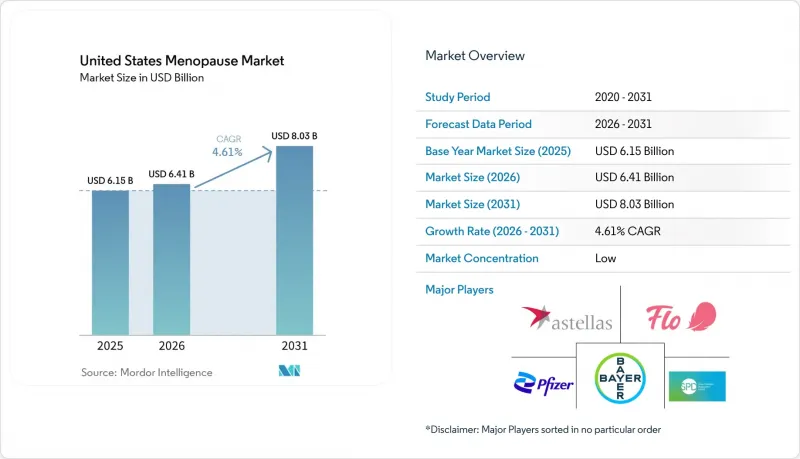
Mordor Intelligence에 의하면, 미국의 갱년기 시장 규모는 2025년 61억 5,000만 달러로 평가되었고, 2026년에는 64억 1,000만 달러로 추정되고, 2031년까지 80억 3,000만 달러에 이를 것으로 예상되며, 2026-2031년 CAGR 4.61%로 성장할 전망입니다.
본 보고서는 치료 유형별(처방 호르몬제, 비호르몬제, 영양보조식품, 일반의약품), 증상별(혈관운동 증상, GSM, 수면·기분, 뼈 및 성기능 건강), 투여 경로별(경구, 경피 및 외용, 질 내, 주사), 유통 채널별(소매 약국, 온라인 및 DTC, 병원 약국, 전문 클리닉)로 분류되어 있습니다. 시장 전망은 금액(달러) 기준으로 제시되어 있습니다.
미국의 갱년기 시장 동향 및 인사이트
갱년기를 맞이하여 심각한 증상을 보이는 여성층
미국의 갱년기 시장은 베이비붐 세대의 후반부와 X세대의 초반부에 속하는 여성들이 동시에 갱년기를 맞이하는 대규모 인구 동향의 흐름에 힘입어 성장하고 있습니다. 해당 국가에서는 매년 약 130만 명의 새로운 갱년기 여성이 늘어나고 있으며, 전체 의료비 지출이 억제되는 추세 속에서도 돌봄 대상자층은 계속해서 확대되고 있습니다. 이 세대는 디지털 건강 관리 도구에 익숙해져 있어, 도움 없이 증상을 참기보다는 적극적으로 치료를 받는 경향이 강해지고 있습니다. 이러한 요인들이 복합적으로 작용함에 따라, 일회성 증상 관리가 아닌, 건강기능식품, 처방약, 온라인 진료 등을 결합한 다각적인 관리 방식이 채택될 가능성이 높아지고 있습니다. 그 결과, 미국의 갱년기 시장에는 자유재량 지출보다는 인구 구조나 증상 부담과 밀접하게 연관된 지속적인 수요 기반이 형성되어 있습니다.
갱년기 관리에 대한 인식 제고와 편견 해소
미국의 갱년기 시장은 직장, 진료소, 그리고 소비자 대상 헬스케어 채널 전반에서 갱년기에 대한 논의 방식에 뚜렷한 변화가 일어나고 있는 데 힘입어 성장하고 있습니다. 고용주에 의한 인식 제고 활동, 여성 건강 옹호 활동, 그리고 과거에는 간과되기 쉬웠던 증상에 대한 언론의 관심이 높아짐에 따라, 이에 대한 인지도가 향상되고 있습니다. 여성건강연구협회(Society for Women's Health Research)의 조사에 따르면, 직원의 64%가 갱년기와 관련된 직장 복리후생을 희망하고 있으며, 이는 치료에 대한 수요가 진료소뿐만 아니라 고용주의 현장에서도 나타나고 있음을 보여줍니다. 이러한 변화는 GSM(갱년기 관련 신체 증상), 수면장애, 기분 장애와 같은 분야에서 특히 중요한데, 이는 여성들이 이러한 증상에 대해 치료를 미루거나 애초에 문제로 삼지 않는 경우가 많기 때문입니다. 2025년 7월에 개최된 FDA 전문가 패널 회의는 호르몬 요법의 위험과 이점에 대한 정보 제공에 직접 초점을 맞추어, 적극적인 치료의 정당성을 한층 더 높였습니다.
호르몬 요법의 안전성에 대한 과거 우려의 잔재
미국의 갱년기 치료 시장에서는 특히 일반 진료 현장에서 기존의 호르몬 요법에 대한 위험 인식의 영향이 여전히 남아 있습니다. 『JAMA Internal Medicine』에 실린 최근의 '여성 건강 이니셔티브(WHI)' 시험 데이터를 재분석한 결과, 시작 시기와 시작 당시의 연령을 고려했을 때, 혈관운동 증상이 있는 50-59세 여성에게 호르몬 요법이 심혈관계에 실질적인 이점을 가져다줄 수 있음이 밝혀졌습니다. 그럼에도 불구하고, 모든 임상의가 현재의 근거를 똑같이 해석하는 것은 아니기 때문에 처방 행태에는 편차가 나타납니다. 미국 가정의학회는 2025년 7월에 지침을 발표했는데, 그 지침에서는 갱년기 호르몬 요법에 대해 여전히 '효과는 제한적이며, 심각한 부작용이 있다'라는 견해가 유지되고 있으며, 의료 현장에 따라 전문가들의 메시지에 여전히 차이가 있음을 보여주고 있습니다. 이 때문에 치료 대상인 많은 여성들이 치료를 받지 못한 채로 있거나 치료 시작이 지연되고 있으며, 그 결과 미국의 갱년기 시장에서 임상적 수요가 실제 매출로 이어지는 속도가 느려지고 있습니다.
부문별 분석
2025년, 미국의 갱년기 시장 점유율 중 84.87%를 영양보조식품 및 OTC(일반의약품) 지원 제품이 차지했습니다. 이는 구하기 쉬운 제품을 이용한 자발적인 증상 관리라는 오랜 습관을 반영하고 있습니다. 이러한 제품들은 소매 약국, 식료품점 및 온라인을 통한 직접 정기 구독을 통해 판매되고 있기 때문에 보급 범위가 넓으며, 처방 치료로는 따라잡을 수 없을 정도의 인지도 우위를 점하고 있습니다. 그러나 이러한 주도적인 지위가 이 부문이 시장의 변화에서 자유롭다는 것을 의미하는 것은 아닙니다. 처방전이 필요한 비호르몬 요법은 2031년까지 연평균 성장률(CAGR) 5.06%를 나타낼 것으로 예측되며, 이는 미국 갱년기 시장에서 임상적으로 권장되는 치료 옵션으로의 전환이 완만하지만 의미 있게 진행되고 있음을 보여줍니다.
이러한 변화는 처방약과 일반의약품의 경계가 모호해지기 시작하고 있다는 점에서도 드러납니다. Bonafide Health는 2024년 9월, 처방약으로 사용되는 혈관운동 증상 치료제에서 큰 관심을 받고 있는 것과 동일한 광범위한 생물학적 경로를 활용한,월40-45달러의 일반의약품용 NK3R 길항제 보충제 '서멜라(Thermella)'를 출시했습니다. 호르몬 계열 처방약 분야에서는 전신 치료와 국소 치료의 요구를 모두 충족시킬 수 있는 폭넓은 제품 포트폴리오를 보유한 기업이 여전히 중요한 위치를 차지하고 있습니다. 화이자의 갱년기 호르몬 요법 제품군에는 '프레마린','프레믈프로','에스트링', '프레마린 질용 크림', '듀아비'가 포함되어 있어, 이를 통해 다양한 환자 프로파일과 증상의 양상을 포괄하고 있습니다. 또한 Mayne Pharma도 2025 회계연도 여성 건강 사업 부문의 매출이 1억 7,840만 달러에 달했다고 보고했으며, 'IMVEXXY' 그리고 'BIJUVA'가 견조한 성장세를 보이고 있습니다. 이는 국소 에스트로겐 요법에 대한 규제 당국의 태도가 더 우호적으로 변한 것도 한 가지 원인입니다.
2025년 미국 갱년기 시장 규모 중 혈관운동 증상이 53.83%를 차지했으며, 이는 안면홍조와 야간 발한이 여전히 여성들이 치료를 받는 주된 계기가 되고 있음을 반영합니다. 최근 출시된 주요 의약품은 이 증상군에 초점을 맞춘 제품이 주를 이루고 있으며, 이러한 노력은 의사의 관심과 상업적 투자 모두를 촉진하고 있습니다. 새로운 NK 세포 표적 치료법의 승인으로, 호르몬제를 사용하지 않고 증상 완화를 원하는 여성이나 호르몬 요법을 받을 수 없는 여성에 대한 처방 경로가 강화되었습니다. 그렇긴 하지만, 미국의 갱년기 시장은 혈관운동 증상 치료에만 국한되지 않습니다. 다른 범주에 속하는 치료되지 않은 증상들이 현재 임상적으로 주목을 받고 있기 때문입니다.
갱년기 비뇨생식기 증후군(GSM)은 2031년까지 연평균 성장률(CAGR) 6.12%로 확대될 것으로 예상되며, 미국 갱년기 시장에서 가장 빠르게 성장하는 증상 부문이 될 전망입니다. 이러한 증가는 GSM이 단순한 좁은 의미의, 혹은 임의적인 삶의 질(QOL) 문제가 아니라, 만성적이고 진행성 질환으로 인식되고 있음을 반영하고 있습니다. 지금까지 이 분야의 성장은 환자들이 질 증상에 대해 이야기하는 것을 주저하거나, 의료진이 진단 및 장기 관리에 대한 이해도가 제각각이었기 때문에 저해되어 왔습니다. 또한, 국소 에스트로겐 요법의 선택지가 늘어나고 있으며, 갱년기 관리에는 단일하고 고립된 증상이 아닌 여러 증상군에 걸친 치료가 필요하다는 인식이 확산되고 있는 점도 성장을 뒷받침하고 있습니다. 에리냐제탄에 대한 현재 진행 중인 연구를 통해 혈관운동 증상 억제 이외의 효과가 확인된다면, 수면 및 기분 관련 증상도 상업적으로 그 중요성이 커질 가능성이 있습니다. 왜냐하면, 이를 통해 단일 처방약 군 내에서 실질적인 치료 범위가 확대되기 때문입니다.
기타 혜택 :
- 엑셀 형식 시장 예측(ME) 시트
- 3개월간의 애널리스트 지원
자주 묻는 질문
목차
제1장 서론
제2장 조사 방법
제3장 주요 요약
제4장 시장 구도
제5장 시장 규모 및 성장 예측
제6장 경쟁 구도
제7장 시장 기회 및 향후 전망
AJY 26.07.03According to Mordor Intelligence, the united states menopause market size is expected to increase from USD 6.15 billion in 2025 to USD 6.41 billion in 2026 and reach USD 8.03 billion by 2031, growing at a CAGR of 4.61% over 2026-2031.
This report is Segmented by Treatment Type (Prescription Hormonal, Non-Hormonal, Dietary Supplements & OTC), Symptom Focus (Vasomotor, GSM, Sleep & Mood, Bone & Sexual Health), Route of Administration (Oral, Transdermal/Topical, Vaginal, Injectable), and Distribution Channel (Retail Pharmacies, Online/DTC, Hospital Pharmacies, Specialty Clinics). Market Forecasts are Provided in Terms of Value (USD).
United States Menopause Market Trends and Insights
Large Symptomatic Female Cohort Entering Menopause
The United States menopause market is supported by a dense demographic wave as later Baby Boomers and early Generation X women move through menopause at the same time. The country adds nearly 1.3 million new menopause entrants each year, which keeps the care pool expanding even when broader health spending becomes cautious. This population is entering menopause with greater familiarity with digital care tools and with a stronger willingness to ask for treatment instead of accepting symptoms without support. That combination raises the likelihood of multi-modal care, including supplements, prescriptions, and virtual consultations, rather than one-time symptom management. The result is a durable demand base for the United States menopause market that is tied more to population structure and symptom burden than to discretionary spending.
Rising Awareness and Destigmatization of Menopause Care
The United States menopause market is benefiting from a clear change in how menopause is discussed at work, in clinics, and across consumer health channels. Awareness is improving through employer education, women's health advocacy, and a broader media focus on symptoms that were often minimized in the past. The Society for Women's Health Research found that 64% of employees want menopause-related workplace benefits, which shows that treatment demand is now visible inside employer settings as well as in physician offices. This change is especially important in areas such as GSM, sleep disruption, and mood symptoms, where women often delay care or never raise the issue at all. The FDA's July 2025 expert panel added further legitimacy to active treatment by focusing directly on hormone therapy risk and benefit communication.
Legacy Hormone Therapy Safety Overhang
The United States menopause market still carries the effects of older hormone therapy risk perceptions, especially in general practice settings. A recent JAMA Internal Medicine reanalysis of Women's Health Initiative trial data showed that hormone therapy can offer a net cardiovascular benefit for women aged 50-59 with vasomotor symptoms when timing and age at initiation are considered. Even so, prescribing behavior remains uneven because not all clinicians interpret current evidence in the same way. The American Academy of Family Physicians published guidance in July 2025 that continued to frame menopausal hormone therapy as having limited benefits and significant harms, which shows that professional messaging still differs across care settings. This leaves many eligible women untreated or delayed in treatment, which slows the conversion of clinical demand into realized sales across the United States menopause market.
Other drivers and restraints analyzed in the detailed report include:
- Non-Hormonal Prescription Innovation
- Employer-Sponsored and Virtual Menopause Care
- Liver-Monitoring and Reimbursement Friction For NK-Targeted Therapies
For complete list of drivers and restraints, kindly check the Table Of Contents.
Segment Analysis
Dietary supplements & OTC support products held 84.87% of the United States menopause market share in 2025, which reflects the long-standing habit of self-directed symptom management through easily accessible products. Their reach is broad because these products are sold through retail pharmacies, grocery outlets, and direct online subscriptions, which gives them a visibility advantage that prescription therapies cannot match. This leadership position, however, does not mean the category is secure from disruption. Prescription non-hormonal therapies are projected to grow at a 5.06% CAGR through 2031, which points to a gradual but meaningful shift in the United States menopause market toward clinically guided treatment options.
That shift is visible in how prescription and OTC boundaries are starting to blur. Bonafide Health launched Thermella in September 2024 as an OTC NK3R antagonist supplement priced at USD 40-45 per month, using the same broad biological pathway that has attracted strong interest in prescription vasomotor care. Within hormonal prescriptions, companies with broad portfolios still hold an important place because they cover both systemic and local treatment needs. Pfizer's menopause hormone therapy portfolio includes Premarin, Prempro, Estring, Premarin Vaginal Cream, and Duavee, which gives it coverage across multiple patient profiles and symptom settings. Mayne Pharma also reported USD 178.4 million in FY2025 revenue from its women's health business, with strong growth from IMVEXXY and BIJUVA, supported in part by a more favorable regulatory tone toward local estrogen therapies.
Vasomotor symptoms accounted for 53.83% of the United States menopause market size in 2025, which reflects how hot flashes and night sweats remain the main triggers for women to seek treatment. The leading drug launches in recent years have centered on this symptom group, and that focus has reinforced both physician attention and commercial investment. The approval of newer NK-targeted therapies has strengthened the prescription pathway for women who want relief without hormone use or who cannot take hormone therapy. That said, the United States menopause market is not staying limited to vasomotor care alone, because untreated symptoms in other categories are now drawing more clinical focus.
Genitourinary syndrome of menopause is forecast to expand at a 6.12% CAGR through 2031, making it the fastest-growing symptom segment in the United States menopause market. This growth reflects better recognition of GSM as a chronic and progressive condition rather than a narrow or optional quality-of-life issue. The segment had been held back by patient reluctance to discuss vaginal symptoms and by uneven provider familiarity with diagnosis and long-term management. Growth is also being supported by local estrogen options and by broader awareness that menopause care often requires treatment across multiple symptom clusters rather than in one isolated complaint. Sleep and mood symptoms could also become more commercially important if ongoing work around elinzanetant confirms benefits beyond vasomotor control, because that would widen the practical treatment scope for a single prescription class.
Complete Report Scope:
- By Treatment Type
- Prescription Hormone Therapies
- Systemic Estrogen-Only Therapies
- Estrogen-Progestogen Combination Therapies
- Local Vaginal Estrogen Therapies
- Prescription Non-Hormonal Therapies
- NK-Targeted Therapies
- SSRI / SNRI and Other Symptom-Targeted Prescriptions
- SERM and Other Non-Estrogen Therapies
- Dietary Supplements & OTC Support Products
- Prescription Hormone Therapies
- By Primary Symptom Focus
- Vasomotor Symptoms
- Genitourinary Syndrome of Menopause
- Sleep and Mood Symptoms
- Bone, Sexual Health, and Healthy Aging Support
- By Route of Administration
- Oral
- Transdermal / Topical
- Vaginal
- Injectable / Other
- By Distribution Channel
- Retail Pharmacies & Drugstores
- Online Pharmacies & Direct-to-Consumer
- Hospital / Health-System Pharmacies
- Specialty Clinics & Virtual Menopause Platforms
List of Companies Covered in this Report:
- Alloy, Inc.
- Astellas Pharma
- Bayer
- Bonafide Health, LLC
- Duchesnay USA Inc.
- Elektra Health
- Estroven (i-Health, Inc.)
- Evernow
- Flo Health Inc.
- Gennev
- Kindra
- Lisa Health
- Mayne Pharma
- MenoLabs (Dr. Reddy's Laboratories Ltd.)
- Midi Health
- O Positiv Health
- Padagis LLC
- Pfizer
- SPD Swiss Precision Diagnostics GmbH (Clearblue)
- Womaness
Additional Benefits:
- The market estimate (ME) sheet in Excel format
- 3 months of analyst support
TABLE OF CONTENTS
1 Introduction
- 1.1 Study Assumptions & Market Definition
- 1.2 Scope of the Study
2 Research Methodology
3 Executive Summary
4 Market Landscape
- 4.1 Market Overview
- 4.2 Market Drivers
- 4.2.1 Large Symptomatic Female Cohort Entering Menopause
- 4.2.2 Rising Awareness and Destigmatization of Menopause Care
- 4.2.3 Non-Hormonal Prescription Innovation
- 4.2.4 Preference For Hormone-Free and Natural Symptom Relief
- 4.2.5 Large Untreated Population with Conversion Runway
- 4.2.6 Employer-Sponsored and Virtual Menopause Care
- 4.3 Market Restraints
- 4.3.1 Legacy Hormone-Therapy Safety Overhang
- 4.3.2 Stringent Evidence and Regulatory Burden
- 4.3.3 Liver-Monitoring and Reimbursement Friction For NK-Targeted Therapies
- 4.3.4 Import-Cost Pressure on Hormone Formulations
- 4.4 Value / Supply-Chain Analysis
- 4.5 Regulatory Landscape
- 4.6 Technological Outlook
- 4.7 Porter's Five Forces Analysis
- 4.7.1 Threat of New Entrants
- 4.7.2 Bargaining Power of Suppliers
- 4.7.3 Bargaining Power of Buyers
- 4.7.4 Threat of Substitutes
- 4.7.5 Industry Rivalry
5 Market Size & Growth Forecasts
- 5.1 By Treatment Type
- 5.1.1 Prescription Hormone Therapies
- 5.1.1.1 Systemic Estrogen-Only Therapies
- 5.1.1.2 Estrogen-Progestogen Combination Therapies
- 5.1.1.3 Local Vaginal Estrogen Therapies
- 5.1.2 Prescription Non-Hormonal Therapies
- 5.1.2.1 NK-Targeted Therapies
- 5.1.2.2 SSRI / SNRI and Other Symptom-Targeted Prescriptions
- 5.1.2.3 SERM and Other Non-Estrogen Therapies
- 5.1.3 Dietary Supplements & OTC Support Products
- 5.1.1 Prescription Hormone Therapies
- 5.2 By Primary Symptom Focus
- 5.2.1 Vasomotor Symptoms
- 5.2.2 Genitourinary Syndrome of Menopause
- 5.2.3 Sleep and Mood Symptoms
- 5.2.4 Bone, Sexual Health, and Healthy Aging Support
- 5.3 By Route of Administration
- 5.3.1 Oral
- 5.3.2 Transdermal / Topical
- 5.3.3 Vaginal
- 5.3.4 Injectable / Other
- 5.4 By Distribution Channel
- 5.4.1 Retail Pharmacies & Drugstores
- 5.4.2 Online Pharmacies & Direct-to-Consumer
- 5.4.3 Hospital / Health-System Pharmacies
- 5.4.4 Specialty Clinics & Virtual Menopause Platforms
6 Competitive Landscape
- 6.1 Market Concentration
- 6.2 Market Share Analysis
- 6.3 Company Profiles (includes Global level Overview, Market-level Overview, Core Segments, Financials, Strategic Information, Market Rank/Share, Products & Services, Recent Developments)
- 6.3.1 Alloy, Inc.
- 6.3.2 Astellas Pharma Inc.
- 6.3.3 Bayer AG
- 6.3.4 Bonafide Health, LLC
- 6.3.5 Duchesnay USA Inc.
- 6.3.6 Elektra Health
- 6.3.7 Estroven (i-Health, Inc.)
- 6.3.8 Evernow
- 6.3.9 Flo Health Inc.
- 6.3.10 Gennev
- 6.3.11 Kindra
- 6.3.12 Lisa Health
- 6.3.13 Mayne Pharma Group Limited
- 6.3.14 MenoLabs (Dr. Reddy's Laboratories Ltd.)
- 6.3.15 Midi Health
- 6.3.16 O Positiv Health
- 6.3.17 Padagis LLC
- 6.3.18 Pfizer Inc.
- 6.3.19 SPD Swiss Precision Diagnostics GmbH (Clearblue)
- 6.3.20 Womaness
7 Market Opportunities & Future Outlook
- 7.1 White-space & Unmet-need Assessment


