|
시장보고서
상품코드
2072698
환자 혈액 관리 시장 : 시장 점유율 분석, 업계 동향 및 통계, 성장 예측(2026-2031년)Patient Blood Management - Market Share Analysis, Industry Trends & Statistics, Growth Forecasts (2026 - 2031) |
||||||
 Mordor Intelligence
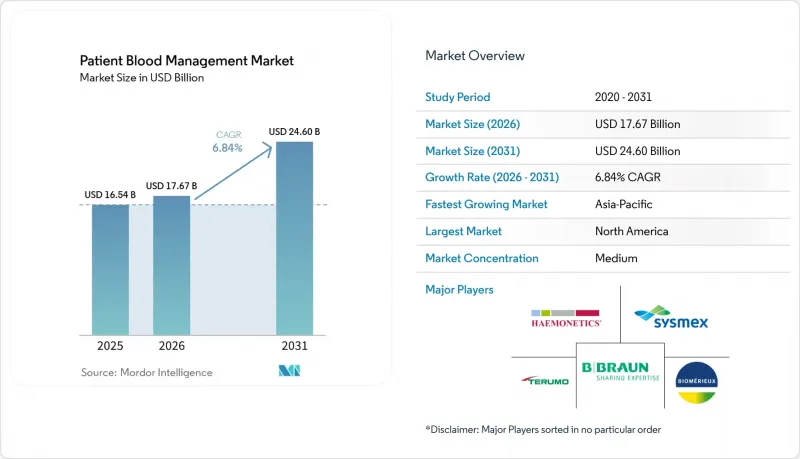
Mordor Intelligence에 의하면, 환자 혈액 관리 시장 규모는 2025년에 165억 4,000만 달러로 평가되었고, 2026년에 176억 7,000만 달러로 추정되고, 2031년까지 246억 달러에 이를 것으로 예측되며, 2026-2031년 CAGR 6.84%로 성장할 전망입니다.
본 보고서는 제품 유형별(기기, 부속품, 시약 및 키트, 소프트웨어), 최종 사용자별(병원 및 진료소, 혈액은행, 진단센터 및 검사실, 기타) 및 지역별(북미, 유럽, 아시아태평양, 중동 및 아프리카, 남미)로 분류되어 있습니다. 시장 전망은 금액(달러) 기준으로 제시되어 있습니다.
세계의 환자 혈액 관리 시장 동향 및 인사이트
선택적 수술 건수 증가와 혈액 보존 우선순위의 제고
많은 고소득 국가의 의료 시스템에서 선택적 수술 건수가 팬데믹 이전 수준을 상회하고 있어, 환자 혈액 관리 시장 수요를 끌어올리고 있습니다. 2025년 조사에 따르면, 비심장 선택적 수술에 사용되는 적혈구 1단위당 평균 491달러의 직접적인 병원 비용이 발생하며, 이는 1건당 총 비용의 중앙값의 5.2%에 해당합니다. 병원에서는 비용 관리 부서로서 혈액 관리 팀을 활용하는 추세가 점점 더 강해지고 있으며, 이는 모니터링 시스템 및 회수 시스템에 대한 설비 투자 승인에 영향을 미치고 있습니다. 2024년 EACTS 및 EACTAIC 지침에서는 현장 진단(point-of-care)에서의 점탄성 검사 알고리즘이 심장 센터의 필수 도구로 자리매김함에 따라, 이에 따라 혈전탄성측정법(thromboelastography) 및 ROTEM 플랫폼에 대한 수요가 촉진되고, 장비의 이용률과 소모품 수요가 증가하고 있습니다.
수술 전 빈혈의 선별 검사 및 치료가 PBM 도입 확대
수술 환자의 25%에서 35%에 영향을 미치는 수술 전 빈혈은 여전히 진단과 치료가 충분히 이루어지지 않고 있어, 환자 혈액 관리(PBM) 시장의 성장 가능성을 창출하고 있습니다. 치료되지 않은 빈혈은 수술 전후의 위험을 높이고, 수혈에 대한 의존도를 증가시킵니다. 2025년에 실시된 대장암 환자 1,294명을 대상으로 한 연구에 따르면, 정맥 내 철분제 투여 프로토콜을 통해 수술 후 수혈률이 10.7%로 감소했으며, 준수율도 시간이 지남에 따라 개선된 것으로 나타났습니다. 병원에서는 수요가 외래용 선별 검사 키트, 철분제 치료 및 관련 부자재와 같은 업스트림 공정으로 이동하고 있어, 시약 및 키트에 대한 수요를 끌어올리고 있습니다. AABB의 인증 프레임워크는 빈혈 선별 검사를 의료 기관의 업무 흐름에 통합하는 데 기여하고 있습니다.
PBM용 장비, 소프트웨어 및 교육에 드는 고액의 초기 비용
설비 투자는 환자 혈액 관리(PBM) 확대에 있어 여전히 주요 장애물로 남아 있으며, 특히 예산이 제한적인 지방이나 소규모 지역 병원의 경우 더욱 그러합니다. 독일에서는 2,000개 병원 중 불과 70개 병원만이 전국적인 PBM 네트워크에 참여하고 있으며, 이는 재정적 및 관리상의 어려움을 반영하고 있습니다. 2024년 옥스퍼드 대학의 연구에 따르면, 잉글랜드 국민보건서비스(NHS) 소속 병원 중 수혈 관리를 위한 첨단 임상 의사결정 지원 시스템을 도입한 곳은 고작 14.2%에 불과하며, 재정적 제약과 경영진의 참여 부족이 주요 장애 요인으로 꼽히고 있습니다. 장비 설치와 함께 체결되는 다년 계약은 장기적인 비용을 파악하기 어렵게 만드는 경우가 많으며, 그 결과 소모품 비용이 과소평가되거나 도입이 지연되는 경우가 있습니다. 2025년 WHO 지침에서는 비용 대비 효과가 높은 확대 전략이 제안되었으나, 많은 의료기관에서 도입까지의 기간은 여전히 길게 소요되고 있습니다.
부문별 분석
2025년, 환자 혈액 관리 시장의 59.6%를 기기가 차지했으며, 이는 자동 혈액 분석기, 세포 회수 시스템 및 점탄성 검사 플랫폼에 대한 10년간의 투자가 원동력이 되고 있습니다. 이러한 시스템의 이용 확대에 따라 시약 수요가 크게 증가하고 있습니다. 시약 및 키트 시장은 빈혈 선별 검사, 헌혈자 패널 검사, 응고 검사 수요 증가에 힘입어 2031년까지 연평균 성장률(CAGR) 8.76%를 기록하며 성장할 것으로 전망됩니다. 로슈가 2026년에 출시할 'cobas MPX-E' 분석은 워크플로우의 통합과 시료당 시약 사용량 증가라는 시장 변화를 여실히 보여주고 있습니다.
소프트웨어는 환자 혈액 관리 시장에서 여전히 매출 규모가 가장 작은 부문이지만, 부속품 부문은 혈액은행 및 병원에서 혈액 취급, 분리 및 아페레시스 활동이 증가함에 따라 그 혜택을 누리고 있습니다. 혈액백, 주사기, 바이알 등의 부속품은 특히 아시아태평양과 라틴아메리카에서 안정적인 수요가 나타나고 있습니다. 매출 규모는 작지만, 이 소프트웨어는 장비 사용 현황 및 수혈 프로토콜 준수 여부에 영향을 미칩니다는 점에서 전략적인 역할을 수행하고 있습니다. 병원에서는 감시 및 감사 가능성을 확보하고, 정책과 일상적인 수혈 업무 간의 일관성을 도모하기 위해 소프트웨어 도입이 진행되고 있습니다.
지역별 분석
2025년, 북미는 환자 혈액 관리 시장의 39.4%를 차지했습니다. 이는 선진적인 의료 인프라, 높은 수술 건수, 확립된 혈액 관리 거버넌스에 힘입은 결과입니다. 미국은 병원의 성과를 수혈의 안전성과 효율성이라는 결과와 연계하는 보상 체계를 통해 지역 내 수요를 견인하고 있습니다. 북미의 PBM 프로그램 도입률은 2013년 37.8%에서 2025년에는 50.2%를 나타낸 것으로 평가되었으며, 의료기관의 80.2%가 1단위 수혈 전략을 추진하고 있습니다. 캐나다는 미국의 임상 관행을 따름으로써 시장의 안정을 유지하고 있으며, 멕시코에서는 PBM 도입이 확대됨에 따라 수요가 증가하고 있습니다. 이 지역에서는 EHR(전자건강기록)과 통합된 의사결정 지원 시스템의 혜택을 누리고 있으며, 병원 업무 흐름에서 해당 공급업체의 정착률이 높아지고 있습니다.
유럽은 여전히 환자 혈액 관리 시장의 주요 주자로 자리 잡고 있으며, 독일, 영국, 프랑스, 이탈리아, 스페인이 주요 수요 거점입니다. 독일은 막대한 잠재력을 지니고 있으며, 국내 2,000개 병원 중 전국 PBM 네트워크에 참여하고 있는 곳은 불과 70개 병원에 그치고 있어, 확대 여지가 있습니다. 2024년 심장외과 지침에 따라 유럽 전역의 심장 센터에서 점탄성 검사가 공식적으로 도입되면서, TEG 및 ROTEM 플랫폼의 체계적인 업데이트 주기가 가속화되고 있습니다. 상환 제도는 국가마다 다르지만, 독일 등 시장에서는 PBM의 성과, 합병증 감소, 그리고 병원의 실적 향상 사이에 명확한 상관관계가 나타납니다.
아시아태평양은 2031년까지 연평균 성장률(CAGR)이 7.23%에 달할 전망이며, 환자 혈액 관리 시장에서 가장 빠른 성장세를 보일 것으로 전망됩니다. 중국은 환자 중심의 혈액 관리 프로토콜, 수술 전 빈혈 관리, 자가혈 수혈 촉진을 의무화하는 개정 규정을 통해 이러한 성장을 주도하고 있습니다. 해당 국가의 '국가 혈액 관리 정보 시스템'은 혈액은행 정보 시스템 및 관련 소프트웨어에 대한 병원 수요를 높이고 있습니다. 인도, 일본, 호주, 한국에서는 고령화와 수술 건수 증가에 따라 PBM 도입이 확대되고 있습니다. 한편, GCC 국가들과 남미의 일부 지역에서는 혈액은행의 자동화가 서서히 진행되고 있습니다.
기타 혜택 :
- 엑셀 형식 시장 예측(ME) 시트
- 3개월간의 애널리스트 지원
자주 묻는 질문
목차
제1장 서론
제2장 조사 방법
제3장 주요 요약
제4장 시장 구도
제5장 시장 규모 및 성장 예측
제6장 경쟁 구도
제7장 시장 기회 및 향후 전망
AJY 26.07.03According to Mordor Intelligence, the patient blood management market size is projected to be USD 16.54 billion in 2025, USD 17.67 billion in 2026, and reach USD 24.60 billion by 2031, growing at a CAGR of 6.84% from 2026 to 2031.
This report is Segmented by Product Type (Instrument, Accessories, Reagent and Kits, Software), End User (Hospitals & Clinics, Blood Banks, Diagnostic Centers & Laboratories, Others), and Geography (North America, Europe, Asia-Pacific, Middle East and Africa, South America). The Market Forecasts are Provided in Terms of Value (USD).
Global Patient Blood Management Market Trends and Insights
Rising Elective Surgical Volumes and Blood Conservation Priorities
Elective surgeries have surpassed pre-pandemic levels in many high-income healthcare systems, boosting demand in the patient blood management market. A 2025 study revealed that each unit of red blood cells used in elective non-cardiac surgeries added an average direct hospital cost of USD 491, representing 5.2% of the median total episode cost. Hospitals are increasingly leveraging blood management teams as cost-control units, influencing capital approvals for monitoring and salvage systems. The 2024 EACTS and EACTAIC guidelines elevated point-of-care viscoelastic testing algorithms to essential tools in cardiac centers, driving demand for thromboelastography and ROTEM platforms and enhancing instrument utilization and consumable demand.
Preoperative Anemia Screening and Treatment Expands PBM Adoption
Preoperative anemia, affecting 25% to 35% of surgical patients, remains underdiagnosed and untreated, creating growth potential for the patient blood management market. Untreated anemia increases perioperative risks and reliance on transfusions. A 2025 study of 1,294 colorectal cancer patients showed intravenous iron protocols reduced postoperative transfusion rates to 10.7%, with compliance improving over time. Hospitals are shifting demand upstream to outpatient screening kits, iron therapy, and related accessories, boosting reagent and kit demand. AABB certification frameworks are helping integrate anemia screening into institutional workflows.
High Upfront Cost of PBM Devices, Software, and Training
Capital expenditures remain a key barrier to expanding patient blood management (PBM), particularly for district and smaller community hospitals with limited budgets. In Germany, only 70 out of 2,000 hospitals participated in the national PBM network, reflecting financial and administrative challenges. A 2024 Oxford University study found that just 14.2% of NHS England hospitals implemented advanced clinical decision support for transfusion management, with financial constraints and limited senior engagement as major obstacles. Multi-year contracts bundled with instrument placements often obscure long-term costs, leading to underestimated consumable expenses and delayed rollouts. WHO guidance from 2025 suggests cost-effective scale-up strategies, but adoption timelines remain lengthy for many facilities.
Other drivers and restraints analyzed in the detailed report include:
- Value-Based Care and Transfusion Stewardship Pressure Hospitals to Standardize
- Expansion of Point-of-Care Testing for Rapid Blood Management Decisions
- Workflow Resistance Among Clinicians and Transfusion Committees
For complete list of drivers and restraints, kindly check the Table Of Contents.
Segment Analysis
In 2025, instruments accounted for 59.6% of the patient blood management market, driven by a decade of investments in automated blood analyzers, cell salvage systems, and viscoelastic testing platforms. Increased utilization of these systems is significantly enhancing reagent demand. Reagents and kits are projected to grow at an 8.76% CAGR through 2031, supported by rising anemia screenings, donor panels, and coagulation tests. Roche's 2026 launch of the cobas MPX-E assay highlights the market's shift toward workflow consolidation and higher reagent use per sample.
Software remains the smallest revenue segment in the patient blood management market, while accessories benefit from increased blood handling, separation, and apheresis activities in blood banks and hospitals. Accessories like blood bags, syringes, and vials see steady demand, particularly in Asia-Pacific and Latin America. Despite its smaller revenue base, software plays a strategic role in influencing instrument usage and adherence to transfusion protocols. Hospitals are adopting software for oversight, auditability, and aligning policies with daily transfusion practices.
Complete Report Scope:
- By Product Type
- Instrument
- Accessories
- Reagent and Kits
- Softwares
- By End User
- Hospitals & Clinics
- Blood Banks
- Diagnostic Centers & Laboratories
- Others
- By Geography
- North America
- United States
- Canada
- Mexico
- Europe
- Germany
- United Kingdom
- France
- Italy
- Spain
- Rest of Europe
- Asia-Pacific
- China
- India
- Japan
- Australia
- South Korea
- Rest of Asia-Pacific
- Middle East and Africa
- GCC
- South Africa
- Rest of Middle East and Africa
- South America
- Brazil
- Argentina
- Rest of South America
- North America
Geography Analysis
In 2025, North America accounted for 39.4% of the patient blood management market, driven by advanced healthcare infrastructure, high surgical volumes, and established stewardship governance. The United States leads regional demand due to a reimbursement framework linking hospital performance to transfusion safety and efficiency outcomes. PBM program adoption in North America reached 50.2% in 2025, up from 37.8% in 2013, with 80.2% of institutions promoting single-unit transfusion strategies. Canada supports market stability by aligning with U.S. clinical practices, while Mexico shows growing demand as PBM adoption expands. The region benefits from EHR-integrated decision support, increasing vendor retention in hospital workflows.
Europe remains a key player in the patient blood management market, with Germany, the United Kingdom, France, Italy, and Spain as major demand centers. Germany highlights significant potential, with only 70 of its 2,000 hospitals part of the national PBM network, leaving room for expansion. The 2024 cardiac surgery guidelines are formalizing viscoelastic testing across European cardiac centers, supporting structured replacement cycles for TEG and ROTEM platforms. Reimbursement structures vary, but markets like Germany show clear alignment between PBM outcomes, reduced complications, and improved hospital performance.
Asia-Pacific is projected to achieve the fastest growth in the patient blood management market, with a 7.23% CAGR through 2031. China drives this growth with revised regulations mandating patient-centered blood management protocols, preoperative anemia management, and autologous transfusion promotion. Its National Blood Management Information System is enhancing hospital demand for blood bank information systems and related software. India, Japan, Australia, and South Korea are scaling adoption due to aging populations and rising surgical volumes, while the GCC and parts of South America are gradually advancing blood bank automation.
- Abbott Laboratories
- B. Braun
- Baxter
- bioMerieux
- Cerus
- CSL Behring
- Danaher
- Roche
- Fresenius SE and Co. KGaA
- Grifols
- Haemonetics
- LivaNova
- Masimo
- Medtronic
- Ortho Clinical Diagnostics, LLC
- QIAGEN
- Siemens Healthineers
- Sysmex
- Terumo
- Werfen, S.A.
Additional Benefits:
- The market estimate (ME) sheet in Excel format
- 3 months of analyst support
TABLE OF CONTENTS
1 Introduction
- 1.1 Study Assumptions & Market Definition
- 1.2 Scope of the Study
2 Research Methodology
3 Executive Summary
4 Market Landscape
- 4.1 Market Overview
- 4.2 Market Drivers
- 4.2.1 Rising Elective Surgical Volumes and Blood Conservation Priorities
- 4.2.2 Preoperative Anemia Screening and Treatment Expands PBM Adoption
- 4.2.3 Value-Based Care and Transfusion Stewardship Pressure Hospitals to Standardize PBM
- 4.2.4 Expansion of Point-of-Care Testing for Rapid Blood Management Decisions
- 4.2.5 AI-Enabled Transfusion Decision Support and Analytics Improve Compliance
- 4.2.6 Reimbursement and Quality Reporting Incentives Favor Lower Transfusion Use
- 4.3 Market Restraints
- 4.3.1 High Upfront Cost of PBM Devices, Software, and Training
- 4.3.2 Workflow Resistance Among Clinicians and Transfusion Committees
- 4.3.3 Uneven Clinical Evidence Adoption Across Specialty and Resource-Constrained Facilities
- 4.3.4 Fragmented Procurement and Lack of Interoperability Across Hospital IT Systems
- 4.4 Value / Supply-Chain Analysis
- 4.5 Regulatory Landscape
- 4.6 Technological Outlook
- 4.7 Porter's Five Forces Analysis
- 4.7.1 Threat of New Entrants
- 4.7.2 Bargaining Power of Suppliers
- 4.7.3 Bargaining Power of Buyers
- 4.7.4 Threat of Substitutes
- 4.7.5 Industry Rivalry
5 Market Size & Growth Forecasts (Value, USD)
- 5.1 By Product Type
- 5.1.1 Instrument
- 5.1.2 Accessories
- 5.1.3 Reagent and Kits
- 5.1.4 Softwares
- 5.2 By End User
- 5.2.1 Hospitals & Clinics
- 5.2.2 Blood Banks
- 5.2.3 Diagnostic Centers & Laboratories
- 5.2.4 Others
- 5.3 By Geography
- 5.3.1 North America
- 5.3.1.1 United States
- 5.3.1.2 Canada
- 5.3.1.3 Mexico
- 5.3.2 Europe
- 5.3.2.1 Germany
- 5.3.2.2 United Kingdom
- 5.3.2.3 France
- 5.3.2.4 Italy
- 5.3.2.5 Spain
- 5.3.2.6 Rest of Europe
- 5.3.3 Asia-Pacific
- 5.3.3.1 China
- 5.3.3.2 India
- 5.3.3.3 Japan
- 5.3.3.4 Australia
- 5.3.3.5 South Korea
- 5.3.3.6 Rest of Asia-Pacific
- 5.3.4 Middle East and Africa
- 5.3.4.1 GCC
- 5.3.4.2 South Africa
- 5.3.4.3 Rest of Middle East and Africa
- 5.3.5 South America
- 5.3.5.1 Brazil
- 5.3.5.2 Argentina
- 5.3.5.3 Rest of South America
- 5.3.1 North America
6 Competitive Landscape
- 6.1 Market Concentration
- 6.2 Market Share Analysis
- 6.3 Company Profiles (includes Global level Overview, Market level overview, Core Segments, Financials as available, Strategic Information, Market Rank/Share for key companies, Products & Services, and Recent Developments)
- 6.3.1 Abbott Laboratories
- 6.3.2 B. Braun SE
- 6.3.3 Baxter International Inc.
- 6.3.4 bioMerieux SA
- 6.3.5 Cerus Corporation
- 6.3.6 CSL Limited
- 6.3.7 Danaher Corporation
- 6.3.8 F. Hoffmann-La Roche AG
- 6.3.9 Fresenius SE and Co. KGaA
- 6.3.10 Grifols, S.A.
- 6.3.11 Haemonetics Corporation
- 6.3.12 LivaNova PLC
- 6.3.13 Masimo Corporation
- 6.3.14 Medtronic plc
- 6.3.15 Ortho Clinical Diagnostics, LLC
- 6.3.16 QIAGEN N.V.
- 6.3.17 Siemens Healthineers AG
- 6.3.18 Sysmex Corporation
- 6.3.19 Terumo Corporation
- 6.3.20 Werfen, S.A.
7 Market Opportunities & Future Outlook
- 7.1 White-space & Unmet-need Assessment