

|
시장보고서
상품코드
2072701
미국의 여드름 치료 시장 : 시장 점유율 분석, 업계 동향 및 통계, 성장 예측(2026-2031년)U.S. Acne Treatment - Market Share Analysis, Industry Trends & Statistics, Growth Forecasts (2026 - 2031) |
||||||
 Mordor Intelligence
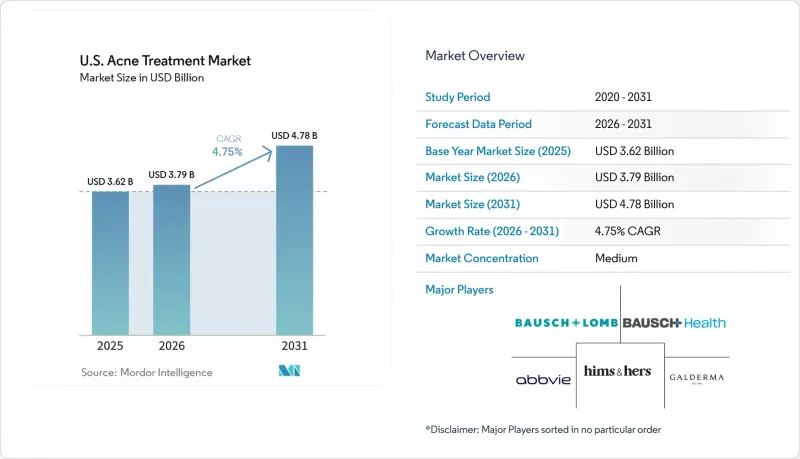
Mordor Intelligence에 의하면, 미국의 여드름 치료 시장 규모는 2025년 36억 2,000만 달러로 평가되었고, 2026년에는 37억 9,000만 달러로 추정되고, 2026-2031년 CAGR 4.75%로 성장을 지속할 전망이며, 2031년에는 47억 8,000만 달러에 이를 것으로 예측됩니다.
본 보고서는 제품 유형별(외용 레티노이드, 벤조일 퍼옥사이드, 외용 및 경구용 항생제, 이소트레티노인, 호르몬 요법, 복합 제제, 기타), 투여 경로별(외용, 경구), 성별(여성, 남성), 유통 채널별(소매, 병원, 온라인 약국, 피부과 클리닉, 메디컬 스파)로 분류되어 있습니다. 시장 전망은 금액(달러) 기준으로 제시되어 있습니다.
미국의 여드름 치료 시장 동향 및 인사이트
사춘기부터 성인기에 이르는 높은 유병률
미국에서 가장 흔한 피부 질환인 여드름은 매년 약 5,000만 명의 미국인에게 영향을 미치고 있으며, 여드름 치료 시장을 폭넓고 지속적인 치료 기반으로 뒷받침하고 있습니다. 여드름은 보통 사춘기에 발생하지만, 의사를 반복적으로 방문하거나 장기적인 유지 요법을 통해 현재 치료 수요가 성인기까지 확대되고 있습니다. 이러한 다양한 환자층이 일반의약품, 처방전이 필요한 외용약, 경구 치료제 및 유지 요법에 대한 수요를 뒷받침하고 있습니다. 삶의 질 향상과 새로운 제형에 대한 관심은 제네릭 의약품과의 경쟁이 있는 상황에서도 시장의 회복력을 더욱 강화하고 있습니다.
병용 요법에 대한 수요 증가
미국의 여드름 치료 시장은 임상의들이 한 번의 처방으로 여러 질환 경로를 동시에 다룰 수 있는 치료법을 모색함에 따라 병용 요법으로 전환되고 있습니다. CABTREO의 FDA 승인 및 출시는 이러한 추세를 입증함과 동시에 혁신의 기준을 확립했습니다. 2024년 AAD 지침은 항생제를 이용한 단일 요법보다 상호 보완적인 작용기전을 권장하고 있어, 고정 용량 복합제의 매력을 높이고 있습니다. 또한, 아다팔렌과 벤조일 퍼옥사이드에 대한 FDA의 일반의약품(OTC) 승인으로 인해 이중 작용 치료에 대한 접근성이 더욱 확대되면서, 단일 성분 제품과의 경쟁이 심화되고 있습니다.
경구용 및 외용 항생제에 대한 항생제 적정 사용에 대한 압력
미국피부과학회(AAD)는 2024년, 여드름 치료에 관한 보다 엄격한 지침을 도입하여 전신 항생제 사용을 3-4개월로 제한하는 한편, 항생제 단독 요법을 폐지했습니다. 이러한 조치로 인해 미국 여드름 치료 시장에서 기존의 경구용 및 외용 항생제의 성장이 억제되고 있습니다. 독시사이클린, 미노사이클린, 클린다마이신은 여전히 치료 과정의 일부로 남아 있지만, 그 사용이 제한됨에 따라 반복 처방과 장기적인 수익이 감소하고 있습니다. 시장은 병용 요법이나 항생제 이외의 대체 요법으로 전환되고 있으며, 이는 시장 가치의 성장을 견인하는 한편, 항생제 부문의 판매량 확대를 억제하고 있습니다.
부문별 분석
2026-2031년 미국 여드름 치료 시장에서 병용 제제는 연평균 성장률(CAGR) 5.67%를 나타낼 것으로 예측되는 반면, 2025년에는 외용 레티노이드가 28.35%의 시장 점유율을 차지했습니다. 이는 제품 구성의 변화를 보여주고 있지만, 레티노이드는 여전히 여드름 치료제의 첫 번째 선택약으로서, 또한 병용 제제의 주요 성분으로서 중심적인 위치를 차지하고 있습니다. 외용 레티노이드는 제네릭 의약품 및 OTC(일반의약품)와의 경쟁으로 인해 상품화가 진행되고 있는 기존의 단일제제 카테고리와 비교했을 때, 여전히 확고한 입지를 유지하고 있습니다.
복합 제제로의 전환은 CABTREO의 처방약 채택 확대와 디페린·에피듀오의 일반의약품 전환에 힘입어 가속화되고 있으며, 다성분 케어에 대한 인지도가 높아지고 있습니다. 벤조일 퍼옥사이드의 판매량은 여전히 상당한 비중을 차지하고 있지만, 현재는 고급 복합 제제에서 더 큰 가치를 발휘하고 있습니다. 항생제는 여전히 중요한 위치를 차지하고 있지만, 지침에서 병용 요법이나 사용 기간 단축을 권장하고 있기 때문에 장기적인 역할은 제한적입니다. 갈데르마사의 트리파로텐 사업 확대와 2025년에 예정된 화이자사의 여드름 관련 1상 임상시험 등, 성숙한 외용제 카테고리를 넘어 고부가가치의 틈새 시장을 겨냥한 혁신이 계속되고 있습니다.
2025년 현재, 미국 여드름 치료 시장에서 외용제가 63.76%를 차지했지만, 경구 요법은 2031년까지 연평균 성장률(CAGR) 5.55%로 성장할 것으로 전망됩니다. 외용제는 경증에서 중등도 증례에 대한 1차 치료제로서의 역할 덕분에 시장을 독점하고 있으며, 안정적인 판매량 기반을 확보하고 있습니다. 그러나 복잡한 증례나 성인 환자가 장기적인 경구 요법으로 전환하는 사례가 늘어나면서 그 성장세는 둔화되고 있습니다.
경구 요법은 특히 외용약에 반응하지 않는 환자를 대상으로, 장기간 투여나 보다 집중적인 치료가 필요한 고부가가치 치료법으로 주목받고 있습니다. 2026년 REMS(위험 평가 및 완화 전략)의 개정으로 인해 검사 기준이 완화되어, 이소트레티노인을 더 쉽게 처방받을 수 있게 될 것으로 예측됩니다. 이는 전신 치료나 원격 의료에 의존하고 있는 환자들에게 도움이 될 것입니다. 경구 요법의 성장은 기존의 항생제 부문에서 판매량이 광범위하게 확대된 것보다는 환자에게 제공하는 가치와 지속적인 사용에 의해 주도되고 있습니다.
기타 혜택 :
- 엑셀 형식 시장 예측(ME) 시트
- 3개월간의 애널리스트 지원
자주 묻는 질문
목차
제1장 서론
제2장 조사 방법
제3장 주요 요약
제4장 시장 구도
제5장 시장 규모 및 성장 예측
제6장 경쟁 구도
제7장 시장 기회 및 향후 전망
AJY 26.07.03According to Mordor Intelligence, the u.S. acne treatment market size is expected to grow from USD 3.62 billion in 2025 to USD 3.79 billion in 2026 and is forecast to reach USD 4.78 billion by 2031 at 4.75% CAGR over 2026-2031.
This report is Segmented by Product Type (Topical Retinoids, Benzoyl Peroxide, Topical/Oral Antibiotics, Isotretinoin, Hormonal Therapies, Combination Products, Others), Route of Administration (Topical, Oral), Gender (Female, Male), and Distribution Channel (Retail, Hospital, Online Pharmacies, Dermatology Clinics and Med Spas). The Market Forecasts are Provided in Terms of Value (USD).
U.S. Acne Treatment Market Trends and Insights
High Prevalence Across Adolescents and Adults
Acne, the most common skin condition in the United States, affects approximately 50 million Americans annually, anchoring the acne treatment market to a broad recurring treatment base. While acne typically begins in adolescence, treatment demand now extends into adulthood, driven by repeat physician visits and long-term maintenance routines. This diverse patient base sustains demand for OTC products, prescription topicals, oral therapies, and maintenance regimens. The focus on quality-of-life improvements and newer formulations further strengthens market resilience, even amid generic competition.
Rising Demand for Combination Therapy Regimens
The United States acne treatment market is shifting toward combination therapies as clinicians seek regimens addressing multiple disease pathways in a single prescription. CABTREO's FDA approval and launch validated this trend, setting a benchmark for innovation. The 2024 AAD guidelines favor complementary mechanisms over antibiotic monotherapy, enhancing the appeal of fixed-dose combinations. The FDA's OTC approval for adapalene and benzoyl peroxide further expands access to dual-mechanism care, intensifying competition with single-agent products.
Antibiotic Stewardship Pressure on Oral and Topical Antibiotics
The American Academy of Dermatology (AAD) in 2024 introduced stricter guidelines for acne treatment, capping systemic antibiotic use at 3 to 4 months and eliminating antibiotic monotherapy. These measures limit the growth of older oral and topical antibiotics in the United States acne treatment market. While doxycycline, minocycline, and clindamycin remain part of care pathways, their restricted use reduces repeat prescriptions and long-term revenue. The market is shifting toward combination therapies and non-antibiotic alternatives, driving value growth but constraining unit expansion in the antibiotic segment.
Other drivers and restraints analyzed in the detailed report include:
- Growth in Female Hormonal Acne Diagnosis
- Expanding OTC Access to Acne Therapies
- Irritation, Dryness, and Photosensitivity Limitations
For complete list of drivers and restraints, kindly check the Table Of Contents.
Segment Analysis
Combination products are expected to grow at a 5.67% CAGR in the United States acne treatment market from 2026 to 2031, while topical retinoids held a 28.35% market share in 2025. This indicates a shift in the product mix, though retinoids remain central as first-line acne care and key ingredients in combination formulations. Topical retinoids maintain a strong position compared to older single-agent categories facing commoditization due to generics and OTC competition.
The shift toward combination products has been driven by CABTREO's prescription adoption and the Differin Epiduo OTC switch, increasing visibility of multi-ingredient care. Benzoyl peroxide retains volume presence but is now more valuable in premium combination products. Antibiotics remain relevant but face limited long-term roles as guidelines favor pairing and shorter usage. Innovation continues with Galderma's trifarotene expansion and Pfizer's Phase 1 acne study in 2025, targeting higher-value niches beyond mature topical categories.
Topical formulations accounted for 63.76% of the United States acne treatment market in 2025, while oral therapies are projected to grow at a 5.55% CAGR through 2031. Topicals dominate due to their role in first-line care for mild-to-moderate cases, ensuring a durable volume base. However, growth is slowing as complex cases and adult patients shift to longer-duration oral management.
Oral therapies are gaining traction with high-value treatments requiring extended courses or greater clinical intensity, especially for patients unresponsive to topicals. The 2026 REMS update is expected to ease isotretinoin access by reducing testing barriers, benefiting patients reliant on systemic treatments and telehealth pathways. Oral growth is driven by patient value and continuity of use rather than broad volume expansion in older antibiotic categories.
Complete Report Scope:
- By Product Type
- Topical Retinoids
- Benzoyl Peroxide
- Topical Antibiotics
- Oral Antibiotics
- Isotretinoin
- Hormonal Therapies
- Combination Products
- Other Acne Therapies
- By Route of Administration
- Topical
- Oral
- By Gender
- Female
- Male
- By Distribution Channel
- Retail Pharmacies
- Hospital Pharmacies
- Online Pharmacies
- Dermatology Clinics and Med Spas
List of Companies Covered in this Report:
- Abbvie
- Acella Pharmaceuticals
- Almirall
- Amneal Pharmaceuticals
- Bausch + Lomb Corporation
- Bausch Health
- Cosette Pharmaceuticals, Inc.
- Dermavant Sciences, Inc.
- Galderma Group AG
- Hims & Hers Health, Inc.
- Journey Medical
- Leo Pharma
- Ortho Dermatologics
- Perrigo Company
- Pfizer
- Reckitt Benckiser Group
- Sun Pharmaceuticals Industries
- Taro Pharmaceutical Industries Ltd.
- Teva Pharmaceutical Industries
- Viatris
Additional Benefits:
- The market estimate (ME) sheet in Excel format
- 3 months of analyst support
TABLE OF CONTENTS
1 INTRODUCTION
- 1.1 Study Assumptions and Market Definition
- 1.2 Scope of the Study
2 RESEARCH METHODOLOGY
3 EXECUTIVE SUMMARY
4 MARKET LANDSCAPE
- 4.1 Market Overview
- 4.2 Market Drivers
- 4.2.1 High Prevalence Across Adolescents and Adults
- 4.2.2 Rising Demand for Combination Therapy Regimens
- 4.2.3 Growth in Female Hormonal Acne Diagnosis and Treatment
- 4.2.4 Expanding OTC Access to Acne Therapies
- 4.2.5 Digital Dermatology and Tele-dermatology Prescription Enablement
- 4.2.6 Strong Clinical Preference for Long-term Maintenance Therapy
- 4.3 Market Restraints
- 4.3.1 Antibiotic Stewardship Pressure on Oral and Topical Antibiotics
- 4.3.2 Irritation, Dryness, and Photosensitivity Limiting Adherence
- 4.3.3 iPLEDGE and Pregnancy-prevention Compliance Burden for Isotretinoin
- 4.3.4 High Out-of-pocket Sensitivity for Brand-name Dermatology Therapies
- 4.4 Value/Supply Chain Analysis
- 4.5 Regulatory Landscape
- 4.6 Technological Outlook
- 4.7 Porter's Five Forces Analysis
- 4.7.1 Bargaining Power of Suppliers
- 4.7.2 Bargaining Power of Buyers
- 4.7.3 Threat of New Entrants
- 4.7.4 Threat of Substitutes
- 4.7.5 Industry Rivalry
5 MARKET SIZE AND GROWTH FORECASTS (VALUE USD)
- 5.1 By Product Type
- 5.1.1 Topical Retinoids
- 5.1.2 Benzoyl Peroxide
- 5.1.3 Topical Antibiotics
- 5.1.4 Oral Antibiotics
- 5.1.5 Isotretinoin
- 5.1.6 Hormonal Therapies
- 5.1.7 Combination Products
- 5.1.8 Other Acne Therapies
- 5.2 By Route of Administration
- 5.2.1 Topical
- 5.2.2 Oral
- 5.3 By Gender
- 5.3.1 Female
- 5.3.2 Male
- 5.4 By Distribution Channel
- 5.4.1 Retail Pharmacies
- 5.4.2 Hospital Pharmacies
- 5.4.3 Online Pharmacies
- 5.4.4 Dermatology Clinics and Med Spas
6 COMPETITIVE LANDSCAPE
- 6.1 Market Concentration
- 6.2 Market Share Analysis
- 6.3 Company Profiles (includes Global Level Overview, Market Level Overview, Core Segments, Financials as available, Strategic Information, Market Rank/Share, Products and Services, Recent Developments)
- 6.3.1 AbbVie Inc.
- 6.3.2 Acella Pharmaceuticals, LLC
- 6.3.3 Almirall, S.A.
- 6.3.4 Amneal Pharmaceuticals, Inc.
- 6.3.5 Bausch + Lomb Corporation
- 6.3.6 Bausch Health Companies Inc.
- 6.3.7 Cosette Pharmaceuticals, Inc.
- 6.3.8 Dermavant Sciences, Inc.
- 6.3.9 Galderma Group AG
- 6.3.10 Hims & Hers Health, Inc.
- 6.3.11 Journey Medical Corporation
- 6.3.12 LEO Pharma A/S
- 6.3.13 Ortho Dermatologics
- 6.3.14 Perrigo Company plc
- 6.3.15 Pfizer Inc.
- 6.3.16 Reckitt Benckiser Group plc
- 6.3.17 Sun Pharmaceutical Industries Limited
- 6.3.18 Taro Pharmaceutical Industries Ltd.
- 6.3.19 Teva Pharmaceutical Industries Limited
- 6.3.20 Viatris Inc.
7 MARKET OPPORTUNITIES AND FUTURE OUTLOOK
- 7.1 White-space and Unmet-need Assessment


