|
시장보고서
상품코드
2072742
AI 기반 사전 승인 시장 : 시장 점유율 분석, 업계 동향 및 통계, 성장 예측(2026-2031년)AI-Based Prior Authorization - Market Share Analysis, Industry Trends & Statistics, Growth Forecasts (2026 - 2031) |
||||||
 Mordor Intelligence
Mordor Intelligence에 의하면, AI 기반 사전 승인 시장 규모는 2025년 15억 달러로 평가되었고, 2026년에는 17억 4,000만 달러로 추정되고, 2026-2031년 CAGR 19.38%로 성장을 지속할 전망이며, 2031년에는 42억 1,000만 달러에 이를 것으로 예측됩니다.
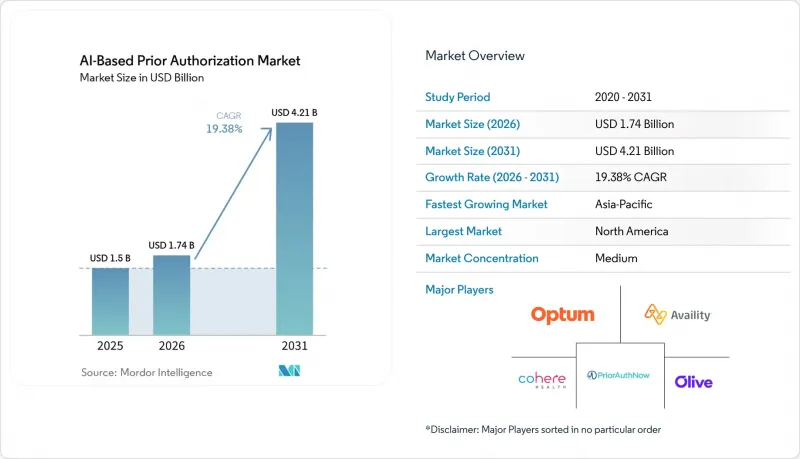
본 보고서는 구성 요소별(소프트웨어 플랫폼 및 서비스), 도입 형태별(클라우드 기반 및 온프레미스형), 용도별(입원 및 외래 진료, 기타), 최종 사용자별(의료 보험사, 기타), 지역별(북미, 유럽, 아시아태평양, 중동 및 아프리카, 남미)로 분류되어 있습니다. 시장 전망치는 금액(달러)으로 표시되어 있습니다.
세계의 AI 기반 사전 승인 시장 동향 및 인사이트
마찰 없는 승인을 원하는 지급 기관 수요가 급증하고 있습니다.
AI 기반 사전 승인 시장은 수동 심사에 수반되는 비효율의 규모에 힘입어 성장하고 있습니다. 이는 CMS(미국 의료보험서비스센터)가 미국 의료 시스템 전반에 걸친 사전 승인에 따른 행정적 부담을 연간 350억 달러로 추산하고, 보고된 의료 사례의 92%에서 지연의 원인이 되고 있다고 지적했기 때문입니다. 또한 CMS는 의사들이 사전 승인 업무에 주당 평균 13시간을 소비하고 있으며, 이는 의료 제공업체 1인당 연간 700시간, 3만 4,000달러에 해당하며, 이 시간은 본래 환자 치료에 할애되었어야 할 시간이라고 지적하고 있습니다. 보험자가 가치가 낮은 요건을 줄인다고 해도, 이러한 부담은 해소되지 않습니다. 왜냐하면 나머지 신청 건들은 임상적으로 복잡해져서, 자동화 없이는 처리가 어려워졌기 때문입니다. 유나이티드 헬스케어는 2026년 5월, 2026년 말까지 나머지 서비스의 30%에 대한 사전 승인 요건을 철폐할 것이라고 발표했습니다. 이는 보다 단순한 신청 건이 제외되는 반면, 보다 복잡한 사례만 워크플로우에 남게 된다는 관점을 뒷받침하는 것입니다. AI 기반 사전 승인 시장에서 이러한 추세에 따라, 단순히 처리 건수를 늘리는 것이 아니라, 전문 의약품, 종양학 치료 경로, 희귀질환 관련 문서를 수작업은 최소화하고 증거 대조를 보다 적절하게 수행할 수 있는 도구에 대한 수요가 높아지고 있습니다.
CMS 상호운용성 의무(2026-2028년)
AI 기반 사전 승인 시장에서 단기적으로 가장 큰 추진력이 되고 있는 것은 CMS-0057-F입니다. 이 규정에 따르면, 메디케어 어드밴티지 조직, 메디케이드 및 CHIP의 종량제 프로그램, 메디케이드 관리형 의료 플랜, CHIP 관리의료 사업체, 그리고 연방 정부가 운영하는 보험 거래소(Federally Facilitated Exchanges)의 적격 건강보험 플랜(Qualified Health Plan) 발행자에게 더 신속한 결정 기한 준수와 FHIR 기반 사전 승인 API 구축이 요구되고 있습니다. 새로운 처리 기한 요건의 시행일인 2026년 1월 1일이 되면서, 이미 조달 활동에 변화가 나타나고 있습니다. 이는 도입 지연이 해당 기관에 업무상의 위험이나 평판 하락과 같은 직접적인 위험을 초래하게 되었기 때문입니다. 그 후, CMS는 2026년 4월, 규정안 CMS-0062-P를 통해 이러한 압력을 더욱 강화했습니다. 이 규정안이 최종 확정되면, 의료 급여와 약국 급여 모두에서 청구되는 의약품이 전자 사전 승인 체계에 포함되며, 이러한 거래에 있어 HIPAA의 행정 표준으로 HL7 FHIR이 채택되게 됩니다. 승인율, 기각율 및 평균 처리 시간에 관한 연례 공개 보고 요건은 추가적인 부담을 가중시키고 있습니다. 왜냐하면 성과는 더 이상 단순한 내부 운영상의 문제가 아니라, 규제 당국, 의료 제공업체, 그리고 경쟁 보험 상품에도 공개되게 되었기 때문입니다. AI 기반 사전 승인 시장에서 이러한 기한, 기준 및 투명성의 조합은 공급업체와 구매자가 더 신속한 도입 주기를 추구하도록 유도하며, 감사에 견딜 수 있는 자동화에 대한 노력을 강화하고 있습니다.
데이터 공유에 따른 책임에 대한 우려
AI 기반 사전 승인 시장은 데이터 공유로 인한 위험으로 인해 실질적인 제약을 받고 있습니다. API를 활용한 광범위한 데이터 교환으로 인해, 사전 승인 워크플로우에서 보호 대상 건강 정보에 접근하는 시스템이나 공급업체의 수가 증가하기 때문입니다. KFF는 2025년에 정책상의 근본적인 격차를 지적했습니다. HIPAA는 보험 플랜, 의료 제공업체, 정보 교환 센터에는 적용되지만, 상호 운용 가능한 시스템을 통해 의료 데이터에 접근할 가능성이 있는 모든 AI 기술 공급업체에는 적용되지 않는다는 점입니다. 또한 KFF는 일반 시민의 77%가 AI 도구와 공유되는 개인 건강 정보의 개인정보 보호에 대해 우려하고 있다는 사실도 밝혔습니다. 이는 도입 결정이 생산성과 마찬가지로 신뢰에 의해서도 좌우되게 되었습니다는 것을 의미합니다. 제안된 연방 정부의 체계는 전자화된 보호 대상 의료 정보에 접근하는 AI 시스템에 대해 자산 관리, 로그 기록, 계약상 관리를 강화하는 방향으로 나아가고 있지만, 이러한 요건들은 도입 비용을 상승시키고 조달을 지연시키는 요인이 되기도 합니다. AI 기반 사전 승인 시장에서 이러한 제약은 중요한 의미를 지닙니다. 왜냐하면 구매자들은 보다 신속한 자동화를 원하면서도, 대규모 대상층에 확대 적용하기 전에 보다 강력한 거버넌스, 보다 명확한 비즈니스 파트너 체제, 그리고 데이터 이용에 관한 보다 명확한 법적 경계가 필요하기 때문입니다.
부문별 분석
2025년에는 소프트웨어 플랫폼이 매출의 51.44%를 차지했으며, AI 기반 사전 승인 시장에서 주도적인 입지를 확립했습니다. 이는 대규모 민간 보험사 및 약국 급여 관리자들이 기존 이용 관리 팀에 적합한, 이미 라이선스를 취득한 플랫폼을 계속해서 선호했기 때문입니다. 이러한 우위는 규모, 통합 관리, 그리고 오랜 기간에 걸친 보험사의 업무 체계 내에서 임상 경로를 구성하는 능력을 중시한 구매 행동을 반영한 것입니다. 한편, 서비스 부문은 2031년까지 연평균 성장률(CAGR) 19.67%로 확대될 것으로 예측되며, 이는 AI 기반 사전 승인 시장이 단순한 라이선싱에서 도입 지원, 워크플로우 재설계, 거버넌스를 중시하는 서비스 제공으로 전환되고 있음을 보여줍니다. 이러한 경향은 규정 준수의 복잡성이 많은 조직이 사내 팀만으로는 대응할 수 있는 속도를 앞지르며 진행되고 있다는 점과, AI 기반 사전 승인 업계의 현황과 일치합니다.
서비스 분야의 확대는 실무상의 역량 격차에 힘입어 이루어지고 있습니다. 많은 중견 보험사 및 관리 기관에는 새로운 CMS 규정 해석, FHIR API 설정, 표준 라이브러리 유지 관리, 그리고 자동화된 의사 결정 거버넌스 방법의 문서화에 필요한 인력이 부족하기 때문입니다. 그 결과, 매니지드 서비스, 도입 지원, 모델 모니터링, 규정 준수 보고가 핵심 플랫폼을 중심으로 한 장기 지속 계약에 포함됨에 따라, AI 기반 사전 승인 시장의 서비스 규모는 확대되고 있습니다. GenAI 코파일럿도 이러한 추세를 더욱 가속화하고 있습니다. 이는 조직들이 현재 대화형 및 앰비언트형 도구를 실제 임상 워크플로우에 도입하기 전에, 감사 로그, 익명화 제어, 모델 테스트 및 비즈니스 파트너의 감독과 관련된 지원이 필요하기 때문입니다.
2025년에는 클라우드 기반 도입이 매출의 55.76%를 차지했으며, AI 기반 사전 승인 시장에서 가장 큰 비중을 차지하는 도입 모델이 되었습니다. 이는 구매자들이 이미 기존의 온프레미스형 이용 관리 스택에서 점차 전환하고 있음을 보여줍니다. 또한, 클라우드 시장은 2031년까지 연평균 성장률(CAGR) 20.17%를 기록하며 성장할 것으로 예상되며, 새로운 규정 준수 및 상호 운용성 요건이 시행됨에 따라 현재 주도적인 위치를 차지하고 있는 이 모델은 그 우위를 더욱 확대해 나갈 전망입니다. 성숙한 소프트웨어 부문에서는 시장 점유율 상위 부문의 성장세가 가장 먼저 둔화되는 경우가 많기 때문에 이러한 조합은 드문 현상이지만, AI 기반 사전 승인 시장은 전환의 초기 단계에 있기 때문에 클라우드가 레거시 환경에서 시장 점유율을 빼앗을 여지가 여전히 남아 있습니다. 이러한 도입 동향은 현대의 사전 승인 프로그램 운영 요구 사항도 반영하고 있습니다. 이러한 프로그램에서는 거래량이 가입 주기에 따라 변동하며, 보고 요건이 지속적으로 적용되므로, 정적인 로컬 인프라로는 여러 사업체 간의 연결성을 효율적으로 처리할 수 없습니다.
온프레미스 도입은 엄격한 거주 요건 및 관리 요건을 갖춘 정부 기관의 구매자나 통합 의료 제공 네트워크에게는 여전히 중요하지만, 그러한 조직들조차도 핵심 임상 데이터의 저장과 확장 가능한 추론 및 라우팅 기능을 분리된 하이브리드 모델로 전환하고 있습니다. AI 기반 사전 승인 시장에서 클라우드 아키텍처는 API 가동 시간 측정, 감사 가능성, 그리고 보험사 간 데이터 교환을 온프레미스 환경에서는 경제적으로 구현하기 어려운 방식으로 지원하고 있습니다. Waystar사는 2026년 1월, AltitudeAI 플랫폼을 통해 에이전트형 AI 기능을 도입하고, 임상, 재무, 관리 각 분야의 전문 지식을 통합하여 신청 시 근거를 더욱 탄탄하게 함으로써 이러한 방향성을 한층 더 강화했습니다.
지역별 분석
2025년, 북미는 매출의 52.23%를 차지했으며, AI 기반 사전 승인 시장에서 지역별 1위를 차지했습니다. 이는 미국 의료 제도에서 유례없이 높은 관리 부담을 반영한 것입니다. 이 지역의 규모는 민간 보험의 복잡성, 메디케어 어드밴티지 이용 관리, 대규모 의료 제공업체 네트워크의 편차, 그리고 사전 승인 절차의 현대화를 '선택적 업그레이드'가 아니라 '긴급한 운영상의 필요성'으로 변경된 규제 일정이 맞물려 형성되고 있습니다. CMS-0057-F는 2026년 1월 1일이라는 기한에 따라 처리 시간, 거부 사유에 대한 구체성 및 성과 보고가 대상 기관의 적극적인 의무가 됨에 따라 그 시급성이 더욱 높아졌습니다. 북미의 AI 기반 사전 승인 시장은 제2의 정책 흐름에 힘입어 점차 형성되고 있습니다. 2026년 4월 CMS-0062-P 제안에 따라, 전자 사전 승인 규정이 의료 급여 및 약국 급여 모두에서 청구되는 의약품으로 확대됨에 따라, 디지털 처리 대상 거래의 범위가 넓어지기 때문입니다. 캐나다와 멕시코는 여전히 시장 규모가 작지만, 두 나라 모두 지불 주체와 공공 제도가 업무 처리 부담을 줄이고 승인 절차의 일관성을 높여야 하는 지역적 환경에 놓여 있습니다.
아시아태평양은 2031년까지 연평균 성장률(CAGR) 21.32%를 기록하며 성장할 것으로 예상되며, 북미에 비해 출발점은 작지만 AI 기반 사전 승인 시장에서 가장 두드러진 성장을 보일 것으로 전망됩니다. 이 지역의 성장 요인으로는 디지털 헬스 인프라 구축, 보험 청구 디지털화의 확대, 그리고 여러 국가가 현재 보험금 지급 심사 워크플로우 자동화에 필요한 정책 및 데이터 환경을 마련해 나가고 있다는 사실을 들 수 있습니다. 일본은 적응형 헬스케어 AI 제품에 대해 비교적 체계적인 규제 체계를 제공하고 있는 반면, 인도에서는 보험 보급이 확대됨에 따라 디지털 헬스 분야에서의 노력이 보험 청구 연동형 자동화의 기반을 넓혀가고 있습니다. 따라서 아시아태평양의 AI 기반 사전 승인 시장은 기존 시스템을 대체하기보다는 새로운 디지털 헬스케어 기반 위에 승인 워크플로를 구축할 수 있는 능력으로 특징지어지며, 이를 통해 공급업체는 도입 주기의 초기 단계에서 프로세스 설계를 형성할 여지가 생기고 있습니다.
유럽, 중동 및 아프리카에서는 AI 기반 사전 승인 시장에서 더욱 복잡한 양상이 나타나고 있습니다. 이는 보험 청구 및 업무 흐름 자동화에 대한 기관 측의 관심이 높아지고 있는 반면, 개인정보 보호 및 국경을 넘는 데이터에 관한 규제가 미국보다 여전히 엄격하기 때문입니다. 유럽에서는 일부 국가에서 승인 및 도입 절차가 구조적으로 유사하지만, 자동화 진행 상황에는 차이가 있으며, 공급업체는 확장 가능한 모델을 구축할 때 더 엄격한 동의, 거버넌스 및 2차 데이터 활용에 관한 요건을 충족해야 합니다. 중동에서는 GCC(걸프협력회의) 회원국들의 의료 시스템이 청구 관리 및 보다 광범위한 디지털 전환 프로그램에 투자하고 있어, 상호 운용성과 규정 준수 기능을 갖춘 플랫폼을 보유한 공급업체들에게 더 장기적인 비즈니스 기회가 창출되고 있습니다. 남미에서는 여전히 도입 속도가 완만하며, 브라질이나 아르헨티나에서는 공공 및 민간 지불자 구조가 명확하게 구분되어 있어 통일된 도입이 지연될 가능성이 있지만, 규제 현대화를 통해 청구 워크플로우 준비가 완료된 분야에서는 대상 범위를 좁혀 도입이 진행되고 있습니다. 따라서, 이들 지역의 AI 기반 사전 승인 시장은 지역마다 각기 다른 경로를 통해 확대되고 있으며, 도입 속도를 결정하는 데 있어 순수한 기술적 준비 상태보다 정책의 명확성과 데이터 거버넌스가 더 중요한 요소로 작용하고 있습니다.
기타 혜택 :
- 엑셀 형식 시장 예측(ME) 시트
- 3개월간의 애널리스트 지원
자주 묻는 질문
목차
제1장 서론
제2장 조사 방법
제3장 주요 요약
제4장 시장 구도
제5장 시장 규모 및 성장 예측
제6장 경쟁 구도
제7장 시장 기회 및 향후 전망
AJY 26.07.03According to Mordor Intelligence, the AI-based prior authorization market size is expected to grow from USD 1.50 billion in 2025 to USD 1.74 billion in 2026 and is forecasted to reach USD 4.21 billion by 2031 at 19.38% CAGR over 2026-2031.
This report is Segmented by Component (Software Platform and Services), Deployment Mode (Cloud-Based and On-Premise), Application (Inpatient and Outpatient Procedures, and Others), End-User (Healthcare Payers, and Others), and Geography (North America, Europe, Asia-Pacific, Middle East and Africa, South America). The Market Forecasts are Provided in Terms of Value (USD).
Global AI-Based Prior Authorization Market Trends and Insights
Surge In Payer Demand for Friction-Free Approvals
The AI-based prior authorization market is being lifted by the scale of waste tied to manual review, because CMS placed the administrative burden of prior authorization at USD 35 billion a year across the U.S. healthcare system and linked it to delays in 92% of reported care episodes.CMS also noted that physicians spent an average of 13 hours a week on prior authorization work, which translated into 700 hours and USD 34,000 per provider each year that could otherwise support patient care. That burden is not disappearing, even when payers reduce low-value requirements, because the remaining requests are becoming more clinically dense and harder to process without automation. UnitedHealthcare stated in May 2026 that it would remove prior authorization requirements for 30% of remaining services by the end of 2026, which supports the view that simpler requests are being taken out while harder cases stay in the workflow. In the AI-based prior authorization market, that pattern shifts demand toward tools that can handle specialty drugs, oncology pathways, and rare disease documentation with fewer touches and better evidence matching rather than just higher transaction volume.
CMS Interoperability Mandates (2026-2028)
The AI-based prior authorization market is seeing its strongest near-term push from CMS-0057-F, which requires Medicare Advantage organizations, Medicaid and CHIP fee-for-service programs, Medicaid managed care plans, CHIP managed care entities, and Qualified Health Plan issuers on the Federally Facilitated Exchanges to meet faster decision timelines and build FHIR-based prior authorization APIs. The January 1, 2026 effective date for the new turnaround requirements has already changed procurement behavior, because delayed implementation now carries direct operational and reputational risk for covered entities. CMS then extended the pressure in April 2026 through proposed rule CMS-0062-P, which would bring drugs billed under both medical and pharmacy benefits into the electronic prior authorization framework and would make HL7 FHIR the HIPAA administrative standard for these transactions once finalized. The annual public reporting requirement for approval rates, denial rates, and average turnaround times adds another layer, because performance is no longer only an internal operations issue and becomes visible to regulators, providers, and competing plans. Within the AI-based prior authorization market, this combination of deadlines, standards, and transparency is pushing vendors and buyers toward faster deployment cycles and a stronger focus on automation that can hold up under audit.
Data-Sharing Liability Concerns
The AI-based prior authorization market faces a real brake from data-sharing risk, because broader API-based exchange increases the number of systems and vendors that touch protected health information during prior authorization workflows. KFF highlighted a core policy gap in 2025, noting that HIPAA applies to plans, providers, and clearinghouses, but not to every AI technology vendor that may gain access to health data through interoperable systems. KFF also found that 77% of the public was concerned about the privacy of personal health information shared with AI tools, which means adoption decisions are now shaped by trust as much as by productivity. The proposed federal framework is moving toward tighter inventory, logging, and contractual controls for AI systems that access electronic protected health information, but those requirements also raise deployment cost and slow procurement. In the AI-based prior authorization market, this restraint matters because buyers want faster automation, yet they also need stronger governance, clearer business associate structures, and a cleaner legal boundary for data use before scaling across large populations.
Other drivers and restraints analyzed in the detailed report include:
- Rapid EHR-Payer API Standardization (HL7 FHIR-Based)
- Cost-Containment Pressure Amid Value-Based Care Shift
- Payer-Provider Trust Gap in Black-Box Models
For complete list of drivers and restraints, kindly check the Table Of Contents.
Segment Analysis
Software platform held 51.44% of revenue in 2025, giving it the leading position in the AI-based prior authorization market as large commercial payers and pharmacy benefit managers continued to favor licensed platforms that fit established utilization management teams. That lead reflected buying behavior built around scale, integration control, and the ability to configure clinical pathways inside long-standing payer operations. At the same time, services is projected to advance at a 19.67% CAGR through 2031, showing that the AI-based prior authorization market is shifting toward implementation support, workflow redesign, and governance-heavy delivery rather than software licensing alone. This pattern fits the current stage of the AI-based prior authorization industry, where compliance complexity is rising faster than many organizations can absorb through internal teams.
The services expansion is being reinforced by a practical gap in capabilities, because many mid-tier payers and administrators lack the staff needed to interpret new CMS rules, configure FHIR APIs, maintain criteria libraries, and document how automated decisions are governed. As a result, the AI-based prior authorization market size for services is rising as managed services, implementation support, model monitoring, and compliance reporting are bundled into longer recurring contracts around the core platform. GenAI copilots are adding to this effect, because organizations now need support for audit logs, de-identification controls, model testing, and business associate oversight before putting conversational or ambient tools into live clinical workflows.
Cloud-based deployment accounted for 55.76% of revenue in 2025, which made it the largest deployment model in the AI-based prior authorization market and showed that buyers are already moving beyond older on-premise utilization management stacks. Cloud is also projected to grow at a 20.17% CAGR through 2031, so the same model that leads today is also widening its position as new compliance and interoperability requirements take effect. This combination is unusual in a more mature software category, because top-share segments often slow first, yet the AI-based prior authorization market remains early enough in migration that cloud still has room to pull share from legacy environments. The deployment trend also reflects the operating needs of modern prior authorization programs, where transaction volumes shift with enrollment cycles, reporting requirements are continuous, and multi-entity connectivity cannot be handled efficiently through static local infrastructure.
On-premise deployments still matter for government buyers and integrated delivery networks with strict residency or control requirements, but even those organizations are moving toward hybrid models that separate core clinical storage from scalable inference and routing functions. In the AI-based prior authorization market, cloud architecture supports API uptime measurement, auditability, and payer-to-payer data exchange in ways that are harder to reproduce economically on premises. Waystar reinforced this direction in January 2026 when it introduced agentic AI capabilities through its AltitudeAI platform to combine clinical, financial, and administrative intelligence and generate stronger justification at submission.
Complete Report Scope:
- By Component
- Software Platform
- Services
- By Depolyment Mode
- Cloud-Based
- On-Premise
- By Application
- Inpatient and Outpatient Procedures
- Pharmacy and Specialty Drugs
- Durable Medical Equipment
- Diagnostics and Imaging Approvals
- By End-User
- Healthcare Payers
- Healthcare Providers
- Third-party Administrators (TPAs)
- By Geography
- North America
- United States
- Canada
- Mexico
- Europe
- Germany
- United Kingdom
- France
- Italy
- Spain
- Rest of Europe
- Asia-Pacific
- China
- Japan
- India
- Australia
- South Korea
- Rest of Asia-Pacific
- Middle East and Africa
- GCC
- South Africa
- Rest of Middle East and Africa
- South America
- Brazil
- Argentina
- Rest of South America
- North America
Geography Analysis
North America held 52.23% of revenue in 2025, which gave it the leading regional position in the AI-based prior authorization market and reflected the unusually high administrative burden of the U.S. healthcare system. The region's scale is tied to a mix of private insurance complexity, Medicare Advantage utilization controls, large provider network variation, and a regulatory calendar that turned prior authorization modernization into an urgent operating need rather than a discretionary upgrade. CMS-0057-F pushed that urgency further when the January 1, 2026 deadlines made turnaround times, denial specificity, and performance reporting active obligations for covered entities. The AI-based prior authorization market in North America is also being shaped by a second policy wave, because the April 2026 CMS-0062-P proposal would extend electronic prior authorization rules to drugs billed under both medical and pharmacy benefits and widen the universe of transactions subject to digital processing. Canada and Mexico remain smaller opportunities, but both sit within a regional environment where payers and public systems are under pressure to lower administrative drag and improve approval consistency.
Asia-Pacific is projected to grow at a 21.32% CAGR through 2031, which makes it the fastest-growing regional pocket in the AI-based prior authorization market even though it starts from a smaller base than North America. The regional growth case rests on digital health infrastructure build-out, expanding claims digitization, and the fact that several countries are now creating the policy and data conditions needed for workflow automation in reimbursement review. Japan offers one of the more structured regulatory pathways for adaptive health AI products, while India's digital health push is widening the foundation for claims-linked automation as insurance penetration grows. The AI-based prior authorization market in Asia-Pacific is therefore being defined less by legacy replacement and more by the ability to build authorization workflows on top of newer digital health rails, which gives vendors room to shape process design earlier in the adoption cycle.
Europe and the Middle East & Africa show a more mixed pattern in the AI-based prior authorization market, because institutional interest in claims and workflow automation is rising while privacy and cross-border data rules remain stricter than in the United States. Europe has structurally similar approval and referral processes in several countries, but automation remains uneven and vendors must navigate tighter consent, governance, and secondary data use expectations when building scalable models. In the Middle East, GCC health systems are investing in claims management and broader digital transformation programs, which creates a longer-cycle opening for vendors with interoperable and compliance-ready platforms. South America remains more gradual, with Brazil and Argentina shaped by distinct public and private payer structures that can slow uniform rollout but still support targeted adoption where regulatory modernization improves claims workflow readiness. The AI-based prior authorization market across these regions is therefore expanding through uneven pathways, with policy clarity and data governance carrying more weight than pure technology readiness in determining adoption speed.
- AKASA
- Availity
- Cognizant
- Cohere Health
- Edifecs
- eviCore healthcare
- Flatten AI
- IBM
- Infinx Healthcare
- MCG Health
- NantHealth
- Olive AI
- Optum
- PriorAuthNow
- Rhyme
- Surescripts
- VisiQuate
- Waystar
- Xealth
- Zelis
Additional Benefits:
- The market estimate (ME) sheet in Excel format
- 3 months of analyst support
TABLE OF CONTENTS
1 Introduction
- 1.1 Study Assumptions and Market Definition
- 1.2 Scope of the Study
2 Research Methodology
3 Executive Summary
4 Market Landscape
- 4.1 Market Overview
- 4.2 Market Drivers
- 4.2.1 Surge In Payer Demand for Friction-Free Approvals
- 4.2.2 CMS Interoperability Mandates (2026-2028)
- 4.2.3 Rapid EHR-Payer API Standardization (HL7 FHIR-Based)
- 4.2.4 Cost-Containment Pressure Amid Value-Based Care Shift
- 4.2.5 Emergence of GenAI Copilots for Prior-Auth Coding
- 4.2.6 Specialty-Drug Benefit Design Complexity
- 4.3 Market Restraints
- 4.3.1 Data-Sharing Liability Concerns
- 4.3.2 Limited AI Training Datasets for Rare Specialties
- 4.3.3 Payer-Provider Trust Gap in Black-Box Models
- 4.3.4 Fragmented State-Level Rule Variations
- 4.4 Value Chain Analysis
- 4.5 Regulatory Landscape
- 4.6 Technological Outlook
- 4.7 Porter's Five Forces Analysis
- 4.7.1 Threat of New Entrants
- 4.7.2 Bargaining Power of Suppliers
- 4.7.3 Bargaining Power of Buyers
- 4.7.4 Threat of Substitutes
- 4.7.5 Competitive Rivalry
5 Market Size & Growth Forecasts (Value, USD)
- 5.1 By Component
- 5.1.1 Software Platform
- 5.1.2 Services
- 5.2 By Depolyment Mode
- 5.2.1 Cloud-Based
- 5.2.2 On-Premise
- 5.3 By Application
- 5.3.1 Inpatient and Outpatient Procedures
- 5.3.2 Pharmacy and Specialty Drugs
- 5.3.3 Durable Medical Equipment
- 5.3.4 Diagnostics and Imaging Approvals
- 5.4 By End-User
- 5.4.1 Healthcare Payers
- 5.4.2 Healthcare Providers
- 5.4.3 Third-party Administrators (TPAs)
- 5.5 By Geography
- 5.5.1 North America
- 5.5.1.1 United States
- 5.5.1.2 Canada
- 5.5.1.3 Mexico
- 5.5.2 Europe
- 5.5.2.1 Germany
- 5.5.2.2 United Kingdom
- 5.5.2.3 France
- 5.5.2.4 Italy
- 5.5.2.5 Spain
- 5.5.2.6 Rest of Europe
- 5.5.3 Asia-Pacific
- 5.5.3.1 China
- 5.5.3.2 Japan
- 5.5.3.3 India
- 5.5.3.4 Australia
- 5.5.3.5 South Korea
- 5.5.3.6 Rest of Asia-Pacific
- 5.5.4 Middle East and Africa
- 5.5.4.1 GCC
- 5.5.4.2 South Africa
- 5.5.4.3 Rest of Middle East and Africa
- 5.5.5 South America
- 5.5.5.1 Brazil
- 5.5.5.2 Argentina
- 5.5.5.3 Rest of South America
- 5.5.1 North America
6 Competitive Landscape
- 6.1 Market Concentration
- 6.2 Market Share Analysis
- 6.3 Company Profiles (includes Global level Overview, Market level overview, Core Segments, Financials as available, Strategic Information, Market Rank/Share for key companies, Products & Services, Recent Developments)
- 6.3.1 AKASA
- 6.3.2 Availity
- 6.3.3 Cognizant
- 6.3.4 Cohere Health
- 6.3.5 Edifecs
- 6.3.6 eviCore healthcare
- 6.3.7 Flatten AI
- 6.3.8 IBM
- 6.3.9 Infinx Healthcare
- 6.3.10 MCG Health
- 6.3.11 NantHealth
- 6.3.12 Olive AI
- 6.3.13 Optum
- 6.3.14 PriorAuthNow
- 6.3.15 Rhyme
- 6.3.16 Surescripts
- 6.3.17 VisiQuate
- 6.3.18 Waystar
- 6.3.19 Xealth
- 6.3.20 Zelis
7 Market Opportunities & Future Outlook
- 7.1 White-space & Unmet-need Assessment