

|
시장보고서
상품코드
2072746
웨어러블 헬스 분야 AI 시장 : 시장 점유율 분석, 업계 동향 및 통계, 성장 예측(2026-2031년)AI In Wearable Health - Market Share Analysis, Industry Trends & Statistics, Growth Forecasts (2026 - 2031) |
||||||
 Mordor Intelligence
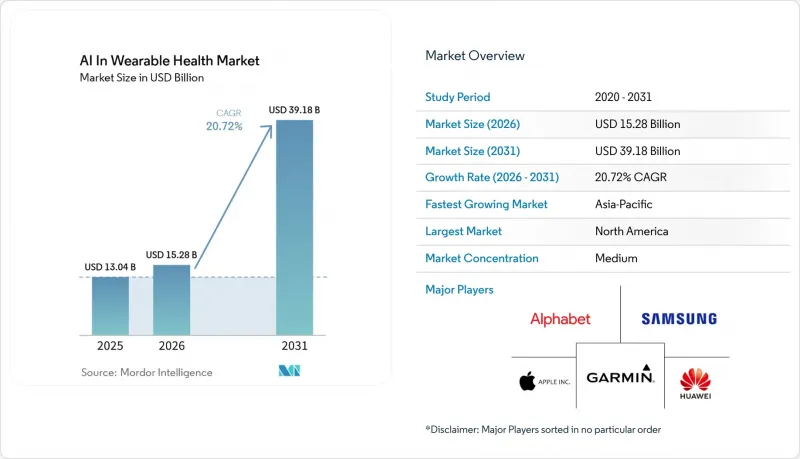
Mordor Intelligence에 의하면, 웨어러블 헬스 분야 AI 시장 규모는 2025년 130억 4,000만 달러로 평가되었고, 2026년에는 152억 8,000만 달러로 추정되고, 2026-2031년 CAGR 20.72%로 성장을 지속할 전망이며, 2031년에는 391억 8,000만 달러에 이를 것으로 예측됩니다.
본 보고서는 기기 유형별(스마트 워치, 피트니스 밴드, 기타), 구성 요소별(소프트웨어, 하드웨어), 용도별(원격 환자 모니터링, 기타), AI 알고리즘별(머신러닝 및 예측 분석, 기타), 최종 사용자별(개인 사용자, 기타), 지역별(북미, 유럽, 기타)로 분류되어 있습니다. 시장 전망은 금액(달러) 기준으로 제시되어 있습니다.
세계의 웨어러블 헬스 분야 AI 시장 동향 및 인사이트
저전력 AI 칩셋의 지속적인 소형화
웨어러블 헬스 분야 AI 시장은 기기의 크기를 늘리거나 충전 부담을 가중시키지 않으면서도 성능을 향상시키는 더 작고 전력 효율이 높은 실리콘의 등장으로 혜택을 보고 있습니다. Ambiq사와 Bravechip사는 2026년 1월에 'BCL603S3H' 칩렛 플랫폼을 발표했습니다. 이 발표에 따르면, 스마트 링의 부품 비용을 최대 85% 절감하고 생산 수율을 20% 향상시키는 동시에, SpO2, 심박 변동, 수면 지표에 대한 기기 내 분석을 지원하며, 최대 7일간의 배터리 사용 시간을 실현한다고 합니다. 이 정도의 비용 절감이 중요한 이유는 웰니스 제품을 구매하는 고객층에서 빈번한 모니터링이 필요하면서도 가격에 민감한 환자층으로 대상 고객 기반을 확대할 수 있기 때문입니다. 퀄컴도 2026년에 'Snapdragon Wear Elite'를 발표했으며, 웨어러블용 칩 설계가 더욱 강력한 로컬 추론 능력과 보다 직접적인 하드웨어 차별화를 향해 나아가고 있음을 보여주고 있습니다. 저전력 NPU가 손목시계, 반지, 의료용 센서에 기본 탑재됨에 따라 웨어러블 헬스케어 시장의 AI는 계속해서 혜택을 볼 것으로 보입니다. 왜냐하면 하드웨어 기반이 클라우드에 의존하지 않고도 더 정교한 모델을 지원할 수 있게 되기 때문입니다.
가치 기반 의료로의 전환과 원격 환자 모니터링에 대한 보험 급여
웨어러블 헬스케어 시장에서 AI는 의료 서비스 제공업체가 단기간 모니터링을 경제적으로 실현할 수 있도록 하는 보험 급여 제도 개혁에 힘입어 성장하고 있습니다. CMS는 2026 회계연도 메디케어 의사 보수 일정에 따라 새로운 RPM(원격 환자 모니터링) 및 이에 상응하는 RTM(원격 치료 모니터링) 제공 코드를 확정했습니다. 이에 따라 30일 기간 중 단 2일에서 15일 동안만 모니터링을 실시하더라도, 기존의 최저 기준인 16일과 동등한 보상 수준으로 청구가 가능해졌습니다. 이번 변경으로 인해, 기존 기준에서는 대상에서 제외되던 경우가 많았던 퇴원 후 관리, 급성기 증상, 그리고 복약 순응도가 낮은 환자에 대한 적격 기준이 확대되었습니다. 또한, 투자 회수 기간이 데이터 수집 기간이 길어질수록 경제성이 떨어졌던 에피소드 단위의 웨어러블 기기 도입에 대해서도 그 타당성이 높아졌습니다. 해당 CMS 규정에서는 소프트웨어, 스토리지, 사이버 보안 요소를 반영한 조사 기법을 활용하여 기기공급 비용을 산정하고 있습니다. 웨어러블 헬스케어 시장에서 AI의 경우, 가치의 상당 부분이 물리적 센서가 아닌 소프트웨어에서 비롯되기 때문에 이는 중요한 점입니다.
AI를 활용한 임상적 효능 주장에 대한 불투명한 규제 방향
웨어러블 헬스 분야의 AI 시장에서는 기업들이 AI 기반 출력 결과에 공식적인 임상 효과 주장을 덧붙이려고 할 때 여전히 상용화 지연에 직면하고 있습니다. FDA는 2025년 1월, AI 탑재 기기의 소프트웨어 기능에 대한 수명 주기 관리 및 판매 신청에 관한 지침 초안을 발표했으나, 대부분의 웨어러블 제품은 AI 기기 전용 승인 절차가 아닌 기존의 510(k) 또는 De Novo 절차를 통해 승인을 받고 있습니다. 많은 새로운 알고리즘은 이용 가능한 프레디케이트(기준이 되는 제품)의 진화 속도를 능가하는 속도로 진화하기 때문에 이로 인해 마찰이 발생하고 있습니다. 이미 승인된 프레디케이트를 보유하고 있으며 과거에 신청 경험이 있는 기존 기업은 일반적으로 새로운 알고리즘을 처음부터 구축하고 있는 스타트업 기업보다 이러한 불확실성에 대처하기가 더 쉬운 경향이 있습니다. 따라서 웨어러블 헬스케어 시장의 AI 분야에서는 더욱 고도화된 용도에 대한 수요가 지속적으로 증가하고 있음에도 불구하고, 임상 분야에서 가장 야심 찬 신규 진출기업들이 규제 절차로 인해 발이 묶일 위험이 있습니다.
부문별 분석
2025년, 스마트 워치는 웨어러블 헬스케어 시장에서 AI 탑재 기기 시장 점유율 43.44%를 차지했으며, 소비자들에게 널리 사랑받고 있을 뿐만 아니라 폭넓은 건강 기능을 갖추고 있어 최대 기기 카테고리로서의 위상을 유지했습니다. 스마트 워치는 웨어러블 헬스케어 시장의 AI 탑재 기기 중 심전도(ECG), 혈중 산소 농도 및 고혈압 관련 모니터링을 위한 주요 접근 수단으로 자리매김하고 있습니다. 『American Journal of Cardiology』 시리즈에 2024년에 게재된 메타분석에 따르면, 4,241명의 참가자를 대상으로 한 심방세동 검출에서 Apple Watch의 심전도 앱의 민감도는 94.8%, 특이도는 95%였던 것으로 보고되었습니다. 피트니스 밴드는 기본적인 건강 모니터링에 진입하기 위한 비용이 저렴하여 신흥 소비자층으로의 보급을 촉진하기 때문에 비용 효율성을 중시하는 환경에서도 여전히 중요한 역할을 하고 있습니다. 또한, 오디오 제품에 의학적으로 의미 있는 검사 및 해석 기능이 추가됨에 따라, 히어러블 제품군도 확대되고 있습니다.
의료용 웨어러블 기기는 2031년까지 연평균 성장률(CAGR) 21.69%를 나타낼 것으로 예측되며, 웨어러블 헬스케어 시장 내 AI 분야에서 가장 빠르게 성장하는 기기 부문이 될 전망입니다. 또한, 시카고 대학교 연구진은 2026년, 신체 위에서 직접 추론을 수행하는 신축성 있는 AI 패치를 시연했습니다. 이는 로컬 인텔리전스가 통합된 텍스타일이나 패치 형태의 폼 팩터로 장기적으로 전환될 것임을 시사합니다. 이러한 개발 동향은 웨어러블 헬스 분야의 AI 산업이 앞으로 단순히 일상적인 건강 상태를 추적하는 데 그치지 않고, 지속적인 치료 경로를 목적으로 설계된 기기를 통해 성장할 것임을 보여줍니다.
2025년 웨어러블 헬스 분야 AI 시장 규모 중 소프트웨어가 59.53%를 차지했으며, 이는 기기 제조에 비해 알고리즘, 임상 용도 및 분석 계층이 가진 가격 결정력을 반영한 것입니다. 이러한 수익 구조는 웨어러블 헬스 분야 AI 시장에서 이익률과 고객 락인이 가장 높은 분야를 보여줍니다. 2025년 『Healthcare』지에 게재된 조사에 따르면, HL7 FHIR 및 SMART on FHIR을 통해 AI, 전자건강기록(EHR), 웨어러블 데이터를 통합함으로써 임상 현장에서 예측적이고 환자 중심의 의사결정 지원이 가능해진다는 사실이 밝혀졌습니다. 상호 운용성이 향상됨에 따라, 소프트웨어는 생체 신호를 분류 플래그, 워크플로우 안내 메시지 및 문서화 가능한 출력으로 변환하는 계층이 될 것입니다.
웨어러블 헬스 분야 AI 시장은 현재 고성능 로컬 처리 및 우수한 전력 관리에 의존하고 있어, 하드웨어가 가장 빠르게 성장할 구성 요소가 될 것으로 예상되며, 2031년까지 연평균 성장률(CAGR)은 21.78%를 나타낼 것으로 전망됩니다. 따라서 웨어러블 헬스케어 시장에서 AI는 하드웨어를 단순한 저수익의 '외피' 그 이상의 것으로 보고 있습니다. 이는 센서 배치, NPU 성능, 그리고 전력 설계가 핵심적인 경쟁 요인으로 부상하고 있기 때문입니다. 비록 수익의 대부분이 소프트웨어에 집중되어 있다 하더라도, 플랫폼 수준의 제어권은 여전히 하드웨어 선택에 의해 결정되며, 이것이 어떤 모델을 지속적으로 실행할 수 있는지, 또한 기기를 신체에 얼마나 오랫동안 착용할 수 있는지를 좌우하기 때문입니다.
지역별 분석
2025년, 북미는 웨어러블 헬스케어 시장에서 AI 점유율의 54.19%를 차지했으며, 매출 측면에서 여전히 압도적인 1위를 유지했습니다. 이 지역은 의료기기 분야의 선도 기업들이 집중되어 있고, 탄탄한 보험 인프라를 갖추고 있으며, 디지털 헬스케어에 대한 보험 급여를 위한 확립된 체계 등의 혜택을 누리고 있습니다. FDA는 AI 탑재 소프트웨어 기능에 대한 수명 주기 지침 및 변경 관리 요건을 통해 시장 동향을 지속적으로 형성해 왔으며, 이를 통해 제조업체들은 시판 후 모델 관리에 대해 보다 명확한 지침을 얻을 수 있게 되었습니다. 캐나다와 멕시코도 기여도를 높이고 있지만, 상환, 플랫폼 개발, 임상 통합 활동의 대부분이 여전히 미국에 집중되어 있어, 미국이 여전히 이 지역 수요를 지탱하고 있습니다.
아시아태평양은 2031년까지 연평균 성장률(CAGR) 23.24%로 성장할 것으로 예상되며, 웨어러블 헬스 분야 AI 시장에서 가장 빠르게 성장하는 지역이 될 전망입니다. 중국에서는 정책에 뒷받침된 디지털 헬스 및 원격의료에 대한 집중적인 노력이, 특히 통신 환경이나 병원 정보 시스템의 개선이 진전되고 있는 지역에서 웨어러블 기기를 정식 의료 서비스에 한 걸음 더 가까이 다가서게 하는 데 기여하고 있습니다. 또한, 의사 부족을 배경으로 원격의료에 대한 수요가 증가하고 있으며, 진단 기능을 갖춘 소비자용 기기가 주목을 받고 있는 만큼, 일본에서도 그 중요성이 커지고 있습니다.
2025년 시점에서 유럽은 웨어러블 헬스 분야의 AI 시장에서 중요한 위치를 차지하고 있었지만, 여전히 보조적인 입장에 머물러 있었습니다. 독일은 디지털 헬스의 보급이 확대되고 의료 IT에 대한 대응력이 높은 점을 바탕으로, 비교적 성숙한 시장 중 하나로 자리매김하고 있습니다. EU의 AI법은 직장에서의 감정 인식을 금지함으로써 도입 방안을 마련하고 있으며, 이로 인해 일부 기업용 웨어러블 기기의 활용 사례가 제한되는 한편, 공급업체들은 임상 및 웰니스 분야에 더욱 명확하게 초점을 맞추도록 압박받고 있습니다. 유럽 헬스 데이터 스페이스(European Health Data Space) 및 관련 FHIR 기반의 상호운용성 노력은 단기적으로는 규정 준수상의 부담이 될 수 있지만, 웨어러블 데이터를 공식 의료 시스템에 통합하기 쉽게 함으로써 장기적인 규모 확대를 뒷받침하는 역할도 합니다. 남미, 중동 및 아프리카는 여전히 초기 단계 시장이며, 브라질과 GCC(걸프협력회의) 국가들이 디지털 헬스 확대의 주요 관문으로 자리 잡고 있습니다.
기타 혜택 :
- 엑셀 형식 시장 예측(ME) 시트
- 3개월간의 애널리스트 지원
자주 묻는 질문
목차
제1장 서론
제2장 조사 방법
제3장 주요 요약
제4장 시장 구도
제5장 시장 규모 및 성장 예측
제6장 경쟁 구도
제7장 시장 기회 및 향후 전망
AJY 26.07.07According to Mordor Intelligence, the AI in wearable health market size is expected to grow from USD 13.04 billion in 2025 to USD 15.28 billion in 2026 and is forecasted to reach USD 39.18 billion by 2031 at 20.72% CAGR over 2026-2031.
This report is Segmented by Device Type (Smartwatches, Fitness Bands, and Others), Component (Software, Hardware), Application (Remote Patient Monitoring, and Others, AI Algorithm (Machine Learning and Predictive Analytics, and Others)), End-User (Individual Users, and Others), and Geography (North America, Europe, and Others). The Market Forecasts are Provided in Terms of Value (USD).
Global AI In Wearable Health Market Trends and Insights
Continuous Miniaturization of Low-Power AI Chipsets
The AI in wearable health market is gaining from smaller and more power-efficient silicon that improves performance without raising device size or charging burden. Ambiq and Bravechip introduced the BCL603S3H chiplet platform in January 2026, and the launch claimed smart ring bill-of-materials cuts of up to 85% and production yield improvement of 20% while supporting on-device analysis of SpO2, heart rate variability, and sleep metrics with battery life of up to 7 days. That scale of cost compression matters because it widens the addressable base from wellness buyers to patients who need frequent monitoring but remain price sensitive. Qualcomm also announced Snapdragon Wear Elite in 2026, showing that wearable chip design is moving toward stronger local inference capability and more direct hardware differentiation. The AI in wearable health market should keep benefiting as low-power NPUs become standard in watches, rings, and medical sensors, because the hardware base then supports richer models without depending on the cloud.
Shift to Value-Based Care and Remote Patient Monitoring Reimbursement
The AI in wearable health market is also being pulled forward by reimbursement reform that makes short-duration monitoring economically workable for providers. CMS finalized new RPM and parallel RTM supply coding under the CY 2026 Medicare Physician Fee Schedule, allowing billing for as few as 2 to 15 monitoring days in a 30-day period at the same reimbursement level as the earlier 16-day minimum threshold. That change increases eligibility for post-discharge care, acute episodes, and lower-adherence patients who often failed to qualify under the prior standard. It also improves the case for episodic wearable deployment, which had weak economics when reimbursement depended on longer data collection windows. The same CMS rule recognizes device supply cost using a methodology that captures software, storage, and cybersecurity inputs, which is important for the AI in wearable health market because much of the value sits in software rather than the physical sensor.
Uncertain Regulatory Pathways for AI-Driven Clinical Claims
The AI in wearable health market still faces slower commercialization when companies want to attach formal clinical claims to AI-driven outputs. The FDA published draft guidance in January 2025 on lifecycle management and marketing submissions for AI-enabled device software functions, but most wearable products still move through existing 510(k) or De Novo routes instead of a dedicated AI-device pathway. That creates friction because many newer algorithms evolve faster than the available predicate base. Incumbents with cleared predicates and prior submission experience can usually manage that uncertainty better than startups building novel algorithms from scratch. The AI in wearable health market therefore risks seeing its most clinically ambitious entrants slowed by regulatory process even while demand for higher-acuity applications keeps rising.
Other drivers and restraints analyzed in the detailed report include:
- Consumer Demand for Preventive Health and Wellness Insights
- On-Device Foundation Models Enabling Multimodal Vitals Interpretation
- Battery-Life Limitations Constrain Always-On Inference
For complete list of drivers and restraints, kindly check the Table Of Contents.
Segment Analysis
Smartwatches held 43.44% of AI in wearable health market share in 2025, which kept them as the largest device category because they combine wide consumer familiarity with broad health feature sets. They remain the main access point for ECG, blood oxygen, and hypertension-related monitoring in the AI in wearable health market. A 2024 meta-analysis published in the American Journal of Cardiology series reported 94.8% sensitivity and 95% specificity for the Apple Watch ECG app in atrial fibrillation detection across 4,241 participants. Fitness bands still matter in cost-sensitive settings because they offer a lower entry price for basic health monitoring and support broader penetration in emerging consumer segments. Hearables are also widening the device mix as audio products add medically relevant testing and interpretation.
Medical-grade wearables are projected to expand at 21.69% CAGR through 2031, making them the fastest-growing device segment in the AI in wearable health market. University of Chicago researchers also demonstrated a stretchable AI patch in 2026 that executes inference directly on the body, which points to a longer-term shift toward textile and patch form factors with embedded local intelligence. Those developments show that future growth in the AI in wearable health industry will come from devices designed for continuous care pathways rather than only daily wellness tracking.
Software accounted for 59.53% of the AI in wearable health market size in 2025, which reflects the pricing power of algorithms, clinical applications, and analytics layers relative to device manufacturing. That revenue structure shows where margins and customer lock-in are strongest in the AI in wearable health market. Research published in Healthcare in 2025 found that combining AI, EHR, and wearable data through HL7 FHIR and SMART on FHIR supports predictive and patient-centered decision support in clinical settings. As interoperability improves, software becomes the layer that turns biosignals into triage flags, workflow prompts, and documentation-ready outputs.
Hardware is anticipated to be the fastest-growing component, with 21.78% CAGR projected through 2031, because the AI in the wearable health market now depends on more capable local processing and better power management. The AI in wearable health market therefore treats hardware as more than a low-margin shell, because sensor layout, NPU performance, and power design are becoming core competitive inputs. Even when revenue concentration sits in software, platform-level control is still shaped by hardware choices that determine what kind of model can run continuously and how long the device can stay on the body.
Complete Report Scope:
- By Device Type
- Smartwatches
- Fitness Bands
- Hearables
- Smart Clothing and Patches
- Medical-Grade Wearables
- Other Device Types
- By Component
- Software
- Hardware
- By Application
- Remote Patient Monitoring
- Chronic Disease Management
- Sports and Fitness Monitoring
- Clinical and Diagnostic Monitoring
- Other Applications
- By AI Algorithm
- Machine Learning and Predictive Analytics
- Deep Learning
- Edge AI and Embedded Intelligence
- Multimodal AI (sensor fusion)
- By End-User
- Individual Users
- Healthcare Providers
- Long-Term Care and Home Healthcare Providers
- Employers and Corporate Wellness Programs
- Payers and Insurance Companies
- By Geography
- North America
- United States
- Canada
- Mexico
- Europe
- Germany
- United Kingdom
- France
- Italy
- Spain
- Rest of Europe
- Asia-Pacific
- China
- Japan
- India
- Australia
- South Korea
- Rest of Asia-Pacific
- Middle East and Africa
- GCC
- South Africa
- Rest of Middle East and Africa
- South America
- Brazil
- Argentina
- Rest of South America
- North America
Geography Analysis
North America held 54.19% of AI in wearable health market share in 2025, which kept it as the clear revenue leader. The region benefits from concentrated device leadership, deeper insurance infrastructure, and a more established path for digital health reimbursement. The FDA continued shaping market behavior through lifecycle guidance and change-control expectations for AI-enabled software functions, which gave manufacturers more direction on post-market model management. Canada and Mexico are growing contributors, but the United States still anchors regional demand because most reimbursement, platform development, and clinical integration activity remains centered there.
Asia-Pacific is projected to grow at 23.24% CAGR through 2031, making it the fastest-growing region in the AI in wearable health market. China's policy-backed focus on digital health and remote care is helping move wearables closer to formal healthcare delivery, especially where connectivity and hospital information systems are improving. Japan is also becoming more important because remote care need is rising against physician shortages and because consumer devices with diagnostic features are gaining more attention.
Europe held a meaningful but secondary position in the AI in wearable health market during 2025. Germany remained one of the more mature markets, supported by wider digital health adoption and stronger healthcare IT readiness. The EU AI Act is shaping deployment choices by prohibiting workplace emotion recognition, which limits some enterprise wearable use cases and pushes vendors to focus more clearly on clinical and wellness boundaries. The European Health Data Space and related FHIR-based interoperability efforts may be a short-term compliance burden, but they also support longer-term scaling by making wearable data easier to integrate into formal care systems. South America and the Middle East and Africa remain early-stage contributors, with Brazil and the GCC serving as the main entry points for digital health expansion.
- Abbott Laboratories
- AliveCor
- Alphabet Inc.
- Amazon.com
- Apple
- BioIntelliSense Inc.
- Dexcom
- Garmin
- Huawei Technologies Co. Ltd.
- Masimo
- Medtronic
- NeuroSky Inc.
- OMRON
- Oura Health Oy
- Koninklijke Philips
- Samsung Group
- Senseonics
- Valencell Inc.
- Withings SA
- Xiaomi Corporation
Additional Benefits:
- The market estimate (ME) sheet in Excel format
- 3 months of analyst support
TABLE OF CONTENTS
1 Introduction
- 1.1 Study Assumptions and Market Definition
- 1.2 Scope of the Study
2 Research Methodology
3 Executive Summary
4 Market Landscape
- 4.1 Market Overview
- 4.2 Market Drivers
- 4.2.1 Continuous Miniaturization of Low-Power AI Chipsets
- 4.2.2 Integration of Wearable Data Into EHR/EMR Ecosystems
- 4.2.3 Shift to Value-Based Care and Remote Patient Monitoring Reimbursement
- 4.2.4 Consumer Demand for Preventive Health and Wellness Insights
- 4.2.5 Federated Learning Rollouts to Solve Privacy-Regulated Data Scarcity
- 4.2.6 On-Device Foundation Models Enabling Multimodal Vitals Interpretation
- 4.3 Market Restraints
- 4.3.1 Uncertain Regulatory Pathways for AI-Driven Clinical Claims
- 4.3.2 Battery-Life Limitations Constrain Always-On Inference
- 4.3.3 Edge-AI Model Drift Caused by Sensor Degradation Over Time
- 4.3.4 Ethical Concerns Around Emotion-Recognition Wearables in Workplaces
- 4.4 Supply/Value Chain Analysis
- 4.5 Regulatory Landscape
- 4.6 Technological Outlook
- 4.7 Porter's Five Forces Analysis
- 4.7.1 Threat of New Entrants
- 4.7.2 Bargaining Power of Suppliers
- 4.7.3 Bargaining Power of Buyers
- 4.7.4 Threat of Substitutes
- 4.7.5 Competitive Rivalry
5 Market Size & Growth Forecasts (Value, USD)
- 5.1 By Device Type
- 5.1.1 Smartwatches
- 5.1.2 Fitness Bands
- 5.1.3 Hearables
- 5.1.4 Smart Clothing and Patches
- 5.1.5 Medical-Grade Wearables
- 5.1.6 Other Device Types
- 5.2 By Component
- 5.2.1 Software
- 5.2.2 Hardware
- 5.3 By Application
- 5.3.1 Remote Patient Monitoring
- 5.3.2 Chronic Disease Management
- 5.3.3 Sports and Fitness Monitoring
- 5.3.4 Clinical and Diagnostic Monitoring
- 5.3.5 Other Applications
- 5.4 By AI Algorithm
- 5.4.1 Machine Learning and Predictive Analytics
- 5.4.2 Deep Learning
- 5.4.3 Edge AI and Embedded Intelligence
- 5.4.4 Multimodal AI (sensor fusion)
- 5.5 By End-User
- 5.5.1 Individual Users
- 5.5.2 Healthcare Providers
- 5.5.3 Long-Term Care and Home Healthcare Providers
- 5.5.4 Employers and Corporate Wellness Programs
- 5.5.5 Payers and Insurance Companies
- 5.6 By Geography
- 5.6.1 North America
- 5.6.1.1 United States
- 5.6.1.2 Canada
- 5.6.1.3 Mexico
- 5.6.2 Europe
- 5.6.2.1 Germany
- 5.6.2.2 United Kingdom
- 5.6.2.3 France
- 5.6.2.4 Italy
- 5.6.2.5 Spain
- 5.6.2.6 Rest of Europe
- 5.6.3 Asia-Pacific
- 5.6.3.1 China
- 5.6.3.2 Japan
- 5.6.3.3 India
- 5.6.3.4 Australia
- 5.6.3.5 South Korea
- 5.6.3.6 Rest of Asia-Pacific
- 5.6.4 Middle East and Africa
- 5.6.4.1 GCC
- 5.6.4.2 South Africa
- 5.6.4.3 Rest of Middle East and Africa
- 5.6.5 South America
- 5.6.5.1 Brazil
- 5.6.5.2 Argentina
- 5.6.5.3 Rest of South America
- 5.6.1 North America
6 Competitive Landscape
- 6.1 Market Concentration
- 6.2 Market Share Analysis
- 6.3 Company Profiles (includes Global level Overview, Market level overview, Core Segments, Financials as available, Strategic Information, Market Rank/Share for key companies, Products & Services, Recent Developments)
- 6.3.1 Abbott Laboratories
- 6.3.2 AliveCor Inc.
- 6.3.3 Alphabet Inc.
- 6.3.4 Amazon.com Inc.
- 6.3.5 Apple Inc.
- 6.3.6 BioIntelliSense Inc.
- 6.3.7 Dexcom Inc.
- 6.3.8 Garmin Ltd.
- 6.3.9 Huawei Technologies Co. Ltd.
- 6.3.10 Masimo Corporation
- 6.3.11 Medtronic plc
- 6.3.12 NeuroSky Inc.
- 6.3.13 Omron Healthcare Inc.
- 6.3.14 Oura Health Oy
- 6.3.15 Philips Healthcare
- 6.3.16 Samsung Electronics Co. Ltd.
- 6.3.17 Senseonics Holdings Inc.
- 6.3.18 Valencell Inc.
- 6.3.19 Withings SA
- 6.3.20 Xiaomi Corporation
7 Market Opportunities & Future Outlook
- 7.1 White-space & Unmet-need Assessment


