

|
시장보고서
상품코드
2072754
심장 마커 검사 제품 시장 : 시장 점유율 분석, 업계 동향 및 통계, 성장 예측(2026-2031년)Cardiac Marker Testing Products - Market Share Analysis, Industry Trends & Statistics, Growth Forecasts (2026 - 2031) |
||||||
 Mordor Intelligence
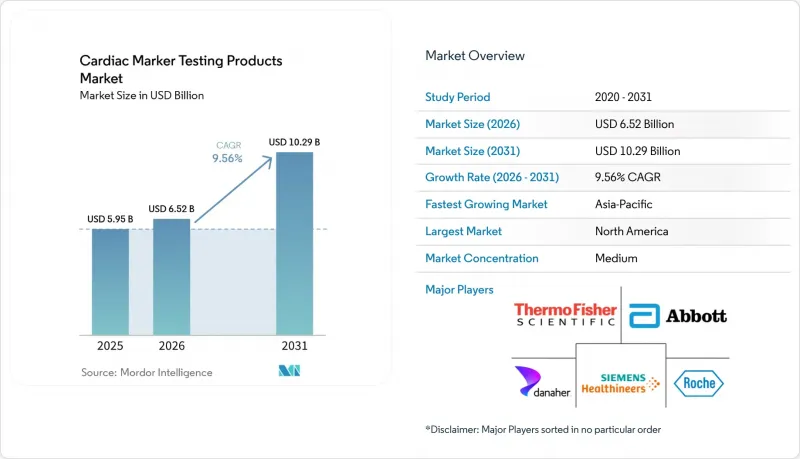
Mordor Intelligence에 의하면, 심장 마커 검사 제품 시장 규모는 2025년에 59억 5,000만 달러로 평가되었고, 2026년 65억 2,000만 달러로 추정되고, 2031년까지 102억 9,000만 달러에 이를 것으로 예측되며, 예측 기간(2026-2031년) CAGR은 9.56%를 나타낼 전망입니다.
본 보고서는 바이오마커 유형별(트로포닌, 크레아틴 키나제-MB 등), 제품별(시약 및 키트, 기기), 기술별(화학발광법 등), 용도별(심근경색 등), 검사 장소별(중앙 검사실, 현장 검사), 최종 사용자별(병원 등), 지역별(북미 등)로 분류되어 있습니다. 예측치는 금액(달러)으로 표시되어 있습니다.
세계의 심장 마커 검사 제품 시장 동향 및 인사이트
심혈관 질환의 부담 증가와 조기 배제 진단의 필요성
심장 마커 검사 제품 시장은 전 세계적으로 대규모이며 지속적인 심혈관 질환의 부담에 힘입어 성장하고 있으며, 이로 인해 응급 심장 평가가 일상 진료에서 계속해서 핵심적인 위치를 차지하고 있습니다. 현재, 여러 가지 대사성 질환이나 노화에 따른 질환을 동반하여 내원하는 환자의 비율이 증가하고 있으며, 이로 인해 증상을 명확하게 해석하기가 어려워져 임상의들은 보다 광범위한 생화학적 평가를 수행해야 하는 상황에 놓여 있습니다. 이러한 임상적 현실로 인해, 많은 사례에서 단일 마커에 기반한 전략의 실용성이 떨어지고 있으며, 보다 신속하고 신뢰할 수 있는 판단을 지원할 수 있는 검사 항목에 대한 수요가 높아지고 있습니다. 질병 부담이 큰 의료 시스템에서는 신속한 진단 과정이 단순한 선택적 진료 기법이 아니라 표준적인 임상 행위의 일부로 자리 잡고 있습니다. 이러한 변화는 심장 바이오마커 검사 제품 시장에 특히 중요한데, 응급 의료의 모든 상황에서 심장 바이오마커 검사 의뢰가 보다 정기적이고 프로토콜에 기반한 활동으로 변화하고 있기 때문입니다.
응급의료 현장에서의 고감도 트로포닌 검사 도입
고감도 심근 트로포닌 검사는 응급실에서의 심장 평가의 신속성과 실용적 가치를 높이기 위해 수요를 주도하는 주요 요인으로 작용하고 있습니다. 2025년에 실시된, 3만 2,076건의 응급실 내원 환자를 대상으로 한 후향적 연구에 따르면, 고감도 트로포닌 I의 도입으로 인해, 입원 기간의 중앙값이 6.6시간에서 6.0시간으로 단축되었고, 입원율이 38.2%에서 32.6%로 감소했으며, 3개 응급실의 주당 심혈관내과 상담 건수가 2.8건 감소하여 연간 1,600건의 추가 진료에 대응할 수 있는 여력이 생긴 것으로 밝혀졌습니다. 이러한 성과는 심장 마커 검사 제품 시장에 있어 중요한 의미를 지닙니다. 왜냐하면, 이러한 방법들은 검사법의 도입을 단순한 분석 성능뿐만 아니라 처리 능력 향상, 혼잡 완화, 그리고 측정 가능한 비용 절감과 연결시키고 있기 때문입니다. 고감도 트로포닌을 기반으로 한 신속 진단 알고리즘의 광범위한 활용은 수요를 단기적인 재량적 지출 압력에 대해 더욱 탄력적으로 만듭니다. 입증된 고감도 성능에 대한 기대를 충족시키는 검사 방법은 입찰 및 구매 결정 과정에서 점점 더 중요하게 여겨지고 있으며, 이로 인해 제한된 수의 적격 플랫폼에 대한 프리미엄 포지셔닝이 강화되고 있습니다.
엄격한 임상 검증과 IVDR·FDA 규정 준수 부담
규제 준수는 심장 마커 검사 제품 시장에서 특히 대형 기존 기업만큼의 연구 예산이나 규제 대응 팀을 갖추지 못한 중소기업에게 더 큰 운영상의 부담이 되고 있습니다. 미국에서는 FDA가 '검사실 개발 검사(LDT)'에 관한 최종 규정에 따라 단계적인 규정 준수 체계가 도입되었습니다. 이에 따라, 기존에는 서로 다른 감독 모델에 따라 운영되던 검사에 대해 의료기기 보고, 품질 시스템, 불만 처리 및 그에 따른 제출 요건이 추가되었습니다. 이러한 요건들로 인해 개발 계획이 장기화되고, 문서화 비용이 증가하며, 새로운 바이오마커 개발 및 적응증 확대를 위한 상용화 일정이 지연될 가능성이 있습니다. 주요 지역에서 여러 규제 체계를 충족하는 증빙 자료를 제조업체가 준비해야 하는 경우, 그 부담은 더욱 커집니다. 승인 지연은 제품 출시 연기나 시장 확대의 제약으로 이어져, 기존 공급업체가 기존 고객을 유지할 수 있는 시간을 늘려주게 되므로, 심장 마커 검사 제품 시장에 있어 중대한 문제가 됩니다.
부문별 분석
2025년, 트로포닌은 매출의 58.31%를 차지했으며, 심장 마커 검사 제품 시장에서 중심적인 위치를 유지했습니다. 이러한 우위는 오랜 기간에 걸친 임상적 검증, 진료 지침에의 채택, 그리고 중앙 검사실 시스템 및 새로운 현장 진단 방식과의 긴밀한 통합을 반영하고 있습니다. 고감도 검사는 급성 관상동맥 사건이 의심되는 환자에서 조기 발견과 신속한 감별 진단을 가능하게 하기 위해 트로포닌의 용도를 확대되고 있습니다. 로슈는 자사의 5세대 분석법이 공인된 고감도 기준을 충족한 최초의 FDA 승인 고감도 심장 트로포닌 검사라고 밝혔으며, 이는 프리미엄 트로포닌 기반 워크플로우의 상업적 타당성을 강화하는 데 기여했습니다. 병원들이 속도와 정확도라는 두 가지 요건을 모두 충족하는 분석법을 중심으로 프로토콜을 표준화해 나가는 가운데, 이러한 도입 실적을 바탕으로 한 경쟁력은 심장 마커 검사 제품 시장의 지속적인 수요를 뒷받침하고 있습니다.
허혈 수식 알부민은 2031년까지 연평균 성장률(CAGR) 12.38%로 확대될 것으로 예상되며, 심장 마커 검사 제품 시장에서 가장 빠르게 성장하는 바이오마커 부문으로 자리매김하고 있습니다. 그 매력은 심근 괴사가 발생하기 전의 가역성 허혈을 보다 정확하게 반영함으로써, 트로포닌만으로는 완전히 메울 수 없는 임상적 공백을 보완할 수 있다는 점에 있습니다. 이는 일과성 허혈 발작이나 조직 손상이 더욱 뚜렷해지기 전에, 임상의가 더 광범위한 위험 요인의 맥락을 파악하고자 하는 사례에서 특히 중요합니다. CK-MB, 미오글로빈 및 관련 지표들은 다중 검사 패널이나 고감도 트로포닌의 도입이 지연되고 있는 상황에서는 여전히 중요한 역할을 하고 있지만, 보험 급여 동향에 따라 단독으로 사용될 때의 가치는 점차 줄어들고 있습니다. 텍사스주의 블루크로스 블루쉴드는 2025년 보험 약관에서 급성 관상동맥 증후군 진단 시 CK-MB 및 미오글로빈 검사를 보험 적용 대상에서 제외한다고 명시하고 있으며, 이는 고소득 시장에서 기존 바이오마커 사용에서 벗어나 새로운 방식으로의 전환이 가속화되고 있음을 시사합니다. 심장 마커 검사 제품 시장은 여전히 트로포닌을 중심으로 이루어지고 있지만, 향후 제품 구성의 개선은 새로운 바이오마커가 프로토콜 중심의 치료 경로에서 보다 명확한 역할을 확보할 수 있느냐에 달려 있습니다.
2025년에는 시약 및 키트가 매출의 67.24%를 차지했으며, 심장 마커 검사 제품 시장에서 가장 큰 제품 카테고리가 되었습니다. 이러한 우위는 면역학적 검사의 기본적인 경제성을 반영하고 있습니다. 왜냐하면 분석 장비가 이미 설치되어 있는지 여부와 관계없이, 환자 1명당 검사마다 시약 팩, 교정제 및 품질 관리 재료가 필요하기 때문입니다. 이러한 지속적인 소모품 소비 모델을 통해 병원 및 검사실 네트워크 내에 플랫폼이 도입되면, 대형 벤더들은 안정적인 수익 기반을 확보할 수 있습니다. 또한, 예측 가능한 소모품 수요를 통해 분석 장비의 유리한 도입 조건을 장기적으로 회수할 수 있기 때문에 자본 투자 캠페인이 여전히 적극적으로 진행되고 있는 이유도 여기에 있습니다. 따라서 심장 마커 검사 제품 시장에서는 이미 도입된 분석 장비를 유지 관리하고, 일상 검사 및 응급 검사 모두에서 높은 가동률을 유지할 수 있는 기업이 계속해서 혜택을 누리고 있습니다.
분석 장비 시장은 2026-2031년 연평균 성장률(CAGR) 10.52%를 나타낼 것으로 예측되며, 현재 매출 규모에서는 다른 제품군에 뒤처져 있지만 가장 빠르게 성장하는 제품군이 될 전망입니다. 이러한 성장은 새로운 검사실 건설, 병원 현대화 프로그램, 그리고 진단 역량이 여전히 확대되고 있는 지역에 분석 장비를 도입함으로써 뒷받침되고 있습니다. 이는 특히 아시아태평양, 중동, 남미에서 두드러지게 나타나며, 이들 지역에서는 새로 설립된 병원이나 독립 검사 기관들이 자동 면역 분석 기능을 도입하고 있습니다. 이 '풀 효과'가 중요한 점은 해당 기기가 진료소나 약국과 같은 경증 환자 대상 의료 현장에 도입되면, 그동안 보급이 미흡했던 의료 환경에서 향후 시약 수요가 창출될 것이기 때문입니다. 심장 마커 검사 제품 업계의 이 분야에서는 구매자가 새로운 플랫폼을 승인하기 전에 품질 관리 체계, 검증의 신뢰성, 규제 대응 준비 상황에 대한 증거를 더욱 엄격하게 검토하고 있기 때문에 조달 심사의 강화도 영향을 미치고 있습니다.
지역별 분석
2025년, 북미는 심장 마커 검사 제품 시장 점유율의 41.22%를 차지했으며, 계속해서 최대 지역 시장으로서의 위상을 유지했습니다. 이러한 우위는 잘 갖춰진 검사 시설 인프라, 응급실에서의 높은 검사 실시 빈도, 그리고 급성 심장 질환 사례에서 그 효과가 입증된 고감도 트로포닌 검사법이 널리 활용되고 있는 데 기인합니다. 미국은 자국의 병원 네트워크와 인증 검사 기관이 광범위한 검사 항목을 제공할 뿐만 아니라, 임상 프로토콜 변경에 따른 신속한 검사법 업그레이드도 지원할 수 있기 때문에 여전히 이 지역의 중심적인 역할을 하고 있습니다. 또한, FDA의 실험실 개발 검사(LDT)에 관한 최종 규정에 따라 심장 검사에 대한 규제가 강화되고 있으며, 이로 인해 향후 상용화되어 검증된 체외진단약으로의 전환이 가속화될 가능성이 있습니다. CMS(미국 의료보험서비스센터)의 정책 또한 상업적 압력을 가중시키고 있습니다. 이는 2025년 의사 보수표에 따라 의사에게 지급되는 보상이 인하되고, 임상검사 보수표에 따라 2026-2028년 검사 비용에 대해 연간 최대 15%의 지급 삭감이 허용되기 때문입니다.
유럽 시장 동향은 규제 대응 체제가 잘 갖춰져 있으며, 폭넓은 서비스 지원을 제공할 수 있는 공급업체의 가치를 높이는 규정 준수 요건에 의해 형성되고 있습니다. 이로 인해, 신규 도입에만 의존하는 것이 아니라 기존 도입 실적을 유지하면서 검사 항목이나 자동화 수준을 업데이트할 수 있는 기업이 유리해집니다. 이탈리아, 스페인 및 기타 유럽 국가들에서도 지역 병원과 지역 의료 시스템이 자동화된 심장 바이오마커 검사에 대한 접근성을 확대하고 있어, 이에 따른 성장에 기여하고 있습니다. 영국에서는 흉통 대응 프로토콜과 디지털 헬스 이니셔티브를 통해 커넥티드 케어 환경 내에서 바이오마커에 기반한 임상 의사결정 지원이 계속해서 중시되고 있어, 여전히 긍정적인 환경이 유지되고 있습니다.
아시아태평양은 2026-2031년 연평균 성장률(CAGR) 13.65%를 기록할 전망이며, 가장 빠르게 성장하고 있는 지역 부문입니다. 이는 질병 부담 증가와 급속히 확대되는 의료 인프라를 모두 반영하고 있습니다. 중국과 인도는 이러한 추세의 중심적인 역할을 하고 있으며, 병원 건설, 검사망 확대, 면역 측정법의 보급에 힘입어 고감도 트로포닌 검사나 패널 검사를 실시할 수 있는 시설이 늘어나고 있습니다. 또한, 일본에서는 고령화가 진행되고 있기 때문에 병원이나 외래 진료 현장에서 심장 진단이 여전히 임상적으로 중요한 위치를 차지하고 있으며, 이것이 지역 전체 수요를 뒷받침하고 있습니다. 아시아태평양 이외의 중동 및 아프리카에서는 걸프 연안 국가들을 중심으로 첨단 심장 진단 플랫폼의 도입이 활발해지고 있습니다. 한편, 남미에서는 브라질의 민간 병원 네트워크가 주도적인 역할을 하고 있으며, 재정적 제약이 있는 시장에서는 분석 장비와의 호환성을 중시한 보다 선별적인 구매가 이루어지고 있습니다. 이러한 추세를 종합해 보면, 심장 마커 검사 제품 시장은 여전히 성숙한 의료 시스템에서 가장 큰 규모를 유지하고 있지만, 검사실의 처리 능력, 병원 인프라, 그리고 지역 분산형 의료 접근성이 동시에 확대되고 있는 지역에서 가장 빠르게 성장하고 있음을 알 수 있습니다.
기타 혜택 :
- 엑셀 형식 시장 예측(ME) 시트
- 3개월간의 애널리스트 지원
자주 묻는 질문
목차
제1장 서론
제2장 조사 방법
제3장 주요 요약
제4장 시장 구도
제5장 시장 규모 및 성장 예측
제6장 경쟁 구도
제7장 시장 기회 및 향후 전망
AJY 26.07.03According to Mordor Intelligence, the cardiac marker testing products market size was valued at USD 5.95 billion in 2025 and is estimated to grow from USD 6.52 billion in 2026 to reach USD 10.29 billion by 2031, at a CAGR of 9.56% during the forecast period (2026-2031).
This report is Segmented by Biomarker Type (Troponins, Creatine Kinase-MB, and More), Product (Reagents and Kits, Instruments), Technology (Chemiluminescence, and More), Application (Myocardial Infarction, and More), Location of Testing (Central Laboratory Testing, Point-Of-Care Testing), End User (Hospitals, and More), and Geography (North America, and More). Forecasts are Provided in Value (USD).
Global Cardiac Marker Testing Products Market Trends and Insights
Rising Cardiovascular Disease Burden and Earlier Rule-Out Demand
The cardiac marker testing products market is being supported by a large and persistent global cardiovascular disease load that keeps emergency cardiac evaluation central to routine care. A rising share of patients now arrive with multiple metabolic and age-related conditions, which makes clean symptom interpretation harder and pushes clinicians toward broader biochemical assessment. That clinical reality weakens the practicality of single-marker strategies in many presentations and strengthens demand for test menus that can support faster and more reliable decisions. In higher-burden care systems, accelerated diagnostic pathways are becoming part of standard clinical behavior rather than optional practice variation. This shift is especially important for the cardiac marker testing products market because it turns cardiac biomarker ordering into a more regular and protocol-linked activity across emergency settings.
High-Sensitivity Troponin Adoption Across Emergency Care
High-sensitivity cardiac troponin assays are a major demand catalyst because they improve the speed and operational value of cardiac assessment in emergency departments. A 2025 retrospective study covering 32,076 emergency department patient visits found that high-sensitivity troponin I implementation reduced median hospital length of stay from 6.6 hours to 6.0 hours, lowered admission rates from 38.2% to 32.6%, reduced weekly cardiology consultations across 3 emergency departments by 2.8, and supported capacity for 1,600 additional annual visits. These outcomes matter for the cardiac marker testing products market because they link assay adoption to better throughput, lower congestion, and measurable cost relief rather than only to analytical performance. The broad use of accelerated diagnostic algorithms built around high-sensitivity troponin also makes demand more resistant to short-term discretionary spending pressure. Assays that satisfy recognized high-sensitivity performance expectations are gaining added weight in tender and purchasing decisions, which supports premium positioning for a limited group of qualified platforms.
Stringent Clinical Validation and IVDR-FDA Compliance Burden
Regulatory compliance has become a heavier operating burden for the cardiac marker testing products market, especially for smaller companies that do not have the same study budgets or regulatory teams as larger incumbents. In the United States, the FDA final rule on laboratory developed tests introduced a phased compliance framework that adds medical device reporting, quality system, complaint handling, and later submission requirements to tests that had previously operated under a different oversight model. These requirements lengthen development planning, raise documentation costs, and can delay the commercial path for novel biomarkers or expanded claims. The burden is even harder when manufacturers must prepare evidence packages that satisfy more than one regulatory framework across key geographies. That delay matters for the cardiac marker testing products market because slower approvals can postpone product launches, limit geographic expansion, and give established vendors more time to defend installed accounts.
Other drivers and restraints analyzed in the detailed report include:
- Expansion of Point-of-Care and Near-Patient Testing
- Greater Use of Multiplex and Algorithm-Linked Biomarker Panels
- Limited Specificity and False-Positive Interpretations in Real-World Use
For complete list of drivers and restraints, kindly check the Table Of Contents.
Segment Analysis
Troponins accounted for 58.31% of revenue in 2025, which kept them at the center of the cardiac marker testing products market. Their lead reflects long-standing clinical validation, guideline acceptance, and deep integration into both central laboratory systems and newer point-of-care formats. High-sensitivity versions have widened troponin use because they support earlier detection and faster rule-out in patients who present with suspected acute coronary events. Roche stated that its Gen 5 assay was the first FDA-cleared high-sensitivity cardiac troponin test to meet recognized high-sensitivity criteria, which helped strengthen the commercial case for premium troponin-based workflows. That installed-base advantage continues to support recurring demand in the cardiac marker testing products market as hospitals standardize protocols around assays that can fit both speed and precision requirements.
Ischemia-modified albumin is forecast to expand at a 12.38% CAGR through 2031, which makes it the fastest-growing biomarker segment in the cardiac marker testing products market. Its appeal comes from a clinical gap that troponin does not fully close because ischemia-modified albumin is better aligned with reversible ischemia before myocardial necrosis occurs. This is particularly relevant in transient ischemic episodes and in cases where clinicians want broader risk context before tissue injury becomes more obvious. CK-MB, myoglobin, and related markers still have a role in multiplex panels and in settings where high-sensitivity troponin adoption is slower, but reimbursement behavior is narrowing their standalone value. Blue Cross Blue Shield of Texas stated in its 2025 policy that CK-MB and myoglobin were excluded from reimbursement for acute coronary syndrome diagnosis, which points to a faster move away from legacy marker use in higher-income markets. The cardiac marker testing products market remains anchored in troponin, but future mix improvement depends on whether newer biomarkers can secure a clearer role inside protocol-driven care pathways.
Reagents and kits represented 67.24% of revenue in 2025, which made them the largest product category in the cardiac marker testing products market. This lead reflects the basic economics of immunoassay testing because every patient run requires reagent packs, calibrators, and quality controls regardless of whether the analyzer is already placed. That recurring consumption model gives large vendors a stable revenue floor once a platform is installed inside a hospital or laboratory network. It also explains why capital placement campaigns remain aggressive, since favorable analyzer terms can be recovered over time through predictable consumable demand. The cardiac marker testing products market therefore continues to reward companies that can protect installed analyzers and keep utilization high across routine and urgent testing volumes.
Instruments are projected to grow at a 10.52% CAGR from 2026 to 2031, which makes them the faster-growing product group even though they trail in current revenue. Growth is being supported by new laboratory build-outs, hospital modernization programs, and analyzer placements in regions where diagnostic capacity is still expanding. This is especially relevant in Asia-Pacific, the Middle East, and South America, where new hospitals and independent laboratories are adding automated immunoassay capability. The pull effect is important because once instruments are placed in lower-acuity settings such as clinics and pharmacies, they bring future reagent demand into care environments that were previously underpenetrated. This part of the cardiac marker testing products industry is also shaped by tighter procurement screens because buyers are paying closer attention to quality systems, validation strength, and evidence of regulatory readiness before approving new platforms.
Complete Report Scope:
- By Biomarker Type
- Troponins
- Creatine Kinase-MB
- Myoglobin
- Ischemia-Modified Albumin
- Other Biomarker Types
- By Product
- Reagents and Kits
- Instruments
- By Technology
- Chemiluminescence
- Enzyme-Linked Immunosorbent Assay
- Immunofluorescence
- Immunochromatography
- Other Technologies
- By Application
- Myocardial Infarction
- Acute Coronary Syndrome
- Congestive Heart Failure
- Atherosclerosis
- Other Applications
- By Location of Testing
- Central Laboratory Testing
- Point-of-Care Testing
- By End User
- Hospitals
- Diagnostic Laboratories
- Ambulatory Surgery Centers and Clinics
- Home Healthcare Settings
- Academic and Research Institutions
- By Geography
- North America
- United States
- Canada
- Mexico
- Europe
- Germany
- United Kingdom
- France
- Italy
- Spain
- Rest of Europe
- Asia-Pacific
- China
- Japan
- India
- Australia
- South Korea
- Rest of Asia-Pacific
- Middle East and Africa
- GCC
- South Africa
- Rest of Middle East and Africa
- South America
- Brazil
- Argentina
- Rest of South America
- North America
Geography Analysis
North America held 41.22% of the cardiac marker testing products market share in 2025, which kept it as the largest regional market. This lead reflects dense laboratory infrastructure, high emergency department testing intensity, and strong use of validated high-sensitivity troponin pathways in acute cardiac presentations. The United States remains the regional anchor because its hospital networks and accredited laboratories can support both broad menu testing and rapid assay upgrades when clinical protocols change. The FDA final rule on laboratory developed tests is also increasing regulatory rigor for cardiac tests, which can shift utilization toward commercially validated in vitro diagnostics over time. CMS policies add commercial pressure because the 2025 physician fee schedule lowered physician reimbursement and the Clinical Laboratory Fee Schedule allows payment reductions of up to 15% annually on laboratory tests from 2026 through 2028.
Europe's commercial direction is being shaped by compliance requirements that raise the value of vendors with strong regulatory readiness and broad service support. That favors companies that can protect existing placements while updating assay menus and automation layers rather than relying only on first-time adoption. Italy, Spain, and the wider rest of Europe are also contributing growth as community hospitals and regional systems widen access to automated cardiac biomarker testing. The United Kingdom remains supportive because chest pain pathways and digital health initiatives continue to favor biomarker-based clinical decision support inside connected care environments.
Asia-Pacific is the fastest-growing regional segment at a 13.65% CAGR from 2026 to 2031, which reflects both rising disease burden and a fast-expanding healthcare base. China and India are central to this trend because hospital construction, laboratory chain expansion, and broader immunoassay adoption are opening more sites to high-sensitivity troponin and panel testing. Japan also supports regional demand because its aging population keeps cardiac diagnostics clinically important across hospital and ambulatory settings. Outside Asia-Pacific, the Middle East and Africa are seeing stronger procurement of advanced cardiac platforms in the Gulf, while South America is being led by Brazil's private hospital networks and more selective analyzer-compatible purchasing in financially constrained markets. Together, these patterns show that the cardiac marker testing products market is still largest in mature systems but is growing fastest where laboratory capacity, hospital infrastructure, and decentralized access are all expanding at the same time.
- Abbott Laboratories
- Beckton Dickinson
- bioMerieux
- Bio-Rad Laboratories
- Danaher
- DiaSorin
- Roche
- Fujirebio Holdings, Inc.
- Life Diagnostics, Inc.
- LSI Medience Corporation
- QuidelOrtho
- Randox Laboratories
- Response Biomedical
- Revvity Inc.
- Mindray
- Siemens Healthineers
- SpinChip Diagnostics AS
- Thermo Fisher Scientific
- Tosoh
- Trinity Biotech plc
- Werfen S.A.
Additional Benefits:
- The market estimate (ME) sheet in Excel format
- 3 months of analyst support
TABLE OF CONTENTS
1 Introduction
- 1.1 Study Assumptions & Market Definition
- 1.2 Scope of the Study
2 Research Methodology
3 Executive Summary
4 Market Landscape
- 4.1 Market Overview
- 4.2 Market Drivers
- 4.2.1 Rising Cardiovascular Disease Burden and Earlier Rule-Out Demand
- 4.2.2 High-Sensitivity Troponin Adoption Across Emergency Care
- 4.2.3 Expansion of Point-of-Care and Near-Patient Testing
- 4.2.4 Greater Use of Multiplex and Algorithm-Linked Biomarker Panels
- 4.2.5 AI-Assisted Risk Stratification Linked to EHR Workflows
- 4.2.6 At-Home and Decentralized Cardiac Testing Formats
- 4.3 Market Restraints
- 4.3.1 Stringent Clinical Validation and IVDR-FDA Compliance Burden
- 4.3.2 Limited Specificity and False-Positive Interpretations in Real-World Use
- 4.3.3 Reimbursement Pressure on High-Frequency Biomarker Testing
- 4.3.4 Fragmented Care Pathways That Slow Standardized Adoption
- 4.4 Supply Chain Analysis
- 4.5 Regulatory Landscape
- 4.6 Technological Outlook
- 4.7 Porter's Five Forces Analysis
- 4.7.1 Threat of New Entrants
- 4.7.2 Bargaining Power of Suppliers
- 4.7.3 Bargaining Power of Buyers
- 4.7.4 Threat of Substitutes
- 4.7.5 Competitive Rivalry
5 Market Size & Growth Forecasts (Value, USD)
- 5.1 By Biomarker Type
- 5.1.1 Troponins
- 5.1.2 Creatine Kinase-MB
- 5.1.3 Myoglobin
- 5.1.4 Ischemia-Modified Albumin
- 5.1.5 Other Biomarker Types
- 5.2 By Product
- 5.2.1 Reagents and Kits
- 5.2.2 Instruments
- 5.3 By Technology
- 5.3.1 Chemiluminescence
- 5.3.2 Enzyme-Linked Immunosorbent Assay
- 5.3.3 Immunofluorescence
- 5.3.4 Immunochromatography
- 5.3.5 Other Technologies
- 5.4 By Application
- 5.4.1 Myocardial Infarction
- 5.4.2 Acute Coronary Syndrome
- 5.4.3 Congestive Heart Failure
- 5.4.4 Atherosclerosis
- 5.4.5 Other Applications
- 5.5 By Location of Testing
- 5.5.1 Central Laboratory Testing
- 5.5.2 Point-of-Care Testing
- 5.6 By End User
- 5.6.1 Hospitals
- 5.6.2 Diagnostic Laboratories
- 5.6.3 Ambulatory Surgery Centers and Clinics
- 5.6.4 Home Healthcare Settings
- 5.6.5 Academic and Research Institutions
- 5.7 By Geography
- 5.7.1 North America
- 5.7.1.1 United States
- 5.7.1.2 Canada
- 5.7.1.3 Mexico
- 5.7.2 Europe
- 5.7.2.1 Germany
- 5.7.2.2 United Kingdom
- 5.7.2.3 France
- 5.7.2.4 Italy
- 5.7.2.5 Spain
- 5.7.2.6 Rest of Europe
- 5.7.3 Asia-Pacific
- 5.7.3.1 China
- 5.7.3.2 Japan
- 5.7.3.3 India
- 5.7.3.4 Australia
- 5.7.3.5 South Korea
- 5.7.3.6 Rest of Asia-Pacific
- 5.7.4 Middle East and Africa
- 5.7.4.1 GCC
- 5.7.4.2 South Africa
- 5.7.4.3 Rest of Middle East and Africa
- 5.7.5 South America
- 5.7.5.1 Brazil
- 5.7.5.2 Argentina
- 5.7.5.3 Rest of South America
- 5.7.1 North America
6 Competitive Landscape
- 6.1 Market Concentration
- 6.2 Market Share Analysis
- 6.3 Company Profiles (includes Global Level Overview, Market Level Overview, Core Segments, Financials as available, Strategic Information, Market Rank/Share, Products and Services, Recent Developments)
- 6.3.1 Abbott Laboratories
- 6.3.2 Becton, Dickinson and Company
- 6.3.3 bioMerieux SA
- 6.3.4 Bio-Rad Laboratories, Inc.
- 6.3.5 Danaher Corporation
- 6.3.6 DiaSorin S.p.A.
- 6.3.7 F. Hoffmann-La Roche AG
- 6.3.8 Fujirebio Holdings, Inc.
- 6.3.9 Life Diagnostics, Inc.
- 6.3.10 LSI Medience Corporation
- 6.3.11 QuidelOrtho Corporation
- 6.3.12 Randox Laboratories Ltd.
- 6.3.13 Response Biomedical Corp.
- 6.3.14 Revvity Inc.
- 6.3.15 Shenzhen Mindray Bio-Medical Electronics Co., Ltd.
- 6.3.16 Siemens Healthineers AG
- 6.3.17 SpinChip Diagnostics AS
- 6.3.18 Thermo Fisher Scientific Inc.
- 6.3.19 Tosoh Corporation
- 6.3.20 Trinity Biotech plc
- 6.3.21 Werfen S.A.
7 Market Opportunities & Future Outlook
- 7.1 White-space & unmet-need assessment


