

|
시장보고서
상품코드
2072759
동결건조 장비 시장 : 시장 점유율 분석, 업계 동향 및 통계, 성장 예측(2026-2031년)Freeze Drying Equipment - Market Share Analysis, Industry Trends & Statistics, Growth Forecasts (2026 - 2031) |
||||||
 Mordor Intelligence
Mordor Intelligence에 의하면, 동결건조 장비 시장 규모는 2025년에 24억 9,000만 달러로 평가되었고, 2026년 26억 9,000만 달러로 추정되고, 2031년까지 39억 9,000만 달러에 이를 것으로 예측되며, 예측 기간(2026-2031년) CAGR은 8.16%를 나타낼 전망입니다.
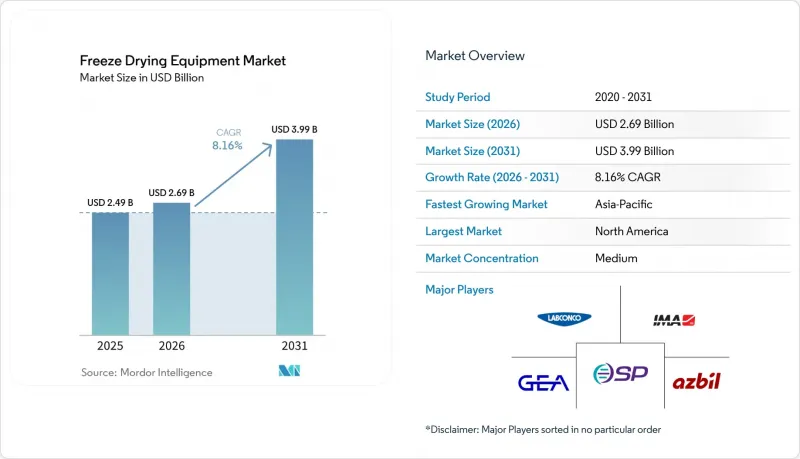
본 보고서는 제품 유형별(트레이식, 벤치탑식, 산업용, 실험실용 동결건조기), 가동 규모별(실험실 규모, 파일럿 규모, 산업 규모), 용도별(의약품, 생명공학, 식품 가공, 기능성 식품, 기타), 지역별(북미, 유럽, 아시아태평양, 남미)로 분류되어 있습니다. 시장 전망은 금액(달러) 기준으로 제시되어 있습니다.
세계의 동결건조 장비 시장 동향 및 인사이트
바이오의약품, 백신 및 주사제의 생산 확대
제약사들은 바이오의약품, 백신 및 주사제 생산 설비에 대한 투자를 점점 더 우선시하고 있습니다. 열, 습기, 보관 조건에 민감한 이러한 제품들은 무균 제조 과정에서 안정성을 확보하는 데 있어 동결 건조가 얼마나 중요한지를 여실히 보여주고 있습니다. 그 결과, 주사제 생산량이 증가함에 따라 동결건조 장비 시장에서 의약품 등급 시스템에 대한 수요도 높아지고 있습니다. 이는 규제 대상 제품을 취급하는 시설이나 수출 프로그램에서 특히 두드러지게 나타납니다. 제조업체들은 제품의 품질을 유지하면서, 검증된 공정의 재현성, 오염 관리, 그리고 복잡한 충전 및 마무리 작업 흐름에 대한 대응을 확보해야 한다는 점점 더 커지는 압박에 직면해 있습니다.
부속서 1 및 무균 제조를 통한 무균성 확보의 압박
개정된 유럽연합(EU) GMP 부속서 1은 규정 준수를 중시하는 구형 동결건조 시스템에 대한 전면적인 재검토를 촉진했습니다. 2024년 8월부터 시행되는 이 구속력 있는 동결건조 관련 조항은 JUBILANT HOLLISTERSTIER사가 지적한 바와 같이, 고도의 오염 관리 기능을 갖추지 않은 수동 적재식 시스템에 대한 운영 요건을 더욱 엄격하게 만들었습니다. 이 프레임워크는 아이솔레이터, 접근 제한이 적용된 배리어 시스템, 그리고 견고한 오염 관리 전략을 권장하며, 구매자들에게 단순히 기존 시스템의 유지 관리에 그치지 않고 최신 플랫폼으로의 전환을 촉진하고 있습니다. 캐나다 보건부가 부속서 1을 준수한 결과, 이러한 규제적 압박은 더욱 강화되었으며, 그 영향 범위는 EU를 넘어 또 다른 중요한 의약품 시장까지 미치고 있습니다.
기존 건조 방식에 비해 높은 초기 설비 투자 비용
설비 투자 비용은 특히 동결 건조와 저비용 건조 기술을 비교 검토하고 있는 수탁 제조업체, 특히 처음 구매하는 업체에게 여전히 큰 장벽으로 작용하고 있습니다. 대규모 제약 시스템에는 고액의 도입 비용이 소요되며, CIP 및 SIP 인프라, 클린 유틸리티, 격리 기능, 배리어 기술이 추가됨에 따라 그 비용은 더욱 증가합니다. 이러한 비용은 투자 회수 기간을 연장시키며, 자금 조달 조건, 고객 전망 및 플랜트 가동률 전망에 민감하게 반응하게 됩니다. 인도 및 동남아시아의 중소규모 CDMO는 동결건조 장비 시장에 진출할 때 대규모 통합 라인을 피하고, 모듈식 또는 소규모 설비를 선호합니다. 이로 인해, 설비 투자액이 큰 제약 설비와 아직 동결건조 업무 경험을 쌓아가는 단계에 있는 신중한 구매자 사이에서 명확한 수요 계층이 형성되고 있습니다.
부문별 분석
2025년, 산업용 동결건조기는 시장의 45.67%를 차지했으며, 높은 처리 능력과 안정적인 사이클이 요구되는 대규모 제약 및 식품 사업 분야에서 그 중요한 역할이 부각되었습니다. 이러한 시스템은 고정된 제품 포트폴리오, 무균 라인 및 Annex 1 준수가 요구되는 시설에 가장 적합하며, 아이솔레이터가 통합된 설비에 대한 수요를 주도하고 있습니다. 트레이식 동결건조기는 2031년까지 연평균 성장률(CAGR) 10.10%를 나타낼 것으로 예측되며, 그 유연성 덕분에 다품종 생산 거점이나 수탁 제조 환경에서 인기가 높아지고 있습니다.
로터리식 동결건조기는 벌크 분말 용도로 널리 채택되고 있으며, 선반식 방식에 비해 연속적인 회전 운동을 이용하여 형태를 개선하고 건조 속도를 높입니다. 범용 시스템은 영양 보조제 및 특수 화학물질 가공 분야에서 도입이 확대되고 있으며, 완전히 검증된 제약용 구성을 필요로 하지 않는 신규 사용자들의 관심을 끌고 있습니다. 2026년 5월, IMA Life사는 컴팩트한 설계이면서도 생산 등급의 성능을 추구하는 제조업체를 대상으로, 동결건조기 'F57 EVO COMPACT'를 발매했습니다. GEA사는 2026년 2월, 수작업을 최소화하고 Annex 1을 준수하는 환경에서의 오염 관리를 강화하도록 설계된 자동 반입·반출 시스템 'ALUS'를 통해 프리미엄 부문을 확대했습니다. 이러한 발전은 반입, 건조, 반출을 결합한 통합 솔루션으로 시장 전환을 보여주고 있습니다.
지역별 분석
2025년, 북미는 전 세계 동결건조기 시장의 39.25%를 차지했습니다. 이는 강력한 의약품 제조거점, 광범위한 CDMO 네트워크, 그리고 엄격한 규제 감독에 힘입은 결과입니다. 미국은 여전히 주요 수요 거점이며, 무균 제조 거점에서는 생산 능력 확대가 진행되고 있으며, 구형 시스템이 자동화되고 규정을 준수하는 대체 시스템으로 교체되고 있습니다. 바이오의약품 개발은 혁신 기업 및 수탁 제조업체의 검증 완료된 의약품용 동결건조기에 대한 수요를 더욱 뒷받침하고 있습니다. 2026년 1월, IMA Life는 Sharp Sterile Manufacturing과 제휴하여 매사추세츠주 리에서 2,800만 달러 규모의 확장 프로젝트를 진행했습니다. 이 프로젝트에서는 완전 자동화된 격리 충전 라인과 고성능 동결건조기를 도입하여, 해당 거점의 충전 능력을 두 배로 늘릴 예정입니다. 캐나다에서는 Annex 1에 부합하는 지침에 따라 오염 관리 및 무균 처리에 대한 기대가 높아지면서, 교체 수요가 촉진되고 있습니다.
유럽에서는 규제에 따른 교체 수요와 견고한 OEM 제조거점이 맞물려, 동결건조 장비 시장에서 그 중요성을 유지하고 있습니다. 독일은 대규모 의약품 생산 거점과 주요 장비 공급업체를 보유하고 있어 이 지역을 선도하고 있습니다. 2026년 2월, GEA사는 엘스도르프에 의약품용 동결건조 기술 센터를 개설하고, 8,000만 유로(약 8,500만 달러) 이상을 투자하여 연구개발, 생산 및 서비스 체계를 확충했습니다. 2026년 3월, LYOCONTRACT사와 Syntegon사는 독일 일젠부르크에 위치한 동결건조 시설의 확장 공사(5,000만 유로, 약 5,300만 달러)에 착수했으며, 2027년 여름까지 새로운 바이알 생산 라인이 가동될 것으로 예측됩니다.
아시아태평양은 2031년까지 연평균 성장률(CAGR) 11.20%를 기록하며 성장할 것으로 예상되며, 가장 빠르게 성장하는 지역 시장이 될 전망입니다. 중국은 국제 규제 기준을 준수하고 수출에 대응할 수 있는 생산 능력을 구축함으로써 바이오의약품 시설에서의 조달을 확대되고 있습니다. 인도에서는 CDMO의 확대, 무균 제제의 성장, 그리고 의약품 등급 설비 수요를 뒷받침하는 지원 정책에 힘입어 성장세가 가속화되고 있습니다. 일본과 한국은 정밀 시스템 및 공정 제어를 중시하는 선진적인 제약·식품 가공 분야를 통해 기여하고 있습니다. 중동 및 아프리카와 남미는 수요 규모는 작지만, 현지에서의 백신 생산 및 콜드체인에 대한 의존도 감소로 인해 국내 동결건조 능력에 대한 관심이 높아지고 있어, 전략적으로 중요한 지역으로 부상하고 있습니다.
기타 혜택 :
- 엑셀 형식 시장 예측(ME) 시트
- 3개월간의 애널리스트 지원
자주 묻는 질문
목차
제1장 서론
제2장 조사 방법
제3장 주요 요약
제4장 시장 구도
제5장 시장 규모 및 성장 예측
제6장 경쟁 구도
제7장 시장 기회 및 향후 전망
AJY 26.07.07According to Mordor Intelligence, the freeze drying equipment market size was valued at USD 2.49 billion in 2025 and is estimated to grow from USD 2.69 billion in 2026 to reach USD 3.99 billion by 2031, at a CAGR of 8.16% during the forecast period (2026-2031).
This report is Segmented by Product Type (Tray-Style, Bench Top, Industrial, and Laboratory Freeze Dryers), Scale of Operation (Laboratory, Pilot, and Industrial Scale), Application (Pharmaceuticals, Biotechnology, Food Processing, Nutraceuticals, and Others), and Geography (North America, Europe, Asia-Pacific, and South America). The Market Forecasts are Provided in Terms of Value (USD).
Global Freeze Drying Equipment Market Trends and Insights
Rising Biologics, Vaccines, and Injectable Manufacturing
Pharmaceutical manufacturers are increasingly prioritizing spending on equipment for biologics, vaccines, and injectable therapies. These products, sensitive to heat, moisture, and storage conditions, underscore the importance of lyophilization in ensuring stability during sterile manufacturing. Consequently, as the output of injectables rises, so does the demand for pharmaceutical-grade systems in the freeze-drying equipment market. This is particularly true for facilities handling regulated products and export programs. Manufacturers face heightened pressure to ensure validated cycle reproducibility, contamination control, and support for intricate fill-finish workflows, all while maintaining product quality.
Sterility Assurance Pressure from Annex 1 and Aseptic Manufacturing
The updated European Union GMP Annex 1 has catalyzed a compliance-driven overhaul of older lyophilization systems. Effective August 2024, the binding lyophilization section heightened operational demands on manually loaded systems lacking advanced contamination controls, as highlighted by JUBILANT HOLLISTERSTIER. The framework advocates for isolators, restricted access barrier systems, and robust contamination control strategies, nudging buyers towards modern platforms over mere maintenance of legacy systems. Health Canada's alignment with Annex 1 amplifies this regulatory pressure, extending its reach beyond the EU and into another significant pharmaceutical market.
High Upfront Capital Cost Versus Conventional Drying
Capital costs remain a significant barrier for first-time buyers, particularly contract manufacturers comparing lyophilization with lower-cost drying technologies. Production-scale pharmaceutical systems involve high acquisition expenses, which increase further with the addition of CIP and SIP infrastructure, clean utilities, containment features, and barrier technologies. These costs extend payback periods and make them sensitive to financing conditions, customer visibility, and plant utilization assumptions. Smaller CDMOs in India and Southeast Asia prefer modular or scaled-down installations when entering the freeze-drying equipment market, avoiding large integrated lines. This creates distinct demand tiers between high-capex pharmaceutical installations and cautious buyers still gaining experience in freeze-drying operations.
Other drivers and restraints analyzed in the detailed report include:
- Automation, IoT, and PAT Adoption in Lyophilization Systems
- Expanding Freeze-Dried Food Demand Across Premium and Functional Segments
- Energy Intensity and Utility Load Requirements
For complete list of drivers and restraints, kindly check the Table Of Contents.
Segment Analysis
In 2025, industrial freeze dryers captured 45.67% of the market, emphasizing their critical role in large-scale pharmaceutical and food operations that demand high throughput and consistent cycles. These systems are ideal for fixed product portfolios, aseptic lines, and facilities requiring Annex 1 compliance, driving demand for isolator-integrated setups. Tray-style freeze dryers, projected to grow at a 10.10% CAGR through 2031, are gaining popularity in multi-product sites and contract manufacturing environments due to their flexibility.
Rotary freeze dryers are preferred for bulk powder applications, utilizing continuous tumbling to improve morphology and accelerate drying compared to shelf-based methods. General-purpose systems are increasingly adopted in nutraceutical and specialty chemical processing, attracting first-time users who do not require fully validated pharmaceutical configurations. In May 2026, IMA Life launched the F57 EVO COMPACT freeze dryer, targeting manufacturers seeking production-grade performance in a compact design. GEA expanded the premium segment in February 2026 with its ALUS automatic loading and unloading systems, designed to minimize manual intervention and enhance contamination control in Annex 1-sensitive environments. These advancements indicate a market shift toward integrated solutions that combine loading, drying, and unloading.
Complete Report Scope:
- By Product Type
- Tray-Style Freeze Dryers
- Manifold Freeze Dryers
- Rotary Freeze Dryers
- Bench Top Freeze Dryers
- Industrial Freeze Dryers
- Laboratory Freeze Dryers
- General Purpose Freeze Dryers
- By Scale of Operation
- Laboratory Scale
- Pilot Scale
- Industrial Scale
- By Application
- Pharmaceuticals
- Biotechnology
- Food Processing
- Surgical Procedures
- Nutraceuticals
- Other Applications in Freeze Drying Equipment
- By Geography
- North America
- United States
- Canada
- Mexico
- Europe
- Germany
- United Kingdom
- France
- Italy
- Spain
- Rest of Europe
- Asia-Pacific
- China
- India
- Japan
- Australia
- South Korea
- Rest of Asia-Pacific
- Middle East and Africa
- GCC
- South Africa
- Rest of Middle East and Africa
- South America
- Brazil
- Argentina
- Rest of South America
- North America
Geography Analysis
In 2025, North America accounted for 39.25% of the global freeze-drying equipment market, driven by a strong pharmaceutical manufacturing base, an extensive CDMO network, and stringent regulatory oversight. The U.S. remains the primary demand center, with sterile manufacturing sites expanding capacity and replacing older systems with automated, compliant alternatives. Biologics development further sustains demand for validated pharmaceutical lyophilizers among innovators and contract producers. In January 2026, IMA Life partnered with Sharp Sterile Manufacturing on a USD 28 million expansion in Lee, Massachusetts, featuring a fully automated isolated filling line and a high-performance lyophilizer to double site filling capacity. In Canada, Annex 1-aligned guidance is driving replacement demand by raising expectations for contamination control and aseptic processing.
Europe combines regulatory-driven replacement demand with a strong OEM manufacturing base, maintaining its importance in the freeze-drying equipment market. Germany leads the region with large pharmaceutical manufacturing operations and key equipment suppliers. In February 2026, GEA opened its pharmaceutical freeze-drying technology center in Elsdorf, investing over EUR 80 million (approximately USD 85 million) to expand R&D, production, and service capabilities. In March 2026, LYOCONTRACT and Syntegon initiated a EUR 50 million (approximately USD 53 million) expansion of a freeze-drying facility in Ilsenburg, Germany, with a new vial line expected by summer 2027.
Asia-Pacific is projected to grow at an 11.20% CAGR through 2031, making it the fastest-growing regional market. China is increasing procurement at biologics facilities by aligning with international regulatory standards and building export-ready capacity. India is gaining traction with CDMO expansions, sterile dosage growth, and supportive policies driving demand for pharmaceutical-grade installations. Japan and South Korea contribute through advanced pharmaceutical and food processing sectors, emphasizing precision systems and process control. The Middle East, Africa, and South America, while smaller in demand, are strategically important as local vaccine manufacturing and reduced cold-chain dependency boost interest in domestic lyophilization capabilities.
- Azbil
- Biopharma Process Systems Ltd.
- Buchi Labortechnik
- Christ Freeze Dryers GmbH
- Cuddon Freeze Dry
- GEA Group
- Harvest Right, LLC
- HOF Sonderanlagenbau
- IMA Group
- Kyowa Vacuum Engineering Co., Ltd.
- Labconco
- Martin Christ Gefriertrocknungsanlagen
- Millrock Technology, Inc.
- Optima Packaging Group
- SP Scientific LLC
- SPX Technologies, Inc.
- Thermo Fisher Scientific
- Tofflon Science and Technology Group Co., Ltd.
- Yamato Scientific Co., Ltd.
- ZIRBUS technology
Additional Benefits:
- The market estimate (ME) sheet in Excel format
- 3 months of analyst support
TABLE OF CONTENTS
1 INTRODUCTION
- 1.1 Study Assumptions and Market Definition
- 1.2 Scope of the Study
2 RESEARCH METHODOLOGY
3 EXECUTIVE SUMMARY
4 MARKET LANDSCAPE
- 4.1 Market Overview
- 4.2 Market Drivers
- 4.2.1 Rising Biologics, Vaccines, and Injectable Manufacturing Needs
- 4.2.2 Expanding Freeze-Dried Food Demand Across Premium Nutrition and Shelf-Stable Snacking
- 4.2.3 Automation, IoT, and PAT Adoption in Lyophilization Systems
- 4.2.4 Energy-Efficient and Low-Carbon Freeze Drying Retrofits
- 4.2.5 Cold-Chain Fragility and Cargo Disruption Risk Driving On-Site Preservation Capacity
- 4.2.6 Sterility Assurance Pressure from Annex 1 and Aseptic Processing Validation
- 4.3 Market Restraints
- 4.3.1 High Upfront Capital Cost Versus Conventional Drying Equipment
- 4.3.2 Long Cycle Times Constraining Throughput and Installed Base Economics
- 4.3.3 Energy Intensity and Utility Load Requirements
- 4.3.4 Skilled Operator and Validation Burden for Complex Multi-Stage Processes
- 4.4 Value/Supply Chain Analysis
- 4.5 Regulatory Landscape
- 4.6 Technological Outlook
- 4.7 Porter's Five Forces Analysis
- 4.7.1 Threat of New Entrants
- 4.7.2 Bargaining Power of Suppliers
- 4.7.3 Bargaining Power of Buyers
- 4.7.4 Threat of Substitutes
- 4.7.5 Competitive Rivalry
5 MARKET SIZE AND GROWTH FORECASTS (VALUE, USD)
- 5.1 By Product Type
- 5.1.1 Tray-Style Freeze Dryers
- 5.1.2 Manifold Freeze Dryers
- 5.1.3 Rotary Freeze Dryers
- 5.1.4 Bench Top Freeze Dryers
- 5.1.5 Industrial Freeze Dryers
- 5.1.6 Laboratory Freeze Dryers
- 5.1.7 General Purpose Freeze Dryers
- 5.2 By Scale of Operation
- 5.2.1 Laboratory Scale
- 5.2.2 Pilot Scale
- 5.2.3 Industrial Scale
- 5.3 By Application
- 5.3.1 Pharmaceuticals
- 5.3.2 Biotechnology
- 5.3.3 Food Processing
- 5.3.4 Surgical Procedures
- 5.3.5 Nutraceuticals
- 5.3.6 Other Applications in Freeze Drying Equipment
- 5.4 By Geography
- 5.4.1 North America
- 5.4.1.1 United States
- 5.4.1.2 Canada
- 5.4.1.3 Mexico
- 5.4.2 Europe
- 5.4.2.1 Germany
- 5.4.2.2 United Kingdom
- 5.4.2.3 France
- 5.4.2.4 Italy
- 5.4.2.5 Spain
- 5.4.2.6 Rest of Europe
- 5.4.3 Asia-Pacific
- 5.4.3.1 China
- 5.4.3.2 India
- 5.4.3.3 Japan
- 5.4.3.4 Australia
- 5.4.3.5 South Korea
- 5.4.3.6 Rest of Asia-Pacific
- 5.4.4 Middle East and Africa
- 5.4.4.1 GCC
- 5.4.4.2 South Africa
- 5.4.4.3 Rest of Middle East and Africa
- 5.4.5 South America
- 5.4.5.1 Brazil
- 5.4.5.2 Argentina
- 5.4.5.3 Rest of South America
- 5.4.1 North America
6 COMPETITIVE LANDSCAPE
- 6.1 Market Concentration
- 6.2 Market Share Analysis
- 6.3 Company Profiles (includes Global Level Overview, Market Level Overview, Core Segments, Financials as available, Strategic Information, Market Rank/Share, Products and Services, Recent Developments)
- 6.3.1 Azbil Corporation
- 6.3.2 Biopharma Process Systems Ltd.
- 6.3.3 Buchi Labortechnik AG
- 6.3.4 Christ Freeze Dryers GmbH
- 6.3.5 Cuddon Freeze Dry
- 6.3.6 GEA Group
- 6.3.7 Harvest Right, LLC
- 6.3.8 HOF Sonderanlagenbau GmbH
- 6.3.9 IMA Group
- 6.3.10 Kyowa Vacuum Engineering Co., Ltd.
- 6.3.11 Labconco Corporation
- 6.3.12 Martin Christ Gefriertrocknungsanlagen GmbH
- 6.3.13 Millrock Technology, Inc.
- 6.3.14 Optima Packaging Group GmbH
- 6.3.15 SP Scientific LLC
- 6.3.16 SPX Technologies, Inc.
- 6.3.17 Thermo Fisher Scientific Inc.
- 6.3.18 Tofflon Science and Technology Group Co., Ltd.
- 6.3.19 Yamato Scientific Co., Ltd.
- 6.3.20 ZIRBUS technology GmbH
7 MARKET OPPORTUNITIES AND FUTURE OUTLOOK
- 7.1 White-Space and Unmet-Need Assessment


