

|
시장보고서
상품코드
2072793
토양 멸균기 시장 : 시장 점유율 분석, 업계 동향 및 통계, 성장 예측(2026-2031년)Soil Sterilizer - Market Share Analysis, Industry Trends & Statistics, Growth Forecasts (2026 - 2031) |
||||||
 Mordor Intelligence
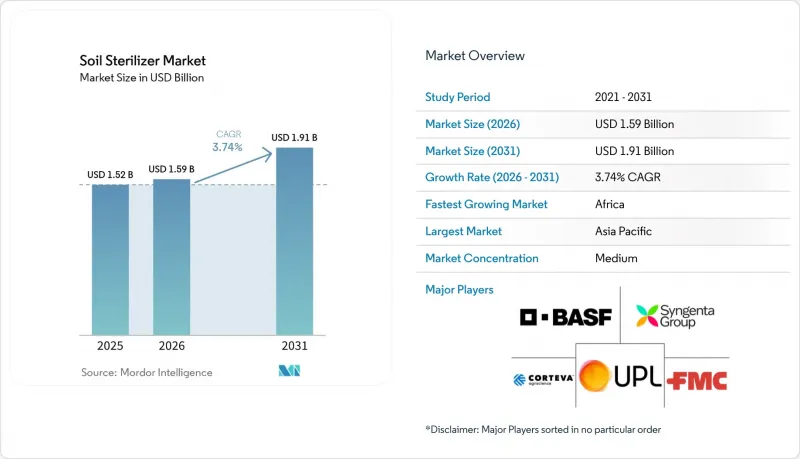
Mordor Intelligence에 의하면, 토양 멸균기 시장 규모는 2025년에 15억 2,000만 달러로 평가되었고, 2026년 15억 9,000만 달러로 추정되고, 2031년까지 19억 1,000만 달러에 이를 것으로 예측되며, 2026-2031년 연평균 복합 성장률(CAGR)은 3.74%를 나타낼 전망입니다.
본 보고서는 살균 방법별(화학적, 증기, 기타), 용도별(노지 재배, 온실 재배, 기타), 작물 유형별(채소, 과일, 기타), 제형별(액체, 기체, 고체), 유통 채널별(직접 판매, 유통업체 등), 지역별(북미, 남미, 유럽, 아시아태평양, 중동 및 아프리카)로 분류되어 있습니다. 시장 전망치는 금액(달러)으로 표시되어 있습니다.
세계의 토양 멸균기 시장 동향 및 인사이트
수출 시장에서 잔류물이 전혀 없는 농산물에 대한 수요 증가
2024년 2월, 유럽집행위원회가 '지속 가능한 사용에 관한 규정'의 시행을 연기함에 따라, 2030년까지 농약 사용량을 50% 감축하겠다는 목표는 현재로서는 강제력을 갖지 못하는 상태입니다. 그러나 유럽 이외공급업체들은 여전히 엄격한 최대 잔류 기준치와 유럽연합(EU)의 환경 기준 준수를 의무화하는 '미러 조항'에 직면해 있습니다. 2024년에 8억 3,500만 달러의 수익을 올린 케냐의 절화 산업은 2025년 4월부터 시행되는 유럽연합 규정 2024/2004의 적용 대상입니다. 이 규정에 따르면, 로테르담 등의 항만에서 코들링가 검출을 목적으로 출하 물품의 25%를 표본 조사해야 하며, 농약 잔류량이 허용치를 초과할 경우 컨테이너 1개당 1만 5,000달러가 넘는 고액의 반송 수수료가 부과될 위험이 높아지고 있습니다. 이러한 위험을 줄이기 위해 생산자들은 태양열 소독, 재생에너지를 이용한 증기 처리, 그리고 인증된 생물학적 훈증제를 채택하고 있습니다. 그 결과, 수출업체들은 잔류물이 남지 않는 처리 결과를 보장하는 토양 멸균기를 우선적으로 채택하고 있으며, 시장 수요에 맞추어 규정 준수 노력을 기울이는 동시에 출하 거부 위험을 줄이고 있습니다.
훈증제 재등록 주기의 엄격화로 인해 기술의 급속한 갱신이 요구되고 있습니다.
미국 환경보호청(EPA)은 '연방 살충제·살균제·살서제법(FIFRA)'에 따라 현재 더 빈번하고 상세한 농약 심사를 실시하고 있으며, 등록 절차의 초기 단계에서 살포 드리프트 및 독성학적 평가를 수행하고 있습니다. 에틸렌옥사이드(EtO)와 같은 화학물질의 경우, 근로자의 안전 및 건강 위험을 해결하기 위해 8년 이내에 잠정 결정이 재평가되고 있습니다. 마찬가지로, 2024년에 시행된 1,3-디클로로프로펜에 관한 규제 조치에서는 300피트의 완충 지대가 도입되어, 도시 근교의 딸기 재배 지역에서 해당 물질의 사용이 제한되었습니다. 유럽연합(EU)도 이러한 추세를 따르고 있으며, 메타나트륨의 승인이 2026년까지 제한적으로 연장된 것은 전 세계적으로 감독이 강화되고 있음을 보여줍니다. 이러한 규제 압력은 시장 구조를 변화시키고 있으며, 강력한 규제 대응 능력을 갖춘 기업이 우위를 점하는 반면, 소규모 제제 제조업체는 시장에서 철수하거나 제휴 파트너를 찾아야 하는 상황에 처하게 됩니다. 코르테바가 2025년에 BASF와 맺은 겨자 유전자 기술 관련 제휴도 그 한 예입니다. 이러한 변화하는 상황에 따라, 규제상의 장벽이 적은 증기나 바이오 유래 토양 멸균기의 도입이 가속화되고 있습니다. 규정 준수 및 혁신을 위한 노력이 더 안전하고 지속 가능한 대체품으로의 신속한 전환을 촉진하고 있으며, 토양 멸균기 시장 경쟁 구도를 재정의하고 있습니다.
장기간이 소요되는 라이선스 요건이 서비스 확장을 지연시킵니다.
캘리포니아주에서는 농지용 훈증제 취급과 관련하여 40시간의 교육과 시험이 의무화되어 있어, 이로 인해 신규 진입 비용이 상승하고 있습니다. 한편, 유럽연합(EU)의 식물보호제품 규정에서는 스페인의 20시간부터 독일의 60시간까지 국가별로 교육 시간이 다르기 때문에 상황은 더욱 복잡해지고 있습니다. 이러한 규제는 신규 살포 작업자들의 진입을 가로막고, 도급업체 확보를 어렵게 하며, 인증 기업의 인건비를 상승시키고 있습니다. 커리큘럼 업데이트가 지연되면서 제품 출시보다 1년 이상 늦어지는 경우가 많아, 차세대 훈증제 도입을 더욱 저해하고 있습니다. 그 결과, 인증된 작업자를 확보하지 못한 도시 근교의 소규모 농가들은 처리를 연기하거나 규제 대상이 아닌 자재를 사용할 수밖에 없게 되어, 병해 방제가 제대로 이루어지지 않게 되고, 결국 토양 멸균기 시장의 성장 가능성을 제한하게 됩니다.
부문별 분석
2025년에 토양 멸균기 시장의 64% 점유율을 차지한 것으로 평가되는 화학 훈증제는 노지 재배의 줄 재배에서 비용 효율성이 뛰어나기 때문에 시장을 독점하고 있습니다. 한편, 생물학적 방법은 시장 점유율은 작지만, 유기농 인증 농지 증가와 잔류물 규제의 강화에 힘입어 2026-2031년 연평균 성장률(CAGR) 9.8%로 급속히 성장할 것으로 전망됩니다. 시장 점유율 21%를 차지하는 증기·열 살균은 연속 생산을 위해 높은 비용을 감당할 수 있는 온실 재배에 활용되고 있는 반면, 점유율 7%를 차지하는 태양열 살균 필름은 건조 지역에 집중되어 있으며, 여름철에는 토양 온도를 50°C까지 올려 병원균을 사멸시킵니다. 이러한 세분화는 비용을 중시하는 기존 농장과 규제 준수를 중시하는 전문 농가 간 시장 분할을 반영하고 있습니다.
생산자들 사이에서는 단일 방식에 따른 실패 위험을 줄이기 위해, 저용량의 합성 훈증제와 캡슐화된 생리활성 물질을 결합한 통합 프로그램의 시범 도입이 점점 더 확대되고 있습니다. 장비 제조업체가 추진하는 모듈식 보일러 시스템은 밭에서의 기동성을 높이고, 헥타르당 비용을 절감합니다. 2026년까지의 메타나트륨 관련 규제가 명확해짐에 따라 일시적인 안정감이 찾아왔지만, 다국적 기업들이 포트폴리오를 다각화함에 따라 생물학적 솔루션으로의 전환이 두드러지고 있습니다. 시장 동향은 MustGrow나 Draslovka와 같은 기업들이 여러 시즌에 걸쳐 효능을 입증할 수 있느냐에 달려 있으며, 이에 따라 시장 역학이 재편되고 지속 가능하며 효과적인 살균 솔루션으로의 전환이 촉진될 가능성이 있습니다.
노지 농업은 토양 멸균기 시장에서 가장 큰 점유율을 차지하고 있으며, 2025년에는 시장의 51%를 차지했습니다. 이는 감자, 당근, 딸기 등 심층 침투형 훈증제가 필요한 작물들이 주도한 결과입니다. 그러나 온실 및 묘목 재배 시설에서의 용도가 가장 빠르게 성장하는 부문으로 부상하고 있으며, 2026년부터 2031년까지 연평균 성장률(CAGR) 7.5%를 나타낼 것으로 전망됩니다. 이러한 성장은 각 재배 주기 후 소독 처리가 필요하다는 점에 힘입어 이루어지고 있으며, 이로 인해 제품 사용 빈도가 크게 증가함에 따라 온실이 시장 확대의 주요 원동력이 되고 있습니다. 지방 자치단체의 농약 규제도 시장을 더욱 형성하고 있으며, 특히 잔디나 관상용 식물 분야에서는 기존 화학 물질에 대한 규제로 인해 증기 처리 및 태양열 소독법의 도입이 가속화되고 있습니다.
마찬가지로, 임업 및 조경 분야에서도 서식병 등의 병해 대책으로 묘상에서 토양 처리가 이루어지고 있으며, 다양한 용도에서 살균이 수행하는 지극히 중요한 역할이 부각되고 있습니다. 지역별 동향 또한 시장의 변천을 여실히 보여주고 있습니다. 스페인 알메리아 지역에서는 이 지역에 밀집해 있는 온실 인프라를 바탕으로 임대형 증기 살균 장치가 널리 보급되어 있어, 소규모 사업자들도 비용 대비 효과가 높은 방식으로 이를 이용할 수 있게 되었습니다. 한편, 노지 재배 현장에서는 식재 기간이 제한적인데다 증기 시스템의 처리 능력도 제한적이기 때문에 화학 훈증제에 대한 의존도가 높아지고 있습니다. 잔디 관리에서는 작업자의 재진입 간격에 관한 엄격한 요건을 충족하기 위해 온수 주입 시스템이 선호되고 있습니다. 매사추세츠주의 '레디니스 그랜트(Readiness Grant)' 등의 정책 조치는 온실에서의 활용 가능성을 더욱 부각시키고 있으며, 토양 멸균기 시장의 향후 성장을 견인하는 역할을 확고히 하고 있습니다.
지역별 분석
2025년에는 중국의 보호재배 확대와 인도의 잔류 기준에 부합하는 수출에 주력한 데 힘입어, 아시아태평양이 38%의 점유율로 시장을 주도했습니다. 증기 설비 비용의 최대 50%를 지원하는 정부 보조금 덕분에 투자 회수 기간이 단축되면서 바이오 훈증제 도입이 가속화되고 있습니다. 2026년부터 2031년에 걸쳐 연평균 성장률(CAGR) 6.8%로 가장 빠른 성장이 예상되는 아프리카에서는 유럽연합(EU) 수요를 충족시키기 위해 케냐, 이집트, 남아프리카공화국에서 온실 토마토와 절화 생산이 확대되고 있습니다. 이는 수출 감사 증가와 토양 건강 관리 도구에 대한 정부의 보조금에 힘입은 결과입니다.
북미에서는 미국 각 주의 보조금이 활용되어, 환경보호청(EPA)의 재등록 심사에 따른 높은 규정 준수 비용을 상쇄하고 있습니다. 유럽에서는 '지속 가능한 사용에 관한 규정(SUS-Reg)'의 지연으로 인한 과제는 있지만, 농장 차원의 보조금이 유럽연합(EU)의 농약 감축 목표와 부합하고 있기 때문에 비화학적 방식으로의 전환이 진행되고 있습니다. 남미에서는 원예 분야로의 다각화가 진행되고 있으며, 선충 피해로 인해 훈증제나 증기 살균 방식의 도입이 촉진되고 있습니다. 중동에서는 빈번한 살균이 필요한 사막 지대의 온실에 대한 투자가 이동식 증기 살균 서비스에 대한 수요를 뒷받침하고 있습니다.
세계적으로 볼 때, 보조금 프로그램, 온실 확대, 그리고 잔류 기준의 강화가 서로 밀접하게 연관되어 있어, 바이오 훈증제, 증기 살균, 그리고 태양열 소독의 도입을 촉진하는 요인이 되고 있습니다. 생산자들이 자금 확보 상황에 맞추어 구매 시기를 조정하는 가운데, 보조금 지급 주기에 맞추어 제품을 출시하는 공급업체들이 시장 점유율을 확보하고 있습니다. 이동식 장비의 대여와 서방형 제제의 등장으로 시장 진입 장벽이 더욱 낮아지면서, 중소규모 농장에서의 도입이 촉진되고 있습니다. 이러한 상호 연관된 동향들이 맞물려 2031년까지 전 세계 토양 멸균기 시장을 강화하고 확대시키고 있습니다.
기타 혜택 :
- 엑셀 형식 시장 예측(ME) 시트
- 3개월간의 애널리스트 지원
자주 묻는 질문
목차
제1장 서론
제2장 조사 방법
제3장 주요 요약
제4장 시장 구도
제5장 시장 규모 및 성장 예측
제6장 경쟁 구도
제7장 시장 기회 및 향후 전망
AJY 26.07.07According to Mordor Intelligence, the soil sterilizer market size was valued at USD 1.52 billion in 2025 and is estimated to grow from USD 1.59 billion in 2026 to reach USD 1.91 billion by 2031, at a 3.74% CAGR during 2026-2031.
This report is Segmented by Sterilization Method (Chemical, Steam, and More), by Application (Open-Field, Greenhouse, and More), by Crop Type (Vegetables, Fruits, and More), by Formulation (Liquid, Gas, and Solid), Distribution Channel (Direct, Dealer, and More), and by Geography (North America, South America, Europe, Asia-Pacific, Middle East, and Africa). Market Forecasts are in Value (USD).
Global Soil Sterilizer Market Trends and Insights
Intensifying Push for Residue-Free Produce in Export Markets
The European Commission's postponement of the Sustainable Use Regulation in February 2024 has left the 50% pesticide reduction target by 2030 without enforcement. However, non-European suppliers still face strict Maximum Residue Levels and "mirror clauses" requiring compliance with European Union environmental standards. Kenya's cut-flower industry, which earned USD 835 million in 2024, is now subject to European Union Regulation 2024/2004, effective April 2025. This regulation mandates a 25% shipment sampling rate at ports like Rotterdam to detect the False Codling Moth, increasing the risk of costly rejection fees exceeding USD 15,000 per container for pesticide over-tolerance. To mitigate these risks, growers are adopting solarization, renewable-energy-powered steaming, and certified biofumigants. Consequently, exporters are prioritizing soil sterilizers that guarantee residue-free outcomes, aligning compliance efforts with market demands and reducing the risk of shipment rejections.
Stricter Fumigant Re-Registration Cycles Forcing Rapid Technology Refresh
The United States Environmental Protection Agency (EPA), under the Federal Insecticide, Fungicide, and Rodenticide Act (FIFRA), now conducts more frequent and detailed pesticide reviews, assessing spray drift and toxicology earlier in the registration process. For chemicals like Ethylene Oxide (EtO), interim decisions are reassessed within 8 years to address worker safety and health risks. Similarly, the 2024 regulatory action on 1,3-dichloropropene, which introduced 300-foot buffer zones, has restricted its use in peri-urban strawberry-growing regions. The European Union mirrors this trend, with the limited extension of metam-sodium approval until 2026 signaling stricter oversight globally. These regulatory pressures are reshaping the market, favoring companies with strong regulatory capabilities while smaller formulators either exit or seek partnerships, as seen in Corteva's 2025 collaboration with BASF on mustard genetics. This evolving landscape is accelerating the adoption of steam and bio-based soil sterilizers, which face fewer regulatory hurdles. The push for compliance and innovation is driving a rapid transition toward safer, sustainable alternatives, redefining competition in the soil sterilizer market.
Lengthy Operator Licensing Requirements Slow Service Scaling
California's requirement of 40 hours of training and an examination for field fumigant handling increases onboarding costs, while the European Union's Plant Protection Products Regulation adds complexity with country-specific training durations, ranging from 20 hours in Spain to 60 hours in Germany. These regulations deter new applicators, reducing contractor availability and driving up labor costs for certified firms. Delayed curriculum updates, often trailing product launches by over a year, further hinder the adoption of next-generation fumigants. Consequently, small peri-urban growers, unable to access certified operators, either delay treatments or use unregulated inputs, undermining disease control and ultimately restricting the growth potential of the soil sterilizer market.
Other drivers and restraints analyzed in the detailed report include:
- Subsidies That Lower Upfront Cost of Soil-Health Equipment
- Greenhouse Acreage Growth Driving Repeat Sterilization Demand
- High Upfront Cost of Stationary Steam Units for Smallholders
For complete list of drivers and restraints, kindly check the Table Of Contents.
Segment Analysis
Chemical fumigants, holding 64% of the soil sterilizer market share in 2025, dominate due to their cost efficiency in open-field row crops. However, biological methods, while contributing a smaller share, are set to grow rapidly at a 9.8% CAGR from 2026 to 2031, driven by the rise in organic-certified acreage and stricter residue regulations. Steam and heat sterilization, with a 21% share, cater to greenhouse operations that justify higher spending for continuous production, while solarization films, at 7%, are concentrated in arid regions, achieving lethal soil temperatures of 50°C during summer. This segmentation reflects a market split between cost-driven conventional farms and compliance-focused specialty growers.
Growers are increasingly trialing integrated programs combining low-dose synthetic fumigants with encapsulated bioactives to mitigate the risk of single-mode failures. Modular boiler systems, promoted by equipment manufacturers, enhance field mobility and reduce per-hectare costs. Regulatory clarity on metam-sodium until 2026 provides temporary stability, but the shift toward biological solutions is evident as multinational companies diversify their portfolios. The market's trajectory will hinge on the ability of firms like MustGrow and Draslovka to demonstrate multi-season efficacy, potentially reshaping market dynamics and driving a transition toward sustainable and effective sterilization solutions.
Open-field agriculture held the largest share of the soil sterilizer market, accounting for 51% of the market in 2025, driven by crops such as potatoes, carrots, and strawberries that require deep-penetrating fumigants. However, greenhouse and nursery applications are emerging as the fastest-growing segment, with a projected 7.5% CAGR from 2026 to 2031. This growth is fueled by the need for sterilization after each cropping cycle, which significantly increases product use frequency and positions greenhouses as a key driver of market expansion. Municipal pesticide regulations are further shaping the market, particularly in turf and ornamental applications, where restrictions on traditional chemicals are accelerating the adoption of steam and solarization methods.
Similarly, forestry and landscaping sectors rely on soil treatments in seedling nurseries to combat diseases like damping-off, underscoring the critical role of sterilization across diverse applications. Regional dynamics also highlight the market's evolution. In Spain's Almeria region, rental steam models thrive due to the region's dense greenhouse infrastructure, enabling cost-effective use for smaller operators. Conversely, in open-field settings, the limited steam system throughput during narrow planting windows reinforces reliance on chemical fumigants. For turf management, hot water injection systems are preferred to meet strict worker re-entry interval requirements. Policy measures, such as the Massachusetts Readiness Grant, further emphasize the growth potential in greenhouse applications, solidifying their role in driving the soil sterilizer market's future expansion.
Complete Report Scope:
- By Sterilization Method
- Chemical
- Steam
- Solarization Films
- Biological
- By Application
- Open-Field Agriculture
- Greenhouse and Nursery
- Turf and Ornamentals
- Forestry and Landscaping
- By Crop Type
- Vegetables
- Fruits
- Cereals and Grains
- Oilseeds and Pulses
- By Formulation
- Liquid
- Gas
- Solid
- By Distribution Channel
- Direct Sales
- Dealer
- Online
- Rental
- By Geography
- North America
- United States
- Canada
- Rest of North America
- South America
- Brazil
- Argentina
- Rest of South America
- Europe
- Germany
- France
- Italy
- Spain
- Russia
- Rest of Europe
- Asia-Pacific
- China
- India
- Japan
- Australia
- Rest of Asia-Pacific
- Middle East
- Saudi Arabia
- United Arab Emirates
- Rest of Middle East
- Africa
- South Africa
- Egypt
- Rest of Africa
- North America
Geography Analysis
In 2025, Asia-Pacific led the market with a 38% share, driven by China's protected cultivation expansion and India's focus on residue-compliant exports. Government subsidies covering up to 50% of steam equipment costs have reduced payback periods, accelerating the adoption of bio-fumigants. Africa, the fastest-growing region with a projected CAGR of 6.8% during 2026-2031, is expanding greenhouse tomato and cut-flower production in Kenya, Egypt, and South Africa to meet European Union demand, supported by rising export audits and national grants for soil-health tools.
North America benefits from state grants in the United States, which offset higher compliance costs tied to Environmental Protection Agency re-registration reviews. Europe is transitioning to non-chemical methods, as farm-level subsidies align with the European Union's pesticide-reduction goals, despite challenges from the Sustainable Use Regulation setback. South America is diversifying into horticulture, where nematode pressure is driving the adoption of fumigants and steam sterilization. In the Middle East, investments in desert greenhouses requiring frequent sterilization sustain demand for mobile steam services.
Globally, subsidy programs, greenhouse expansion, and stricter residue regulations are interlinked drivers boosting the adoption of bio-fumigants, steam sterilization, and solarization. Vendors aligning product launches with grant cycles are capturing market share, as growers time purchases with funding availability. Mobile equipment rentals and controlled-release formulations further lower entry barriers, encouraging adoption among small and mid-sized farms. These interconnected dynamics are collectively strengthening and expanding the global soil sterilizer market through 2031.
- BASF SE
- Syngenta Group Co., Ltd.
- Corteva, Inc.
- Bayer AG
- UPL Limited
- FMC Corporation
- American Vanguard Corporation
- TriCal Group Inc.
- Draslovka a.s.
- MustGrow Biologics Corp.
- Arkema S.A.
- Tessenderlo Kerley, Inc.
- Eastman Chemical Company
- Soil Steam International AS
- CM Regero Industries SAS
Additional Benefits:
- The market estimate (ME) sheet in Excel format
- 3 months of analyst support
TABLE OF CONTENTS
1 Introduction
- 1.1 Study Assumptions and Market Definition
- 1.2 Scope of the Study
2 Research Methodology
3 Executive Summary
4 Market Landscape
- 4.1 Market Overview
- 4.2 Market Drivers
- 4.2.1 Intensifying push for residue-free produce in global export markets
- 4.2.2 Stricter fumigant re-registration cycles forcing rapid technology refresh
- 4.2.3 Subsidies for soil-health equipment in Asia-Pacific and European Union
- 4.2.4 Accelerating greenhouse acreage driving year-round steam sterilizer demand
- 4.2.5 Launch of bio-based fumigants with controlled-release micro-capsules
- 4.2.6 Internet of Things (IoT)-enabled autonomous steaming systems lowering labor by more than 35 percent
- 4.3 Market Restraints
- 4.3.1 Lengthy operator-licensing rules in United States and European Union
- 4.3.2 High capex of stationary steam units for smallholders
- 4.3.3 Nematode resistance to legacy chemistries in high-value vegetable belts
- 4.3.4 Limited field data for novel electric-pulse sterilization methods
- 4.4 Regulatory Landscape
- 4.5 Technological Outlook
- 4.6 Porter's Five Forces
- 4.6.1 Threat of New Entrants
- 4.6.2 Bargaining Power of Suppliers
- 4.6.3 Bargaining Power of Buyers
- 4.6.4 Threat of Substitutes
- 4.6.5 Intensity of Competitive Rivalry
5 Market Size and Growth Forecasts (Value)
- 5.1 By Sterilization Method
- 5.1.1 Chemical
- 5.1.2 Steam
- 5.1.3 Solarization Films
- 5.1.4 Biological
- 5.2 By Application
- 5.2.1 Open-Field Agriculture
- 5.2.2 Greenhouse and Nursery
- 5.2.3 Turf and Ornamentals
- 5.2.4 Forestry and Landscaping
- 5.3 By Crop Type
- 5.3.1 Vegetables
- 5.3.2 Fruits
- 5.3.3 Cereals and Grains
- 5.3.4 Oilseeds and Pulses
- 5.4 By Formulation
- 5.4.1 Liquid
- 5.4.2 Gas
- 5.4.3 Solid
- 5.5 By Distribution Channel
- 5.5.1 Direct Sales
- 5.5.2 Dealer
- 5.5.3 Online
- 5.5.4 Rental
- 5.6 By Geography
- 5.6.1 North America
- 5.6.1.1 United States
- 5.6.1.2 Canada
- 5.6.1.3 Rest of North America
- 5.6.2 South America
- 5.6.2.1 Brazil
- 5.6.2.2 Argentina
- 5.6.2.3 Rest of South America
- 5.6.3 Europe
- 5.6.3.1 Germany
- 5.6.3.2 France
- 5.6.3.3 Italy
- 5.6.3.4 Spain
- 5.6.3.5 Russia
- 5.6.3.6 Rest of Europe
- 5.6.4 Asia-Pacific
- 5.6.4.1 China
- 5.6.4.2 India
- 5.6.4.3 Japan
- 5.6.4.4 Australia
- 5.6.4.5 Rest of Asia-Pacific
- 5.6.5 Middle East
- 5.6.5.1 Saudi Arabia
- 5.6.5.2 United Arab Emirates
- 5.6.5.3 Rest of Middle East
- 5.6.6 Africa
- 5.6.6.1 South Africa
- 5.6.6.2 Egypt
- 5.6.6.3 Rest of Africa
- 5.6.1 North America
6 Competitive Landscape
- 6.1 Market Concentration
- 6.2 Strategic Moves
- 6.3 Market Share Analysis
- 6.4 Company Profiles (Includes Global Level Overview, Market Level Overview, Core Segments, Financials as Available, Strategic Information, Market Rank/Share for Key Companies, Products and Services, and Recent Developments)
- 6.4.1 BASF SE
- 6.4.2 Syngenta Group Co., Ltd.
- 6.4.3 Corteva, Inc.
- 6.4.4 Bayer AG
- 6.4.5 UPL Limited
- 6.4.6 FMC Corporation
- 6.4.7 American Vanguard Corporation
- 6.4.8 TriCal Group Inc.
- 6.4.9 Draslovka a.s.
- 6.4.10 MustGrow Biologics Corp.
- 6.4.11 Arkema S.A.
- 6.4.12 Tessenderlo Kerley, Inc.
- 6.4.13 Eastman Chemical Company
- 6.4.14 Soil Steam International AS
- 6.4.15 CM Regero Industries SAS


