
|
시장보고서
상품코드
2072808
해조 기반 사료 시장 : 시장 점유율 분석, 업계 동향 및 통계, 성장 예측(2026-2031년)Seaweed-Based Feed - Market Share Analysis, Industry Trends & Statistics, Growth Forecasts (2026 - 2031) |
||||||
 Mordor Intelligence
Mordor Intelligence에 의하면, 해조 기반 사료 시장은 2025년에 13억 8,000만 달러 규모로 평가되었고, 2026년 15억 1,000만 달러로 추정되고, 2031년까지 21억 7,000만 달러로 성장할 전망이며, 예측 기간(2026-2031년)에서 CAGR7.52%를 나타낼 전망입니다.
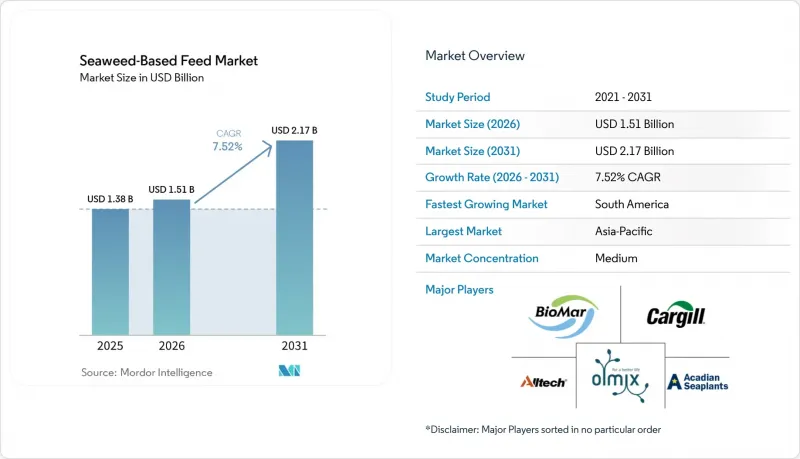
본 보고서는 용도별(양식, 축산 등), 유형별(갈조류, 홍조류 등), 형태별(분말, 펠릿, 액체 추출물, 플레이크), 유통 채널별(직접(B2B) 및 간접), 지역별(북미, 남미, 유럽, 아시아태평양, 중동 및 아프리카)로 분류되어 있습니다. 시장 전망은 금액(달러) 기준으로 제시되어 있습니다.
세계의 해조 기반 사료 시장 동향 및 인사이트
지속 가능한 양식 사료에 대한 수요 증가
양식 어류 및 새우 생산자들은 지속가능성 목표를 달성하고 사료 전환율을 높이기 위해 어분과 대두 농축물을 해조류 유래 원료로 대체하고 있습니다. 2026년, BioMar Group A/S는 부화장을 위한 기능성 수산 사료를 출시하며, 해조류 유래 성분을 지속 가능한 솔루션으로 자리매김했습니다. 인도에서는 '프라단 만트리 마츠야 삼파다 요자나(Pradhan Mantri Matsya Sampada Yojana)'의 추진으로 2024년에 해조류 생산량이 3배인 7만 4,083메트르톤에 달하여 비용 절감이 이루어졌을 뿐만 아니라, 다시마를 원료로 한 사료 공급 분야에서 아시아태평양의 역할이 강화되었습니다. 과학적 검증, 제품 혁신, 공급량 증대가 지속 가능한 수산 양식 영양 분야에서 해조류의 역할을 뒷받침하고 있습니다.
항생제 및 성장 촉진제에 대한 규제상의 제약
유럽연합(EU)의 예방적 항생제 사용 금지 조치와 미국 식품의약국(FDA)의 지침에 따라, 사료 제조업체들은 생산 공정의 일환으로 천연 면역 강화제를 도입할 수밖에 없는 상황에 처해 있습니다. 이러한 규제 변경에 대응하여 카길사는 항생제 미사용 표시 요건을 충족하고 동물의 건강을 지원하기 위해, 해조류의 일종인 아스코필룸 노도섬을 육계용 스타터 사료에 배합했습니다. 2024년, 캐나다는 수산 사료에 조류 유래 오메가-3 오일의 사용을 승인함으로써, 동물 영양 분야에서 해양 유래 생리활성 물질의 도입을 향한 중요한 한 걸음을 내디뎠습니다. 이번 승인은 혁신적이고 지속 가능한 사료 원료에 대한 규제 당국의 수용 태도가 높아지고 있음을 반영하고 있습니다. 또한, 국제표준화기구(ISO) 22,000에 기반한 추적성 기준은 현재 수직 통합형 해양 양식 사업을 우선시하고 있으며, 공급망의 투명성과 설명 책임 향상을 촉진하고 있습니다.
기존 첨가물에 비해 높은 가공 비용
아스파라고프시스의 동결 건조 비용은 1kg당 8-12달러로, 표준 미네랄 프리믹스의 0.50-1.50달러를 훨씬 상회하여 최소 600%의 가격 프리미엄이 발생하고 있습니다. 카스카디아 씨위드(Cascadia Seaweed)사는 2024년, 브리티시컬럼비아주에 바이오리파이너리 건설을 위해 296만 달러를 조달했으나, 대두 단백질 농축물의 원가를 상쇄하기 위해서는 연간 1만 메트릭톤 이상의 생산량이 필요합니다. 서호주에 본사를 둔 양식업체인 프레맨틀 씨위드(Fremantle Seaweed)는 2025년에 3,000헥타르 규모의 아스파라고프시스 양식장 건설을 위해 144만 달러를 확보했으나, 이 기업의 제품은 여전히 3 -니트로옥시프로판올 계열 억제제에 비해 비용 대비 효과가 낮아, 비용에 민감한 쇠고기 생산자들의 도입이 제한되고 있습니다. 브라질과 아르헨티나에서는 에너지 보조금 부족으로 인해 햇볕에 말리는 방식밖에 선택의 여지가 없는데, 이로 인해 열에 약한 다당류가 최대 40%까지 열화되어 버립니다. 그 결과, 기능성이 저하되어 가격 인하를 피할 수 없게 되었습니다. 이러한 비용상의 장벽으로 인해 해조류 유래 첨가물은 틈새 시장용 고가 원료로 계속 분류되고 있으며, 이는 해조 기반 사료 시장의 성장을 둔화시키고 있습니다.
부문별 분석
2025년 기준으로 해조 기반 사료 시장의 46%를 수산 양식이 차지했으며, 이는 수십년동안 연어, 송어, 새우 사료에 해조류가 배합되어 온 사실을 반영하고 있습니다. 2026년부터 2031년까지 연평균 성장률(CAGR) 12.3%의 성장이 예상에 따라, 젖소와 육우 생산자들이 기후 변화 대응세를 대비해 적조 추출물을 도입함에 따라 축산 부문이 해조 기반 사료 시장에서 더 큰 점유율을 차지할 것으로 전망됩니다. 가금류 및 돼지 분야에서는 소규모 시험을 통해 면역학적 효과가 확인된 사례가 있으나, 규제 당국이 더 많은 소화율 데이터를 요구하고 있어 여전히 사용이 제한적입니다. 반려동물사료 제조업체들은 2026년에 출시된 프리미엄 라인의 차별화를 꾀하기 위해, 조류 유래 오메가-3 오일을 첨가하기 시작했습니다. 유럽의 순환식 양식 시스템(RAS) 운영자들로부터, 1%의 다시마 가루를 첨가함으로써 펠렛의 수중 안정성이 향상되었다는 보고가 있습니다.
축산 분야의 급속한 보급은 안정적인 판로 확보에 달려 있습니다. '씨 포레스트'사는 2025년에 12만 3,000두의 소를 대상으로 하는 계약을 체결하고, 유럽연합(EU)의 젖소 시장을 겨냥해 '올파'사와 제휴를 맺었습니다. '신브로시아'사는 2027년 이후 하와이의 정제 시설이 연간 140만 마리 수요를 감당할 수 있을 것으로 전망하고 있습니다. 양식 분야에서의 시험은 태평양 흰새우로도 확대되고 있으며, 아스파라고프시스를 2% 배합함으로써 30%의 성장 증진이 확인되었습니다. 각 반려동물사료 브랜드들은 털의 윤기와 관절 건강 유지를 목적으로 미세조류 혼합물을 시험하고 있지만, 요오드의 상한치를 고려한 배합이 필요합니다. 가금류 통합 기업은 여러 시설에서 실시한 연구를 통해, 육계 품종에 관계없이 0.5-1%의 다시마를 사료에 혼합하는 것이 효과적임이 입증된다면 판매량 확대가 기대됩니다.
2025년에는 중국과 일본의 라미나리아 공급망이 이미 지역 제분 공장에 공급되고 있었기 때문에 갈조류가 매출의 42%를 차지했습니다. 홍조류는 가장 빠르게 성장하고 있는 부문으로, 2031년까지 연평균 성장률(CAGR)이 13.1%를 나타낼 것으로 예측되며, 아스파라고프시스 공급량이 확대될 경우 해조 기반 사료 시장이 급속히 성장할 것으로 전망됩니다. 녹조류 시장 점유율은 작지만, 높은 단백질 함량을 자랑하며 육상 양식 업계에서 주목을 받고 있습니다. 미세조류 블렌드는 반려동물사료나 특수 어류 사료와 같은 프리미엄 틈새 시장에서 1kg당 15달러 이상의 가격대로 수요가 집중되고 있습니다.
아카모의 성장세를 뒷받침하는 것은 그 효능을 입증하는 데이터입니다. 멕시코가 2025년에 '브로미나타'의 사용을 승인함으로써, 규제 측면에서 발판을 마련했습니다. CH4Global사의 '에코파크'는 2025년에 가동을 시작하여 매일 수만 마리의 소에게 사료를 공급하고 있습니다. 갈조류는 2025년에 출시된 BioMar사의 'POWER H2O' 사료를 통해 수산 양식 분야에서 우위를 유지하고 있습니다. 마리노바사는 2024년 사업 확장에 따라 면역 조절제에 대한 수요 증가에 부응하기 위해 후코이단 생산량을 3배로 늘렸습니다. 2024년 실험에서 녹조류인 울바(Ulva)를 배합함으로써 메추라기의 사료전환율이 지속적으로 개선되었으며, 이는 단위위 동물에 대한 더 광범위한 적용 가능성을 시사하고 있습니다.
지역별 분석
아시아태평양은 2025년에도 45%라는 최대 시장 점유율을 유지했습니다. 이는 중국 내 라미나리아의 확립된 공급망과 인도 내 다시마 양식장의 확대를 반영한 것입니다. 일본과 한국의 생산자들은 물류 비용을 절감하고, 로트 단위의 추적성을 신속하게 확보하기 위해 수직 통합형 모델을 활용하고 있습니다. 남미는 가장 빠르게 성장하는 지역으로, 2026-2031년 연평균 성장률(CAGR) 10.5%로 확대되고 있습니다. 이는 칠레의 연어 양식 기업이 통합형 대형 해조류 시스템을 도입하고, 브라질의 쇠고기 수출업체가 블루 탄소배출권을 수익화하고 있기 때문입니다. 이러한 정량적 동향은 주요 지역과 성장세가 빠른 지역이 시장 전체의 성장 모멘텀을 주도하고 있음을 보여줍니다.
유럽에서는 노르웨이의 갈조류 바이오리파이너리가 상업적 규모에 도달했으며, 유럽연합(EU)의 규제가 항생제보다 천연 사료 첨가물을 우선시하고 있어 견조한 수요가 유지되고 있습니다. 북미에서는 북대서양에서의 아스코필룸(Ascophyllum) 수확과 대형 유제품 통합 기업의 아스파라고프시스(Asparagopsis) 보충제 조기 도입이 호재로 작용하고 있습니다. 중동에서는 수입된 분말을 가금류 사료에 혼합함으로써 꾸준히 보급되고 있는 것으로 나타납니다. 한편, 아프리카는 아시아산 추출물에 의존하고는 있지만, 연안에서의 양식 시범 사업을 모색하고 있습니다. 이 지역들은 절대적인 매출액 면에서는 주요 지역에 뒤처져 있지만, 기술 이전과 규제 조화를 통해 대상 시장 기회는 계속해서 확대되고 있습니다.
2031년까지 각 지역별 투자를 통해 해조 기반 사료 시장 규모가 확대될 것으로 예측됩니다. 아시아태평양 각국 정부는 신규 생산자의 진입 장벽을 낮추기 위해 육묘 시설, 건조기, 바이오리액터에 자금을 지원하고 있으며, 한편 호주의 거점에서는 메탄 배출 감축을 목적으로 로프 재배 방식의 아스파라고프시스 생산 규모를 확대되고 있습니다. 칠레, 노르웨이, 캐나다에서는 바이오매스 1kg당 더 많은 가치를 창출하고 비용 경쟁력을 높이기 위해 바이오리파이너리의 설계 개선이 진행되고 있습니다. 추적 가능한 공급망이 성숙해짐에 따라, 모든 지역에서 수산 양식, 축산, 반려동물사료 분야의 배합 비율을 높일 수 있는 체계가 갖춰져, 장기적인 성장 궤도가 더욱 공고해질 것입니다.
기타 혜택 :
- 엑셀 형식 시장 예측(ME) 시트
- 3개월간의 애널리스트 지원
자주 묻는 질문
목차
제1장 서론
제2장 조사 방법
제3장 주요 요약
제4장 시장 구도
제5장 시장 규모 및 성장 예측
제6장 경쟁 구도
제7장 시장 기회 및 향후 전망
AJY 26.07.07According to Mordor Intelligence, the seaweed-based feed market was valued at USD 1.38 billion in 2025 and is projected to grow from USD 1.51 billion in 2026 to USD 2.17 billion by 2031, registering a CAGR of 7.52% during the forecast period (2026-2031).
This report is Segmented by Application (Aquaculture, Livestock, and More), by Species (Brown Seaweed, Red Seaweed, and More), by Form (Powder, Pellets, Liquid Extract, and Flakes), by Distribution Channel (Direct (B2B) and Indirect), and by Geography (North America, South America, Europe, Asia-Pacific, Middle East, and Africa). The Market Forecasts are Provided in Terms of Value (USD).
Global Seaweed-Based Feed Market Trends and Insights
Rising Demand for Sustainable Aquaculture Feed
Farmed fish and shrimp producers are replacing fishmeal and soy concentrate with seaweed-based ingredients to meet sustainability goals and improve feed-conversion ratios. In 2026, BioMar Group A/S launched functional aquafeed for hatcheries, highlighting seaweed derivatives as sustainable solutions. India's seaweed production tripled to 74,083 metric tons in 2024 under the Pradhan Mantri Matsya Sampada Yojana, reducing costs and strengthening Asia-Pacific's role in kelp-based feed supply. Scientific validation, product innovation, and increased supply are driving seaweed's role in sustainable aquaculture nutrition.
Regulatory Curbs on Antibiotic Growth Promoters
The European Union's ban on prophylactic antibiotics and the United States Food and Drug Administration's guidance have compelled feed mills to adopt natural immunity enhancers as part of their production processes. In response to these regulatory changes, Cargill has incorporated Ascophyllum nodosum, a type of seaweed, into broiler starter feeds to comply with antibiotic-free labeling requirements and support animal health. In 2024, Canada approved the use of algal omega-3 oil in aquafeeds, marking a significant step toward the acceptance of marine bioactives in animal nutrition. This approval reflects a growing openness among regulatory agencies to innovative, sustainable feed ingredients. Additionally, traceability standards under the International Organization for Standardization (ISO) 22,000 now favor vertically integrated ocean farming operations, promoting enhanced transparency and accountability in the supply chain.
High Processing Cost Versus Conventional Additives
Freeze-drying Asparagopsis costs USD 8-12 per kilogram, far higher than USD 0.50-1.50 for standard mineral premixes, creating a price premium of at least 600%. Cascadia Seaweed raised USD 2.96 million in 2024 for a British Columbia biorefinery but requires over 10,000 metric tons of annual output to match soy-protein concentrate costs. Fremantle Seaweed an aquaculture farm based in western Australia secured USD 1.44 million in 2025 for a 3,000-hectare Asparagopsis farm, but its product remains less cost-effective than 3-nitrooxypropanol inhibitors, limiting adoption among cost-sensitive beef producers. In Brazil and Argentina, sun-drying necessitated by the lack of energy subsidies degrades heat-sensitive polysaccharides by up to 40%, reducing functional value and forcing price discounts. These cost barriers keep seaweed additives classified as niche, premium inputs, slowing the growth of the seaweed-based feed market.
Other drivers and restraints analyzed in the detailed report include:
- Functional Benefits of Seaweed Bio-actives
- Expansion of Commercial Ocean Farming Capacity
- Supply Variability Due to Seasonal Harvests
For complete list of drivers and restraints, kindly check the Table Of Contents.
Segment Analysis
Aquaculture accounted for 46% of the seaweed-based feed market share in 2025, reflecting decades of established inclusion in the diets of salmon, trout, and shrimp. Livestock is anticipated to capture a larger share of the seaweed-based feed market, driven by 12.3% CAGR growth during 2026-2031, as dairy and beef operators adopt red seaweed extracts to meet climate levies. Poultry and swine remain minor users because regulators require more digestibility data, although small-scale trials show immune benefits. Pet food formulators are beginning to blend algal omega-3 oils to differentiate premium lines launched in 2026. Recirculating aquaculture system operators in Europe report improved pellet water stability when 1% kelp meal is added.
Rapid livestock uptake rests on secured offtake deals. Sea Forest signed agreements covering 123,000 cattle in 2025 and partnered with Orffa for European Union dairy channels. Symbrosia expects its Hawaii refinery to service 1.4 million head annually from 2027. Aquaculture trials have expanded to Pacific white shrimp, showing 30% growth gains at 2% Asparagopsis inclusion. Pet brands test microalgae blends for coat shine and joint health yet must formulate around iodine ceilings. Poultry integrators could unlock volume once multi-site studies validate 0.5-1% kelp inclusion across broiler breeds.
Brown seaweed retained 42% of revenue in 2025 because Laminaria supply chains in China and Japan already feed regional mills. Red seaweed is the fastest-growing segment, with a 13.1% CAGR through 2031, and is forecast to sharply expand the seaweed-based feed market once Asparagopsis volumes scale. Green seaweed holds a smaller slice but brings high protein concentrations that appeal to land-based aquaculture. Micro-algae blends attract premium niches in pet food and specialty fish diets at above USD 15 per kilogram.
Efficacy data underpins red seaweed momentum. Mexico's 2025 authorization of Brominata established a regulatory beachhead. CH4 Global's EcoPark came online in 2025 to serve tens of thousands of cattle daily. Brown seaweed maintains its aquaculture dominance through BioMar's POWER H2O feed launched in 2025. Marinova's 2024 expansion tripled fucoidan output to meet rising demand for immunomodulators. Green Ulva inclusion continued to improve quail feed conversion in 2024 trials, hinting at broader monogastric applications.
Complete Report Scope:
- Application
- Aquaculture
- Livestock
- Poultry
- Pet Food
- Species
- Brown seaweed
- Red seaweed
- Green seaweed
- Micro-algae blends
- Form
- Powder
- Pellets
- Liquid extract
- Flakes
- Distribution Channel
- Direct (B2B)
- Indirect
- Geography
- North America
- United States
- Canada
- Mexico
- Rest of North America
- South America
- Brazil
- Argentina
- Rest of South America
- Europe
- Germany
- United Kingdom
- France
- Italy
- Spain
- Russia
- Rest of Europe
- Asia-Pacific
- China
- Japan
- India
- South Korea
- Australia and New Zealand
- Rest of Asia-Pacific
- Middle East
- Saudi Arabia
- United Arab Emirates
- Rest of Middle East
- Africa
- South Africa
- Kenya
- Rest of Africa
- North America
Geography Analysis
Asia-Pacific retained the largest 45% market share in 2025, reflecting deep Laminaria supply chains in China and expanding kelp farms in India. Producers in Japan and South Korea leverage vertically integrated models that cut logistics costs and speed batch-level traceability. South America is the fastest region, advancing at a 10.5% CAGR over 2026-2031 as Chilean salmon companies adopt integrated macroalgae systems and Brazilian beef exporters monetize blue-carbon credits. These quantitative trends show that the leading, fastest territories drive overall market growth momentum.
Europe maintains robust demand as Norwegian brown-seaweed biorefineries reach commercial scale and European Union regulations favor natural feed additives over antibiotics. North America benefits from Ascophyllum harvests in the North Atlantic and early adoption of Asparagopsis supplements by large dairy integrators. The Middle East shows steady uptake through imported powders blended into poultry rations, while Africa relies on Asian extracts but explores coastal farming pilots. Although these areas trail the leaders in absolute revenue, technology transfer and regulatory alignment continue to widen their addressable opportunity.
Regional investments are anticipated to broaden the seaweed-based feed market size through 2031. Asia-Pacific governments fund nurseries, dryers and bioreactors that lower entry barriers for new growers, while Australian hubs scale rope-grown Asparagopsis for methane reduction. Chile, Norway and Canada refine biorefinery designs that squeeze more value from each kilogram of biomass, improving cost competitiveness. As traceable supply networks mature, all regions are positioned to raise inclusion rates across aquaculture, livestock and pet-food applications, reinforcing the long-term growth trajectory.
- Cargill, Incorporated
- Olmix SA
- BioMar Group A/S
- Acadian Seaplants Limited
- Alltech, Inc.
- Ocean Harvest Technology Group Limited
- DSM-Firmenich AG
- CP Kelco U.S., Inc.
- Algaia SA
- Seakura Ltd.
- Blue Ocean Barns, Inc.
- CH4 Global, Inc.
- Sea Forest Ltd.
- Symbrosia Inc.
- FutureFeed Pty Ltd.
Additional Benefits:
- The market estimate (ME) sheet in Excel format
- 3 months of analyst support
TABLE OF CONTENTS
1 Introduction
- 1.1 Study Assumptions and Market Definition
- 1.2 Scope of the Study
2 Research Methodology
3 Executive Summary
4 Market Landscape
- 4.1 Market Overview
- 4.2 Market Drivers
- 4.2.1 Rising demand for sustainable aquaculture feed
- 4.2.2 Regulatory curbs on antibiotic growth promoters
- 4.2.3 Functional benefits of seaweed bio-actives
- 4.2.4 Expansion of commercial ocean farming capacity
- 4.2.5 Methane-reducing cattle feed trials gain traction
- 4.2.6 Blue-carbon ESG credit monetization
- 4.3 Market Restraints
- 4.3.1 High processing cost versus conventional additives
- 4.3.2 Supply variability due to seasonal harvests
- 4.3.3 Heavy-metal contamination compliance risks
- 4.3.4 Sparse multi-species digestibility datasets
- 4.4 Regulatory Landscape
- 4.5 Technological Outlook
- 4.6 Porter's Five Forces Analysis
- 4.6.1 Threat of New Entrants
- 4.6.2 Bargaining Power of Suppliers
- 4.6.3 Bargaining Power of Buyers
- 4.6.4 Threat of Substitutes
- 4.6.5 Intensity of Competitive Rivalry
5 Market Size and Growth Forecasts (Value)
- 5.1 Application
- 5.1.1 Aquaculture
- 5.1.2 Livestock
- 5.1.3 Poultry
- 5.1.4 Pet Food
- 5.2 Species
- 5.2.1 Brown seaweed
- 5.2.2 Red seaweed
- 5.2.3 Green seaweed
- 5.2.4 Micro-algae blends
- 5.3 Form
- 5.3.1 Powder
- 5.3.2 Pellets
- 5.3.3 Liquid extract
- 5.3.4 Flakes
- 5.4 Distribution Channel
- 5.4.1 Direct (B2B)
- 5.4.2 Indirect
- 5.5 Geography
- 5.5.1 North America
- 5.5.1.1 United States
- 5.5.1.2 Canada
- 5.5.1.3 Mexico
- 5.5.1.4 Rest of North America
- 5.5.2 South America
- 5.5.2.1 Brazil
- 5.5.2.2 Argentina
- 5.5.2.3 Rest of South America
- 5.5.3 Europe
- 5.5.3.1 Germany
- 5.5.3.2 United Kingdom
- 5.5.3.3 France
- 5.5.3.4 Italy
- 5.5.3.5 Spain
- 5.5.3.6 Russia
- 5.5.3.7 Rest of Europe
- 5.5.4 Asia-Pacific
- 5.5.4.1 China
- 5.5.4.2 Japan
- 5.5.4.3 India
- 5.5.4.4 South Korea
- 5.5.4.5 Australia and New Zealand
- 5.5.4.6 Rest of Asia-Pacific
- 5.5.5 Middle East
- 5.5.5.1 Saudi Arabia
- 5.5.5.2 United Arab Emirates
- 5.5.5.3 Rest of Middle East
- 5.5.6 Africa
- 5.5.6.1 South Africa
- 5.5.6.2 Kenya
- 5.5.6.3 Rest of Africa
- 5.5.1 North America
6 Competitive Landscape
- 6.1 Market Concentration
- 6.2 Strategic Moves
- 6.3 Market Share Analysis
- 6.4 Company Profiles (Includes Global Level Overview, Market Level Overview, Core Segments, Financials as Available, Strategic Information, Market Rank/Share, Products and Services, and Recent Developments)
- 6.4.1 Cargill, Incorporated
- 6.4.2 Olmix SA
- 6.4.3 BioMar Group A/S
- 6.4.4 Acadian Seaplants Limited
- 6.4.5 Alltech, Inc.
- 6.4.6 Ocean Harvest Technology Group Limited
- 6.4.7 DSM-Firmenich AG
- 6.4.8 CP Kelco U.S., Inc.
- 6.4.9 Algaia SA
- 6.4.10 Seakura Ltd.
- 6.4.11 Blue Ocean Barns, Inc.
- 6.4.12 CH4 Global, Inc.
- 6.4.13 Sea Forest Ltd.
- 6.4.14 Symbrosia Inc.
- 6.4.15 FutureFeed Pty Ltd.