

|
시장보고서
상품코드
2072822
오피오이드 사용 장애 시장 : 점유율 분석, 업계 동향과 통계, 성장 예측(2026-2031년)Opioid Use Disorder - Market Share Analysis, Industry Trends & Statistics, Growth Forecasts (2026 - 2031) |
||||||
 Mordor Intelligence
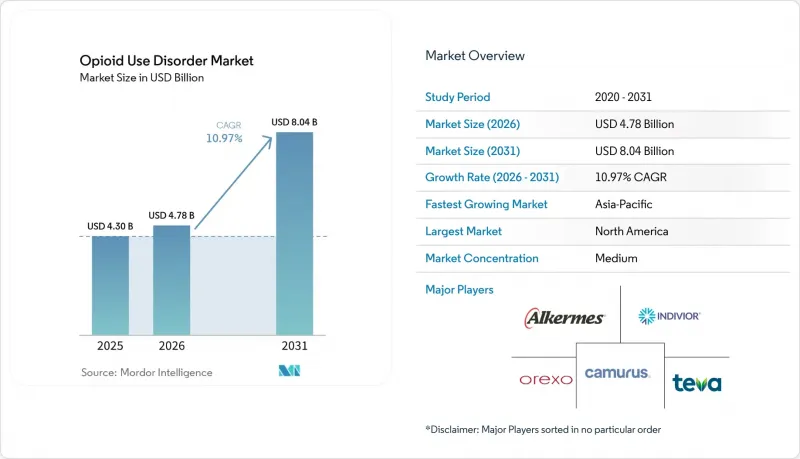
Mordor Intelligence에 의하면, 오피오이드 사용 장애 관련 시장 규모는 2025년 43억 달러에서 2026년에는 47억 8,000만 달러로 확대되어 2031년까지 80억 4,000만 달러에 이를 것으로 예상되고 있어 2026년부터 2031년까지 CAGR 10.97%로 성장할 전망입니다.
본 보고서는 약물 유형별(부프레노르핀, 메타돈, 날트렉손), 투여 경로별(경구, 주사), 유통 채널별(병원 약국, 소매 약국, 온라인 약국) 및 지역별(북미, 유럽, 아시아태평양, 중동 및 아프리카, 남미)로 분류되어 있습니다. 시장 전망치는 금액(달러)으로 표시되어 있습니다.
세계 오피오이드 사용 장애 시장 동향 및 인사이트
오피오이드 의존증 증가와 치료 미비 문제
2024년, 미국에서는 과다 복용으로 인한 사망자가 8만 명 이상 기록되었습니다. 2026년 초의 데이터에 따르면, 총 사망자 수는 최근 감소 추세를 보이고 있으나, 합성 오피오이드로 인한 부담은 펜타닐이 등장하기 전 수준과 비교했을 때 여전히 현저히 높은 상태를 유지하고 있었습니다. 오피오이드 사용 장애 시장에서 주요 수요 요인은 단순한 유병률 수치 그 이상으로, 치료 이용률이 낮다는 점입니다. SAMHSA의 2024년 추산에 따르면, 약물 사용 장애를 가진 개인 중 치료를 받은 비율은 고작 25%에 그쳐, 심각하고 지속적인 치료 격차가 드러났습니다. 2026년의 ‘국가 마약 대책 전략’에 따라 조기 발견과 치료 접근성이 강조되었으며, 승인된 모든 약물 분류에 걸쳐 처방 기회가 확대되어야 한다는 주장이 제기되었습니다. 인도에서는 정부 자료에 따르면 인구의 2.06%가 오피오이드 사용 문제에 직면해 있는 것으로 나타났으며, 오피오이드 사용 장애 시장에서 매우 중요한 성장 지역인 이곳에 치료를 받지 못한 환자층이 방대하다는 사실이 부각되었습니다. 치료를 받고 있는 환자 수는 임상적 수요보다 훨씬 적으며, 시장 확대는 발병률 증가보다는 치료 접근성 개선에 의해 주도되고 있습니다.
부프레노르핀 처방에 있어 원격의료의 확대
2025년 12월, DEA(마약단속국)와 HHS(보건복지부)는 코로나19에 따른 원격의료 유연 조치를 연장하여, 2026년 12월 31일까지 스케줄 III-V에 분류되는 오피오이드 사용 장애 치료제에 대해 음성·영상을 통한, 혹은 음성만을 이용한 원격 진료를 통한 처방전 발급을 허용했습니다. 이 조치로 인해 원격 치료를 받고 있는 환자에 대한 대면 진료 의무가 완화되어, 처방받는 환자의 상당 부분이 보호받게 되었습니다. 또한, 2025년 2월 18일에 발효된 규정에 따라 의료진은 음성만 사용하는 원격의료 상담 후, PDMP(처방약 모니터링 프로그램)의 검증 기준을 충족하는 것을 조건으로 부프레노르핀을 6개월 분량 처방할 수 있게 되었습니다. 2025년 2월 연구에 따르면, 3개월 동안 택배 약국 파트너 서비스를 이용한 환자의 지속 이용률은 82.6%였던 반면, 약국에서 직접 수령한 환자의 경우 58.9%에 그쳤습니다. 원격 의료를 통한 처방에 대한 정책의 유연성은 오피오이드 사용 장애 시장을 지속적으로 뒷받침하고 있지만, 그 확대 가능성은 주 법률 및 DEA(마약단속국)의 규정 준수 여부에 따라 좌우되고 있습니다.
메타돈 사용은 인증된 오피오이드 치료 프로그램으로 제한됨
“규제 물질법”이에 따라 메타돈 제공은 연방 정부가 인정한 오피오이드 치료 프로그램으로만 제한되어 있으며, 이는 오피오이드 사용 장애 치료 시장의 성장에 큰 걸림돌이 되고 있습니다. 2025년, ASAM의 보고서에 따르면 미국 카운티의 80%에 오피오이드 치료 프로그램이 없었으며, 그중 절반은 농촌 지역인 것으로 나타나 접근성 측면에서 지리적 격차가 부각되었습니다. 2025년 연구에 따르면, OTP(오피오이드 치료 프로그램) 규제가 엄격한 주에서는 인구통계학적 차이를 고려한 후에도 우편번호(ZIP 코드)별 메타돈 유지 치료 시행률이 낮은 것으로 나타났습니다. 또한, 주의 ‘필요성 증명서(CON)’ 법규, 구역 지정 규제, 상담 실시 빈도에 대한 요건 등의 과제가 치료 시설의 설립 및 확장에 드는 비용을 상승시키고, 경쟁을 제한하며, 새로운 유통 경로의 개발을 지연시키고 있습니다. 주 정부가 주도하는 메타돈 정책의 변경이나 지역 약국을 통한 조제 모델 등의 개혁안은 현재도 논의되고 있지만, 연방 정부의 지원을 받지 못하고 있는 만큼, 이러한 규제는 예측 기간의 대부분 동안 지속될 것으로 보입니다.
부문별 분석
2025년, 부프레노르핀은 오피오이드 사용 장애 시장의 59.58%를 차지했습니다. 이는 부분 작용제로서의 특성, 메타돈에 비해 뛰어난 안전성, 그리고 설하 필름, 구강 점막 필름, 정제, 주사제 등 다양한 제형으로 구할 수 있다는 점에 기인한 것입니다. 1차 진료 및 원격의료 제공업체를 포함한 OTP(오피오이드 치료 프로그램) 외의 처방 의사는 연방 원격의료 규정에 따라 이러한 도입을 더욱 촉진했습니다. 메타돈은 여전히 두 번째로 많이 사용되는 약물군이며, 의존도가 높은 환자나 다제 병용 환자에서 중요한 역할을 하고 있지만, OTP 이용에 대한 장벽으로 인해 그 보급 범위는 제한되어 있었습니다.
나트렉손은 2031년까지 연평균 성장률(CAGR) 11.45%를 기록하며 성장할 것으로 전망됩니다. 이는 아고니스트 요법보다 완전한 수용체 차단을 선호하는 의료 현장과 환자들로부터 지지를 받고 있으며, 오피오이드를 포함하지 않는 길항제로서의 작용기전에 기반을 두고 있습니다. 알케르메스사는 2025 회계연도 VIVITROL의 순매출이 약 4억 6,800만 달러에 달했다고 보고했으며, 2026년 전망치는 4억 6,000만-4억 8,000만 달러로 예상되어, 고가대에서 수요가 지속되고 있음을 보여주고 있습니다. 2025년 9월 알카메스사와 암니르 파마슈티컬스사 간에 체결된 승인 제네릭 의약품 관련 계약은 2024년 VIVITROL 판매량의 최대 15%를 대상으로 하며, 가격 책정 동향의 변화를 반영하고 있습니다. 나트렉손이 ““규제 물질법”에 따라 비지정 약물로 취급되고 있다는 점은 지역 약국이나 교정 의료 시스템에서 약물을 구하기 쉽게 하며, 부프레노르핀에 비해 복용 순응도 측면에서 부담을 줄여줍니다.
지역별 분석
2025년, 북미는 오피오이드 사용 장애 시장의 39.25%를 차지하며, 금액 및 치료 건수 양면에서 가장 규모가 큰 지역이 되었습니다. 이러한 우위는 높은 질병 부담, 성숙한 오피오이드 치료 프로그램(OTP) 인프라, 그리고 치료 자금 조달에 있어 공적 보험자의 상당한 참여에 기인합니다. 캐나다에서는 도시 지역에서 주사제 치료가 진행되고 있는 반면, 멕시코에서는 OTP 인프라의 미비나 중독 치료비 부족으로 인해 치료 기회가 제한적입니다. 미국에서 메디케이드를 확대하고 있는 주에서는 규제가 강화된 기간 동안 부프레노르핀 처방 건수가 17% 감소하는 데 그쳤으나, 확대하지 않은 주에서는 47.6%의 감소가 나타났습니다. 이는 지불자 구조가 수요의 회복력에 미치는 영향을 여실히 보여주고 있습니다.
유럽은 오피오이드 사용 장애 시장에서 여전히 2위의 규모를 유지하고 있으며, 독일과 프랑스가 주요 기여국으로서 선두를 달리고 있습니다. 양국의 부프레노르핀 및 메타돈 치료 시스템은 오피오이드 작용제 요법에 대한 수요의 상당 부분을 충족시키고 있으며, 견고한 치료 기반을 제공합니다. 『2025년 유럽 약물 보고서』에 따르면, 유럽에서 오피오이드 작용제 치료를 받는 환자의 35%가 부프레노르핀을 사용하고 있으며, 메타돈이 55%를 차지하고 있습니다. 또한, 9개 회원국에서는 부프레노르핀이 1차 선택 약물로 지정되어 있습니다.
아시아태평양은 2031년까지 11.20%라는 가장 높은 연평균 성장률(CAGR)을 기록하며 성장할 것으로 예상되며, 오피오이드 사용 장애 시장에서 중요한 성장 지역이 될 전망입니다. 인도의 오피오이드 문제 유병률 2.06%는 공식적인 치료 체계가 아직 확대 단계에 있음에도 불구하고, 치료를 받지 못한 환자가 다수 존재함을 여실히 보여주고 있습니다. 중국에서는 초기 단계의 공공 투자와 시범 사업이 진행되고 있습니다. 호주, 한국, 일본의 성숙한 치료 환경은 물론, 호주의 “부비달(Buvidal)”의 침투는 장시간 작용형 주사제가 북미 이외의 지역에서도 시장 점유율을 확대할 가능성이 있음을 시사합니다. 남미, 중동 및 아프리카는 여전히 소규모 시장이지만, 브라질과 GCC 국가들에서는 단기적인 기회가 있을 것으로 전망됩니다. 한편, 동남아시아 일부 지역에서는 규제와 정책으로 인해 수요가 제한되면서, 전 세계 공급업체들 시장 진입 비용이 증가하고 있습니다.
기타 혜택:
- 엑셀 형식 시장 예측(ME) 시트
- 3개월간의 애널리스트 지원
자주 묻는 질문
목차
제1장 서론
제2장 조사 방법
제3장 주요 요약
제4장 시장 구도
제5장 시장 규모와 성장 예측
제6장 경쟁 구도
제7장 시장 기회와 향후 전망
JHS 26.07.03According to Mordor Intelligence, the opioid use disorder market size is expected to increase from USD 4.30 billion in 2025 to USD 4.78 billion in 2026 and reach USD 8.04 billion by 2031, growing at a CAGR of 10.97% over 2026-2031.
This report is Segmented by Drug Class (Buprenorphine, Methadone, Naltrexone), Route of Administration (Oral, Injectable), Distribution Channel (Hospital Pharmacies, Retail Pharmacies, Online Pharmacies), and Geography (North America, Europe, Asia-Pacific, Middle East and Africa, South America). The Market Forecasts are Provided in Terms of Value (USD).
Global Opioid Use Disorder Market Trends and Insights
Rising Opioid Dependence and Untreated Treatment Gap
In 2024, the U.S. recorded over 80,000 overdose deaths. Data from early 2026 indicated that, despite a recent decline in total fatalities, the burden of synthetic opioids remained significantly elevated compared to pre-fentanyl levels. A key demand driver in the opioid use disorder market is the low treatment rate, overshadowing mere prevalence figures. SAMHSA's 2024 estimates revealed that only 25% of individuals with substance use disorders received treatment, highlighting a substantial and persistent care gap. The 2026 National Drug Control Strategy emphasized early recognition and treatment access, advocating for broader prescribing opportunities across all approved medication classes. In India, government data indicated that 2.06% of the population faces opioid consumption issues, spotlighting a vast, untreated patient demographic in a pivotal growth region for the opioid use disorder market. The treated population lags significantly behind clinical needs, with market expansion driven more by improved access than by incidence growth.
Telemedicine Expansion for Buprenorphine Prescribing
In December 2025, the DEA and HHS extended COVID-19 telemedicine flexibilities, allowing audio-video and audio-only prescriptions of Schedule III-V opioid use disorder medications through December 31, 2026. This move prevented stricter in-person visit mandates for remote treatment patients, safeguarding a significant portion of the prescribing base. Additionally, a rule effective February 18, 2025, permitted practitioners to prescribe a 6-month supply of buprenorphine post an audio-only telehealth session, contingent on meeting PDMP verification standards. A February 2025 study revealed an 82.6% retention rate for patients using home-delivery pharmacy partners over three months, compared to 58.9% for pharmacy pickups. Policy flexibility for telemedicine prescribing continues to support the opioid use disorder market, though state laws and DEA compliance shape its scalability.
Methadone Access Limited to Certified Opioid Treatment Programs
Under the Controlled Substances Act, methadone is restricted to federally certified opioid treatment programs, creating a significant barrier to growth in the opioid use disorder market. In 2025, ASAM reported that 80% of U.S. counties lacked an opioid treatment program, with half of these counties being rural, highlighting geographic disparities in access. A 2025 study found that states with stricter OTP regulations had lower methadone maintenance treatment rates per ZIP code, even after accounting for demographic differences. Additional challenges, such as state certificate-of-need laws, zoning regulations, and counseling frequency requirements, increase the cost of establishing or expanding treatment sites, limiting competition and slowing new channel development. Reform proposals, including state-led methadone policy changes and community pharmacy dispensing models, remain under discussion, but the lack of federal support suggests these restrictions will persist during much of the forecast period.
Other drivers and restraints analyzed in the detailed report include:
- Long-Acting Injectable Adoption Improves Adherence and Reduces Diversion Risk
- Fentanyl-Driven Demand for Higher-Retention Formulations
- Stigma, Prior Authorization, and Reimbursement Gaps
For complete list of drivers and restraints, kindly check the Table Of Contents.
Segment Analysis
In 2025, Buprenorphine captured 59.58% of the opioid use disorder market share, driven by its partial-agonist profile, superior safety compared to methadone, and availability in various forms such as sublingual and buccal films, tablets, and injectables. Non-OTP prescribers, including primary care and telehealth providers, further boosted its adoption under federal telemedicine regulations. Methadone remained the second-largest drug class, playing a critical role in high-dependency and polysubstance cases, though its reach was limited by OTP access barriers.
Naltrexone is projected to grow at a CAGR of 11.45% through 2031, supported by its opioid-free antagonist mechanism, which appeals to settings and patients favoring full receptor blockade over agonist therapy. Alkermes reported VIVITROL net sales of nearly USD 468 million in FY 2025, with 2026 guidance of USD 460-480 million, indicating sustained demand at premium pricing. The September 2025 authorized generic agreement between Alkermes and Amneal Pharmaceuticals, covering up to 15% of 2024 VIVITROL unit sales, reflects evolving pricing dynamics. Naltrexone's non-scheduled status under the Controlled Substances Act enhances accessibility for community pharmacies and correctional health systems, reducing compliance burdens compared to buprenorphine.
Complete Report Scope:
- By Drug Class
- Buprenorphine
- Methadone
- Naltrexone
- By Route Of Administration
- Oral
- Injectable
- By Distribution Channel
- Hospital Pharmacies
- Retail Pharmacies
- Online Pharmacies
- By Geography
- North America
- United States
- Canada
- Mexico
- Europe
- Germany
- United Kingdom
- France
- Italy
- Spain
- Rest of Europe
- Asia-Pacific
- China
- India
- Japan
- Australia
- South Korea
- Rest of Asia-Pacific
- Middle East and Africa
- GCC
- South Africa
- Rest of Middle East and Africa
- South America
- Brazil
- Argentina
- Rest of South America
- North America
Geography Analysis
In 2025, North America held 39.25% of the opioid use disorder market share, making it the largest region by value and treatment volume. This dominance stems from a high disease burden, a mature opioid treatment program infrastructure, and significant public-payer involvement in treatment financing. While Canada is advancing injectable treatments in urban centers, Mexico faces limited opportunities due to inadequate OTP infrastructure and low addiction-care spending. Medicaid expansion states in the U.S. saw only a 17% decline in buprenorphine prescriptions during restrictive policy periods, compared to a 47.6% decline in non-expansion states, highlighting the impact of payer structures on demand resilience.
Europe remained the second-largest region in the opioid use disorder market, with Germany and France leading as key national contributors. Their buprenorphine and methadone treatment systems address most opioid agonist therapy needs, providing a strong treatment base. The European Drug Report 2025 indicated that 35% of opioid agonist therapy clients in Europe use buprenorphine, while methadone accounts for 55%, with buprenorphine being the primary option in nine member states.
Asia-Pacific is projected to grow at the fastest CAGR of 11.20% through 2031, making it a key expansion region for the opioid use disorder market. India's 2.06% opioid problem prevalence highlights a large untreated population, even as formal treatment systems are still scaling. China is progressing with early-stage public investments and pilot programs. Mature treatment settings in Australia, South Korea, and Japan, along with Buvidal's traction in Australia, demonstrate the potential for long-acting injectable models to gain market share outside North America. South America, the Middle East, and Africa remain smaller markets, with Brazil and GCC countries offering near-term opportunities, while fragmented regulations and criminalization policies in parts of Southeast Asia limit demand and increase entry costs for global suppliers.
- Alkermes plc
- Amneal Pharmaceuticals
- BioDelivery Sciences International, Inc.
- Braeburn Inc.
- Camurus AB
- Collegium Pharmaceutical, Inc.
- Dr. Reddy's Laboratories
- Emergent Bio Solutions
- Hikma Pharmaceuticals
- Indivior
- Johnson & Johnson
- Mallinckrodt plc
- Omeros Corporation
- Orexo
- Pfizer
- Sanofi
- Sun Pharmaceuticals Industries
- Teva Pharmaceutical Industries
- Titan Pharmaceuticals, Inc.
- Viatris
Additional Benefits:
- The market estimate (ME) sheet in Excel format
- 3 months of analyst support
TABLE OF CONTENTS
1 INTRODUCTION
- 1.1 Study Assumptions and Market Definition
- 1.2 Scope of the Study
2 RESEARCH METHODOLOGY
3 EXECUTIVE SUMMARY
4 MARKET LANDSCAPE
- 4.1 Market Overview
- 4.2 Market Drivers
- 4.2.1 Rising Opioid Dependence and Untreated Treatment Gap
- 4.2.2 Telemedicine Expansion for Buprenorphine Access
- 4.2.3 Long-Acting Injectable Adoption Improves Adherence
- 4.2.4 Policy Flexibility for Opioid Treatment Programs
- 4.2.5 Fentanyl-Driven Demand for Higher-Retention MOUD
- 4.2.6 Expanded Payer Coverage for Chronic Addiction Care
- 4.3 Market Restraints
- 4.3.1 Methadone Access Limited to Certified Opioid Treatment Programs
- 4.3.2 Stigma, Prior Authorization, and Reimbursement Friction
- 4.3.3 Diversion Concerns and Controlled-Substance Monitoring Burden
- 4.3.4 Adverse Effects and Induction Complexity for Some Therapies
- 4.4 Value Chain Analysis
- 4.5 Regulatory Landscape
- 4.6 Technological Outlook
- 4.7 Porter's Five Forces Analysis
- 4.7.1 Threat Of New Entrants
- 4.7.2 Bargaining Power Of Suppliers
- 4.7.3 Bargaining Power Of Buyers
- 4.7.4 Threat Of Substitutes
- 4.7.5 Competitive Rivalry
5 MARKET SIZE AND GROWTH FORECASTS (VALUE, USD)
- 5.1 By Drug Class
- 5.1.1 Buprenorphine
- 5.1.2 Methadone
- 5.1.3 Naltrexone
- 5.2 By Route Of Administration
- 5.2.1 Oral
- 5.2.2 Injectable
- 5.3 By Distribution Channel
- 5.3.1 Hospital Pharmacies
- 5.3.2 Retail Pharmacies
- 5.3.3 Online Pharmacies
- 5.4 By Geography
- 5.4.1 North America
- 5.4.1.1 United States
- 5.4.1.2 Canada
- 5.4.1.3 Mexico
- 5.4.2 Europe
- 5.4.2.1 Germany
- 5.4.2.2 United Kingdom
- 5.4.2.3 France
- 5.4.2.4 Italy
- 5.4.2.5 Spain
- 5.4.2.6 Rest of Europe
- 5.4.3 Asia-Pacific
- 5.4.3.1 China
- 5.4.3.2 India
- 5.4.3.3 Japan
- 5.4.3.4 Australia
- 5.4.3.5 South Korea
- 5.4.3.6 Rest of Asia-Pacific
- 5.4.4 Middle East and Africa
- 5.4.4.1 GCC
- 5.4.4.2 South Africa
- 5.4.4.3 Rest of Middle East and Africa
- 5.4.5 South America
- 5.4.5.1 Brazil
- 5.4.5.2 Argentina
- 5.4.5.3 Rest of South America
- 5.4.1 North America
6 COMPETITIVE LANDSCAPE
- 6.1 Market Concentration
- 6.2 Market Share Analysis
- 6.3 Company Profiles (includes Global Level Overview, Market Level Overview, Core Segments, Financials as available, Strategic Information, Market Rank/Share, Products and Services, Recent Developments)
- 6.3.1 Alkermes plc
- 6.3.2 Amneal Pharmaceuticals, Inc.
- 6.3.3 BioDelivery Sciences International, Inc.
- 6.3.4 Braeburn Inc.
- 6.3.5 Camurus AB
- 6.3.6 Collegium Pharmaceutical, Inc.
- 6.3.7 Dr. Reddy's Laboratories Limited
- 6.3.8 Emergent BioSolutions Inc.
- 6.3.9 Hikma Pharmaceuticals PLC
- 6.3.10 Indivior PLC
- 6.3.11 Johnson and Johnson
- 6.3.12 Mallinckrodt plc
- 6.3.13 Omeros Corporation
- 6.3.14 Orexo AB
- 6.3.15 Pfizer Inc.
- 6.3.16 Sanofi
- 6.3.17 Sun Pharmaceutical Industries Limited
- 6.3.18 Teva Pharmaceutical Industries Ltd.
- 6.3.19 Titan Pharmaceuticals, Inc.
- 6.3.20 Viatris Inc.
7 MARKET OPPORTUNITIES AND FUTURE OUTLOOK
- 7.1 White-Space and Unmet-Need Assessment


