

|
시장보고서
상품코드
2072833
피부사상균성 손발톱진균증 치료 시장 : 시장 점유율 분석, 업계 동향 및 통계, 성장 예측(2026-2031년)Dermatophytic Onychomycosis Treatment - Market Share Analysis, Industry Trends & Statistics, Growth Forecasts (2026 - 2031) |
||||||
 Mordor Intelligence
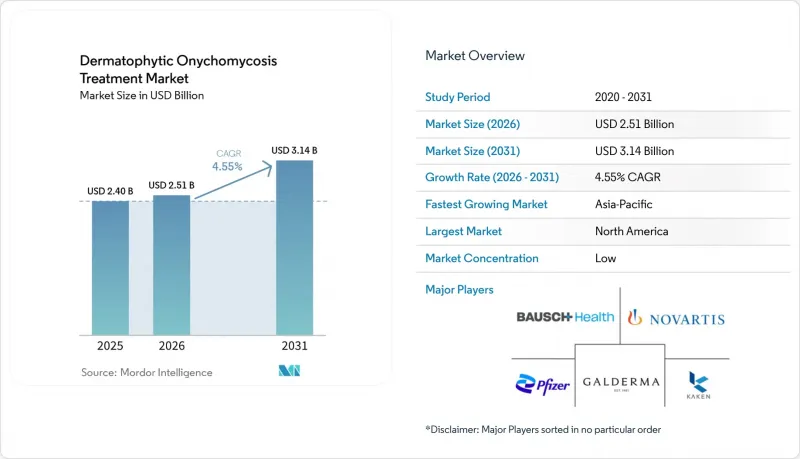
Mordor Intelligence에 의하면, 피부사상균성 손발톱진균증 치료 시장 규모는 2025년 24억 달러로 평가되었고, 2026년에는 25억 1,000만 달러로 추정되고, 2026-2031년 CAGR 4.55%로 성장을 지속할 전망이며, 2031년에는 31억 4,000만 달러에 이를 것으로 예측됩니다.
본 보고서는 약제별(테르비나핀, 이트라코나졸, 플루코나졸, 시클로피록스, 아모롤핀, 기타), 제품 유형별(정제, 네일 페인트), 투여 경로별(경구, 외용), 치료 유형별(처방약, 일반의약품), 유통 채널별(소매 약국 등), 지역별(북미, 유럽 등)로 분류되어 있습니다. 시장 전망은 금액(달러) 기준으로 제시되어 있습니다.
세계의 피부사상균성 손발톱진균증 치료 시장 동향 및 인사이트
고령화 및 당뇨병 환자에서 피부사상균증의 부담 증가
피부사상균성 손발톱진균증 치료 시장은 당뇨병과 관련된 수요에 의해 가장 견고하게 뒷받침되고 있습니다. 이는 2024년 전 세계적으로 5억 8,900만 명이 당뇨병을 앓고 있으며, 이들 환자 중 상당수가 발톱 진균 감염의 위험을 높이고 치료를 복잡하게 만드는 상태를 앓고 있기 때문입니다. 이와 유사한 연구 결과에 따르면, 당뇨병 환자는 비당뇨병 환자에 비해 발톱 백선 발병 확률이 최대 2.8배 높기 때문에 이 환자군은 여전히 장기적인 치료 수요의 중심을 이루고 있습니다. 고령화 또한 구조적인 요인으로 작용합니다. 고령 환자는 손톱의 성장 속도가 느려지고, 시간이 지남에 따라 피부사상균에 대한 누적 노출이 증가하기 때문에 일반 인구에 비해 손발톱 백선 발병 위험이 4.7배 더 높기 때문입니다. 피부사상균성 손발톱진균증 치료 시장에 미치는 영향은 단순히 환자 수 증가에 그치지 않습니다. 왜냐하면, 이러한 환자들은 신경 장애, 면역 기능 장애, 혹은 손톱으로의 혈류 부족이 있는 경우, 더 장기적인 치료와 치밀한 경과 관찰, 그리고 더 신중한 관리가 필요한 경우가 많기 때문입니다. 임상적 부담은 피부과라는 범위를 넘어 중요한 의미를 지닙니다. 왜냐하면, 당뇨병에 따른 발톱 감염은 상처 관리나 족부 관리 분야로까지 파급되어, 치료를 처방하는 의사의 실제 진료 영역을 확대하기 때문입니다. 이에 따라 피부사상균성 손발톱진균증 치료 시장은 단순한 미용적 수요에 대한 의존도를 낮추고, 고령자 및 고위험군에서의 만성 질환 관리와의 연관성을 강화하고 있습니다.
첨단 손톱 침투 기술의 활용 확대
피부사상균성 손발톱진균증 치료 시장은 외용제의 침투성 향상으로 인해 더욱 성장하고 있습니다. 이는 케라틴으로 이루어진 손톱 판에 대한 침투성이 낮았기 때문에 오랫동안 외용약의 유효성이 제한되어 경구 요법이 더 우위에 있었던 때문입니다. 2024년에 실시된 무작위 임상시험에서 하이드록시프로파일 키토산을 함유한 사이클로피록스 8% 제제는 기존의 대조용 래커 제제에 비해 3.25배 더 높은 투과성을 보였습니다. 이는 프리미엄 외용제 형태의 새로운 성장 추세를 직접적으로 뒷받침하는 것입니다. 다른 연구실에서 진행된 연구에 따르면, 미세 기공 형성과 최적화된 겔 기제를 결합함으로써 손톱 판을 가로지르는 약물의 유동이 더욱 향상되는 것으로 나타났으며, 이는 해당 분야에서 기술 주도적 차별화의 근거를 더욱 공고히 하고 있습니다. 2025년, 모버그 파마사가 HPCH 기술을 적용한 수용성 테르비나핀 손발톱용 래커 '테르클라라'가 제3상 임상시험에서 76%의 진균학적 치유율을 달성하고, 출시 직후 노르웨이 시장에서 1위 점유율을 차지했다고 발표함에 따라, 그 상업적 성공은 더욱 분명해졌습니다. 이러한 성과는 피부사상균성 손발톱진균증 치료 시장에 있어 중요한 의미를 지닙니다. 이는 경증에서 중등도 증례에 대한 외용 요법의 가치를 높여, 특정 유럽 시장에서 OTC(일반의약품)로서의 입지를 강화하기 때문입니다. 또한, 제네릭 의약품의 가격 경쟁에만 의존하는 기업이 아닌, 전달 기술에 관한 지적재산권을 보유한 기업으로 경쟁 우위를 전환하는 데에도 기여할 것입니다.
치료 기간이 길어지면 약물 복용 순응도와 치료 지속률이 떨어집니다.
피부사상균성 손발톱진균증 치료 시장은 여전히 기본적인 복약 순응도 문제에 직면해 있습니다. 이는 치료 초기 단계에서 곰팡이 억제가 이루어지더라도, 손톱의 외관상 개선이 서서히만 나타나기 때문입니다. 사용자들의 정보에 따르면, 발가락 손톱에 대한 경구용 테르비나핀 치료는 보통 3-6개월간 지속되는 반면, 국소 단일제 치료의 경우 환부인 발가락 손톱 한 개당 9-12개월에 달하기도 하여, 일상적인 관리에서 치료를 지속하기가 어려워지고 있습니다. 많은 환자들이 진균학적 반응이 아닌 외관상의 개선을 통해 치료 진행 상황을 판단하기 때문에 이러한 지연이 치료 지속 의지를 약화시켜 피부사상균성 손발톱진균증 치료 시장에 큰 부담이 되고 있습니다. 이러한 부담은 특히 고령자나 당뇨병 환자에게서 두드러지는데, 이는 치료 기간이 장기화되는 데다 다제 병용, 이동 제한, 반복적인 통원에 대한 내성 저하와 같은 문제들이 겹치기 때문입니다. 디지털 알림 서비스나 원격 피부과를 통한 경과 관찰이 도움이 될 수는 있겠지만, 고위험 환자 집단에서의 도입 현황이 제각각이기 때문에 피부사상균성 손발톱진균증 치료 시장은 아직 이러한 도구의 혜택을 충분히 누리지 못하고 있습니다. 치료 기간 관리 및 설명이 용이해질 때까지는 복약 순응도 저하로 인해 임상 현장에서의 치료 성과와 브랜드 제품의 지속적인 사용이 계속해서 제한될 것입니다.
부문별 분석
테르비나핀은 2025년 부문 매출의 42.31%를 차지했으며, 피부사상균에 의한 감염증에 대한 표준 1차 전신 치료제로서 입지를 굳건히 하고 있어, 피부사상균성 손발톱진균증 치료 시장에서 최대의 약제로서의 지위를 유지했습니다. 이러한 우위는 가이드라인에 확고히 자리 잡은 점, 광범위한 제네릭 의약품공급, 그리고 진균의 심부 침윤으로 인해 외용 요법의 효과가 제한되는 중등도에서 중증 질환에서 나타나는 높은 임상적 수용성이라는 서로를 보완하는 세 가지 요인을 반영하고 있습니다. 비용에 민감한 의료 현장에서도 이 주도적 지위는 여전히 견고합니다. 이는 제네릭 경구용 치료제가 확립된 처방 경로의 대부분을 차지하는 보험 급여 및 가격 책정 논리에 부합하기 때문입니다. 그렇긴 하지만, 단일 1차 선택 경구제에 대한 의존은 내성 문제나 안전성과 관련된 처방상의 주저를 초래하기 때문에 피부사상균성 손발톱진균증 치료 시장의 약물 구성은 변화하기 시작하고 있습니다. 이러한 변화로 인해 테르비나핀이 주도적인 위치를 잃지는 않겠지만, 특히 내성 균주가 일상적인 임상 현장에서 점차 인식되고 있는 상황에서는 앞으로 시장 점유율을 확대하는 것이 예전만큼 쉽지 않을 것입니다.
사이클로피록스는 2031년까지 연평균 성장률(CAGR)이 6.38%로 가장 빠르게 성장하고 있는 약제이며, 이러한 성장세는 제형 개선이 피부사상균성 조진균증 시장에서 기존 분자가 가져오는 효과를 어떻게 변화시키고 있는지를 보여줍니다. HPCH 전달 기술로 인해 손톱에 대한 침투성이 향상되었을 뿐만 아니라, 2025년 임상 실무 데이터에 따르면 인공지능을 통해 분석된 실제 임상 데이터에서 시클로피록스와 테르비나핀의 병용 요법이 경구 단일 요법보다 우수한 효과를 보였습니다. 이 병용 요법의 역할은 중요하며, 경증 사례에서 시클로피록스를 단독 국소 치료제로서의 위치를 뒷받침하는 동시에, 고위험 사례나 재발 사례에서 보조 요법으로서의 역할도 수행하고 있기 때문입니다. 이트라코나졸은 테르비나핀을 사용할 수 없는 환자나 내성 발생 우려가 큰 경우, 대체 경구 치료법이 필요한 환자들에게 여전히 안전망 역할을 하고 있습니다. 플루코나졸은 피부사상균에 대한 특이성이 테르비나핀만큼 설득력 있지는 않지만, 비용이 저렴하고 의사들에게도 친숙하기 때문에 임상 현장에서 여전히 중요한 위치를 차지하고 있습니다. 아모롤핀은 유럽 및 아시아 전역에서 주 1회 도포라는 유용한 틈새 시장을 유지하고 있으며, 이를 통해 미국 이외 지역의 피부사상균성 손발톱진균증 치료 시장에서 복약 순응도를 중시하는 치료 옵션의 폭이 넓어지고 있습니다.
2025년, 곰팡이성 조진균증 치료 시장 규모 중 57.24%를 정제가 차지했습니다. 이는 병변의 깊이 및 손톱에 대한 침습 정도에 따라 표면 처리의 기대 효과가 떨어지는 사례에서 경구 전신 치료에 대한 지속적인 필요성을 반영한 것입니다. 또한, 정제 제형은 의사의 확고한 관행, 성숙한 제네릭 의약품 공급, 그리고 피부과, 족부과, 1차 진료 분야의 기존 진료 흐름에 부합하는 간편한 투여법이라는 장점도 갖추고 있습니다. 많은 임상의에게 있어, 질환이 중등도 또는 중증이고 미용적 선호도보다 신속한 진균 억제가 중요한 경우, 정제는 여전히 피부사상균성 손발톱진균증 치료 시장의 핵심 치료 기반을 이루고 있습니다. 이로 인해 일부 환자와 의사가 전신 요법에 수반되는 모니터링 부담을 피하고자 하는 경우에도, 이 부문은 견조한 성장세를 유지하고 있습니다. 따라서, 정제의 주도적인 지위는 단순한 제형에 대한 선호가 아니라 임상적 필요성에 근거하고 있습니다.
네일 페인트 시장은 2031년까지 연평균 성장률(CAGR) 5.52%를 기록하며 성장할 것으로 전망되며, 투여 시스템의 개선으로 경증 환자에서의 효능에 대한 기대가 높아짐에 따라 가장 역동적인 제품 형태로 자리매김하고 있습니다. 이 사실을 가장 명확하게 입증한 곳은 모버그 파마(Moberg Pharma)사로, 이 회사는 제3상 임상시험에서 자사 제품인 '테르클라라'의 진균학적 치유율이 76%였던 반면, 기존의 비교 대상 약물은 최대 42%에 그쳤다고 보고했습니다. 이러한 데이터가 중요한 이유는 손발톱용 도포제를 효능이 낮은 기존의 제형에서 피부사상균성 손발톱진균증 치료 시장에서 더 신뢰할 수 있는 치료 옵션으로 전환시켰기 때문입니다. 또한, 많은 환자들은 효능과 외관 사이의 상충 관계가 완화된다면 눈에 보이는 비전신성 제형을 지속적으로 사용하는 것을 더 적극적으로 받아들일 것이므로, 미용 측면에서의 수용성 향상도 이러한 변화를 뒷받침하고 있습니다. 따라서 네일 페인트의 성장은 단순한 제형에 그치지 않고, 과학적 근거와 환자의 행동 양쪽을 모두 반영한 것입니다. 그 결과, 예측 기간 동안 피부사상균성 손발톱진균증 치료 시장에서는 경구제와 첨단 외용제의 비중이 보다 균형 잡힌 분포를 보일 것으로 전망됩니다.
지역별 분석
북미는 2025년에 전 세계 매출의 38.22%를 차지했으며, 피부사상균성 손발톱진균증 치료 시장에서 여전히 가장 큰 비중을 차지하는 지역으로 자리매김했습니다. 이 지역의 입지는 높은 질환 유병률, 피부과 및 족부과 진료에 대한 폭넓은 접근성, 그리고 브랜드 의약품과 제네릭 의약품을 모두 포함하는 성숙한 처방약 구성에 힘입어 공고히 자리 잡고 있습니다. 또한, 미국에서는 치료로 전환되는 비율의 격차가 가장 두드러지게 나타납니다. 이는 진단을 받은 환자 중 상당수가 여전히 확정 검사나 약물 치료 단계로 넘어가지 않았기 때문이며, 진단 체계가 개선된다면 판매량 확대의 여지가 남아 있습니다. 이에 이어 유럽에서는 확립된 피부과 처방 경로, 외용제 분야의 혁신적 발전, 그리고 2024년 분산형 승인 절차가 완료된 후 회원국 간에 단계적으로 도입된 에피나코나졸의 규제 경로에 힘입어 더욱 꾸준한 성장이 예상됩니다.
아시아태평양은 가장 빠르게 성장하고 있는 지역이며, 이 지역의 피부사상균성 손발톱진균증 치료 시장 규모는 2031년까지 연평균 성장률(CAGR) 6.65%로 확대될 것으로 전망됩니다. 이 지역은 성숙한 시장에서는 보기 드문 여러 요인의 조합, 즉 당뇨병 부담 증가, 민간 피부과에 대한 접근성 확대, 그리고 의료 서비스가 충분히 제공되지 않는 환자들이 치료 경로에 접근할 수 있도록 지원하는 정부 주도의 원격의료 보급 등의 혜택을 누리고 있습니다. 일본에서는 전신 치료가 적합하지 않은 고령 환자들 사이에서 예전부터 '외용약 우선'의 처방 관행이 일반적이었기 때문에 여전히 중요한 참고 사례로 남아 있습니다. 2025년에 개정된 일본의 피부 진균증 치료 지침에는 새로운 내성 정보와 경구용 약물에 관한 보다 강력한 근거가 추가되었습니다. 이에 따라 일률적으로 '외용약 우선'이라고 단정 짓기보다는 투여 경로의 선택이 더욱 신중하게 이루어지게 될 가능성이 있습니다. Kaken사가 일본에서 이미 승인을 받은 제네릭 의약품인 에피나코나졸 손발톱용 용액을 출시한 것과 중국에서의 개발 활동은 지역 기업이 아시아 내 유통망을 활용하여 피부과 분야의 자산을 여러 시장으로 확대하고 있는 실제 사례를 보여줍니다.
중동 및 아프리카(MEA) 및 남미는 여전히 시장 기여도가 낮은 편이지만, 접근성이 개선됨에 따라 두 지역 모두 피부사상균성 손발톱진균증 치료 시장에 점진적인 수요 증가를 가져오고 있습니다. MEA 지역에서는 GCC 국가들이 일반의약품(OTC) 항진균제에 대한 지출 규모와 소비자 인지도 면에서 두드러지는 반면, 남아프리카공화국은 사하라 이남 아프리카에서 가장 잘 갖춰진 의약품 유통 인프라를 보유하고 있습니다. 남미에서는 브라질이 확대되는 민간 피부과 클리닉 네트워크와 처방전을 통한 접근성 확대의 혜택을 누리고 있는 반면, 아르헨티나에서는 보험 급여 조건의 변동이 심하기 때문에 프리미엄 외용제 브랜드보다 제네릭 의약품이 계속해서 우위를 점하고 있습니다. 두 지역 모두에서 온라인 약국 이용이 확대됨에 따라 기존 오프라인 매장에 의존하던 제약이 완화되고 있으며, 이에 따라 일반의약품 및 유지요법용 의약품에 대한 접근성이 점차 개선될 것으로 전망됩니다.
기타 혜택 :
- 엑셀 형식 시장 예측(ME) 시트
- 3개월간의 애널리스트 지원
자주 묻는 질문
목차
제1장 서론
제2장 조사 방법
제3장 주요 요약
제4장 시장 구도
제5장 시장 규모 및 성장 예측
제6장 경쟁 구도
제7장 시장 기회 및 향후 전망
AJY 26.07.07According to Mordor Intelligence, the dermatophytic onychomycosis treatment market size is expected to grow from USD 2.40 billion in 2025 to USD 2.51 billion in 2026 and is forecast to reach USD 3.14 billion by 2031 at 4.55% CAGR over 2026-2031.
This report is Segmented by Medication (Terbinafine, Itraconazole, Fluconazole, Ciclopirox, Amorolfine, Others), Product Type (Tablets, Nail Paints), Treatment Route (Oral, Topical), Treatment Type (Prescription, Over-The-Counter), Distribution Channel (Retail Pharmacies, and More), and Geography (North America, Europe, and More). The Market Forecasts are Provided in Terms of Value (USD).
Global Dermatophytic Onychomycosis Treatment Market Trends and Insights
Rising Dermatophyte Burden in Aging and Diabetic Populations
The dermatophytic onychomycosis treatment market is most firmly supported by diabetes-linked demand, because diabetes affected 589 million people worldwide in 2024 and many of these patients face conditions that raise fungal nail infection risk and complicate treatment. The same evidence base shows that diabetic individuals face up to 2.8 times greater odds of developing onychomycosis than non-diabetic individuals, which keeps this patient pool central to long-run therapy demand. Aging adds a second structural layer, because geriatric patients face 4.7 times greater onychomycosis risk than the general population as nail growth slows and cumulative dermatophyte exposure rises over time. The effect on the dermatophytic onychomycosis treatment market is broader than simple case growth, because these patients often need longer treatment, closer follow-up, and more careful management when neuropathy, immune dysfunction, or poor nail perfusion are present. Clinical burden also matters beyond dermatology, because diabetic nail infection can feed into wound-care and podiatry management pathways, which expands the practical prescriber base for therapy. This makes the dermatophytic onychomycosis treatment market less dependent on cosmetic demand alone and more connected to chronic disease management in older and higher-risk populations.
Growing Use of Advanced Nail Penetration Technologies
The dermatophytic onychomycosis treatment market is also being lifted by better topical delivery, because poor penetration through the keratin nail plate had long limited topical efficacy and kept oral therapy in a stronger position. In a 2024 randomized clinical trial, ciclopirox 8% with hydroxypropyl chitosan showed 3.25-fold higher permeability than older reference lacquer formulations, which directly supports the newer growth profile for premium topical formats. Separate laboratory work showed that microporation combined with optimized gel vehicles further improved drug flux across the nail plate, which strengthens the case for technology-led differentiation in this category. The commercial proof point became clearer in 2025, when Moberg Pharma stated that Terclara, a water-soluble terbinafine nail lacquer using HPCH technology, achieved 76% mycological cure in Phase III trials and quickly became the market leader in Norway after launch. These gains matter for the dermatophytic onychomycosis treatment market because they improve the value proposition of topical treatment in mild-to-moderate disease and support OTC positioning in selected European markets. They also shift competitive advantage toward companies that own delivery intellectual property rather than toward companies competing only on generic price.
Long Treatment Duration Depresses Adherence and Persistence
The dermatophytic onychomycosis treatment market still faces a basic adherence problem, because visible nail improvement arrives slowly even when fungal control is achieved earlier in the course of therapy. The user input showed that oral terbinafine regimens commonly run for 3 to 6 months in toenails, while topical monotherapy can extend to 9 to 12 months for a single affected toenail, which makes persistence difficult in routine care. This weighs on the dermatophytic onychomycosis treatment market because many patients judge progress by cosmetic clearing rather than by mycological response, and that delay weakens motivation to continue treatment. The burden is especially relevant in elderly and diabetic populations, where longer treatment windows overlap with polypharmacy, mobility limits, and lower tolerance for repeated follow-up. Digital reminders and teledermatology follow-up can help, but the dermatophytic onychomycosis treatment market does not yet benefit fully from these tools because adoption remains uneven across the highest-risk patient groups. Until treatment timelines become easier to manage or easier to explain, adherence drag will continue to limit realized outcomes and branded product persistence in daily practice.
Other drivers and restraints analyzed in the detailed report include:
- Underdiagnosis Creating Latent Treatment Conversion Opportunity
- Recurrence Management Driving Repeat Prescriptions and Combination Therapy Uptake
- Therapeutic Resistance and Biofilm Persistence Reduce Cure Confidence
For complete list of drivers and restraints, kindly check the Table Of Contents.
Segment Analysis
Terbinafine held 42.31% of segment revenue in 2025, which kept it as the largest medication in the dermatophytic onychomycosis treatment market because it remains the standard first-line systemic option for dermatophyte-led infection. Its lead reflects 3 reinforcing factors, guideline familiarity, broad generic supply, and strong clinical acceptance in moderate-to-severe disease where deeper fungal involvement limits what topical therapy can do. In cost-sensitive settings this leadership is still durable, because generic oral therapy fits the reimbursement and pricing logic that shapes a large share of established prescribing pathways. Even so, the medication mix inside the dermatophytic onychomycosis treatment market is starting to change because reliance on a single first-line oral agent also creates exposure to resistance concerns and safety-related prescribing hesitation. That shift does not remove terbinafine from its leading position, but it does reduce the ease with which it can extend share from here, especially where resistant strains are entering routine clinical awareness.
Ciclopirox is the fastest-growing medication at a 6.38% CAGR through 2031, and that pace shows how formulation improvement is changing what older molecules can deliver in the dermatophytic onychomycosis industry. HPCH delivery technology has improved nail penetration, while clinical practice evidence in 2025 showed that combination ciclopirox-terbinafine therapy outperformed oral monotherapy in real-world records analyzed with artificial intelligence. That combination role matters, because it supports ciclopirox both as a standalone topical option in milder disease and as an adjunct in higher-risk or recurrent cases. Itraconazole continues to hold a defensive place for patients who cannot use terbinafine or who need an alternative oral path when resistance concerns are stronger. Fluconazole remains relevant in practice because of low cost and physician familiarity, even though its dermatophyte-specific profile is less compelling than terbinafine. Amorolfine keeps a useful weekly-application topical niche across Europe and Asia, which gives the dermatophytic onychomycosis treatment market a broader range of adherence-oriented options outside the U.S.
Tablets accounted for 57.24% of the dermatophytic onychomycosis treatment market size in 2025, reflecting the continuing need for oral systemic treatment in cases where disease depth and nail involvement reduce the expected effect of surface therapy. The tablet format also benefits from established physician habit, mature generic availability, and straightforward dosing that fits existing care pathways in dermatology, podiatry, and primary care. For many clinicians, tablets still define the core treatment backbone of the dermatophytic onychomycosis treatment market when disease is moderate or severe and rapid fungal suppression matters more than cosmetic preferences. That keeps the category durable, even while some patients and physicians prefer to avoid monitoring demands associated with systemic therapy. The leading position of tablets therefore remains grounded in clinical necessity rather than in format preference alone.
Nail paints are forecast to grow at a 5.52% CAGR through 2031, which makes them the most dynamic product format as improved delivery systems raise efficacy expectations in milder disease. The clearest validation came from Moberg Pharma, which reported 76% mycological cure for Terclara in Phase III trials compared with up to 42% for prior comparators. Those data matter because they turn nail paints from a lower-efficacy legacy format into a more credible treatment choice within the dermatophytic onychomycosis treatment market. Better cosmetic acceptance also supports this shift, since many patients are more willing to stay on a visible and non-systemic format when the performance tradeoff becomes less severe. The growth of nail paints therefore reflects both science and behavior, not just packaging format. As a result, the dermatophytic onychomycosis treatment market is likely to see a more balanced split between oral and advanced topical product forms over the forecast period.
Complete Report Scope:
- By Medication
- Terbinafine
- Itraconazole
- Fluconazole
- Ciclopirox
- Amorolfine
- Other Medication
- By Product Type
- Tablets
- Nail Paints
- By Treatment Route
- Oral
- Topical
- By Treatment Type
- Prescription
- Over-The-Counter
- By Distribution Channel
- Retail Pharmacies
- Online Pharmacies
- Drug Stores
- Other Distribution Channels
- By Geography
- North America
- United States
- Canada
- Mexico
- Europe
- Germany
- United Kingdom
- France
- Italy
- Spain
- Rest of Europe
- Asia-Pacific
- China
- Japan
- India
- Australia
- South Korea
- Rest of Asia-Pacific
- Middle East and Africa
- GCC
- South Africa
- Rest of Middle East and Africa
- South America
- Brazil
- Argentina
- Rest of South America
- North America
Geography Analysis
North America held 38.22% of global revenue in 2025 and therefore remained the largest regional contributor to the dermatophytic onychomycosis treatment market share. The region's position rests on high disease prevalence, broad access to dermatology and podiatry care, and a mature formulary mix that includes both branded and generic antifungal options. The U.S. also shows the clearest treatment-conversion gap, because many diagnosed visits still do not progress to confirmatory testing or drug treatment, which leaves room for volume expansion if diagnosis improves. Europe follows with steadier expansion, supported by established prescription dermatology pathways, rising topical innovation, and a staggered regulatory pathway for efinaconazole across member states after the decentralized procedure was completed in 2024.
Asia-Pacific is the fastest-growing region, with the dermatophytic onychomycosis treatment market size in this geography projected to expand at a 6.65% CAGR through 2031. The region benefits from a combination that is harder to find in mature markets, rising diabetes burden, expanding private dermatology access, and wider use of government-backed telemedicine that helps underserved patients reach treatment pathways. Japan remains a key reference point because topical-first prescribing has historically been common among older patients who are less suitable for systemic treatment. Updated 2025 skin fungal disease guidance in Japan added new resistance information and stronger oral evidence, which is likely to make route choice more selective rather than uniformly topical-first. Kaken's launch of an authorized generic efinaconazole nail solution in Japan and its China development activity show how regional companies are using intra-Asian pathways to extend dermatology assets across multiple markets.
The Middle East and Africa and South America remain smaller contributors, but both are adding incremental demand to the dermatophytic onychomycosis treatment market as access improves. In MEA, GCC countries stand out for stronger OTC antifungal spending and consumer awareness, while South Africa offers the most structured pharmaceutical distribution base in sub-Saharan Africa. In South America, Brazil benefits from a growing private dermatology clinic network and broader prescription access, while more volatile reimbursement conditions in Argentina continue to favor generics over premium topical brands. Across both regions, wider online pharmacy use is helping reduce reliance on traditional brick-and-mortar constraints, which should gradually improve access for OTC and maintenance products.
- Astellas Pharma
- Bausch Health
- Bayer
- Cipla
- Dr. Reddy's Laboratories
- Galderma
- GlaxoSmithKline
- Janssen Global Services, LLC
- Kaken Pharmaceutical Co., Ltd.
- Medimetriks Pharmaceuticals, Inc.
- Merck
- Moberg Pharma
- Novartis
- Pfizer
- Sanofi
- Sun Pharmaceuticals Industries
- Teva Pharmaceutical Industries
- TheOTCLab B.V.
Additional Benefits:
- The market estimate (ME) sheet in Excel format
- 3 months of analyst support
TABLE OF CONTENTS
1 Introduction
- 1.1 Study Assumptions & Market Definition
- 1.2 Scope of the Study
2 Research Methodology
3 Executive Summary
4 Market Landscape
- 4.1 Market Overview
- 4.2 Market Drivers
- 4.2.1 Rising Dermatophyte Burden in Aging and Diabetic Populations
- 4.2.2 Preference Shift Toward Topical Therapies With Better Cosmetic Acceptance
- 4.2.3 Expanding Access To Specialist Dermatology and Retail Pharmacy Channels
- 4.2.4 Growing Use of Advanced Nail Penetration Technologies
- 4.2.5 Underdiagnosis Creating Latent Treatment Conversion Opportunity
- 4.2.6 Recurrence Management Driving Repeat Prescriptions and Combination Therapy Uptake
- 4.3 Market Restraints
- 4.3.1 Long Treatment Duration Depresses Adherence and Persistence
- 4.3.2 Oral Antifungal Safety Concerns Limit High-Value Prescribing
- 4.3.3 Limited Reimbursement and High Out-Of-Pocket Cost in Several Markets
- 4.3.4 Therapeutic Resistance and Biofilm Persistence Reduce Cure Confidence
- 4.4 Supply Chain Analysis
- 4.5 Regulatory Landscape
- 4.6 Technological Outlook
- 4.7 Porter's Five Forces Analysis
- 4.7.1 Bargaining Power of Suppliers
- 4.7.2 Bargaining Power of Buyers
- 4.7.3 Threat of New Entrants
- 4.7.4 Threat of Substitutes
- 4.7.5 Competitive Rivalry
5 Market Size & Growth Forecasts (Value, USD)
- 5.1 By Medication
- 5.1.1 Terbinafine
- 5.1.2 Itraconazole
- 5.1.3 Fluconazole
- 5.1.4 Ciclopirox
- 5.1.5 Amorolfine
- 5.1.6 Other Medication
- 5.2 By Product Type
- 5.2.1 Tablets
- 5.2.2 Nail Paints
- 5.3 By Treatment Route
- 5.3.1 Oral
- 5.3.2 Topical
- 5.4 By Treatment Type
- 5.4.1 Prescription
- 5.4.2 Over-The-Counter
- 5.5 By Distribution Channel
- 5.5.1 Retail Pharmacies
- 5.5.2 Online Pharmacies
- 5.5.3 Drug Stores
- 5.5.4 Other Distribution Channels
- 5.6 By Geography
- 5.6.1 North America
- 5.6.1.1 United States
- 5.6.1.2 Canada
- 5.6.1.3 Mexico
- 5.6.2 Europe
- 5.6.2.1 Germany
- 5.6.2.2 United Kingdom
- 5.6.2.3 France
- 5.6.2.4 Italy
- 5.6.2.5 Spain
- 5.6.2.6 Rest of Europe
- 5.6.3 Asia-Pacific
- 5.6.3.1 China
- 5.6.3.2 Japan
- 5.6.3.3 India
- 5.6.3.4 Australia
- 5.6.3.5 South Korea
- 5.6.3.6 Rest of Asia-Pacific
- 5.6.4 Middle East and Africa
- 5.6.4.1 GCC
- 5.6.4.2 South Africa
- 5.6.4.3 Rest of Middle East and Africa
- 5.6.5 South America
- 5.6.5.1 Brazil
- 5.6.5.2 Argentina
- 5.6.5.3 Rest of South America
- 5.6.1 North America
6 Competitive Landscape
- 6.1 Market Concentration
- 6.2 Market Share Analysis
- 6.3 Company Profiles (includes Global Level Overview, Market Level Overview, Core Segments, Financials as available, Strategic Information, Market Rank/Share, Products and Services, Recent Developments)
- 6.3.1 Astellas Pharma Inc.
- 6.3.2 Bausch Health Companies Inc.
- 6.3.3 Bayer AG
- 6.3.4 Cipla Limited
- 6.3.5 Dr. Reddy's Laboratories Ltd.
- 6.3.6 Galderma S.A.
- 6.3.7 GlaxoSmithKline plc
- 6.3.8 Janssen Global Services, LLC
- 6.3.9 Kaken Pharmaceutical Co., Ltd.
- 6.3.10 Medimetriks Pharmaceuticals, Inc.
- 6.3.11 Merck & Co., Inc.
- 6.3.12 Moberg Pharma AB
- 6.3.13 Novartis AG
- 6.3.14 Pfizer Inc.
- 6.3.15 Sanofi
- 6.3.16 Sun Pharmaceutical Industries Ltd.
- 6.3.17 Teva Pharmaceutical Industries Ltd.
- 6.3.18 TheOTCLab B.V.
7 Market Opportunities & Future Outlook
- 7.1 White-space & unmet-need assessment


