

|
시장보고서
상품코드
2072852
미국의 상완신경총 손상 시장 : 점유율 분석, 업계 동향과 통계, 성장 예측(2026-2031년)United States Brachial Plexus Injury - Market Share Analysis, Industry Trends & Statistics, Growth Forecasts (2026 - 2031) |
||||||
 Mordor Intelligence
Mordor Intelligence에 의하면, 미국 상완신경총 손상 시장 규모는 2025년 1억 8,134만 달러에서 2026년에는 1억 9,302만 달러로 확대되어 2031년까지 2억 7,164만 달러에 이를 것으로 예상되고 있어 2026년부터 2031년까지 CAGR 7.07%로 성장할 전망입니다.
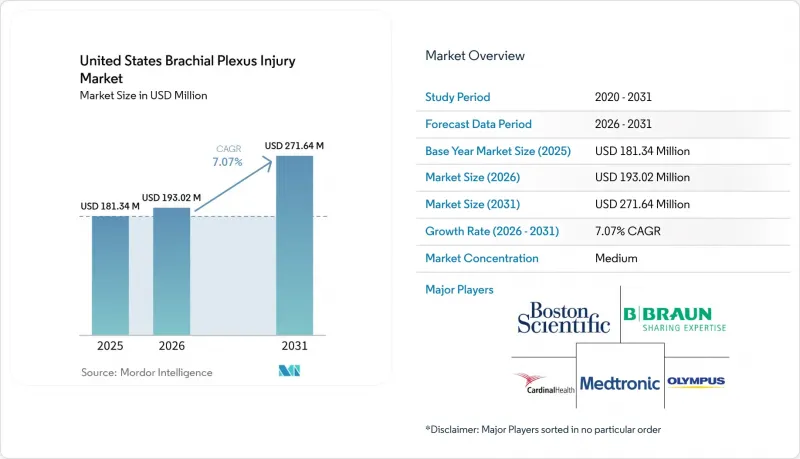
본 보고서는 손상 유형(박리, 파열, 신경종, 신전), 치료 유형(외과적 치료, 물리치료, 약물 치료, 재활치료), 환자층(영유아, 성인, 고령자), 진단 방법(근전도, 초음파, MRI), 그리고 최종 사용자(병원, 전문 클리닉, 외래수술센터(ASC), 재활센터)별로 분류되어 있습니다. 시장 전망은 금액(달러) 기준으로 제시되어 있습니다.
미국 상완신경총 손상 시장 동향 및 인사이트
교통사고나 스포츠 사고로 인한 외상성 손상 증가
외상 환자 중 상완신경총 손상 사례의 32.8%가 오토바이 사고로 인한 것이며, 더 나아가 광의의 말초 신경 손상 전체에서도 자동차 충돌 사고가 16.7%를 차지하고 있어, 이로 인해 미국의 상완신경총 손상 시장에는 중증 사례가 끊임없이 유입되고 있습니다. 이러한 경향이 중요한 이유는 교통사고로 인한 외상이 저에너지 신경 손상에 비해 고에너지 경추 신경근 손상을 유발할 가능성이 높으며, 이는 고도의 영상 진단, 외과적 분류, 장기적인 재활 치료가 필요할 수 있기 때문입니다. 운동으로 인한 부담도, 특히 젊은 환자들에게 있어 중요한 요소입니다. 소아 외상성 상완신경총 손상에 관한 데이터에 따르면, 자동차 사고가 전체 사례의 35%를 차지하고, 스포츠 사고가 28%를 차지하는 것으로 나타났기 때문입니다. 또한, 같은 자료에 따르면 외상성 사례의 41%에서 현미경 수술이 적응증으로 판정된 반면, 분만 시 손상 사례에서는 13%에 그쳤는데, 이는 외상 사례가 전문의의 진료를 받게 되면 수술로 전환되는 비율이 높아진다는 것을 의미합니다. 그 결과, 미국의 상완신경총 손상 시장은 환자 수뿐만 아니라, 복잡하고 고비용인 치료 사례의 과반수를 차지한다는 점에서도 외상 사례의 발생 건수에 계속해서 의존하고 있습니다.
중증 신경근 박리 및 복잡한 상완 신경총 손상에 대한 높은 수술 적응률
미국의 상완신경총 손상 시장은 중증 사례에 대해 여전히 높은 반응성을 보이고 있습니다. 이는 신경근 박리 및 완전한 상완 신경총 파열 사례에서 수술에 의한 치료율이 53%에 달했고, 또한 상완 신경총 손상 수술 전체의 48%에서 신경 이식술이 시행되었기 때문입니다. 근부 박리 손상은 수술 전 신경절의 상실로 인해 표준 이식편을 이용한 복원이 불가능해지며, 외과의사가 늑간 신경 이식이나 대측 C7 신경 이식과 같은 신경총 외 기증 전략을 채택할 수밖에 없게 되므로, 수술 수요를 크게 유발하고 있습니다. 2024년에 발표된 임상 증거에 따르면, 대측 C7 신경 이식은 신경총 내 기증자 선택지가 없는 다발성 신경근 박리 손상 환자에게 현재 신뢰할 수 있는 치료법으로 간주되고 있으며, 이로 인해 미국의 상완신경총 손상 시장에서 치료 대상 환자층이 확대되고 있습니다. 또한, 2025년 메타분석에 따르면 상부 줄기 복원술의 성공률이 75%에 달한 반면, 완전 손상의 경우 29%에 그친 것으로 나타났으며, 이는 조기 환자 선별과 전문 의료기관으로의 신속한 의뢰의 중요성을 뒷받침하고 있습니다. 이러한 기술적 실현 가능성과 보다 명확하게 정의된 치료 결과에 대한 기대가 맞물리면서, 가장 심각한 장애를 유발하는 신경 손상에 대한 수술은 미국 상완신경총 손상 시장에서 여전히 중심적인 위치를 차지하고 있습니다.
수술이 가능한 기간이 제한되어 있어, 치료 가능한 환자 수가 감소
미국의 상완신경총 손상 시장은 신경 재생 속도가 하루 1mm에 불과하다는 엄격한 생물학적 한계에 직면해 있으며, 3-6개월을 초과하는 지연은 유의미한 운동 기능 회복 가능성을 저하시킵니다. 한 다기관 공동 연구에 따르면, 수술이 6개월 이내에 시행된 경우 어깨 외전 각도의 평균값이 110°였던 반면, 수술이 지연된 사례에서는 51°에 그친 것으로 보고되어, 실용적인 관점에서도 조기 개입이 중요하다는 사실이 밝혀졌습니다. 이러한 시기적 문제는 미국 상완신경총 손상 시장에서 특히 중요합니다. 왜냐하면 많은 환자가 처음에 응급실이나 지역 병원을 찾지만, 이러한 의료기관에는 신경 재건 전문 분야에 대한 직접적인 의뢰 경로가 없기 때문입니다. 그 결과, 수요가 완전히 사라지는 것은 아닙니다. 왜냐하면, 그러한 환자들은 여전히 물리치료와 통증 관리를 받고 있기 때문입니다. 그러나 그로 인해 환자는 가장 가치 있는 외과적 치료의 대상에서 제외되게 됩니다. 적격 사례 수의 이러한 감소로 인해, 미국의 상완신경총 손상 시장은 수술법의 혁신만으로는 달성할 수 있는 수익 성장에 한계가 생길 것입니다.
부문별 분석
2025년, 미국 상완신경총 손상 시장에서 박리성 손상은 34.48%의 점유율을 차지했습니다. 이는 중증 성인 환자에게서 주로 나타나는 고에너지 외상 양상과 밀접한 관련이 있음을 반영합니다. 박리 손상은 신경근이 척수에서 떼어져 나오기 때문에 많은 사례에서 표준적인 신경총 내 이식술이라는 선택지가 배제되므로, 상완 신경총 손상 중에서도 수술적으로 가장 어려운 형태입니다. 이러한 임상적 중증도로 인해, 미국 상완신경총 손상 치료 분야의 평균적인 치료 난이도가 높아지고 있습니다. 이는 외과의사가 늑간신경이나 척수부신경의 전이와 같이 신경총 외부에서 신경을 확보하는 전략이 종종 필요하기 때문입니다. 또한, 완전하거나 거의 완전한 신경총 손상의 경우, 수술실에서의 정교한 조율, 고도의 영상 진단, 그리고 장기간에 걸친 경과 관찰이 필요하기 때문에 대학 부속 병원으로의 전원 의료기관의 역할도 확대되고 있습니다.
신경종은 2031년까지 연평균 성장률(CAGR)이 7.36%로, 가장 빠르게 성장하고 있는 손상 하위 유형입니다. 이는 불완전한 회복이나 재건 수술의 실패 후에 발생하는 통증을 동반하는 신경 후유증에 대해 임상의들이 더욱 주의를 기울이고 있기 때문입니다. 이러한 변화로 인해 미국의 상완신경총 손상 시장은 급성 외상 치료에 그치지 않고, 만성적인 기능 상실, 통증 완화 및 재수술 분야로 관심이 쏠리고 있습니다. 파열 및 신전 손상은 진단, 약물 처방, 치료, 재활에 이르는 저급성 치료 수요의 안정적인 기반을 형성하기 때문에 여전히 중요한 위치를 차지하고 있습니다. 이러한 요인들이 복합적으로 작용함에 따라, 미국의 상완신경총 손상 시장은 금액 기준으로는 박리 손상이 핵심을 이루는 반면, 신경종은 후기 치료 단계에서 대상 환자층을 확대되고 있습니다.
2025년 미국 상완신경총 손상 시장 규모 중 외과적 치료가 51.17%를 차지하고 있으며, 이는 수술 기반 치료가 여전히 매출에서 가장 큰 비중을 차지하고 있음을 뒷받침합니다. 이 부문에는 신경 복원, 이식, 전이 및 현미경 수술적 재건이 포함되며, 이들 분야는 종합적으로 미국 상완신경총 손상 시장에서 가장 높은 수술 난이도와 가장 높은 보험 보상률을 자랑합니다. 신경 이식술은 상완신경총 손상 수술 전체의 48%에서 시행되고 있으며, 이는 현재 임상 현장에서 재건 전략이 얼마나 중심적인 위치를 차지하게 되었는지를 보여줍니다. 공개된 치료 결과 또한 특정 증례에서 보다 진보된 전이 치료 프로토콜을 뒷받침하고 있으며, 특히 "오버린 2법"에서는 늑간신경에서 근피신경으로의 이식술과 비교했을 때, 팔꿈치 관절 굴곡 기능 회복 과정에서 더 강한 sEMG 신호가 확인되었습니다.
물리치료 시장은 2031년까지 연평균 성장률(CAGR) 8.87%를 나타낼 것으로 예측되며, 이에 따라 미국 상완신경총 손상 시장에서 가장 빠르게 성장하는 치료 분야가 될 것입니다. 이러한 변화는 재활 치료가 수술 후에만 시작되는 것이 아니라, 공동 주치료 경로로서 점차 그 위상이 강화되고 있다는 보다 광범위한 임상적 전환을 반영하고 있습니다. 2024년에 발표된 독일의 임상 지침에서는 학제간 말초신경 치료에 있어 장기적인 작업치료 및 물리치료를 매우 중요하게 여기고 있으며, 이러한 입장은 현재 미국의 주요 프로그램들이 치료 계획을 수립하는 방식과 일치합니다. 따라서 진료를 늦게 받거나, 동반 질환이 있거나, 보험사의 규정에 따라 수술이 어려운 경우에도 약물 치료 및 재활 서비스는 미국의 상완신경총 손상 치료 분야를 지속적으로 지탱하고 있습니다.
기타 혜택:
- 엑셀 형식 시장 예측(ME) 시트
- 3개월간의 애널리스트 지원
자주 묻는 질문
목차
제1장 서론
제2장 조사 방법
제3장 주요 요약
제4장 시장 구도
제5장 시장 규모와 성장 예측
제6장 경쟁 구도
제7장 시장 기회와 향후 전망
JHS 26.07.03According to Mordor Intelligence, the united states brachial plexus injury market size is expected to increase from USD 181.34 million in 2025 to USD 193.02 million in 2026 and reach USD 271.64 million by 2031, growing at a CAGR of 7.07% over 2026-2031.
This report is Segmented by Type of Injury (Avulsion, Rupture, Neuroma, Stretch), Treatment Type (Surgical Treatment, Physical Therapy, Medication, Rehabilitation), Patient Demographics (Infants, Adults, Elderly), Diagnostic Method (EMG, Ultrasound, MRI), and End User (Hospitals, Specialty Clinics, Ascs, Rehabilitation Centers). The Market Forecasts are Provided in Terms of Value (USD).
United States Brachial Plexus Injury Market Trends and Insights
Rising Traumatic Injury Burden From Road Accidents and Sports Incidents
Motorcycle accidents represented 32.8% of brachial plexus injury cases in trauma populations, and motor vehicle collisions accounted for another 16.7% of peripheral nerve injuries more broadly, which keeps a steady inflow of severe cases into the United States brachial plexus injury market. This pattern matters because road trauma produces high-force cervical root damage that is more likely to need advanced imaging, surgical triage, and long rehabilitation than lower-energy nerve injuries. The sports burden also matters, especially in younger patients, because pediatric traumatic brachial plexus injury data showed that motor vehicle accidents accounted for 35% of cases and sports incidents for 28%. Those same data showed that microsurgery was indicated in 41% of traumatic cases compared with 13% of birth injury cases, which means trauma cases generate a higher surgical conversion rate once they enter specialist care. As a result, the United States brachial plexus injury market continues to depend on trauma volume not just for patient counts, but for a disproportionate share of complex and high-value treatment episodes.
High Surgical Receptivity for Severe Root Avulsion and Complex Plexus Damage
The United States brachial plexus injury market remains highly responsive to severe cases because root avulsion and complete brachial plexus disruptions carried a 53% operative management rate, and nerve transfers were used in 48% of all brachial plexus injury surgeries. Avulsion injuries create strong procedure demand because preganglionic root loss prevents standard graft-based repair and pushes surgeons toward extraplexal donor strategies such as intercostal transfer or contralateral C7 transfer. Published clinical evidence in 2024 showed that contralateral C7 transfer is now viewed as a reliable pathway for patients with multiple root avulsions who lack intraplexal donor options, which expands the treatable population within the United States brachial plexus injury market. A 2025 meta-analysis also showed that upper trunk repairs achieved a 75% success rate, while complete injuries reached 29%, which reinforces the value of early case selection and rapid referral into specialized centers. That mix of technical feasibility and better-defined outcome expectations keeps surgery at the center of the United States brachial plexus injury market for the most disabling forms of nerve damage.
Narrow Surgical Timing Window Reduces Treatable Patient Pool
The United States brachial plexus injury market faces a hard biological limit because nerve regeneration moves at 1 mm per day, and delays beyond 3 to 6 months lower the chance of meaningful motor recovery. Early intervention matters in practical terms, since one multicenter series reported mean shoulder abduction of 110° for surgery performed within 6 months compared with 51° for delayed cases. This timing problem is especially important in the United States brachial plexus injury market because many patients first present to emergency departments or community hospitals that do not have a direct referral pathway into subspecialty nerve reconstruction. The result is not a full loss of demand, because those patients still use physical therapy and pain management, but it does remove them from the highest-value surgical funnel. That compression of eligible case volume limits how much revenue growth the United States brachial plexus injury market can realize from procedure innovation alone.
Other drivers and restraints analyzed in the detailed report include:
- Faster Adoption of AI-Assisted Imaging and Intraoperative Nerve Monitoring
- Higher Coverage for Medically Necessary Reconstructive Care and Rehabilitation
- Scarcity of Subspecialty Surgeons Slows Referral-to-Treatment Conversion
For complete list of drivers and restraints, kindly check the Table Of Contents.
Segment Analysis
Avulsion held 34.48% of the United States brachial plexus injury market share in 2025, which reflects its close link with the high-energy trauma patterns that dominate severe adult presentations. Avulsion is the most procedurally demanding form of brachial plexus injury because the nerve root is torn from the spinal cord, which removes the option of standard intraplexal grafting in many cases. That clinical severity raises the average treatment intensity in the United States brachial plexus injury industry, because surgeons often need extraplexal donor strategies such as intercostal or spinal accessory transfers. It also increases the role of academic referral centers, since complete and near-complete plexus injuries demand higher operating room coordination, advanced imaging, and longer follow-up.
Neuroma is the fastest-growing injury subtype, with a 7.36% CAGR through 2031, as clinicians are paying closer attention to painful nerve sequelae after incomplete recovery or failed reconstruction. That shift broadens the United States brachial plexus injury market beyond acute trauma repair and pushes more attention toward chronic functional loss, pain relief, and revision pathways. Rupture and stretch injuries remain important because they create a stable base of lower-acuity treatment demand across diagnostics, medication, therapy, and rehabilitation. Together, that mix leaves the United States brachial plexus injury market anchored by avulsion in value terms, while neuroma expands the addressable pool in later-stage care.
Surgical treatment accounted for 51.17% of the United States brachial plexus injury market size in 2025, which confirms that procedure-based care still drives the largest share of revenue. That segment includes nerve repair, grafting, transfer, and microsurgical reconstruction, which together carry the highest procedural complexity and the strongest reimbursement intensity in the United States brachial plexus injury market. Nerve transfer was used in 48% of all brachial plexus injury surgeries, which shows how central reconstructive strategy has become in current practice. Published outcomes also favor more advanced transfer protocols in selected cases, with the Oberlin 2 technique showing stronger sEMG signals for elbow flexion recovery than intercostal-to-musculocutaneous transfers.
Physical therapy is projected to grow at 8.87% CAGR through 2031, which makes it the fastest-growing treatment category in the United States brachial plexus injury market. This change reflects a broader clinical shift, because rehabilitation is increasingly treated as a co-primary pathway rather than something that starts only after surgery. German clinical guidance published in 2024 placed high importance on long-term ergotherapy and physiotherapy in interdisciplinary peripheral nerve care, and that position aligns with how leading U.S. programs now structure treatment planning. Medication and rehabilitation services, therefore, continue to support the United States brachial plexus injury industry even when delayed presentation, comorbidity, or payer rules prevent surgery.
Complete Report Scope:
- By Type of Injury
- Avulsion
- Rupture
- Neuroma
- Stretch
- By Treatment Type
- Surgical Treatment
- Physical Therapy
- Medication
- Rehabilitation
- By Patient Demographics
- Infants
- Adults
- Elderly
- By Diagnostic Method
- Electromyography
- Ultrasound
- Magnetic Resonance Imaging
- By End User
- Hospitals
- Specialty Clinics
- Ambulatory Surgical Centers
- Rehabilitation Centers
List of Companies Covered in this Report:
- Arthrex
- B. Braun
- Baxter
- Beckton Dickinson
- Boston Scientific
- Cardinal Health
- Cook Group
- FUJIFILM
- HCA Healthcare, Inc.
- Integra LifeSciences
- Johnson & Johnson
- Medtronic
- Olympus
- Orthofix
- Pacira BioSciences
- Smiths Group
- Stryker
- Teleflex
- Terumo
- Zimmer Biomet
Additional Benefits:
- The market estimate (ME) sheet in Excel format
- 3 months of analyst support
TABLE OF CONTENTS
1 Introduction
- 1.1 Study Assumptions & Market Definition
- 1.2 Scope of the Study
2 Research Methodology
3 Executive Summary
4 Market Landscape
- 4.1 Market Overview
- 4.2 Market Drivers
- 4.2.1 Rising Traumatic Injury Burden From Road Accidents and Sports Incidents
- 4.2.2 High Surgical Receptivity for Severe Root Avulsion and Complex Plexus Damage
- 4.2.3 Expanding Access to Multidisciplinary Nerve Reconstruction and Rehabilitation Centers
- 4.2.4 Faster Adoption of AI-Assisted Imaging and Intraoperative Nerve Monitoring
- 4.2.5 Higher Coverage for Medically Necessary Reconstructive Care and Rehabilitation
- 4.2.6 Growing Clinical Use of Nerve Transfer and Microsurgical Reconstruction
- 4.3 Market Restraints
- 4.3.1 Narrow Surgical Timing Window Reduces Treatable Patient Pool
- 4.3.2 Scarcity of Subspecialty Surgeons Slows Referral-to-Treatment Conversion
- 4.3.3 High Episode Cost and Rehabilitation Intensity Limit Utilization
- 4.3.4 Uneven Access to Specialized Follow-Up Care Limits Functional Recovery Pathways
- 4.4 Value / Supply-Chain Analysis
- 4.5 Regulatory Landscape
- 4.6 Technological Outlook
- 4.7 Porter's Five Forces Analysis
- 4.7.1 Threat of New Entrants
- 4.7.2 Bargaining Power of Suppliers
- 4.7.3 Bargaining Power of Buyers
- 4.7.4 Threat of Substitutes
- 4.7.5 Industry Rivalry
5 Market Size & Growth Forecasts
- 5.1 By Type of Injury
- 5.1.1 Avulsion
- 5.1.2 Rupture
- 5.1.3 Neuroma
- 5.1.4 Stretch
- 5.2 By Treatment Type
- 5.2.1 Surgical Treatment
- 5.2.2 Physical Therapy
- 5.2.3 Medication
- 5.2.4 Rehabilitation
- 5.3 By Patient Demographics
- 5.3.1 Infants
- 5.3.2 Adults
- 5.3.3 Elderly
- 5.4 By Diagnostic Method
- 5.4.1 Electromyography
- 5.4.2 Ultrasound
- 5.4.3 Magnetic Resonance Imaging
- 5.5 By End User
- 5.5.1 Hospitals
- 5.5.2 Specialty Clinics
- 5.5.3 Ambulatory Surgical Centers
- 5.5.4 Rehabilitation Centers
6 Competitive Landscape
- 6.1 Market Concentration
- 6.2 Market Share Analysis
- 6.3 Company Profiles (includes Global level Overview, Market-level Overview, Core Segments, Financials, Strategic Information, Market Rank/Share, Products & Services, Recent Developments)
- 6.3.1 Arthrex Inc.
- 6.3.2 B. Braun Melsungen AG
- 6.3.3 Baxter International Inc.
- 6.3.4 Becton, Dickinson and Company
- 6.3.5 Boston Scientific Corporation
- 6.3.6 Cardinal Health Inc.
- 6.3.7 Cook Medical LLC
- 6.3.8 Fujifilm Holdings Corporation
- 6.3.9 HCA Healthcare, Inc.
- 6.3.10 Integra LifeSciences Holdings Corporation
- 6.3.11 Johnson and Johnson
- 6.3.12 Medtronic plc
- 6.3.13 Olympus Corporation
- 6.3.14 Orthofix Medical Inc.
- 6.3.15 Pacira BioSciences, Inc.
- 6.3.16 Smith and Nephew plc
- 6.3.17 Stryker Corporation
- 6.3.18 Teleflex Incorporated
- 6.3.19 Terumo Corporation
- 6.3.20 Zimmer Biomet Holdings Inc.
7 Market Opportunities & Future Outlook
- 7.1 White-space & Unmet-need Assessment


