|
시장보고서
상품코드
2072860
적외선 분광법 시장 : 시장 점유율 분석, 업계 동향 및 통계, 성장 예측(2026-2031년)IR Spectroscopy - Market Share Analysis, Industry Trends & Statistics, Growth Forecasts (2026 - 2031) |
||||||
 Mordor Intelligence
Mordor Intelligence에 의하면, 적외선 분광법 시장 규모는 2025년에 13억 6,000만 달러로 평가되었고, 2026년 14억 4,000만 달러로 추정되고, 2031년까지 19억 2,000만 달러에 이를 것으로 예측되며, 예측 기간(2026-2031년) CAGR은 5.98%를 나타낼 전망입니다.
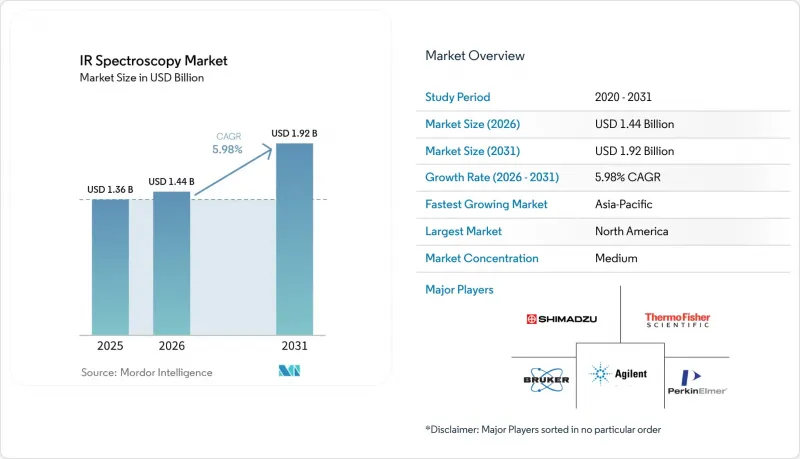
본 보고서는 기술별(근적외선 분광법 등), 제품 유형별(FTIR 분광기 등), 구성 요소별(광원, 검출기, 광학계, 부속품, 소프트웨어), 용도(의약품 및 바이오의약품 등), 최종 사용자(제약 및 바이오의약품 기업 등), 지역(북미, 유럽 등)별로 분류되어 있습니다. 예상치는 금액(달러)으로 표시되어 있습니다.
세계의 적외선 분광법 시장 동향 및 인사이트
제약 업계에서의 PAT 및 인라인 방출 시험 도입
제약사들은 품질 관리 분야에서 오프라인 배치 시험에서 실시간 공정 데이터로 전환을 추진하고 있으며, 이것이 적외선 분광법 시장의 성장을 견인하고 있습니다. 광섬유 결합형 NIR 시스템은 생산을 중단하지 않고도 원료 식별, 혼합물 모니터링 및 공정 측정이 가능하도록 함으로써 중요한 역할을 수행하고 있습니다. FDA의 PAT 프레임워크와 ICH Q13 지침은 연속 공정 및 등록 요건을 충족하는 제조 과정에서 인라인 분광법의 중요성을 강조하고 있습니다. 이러한 변화에 따라, 규정 준수를 충족하는 데이터 파이프라인, 검증된 화학계량학 모델, 그리고 21 CFR Part 11을 준수하는 소프트웨어에 대한 수요가 증가하고 있으며, 구매자들은 종합적인 솔루션을 제공하는 공급업체로 관심을 돌리고 있습니다. 고속 처리 능력을 갖춘 제조 현장에서는 모델의 드리프트를 모니터링하고 출력을 검증하기 위한 다중 분광계의 도입이 확대되고 있으며, 이에 따라 장비 수요가 증가하는 동시에 소프트웨어 및 스펙트럼 라이브러리의 발전도 가속화되고 있습니다.
현장 선별 검사에서 휴대용 및 핸드헬드형 적외선(IR) 장치의 활용
휴대용 및 핸드헬드형 기기의 도입으로 인해 법의학, 식품 검사, 보안 검색 및 상품 검증 분야의 도입 주기가 단축되면서 적외선 분광법 시장이 확대되고 있습니다. 견고한 본체와 배터리 백업 기능을 갖춘 휴대용 시스템은 현재 데스크톱형 기기에 필적하는 성능을 발휘하고 있어, 일상적인 현장 사용에 적합합니다. Bruker의 MOBILE-IR II나 Agilent의 4500 시리즈와 같은 제품들은 각 벤더사가 스펙트럼 성능을 실용 환경에 맞추어 최적화하고 있음을 보여줍니다. 휴대용 적외선 분광법 및 라만 분광법은 CODEX 기준에 부합하는 수준으로 밀가루의 이물질을 검출할 수 있어, 검사 워크플로우에의 통합이 촉진되고 있습니다. 이러한 동향은 APAC 및 MEA 지역공급망에서 특히 중요하며, 현장 검증을 통해 콜드체인의 취약성이나 실험실 접근 제한으로 인한 손실과 지연을 줄이고 있습니다.
고성능 FTIR 및 QCL 시스템의 높은 초기 투자 비용
높은 초기 비용으로 인해, 특히 소규모 연구소, 비용에 민감한 제조업체, 그리고 예산이 제한된 공공기관에서 적외선 분광법 시장의 확장이 저해되고 있습니다. 검증이 완료된 소프트웨어, 환경 보호 기능 및 공장과의 연동 기능을 갖춘 공정용 FTIR 시스템은 노드당 9만 달러를 초과할 수 있으며, 제약 연구 개발용 QCL 기반 이미징 시스템은 20만 달러를 초과하기도 합니다. 이러한 비용 때문에 구매자들은 구매를 미루거나 더 저렴한 시스템을 선택하는 경우가 종종 있습니다. 여러 거점에 도입할 경우 비용이 더욱 증가합니다. 인증 작업, 유지보수, 서비스 계약으로 인해 초기 투자액에 연간 15-25%가 추가되기 때문입니다. 이러한 가격 동향에 따라, 수요는 공급업체의 가격 결정력이 비교적 약한 1만 5,000-3만 달러 가격대의 재생 벤치탑 시스템이나 소형 장비로 이동하고 있습니다. Fraunhofer IAF의 MOEMS-EC-QCL 모듈용 반자동 공정은 장기적으로는 비용 절감으로 이어질 가능성이 있지만, 검증된 산업용도입의 경우 당장 가격이 인하될 전망은 낮을 것으로 보입니다.
부문별 분석
2025년, 근적외선(NIR) 분광법은 의약품 원료의 동정, 곡물 검사, 식품 품질 관리 분야에서의 활용에 힘입어 적외선 분광법 시장 전체의 42.45%를 차지했습니다. 광섬유와의 호환성, 최소한의 시료 전처리, 충실한 참조 라이브러리 기반과 같은 이러한 장점은 타 기술로의 전환 장벽이 되어 워크플로우의 연속성을 뒷받침하고 있습니다. NIR은 앳라인 및 인라인 용도에 적합하며, 규정 준수 및 효율화 목표에도 부합하기 때문에 새로운 기술의 등장에도 불구하고 산업 분야에서의 도입에 있어 기초적인 역할을 유지하고 있습니다.
중적외선(MIR) 분광법은 2031년까지 연평균 성장률(CAGR) 7.25%를 기록하며 성장할 것으로 예상되며, 가장 빠르게 성장하는 부문이 될 전망입니다. 이러한 성장을 주도하고 있는 것은 반도체 웨이퍼의 품질 관리와, 특정 작업에서 뛰어난 속도와 공간 분해능을 제공하는 QCL이 탑재된 중적외선 플랫폼의 도입입니다. 2025년 1월에 출시된 Bruker의 QCL 탑재 이미징 현미경 LUMOS II ILIM은 고처리량 정제 검사 및 반도체 결함 분석 분야의 기술 발전을 상징하는 제품입니다. 원적외선 분광법은 틈새 분야이긴 하지만, 연구용 진공 시스템의 지원을 받아 폴리머의 저주파 진동 분석 및 결정학 연구에서 여전히 중요한 역할을 하고 있습니다.
2025년 적외선 분광법 시장에서 탁상형 분광기는 44.56%를 차지했으며, 이는 학술 연구소, 산업 분야의 품질 관리 및 의약품 시험 분야에서 이 기기가 확고히 자리 잡은 역할을 반영한 것입니다. 이러한 우위는 뛰어난 감도, 다양한 구성, 그리고 다양한 시료 유형 및 분석법에 대한 적응성에서 비롯됩니다. 벤치탑형 시스템은 높은 처리량과 유연한 분석 요구 사항에 여전히 선호되고 있으며, 시장이 전문 장비로 전환되는 와중에도 안정적인 수익 기반을 제공합니다.
FTIR 분광계는 연속 생산 과정에서의 실시간 정량 분석 및 복잡한 혼합물의 동정을 주요 동력으로 삼아, 2031년까지 연평균 성장률(CAGR) 6.55%를 기록하며 성장할 것으로 예측됩니다. 2025년 11월에 출시된 Bruker의 VERTEX NEO Ultra는 연구용 하이엔드 탁상형 FTIR 시스템의 발전을 상징하는 제품입니다. 휴대용 및 핸드헬드형 분광기는 현장 선별 검사, 법과학 분석, 제품 검증 분야에서 활용이 확대되고 있습니다. FTIR과 GC, TGA 또는 레오메트리를 결합한 하이브리드형 시스템은 고분자 및 특수 화학물질 연구 분야에서 주목을 받고 있는 반면, 마이크로 분광기는 전자제품 및 IoT 연동 품질 모니터링 분야에서 소형 인라인 프로브로서 관심을 모으고 있습니다.
지역별 분석
2025년, 북미는 적외선 분광법 시장의 40.25%를 차지했으며, 지역별 최대 점유율을 유지했습니다. 미국은 제약 제조 산업의 집적, 견고한 규제 체계, 그리고 검증된 소프트웨어 및 인라인 측정 시스템의 높은 보급률 덕분에 이러한 수요를 주도하고 있습니다. ICH Q13에 부합하는 운영에 필요한 자본, 규정 준수, 데이터 통합 요건을 충족할 수 있는 시설을 바탕으로, 이 지역에서는 특히 연속 생산 방식의 도입이 활발히 진행되고 있습니다. 캐나다와 멕시코는 기여도는 크지 않지만, 식품 가공, 의약품 제조 및 일상적인 검사 분야에서 휴대용 NIR의 활용을 통해 수요를 확대되고 있습니다.
유럽은 적외선 분광법 시장에서 지역별 2위를 차지하고 있으며, 독일과 영국은 주요 분석기기 시장이고, 스위스와 프랑스는 제약 연구개발의 거점입니다. 유럽 약전(European Pharmacopoeia)의 동정 시험 요건과 EMA(유럽의약품청)의 ICH 지침 준수가 GMP 규제 환경 하에서 안정적인 조달을 뒷받침하고 있습니다. 독일은 공급 측면에서도 중요한 역할을 수행하고 있으며, Bruker의 FTIR 분야 혁신과 생산 거점의 핵심을 담당하고 있습니다. 이탈리아, 스페인 및 기타 유럽 국가들은 식품 품질 관리와 환경 모니터링을 통해 기여하고 있는 반면, 동유럽의 연구소 네트워크는 식품 안전 및 환경 분석 역량에 중점을 두고 점차 확대되고 있습니다.
아시아태평양의 적외선 분광법 시장은 2031년까지 연평균 성장률(CAGR) 8.12%를 나타낼 것으로 예측되며, 이는 지역별 성장률 중 가장 높은 수치입니다. 중국의 제14차 5개년 계획에 따른 스마트 제조 추진으로 인해, 국내에서 고성능 분석 장비의 조달이 활성화되면서 해외산 시스템에 대한 대체 압력이 커지고 있습니다. 인도에서는 CDMO(위탁 개발·제조) 기반의 확대에 따라, USP <857>원료 식별 요건을 충족하기 위해 중저가 FTIR 플랫폼에 대한 수요가 증가하고 있습니다. 한국과 대만에서는 300mm 웨이퍼 검사에 비파괴적인 중적외선(mid-IR) 특성 평가가 필요한 최첨단 반도체 팹 덕분에 시장이 성장하고 있습니다. 일본과 호주는 식품 안전 검사 및 연구 수요에 힘입어 계속해서 안정적인 수요처로 자리 잡고 있습니다. 중동 및 아프리카와 남미는 현재 시장 점유율이 낮지만, GCC 국가들의 제약 제조 분야 투자와 브라질의 식품 진위 확인 관련 법규 강화에 힘입어 2028년 이후에는 조달량이 증가할 것으로 예측됩니다.
기타 혜택 :
- 엑셀 형식 시장 예측(ME) 시트
- 3개월간의 애널리스트 지원
자주 묻는 질문
목차
제1장 서론
제2장 조사 방법
제3장 주요 요약
제4장 시장 구도
제5장 시장 규모 및 성장 예측
제6장 경쟁 구도
제7장 시장 기회 및 향후 전망
AJY 26.07.07According to Mordor Intelligence, the IR spectroscopy market size was valued at USD 1.36 billion in 2025 and is estimated to grow from USD 1.44 billion in 2026 to reach USD 1.92 billion by 2031, at a CAGR of 5.98% during the forecast period (2026-2031).
This report is Segmented by Technology (Near-Infrared Spectroscopy, and More), Product Type (FTIR Spectrometer, and More), Component (Sources, Detectors, Optics, Accessories, Software), Application (Pharmaceuticals and Biopharmaceuticals, and More), End User (Pharmaceutical and Biopharmaceutical Companies, and More), and Geography (North America, Europe, and More). Forecasts in Value (USD).
Global IR Spectroscopy Market Trends and Insights
Pharma PAT and In-Line Release Testing Adoption
Pharmaceutical manufacturers are transitioning from offline batch testing to real-time process data for quality control, driving growth in the IR spectroscopy market. Fiber-coupled NIR systems play a key role by enabling raw material identification, blend monitoring, and process measurement without disrupting production. The FDA's PAT framework and ICH Q13 guidelines emphasize the importance of in-line spectroscopy for continuous processes and registration-ready manufacturing. This shift increases demand for compliant data pipelines, validated chemometric models, and 21 CFR Part 11-aligned software, pushing buyers toward vendors offering complete solutions. Multi-spectrometer setups are gaining traction in high-throughput sites to monitor model drift and validate outputs, boosting instrument demand and accelerating the growth of software and spectral libraries.
Portable and Handheld IR Use in Field Screening
The adoption of portable and handheld devices is shortening deployment cycles in forensic work, food inspection, security screening, and goods verification, expanding the IR spectroscopy market. Handheld systems with rugged enclosures and battery backups now deliver performance levels comparable to benchtop instruments, making them suitable for routine field use. Products like Bruker's MOBILE-IR II and Agilent's 4500 series demonstrate how vendors are aligning spectral performance with real-world conditions. Portable infrared and Raman spectroscopy can detect wheat flour adulteration at CODEX-relevant levels, supporting its integration into inspection workflows. This trend is particularly significant in APAC and MEA supply chains, where field verification reduces losses and delays caused by weak cold chains or limited laboratory access.
High Capital Cost for High-End FTIR and QCL Systems
High upfront costs limit the IR spectroscopy market's expansion, particularly among smaller labs, cost-sensitive manufacturers, and public institutions with constrained budgets. Process-grade FTIR systems with validated software, environmental safeguards, and plant connectivity can exceed USD 90,000 per node, while QCL-based imaging systems for pharmaceutical R&D can surpass USD 200,000. These costs often lead buyers to delay purchases or choose lower-tier systems. Multi-site rollouts further escalate expenses, as qualification work, maintenance, and service contracts add 15-25% annually to the initial investment. This pricing dynamic is driving demand toward refurbished benchtop systems and compact instruments priced between USD 15,000 and 30,000, where vendor pricing power is weaker. Fraunhofer IAF's semi-automated process for MOEMS-EC-QCL modules may reduce costs over time, but immediate price relief for validated industrial deployments is unlikely.
Other drivers and restraints analyzed in the detailed report include:
- AI-Enabled Spectral Libraries and Workflow Automation
- Food Authenticity and Contamination Screening
- Skilled Operator and Method Validation Dependencies
For complete list of drivers and restraints, kindly check the Table Of Contents.
Segment Analysis
In 2025, near-infrared (NIR) spectroscopy held 42.45% of the IR spectroscopy market, driven by its use in pharmaceutical raw material identification, grain testing, and food quality control. Its advantages, including fiber-optic compatibility, minimal sample preparation, and a strong reference library base, create switching barriers and support workflow continuity. NIR's suitability for at-line and in-line applications aligns with compliance and efficiency goals, maintaining its foundational role in industrial deployments despite the rise of newer technologies.
Mid-infrared (MIR) spectroscopy is projected to grow at a 7.25% CAGR through 2031, making it the fastest-growing segment. Its growth is fueled by semiconductor wafer quality control and the adoption of QCL-enabled mid-IR platforms, which offer superior speed and spatial resolution for specific tasks. Bruker's LUMOS II ILIM QCL-based imaging microscope, launched in January 2025, exemplifies advancements in high-throughput tablet inspection and semiconductor defect analysis. Far-infrared spectroscopy, while niche, remains relevant for low-frequency vibrational analysis in polymers and crystallographic studies, supported by research-grade vacuum systems.
Benchtop spectrometers accounted for 44.56% of the IR spectroscopy market in 2025, reflecting their established role in academic labs, industrial quality control, and pharmaceutical testing. Their dominance stems from superior sensitivity, diverse configurations, and adaptability to varied sample types and methods. Benchtop systems remain preferred for high-throughput and flexible analytical needs, providing a stable revenue base even as the market shifts toward specialized instruments.
FTIR spectrometers are expected to grow at a 6.55% CAGR through 2031, driven by real-time quantitative analysis in continuous manufacturing and complex mixture identification. Bruker's VERTEX NEO Ultra, launched in November 2025, highlights advancements in high-end benchtop FTIR systems for research. Portable and handheld spectrometers are expanding in field screening, forensic analysis, and goods verification. Hyphenated systems combining FTIR with GC, TGA, or rheometry are gaining traction in polymer and specialty chemical research, while micro spectrometers are drawing interest for compact inline probes in electronics and IoT-linked quality monitoring.
Complete Report Scope:
- By Technology
- Near-Infrared Spectroscopy
- Mid-Infrared Spectroscopy
- Far-Infrared Spectroscopy
- By Product Type
- FTIR Spectrometers
- Benchtop Spectrometers
- Portable and Handheld Spectrometers
- Micro Spectrometers
- Hyphenated Spectrometers
- By Component
- Light Sources
- Detectors
- Beam Splitters and Optics
- Accessories and Consumables
- Software and Spectral Libraries
- By Application
- Pharmaceuticals and Biopharmaceuticals
- Chemicals and Petrochemicals
- Food and Beverage Testing
- Environmental Testing
- Forensics and Security Screening
- Materials Science and Polymers
- Semiconductor and Electronics
- Others
- By End User
- Pharmaceutical and Biopharmaceutical Companies
- Industrial and Manufacturing Companies
- Food Testing Laboratories
- Environmental Testing Laboratories
- Forensic Laboratories
- Academic and Research Institutes
- Government and Regulatory Laboratories
- By Geography
- North America
- United States
- Canada
- Mexico
- Europe
- Germany
- United Kingdom
- France
- Italy
- Spain
- Rest of Europe
- Asia-Pacific
- China
- India
- Japan
- Australia
- South Korea
- Rest of Asia-Pacific
- Middle East and Africa
- GCC
- South Africa
- Rest of Middle East and Africa
- South America
- Brazil
- Argentina
- Rest of South America
- North America
Geography Analysis
In 2025, North America accounted for 40.25% of the IR spectroscopy market share, maintaining its position as the largest regional contributor. The U.S. drives this demand due to its pharmaceutical manufacturing concentration, strong regulatory framework, and high adoption of validated software and in-line measurement systems. Continuous manufacturing adoption is particularly favorable in this region, supported by facilities capable of meeting the capital, compliance, and data integration requirements of ICH Q13-aligned operations. Canada and Mexico, though smaller contributors, are adding demand through food processing, pharmaceutical production, and portable NIR use in routine inspections.
Europe held the second-largest regional position in the IR spectroscopy market, with Germany and the U.K. as key instrument markets and Switzerland and France as pharmaceutical R&D hubs. European Pharmacopoeia identity testing requirements and EMA alignment with ICH guidance support stable procurement in GMP-regulated environments. Germany also plays a critical role on the supply side, anchoring Bruker's FTIR innovation and production footprint. Italy, Spain, and other European countries contribute through food quality control and environmental monitoring, while Eastern European laboratory networks are gradually expanding with a focus on food safety and environmental capabilities.
The Asia-Pacific IR spectroscopy market is projected to grow at an 8.12% CAGR through 2031, the fastest regional growth rate. China's 14th Five-Year Plan for intelligent manufacturing is driving domestic procurement of high-end analytical instruments and increasing substitution pressure on foreign systems. India's expanding CDMO base is fueling demand for mid-range FTIR platforms to meet USP <857> raw material identification requirements. South Korea and Taiwan are experiencing growth due to advanced semiconductor fabs requiring non-destructive mid-IR characterization for 300 mm wafer inspections. Japan and Australia remain steady contributors, driven by food safety testing and research demand. The Middle East, Africa, and South America currently hold smaller shares, but GCC pharmaceutical manufacturing investments and Brazil's food authentication enforcement are expected to boost procurement after 2028.
- ABB Ltd.
- Agilent Technologies
- B&W Tek, LLC
- Bruker
- Carl Zeiss
- Edinburgh Instruments Ltd.
- Emerson Electric
- Foss Analytical A/S
- HORIBA
- JASCO Corporation
- Lumex Instruments
- Metrohm
- Mettler Toledo
- Oxford Instruments
- PerkinElmer
- Renishaw plc
- Revvity, Inc.
- Shimadzu
- Teledyne Technologies
- Thermo Fisher Scientific
Additional Benefits:
- The market estimate (ME) sheet in Excel format
- 3 months of analyst support
TABLE OF CONTENTS
1 INTRODUCTION
- 1.1 Study Assumptions and Market Definition
- 1.2 Scope of the Study
2 RESEARCH METHODOLOGY
3 EXECUTIVE SUMMARY
4 MARKET LANDSCAPE
- 4.1 Market Overview
- 4.2 Market Drivers
- 4.2.1 Pharma PAT and in-Line Release Testing Adoption
- 4.2.2 Portable and Handheld IR Use in Field Screening
- 4.2.3 Semiconductor and Advanced Materials QC Demand
- 4.2.4 AI-Enabled Spectral Libraries and Workflow Automation
- 4.2.5 Food Authenticity and Contamination Screening Expansion
- 4.2.6 Environmental Compliance Monitoring at Low Detection Limits
- 4.3 Market Restraints
- 4.3.1 High Capital Cost for High-End FTIR and QCL Systems
- 4.3.2 Skilled Operator and Method Validation Dependence
- 4.3.3 Matrix Interference and Spectral Overlap in Complex Samples
- 4.3.4 Ongoing Calibration, Drift Control, and Regulatory Documentation Burden
- 4.4 Supply/ Value Chain Analysis
- 4.5 Regulatory Landscape
- 4.6 Technological Outlook
- 4.7 Porter's Five Forces Analysis
- 4.7.1 Bargaining Power of Suppliers
- 4.7.2 Bargaining Power of Buyers
- 4.7.3 Threat of New Entrants
- 4.7.4 Threat of Substitutes
- 4.7.5 Industry Rivalry
5 MARKET SIZE AND GROWTH FORECASTS (VALUE, USD)
- 5.1 By Technology
- 5.1.1 Near-Infrared Spectroscopy
- 5.1.2 Mid-Infrared Spectroscopy
- 5.1.3 Far-Infrared Spectroscopy
- 5.2 By Product Type
- 5.2.1 FTIR Spectrometers
- 5.2.2 Benchtop Spectrometers
- 5.2.3 Portable and Handheld Spectrometers
- 5.2.4 Micro Spectrometers
- 5.2.5 Hyphenated Spectrometers
- 5.3 By Component
- 5.3.1 Light Sources
- 5.3.2 Detectors
- 5.3.3 Beam Splitters and Optics
- 5.3.4 Accessories and Consumables
- 5.3.5 Software and Spectral Libraries
- 5.4 By Application
- 5.4.1 Pharmaceuticals and Biopharmaceuticals
- 5.4.2 Chemicals and Petrochemicals
- 5.4.3 Food and Beverage Testing
- 5.4.4 Environmental Testing
- 5.4.5 Forensics and Security Screening
- 5.4.6 Materials Science and Polymers
- 5.4.7 Semiconductor and Electronics
- 5.4.8 Others
- 5.5 By End User
- 5.5.1 Pharmaceutical and Biopharmaceutical Companies
- 5.5.2 Industrial and Manufacturing Companies
- 5.5.3 Food Testing Laboratories
- 5.5.4 Environmental Testing Laboratories
- 5.5.5 Forensic Laboratories
- 5.5.6 Academic and Research Institutes
- 5.5.7 Government and Regulatory Laboratories
- 5.6 By Geography
- 5.6.1 North America
- 5.6.1.1 United States
- 5.6.1.2 Canada
- 5.6.1.3 Mexico
- 5.6.2 Europe
- 5.6.2.1 Germany
- 5.6.2.2 United Kingdom
- 5.6.2.3 France
- 5.6.2.4 Italy
- 5.6.2.5 Spain
- 5.6.2.6 Rest of Europe
- 5.6.3 Asia-Pacific
- 5.6.3.1 China
- 5.6.3.2 India
- 5.6.3.3 Japan
- 5.6.3.4 Australia
- 5.6.3.5 South Korea
- 5.6.3.6 Rest of Asia-Pacific
- 5.6.4 Middle East and Africa
- 5.6.4.1 GCC
- 5.6.4.2 South Africa
- 5.6.4.3 Rest of Middle East and Africa
- 5.6.5 South America
- 5.6.5.1 Brazil
- 5.6.5.2 Argentina
- 5.6.5.3 Rest of South America
- 5.6.1 North America
6 COMPETITIVE LANDSCAPE
- 6.1 Market Concentration
- 6.2 Market Share Analysis
- 6.3 Company Profiles (includes Global Level Overview, Market Level Overview, Core Segments, Financials as available, Strategic Information, Market Rank/Share, Products and Services, Recent Developments)
- 6.3.1 ABB Ltd.
- 6.3.2 Agilent Technologies, Inc.
- 6.3.3 B&W Tek, LLC
- 6.3.4 Bruker Corporation
- 6.3.5 Carl Zeiss AG
- 6.3.6 Edinburgh Instruments Ltd.
- 6.3.7 Emerson Electric Co.
- 6.3.8 Foss Analytical A/S
- 6.3.9 HORIBA, Ltd.
- 6.3.10 JASCO Corporation
- 6.3.11 Lumex Instruments
- 6.3.12 Metrohm AG
- 6.3.13 Mettler-Toledo International Inc.
- 6.3.14 Oxford Instruments plc
- 6.3.15 PerkinElmer, Inc.
- 6.3.16 Renishaw plc
- 6.3.17 Revvity, Inc.
- 6.3.18 Shimadzu Corporation
- 6.3.19 Teledyne Technologies Incorporated
- 6.3.20 Thermo Fisher Scientific Inc.
7 MARKET OPPORTUNITIES AND FUTURE OUTLOOK
- 7.1 White-Space and Unmet-Need Assessment