

|
시장보고서
상품코드
2072885
의료 기술 관리 시장 : 점유율 분석, 업계 동향과 통계, 성장 예측(2026-2031년)Healthcare Technology Management - Market Share Analysis, Industry Trends & Statistics, Growth Forecasts (2026 - 2031) |
||||||
 Mordor Intelligence
Mordor Intelligence에 의하면, 의료 기술 관리 시장 규모는 2025년 97억 6,000만 달러에서 2026년에는 112억 3,000만 달러로 확대되어 2031년까지 226억 9,000만 달러에 이를 것으로 예상되고 있어 2026-2031년까지 CAGR 15.10%로 성장할 전망입니다.
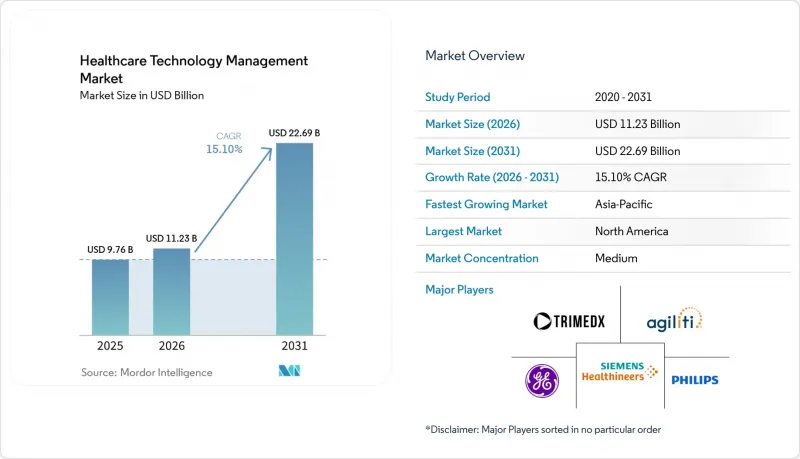
본 보고서는 기술 스택(서비스, 소프트웨어 등), 도입 형태(On-Premise, 클라우드 기반, 하이브리드), 기능(자산 추적·위치 정보 서비스(RTLS), 가동률·용량 계획 등), 최종 사용자(병원, 외래 진료 센터 등), 지역(북미, 유럽 등)별로 분류되어 있습니다. 시장 전망은 금액(달러) 기준으로 제시되어 있습니다.
세계 의료 기술 관리 시장 동향과 인사이트
연결형 의료기기 및 다중 공급업체 환경의 확대
오늘날 병원에서는 과거에 비해 더 다양한 유형의 의료기기, 공급업체 및 서비스 이력을 관리하고 있으며, 이것이 의료 기술 관리 시장의 성장을 주도하고 있습니다. 급성기 병원에서는 일반적으로 25-50개의 OEM 브랜드 장비를 운영하고 있으며, 각 장비마다 고유한 펌웨어 업데이트 주기, 교정 일정 및 유지보수 패턴이 있습니다. 이러한 복잡성으로 인해, 자산 데이터를 단일 시스템으로 통합하는 벤더 중립적 플랫폼의 필요성이 부각되고 있습니다. 통합 팀을 충분히 갖추지 못한 경우가 많은 지역 병원이나 외래 진료 네트워크에서는 대규모 디지털 시스템과의 연동을 위해 사전에 구축된 커넥터를 갖춘 클라우드 네이티브 도구가 선호되고 있습니다. Kahua와 Nuvolo의 통합은 건설 단계의 인계부터 본격적인 운영으로의 원활한 전환을 통해, 그동안 생체의료팀의 업무를 지연시켜 온 자산 기록의 미비점을 어떻게 해소할 수 있는지 입증했습니다.
의료기기 수명주기 관리에 따른 규정 준수 부담 증가
규제 준수 요건의 확대가 의료 기술 관리 시장 수요를 견인하고 있습니다. FDA가 2025년 6월에 발표한 사이버 보안에 관한 최종 지침에서는 의료기기의 전체 수명 주기에 걸친 시판 후 취약점 모니터링이 강조됨에 따라, 펌웨어 버전, 패치 및 취약점을 추적하는 플랫폼의 필요성이 대두되고 있습니다. 독일에서는 43억 유로(49억 8,000만 달러) 규모의 ‘Krankenhauszukunftsgesetz(병원 미래법)’ 프로그램을 통해 병원 시스템의 현대화가 가속화되고 있으며, 수명 주기 관리 도구가 조달 프로그램에 포함되고 있습니다. 마찬가지로, EU 사이버 복원력 법 및 EU MDR(의료기기 규정)에 따라 의료 시스템은 자동화된 기록 및 감사 추적 기능의 도입을 요구받고 있으며, 스프레드시트를 통한 추적 방식에서 벗어나 여러 거점에 분산된 기기 전체에 걸쳐 검사 대응이 가능한 기록을 생성할 수 있는 플랫폼으로의 전환이 진행되고 있습니다.
생물의학 공학 및 의료 기술 관리(HTM) 인력 부족
의료 기술 관리(HTM) 시장은 인력 부족에 직면해 있어 서비스 제공 능력의 확장이 제한되고 있습니다. AAMI는 2025년에도 HTM 직종에 대한 수요가 여전히 견조할 것이며, 직무 만족도도 높을 것이라고 지적했습니다. 한편, 미국 노동통계국은 2033년까지 생의학 기기 기술자의 고용이 18% 증가하고, 연간 약 8,800건의 채용 수요가 발생할 것으로 전망하고 있습니다. 이러한 격차로 인해 의료 시스템은 사내 팀 확충에 어려움을 겪고 있으며, 외부 위탁형 매니지드 서비스에 대한 의존도가 높아지고 있습니다. AI를 활용한 분류 및 원격 진단을 통해 일부 업무 부담은 줄어들겠지만, 유지보수, 점검, 복잡한 수리에 필수적인 숙련된 현장 인력을 대체할 수는 없습니다. 기술자 양성이 뒤처진 지역에서는 수요가 여전히 높음에도 불구하고, 서비스 도입이나 서비스 범위 확대가 종종 지연되는 경향이 있습니다.
부문별 분석
2025년, 이 서비스는 의료 기술 관리(HTM) 시장의 55.13%를 차지하고 있으며, 이는 단독 소프트웨어 도입에 앞서 외부 위탁형 HTM 관리 계약이 선호되는 경향을 반영하고 있습니다. 서비스 제공업체는 현장 지원, 워크플로우 실행, 소프트웨어를 하나의 서비스로 묶어 제공하는 경우가 많으며, 그 결과 서비스가 핵심 계층이 되고 있습니다. 병원은 일반적으로 내부 역량 구축보다 즉각적인 운영 모델을 우선시하며, 소프트웨어 도입은 운영 측면에서의 신뢰가 확립된 후에 이루어집니다.
병원들이 자산의 가시성을 높이기 위해 RTLS 태그, BLE 리더기, IoT 센서 어레이에 의존하고 있기 때문에 하드웨어는 여전히 중요한 역할을 하고 있습니다. 추적 기능에 더해, 기기의 위치 정보 및 상태에 관한 신호의 정확도가 향상됨에 따라 신속한 파견, 이용 현황 데이터의 개선, 그리고 보다 확실한 기록이 가능해집니다. 2031년까지 연평균 성장률(CAGR) 17.25%를 나타낼 것으로 예측되는 AI 및 분석 분야는 예측 및 의사결정 지원 영역으로의 전환을 보여주고 있습니다. TRIMEDX는 2026년 2월, 공급망 자동화 및 고장 예측 인텔리전스를 TRIMEDX AIQ에 통합함으로써 이러한 추세를 주도했습니다. 한편, 업계 전반에서는 최적화를 위해 구독형 분석 모듈로의 전환이 진행되고 있습니다.
2025년, On-Premise 방식 도입은 의료 기술 관리 시장 점유율의 57.13%를 차지했습니다. 이는 엄격한 데이터 거버넌스 요건을 갖춘 대학 부속 병원, 재향군인부 산하 기관 및 국방 관련 의료시설의 요구에 힘입은 결과입니다. 이러한 조직들은 복잡한 임상 환경을 지원하고, 규정 준수, 보안 및 인프라 관리를 보장하기 위해 대개 자체 시스템을 운영하고 있습니다. 이로 인해 클라우드 도입이 확대되고 있는 상황에서도 On-Premise형 도입의 중요성은 여전히 유지되고 있습니다.
외래 진료 그룹과 지역 의료 시스템이 인프라 부담을 줄이고 업데이트를 신속히 진행하기를 요구하는 가운데, 클라우드 기반 시스템의 도입은 2031년까지 연평균 성장률(CAGR) 16.55%를 나타낼 것으로 예측됩니다. Nuvolo가 2026년 ServiceNow Store Partner of the Year로 선정된 것은 CMMS, 시설 관리, 사이버 보안을 통합한 통합 플랫폼의 매력을 여실히 보여주고 있습니다. 또한 하이브리드 구축도 탄력을 받고 있으며, 대규모 시스템의 경우 시간적 제약이 있는 경보 처리는 On-Premise에서 유지하면서 분석 기능은 클라우드로 이전하고 있습니다. IBM과 Oracle은 2025년, 이러한 전환을 지원하기 위해 Oracle Fusion Cloud ERP용 Maximo Application Suite 커넥터를 제공하며 파트너십을 확대했습니다.
지역별 분석
2025년, 북미는 의료 기술 관리 시장의 39.56%를 차지했습니다. 이는 견고한 급성기 병원 네트워크, 조인트 커미션(Joint Commission) 및 CMS(미국 의료보험서비스센터)의 엄격한 규제, 그리고 통합이 진행 중인 매니지드 서비스 부문에 힘입은 결과입니다. 미국은 여전히 최대의 수익원이며, 기업 고객들은 대규모의 다중 거점 시설군이나 정식 아웃소싱 서비스 프로그램을 선호하고 있습니다. 2024년 5월 Thomas H. Lee Partners가 Agiliti를 25억 달러에 인수한 것은 1만 곳 이상의 시설에 걸친 기술 주도형 사업 확장에 대한 강력한 자본 지원을 여실히 보여주었습니다. FDA의 2025년 사이버 보안 지침에 따라, 특히 엔터프라이즈급 네트워크 연결 기기를 관리하는 의료 시스템에서 플랫폼 요구 사항이 확대되었습니다. 캐나다와 멕시코의 기여도는 미미하지만, 민간 병원의 디지털화와 클라우드 도입이 점진적인 성장을 뒷받침하고 있습니다.
아시아태평양은 2031년까지 연평균 성장률(CAGR) 18.12%를 나타낼 것으로 예측되며, 의료 기술 관리 시장에서 가장 빠르게 성장하는 지역이 될 전망입니다. 이러한 성장은 규제 현대화, 병원 인프라에 대한 투자, 그리고 공공 및 민간 네트워크 전반에 걸친 자산 관리 성숙도 향상에 힘입어 이루어지고 있습니다. 중국에서는 병원 장비 관리를 위한 IoT 프로토콜 표준화를 통해, 분절화된 시스템에서 표준화된 조달 체계로의 전환이 진행되고 있습니다. 인도에서는 민간 병원 그룹들이 임상 자산의 가시화를 디지털 전환 전략에 포함시키고 있으며, Infosys는 2026년에 IHH Healthcare와 7년간의 AI 기반 ERP 프로그램 계약을 체결했습니다. 일본, 호주, 한국에서는 이용 현황 데이터 연동, 가정 내 설치 기기 추적, 디지털 헬스 인프라 강화를 통해 고급 기능을 추가하고 있습니다.
유럽에서는 의료 기술 관리 시장의 도입 현황에 차이가 나타나고 있습니다. 독일, 영국, 프랑스에서는 클라우드를 활용한 업그레이드가 진행되고 있는 반면, 남유럽 및 동유럽에서는 뒤처지고 있습니다. 독일의 ‘Krankenhauszukunftsgesetz(병원 미래법)’은 43억 유로(약 49억 8,000만 달러)의 지원을 바탕으로 1,900개 병원의 현대화를 추진하고, 디지털 라이프사이클 도구의 도입을 가속화하고 있습니다. EU의 MDR(의료기기 규정) 및 사이버 복원력 법의 요건에 따라, 견고한 기능과 수명 주기 문서화 기능을 갖춘 플랫폼에 대한 수요가 증가하고 있습니다.
기타 혜택:
- 엑셀 형식 시장 예측(ME) 시트
- 3개월간의 애널리스트 지원
자주 묻는 질문
목차
제1장 서론
제2장 조사 방법
제3장 주요 요약
제4장 시장 구도
제5장 시장 규모와 성장 예측
제6장 경쟁 구도
제7장 시장 기회와 향후 전망
JHS 26.07.07According to Mordor Intelligence, the healthcare technology management market size is expected to increase from USD 9.76 billion in 2025 to USD 11.23 billion in 2026 and reach USD 22.69 billion by 2031, growing at a CAGR of 15.10% over 2026-2031.
This report is Segmented by Technology Stack (Services, Software, and More), Deployment (On-Premises, Cloud-Based, Hybrid), Functionality (Asset Tracking & Location Services (RTLS), Utilization & Capacity Planning, and More), End User (Hospitals, Ambulatory & Outpatient Centers, and More), and Geography (North America, Europe, and More). The Market Forecasts are Provided in Terms of Value (USD).
Global Healthcare Technology Management Market Trends and Insights
Expansion of Connected Medical Devices and Multi-Vendor Environments
Hospitals today manage a broader range of device types, vendors, and service histories compared to previous years, driving growth in the healthcare technology management market. Acute care hospitals typically operate equipment from 25 to 50 OEM brands, each with unique firmware cycles, calibration schedules, and maintenance patterns. This complexity highlights the need for vendor-neutral platforms that consolidate asset data into a single system. Community hospitals and ambulatory networks, often lacking integration teams, prefer cloud-native tools with pre-built connectors to larger digital systems. The integration of Kahua and Nuvolo has demonstrated how seamless transitions from construction handover to live operations can address asset record gaps that have historically delayed biomedical teams.
Rising Compliance Burden Across Device Lifecycle Management
Expanding compliance requirements are driving demand in the healthcare technology management market. The FDA's final cybersecurity guidance for June 2025 emphasizes post-market vulnerability monitoring across the device lifecycle, increasing the need for platforms that track firmware versions, patches, and vulnerabilities. In Germany, the EUR 4.3 billion (USD 4.98 billion) Krankenhauszukunftsgesetz program is accelerating hospital system upgrades and integrating lifecycle management tools into procurement programs. Similarly, the EU Cyber Resilience Act and EU MDR are pushing health systems to adopt automated records and audit trails, replacing spreadsheet-based tracking with platforms capable of generating inspection-ready records across multi-site fleets.
Shortage of Biomedical Engineering And HTM Talent
The healthcare technology management (HTM) market is constrained by a talent shortage, limiting the scalability of service capacities. AAMI noted in 2025 that demand for HTM roles remained strong with high job satisfaction, while the U.S. Bureau of Labor Statistics projected an 18% growth for biomedical equipment technicians through 2033, equating to nearly 8,800 annual job openings. This gap forces health systems to face challenges in expanding in-house teams, increasing reliance on outsourced managed services. While AI-driven triage and remote diagnostics ease some workloads, they cannot replace skilled on-site personnel essential for maintenance, inspections, and complex repairs. In regions with slow technician pipeline development, demand remains high, but service implementation and coverage often lag.
Other drivers and restraints analyzed in the detailed report include:
- Hospital Cost-Containment Programs Prioritizing Uptime and Utilization
- Rising Right-To-Repair And Service-Access Pressure
- OEM Service Lock-In And Contractual Barriers
For complete list of drivers and restraints, kindly check the Table Of Contents.
Segment Analysis
In 2025, services accounted for 55.13% of the healthcare technology management market, reflecting the preference for outsourced managed HTM contracts before standalone software adoption. Providers often bundle field support, workflow execution, and software into a single offering, making services the dominant layer. Hospitals typically prioritize an immediate operational model over building internal capabilities, with software adoption following operational trust.
Hardware remains critical as hospitals rely on RTLS tags, BLE readers, and IoT sensor arrays to enhance asset visibility. Beyond tracking, improved device location and condition signals enable faster dispatch, better utilization data, and stronger documentation. AI and Analytics, projected to grow at a 17.25% CAGR through 2031, indicate a shift toward predictive and decision-support layers. TRIMEDX advanced this trend in February 2026 by integrating supply chain automation and predictive failure intelligence into TRIMEDX AIQ, while the industry moves toward subscription-based analytics modules for optimization.
On-premises deployment held 57.13% of the healthcare technology management market share in 2025, driven by the needs of academic medical centers, veterans affairs systems, and defense-linked health settings with strict data governance requirements. These organizations often maintain local systems to support complex clinical environments and ensure compliance, security, and infrastructure control. This sustains the relevance of on-premises deployments alongside growing cloud adoption.
Cloud-based deployment is forecast to grow at a 16.55% CAGR through 2031 as ambulatory groups and community health systems seek reduced infrastructure burdens and faster updates. Nuvolo's recognition as a 2026 ServiceNow Store Partner of the Year highlights the appeal of unified platforms integrating CMMS, facilities management, and cybersecurity. Hybrid deployment is also gaining traction, with large systems retaining local processing for time-sensitive alerts while moving analytics to the cloud. IBM and Oracle expanded their partnership in 2025 to support this transition with a Maximo Application Suite connector for Oracle Fusion Cloud ERP.
Complete Report Scope:
- By Technology Stack
- Services
- Software
- Hardware
- AI and Analytics
- By Deployment
- On-Premises
- Cloud-Based
- Hybrid
- By Functionality
- Asset Tracking & Location Services (RTLS)
- Utilization & Capacity Planning
- Workorder Management & Technician Dispatch
- Regulatory & Compliance Reporting
- Costing & Chargeback / Cost Allocation
- Performance Benchmarking & SLA Management
- Spare Parts Forecasting & Automated Replenishment
- Device Interoperability & Clinical Workflow Enablement
- By End User
- Hospitals
- Ambulatory & Outpatient Centers
- Diagnostic Imaging Centers & Labs
- Long-term Care & Nursing Homes
- Home Healthcare Providers
- Clinical Research / CROs / Trial sites
- Government & Public Health Facilities
- Private Clinics / Specialty Centers
- Medical Equipment Distributors / OEM Service Partners
- By Geography
- North America
- United States
- Canada
- Mexico
- Europe
- Germany
- United Kingdom
- France
- Italy
- Spain
- Rest of Europe
- Asia-Pacific
- China
- India
- Japan
- Australia
- South Korea
- Rest of Asia-Pacific
- Middle East and Africa
- GCC
- South Africa
- Rest of Middle East and Africa
- South America
- Brazil
- Argentina
- Rest of South America
- North America
Geography Analysis
In 2025, North America accounted for 39.56% of the healthcare technology management market, driven by a robust acute care hospital network, stringent Joint Commission and CMS mandates, and a consolidating managed services layer. The U.S. remains the largest revenue contributor, with enterprise buyers favoring large multi-site fleets and formal outsourced service programs. Agiliti's acquisition by Thomas H. Lee Partners in May 2024, valued at USD 2.5 billion, highlighted strong capital support for technology-driven expansion across over 10,000 facilities. The FDA's 2025 cybersecurity guidelines have expanded platform requirements, particularly for health systems managing enterprise-scale networked devices. Canada and Mexico contribute modestly, with private hospital digitization and cloud adoption supporting incremental growth.
Asia Pacific is projected to grow at an 18.12% CAGR through 2031, making it the fastest-growing region in the healthcare technology management market. Growth is fueled by regulatory modernization, hospital infrastructure investments, and improved asset management maturity across public and private networks. In China, IoT protocol standards for hospital equipment management are driving a shift from siloed systems to standardized procurement. In India, private hospital groups are integrating clinical asset visibility into digital transformation strategies, with Infosys securing a seven-year AI-driven ERP program with IHH Healthcare in 2026. Japan, Australia, and South Korea add advanced capabilities by connecting utilization data, tracking home-deployed devices, and enhancing digital health infrastructure.
Europe shows a mixed adoption pattern in the healthcare technology management market. Germany, the UK, and France are advancing cloud-enabled upgrades, while Southern and Eastern Europe lag. Germany's Krankenhauszukunftsgesetz, supported by EUR 4.3 billion (approximately USD 4.98 billion), is driving modernization across 1,900 hospitals and accelerating digital lifecycle tool adoption. EU MDR and Cyber Resilience Act requirements are increasing demand for platforms with robust functionality and lifecycle documentation.
- ABM Industries Incorporated
- Accruent, LLC
- Agiliti Health, Inc.
- Aramark
- Crothall Healthcare, LLC
- Eptura, LLC
- FUJIFILM
- GE HealthCare Technologies Inc.
- IBM
- Koninklijke Philips
- Nuvolo Technologies Corporation
- Oracle
- Renovo Solutions, LLC
- Securitas Healthcare LLC
- ServiceNow, Inc.
- Siemens Healthineers
- STERIS
- TeleTracking Technologies, Inc.
- TRIMEDX Holdings, LLC
- Zebra Technologies
Additional Benefits:
- The market estimate (ME) sheet in Excel format
- 3 months of analyst support
TABLE OF CONTENTS
1 NTRODUCTION
- 1.1 Study Assumptions and Market Definition
- 1.2 Scope of the Study
2 RESEARCH METHODOLOGY
3 EXECUTIVE SUMMARY
4 MARKET LANDSCAPE
- 4.1 Market Overview
- 4.2 Market Drivers
- 4.2.1 Expansion of Connected Medical Devices and Multi-Vendor Asset Bases
- 4.2.2 Rising Compliance Burden Across Device Lifecycle Management
- 4.2.3 Hospital Cost-Containment Programs Prioritizing Uptime and Utilization
- 4.2.4 Rising Right-to-Repair and Service-Access Pressure
- 4.2.5 Cybersecurity Exposure of Networked Clinical Equipment
- 4.3 Market Restraints
- 4.3.1 Shortage of Biomedical Engineering and HTM Talent
- 4.3.2 Fragmented Legacy Asset Data and Interoperability Gaps
- 4.3.3 OEM Service Lock-In and Contractual Barriers
- 4.3.4 Budget Deferrals in Smaller Hospitals and Post-Acute Facilities
- 4.4 Value/Supply Chain Analysis
- 4.5 Regulatory Landscape
- 4.6 Technological Outlook
- 4.7 Porter's Five Forces Analysis
- 4.7.1 Threat of New Entrants
- 4.7.2 Bargaining Power of Suppliers
- 4.7.3 Bargaining Power of Buyers
- 4.7.4 Threat of Substitutes
- 4.7.5 Competitive Rivalry
5 MARKET SIZE AND GROWTH FORECASTS (VALUE, USD)
- 5.1 By Technology Stack
- 5.1.1 Services
- 5.1.2 Software
- 5.1.3 Hardware
- 5.1.4 AI and Analytics
- 5.2 By Deployment
- 5.2.1 On-Premises
- 5.2.2 Cloud-Based
- 5.2.3 Hybrid
- 5.3 By Functionality
- 5.3.1 Asset Tracking & Location Services (RTLS)
- 5.3.2 Utilization & Capacity Planning
- 5.3.3 Workorder Management & Technician Dispatch
- 5.3.4 Regulatory & Compliance Reporting
- 5.3.5 Costing & Chargeback / Cost Allocation
- 5.3.6 Performance Benchmarking & SLA Management
- 5.3.7 Spare Parts Forecasting & Automated Replenishment
- 5.3.8 Device Interoperability & Clinical Workflow Enablement
- 5.4 By End User
- 5.4.1 Hospitals
- 5.4.2 Ambulatory & Outpatient Centers
- 5.4.3 Diagnostic Imaging Centers & Labs
- 5.4.4 Long-term Care & Nursing Homes
- 5.4.5 Home Healthcare Providers
- 5.4.6 Clinical Research / CROs / Trial sites
- 5.4.7 Government & Public Health Facilities
- 5.4.8 Private Clinics / Specialty Centers
- 5.4.9 Medical Equipment Distributors / OEM Service Partners
- 5.5 By Geography
- 5.5.1 North America
- 5.5.1.1 United States
- 5.5.1.2 Canada
- 5.5.1.3 Mexico
- 5.5.2 Europe
- 5.5.2.1 Germany
- 5.5.2.2 United Kingdom
- 5.5.2.3 France
- 5.5.2.4 Italy
- 5.5.2.5 Spain
- 5.5.2.6 Rest of Europe
- 5.5.3 Asia-Pacific
- 5.5.3.1 China
- 5.5.3.2 India
- 5.5.3.3 Japan
- 5.5.3.4 Australia
- 5.5.3.5 South Korea
- 5.5.3.6 Rest of Asia-Pacific
- 5.5.4 Middle East and Africa
- 5.5.4.1 GCC
- 5.5.4.2 South Africa
- 5.5.4.3 Rest of Middle East and Africa
- 5.5.5 South America
- 5.5.5.1 Brazil
- 5.5.5.2 Argentina
- 5.5.5.3 Rest of South America
- 5.5.1 North America
6 COMPETITIVE LANDSCAPE
- 6.1 Market Concentration
- 6.2 Market Share Analysis
- 6.3 Company Profiles (includes Global Level Overview, Market Level Overview, Core Segments, Financials as available, Strategic Information, Market Rank/Share, Products and Services, Recent Developments)
- 6.3.1 ABM Industries Incorporated
- 6.3.2 Accruent, LLC
- 6.3.3 Agiliti Health, Inc.
- 6.3.4 Aramark
- 6.3.5 Crothall Healthcare, LLC
- 6.3.6 Eptura, LLC
- 6.3.7 Fujifilm Holdings Corporation
- 6.3.8 GE HealthCare Technologies Inc.
- 6.3.9 IBM Corporation
- 6.3.10 Koninklijke Philips N.V.
- 6.3.11 Nuvolo Technologies Corporation
- 6.3.12 Oracle Corporation
- 6.3.13 Renovo Solutions, LLC
- 6.3.14 Securitas Healthcare LLC
- 6.3.15 ServiceNow, Inc.
- 6.3.16 Siemens Healthineers AG
- 6.3.17 STERIS plc
- 6.3.18 TeleTracking Technologies, Inc.
- 6.3.19 TRIMEDX Holdings, LLC
- 6.3.20 Zebra Technologies Corporation
7 MARKET OPPORTUNITIES AND FUTURE OUTLOOK
- 7.1 White-Space and Unmet-Need Assessment


