

|
시장보고서
상품코드
2072894
집중 치료실(ICU) 병상 시장 : 점유율 분석, 업계 동향과 통계, 성장 예측(2026-2031년)Intensive Care Unit (ICU) Beds - Market Share Analysis, Industry Trends & Statistics, Growth Forecasts (2026 - 2031) |
||||||
 Mordor Intelligence
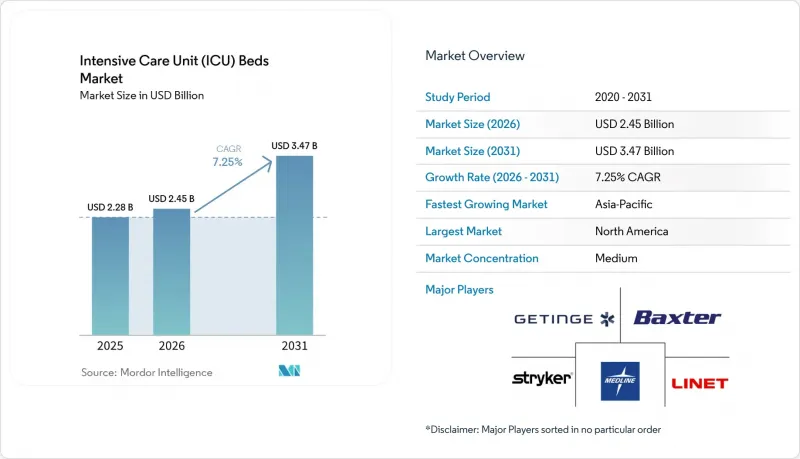
Mordor Intelligence에 의하면, 집중 치료실(ICU) 병상 시장 규모는 2025년 22억 8,000만 달러에서 2026년에는 24억 5,000만 달러로 확대되어 2031년까지 34억 7,000만 달러에 이를 것으로 예상되고 있어 2026-2031년까지 CAGR 7.25%로 성장할 전망입니다.
본 보고서는 제품 유형(전동식, 반전동식, 수동식, 비만 환자용, 소아용), 용도(범용, 특수, 소아·신생아, 심장 집중치료실(ICU), 기타), 최종 용도(병원 및 클리닉, 외래수술센터(ASC), 전문 병원, 기타), 지역(북미, 유럽, 아시아태평양, 중동 및 아프리카, 남미)별로 분류되어 있습니다. 시장 전망은 금액(달러) 기준으로 제시되어 있습니다.
전 세계 집중치료실(ICU) 병상 시장 동향 및 인사이트
만성 질환으로 인한 ICU 수요 증가
ICU 병상 시장은 주요 의료 시스템 전반에 걸쳐 규모가 크며, 지속적인 질병 부담에 의해 주도되고 있습니다. 『Journal of the American College of Cardiology』지 2025년 분석에 따르면, 전 세계적으로 6억 2,600만 건의 심혈관 질환이 보고되었으며, 『Nature Medicine』지 2025년 연구에서는 5억 6,920만 건의 만성 호흡기 질환과 420만 명의 사망이 보고되었습니다. 이로 인해, 고도의 관리와 집중 치료가 필요한 환자들이 끊임없이 유입되는 높은 기준선이 유지되고 있습니다. 심혈관 질환과 호흡기 질환이 동반될 경우, 그 수요가 받는 영향은 더욱 커집니다. 왜냐하면 이러한 환자들은 집중치료실(ICU)에 머무는 기간이 길어지고, 보다 지속적인 모니터링이 필요하기 때문에 실제 병상 수가 변하지 않더라도 시설의 기능적 수용 능력이 저하되기 때문입니다. 잉글랜드에서는 영국 보건 개선 및 격차 대책국(Office for Health Improvement and Disparities)이 2025년도 말까지의 회계연도 동안 호흡기 질환으로 인한 응급 입원이 87만 3,461건(이 중 독감으로 인한 입원은 5만 6,000건 이상) 에 달했다고 보고하고 있으며, 자금이 충분히 확보된 의료 제도라 하더라도 여전히 부담이 표면화되고 있음을 보여주고 있습니다. 또한, WHO 유럽 사무소도 2025년에 만성 호흡기 질환이 해당 지역에서 여전히 주요한 장기적 부담으로 남아 있을 것이라고 밝혔으며, 이는 집중치료실 병상 시장에서 지속적인 갱신 및 확장 수요를 뒷받침하는 것입니다. 이로 인해 ICU 병상 시장은 단기적인 조달 주기가 아닌, 구조적인 의료 수요와 연계된 상태가 유지되고 있습니다.
병원의 디지털화가 스마트 ICU 병상에 대한 수요를 견인하고 있습니다.
ICU 병상 시장은 또한 단순한 독립형 가구가 아닌, 연결된 임상 플랫폼으로서 기능하는 병상으로 전환되고 있습니다. 2025년 『Frontiers in Digital Health』지에 게재된 연구에 따르면, 실시간 데이터 통합, 예측 분석, 워크플로우 자동화를 결합한 SmartICU 프레임워크를 통해 상파울루의 한 병원에서 진행된 시범 프로젝트에서 평균 병상 교체 간격이 1.7일에서 거의 실시간으로 단축된 것으로 나타났습니다. 해당 조사에서는 간호 기록의 디지털화를 통해 환자 1인당 하루 56분의 시간 단축이 실현된 것으로 보고되었으며, 디지털 ICU 모델과 사망률이 12% 감소했음을 보여준 선행 연구와의 연관성도 지적되고 있습니다. 이를 통해 병원 구매 담당자들에게는 연결형 병상 도입에 대한 운영적·임상적 근거가 더욱 명확해졌습니다. 이 조사에서 인용된 머신러닝 기반의 패혈증 예측 모델은 AUROC 0.952를 달성했으며, 임상 증상이 나타나기 최대 4시간 전에 발병을 감지했습니다. 이는 환자의 데이터를 지속적으로 보다 광범위한 집중치료실(ICU) 시스템으로 전송할 수 있는 병상의 도입을 뒷받침하는 근거가 되고 있습니다. 실제로 이는 병원이 입찰 단계에서 센서 통합, 연결 경로, 혹은 전자 진료 기록과의 호환성이 부족한 저사양 제품을 걸러내고 있음을 의미합니다. 이러한 변화는 ICU 병상 시장에서 가격 결정력을 강화하고 있습니다. 왜냐하면 그 가치가 상호 운용성이나 워크플로우 지원과 더 밀접하게 연결되어 있기 때문입니다.
높은 초기 비용으로 인해 예산에 제약이 있는 병원의 교체 주기가 제한되고 있습니다.
ICU 병상 시장은 여전히 명백한 자금적 장벽에 직면해 있습니다. 왜냐하면, 완전 전동식이며 네트워크 연결 기능을 갖춘 ICU 병상은 수동식이나 반전동식 제품보다 훨씬 비싸기 때문입니다. 이러한 비용 격차는 높은 가동률과 인력 배치에 대한 압박을 감당하면서도 자본을 보존하려는 병원에서 가장 큰 문제가 됩니다. 이러한 상황에서 구매 담당자는 갱신을 미루거나, 사양 수준별로 조달을 분할하거나, ICU의 모든 병상에 도입하는 대신 신설 또는 개보수된 병동에만 고급 병상을 배정하는 등의 조치를 취하는 경우가 많습니다. 이러한 행동은 비록 이미 임상적 필요성이 존재하더라도, ICU 병상 시장이 더 높은 부가가치를 지닌 구조로 전환되는 속도를 늦추게 됩니다. 또한, 이로 인해 고급 병상 공급업체들은 선별된 프로젝트를 놓고 경쟁하는 반면, 예산에 제약이 있는 시설에서는 저사양 제품에 대한 수요가 여전히 유지되는 등 양극화된 시장 구조가 형성되고 있습니다.
부문별 분석
2025년, 전동 병상는 ICU 병상 시장 점유율의 39.31%를 차지하며, 지속적인 체위 변경, 욕창 예방, 그리고 더 강력한 간병인 지원이 필요한 급성기 의료 현장에서 기본 사양으로 자리 잡았습니다. 이러한 역할은 병원이 집중치료실에서 더 뛰어난 인체공학, 환자 모니터링과의 폭넓은 통합, 그리고 더 높은 안전성에 대한 기대를 표준화하고 있는 상황에 의해 뒷받침되고 있습니다. ICU 병상 시장의 이 분야는 전동 시스템이 디지털화된 치료 환경에 쉽게 적응할 수 있다는 점에서도 이점을 얻고 있습니다. 이러한 환경에서는 워크플로우의 효율화와 환자 처리 효율이 단순한 옵션 업그레이드가 아닌, 조달상의 우선순위로 다루어지고 있습니다. 반전동식 및 수동식 병상는 비용을 중시하는 시장, 특히 공공 조달 예산이 여전히 빠듯하고 도입 대수가 이미 많은 시장에서 여전히 일정한 역할을 하고 있습니다. 따라서 ICU 병상 시장의 중심은 여전히 전동식 구성으로 이동하고 있지만, 제품 구성은 여전히 폭넓은 상태를 유지하고 있습니다.
ICU 병상 시장에서 비만 환자용 병상 시장 규모는 2031년까지 연평균 성장률(CAGR) 8.38%로 확대될 것으로 예상되며, 이는 가장 빠르게 성장하는 제품 부문입니다. 수요가 증가하고 있는 배경에는 병원이 고도의 급성기 치료 과정에서 관절 가동성, 체위 조절 지원, 의료진의 안전을 확보하면서도 더 큰 하중을 안전하게 관리할 수 있는 병상를 필요로 하고 있기 때문입니다. 각 제조업체는 높은 하중 지지 능력, 완전 전동식 가동 기능, 일체형 횡방향 경사 기능 및 내장 계량 기능을 결합한 설계로 이에 대응하고 있으며, 이를 통해 임상적 유용성이 단순한 구조적 지지라는 범위를 넘어섰습니다. 이는 표준적인 집중치료실(ICU) 구성으로는 충분한 치료를 받기 어려울 수 있는 환자에게, 비만 환자용 병상가 욕창 예방 및 조기 이동 지원에도 기여할 수 있기 때문에 중요한 의미를 지닙니다. 그 결과, ICU 병상 시장에서는 임상적 및 운영상의 가치가 보다 구체적이기 때문에 프리미엄 가격 책정을 정당화하기 쉬운 부문이 형성되고 있습니다.
지역별 분석
2025년, 북미는 ICU 병상 시장의 35.22%를 차지하며 최대 지역 부문이 되었습니다. 이 지역은 ICU 병상 도입 대수가 많고, 교체 주기가 활발하며, 연결 기능을 갖춘 고사양 제품으로 조기에 전환할 수 있는 재정적 여유가 있다는 장점이 있습니다. 마운트 시나이 헬스 시스템은 마운트 시나이 퀸즈에 21병상 규모의 새로운 집중치료실을 건설 중입니다. 이로 인해 해당 병원의 중환자 치료 역량은 약 3배로 늘어났으며, 2026년에도 주요 도시 시장에서 수용 능력 확대가 활발히 진행되고 있음을 보여줍니다. 또한, 노스웨스턴 메모리얼 병원(Northwestern Memorial Hospital)도 응급실의 환자 대기 상황에 대응하기 위해 42병상 규모의 집중치료실(ICU) 확충을 추진하고 있으며, 이는 병원의 환자 유입 압박과 중환자 치료에 대한 투자 사이에 직접적인 연관성이 있음을 시사합니다. 유럽은 여전히 2위 지역 클러스터이며, 성숙한 병원 시스템과 더 엄격한 의료기기 기준 덕분에 조달 시기가 제각각이라 하더라도 고성능 제품에 대한 수요가 유지되고 있습니다.
아시아태평양은 2031년까지 연평균 성장률(CAGR) 9.65%로 확대될 것으로 예측되며, 집중치료실 병상 시장에서 가장 높은 지역 성장률을 기록할 전망입니다. 이러한 추세는 중국, 인도, 동남아시아 전역에서 진행되고 있는 정부 주도의 의료 서비스 확충, 만성 질환 유병률 증가, 그리고 민간 병원에 대한 투자 확대를 반영하고 있습니다. 인도에서는 AB-PMJAY에 기반한 광범위한 병원 네트워크와 중환자 치료 시설의 지속적인 확충이 판매량 증가를 뒷받침하고 있는 반면, 스트라이커(Stryker)가 2025년 6월 인도 시장을 겨냥해 APAISER X1을 출시한 것은 전 세계 공급업체들이 이러한 기회를 포착하여 제품의 현지화를 추진하고 있음을 보여줍니다. 일본도 ICU 병상 시장에서 여전히 중요한 위치를 차지하고 있으며, Paramount Bed는 2025년 6월, 간호 인력의 업무 부담을 줄이고 이동성 요구를 충족시키기 위해 전동 이송 지원 기능을 갖춘 ICU 병상 ‘Arius’를 출시했습니다. 이러한 사례들은 아시아태평양의 성장이 단순히 대수 증가에 그치지 않고, 보다 전문적이고 통합성이 높은 제품으로의 전환도 진행되고 있음을 보여줍니다.
중동 및 아프리카에서는 걸프 연안 국가들의 의료 인프라 구축 프로그램과 주요 도시권의 민간 병원에 대한 투자가 뒷받침되면서, 집중치료실(ICU) 병상 시장이 꾸준히 성장하고 있습니다. 이 지역에서는 병원들이 수용 능력을 프리미엄 의료 서비스 제공 및 의료 관광 전략과 조화시키려 하고 있기 때문에 전문적인 집중치료실(ICU) 및 비만 환자 대응 체계에 대한 수요가 특히 높은 경향을 보이고 있습니다. 남아프리카는 사하라 이남 아프리카의 조달 시장에서 여전히 핵심적인 위치를 차지하고 있습니다. 이는 민간 병원 그룹이 많은 공공 의료 시스템보다 자본 프로젝트 추진에 더 신속하기 때문입니다. 남미, 특히 브라질에서는 여전히 의미 있는 도입 실적이 있지만, 조달 시기는 공공 입찰 주기와 상환 제도의 파편화로 인해 좌우되는 경우가 많아, 그로 인해 성장 속도는 아시아태평양에서 나타나는 수준보다 낮습니다. 그 결과, ICU 병상 시장의 지역별 특징을 살펴보면, 현재 규모 면에서는 북미가 주도하고 있으며, 성장률 면에서는 아시아태평양이 주도하고 있고, 세계 기타 지역은 제한적이긴 하지만 여전히 중요한 수요 거점으로 자리 잡고 있는 상황입니다.
기타 혜택:
- 엑셀 형식 시장 예측(ME) 시트
- 3개월간의 애널리스트 지원
자주 묻는 질문
목차
제1장 서론
제2장 조사 방법
제3장 주요 요약
제4장 시장 구도
제5장 시장 규모와 성장 예측
제6장 경쟁 구도
제7장 시장 기회와 향후 전망
JHS 26.07.09According to Mordor Intelligence, the intensive care unit (ICU) beds market size is expected to increase from USD 2.28 billion in 2025 to USD 2.45 billion in 2026 and reach USD 3.47 billion by 2031, growing at a CAGR of 7.25% over 2026-2031.
This report is Segmented by Product Type (Electric, Semi-Electric, Manual, Bariatric, Pediatric Beds), Application (General, Specialized, Pediatric and Neonatal, Cardiac ICUs, Other), End Use (Hospitals and Clinics, Ascs, Specialty Hospitals, Others), and Geography (North America, Europe, Asia-Pacific, Middle East and Africa, South America). The Market Forecasts are Provided in Terms of Value (USD).
Global Intensive Care Unit (ICU) Beds Market Trends and Insights
Growing ICU Demand From Chronic Disease Burden
The ICU beds market is being pushed by a disease burden that is both large and persistent across major healthcare systems. A 2025 Journal of the American College of Cardiology analysis reported 626 million cardiovascular disease cases worldwide, and a 2025 Nature Medicine study reported 569.2 million chronic respiratory disease cases with 4.2 million deaths, which keeps a high baseline of patients flowing into high dependency and intensive care settings. The demand effect is stronger when cardiovascular and respiratory conditions overlap, because those patients often require longer ICU stays and more constant monitoring, which reduces functional capacity even when the physical bed count does not change. In England, the UK Office for Health Improvement and Disparities reported 873,461 emergency respiratory admissions in the financial year ending 2025, including more than 56,000 influenza admissions, which shows that pressure is still visible even in a well funded health system. WHO Europe also stated in 2025 that chronic respiratory disease remains a major long term burden in the region, which supports continued replacement and expansion demand in the ICU beds market. This keeps the ICU beds market tied to a structural care need rather than a short procurement cycle.
Hospital Digitization Is Pulling Demand Toward Smart ICU Beds
The ICU beds market is also moving toward beds that work as connected clinical platforms rather than as stand alone furniture. A 2025 Frontiers in Digital Health study showed that SmartICU frameworks combining real time data integration, predictive analytics, and workflow automation reduced average bed replacement intervals from 1.7 days to near real time in a Sao Paulo hospital pilot. The same study reported 56 minutes saved per patient per day through digitized nursing documentation, and it linked digital ICU models to prior studies that showed 12% lower mortality, which gives hospital buyers a clearer operational and clinical case for connected beds. Machine learning sepsis prediction models cited in that research achieved an AUROC of 0.952 and flagged onset up to 4 hours before clinical presentation, which strengthens the case for beds that can transmit continuous patient data into broader ICU systems. In practice, this means hospitals are screening out lower specification products at the tender stage when they lack sensor integration, connectivity pathways, or electronic medical record compatibility. That shift supports pricing strength in the ICU beds market because value is now tied more closely to interoperability and workflow support.
High Upfront Cost Limits Replacement Cycles in Budget-Constrained Hospitals
The ICU beds market still faces a clear funding barrier because full electric and connected ICU beds cost much more than manual or semi electric products. This cost gap matters most in hospitals that are trying to preserve capital while still managing high occupancy and staffing pressure. In those settings, buyers often delay replacement, split tenders across specification tiers, or reserve premium beds for new or renovated units rather than extending them across the full ICU fleet. That behavior slows the speed at which the ICU beds market can move toward higher value configurations even when clinical need is already present. It also creates a two track market in which premium suppliers compete for selective projects while lower specification products remain relevant in budget limited systems.
Other drivers and restraints analyzed in the detailed report include:
- ICU Capacity Expansion in Emerging Care Networks
- Shorter Bed Turnaround Time Through Infection-Control Design
- Certification, Tender, and Reimbursement Friction Slows Adoption
For complete list of drivers and restraints, kindly check the Table Of Contents.
Segment Analysis
Electric beds held 39.31% of the ICU beds market share in 2025, which made them the default specification in acute care settings that need continuous repositioning, pressure injury prevention, and stronger caregiver support. Their role is supported by the way hospitals are standardizing around better ergonomics, broader patient monitoring integration, and higher safety expectations in critical care units. This part of the ICU beds market also benefits from the fact that electric systems fit more easily into digitized care environments, where workflow efficiency and patient handling are being treated as procurement priorities rather than as optional upgrades. Semi electric and manual beds still retained a role in cost sensitive markets, especially where public procurement budgets remain tight and the installed base is already large. That keeps the product mix broad, even though the center of gravity in the ICU beds market is still moving toward powered configurations.
The ICU beds market size for bariatric beds is projected to expand at 8.38% CAGR through 2031, making this the fastest growing product segment. Demand is rising because hospitals need beds that can safely manage higher weight loads while still providing articulation, positioning support, and staff safety in high acuity care. Manufacturers are responding with designs that combine high weight ratings, full electric movement, integrated lateral tilt, and onboard weighing capability, which lifts clinical utility beyond basic structural support. This matters because bariatric beds can also support pressure injury prevention and early mobilization for patients who may not be well served by standard ICU configurations. As a result, the ICU beds market is seeing a segment where premium pricing is easier to defend because the clinical and operational value is more specific.
Complete Report Scope:
- By Product Type
- Electric Beds
- Semi-Electric Beds
- Manual Beds
- Bariatric Beds
- Pediatric Beds
- By Application
- General ICUs
- Specialized ICUs
- Pediatric and Neonatal ICUs
- Cardiac ICUs
- Other Applications
- By End Use
- Hospitals and Clinics
- Ambulatory Surgical Centers
- Specialty Hospitals
- Others
- By Geography
- North America
- United States
- Canada
- Mexico
- Europe
- Germany
- United Kingdom
- France
- Italy
- Spain
- Rest of Europe
- Asia-Pacific
- China
- Japan
- India
- Australia
- South Korea
- Rest of Asia-Pacific
- Middle East and Africa
- GCC
- South Africa
- Rest of Middle East and Africa
- South America
- Brazil
- Argentina
- Rest of South America
- North America
Geography Analysis
North America held 35.22% of the ICU beds market in 2025, which made it the largest regional segment. The region benefits from a deep installed ICU base, active replacement cycles, and the financial ability to move earlier toward connected and higher specification products. Mount Sinai Health System is building a new 21-bed ICU at Mount Sinai Queens, which will nearly triple the hospital's critical care capacity and shows that capacity expansion remains active in a major urban market in 2026. Northwestern Memorial Hospital is also pursuing a 42-bed ICU expansion tied to emergency department backlogs, which points to a direct connection between hospital flow pressure and critical care investment. Europe remained the second largest regional cluster, where mature hospital systems and tighter device standards support demand for more advanced products even when procurement timing is uneven.
Asia-Pacific is projected to expand at 9.65% CAGR through 2031, giving it the fastest regional growth in the ICU beds market. This pace reflects government led healthcare expansion, rising chronic disease prevalence, and stronger private hospital investment across China, India, and Southeast Asia. India's broad hospital network under AB-PMJAY and continued critical care buildout support volume growth, while Stryker's June 2025 launch of the APAISER X1 for the Indian market shows that global suppliers are localizing products for this opportunity. Japan also remains important in the ICU beds market, where Paramount Bed introduced an Arius ICU bed with powered transport assistance in June 2025 to address nursing workload and mobility needs. These examples show that Asia-Pacific growth is not only about adding units, it is also about moving toward more specialized and better integrated products.
The Middle East and Africa region is growing steadily in the ICU beds market, supported by healthcare infrastructure programs in the Gulf and by private hospital investment in key urban centers. Demand in this region is often strongest for specialty ICU and bariatric configurations where hospitals are trying to align capacity with premium care offerings and medical tourism strategies. South Africa remains an anchor for sub-Saharan procurement because private hospital groups typically move faster on capital projects than many public systems. South America continues to offer a meaningful installed base, especially in Brazil, but procurement timing is often shaped by public tender cycles and reimbursement fragmentation, which keeps growth below the pace seen in Asia-Pacific. This leaves the ICU beds market with a regional profile in which North America leads on current scale, Asia-Pacific leads on growth, and the rest of the world adds selective but still important demand pockets.
- Arjo AB
- Baxter
- Favero Health Projects S.p.A.
- Gendron
- Getinge
- Invacare
- LINET Group
- Malvestio S.p.A.
- Medline Industries
- Merivaara
- MESPA
- Nitrocare Medical Bed
- Paramount Bed Co., Ltd.
- Savion Industries Ltd.
- Stiegelmeyer GmbH and Co. KG
- Stryker
- Umano Medical Inc.
Additional Benefits:
- The market estimate (ME) sheet in Excel format
- 3 months of analyst support
TABLE OF CONTENTS
1 Introduction
- 1.1 Study Assumptions & Market Definition
- 1.2 Scope of the Study
2 Research Methodology
3 Executive Summary
4 Market Landscape
- 4.1 Market Overview
- 4.2 Market Drivers
- 4.2.1 Growing ICU Demand From Chronic Disease Burden
- 4.2.2 Hospital Digitization Is Pulling Demand Toward Smart ICU Beds
- 4.2.3 ICU Capacity Expansion in Emerging Care Networks
- 4.2.4 Shorter Bed Turnaround Time Through Infection-Control Design
- 4.2.5 Rising Focus on Staff Ergonomics and Safe Patient Handling
- 4.2.6 Procurement Shift Toward Modular Beds With Upgradeable Interfaces
- 4.3 Market Restraints
- 4.3.1 High Upfront Cost Limits Replacement Cycles in Budget-Constrained Hospitals
- 4.3.2 Certification, Tender, and Reimbursement Friction Slows Adoption
- 4.3.3 Biomedical Maintenance and Spare-Part Dependence Raises Total Cost of Ownership
- 4.3.4 ICU Space Constraints Reduce Retrofit Feasibility in Legacy Facilities
- 4.4 Supply-Chain Analysis
- 4.5 Regulatory Landscape
- 4.6 Technological Outlook
- 4.7 Porter's Five Forces Analysis
- 4.7.1 Threat of New Entrants
- 4.7.2 Bargaining Power of Suppliers
- 4.7.3 Bargaining Power of Buyers
- 4.7.4 Threat of Substitutes
- 4.7.5 Intensity of Competitive Rivalry
5 Market Size & Growth Forecasts (Value, USD)
- 5.1 By Product Type
- 5.1.1 Electric Beds
- 5.1.2 Semi-Electric Beds
- 5.1.3 Manual Beds
- 5.1.4 Bariatric Beds
- 5.1.5 Pediatric Beds
- 5.2 By Application
- 5.2.1 General ICUs
- 5.2.2 Specialized ICUs
- 5.2.3 Pediatric and Neonatal ICUs
- 5.2.4 Cardiac ICUs
- 5.2.5 Other Applications
- 5.3 By End Use
- 5.3.1 Hospitals and Clinics
- 5.3.2 Ambulatory Surgical Centers
- 5.3.3 Specialty Hospitals
- 5.3.4 Others
- 5.4 By Geography
- 5.4.1 North America
- 5.4.1.1 United States
- 5.4.1.2 Canada
- 5.4.1.3 Mexico
- 5.4.2 Europe
- 5.4.2.1 Germany
- 5.4.2.2 United Kingdom
- 5.4.2.3 France
- 5.4.2.4 Italy
- 5.4.2.5 Spain
- 5.4.2.6 Rest of Europe
- 5.4.3 Asia-Pacific
- 5.4.3.1 China
- 5.4.3.2 Japan
- 5.4.3.3 India
- 5.4.3.4 Australia
- 5.4.3.5 South Korea
- 5.4.3.6 Rest of Asia-Pacific
- 5.4.4 Middle East and Africa
- 5.4.4.1 GCC
- 5.4.4.2 South Africa
- 5.4.4.3 Rest of Middle East and Africa
- 5.4.5 South America
- 5.4.5.1 Brazil
- 5.4.5.2 Argentina
- 5.4.5.3 Rest of South America
- 5.4.1 North America
6 Competitive Landscape
- 6.1 Market Concentration
- 6.2 Market Share Analysis
- 6.3 Company Profiles (includes Global Level Overview, Market Level Overview, Core Segments, Financials as available, Strategic Information, Market Rank/Share, Products and Services, Recent Developments)
- 6.3.1 Arjo AB
- 6.3.2 Baxter International Inc.
- 6.3.3 Favero Health Projects S.p.A.
- 6.3.4 Gendron Inc.
- 6.3.5 Getinge AB
- 6.3.6 Invacare Corporation
- 6.3.7 LINET Group SE
- 6.3.8 Malvestio S.p.A.
- 6.3.9 Medline Industries, Inc.
- 6.3.10 Merivaara Corp.
- 6.3.11 MESPA
- 6.3.12 Nitrocare Medical Bed
- 6.3.13 Paramount Bed Co., Ltd.
- 6.3.14 Savion Industries Ltd.
- 6.3.15 Stiegelmeyer GmbH and Co. KG
- 6.3.16 Stryker Corporation
- 6.3.17 Umano Medical Inc.
7 Market Opportunities & Future Outlook
- 7.1 White-space & unmet-need assessment


