

|
시장보고서
상품코드
2072896
수막염 진단 및 치료 시장 : 점유율 분석, 업계 동향과 통계, 성장 예측(2026-2031년)Meningitis Diagnosis and Treatment - Market Share Analysis, Industry Trends & Statistics, Growth Forecasts (2026 - 2031) |
||||||
 Mordor Intelligence
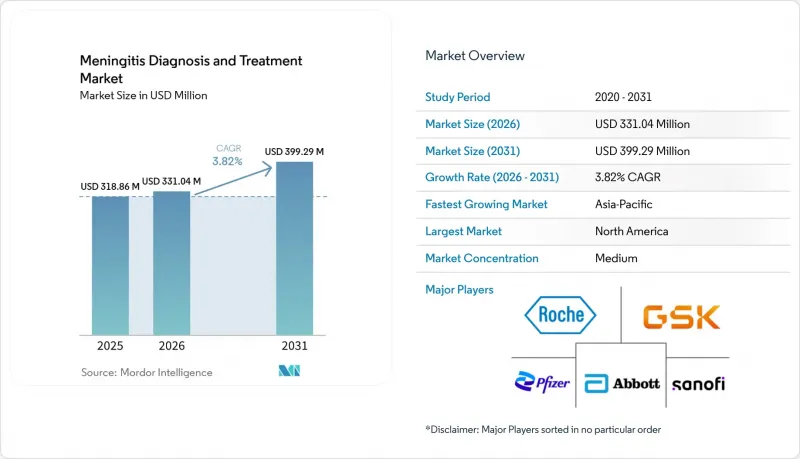
Mordor Intelligence에 의하면, 수막염 진단 및 치료 시장 규모는 2025년에 3억 1,886만 달러, 2026년에 3억 3,104만 달러가 되어, 2031년까지 3억 9,929만 달러에 이를 것으로 예측되며, 2026-2031년까지 CAGR 3.82%로 성장할 전망입니다.
본 보고서는 유형(진단(요추 천자 등), 치료(항생제 등)), 수막염 유형(세균성, 바이러스성, 진균성, 기생충성), 최종 사용자(병원, 진단실험실, 연구소, 기타), 지역(북미, 유럽, 아시아태평양 등)별로 분류되어 있습니다. 시장 전망은 금액(달러) 기준으로 제시되어 있습니다.
전 세계 수막염 진단 및 치료 시장 동향과 인사이트
수막염 발생률 증가와 집단 발생의 재발
세계 환자 수가 여전히 상당히 높은 수준을 유지하고 있기 때문에 수막염 집단 발병의 재발은 수막염 진단 및 치료 시장에 있어 계속해서 직접적인 성장 요인으로 작용하고 있습니다. 2023년 세계 질병 부담 연구(Global Burden of Disease Study 2023)에 따르면, 2023년의 신규 환자 수는 254만 건, 사망자 수는 25만 9,000명에 달했으며, 또한 예방 가능한 4가지 병원체만으로도 59만 4,000건의 사례와 9만 8,700명의 사망을 초래한 것으로 나타났습니다. 미국에서는 세균성 수막염 환자 수가 2014년 이후 최고 수준에 달하면서, 재유행의 압박이 저소득 국가에만 국한된 것이 아니라는 사실이 드러났습니다. 프랑스에서도 2025년 초에 침습성 수막구균 감염증이 급증하자, 정부는 이에 대응해 전국적인 백신 접종 전략을 강화하는 한편, 2025-2026학년도에 11-14세 청소년을 대상으로 MenACWY 백신 접종을 시작했습니다. 백신 접종 프로그램이 정착된 시장에서도 여전히 혈청군 변화나 면역력 저하 문제에 직면하고 있으며, 이로 인해 수막염 진단 및 치료 시장에서 추가 접종용 백신 조달과 진단 수요 모두 활발하게 유지되고 있습니다. 또한, 공중보건 예산을 통해 감시 활동에 대한 자금 지원도 확대되고 있어, 이로 인해 검사 패널의 검사 건수가 병원의 일반적인 설비 투자 주기의 영향을 덜 받게 되었습니다.
응급 및 의약품 적정 사용 과정에서 신속한 배제 검사로의 전환
항생제 투여 결정이 훨씬 더 짧은 임상적 시간 창 내에서 이루어져야 할 필요가 생기면서, 신속한 배제 검사는 수막염 진단 및 치료 시장에서 구조적인 수요를 견인하는 요인으로 부상하고 있습니다. 2025년 2월에 발표된 독일의 최신 임상 지침에서는 세균성 수막염과 바이러스성 수막염을 구별하기 위한 혈청 바이오마커로 프로칼시토닌이 권장되었으며, 또한 PCR 패널 진단이 핵심적인 진단 근거로 인정되었습니다. bioMerieux에 따르면, BioFire FilmArray ME 패널은 약 1시간 만에 결과를 확인할 수 있으며, 항바이러스 치료 결정과 관련된 5가지 헤르페스 바이러스 표적을 모두 포함하는 FDA 승인을 받은 유일한 증후군별 패널이라고 합니다. 미국에서는 2025년 1월 1일부터 시행된 MolDX 정책에 따라 중증 환자를 대상으로 한 수막염 분자 패널의 보험 적용 기준이 마련되었으며, 이를 통해 병원 시스템 내 도입에 대한 큰 장벽이 완화되었습니다. 검사의 신속화는 임상의가 광범위 항생제의 투여를 조기에 단계적으로 줄이고, 보다 확신 있게 치료 범위를 좁힐 수 있게 해주므로, 항생제의 적정 사용 촉진에도 기여합니다. 검사 결과의 신속화, 항생제 적정 사용의 개선, 기존 배양 검사 워크플로우의 사용 감소가 맞물리면서, 수막염 진단 및 치료 시장은 패널 기반 진단으로 더욱 빠르게 전환되고 있습니다.
분자 검사에서 장비 및 시약의 높은 비용
높은 검사 비용은 여전히 수막염 진단 및 치료 시장에서 가장 큰 구조적 장벽으로 남아 있습니다. 이는 최첨단 플랫폼의 가격이 공중보건 분야에서 광범위하게 활용되기 위해 필요한 수준을 훨씬 웃돌고 있기 때문입니다. WHO가 수립한 저비용 세균성 수막염 진단 키트에 관한 목표 제품 프로파일에서는 저·중소득 국가에서의 집단 발생 대응 및 감시 활동에의 사용을 염두에 두고, 검사 1회당 목표 정가를 8달러 미만으로 설정하고 있습니다. 주요 공급업체들이 제공하는 시판 중인 증후군별 패널은 이 기준을 훨씬 상회하고 있으며, 그 결과 가장 빠르게 성장하고 있는 진단 분야임에도 불구하고 아프리카의 수막염 벨트나 남아시아 일부 지역에 위치한 많은 병원들에게는 감당하기 어려운 수준이 되고 있습니다. 이러한 가격 격차로 인해, 고소득층을 대상으로 한 의료 제도에 이끌리는 상업 시장과, 공공 조달 및 보조금 지원에 크게 의존하는 기부자 지원형 세계 보건 시장 사이에 단절이 발생하고 있습니다. 『Annals of Clinical Microbiology and Antimicrobials』지에 게재된 2024년 연구에 따르면, CRISPR 및 Cas12a를 기반으로 한 LAMP 측면 유동 분석법은 열순환 장치 없이도 수막염균(N. meningitidis)을 검출할 수 있는 것으로 나타났습니다. 이는 비용 절감의 방향을 제시하는 것이지만, 단기적인 상용화 격차를 해소하는 것은 아닙니다. EU의 IVDR이나 FDA의 클래스 II 의료기기 규정 등의 체계에 기반한 추가적인 규정 준수 요건은 신규 진출기업에게 더 큰 비용 부담이 되어, 수막염 진단 및 치료 시장을 기존 대기업들에게 유리한 상태로 유지시키고 있습니다.
부문별 분석
2025년 수막염 진단 및 치료 시장 규모 중 치료 부문이 55.31%를 차지했습니다. 이는 항생제, 코르티코스테로이드, 백신, 지지 요법 및 항바이러스 요법에 대한 수요의 합계를 반영한 것입니다. 이러한 주도적인 지위는 세균성 수막염의 긴급성에 기인합니다. 이 질환의 경우, 발병 후 1-3시간 이내에 경험적 항생제 투여가 필요하기 때문에 안정적인 치료 수요가 발생하고 있습니다. 코르티코스테로이드, 특히 폐렴구균 감염 사례에서 데ksametazon은 그 사용이 임의적인 처방 패턴이 아니라 확립된 임상 관행과 연계되어 있기 때문에 안정적인 보조 요법으로 자리매김하고 있습니다. 또한, 특히 2025년 2월 GSK가 PENMENVY의 승인을 획득한 이후, 수막구균에 대한 예방 범위가 더 넓은 백신이 시장에 출시됨에 따라, 치료 분야에서 백신의 비중도 상업적으로 점차 확대되고 있습니다. 수막염 진단 및 치료 시장에서는 새로운 진단 기술이 세를 넓혀가고 있음에도 불구하고, 치료 부문이 여전히 더 큰 수익 기반을 유지하고 있습니다.
진단 분야는 2031년까지 연평균 성장률(CAGR) 4.38%를 나타낼 것으로 예측되며, 수막염 진단 및 치료 시장에서 가장 빠르게 성장하는 분야입니다. PCR 기반 검사법, 특히 증후군별 다중 검사는 고소득국의 의료 시스템에서 단일 병원체 검사나 배양을 주축으로 한 업무 흐름을 점차 대체하고 있습니다. 이러한 국가들에서는 검사 결과 확인이 빨라짐에 따라 중환자실 입원 기간을 단축하고 불필요한 치료를 줄일 수 있기 때문입니다. 『Frontiers in Medical Technology』지는 2025년에 결과가 나오기까지 약 1시간이 걸리는 신드로믹 패널이 세균, 바이러스, 곰팡이 등 병원체를 동시에 검출할 수 있다고 지적했습니다. 또한, 당시 BioFire의 FilmArray ME 패널은 FDA 승인을 받은 유일한 중추신경계(CNS)용 멀티플렉스 패널이었으며, QIAGEN은 2024년 하반기에 FDA 승인을 받아 이미 이 분야에 진출한 상태였습니다고 보도하고 있습니다. 자원이 제한된 환경에서는 혈액 배양 및 혈청학적 검사가 여전히 중요하며, 영상 진단은 일선에서 병원체를 확인하기보다는 환자 분류를 지원하는 역할을 계속하고 있습니다. 수막염 진단 및 치료 업계 전반에서 ISO 15189의 품질 요건과 FDA의 의료기기 규제로 인해 성장은 증거 기반, 규제 대응 능력, 그리고 규모 확대를 위한 도입 실적의 우위를 갖춘 인증 플랫폼에 집중되고 있습니다.
지역별 분석
2025년, 북미는 수막염 진단 및 치료 시장 점유율의 38.22%를 차지하며, 다른 지역을 크게 앞지르고 가장 큰 기여 지역이 되었습니다. 그 지위의 상당 부분은 미국이 차지하고 있으며, 이는 광범위한 병원 접근성, MolDX 프레임워크에 기반한 분자 패널에 대한 보험 급여 지원, 그리고 통합형 멀티플렉스 PCR 시스템의 대규모 도입 실적이 결합되어 실현된 것입니다. 또한, 이 지역은 2025년 GSK의 PENMENVY가 FDA 승인을 받은 것을 포함해 최근 백신 포트폴리오 확대의 혜택을 누리고 있으며, 이를 통해 해당 연령대를 위한 수막구균 예방 옵션의 선택 폭이 넓어졌습니다. 캐나다와 멕시코의 기여도는 비교적 낮은 편이지만, 캐나다는 공공 자금을 통한 병원 진단에 의존하는 반면, 멕시코에서는 민간 검사 기관을 이용하는 사례가 더 두드러지게 나타납니다. 북미의 사례당 진단 실시 빈도는 여전히 높은 수준을 유지하고 있으며, 이는 아프리카나 아시아의 일부 지역에 비해 질병 발생률이 낮은 경우에도 수막염 진단 및 치료 시장에서 큰 수익 기반을 유지하는 데 기여하고 있습니다.
유럽은 규제를 통해 공급업체 시장 진입 및 조달의 예측 가능성을 적극적으로 재구축하고 있기 때문에 수막염 진단 및 치료 시장에서 구조적으로 가장 중요한 지역 중 하나로 자리매김하고 있습니다. EU의 IVDR(체외진단용 의료기기 규정) 체계에 따라 규정 준수 기준이 강화됨에 따라, 2025년 7월에 QIAGEN이 “QIAstat-Dx 수막염·뇌염 패널”에 대해 취득한 CE-IVDR 인증은 이 제도에 따른 승인이 병원 네트워크에 대한 접근을 확대하는 동시에 경쟁력이 약한 신규 시장 진출기업을 억제할 수 있음을 보여줍니다. 독일, 프랑스, 영국, 이탈리아, 스페인은 여전히 주요 국가별 시장이며, 독일이 2025년에 개정된 지침에 따라 PCR 및 패널 진단이 일상 진료에서 더욱 중요한 위치를 차지하게 되었고, 또한 프랑스에서는 2025년 초에 수막구균 감염증이 급증함에 따라 단기적으로는 백신 도입에 확실한 추진력을 제공합니다. 유럽의 소규모 시장에서도 조화로운 조달 조건의 혜택을 누리고 있으며, 이는 지역 전체에서 플랫폼 표준화의 확대에 기여하고 있습니다.
아시아태평양은 2031년까지 연평균 성장률(CAGR) 5.65%로 확대될 것으로 예측되며, 수막염 진단 및 치료 시장에서 가장 빠르게 성장하는 지역이 될 전망입니다. 중국은 ‘Healthy China 2030’을 통해 이러한 성장 궤도를 뒷받침하고 있으며, 이 계획은 병원 검사실의 자동화와 차세대 염기서열 분석 및 다중 PCR 역량의 보다 광범위한 도입에 자금을 지원하고 있습니다. 인도의 ‘아유슈만 바라트(Ayushman Bharat)’ 프로그램은 신생아 및 소아의 선별 검사 접근성을 확대하고 있으며, 이로 인해 2차 의료기관에서의 세균 배양 검사 및 PCR 검사가 증가하고 있습니다. 또한, QIAGEN이 2024년 1월 싱가포르 보건과학청(HSA)으로부터 승인을 획득한 것은 동남아시아로의 단계적 진출을 시사하며, 싱가포르가 더 광범위한 시장 확대를 위한 관문 시장으로서의 역할을 수행하고 있음을 보여줍니다. 반면, 중동 및 아프리카 및 남미 지역에서는 질병 부담이 크지만, 상업 기반은 소규모에 그치고 있습니다. 이는 비상용 백신 비축 및 PCR 검사의 콜드체인 물류에 대한 의존도가 여전히 규모 확대를 제한하고 있기 때문이지만, WHO가 제안한 저비용 검사 체계는 향후 상업적으로 지속 가능한 접근 체계를 구축하기 위한 노력을 시사하고 있습니다.
기타 혜택:
- 엑셀 형식 시장 예측(ME) 시트
- 3개월간의 애널리스트 지원
자주 묻는 질문
목차
제1장 서론
제2장 조사 방법
제3장 주요 요약
제4장 시장 구도
제5장 시장 규모와 성장 예측
제6장 경쟁 구도
제7장 시장 기회와 향후 전망
JHS 26.07.09According to Mordor Intelligence, the meningitis diagnosis and treatment market size is projected to be USD 318.86 million in 2025, USD 331.04 million in 2026, and reach USD 399.29 million by 2031, growing at a CAGR of 3.82% from 2026 to 2031.
This report is Segmented by Type (Diagnosis [Lumbar Puncture, and More], Treatment [Antibiotics and More]), Type of Meningitis (Bacterial, Viral, Fungal, Parasitic), End User (Hospitals, Diagnostic Laboratories, Research Institutions, Other End Users), and Geography (North America, Europe, Asia-Pacific, and More). The Market Forecasts are Provided in Terms of Value (USD).
Global Meningitis Diagnosis and Treatment Market Trends and Insights
Rising Incidence of Meningitis and Outbreak Recurrence
The recurrence of meningitis outbreaks remains a direct growth force for the meningitis diagnosis and treatment market because the global case load has stayed materially high. The Global Burden of Disease Study 2023 reported 2.54 million incident cases and 259,000 deaths in 2023, and it also showed that the 4 preventable pathogens alone caused 594,000 cases and 98,700 deaths. In the United States, bacterial meningitis cases reached their highest levels since 2014, which underlined that recurrence pressure is not limited to lower-income countries. France also recorded a sharp rise in invasive meningococcal infections in early 2025, and the government responded by intensifying the national vaccination strategy and rolling out MenACWY vaccination for adolescents aged 11 to 14 years in the 2025 to 2026 school year. Even markets with established vaccine programs still face serogroup shifts and waning immunity, which keeps both booster procurement and diagnostic demand active in the meningitis diagnosis and treatment market. Public health budgets are also funding more surveillance activity, which helps protect laboratory panel volumes from normal hospital capital spending cycles.
Shift Toward Rapid Rule-Out Testing in Emergency and Stewardship Pathways
Rapid rule-out testing is becoming a structural demand driver in the meningitis diagnosis and treatment market because antibiotic decisions now need to be made within a much shorter clinical window. Updated German clinical guidance published in February 2025 endorsed procalcitonin as a serum biomarker to help distinguish bacterial from viral meningitis and also recognized PCR panel diagnostics as core diagnostic evidence. bioMerieux states that the BioFire FilmArray ME Panel delivers results in around 1 hour and is the only FDA-cleared syndromic panel that includes all 5 relevant herpes virus targets tied to antiviral treatment decisions. In the United States, the MolDX policy effective January 1, 2025 provides reimbursement criteria for meningitis molecular panels in critically ill patients, which lowers a major adoption barrier for hospital systems. Faster testing also supports antimicrobial stewardship because it helps clinicians de-escalate broad-spectrum antibiotics sooner and narrow therapy with greater confidence. That combination of shorter turnaround time, better stewardship, and lower use of legacy culture workflows is helping the meningitis diagnosis and treatment market move toward panel-based diagnostics more quickly.
High Instrument and Reagent Cost of Molecular Testing
High test cost remains the biggest structural brake on the meningitis diagnosis and treatment market because the most advanced platforms are still priced far above the levels needed for broad public health use. The WHO target product profile for a low-cost bacterial meningitis diagnostic set a target list price below USD 8 per test for use in outbreak response and surveillance in low- and middle-income countries. Commercial syndromic panels from leading suppliers sit far above that threshold, which keeps the fastest-growing diagnostic category out of reach for many hospitals in the African meningitis belt and parts of South Asia. This pricing gap creates a split between the commercial market, which is driven by higher-income health systems, and the donor-backed global health market, which depends more heavily on public procurement and subsidy support. A 2024 study in Annals of Clinical Microbiology and Antimicrobials showed that a CRISPR and Cas12a-based LAMP lateral flow assay could detect N. meningitidis without thermocycling equipment, which points to a lower-cost path but does not solve the near-term commercialization gap. Additional compliance demands under frameworks such as EU IVDR and FDA Class II device rules add more cost layers for new entrants and keep the meningitis diagnosis and treatment market tilted toward established players.
Other drivers and restraints analyzed in the detailed report include:
- Expanding Vaccination and Post-Vaccination Surveillance Programs
- Molecular Syndromic Panels Improving Diagnostic Yield
- Limited CSF Sampling and Pediatric Specimen Constraints
For complete list of drivers and restraints, kindly check the Table Of Contents.
Segment Analysis
Treatment accounted for 55.31% of the meningitis diagnosis and treatment market size in 2025, which reflected the combined demand for antibiotics, corticosteroids, vaccines, supportive care, and antiviral therapy. This leadership was rooted in the emergency nature of bacterial meningitis, where empirical antibiotics are expected within 1 to 3 hours of presentation and therefore create a dependable treatment volume. Corticosteroids, especially dexamethasone in pneumococcal cases, remain a stable adjunct because their use is tied to established clinical practice rather than optional prescribing patterns. The vaccine portion of treatment is also becoming more commercially active as broader meningococcal coverage enters the market, especially after GSK received approval for PENMENVY in February 2025. In the meningitis diagnosis and treatment market, this keeps treatment as the larger revenue base even while newer diagnostic technologies gain momentum.
Diagnosis is projected to grow at a 4.38% CAGR through 2031, which makes it the faster-moving side of the meningitis diagnosis and treatment market. PCR-based methods, especially syndromic multiplex panels, are replacing single-pathogen tests and culture-led workflows in high-income systems where faster results can reduce ICU stay and narrow unnecessary therapy. Frontiers in Medical Technology noted in 2025 that syndromic panels with around 1-hour result times can detect bacterial, viral, and fungal pathogens together, and that the BioFire FilmArray ME Panel remained the only FDA-approved multiplex CNS panel at that point while QIAGEN had already entered the field with FDA clearance in late 2024. Blood cultures and serology still matter in resource-constrained settings, and imaging continues to support triage rather than first-line pathogen identification. Across the meningitis diagnosis and treatment industry, ISO 15189 quality demands and FDA device rules keep growth concentrated among accredited platforms with the evidence, regulatory capacity, and installed-base advantage to scale.
Complete Report Scope:
- By Type
- Diagnosis
- Lumbar Puncture
- Blood Cultures
- Polymerase Chain Reaction
- Serological Tests
- Imaging Techniques
- Treatment
- Antibiotics
- Corticosteroids
- Vaccines
- Supportive Care
- Antiviral Medication
- Diagnosis
- By Type of Meningitis
- Bacterial Meningitis
- Viral Meningitis
- Fungal Meningitis
- Parasitic Meningitis
- By End User
- Hospitals
- Diagnostic Laboratories
- Research Institutions
- Other End Users
- By Geography
- North America
- United States
- Canada
- Mexico
- Europe
- Germany
- United Kingdom
- France
- Italy
- Spain
- Rest of Europe
- Asia-Pacific
- China
- Japan
- India
- Australia
- South Korea
- Rest of Asia-Pacific
- Middle East and Africa
- GCC
- South Africa
- Rest of Middle East and Africa
- South America
- Brazil
- Argentina
- Rest of South America
- North America
Geography Analysis
North America held 38.22% of meningitis diagnosis and treatment market share in 2025, which made it the largest regional contributor by a clear margin. The United States accounts for most of that position because it combines broad hospital access, reimbursement support for molecular panels under the MolDX framework, and a large installed base of integrated multiplex PCR systems. The region also benefits from recent vaccine portfolio expansion, including GSK's FDA approval for PENMENVY in 2025, which widened the menu of meningococcal protection options for eligible age groups. Canada and Mexico contribute more modestly, with Canada leaning on publicly funded hospital diagnostics and Mexico showing stronger private laboratory adoption patterns. North America's diagnostic intensity per case remains high, which helps preserve a large revenue footprint for the meningitis diagnosis and treatment market even when disease incidence is lower than in Africa or parts of Asia.
Europe remains one of the most structurally important regions in the meningitis diagnosis and treatment market because regulation is actively reshaping supplier access and procurement predictability. The EU IVDR framework has raised the compliance bar, and QIAGEN's CE-IVDR certification for the QIAstat-Dx Meningitis and Encephalitis Panel in July 2025 shows how approval under that regime can expand access to hospital networks while constraining weaker entrants. Germany, France, the United Kingdom, Italy, and Spain remain the main country markets, with Germany's updated 2025 guidance giving PCR and panel diagnostics a stronger place in routine practice and France's early 2025 meningococcal surge creating a clear near-term vaccine catalyst. Smaller European markets still benefit from harmonized procurement conditions, which helps extend platform standardization across the region.
Asia-Pacific is forecast to expand at a 5.65% CAGR through 2031, making it the fastest-growing region in the meningitis diagnosis and treatment market. China is supporting that trajectory through Healthy China 2030, which is funding hospital laboratory automation and wider deployment of next-generation sequencing and multiplex PCR capacity. India's Ayushman Bharat program is widening neonatal and pediatric screening access, which is increasing bacterial culture and PCR testing at secondary care facilities. QIAGEN's January 2024 approval from Singapore's Health Sciences Authority also shows a staged route into Southeast Asia, with Singapore serving as a gateway market for broader adoption. In contrast, the Middle East and Africa and South America carry heavy disease pressure but a smaller commercial base, since dependence on emergency vaccine stockpiles and cold-chain PCR logistics still limits scale, although WHO's low-cost test profile points to a future effort to build a more commercially viable access segment.
- Abbott Laboratories
- Beckton Dickinson
- BioFire Diagnostics, LLC
- bioMerieux S.A.
- Bio-Rad Laboratories
- Cepheid
- CSL Behring
- DiaSorin
- GlaxoSmithKline
- Merck
- Pfizer
- QIAGEN
- QuidelOrtho
- Roche
- Sanofi
- Seegene
- Siemens Healthineers
- Takeda Pharmaceuticals
- Thermo Fisher Scientific
Additional Benefits:
- The market estimate (ME) sheet in Excel format
- 3 months of analyst support
TABLE OF CONTENTS
1 Introduction
- 1.1 Study Assumptions & Market Definition
- 1.2 Scope of the Study
2 Research Methodology
3 Executive Summary
4 Market Landscape
- 4.1 Market Overview
- 4.2 Market Drivers
- 4.2.1 Rising Incidence of Meningitis and Outbreak Recurrence
- 4.2.2 Shift Toward Rapid Rule-Out Testing in Emergency and Stewardship Pathways
- 4.2.3 Expanding Vaccination and Post-Vaccination Surveillance Programs
- 4.2.4 Molecular Syndromic Panels Improving Diagnostic Yield
- 4.2.5 Reimbursement Support for Fast Diagnostics in High-Income Markets
- 4.2.6 Low-Resource, Heat-Stable Assays Unlocking Underserved Access
- 4.3 Market Restraints
- 4.3.1 High Instrument and Reagent Cost of Molecular Testing
- 4.3.2 Limited CSF Sampling and Pediatric Specimen Constraints
- 4.3.3 Reimbursement Gaps for Rapid Point-of-Care Tests
- 4.3.4 Supply Chain Concentration in Critical Reagent Inputs
- 4.4 Supply Chain Analysis
- 4.5 Regulatory Landscape
- 4.6 Technological Outlook
- 4.7 Porter's Five Forces Analysis
- 4.7.1 Bargaining Power of Suppliers
- 4.7.2 Bargaining Power of Buyers
- 4.7.3 Threat of New Entrants
- 4.7.4 Threat of Substitutes
- 4.7.5 Competitive Rivalry
5 Market Size & Growth Forecasts (Value, USD)
- 5.1 By Type
- 5.1.1 Diagnosis
- 5.1.1.1 Lumbar Puncture
- 5.1.1.2 Blood Cultures
- 5.1.1.3 Polymerase Chain Reaction
- 5.1.1.4 Serological Tests
- 5.1.1.5 Imaging Techniques
- 5.1.2 Treatment
- 5.1.2.1 Antibiotics
- 5.1.2.2 Corticosteroids
- 5.1.2.3 Vaccines
- 5.1.2.4 Supportive Care
- 5.1.2.5 Antiviral Medication
- 5.1.1 Diagnosis
- 5.2 By Type of Meningitis
- 5.2.1 Bacterial Meningitis
- 5.2.2 Viral Meningitis
- 5.2.3 Fungal Meningitis
- 5.2.4 Parasitic Meningitis
- 5.3 By End User
- 5.3.1 Hospitals
- 5.3.2 Diagnostic Laboratories
- 5.3.3 Research Institutions
- 5.3.4 Other End Users
- 5.4 By Geography
- 5.4.1 North America
- 5.4.1.1 United States
- 5.4.1.2 Canada
- 5.4.1.3 Mexico
- 5.4.2 Europe
- 5.4.2.1 Germany
- 5.4.2.2 United Kingdom
- 5.4.2.3 France
- 5.4.2.4 Italy
- 5.4.2.5 Spain
- 5.4.2.6 Rest of Europe
- 5.4.3 Asia-Pacific
- 5.4.3.1 China
- 5.4.3.2 Japan
- 5.4.3.3 India
- 5.4.3.4 Australia
- 5.4.3.5 South Korea
- 5.4.3.6 Rest of Asia-Pacific
- 5.4.4 Middle East and Africa
- 5.4.4.1 GCC
- 5.4.4.2 South Africa
- 5.4.4.3 Rest of Middle East and Africa
- 5.4.5 South America
- 5.4.5.1 Brazil
- 5.4.5.2 Argentina
- 5.4.5.3 Rest of South America
- 5.4.1 North America
6 Competitive Landscape
- 6.1 Market Concentration
- 6.2 Market Share Analysis
- 6.3 Company Profiles (includes Global Level Overview, Market Level Overview, Core Segments, Financials as available, Strategic Information, Market Rank/Share, Products and Services, Recent Developments)
- 6.3.1 Abbott Laboratories
- 6.3.2 Becton, Dickinson and Company
- 6.3.3 BioFire Diagnostics, LLC
- 6.3.4 bioMerieux S.A.
- 6.3.5 Bio-Rad Laboratories, Inc.
- 6.3.6 Cepheid
- 6.3.7 CSL Limited
- 6.3.8 DiaSorin S.p.A.
- 6.3.9 GlaxoSmithKline plc
- 6.3.10 Merck & Co., Inc.
- 6.3.11 Pfizer Inc.
- 6.3.12 QIAGEN N.V.
- 6.3.13 QuidelOrtho Corporation
- 6.3.14 Roche Holding AG
- 6.3.15 Sanofi S.A.
- 6.3.16 Seegene Inc.
- 6.3.17 Siemens Healthineers AG
- 6.3.18 Takeda Pharmaceutical Company Limited
- 6.3.19 Thermo Fisher Scientific Inc.
7 Market Opportunities & Future Outlook
- 7.1 White-Space and Unmet-Need Assessment


