|
시장보고서
상품코드
2072936
유럽의 의료기기 유지관리 시장 : 시장 점유율 분석, 업계 동향 및 통계, 성장 예측(2026-2031년)Europe Medical Equipment Maintenance - Market Share Analysis, Industry Trends & Statistics, Growth Forecasts (2026 - 2031) |
||||||
 Mordor Intelligence
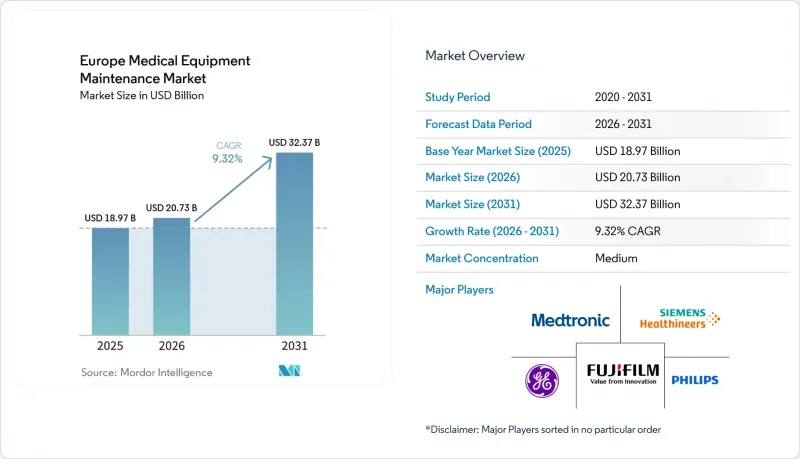
Mordor Intelligence에 의하면, 유럽의 의료기기 유지관리 시장 규모는 2025년 189억 7,000만 달러로 평가되었고, 2026년에는 207억 3,000만 달러로 추정되고, 2031년까지 323억 7,000만 달러에 이를 것으로 예상되며, 2026-2031년 CAGR 9.32%로 성장할 전망입니다.
본 보고서는 서비스 유형별(예방 유지보수, 수정 유지보수 등), 계약 모델별(풀 서비스, 공유 서비스, T&M, 멀티 벤더), 장비 유형별(영상 진단, 외과용, 생명 유지 장치, 기타), 서비스 제공업체별(OEM, ISO, 사내), 최종 사용자별(병원, ASC, 투석 시설, 검사실, 기타), 지역별(독일, 영국, 프랑스, 기타)로 분류되어 있습니다. 시장 전망은 금액(달러) 기준으로 제시되어 있습니다.
유럽의 의료기기 유지관리 시장 동향 및 인사이트
EU MDR 및 시판 후 문서화 요건
EU MDR에 따라 시판 후 조사를 통해 유럽 의료기기 유지관리 시장 전반에서 일상적인 기기 유지보수가 문서화된 규정 준수 업무로 변화했습니다. 병원 및 제조업체는 지속적인 안전성 및 품질 심사를 입증하기 위해 서비스 이력, 시정 조치 기록 및 기기 수준의 증거를 보관해야 합니다. MDCG 2025-10에서는 이러한 지속적인 업무를 공식적인 품질 관리 프로세스에 통합하는 것의 중요성이 강조되고 있습니다. 2025년 12월에 제안된 제87a조 추가안에는 보고 절차에 사이버 보안 취약점이 포함되었으며, 패치 적용, 펌웨어 검증 및 원격 소프트웨어 지원의 중요성이 강조되고 있습니다. 병원에서는 규정 준수 문서의 적시 작성을 보장하고, 특히 유지보수의 품질과 문서화가 동등하게 중요한 고위험 커넥티드 기기의 경우 관리상의 부담을 줄이기 위해 체계적인 서비스 계약 도입이 진행되고 있습니다.
예지정비 및 상태 기반 유지보수로의 전환
예지 보전은 2031년까지 연평균 성장률(CAGR) 12.25%를 나타낼 것으로 예측되며, 유럽 의료기기 유지관리 시장에서 가장 빠르게 성장하는 서비스 유형이 될 전망입니다. 이러한 성장은 다운타임을 유발하기 전에 장애를 파악하는 원격 모니터링, 센서 데이터 및 소프트웨어 도구에 힘입어 이루어지고 있습니다. Siemens Healthineers에 따르면, 서비스 요청의 60%를 원격으로 해결하고 있어 현장 작업의 필요성을 줄이고 있습니다. MRI나 CT와 같이 가동률이 높은 시스템의 경우, 가동 중단 시간이 업무에 막대한 영향을 미치기 때문에 조기 고장 감지가 매우 중요합니다. 텔레메트리를 활용한 서비스는 의료기관의 이용률 향상에도 기여하고 있으며, 예측 유지보수는 기술적 및 상업적 우위를 가져다주고 있습니다.
숙련된 생의학 서비스 엔지니어의 부족
훈련을 받은 생체의료 엔지니어의 부족은 유럽의 의료기기 유지관리 시장에 있어 여전히 과제로 남아 있습니다. MRI, CT, 로봇 시스템 등 첨단 시스템의 유지보수에는 전문적인 기술 지식이 필요하지만, 도입 대수가 늘어나는 만큼 인력 풀이 확대되고 있는 것은 아닙니다. Conworx에 따르면, 독일, 스위스, 오스트리아, 베네룩스 지역에서 연간 6,000건 이상의 현장 서비스를 제공하고 있지만, 기술자 확보는 여전히 제약 요인으로 작용하고 있습니다. 이러한 인력 부족으로 인해 병원 측은 비용 중심의 선택지보다는 다중 공급업체 관리, 일원화된 파견 체계, 종합적인 연수 프로그램을 갖춘 공급업체를 우선적으로 선택하고 있습니다. Siemens Healthineers와 같은 대규모 OEM 서비스 네트워크는 확립된 교육 인프라와 원격 지원 기능의 혜택을 누리고 있습니다. 인력 공급 체계가 개선될 때까지, 노동력 부족은 계속해서 이 지역의 서비스 제공 범위 확대를 제약할 것입니다.
부문별 분석
2025년, 예방 유지보수는 서비스 유형별 매출의 40.56%를 차지했으며, 유럽 의료기기 유지관리 시장에서 주요 서비스 부문으로서의 위상을 유지했습니다. 이는 정기적인 교정, 점검, 전기 안전 점검 및 예정된 부품 교체를 통한 예방 정비의 역할을 반영한 것으로, 이는 감사에 대응할 수 있는 워크플로우 및 규정 준수 요건과 부합합니다. 예정된 서비스는 병원이 예산 계획을 수립하기 쉽다는 장점이 있으며, 사후 대응형 수리에 비해 서비스 제공업체에게는 안정적인 계약 갱신 기반을 마련해 줍니다.
예지 보전은 2031년까지 연평균 성장률(CAGR) 12.25%를 나타낼 것으로 예측되며, 시장에서 가장 빠르게 성장하는 부문이 될 전망입니다. 원격 진단 및 데이터 기반 고장 감지를 통해, 특히 사용 빈도가 높은 영상 진단 장비나 생명 유지 장치에서 조기 대응이 가능해집니다. 또한, 새로운 장비의 경우 정기적인 업데이트와 성능 모니터링이 필요하기 때문에 소프트웨어 및 펌웨어 유지보수의 중요성도 커지고 있습니다. 병원들이 커넥티드 플랫폼을 도입함에 따라, 소프트웨어 중심의 서비스 수익은 기존의 수리 서비스보다 더 빠른 속도로 성장할 것으로 예측됩니다.
2025년에는 풀서비스 계약이 계약 모델 수익의 47.53%를 차지했으며, 시장에서 가장 선호되는 계약 형태가 되었습니다. 병원들은 비용 투명성, 가동 시간 보장, 규정 준수 추적의 간소화 등의 이유로 고부가가치 영상 진단 시스템에 이 모델을 선호하고 있습니다. 부품, 인건비, 소프트웨어 업데이트 및 문서 관리를 하나의 계약으로 통합할 수 있으므로, 병원 내 의료기기 관리 인력이 부족한 시설에서 특히 효과적입니다.
다중 공급업체 계약 시장은 2031년까지 연평균 성장률(CAGR) 11.85%를 나타낼 것으로 예측되며, 이는 병원들이 다양한 의료기기군에 걸친 서비스를 통합하는 것을 점점 더 선호하는 추세를 반영하고 있습니다. 이러한 계약은 단일 청구서, 통합된 보고 체계, 일관된 서비스 수준을 통해 조달 프로세스를 간소화합니다. 시간 및 재료 기반 계약은 여전히 틈새 자산에 대해 이용되고 있지만, 보다 엄격한 예산 관리를 요구하는 대규모 병원에게는 그 매력이 줄어들고 있습니다. 또한, 사용 빈도가 낮은 장비를 활용하기 위해 소규모 지역에서는 공유 서비스 계약도 점차 확산되고 있습니다.
기타 혜택 :
- 엑셀 형식 시장 예측(ME) 시트
- 3개월간의 애널리스트 지원
자주 묻는 질문
목차
제1장 서론
제2장 조사 방법
제3장 주요 요약
제4장 시장 구도
제5장 시장 규모 및 성장 예측
제6장 경쟁 구도
제7장 시장 기회 및 향후 전망
AJY 26.07.07According to Mordor Intelligence, the europe medical equipment maintenance market size is expected to increase from USD 18.97 billion in 2025 to USD 20.73 billion in 2026 and reach USD 32.37 billion by 2031, growing at a CAGR of 9.32% over 2026-2031.
This report is Segmented by Service Type (Preventive, Corrective, and More), Contract Model (Full-Service, Shared-Service, T&M, Multi-Vendor), Equipment Type (Imaging, Surgical, Life-Support, Other), Service Provider (OEMs, Isos, In-House), End User (Hospitals, Ascs, Dialysis, Lab, Other), and Geography (Germany, UK, France, and More). The Market Forecasts are Provided in Terms of Value (USD).
Europe Medical Equipment Maintenance Market Trends and Insights
EU MDR and Post-Market Documentation Requirements
Under the EU MDR, post-market surveillance has turned routine equipment servicing into a documented compliance task across Europe's medical equipment maintenance market. Hospitals and manufacturers must maintain service histories, corrective action records, and device-level evidence to support ongoing safety and quality reviews. MDCG 2025-10 emphasizes integrating this continuous work into a formal quality management process. A December 2025 proposal adding Article 87a includes cybersecurity vulnerabilities in the reporting process, highlighting the importance of patching, firmware validation, and remote software support. Hospitals are increasingly adopting structured service contracts to ensure timely compliance documentation and reduce administrative burdens, especially for higher-risk connected devices where maintenance quality and documentation are equally critical.
Shift Toward Predictive and Condition-Based Maintenance
Predictive maintenance is projected to grow at a 12.25% CAGR through 2031, making it the fastest-growing service type in Europe's medical equipment maintenance market. This growth is driven by remote monitoring, sensor data, and software tools that identify faults before they cause downtime. Siemens Healthineers reports resolving 60% of service requests remotely, reducing the need for fieldwork. Early fault detection is crucial for high-utilization systems like MRI and CT, where downtime impacts operations. Telemetry-based services also enhance provider retention, making predictive maintenance a technical and commercial advantage.
Shortage of Skilled Biomedical Service Engineers
The shortage of trained biomedical engineers continues to challenge the Europe medical equipment maintenance market. Servicing advanced systems like MRI, CT, and robotics requires specialized technical expertise, but the labor pool is not growing in line with the expanding installed base. Conworx reports conducting over 6,000 annual field service deployments across Germany, Switzerland, Austria, and the Benelux region, yet technician availability remains a limiting factor. This shortage drives hospitals to prioritize providers with multi-vendor management, centralized dispatch, and comprehensive training programs over cost-focused options. Larger OEM service networks, such as Siemens Healthineers, benefit from their established training infrastructure and remote support capabilities. Until the staffing pipeline improves, labor constraints will continue to restrict service coverage expansion in the region.
Other drivers and restraints analyzed in the detailed report include:
- Rising Installed Base of High-Uptime Diagnostic Equipment
- Aging Equipment Fleets Increasing Reactive Service Demand
- Cybersecurity Exposure in Remote Diagnostics
For complete list of drivers and restraints, kindly check the Table Of Contents.
Segment Analysis
In 2025, preventive maintenance accounted for 40.56% of service-type revenue, maintaining its position as the leading service category in Europe's medical equipment maintenance market. This reflects its role in routine calibrations, inspections, electrical safety checks, and scheduled component replacements, which align with audit-ready workflows and compliance requirements. Scheduled services offer predictable budgeting for hospitals and provide service providers with a stable renewal base compared to reactive repairs.
Predictive maintenance is projected to grow at a 12.25% CAGR through 2031, making it the fastest-growing segment in the market. Remote diagnostics and data-driven fault detection enable earlier interventions, particularly for high-utilization imaging and life-support assets. Software and firmware servicing are also gaining importance as newer devices require regular updates and performance monitoring. As hospitals adopt connected platforms, software-led service revenue is expected to grow faster than traditional repair services.
Full-service agreements held 47.53% of contract-model revenue in 2025, making them the preferred structure in the market. Hospitals favor this model for high-value imaging systems due to its cost visibility, uptime commitments, and simplified compliance tracking. It is particularly effective for facilities with limited internal biomedical teams, as it consolidates parts, labor, software updates, and documentation under one contract.
Multi-vendor contracts are projected to grow at an 11.85% CAGR through 2031, reflecting hospitals' increasing preference for consolidating services across diverse device estates. These contracts simplify procurement with a single invoice, unified reporting, and consistent service levels. Time-and-material contracts remain in use for niche assets but are less attractive for larger hospitals seeking tighter budget control. Shared-service arrangements are also gaining traction in smaller regions to cover less frequently used equipment.
Complete Report Scope:
- By Service Type
- Preventive Maintenance
- Corrective Maintenance
- Operational Maintenance
- Predictive Maintenance
- Software and Firmware Updates
- By Contract Model
- Full-Service Agreements
- Shared-Service Agreements
- Time and Material Contracts
- Multi-Vendor Contracts
- By Equipment Type
- Imaging Equipment
- Magnetic Resonance Imaging (MRI)
- Computed Tomography (CT)
- X-Ray and Fluoroscopy Systems
- Ultrasound Systems
- Nuclear Medicine and PET Systems
- Surgical Equipment
- Electrosurgical Devices
- Robotic Surgical Systems
- Minimally Invasive Surgical Devices
- Life-Support Equipment
- Ventilators
- Anesthesia Machines
- Other Medical Equipment
- Endoscopic Devices
- Patient Monitoring Systems
- Dialysis Equipment
- Imaging Equipment
- By Service Provider
- Original Equipment Manufacturers
- Independent Service Organizations
- In-House Biomedical Teams
- By End User
- Hospitals
- Diagnostic Imaging Centers
- Ambulatory Surgical Centers
- Dialysis Centers
- Laboratories
- Dental and Specialty Clinics
- Others
- By Geography
- Germany
- United Kingdom
- France
- Italy
- Spain
- Rest of Europe
List of Companies Covered in this Report:
- Agfa-Gevaert
- B. Braun
- Beckton Dickinson
- Canon
- Dragerwerk
- Roche
- Fresenius
- FUJIFILM
- GE HealthCare Technologies Inc.
- Getinge
- Hologic
- Karl Storz
- Koninklijke Philips
- Medtronic
- Mindray
- Olympus
- Shimadzu
- Siemens Healthineers
- STERIS
- Stryker
Additional Benefits:
- The market estimate (ME) sheet in Excel format
- 3 months of analyst support
TABLE OF CONTENTS
1 INTRODUCTION
- 1.1 Study Assumptions and Market Definition
- 1.2 Scope of the Study
2 RESEARCH METHODOLOGY
3 EXECUTIVE SUMMARY
4 MARKET LANDSCAPE
- 4.1 Market Overview
- 4.2 Market Drivers
- 4.2.1 EU MDR and Post-Market Documentation Requirements
- 4.2.2 Rising Installed Base of High-Uptime Diagnostic and Therapeutic Equipment
- 4.2.3 Shift Toward Predictive and Condition-Based Maintenance
- 4.2.4 Hospital Cost Pressure Supporting Multi-Vendor Service Contracts
- 4.2.5 Aging Equipment Fleets Increasing Reactive Service Demand
- 4.2.6 Cross-Border Standardization of Service Quality and Traceability
- 4.3 Market Restraints
- 4.3.1 Shortage of Skilled Biomedical Service Engineers
- 4.3.2 Cybersecurity Exposure in Remote Diagnostics and Firmware Updates
- 4.3.3 OEM Lock-In and Proprietary Parts Restrictions
- 4.3.4 Fragmented Public Procurement and Tender Complexity
- 4.4 Value/Supply Chain Analysis
- 4.5 Regulatory Landscape
- 4.6 Technological Outlook
- 4.7 Porter's Five Forces Analysis
- 4.7.1 Bargaining Power of Suppliers
- 4.7.2 Bargaining Power of Buyers
- 4.7.3 Threat of New Entrants
- 4.7.4 Threat of Substitutes
- 4.7.5 Competitive Rivalry
5 MARKET SIZE AND GROWTH FORECASTS (VALUE, USD)
- 5.1 By Service Type
- 5.1.1 Preventive Maintenance
- 5.1.2 Corrective Maintenance
- 5.1.3 Operational Maintenance
- 5.1.4 Predictive Maintenance
- 5.1.5 Software and Firmware Updates
- 5.2 By Contract Model
- 5.2.1 Full-Service Agreements
- 5.2.2 Shared-Service Agreements
- 5.2.3 Time and Material Contracts
- 5.2.4 Multi-Vendor Contracts
- 5.3 By Equipment Type
- 5.3.1 Imaging Equipment
- 5.3.1.1 Magnetic Resonance Imaging (MRI)
- 5.3.1.2 Computed Tomography (CT)
- 5.3.1.3 X-Ray and Fluoroscopy Systems
- 5.3.1.4 Ultrasound Systems
- 5.3.1.5 Nuclear Medicine and PET Systems
- 5.3.2 Surgical Equipment
- 5.3.2.1 Electrosurgical Devices
- 5.3.2.2 Robotic Surgical Systems
- 5.3.2.3 Minimally Invasive Surgical Devices
- 5.3.3 Life-Support Equipment
- 5.3.3.1 Ventilators
- 5.3.3.2 Anesthesia Machines
- 5.3.4 Other Medical Equipment
- 5.3.4.1 Endoscopic Devices
- 5.3.4.2 Patient Monitoring Systems
- 5.3.4.3 Dialysis Equipment
- 5.3.1 Imaging Equipment
- 5.4 By Service Provider
- 5.4.1 Original Equipment Manufacturers
- 5.4.2 Independent Service Organizations
- 5.4.3 In-House Biomedical Teams
- 5.5 By End User
- 5.5.1 Hospitals
- 5.5.2 Diagnostic Imaging Centers
- 5.5.3 Ambulatory Surgical Centers
- 5.5.4 Dialysis Centers
- 5.5.5 Laboratories
- 5.5.6 Dental and Specialty Clinics
- 5.5.7 Others
- 5.6 By Geography
- 5.6.1 Germany
- 5.6.2 United Kingdom
- 5.6.3 France
- 5.6.4 Italy
- 5.6.5 Spain
- 5.6.6 Rest of Europe
6 COMPETITIVE LANDSCAPE
- 6.1 Market Concentration
- 6.2 Market Share Analysis
- 6.3 Company Profiles (includes Global Level Overview, Market Level Overview, Core Segments, Financials as available, Strategic Information, Market Rank/Share, Products and Services, Recent Developments)
- 6.3.1 Agfa-Gevaert NV
- 6.3.2 B. Braun SE
- 6.3.3 Becton, Dickinson and Company
- 6.3.4 Canon Medical Systems Corporation
- 6.3.5 Dragerwerk AG & Co. KGaA
- 6.3.6 F. Hoffmann-La Roche AG
- 6.3.7 Fresenius SE & Co. KGaA
- 6.3.8 FUJIFILM Holdings Corporation
- 6.3.9 GE HealthCare Technologies Inc.
- 6.3.10 Getinge AB
- 6.3.11 Hologic, Inc.
- 6.3.12 KARL STORZ SE & Co. KG
- 6.3.13 Koninklijke Philips N.V.
- 6.3.14 Medtronic plc
- 6.3.15 Mindray Medical International Limited
- 6.3.16 Olympus Corporation
- 6.3.17 Shimadzu Corporation
- 6.3.18 Siemens Healthineers AG
- 6.3.19 STERIS plc
- 6.3.20 Stryker Corporation
7 MARKET OPPORTUNITIES AND FUTURE OUTLOOK
- 7.1 White-Space and Unmet-Need Assessment