

|
시장보고서
상품코드
2072938
일회용 혈압 커프 시장 : 시장 점유율 분석, 업계 동향 및 통계, 성장 예측(2026-2031년)Disposable Blood Pressure Cuffs - Market Share Analysis, Industry Trends & Statistics, Growth Forecasts (2026 - 2031) |
||||||
 Mordor Intelligence
Mordor Intelligence에 의하면, 일회용 혈압 커프 시장 규모는 2025년 3억 6,719만 달러로 평가되었고, 2026년 4억 1,202만 달러로 추정되고, 2031년까지 7억 3,295만 달러로 확대될 것으로 예측되며, 2026-2031년 연평균 복합 성장률(CAGR)은 12.21%를 나타낼 전망입니다.
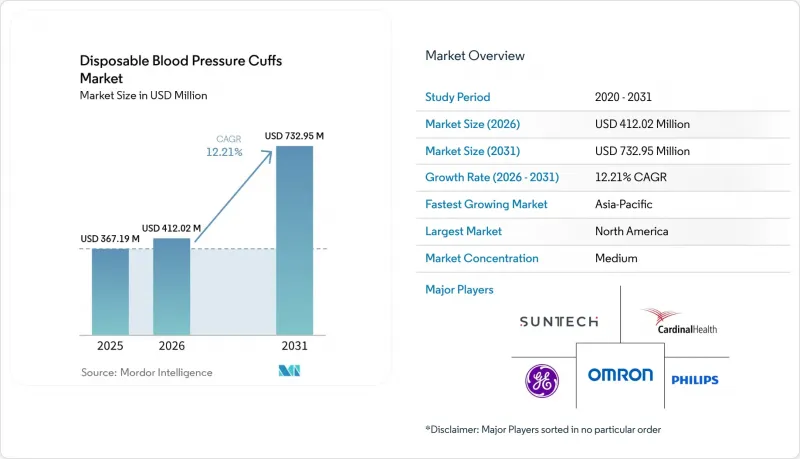
본 보고서는 제품 유형별(성인용 일회용 혈압 커프 등), 소재별(비닐제 일회용 혈압 커프 등), 최종 사용자별(병원, 외래수술센터(ASC), 진료소, 재택치료, 기타) 및 지역별(북미, 유럽, 아시아태평양, 중동 및 아프리카, 남미)로 분류되어 있습니다. 시장 전망은 금액(달러) 기준으로 제시되어 있습니다.
세계의 일회용 혈압 커프 시장 동향 및 인사이트
의료 시술 시 감염 관리 프로토콜 강화
일회용 혈압 커프 시장은 감염 관리 프로토콜이 강화됨에 따라 성장세를 보이고 있습니다. 2025년 4월, 미국 질병통제예방센터(CDC)는 지침을 개정하여 혈압 측정용 커프를 포함한 재사용 가능한 의료기기에 대해 재사용 전에 세척 및 재처리를 의무화했습니다. 또한, 재처리 업무에 종사하는 직원은 연수와 정기적인 평가를 받아야 합니다. 휴대용 비중요 의료기기의 오염은 조달 결정에 영향을 미칠 정도로 빈번하게 발생한다는 사실이 입증되었습니다. 병원에서 소독제, 기록 관리, 직원의 근무 시간, 품질 검사 비용 등을 고려하면 재사용 가능한 커프와 일회용 커프의 비용 차이는 그리 뚜렷하지 않게 됩니다. 또한, 2025년에 발표된 여러 학회의 공동 지침에 따라 의료 시스템에 대한 멸균 및 소독 관행 개선에 대한 압력이 높아지면서 일회용 커프에 대한 수요가 더욱 증가하고 있습니다.
중환자실(ICU)에서의 '환자 1명당 1회 사용'에서 액세서리로의 전환
ICU 및 NICU에서는 환자의 상태가 매우 취약하고 집중적인 모니터링이 필요하기 때문에 일회용 혈압 커프 시장의 성장에 크게 기여하고 있습니다. 2025년 연구에 따르면, 중증 신생아의 40.1%가 의료 관련 감염증을 앓고 있으며, 30.3%가 패혈증을 앓고 있고, 체중 750g 미만의 환자의 경우 사망률이 더욱 높은 것으로 나타났습니다. 신생아 간호 시에는 커프가 반복적으로 팽창하고 피부와 접촉하게 되므로 교차 오염의 위험이 높아집니다. 2024년 1월에 도입된 표준화된 신생아 혈압 측정 차트 덕분에 모니터링이 철저히 이루어지게 되었으며, 환자 1인당 커프 사용량이 증가했습니다. 이러한 추세는 중환자 치료에 대한 수요가 단순히 환자 입원 건수뿐만 아니라 모니터링 빈도에 따라 증가하고 있음을 보여줍니다.
재사용 가능한 커프와 비교했을 때, 환자 1인당 소모품 비용이 높은 점
예산에 중점을 두는 병원, 외래 진료소 및 정부 주도의 입찰에서 재무 부서는 종종 환자 1인당 소모품 비용을 기준으로 일회용 혈압 커프를 평가합니다. 이러한 단가 중시 태도는 재사용 가능한 커프, 훈련을 받은 직원, 확립된 세척 절차를 갖춘 시설에서도 숨겨진 인건비나 규정 준수 비용이 있음에도 불구하고 시장 침투를 제한하고 있습니다. 신흥 시장에서는 집중 조달로 인해 감염 관리에 관한 결정이, 임상적 및 관리적 영향을 다루는 예산과 분리되어 있습니다. 일회용 커프로의 전환에는 발주, 보관, 직원의 선호도, 자재 관리의 변경이 필요하기 때문에 가격에 민감한 환경에서는 도입이 더딘 임베디드니다.
부문별 분석
2025년, 성인용 일회용 혈압 커프는 시장의 39.63%를 차지했으며, 이는 병원, 진료소, 수술센터에서 성인 대상 혈압 모니터링이 일상적으로 이루어지고 있음을 반영합니다. 의료시설에서의 일상적인 모니터링의 대부분을 성인 환자가 차지하고 있기 때문에 이 부문이 시장을 독점하고 있습니다. 비만율 증가로 인해, '기타' 카테고리에 대한 수요가 증가하고 있습니다. 이 카테고리에는 표준 성인용 커프가 적합하지 않은 대퇴용이나 상완용 대형 사이즈 등이 포함됩니다.
소아용 일회용 혈압 커프는 2031년까지 연평균 성장률(CAGR) 14.38%를 기록하며 성장할 것으로 예상되며, 가장 빠르게 성장하는 부문이 될 전망입니다. 위험군에 속하는 소아를 대상으로 한 혈압 선별 검사 및 모니터링에 대한 관심이 높아지고 있는 것이 이러한 성장을 주도하고 있습니다. 신생아용 커프는 틈새 시장이지만, 착용감이나 모니터 성능과 같은 중요한 요소로 인해 높은 정밀도가 요구되므로, 다양한 사이즈를 갖춘 공급업체는 고급 병원 시장에서 유리한 입지를 차지하고 있습니다.
지역별 분석
2025년, 북미는 일회용 혈압 커프 시장 점유율의 38.86%를 차지했으며, 탄탄한 감염 예방 체계와 규정 준수 제품에 대한 높은 투자 의지 덕분에 1위 자리를 유지했습니다. 미국 시장은 CDC(미국 질병통제예방센터)의 지침 및 인증과 관련된 조달 기준의 혜택을 받고 있으며, 이러한 기준들은 의료 기관들이 '환자 1명당 1회 사용' 프로그램을 도입하고 재처리 절차를 개선하도록 촉진하고 있습니다. 캐나다도 비슷한 추세를 보이고 있지만, 멕시코에서는 사립 병원들이 의료기기의 현대화를 추진함에 따라 성장 가능성이 기대되고 있습니다. 2025년에 Baxter가 Welch Allyn의 'FlexiPort' 커프의 미국 내 생산을 확대함으로써 공급 회복력이 향상되었고, 현지 공급에 대한 신뢰도가 높아졌습니다.
2025년, 유럽은 일회용 혈압 커프 시장에서 큰 점유율을 차지하고 있으며, 이는 감염 관리의 필요성과 환경 보호 사이의 균형에 의해 형성된 결과입니다. 독일, 영국, 프랑스, 북유럽 국가들의 엄격한 임상 기준이 시장을 뒷받침하고 있으며, 조달 팀은 환자의 안전과 의료기기의 성능을 중시하고 있습니다. 영국에서는 폐기물 및 배출량에 미치는 영향을 평가하기 위해 재사용 가능한 대체품의 도입을 검토하고 있습니다. 이탈리아, 스페인, 동유럽, 튀르키예 등의 지역에서는 병원의 현대화와 외래 진료 네트워크의 확대로 인해 성장 기회가 예상됩니다.
아시아태평양은 2031년까지 연평균 성장률(CAGR) 14.67%를 기록하며 성장할 것으로 예상되며, 일회용 혈압 커프 시장에서 가장 두드러진 성장세를 보일 것으로 전망됩니다. 중국과 인도의 성장은 병원 네트워크의 확대와 비용 대비 효과가 높으며 규정을 준수하는 소모품에 대한 수요에 힘입어 이루어지고 있습니다. 한편, 일본과 한국은 고품질의 의료 환경 조성에 주력하고 있습니다. 이 지역에서는 코베스트로(Covestro)가 대만에서 의료용 TPU 생산을 현지화한 데 따라 제조 기술의 고도화가 진행되고 있습니다. 중동 및 아프리카와 남미에서는 민간 병원의 확대와 감염 예방 대책에 대한 기대감이 높아짐에 따라 일회용 커프의 도입이 점차 확대되고 있습니다. GCC 국가들에서는 민간 병원의 인증 획득 목표가 국제 기준을 충족하는 일회용 모니터링 용품에 대한 수요를 끌어올리고 있습니다.
기타 혜택 :
- 엑셀 형식 시장 예측(ME) 시트
- 3개월간의 애널리스트 지원
자주 묻는 질문
목차
제1장 서론
제2장 조사 방법
제3장 주요 요약
제4장 시장 구도
제5장 시장 규모 및 성장 예측
제6장 경쟁 구도
제7장 시장 기회 및 향후 전망
AJY 26.07.07According to Mordor Intelligence, the disposable blood pressure cuffs market size is projected to expand from USD 367.19 million in 2025 and USD 412.02 million in 2026 to USD 732.95 million by 2031, registering a CAGR of 12.21% between 2026 to 2031.
This report is Segmented by Product Type (Adult Disposable Blood Pressure Cuffs, and More), Material (Vinyl Disposable Blood Pressure Cuffs, and More), End User (Hospitals, Ambulatory Surgical Centers, Clinics, Home Care Settings, Others), and Geography (North America, Europe, Asia-Pacific, Middle East and Africa, South America). The Market Forecasts are Provided in Terms of Value (USD).
Global Disposable Blood Pressure Cuffs Market Trends and Insights
Rising Infection-Control Protocols in Procedures
The disposable blood pressure cuffs market is experiencing growth due to stricter infection-control protocols. In April 2025, the CDC updated its guidelines, requiring reusable medical equipment, including blood pressure cuffs, to be cleaned and reprocessed before reuse. Staff involved in reprocessing must also undergo training and periodic assessments. Evidence shows contamination on portable non-critical devices is frequent enough to influence procurement decisions. When hospitals account for disinfectants, documentation, staff time, and quality checks, the cost difference between reusable and disposable cuffs becomes less clear. Additionally, a 2025 multisociety guidance paper increased pressure on healthcare systems to improve sterilization and disinfection practices, further driving demand for disposable cuffs.
Shift Toward Patient-Per-Use Accessories in ICUs
ICUs and NICUs are significantly contributing to the growth of the disposable blood pressure cuffs market due to high patient vulnerability and intensive monitoring needs. A 2025 study revealed that 40.1% of critically ill neonates developed healthcare-associated infections, with 30.3% experiencing sepsis and higher mortality rates in those under 750 g. Neonatal care involves repeated cuff inflation and skin contact, increasing cross-contamination risks. Standardized neonatal blood pressure charts, implemented in January 2024, have improved monitoring discipline, leading to higher cuff usage per patient. This trend highlights that demand in intensive care grows with monitoring frequency, not just patient admissions.
Higher Per-Patient Consumable Cost Versus Reusable
In budget-conscious hospitals, outpatient clinics, and government-led tenders, financial teams often evaluate disposable blood pressure cuffs based on their per-patient consumable cost. This focus on unit price limits market penetration in facilities with reusable cuffs, trained staff, and established cleaning routines, despite hidden labor and compliance costs. In emerging markets, centralized purchasing separates infection-control decisions from budgets handling clinical and administrative consequences. Transitioning to disposable cuffs requires changes in ordering, storage, staff preferences, and materials management, slowing adoption in price-sensitive environments.
Other drivers and restraints analyzed in the detailed report include:
- Standardization of Cuff Sizing to Reduce Misdiagnosis
- Growth in Contract Manufacturing for Private Label Brands
- Waste-Handling and Sustainability Pressure
For complete list of drivers and restraints, kindly check the Table Of Contents.
Segment Analysis
In 2025, adult disposable blood pressure cuffs accounted for 39.63% of the market, reflecting the routine nature of adult blood pressure monitoring in hospitals, clinics, and surgical centers. This segment dominates the market as adult patients represent the majority of daily monitoring in healthcare facilities. Rising obesity rates are driving demand for the 'others' category, which includes thigh and large-arm formats, where standard adult cuffs are unsuitable.
Pediatric disposable blood pressure cuffs are projected to grow at a 14.38% CAGR through 2031, making them the fastest-growing segment. Increased focus on blood pressure screening and monitoring for at-risk children is driving this growth. Neonatal cuffs, though a smaller niche, require higher sensitivity due to critical factors like fit and monitor performance, positioning suppliers with diverse size ranges favorably in premium hospital accounts.
Complete Report Scope:
- By Product Type
- Adult Disposable Blood Pressure Cuffs
- Pediatric Disposable Blood Pressure Cuffs
- Neonatal Disposable Blood Pressure Cuffs
- Others
- By Material
- Vinyl Disposable Blood Pressure Cuffs
- Nylon Disposable Blood Pressure Cuffs
- Thermoplastic Polyurethane Disposable Blood Pressure Cuffs
- Others
- By End User
- Hospitals
- Ambulatory Surgical Centers
- Clinics
- Home Care Settings
- Others
- By Geography
- North America
- United States
- Canada
- Mexico
- Europe
- Germany
- United Kingdom
- France
- Italy
- Spain
- Rest of Europe
- Asia-Pacific
- China
- India
- Japan
- Australia
- South Korea
- Rest of Asia-Pacific
- Middle East and Africa
- GCC
- South Africa
- Rest of Middle East and Africa
- South America
- Brazil
- Argentina
- Rest of South America
- North America
Geography Analysis
In 2025, North America accounted for 38.86% of the disposable blood pressure cuffs market share, maintaining its lead due to robust infection prevention systems and a higher willingness to invest in compliance-ready products. The U.S. market benefits from CDC guidelines and accreditation-linked purchasing standards, which drive healthcare facilities toward single-patient-use programs or improved reprocessing practices. Canada follows a similar trend, while Mexico shows growth potential as private hospitals modernize their clinical equipment. Baxter's expansion of U.S. manufacturing for Welch Allyn FlexiPort cuffs in 2025 enhanced supply resilience and strengthened local supply confidence.
Europe held a significant share of the disposable blood pressure cuffs market in 2025, shaped by the balance between infection control needs and environmental concerns. Strong clinical standards in Germany, the U.K., France, and the Nordics support the market, with procurement teams focusing on patient safety and device performance. The U.K. is exploring reusable alternatives to assess their impact on waste and emissions. Regions like Italy, Spain, Eastern Europe, and Turkey offer growth opportunities due to hospital modernization and expanding ambulatory care networks.
Asia-Pacific is projected to grow at a 14.67% CAGR through 2031, making it the fastest-growing region in the disposable blood pressure cuffs market. Growth in China and India is driven by hospital network expansion and demand for cost-effective, compliant consumables, while Japan and South Korea focus on premium care environments. The region benefits from increased manufacturing depth, supported by Covestro's localization of medical-grade TPU production in Taiwan. In the Middle East, Africa, and South America, private hospital expansions and rising infection-control expectations are gradually driving the adoption of single-patient-use cuffs. In the GCC, accreditation goals among private hospitals are boosting demand for disposable monitoring accessories that meet international standards.
- American Diagnostic
- B. Braun
- Baxter
- Beurer
- Cardinal Health
- Contec Medical Systems
- GE HealthCare Technologies Inc.
- Halma
- Koninklijke Philips
- Mckesson
- Medline Industries
- Microlife
- Midmark
- Nihon Kohden
- OMRON
- OSI Systems, Inc.
- Schiller
- Mindray
- Spacelabs Healthcare, Inc.
- SunTech Medical, Inc.
Additional Benefits:
- The market estimate (ME) sheet in Excel format
- 3 months of analyst support
TABLE OF CONTENTS
1 INTRODUCTION
- 1.1 Study Assumptions and Market Definition
- 1.2 Scope of the Study
2 RESEARCH METHODOLOGY
3 EXECUTIVE SUMMARY
4 MARKET LANDSCAPE
- 4.1 Market Overview
- 4.2 Market Drivers
- 4.2.1 Rising Infection-Control Protocols in Procedural and Inpatient Settings
- 4.2.2 Expansion of Single-Use Clinical Consumables Procurement by Hospitals and IDNs
- 4.2.3 Standardization of Cuff Sizing to Reduce Miscuffing and Liability Risk
- 4.2.4 Shift Toward Patient-Per-Use Accessories in High-Acuity and Isolation Workflows
- 4.2.5 Growth in Contract Manufacturing for Private-Label Disposable Monitoring Accessories
- 4.2.6 Compatibility With Multi-Vendor Monitor Fleets Through Universal Connector Designs
- 4.3 Market Restraints
- 4.3.1 Higher Per-Patient Consumable Cost Versus Reusable Cuffs
- 4.3.2 Hospital Reprocessing Habits and Installed Base Stickiness in Low-Infection-Risk Settings
- 4.3.3 Connector Fragmentation Across Monitor Platforms Creates Inventory Complexity
- 4.3.4 Waste-Handling and Sustainability Pressure on Single-Use Medical Textiles and Plastics
- 4.4 Supply/Value Chain Analysis
- 4.5 Regulatory Landscape
- 4.6 Technological Outlook
- 4.7 Porter's Five Forces Analysis
- 4.7.1 Bargaining Power of Suppliers
- 4.7.2 Bargaining Power of Buyers
- 4.7.3 Threat of New Entrants
- 4.7.4 Threat of Substitutes
- 4.7.5 Intensity of Competitive Rivalry
5 MARKET SIZE AND GROWTH FORECASTS (VALUE, USD)
- 5.1 By Product Type
- 5.1.1 Adult Disposable Blood Pressure Cuffs
- 5.1.2 Pediatric Disposable Blood Pressure Cuffs
- 5.1.3 Neonatal Disposable Blood Pressure Cuffs
- 5.1.4 Others
- 5.2 By Material
- 5.2.1 Vinyl Disposable Blood Pressure Cuffs
- 5.2.2 Nylon Disposable Blood Pressure Cuffs
- 5.2.3 Thermoplastic Polyurethane Disposable Blood Pressure Cuffs
- 5.2.4 Others
- 5.3 By End User
- 5.3.1 Hospitals
- 5.3.2 Ambulatory Surgical Centers
- 5.3.3 Clinics
- 5.3.4 Home Care Settings
- 5.3.5 Others
- 5.4 By Geography
- 5.4.1 North America
- 5.4.1.1 United States
- 5.4.1.2 Canada
- 5.4.1.3 Mexico
- 5.4.2 Europe
- 5.4.2.1 Germany
- 5.4.2.2 United Kingdom
- 5.4.2.3 France
- 5.4.2.4 Italy
- 5.4.2.5 Spain
- 5.4.2.6 Rest of Europe
- 5.4.3 Asia-Pacific
- 5.4.3.1 China
- 5.4.3.2 India
- 5.4.3.3 Japan
- 5.4.3.4 Australia
- 5.4.3.5 South Korea
- 5.4.3.6 Rest of Asia-Pacific
- 5.4.4 Middle East and Africa
- 5.4.4.1 GCC
- 5.4.4.2 South Africa
- 5.4.4.3 Rest of Middle East and Africa
- 5.4.5 South America
- 5.4.5.1 Brazil
- 5.4.5.2 Argentina
- 5.4.5.3 Rest of South America
- 5.4.1 North America
6 COMPETITIVE LANDSCAPE
- 6.1 Market Concentration
- 6.2 Market Share Analysis
- 6.3 Company Profiles (includes Global Level Overview, Market Level Overview, Core Segments, Financials as available, Strategic Information, Market Rank/Share, Products and Services, Recent Developments)
- 6.3.1 American Diagnostic Corporation
- 6.3.2 B. Braun Melsungen AG
- 6.3.3 Baxter International Inc.
- 6.3.4 Beurer GmbH
- 6.3.5 Cardinal Health, Inc.
- 6.3.6 Contec Medical Systems Co., Ltd.
- 6.3.7 GE HealthCare Technologies Inc.
- 6.3.8 Halma plc
- 6.3.9 Koninklijke Philips N.V.
- 6.3.10 McKesson Corporation
- 6.3.11 Medline Industries, LP
- 6.3.12 Microlife Corporation
- 6.3.13 Midmark Corporation
- 6.3.14 Nihon Kohden Corporation
- 6.3.15 OMRON Corporation
- 6.3.16 OSI Systems, Inc.
- 6.3.17 Schiller AG
- 6.3.18 Shenzhen Mindray Bio-Medical Electronics Co., Ltd.
- 6.3.19 Spacelabs Healthcare, Inc.
- 6.3.20 SunTech Medical, Inc.
7 MARKET OPPORTUNITIES AND FUTURE OUTLOOK
- 7.1 White-Space and Unmet-Need Assessment


