

|
시장보고서
상품코드
2072956
지속가능한 AI 모델 훈련 플랫폼 시장 : 시장 점유율 분석, 업계 동향 및 통계, 성장 예측(2026-2031년)Sustainable AI Model Training Platform - Market Share Analysis, Industry Trends & Statistics, Growth Forecasts (2026 - 2031) |
||||||
 Mordor Intelligence
Mordor Intelligence에 의하면, 지속가능한 AI 모델 훈련 플랫폼 시장 규모는 2025년에 10억 8,000만 달러로 평가되었고, 2026년 13억 1,000만 달러로 추정되고, 2031년까지 39억 3,000만 달러에 이를 것으로 예측되며, 예측 기간(2026-2031년) CAGR은 24.57%를 나타낼 전망입니다.
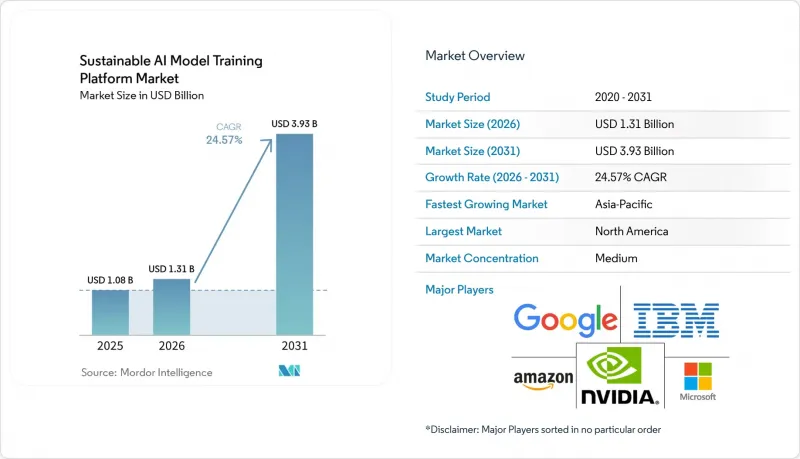
본 보고서는 구성 요소별(소프트웨어 및 서비스), 도입 형태별(클라우드 기반, 온프레미스형, 하이브리드형), 기술별(카본 어웨어 스케줄링, 분산 학습 최적화, 모델 압축 및 프루닝 등), 최종 사용자별(하이퍼스케일 클라우드 및 AI 인프라 제공업체 등), 지역별로 분류되어 있습니다. 시장 전망은 금액(달러) 기준으로 제시되어 있습니다.
세계의 지속가능한 AI 모델 훈련 플랫폼 시장 동향 및 인사이트
기반 모델의 규모 확대가 토큰당 연산량의 최적화를 요구하고 있습니다.
최첨단 규모의 대규모 언어 모델 훈련은 지속 가능한 AI 모델 훈련 플랫폼 시장의 비용 구조를 완전히 바꿔 놓았습니다. 이는 현재 전력 소비량이 모든 주요 조달 결정에 직접적인 영향을 미치게 되었기 때문입니다. PLOS ONE에 게재된 시나리오 기반 모델링 연구에 따르면, GPT-3의 훈련에는 1,287MWh의 전력이 소비되며, 후속 모델 세대에서는 50-70GWh가 소비되고, 현 상태를 유지할 경우 훈련이 AI 수명 주기 내 탄소 배출량의 최대 68.5%를 차지할 가능성이 있는 것으로 나타났습니다. MIT CSAIL 및 막스 플랑크 연구소의 연구진은 또한 CompreSSM을 활용해 훈련 과정에서 모델을 압축함으로써, 사후 전정에 필요한 추가 훈련 과정이 불필요해지며, 이로 인해 최적화 모듈의 설계 방식도 달라질 수 있음을 보여주었습니다. 이러한 결과는 압축 및 효율 제어를 실행 완료 후의 정리 단계로 취급하기보다는 훈련 루프 내에 통합하는 플랫폼 공급업체에 유리하게 작용합니다. 구매자 측도 상업적인 관점에서 이러한 압력에 반응하고 있으며, CoreWeave사는 2025년 말 기준으로 668억 달러 규모의 미수주 잔고를 보고했습니다. 이는 AI 연구 기관이 사전에 막대한 비용이 드는 처리 능력을 얼마나 강력하게 확보하려 하고 있는지를 보여줍니다. 지속 가능한 AI 모델 학습 플랫폼 시장에서 학습 중인 토큰당 낭비를 줄이는 공급업체는 플랫폼 선정 및 계약 갱신 결정에 있어 점점 더 중요한 위치를 차지하고 있습니다.
탄소 배출을 고려한 모델 훈련 워크플로우에 대한 수요 증가
탄소 인식형 스케줄링은 지속 가능한 AI 모델 훈련 플랫폼 시장에서 핵심 요건으로 자리 잡고 있습니다. 이는 설치 장소, 전원, 그리고 워크로드의 타이밍이 배출량과 운영 비용 모두에 영향을 미치게 되었기 때문입니다. 2026년 『Energy Informatics』지에 게재된 체계적 문헌고찰에 따르면, 데이터센터의 입지, 전력망의 탄소 집약도, PUE, 그리고 워크로드 스케줄링에 따라 전체 훈련 과정의 배출량이 한 자릿수 이상 변동할 가능성이 있으며, 지오라우팅을 동반한 탄소 인식형 스케줄링은 전력망 구성에 따라 배출량을 20%에서 70%까지 줄일 수 있는 것으로 밝혀졌습니다. 이러한 수요는 빠르게 상업적 수준으로 확대되고 있습니다. 이는 범용 AI와 관련된 EU AI법의 의무 조항이 2025년 8월에 발효됨에 따라, 서비스 제공업체가 모델의 알려진 또는 추정되는 에너지 소비량을 문서화하고 공개해야 하기 때문입니다. AWS는 2026년 3월, 스코프 1-3에 대한 보고 기능과 지역 단위의 배출량을 거의 실시간으로 시각화하는 '지속가능성 콘솔'을 출시하여 이에 대응했습니다. 이를 통해 MLOps 팀은 보고 마감일을 앞두고 준비를 진행하는 과정에서 운영 상황을 보다 명확하게 파악할 수 있게 됩니다. 연구도 상용화를 향해 진전을 보이고 있으며, CarbonGearRL은 실제 전력망 신호에 따라 클러스터 폭과 연산 정밀도를 조정함으로써, 700억 개의 매개변수를 가진 LLaMA 스타일 모델에서 처리량 저하 없이 최대 52%의 CO2 감축을 실현했습니다. 지속 가능한 AI 모델 훈련 플랫폼 시장에서 비즈니스 기회는 이러한 유망한 조사 기법을 실용적이고 감사 가능하며, 구매자가 대규모로 도입하기 쉬운 워크플로로 전환하는 데 있습니다.
높은 전력 밀도와 냉각상의 제약이 훈련 처리량을 제한합니다.
전력 밀도와 냉각 관련 제약으로 인해 지속 가능한 AI 모델 훈련 플랫폼 시장의 발전이 지연되고 있습니다. 많은 기존 시설에서는 대규모 개보수 공사 없이는 최신 AI 랙을 도입할 수 없기 때문입니다. 즉, 물리적 시설이 지속적인 고밀도 부하를 감당할 수 없는 한, 재생에너지 조달만으로는 훈련 용량을 확대할 수 없습니다. Crusoe사의 아빌린 캠퍼스는 1단계에서 연간 PUE 1.2-1.4를 목표로 설계되었으나, 2026년 프로젝트의 지속가능성 요건에 따라 목표치가 1.1-1.25로 상향 조정되었습니다. 이는 인프라 설계가 얼마나 정밀해야 하는지를 보여줍니다. 플랫폼 차원에서의 영향도 마찬가지로 중요합니다. 왜냐하면, 열적 포화로 인한 연산 능력의 제한은 열적 여유를 실시간으로 모니터링하지 않는 한, 소프트웨어의 비효율성으로 나타날 가능성이 있기 때문입니다. 2026년 3월, Preferred Networks, IIJ 및 JAIST는 수냉식 인프라의 에너지 지표에 관한 참고 사례로 설계된 전용 모듈형 데이터센터에 직접 액체 냉각 방식의 고밀도 AI 서버를 도입함으로써, 이러한 연관성을 한층 더 부각시켰습니다. 따라서 지속 가능한 AI 모델 학습 플랫폼 시장은 소프트웨어 제어의 향상뿐만 아니라, 오케스트레이션 계층과 해당 워크로드가 실행되는 시설의 열적 한계 간의 보다 긴밀한 연계에도 의존하게 될 것입니다.
부문별 분석
2025년, 소프트웨어는 지속 가능한 AI 모델 훈련 플랫폼 시장 점유율 69.85%를 차지했으며, 이는 구매자들이 물리적 인프라에 대한 투자를 결정하기 전에 여전히 오케스트레이션, 최적화 및 탄소 인텔리전스 각 계층을 가장 중요하게 여긴다는 것을 보여줍니다. 훈련 오케스트레이션, 작업 스케줄링 및 리소스 할당은 지속 가능한 AI 모델 훈련 플랫폼 시장에서 모든 대규모 훈련 실행의 기반이 되기 때문에 핵심 훈련 플랫폼 소프트웨어는 여전히 가장 큰 하위 부문으로 남아 있습니다. 카본 인텔리전스 모듈은 비용 관리와 규정 준수 대응을 모두 지원하기 때문에 상용화가 빠르게 진행되고 있습니다. 구매자들은 해당 모델의 에너지 소비량에 대한 보다 명확한 기록을 원하기 때문입니다. 2026년 5월 오픈소스 모듈형 소프트웨어로 출시된 NVIDIA의 DSX OS는 AI 팩토리의 운영 계층에 '와트당 토큰 수'라는 텔레메트리 데이터를 직접 가져옴으로써, 이러한 변화를 여실히 보여주고 있습니다. 이러한 움직임은 하드웨어 관련 기업들이 지속 가능한 AI 모델 훈련 플랫폼 시장에서 최적화의 가치를 더 많이 확보하기 위해 소프트웨어 스택의 상위 계층으로 진출하고 있음을 보여줍니다.
서비스 시장은 2026-2031년 연평균 성장률(CAGR) 25.34%를 나타낼 것으로 예측되며, 지속 가능한 AI 모델 훈련 플랫폼 시장에서 가장 두드러진 성장을 보일 것으로 전망됩니다. 이러한 성장은 실무상의 격차를 반영한 것입니다. 많은 기업은 플랫폼을 구매할 수는 있지만, 텔레메트리 데이터를 활용해 실행 효율이나 보고서의 품질을 향상시키기 위한 구체적인 개선책을 마련하는 데 여전히 지원이 필요하기 때문입니다. 따라서 기업들이 소프트웨어 도구를 통해 생성된 데이터를 운영에 활용하려는 가운데, 매니지드 서비스, 지속가능성 자문, 그리고 모델 효율성 컨설팅이 부상하고 있습니다. 이러한 경향은 클라우드 MLOps의 초기 발전 과정과 유사합니다. 그곳에서는 조직이 먼저 도구를 도입한 뒤, 플랫폼의 결과를 일상적인 의사결정에 반영하기 위해 서비스 파트너를 추가했습니다. 이러한 서비스 수요 증가는 지속 가능한 AI 모델 훈련 플랫폼 업계가 초기 도구 도입 단계에서 벗어나, 소프트웨어와 인간의 전문 지식이 점점 더 유기적으로 결합되어 제공되는 실행 중심 단계로 전환되고 있음을 시사합니다.
2025년, 지속 가능한 AI 모델 훈련 플랫폼 시장의 67.12%를 클라우드 기반 도입이 차지했습니다. 이는 여전히 많은 조직이 자사 시설 내에서 하이퍼스케일 수준의 훈련 역량을 구현하지 못하고 있기 때문입니다. 지속 가능한 AI 모델 훈련 플랫폼 시장에서 GPU에 대한 광범위한 접근성, 신속한 확장성, 그리고 광범위한 인프라 서비스와의 긴밀한 통합이 필요한 최첨단 워크로드의 경우, 클라우드는 여전히 기본적인 선택지로 자리 잡고 있습니다. 마이크로소프트의 2025년도 환경 지속가능성 보고서에 따르면, 이 회사는 24개국에서 34GW의 탄소 배출이 없는 전력을 조달하고 있으며, 이는 2020년 대비 18배 증가한 수치입니다. 이를 통해 클라우드 고객은 전력 조달을 직접 관리할 필요 없이 저탄소 훈련용 컴퓨팅 리소스를 이용할 수 있게 됩니다. 이러한 재생에너지에 기반을 둔 인프라야말로, 구매자들이 에너지에 대한 설명 책임을 더욱 중요하게 여기게 되었음에도 불구하고, 클라우드 플랫폼이 지속 가능한 AI 모델 훈련 플랫폼 시장에서 계속해서 지배적인 위치를 유지하고 있는 이유 중 하나입니다. 온프레미스 배포도 여전히 중요하지만, 그 활용은 금융 서비스, 의료, 국방과 같이 규제가 엄격한 분야에 집중되어 있으며, 이러한 분야에서는 기밀 데이터를 공유 클라우드 환경으로 자유롭게 이동시킬 수 없습니다.
하이브리드 방식은 2026-2031년 연평균 성장률(CAGR) 25.89%를 나타낼 것으로 예측되며, 지속가능한 AI 모델 훈련 플랫폼 시장에서 가장 빠르게 성장하는 방식이 될 전망입니다. 그 주된 이유는 스타일적인 것이 아니라 구조적인 것입니다. 국가 주도의 AI 프로그램이나 규제 대상 업계에서는 하이퍼스케일급 도구에 대한 접근성을 유지하면서도, 데이터의 저장 및 처리 장소에 대해서는 현지에서 관리해야 하기 때문입니다. AWS AI Factories는 고객의 데이터센터 내에 전용 AWS AI 인프라를 구축하고, 이를 프라이빗 AWS 리전으로 운영함으로써 이러한 설계상의 과제를 해결하고 있습니다. 이러한 아키텍처를 통해 기업 및 주권적 구매자는 지속 가능한 AI 모델 훈련 플랫폼 시장에서 지역성, 정책 제어, 하이퍼스케일 훈련 워크플로를 결합할 수 있는 길이 열립니다. 또한, 모델을 보유하고 있거나 자사 단독으로는 전용 인프라를 신속하게 구축할 수 없는 고객을 대상으로, GPU를 풍부하게 갖춘 지속 가능한 전력 공급 용량을 제공하고자 하는 코로케이션 사업자에게도 그 중요성이 커지고 있습니다.
지역별 분석
2025년, 북미는 지속가능한 AI 모델 훈련 플랫폼 시장의 34.56%를 차지했으며, 지역별로는 가장 큰 기여도를 보였습니다. 미국은 하이퍼스케일러, 최첨단 모델 개발사, 전문 AI 클라우드, 그리고 인프라 및 MLOps 계층에 걸친 밀집된 벤더 기반을 보유하고 있어 여전히 핵심 수요 거점으로 자리 잡고 있습니다. CoreWeave사의 2026년 1분기 실적에 따르면, 2026년 연간 용량은 사실상 매진되었으며, 계약 전망은 2027년까지 이어지고 있어 이 지역의 강력한 교육 수요를 반영하고 있습니다. 캐나다는 국가 주도의 인프라와 재생에너지 중심의 인프라를 통해 독자적인 하위 시장으로 부상하고 있습니다. TELUS와 캐나다 정부는 밴쿠버에 재생에너지로 98%를 가동하며 액체 냉각 시스템을 도입한 시설을 구축하고 있으며, 기존 데이터센터에 비해 냉각 에너지 사용량을 80% 절감할 수 있을 것으로 전망됩니다. 멕시코는 여전히 발전의 초기 단계에 있으며, 그 성장은 최첨단 규모의 국내 교육 인프라보다는 니어쇼어 AI 서비스 제공과 미국 시장과의 근접성에 크게 의존하고 있습니다.
아시아태평양은 지속가능한 AI 모델 훈련 플랫폼 시장에서 2026-2031년 26.45%라는 가장 높은 연평균 성장률(CAGR)을 보일 것으로 예측됩니다. 이 지역은 국가 주도의 AI 투자, 하이퍼스케일 시설 건설, 그리고 보다 친환경적인 컴퓨팅 시스템에 대한 정책적 집중 등 여러 요소가 맞물려 발전하고 있습니다. 중국 데이터센터의 전력 소비량은 2024년에 1조 6,600억 kWh에 달하며, 이는 국내 전력 소비량의 1.68%에 해당하고, 8,590만 톤의 이산화탄소 배출로 이어지고 있습니다. 한편, 해당 국가의 '동쪽에서 서쪽으로의 컴퓨팅 추진' 정책에 따라 일부 선진적인 시설에서는 재생에너지 이용률이 80%에 달하고 있습니다. 인도 역시 구조적으로 중요한 위치를 차지하고 있으며, 아다니 그룹은 2035년까지 재생에너지로 가동되는 AI 대응 데이터센터에 1,000억 달러를 투자하겠다고 밝혔으며, 구글은 2026년에 비샤카파트남에서 150억 달러 규모의 AI 허브 건설을 시작할 예정입니다. 이 프로젝트는 해당 기업에서 가장 친환경적인 데이터센터 프로젝트 중 하나로 꼽히고 있습니다. 일본 역시 중요한 길을 개척하고 있으며, 유라스 에너지와 도요타 통상은 2026년 4월, 전용 송전선을 통해 풍력 발전소에 직접 연결된 친환경 데이터센터 건설을 시작할 예정입니다.
유럽은 2025년 지역별 점유율에서 3위를 차지했으며, EU AI법에 따른 규정 준수 요건이 지속 가능한 AI 모델 학습 플랫폼 시장의 조달에 큰 영향을 미치고 있습니다. 북유럽 국가들이 두드러지는 이유는 덴마크의 국가 AI 슈퍼컴퓨터가 폐열 회수 시스템을 지자체의 탄소 중립 에너지 시스템과 연계하여, 해당 지역에 효율적인 학습 인프라의 강력한 참고 모델을 제공하고 있기 때문입니다. 중동 및 아프리카은 상황에 따라 차이가 있습니다. 만안 국가들이 정부 주도의 AI 수요 대부분을 차지하는 반면, 기타 국가들은 도입 초기 단계에 있기 때문에 추적 가능한 에너지 성능과 지역별 규정 준수 요건을 모두 충족할 수 있는 공급업체에게는 비즈니스 기회가 열리고 있습니다. 남미에서는 브라질이 주도적인 입지를 차지하고 있지만, 현지 MLOps 인력 부족과 더 성숙한 지역에 비해 높은 국경 간 데이터 전송 비용으로 인해 도입은 여전히 제한적인 수준에 머물러 있습니다.
기타 혜택 :
- 엑셀 형식 시장 예측(ME) 시트
- 3개월간의 애널리스트 지원
자주 묻는 질문
목차
제1장 서론
제2장 조사 방법
제3장 주요 요약
제4장 시장 구도
제5장 시장 규모 및 성장 예측
제6장 경쟁 구도
제7장 시장 기회 및 향후 전망
AJY 26.07.07According to Mordor Intelligence, the sustainable AI model training platform market size was valued at USD 1.08 billion in 2025 and is estimated to grow from USD 1.31 billion in 2026 to reach USD 3.93 billion by 2031, at a CAGR of 24.57% during the forecast period (2026-2031).
This report is Segmented by Component (Software, and Services), Deployment Mode (Cloud-Based, On-Premises, and Hybrid), Technology (Carbon-Aware Scheduling, Distributed Training Optimization, Model Compression and Pruning, and More), End User (Hyperscale Cloud and AI Infrastructure Providers, and More), and Geography. The Market Forecasts are Provided in Terms of Value (USD).
Global Sustainable AI Model Training Platform Market Trends and Insights
Foundation Model Scale Forces Optimization of Compute Per Token
Training large language models at frontier scale has changed the cost logic of the sustainable AI model training platform market, as electricity use now directly affects every major procurement decision. A scenario-based modeling study published in PLOS ONE showed that GPT-3 training consumed 1,287MWh of electricity, later model generations consumed 50-70GWh, and that training could account for as much as 68.5% of lifecycle AI carbon emissions under business-as-usual conditions. Researchers from MIT CSAIL and the Max Planck Institute also showed that compressing models during training with CompreSSM removes the extra training pass required by post-hoc pruning, thereby changing how optimization modules are designed. That result favors platform vendors that place compression and efficiency controls within the training loop rather than treating them as a cleanup step after the run is complete. Buyers are responding to the same pressure in commercial terms, with CoreWeave reporting a USD 66.8 billion revenue backlog at the end of 2025, which shows how strongly AI labs are locking in costly capacity ahead of time. In the sustainable AI model training platform market, vendors that reduce waste per token during training are moving closer to the center of platform selection and contract renewal decisions.
Rising Demand for Carbon-Aware Model Training Workflows
Carbon-aware scheduling is becoming a core requirement in the sustainable AI model training platform market because location, power source, and workload timing now shape both emissions and operating cost. A 2026 systematic review in Energy Informatics found that data center location, grid carbon intensity, PUE, and workload scheduling can shift total training emissions by more than an order of magnitude, and carbon-aware scheduling with geo-routing can cut emissions by 20% to 70%, depending on the grid mix. This demand is reaching the commercial layer quickly because the EU AI Act obligations for general-purpose AI took effect in August 2025 and require providers to document and disclose known or estimated model energy consumption. AWS responded in March 2026 by launching its Sustainability console with Scope 1-3 reporting and near-real-time regional-level emissions visibility, which gives MLOps teams a clearer operating view as they prepare for reporting timelines. Research is also moving toward production relevance, with CarbonGearRL demonstrating up to 52% CO2 reduction without throughput loss on 70-billion-parameter LLaMA-style models by adjusting cluster width and arithmetic precision against live grid signals. The commercial opening in the sustainable AI model training platform market lies in turning those promising research methods into workflows that are usable, auditable, and easy for buyers to deploy at scale.
High Power Density And Cooling Constraints Limit Training Throughput
Power density and cooling limitations are slowing the sustainable AI model training platform market, as many legacy facilities cannot host the latest AI racks without major retrofit work. This means renewable procurement alone does not unlock training capacity if the physical plant still cannot support sustained high-density loads. Crusoe's Abilene campus was designed to an annualized PUE of 1.2-1.4 for Phase 1, and its 2026 project sustainability requirements tightened the target to 1.1-1.25, which shows how precise the infrastructure design now has to be. The platform-level consequences are equally important because throttled compute due to thermal saturation can appear as software inefficiency unless thermal headroom is monitored in real time. Preferred Networks, IIJ, and JAIST reinforced that link in March 2026 when they deployed direct-liquid-cooled, high-density AI servers in a purpose-built, modular data center designed as a reference case for water-cooled infrastructure energy metrics. The sustainable AI model training platform market will therefore depend not only on better software controls but also on tighter coordination between orchestration layers and the thermal limits of the facilities where those workloads run.
Other drivers and restraints analyzed in the detailed report include:
- Enterprise MLOps Teams Prioritize Energy Telemetry and Cost Governance
- Sovereign AI Buildouts Favor Regional Training Efficiency
- GPU Supply Tightness Delays Sustainable Infrastructure Rollouts
For complete list of drivers and restraints, kindly check the Table Of Contents.
Segment Analysis
Software held 69.85% of the sustainable AI model training platform market share in 2025, indicating that buyers still place the greatest value on orchestration, optimization, and carbon intelligence layers before committing to physical infrastructure. Core training platform software remains the largest sub-segment because training orchestration, job scheduling, and resource allocation are the foundation of every large training run in the sustainable AI model training platform market. Carbon intelligence modules are commercializing quickly because they support both cost control and compliance readiness, where buyers need clearer records of model energy use. NVIDIA's DSX OS, released as open-source modular software in May 2026, illustrates this shift by bringing tokens-per-watt telemetry directly into the operating layer for AI factories. That move also shows how hardware-linked companies are pushing up the software stack to capture more of the optimization value in the sustainable AI model training platform market.
Services are projected to grow at a 25.34% CAGR from 2026 to 2031, making them the fastest-growing component of the sustainable AI model training platform market. This growth reflects a practical gap, because many enterprises can buy the platform but still need help turning telemetry into changes that improve run efficiency and reporting quality. Managed services, sustainability advisory, and model efficiency consulting are therefore gaining ground as companies try to operationalize the data generated by software tools. The pattern resembles the earlier development of cloud MLOps, where organizations first adopted the tooling and then added service partners to translate platform outputs into day-to-day decisions. That service pull also suggests that the sustainable AI model training platform industry is moving from an early tooling phase toward an execution-focused phase, where software and human expertise are increasingly sold together.
Cloud-based deployment accounted for 67.12% of the sustainable AI model training platform market in 2025, as most organizations still cannot replicate hyperscale training capacity in their own facilities. The cloud remains the default mode for frontier workloads that require heavy GPU access, rapid scaling, and close integration with broader infrastructure services in the sustainable AI model training platform market. Microsoft's FY2025 Environmental Sustainability Report stated that the company contracted 34GW of carbon-free electricity across 24 countries, an 18-fold increase since 2020, which helps cloud customers access lower-carbon training compute without managing power sourcing themselves. That renewable-backed infrastructure is part of the reason cloud platforms continue to dominate the sustainable AI model training platform market even when buyers care more about energy accountability. On-premises deployment still matters, but it is concentrated in regulated sectors such as financial services, healthcare, and defense, where sensitive data cannot be moved freely into shared cloud environments.
Hybrid deployment is expected to grow at a 25.89% CAGR from 2026 to 2031, making it the fastest-rising mode in the sustainable AI model training platform market. The main reason is structural, not stylistic, because sovereign AI programs and regulated industries need local control over where data is stored and processed while still needing access to hyperscale-grade tooling. AWS AI Factories reflect that design response by placing dedicated AWS AI infrastructure in customer data centers and operating it as a private AWS Region. This architecture gives enterprise and sovereign buyers a path to combine locality, policy control, and hyperscale training workflows inside the sustainable AI model training platform market. It is also becoming more relevant for colocation operators that want to offer GPU-dense, sustainably powered capacity to customers who own the models but cannot build dedicated infrastructure quickly enough on their own.
Complete Report Scope:
- By Component
- Software
- Core Platform
- Optimization Modules
- Carbon Intelligence Modules
- Services
- Software
- By Deployment Mode
- Cloud-Based
- On-Premises
- Hybrid
- By Technology
- Carbon-Aware Scheduling
- Distributed Training Optimization
- Model Compression and Pruning
- Efficient Hyperparameter Optimization
- Federated and Distributed Learning
- Green MLOps Automation
- By End User
- Hyperscale Cloud and AI Infrastructure Providers
- Colocation Data Center Operators
- Enterprise Data Centers
- Research Institutions
- AI Startups and Model Developers
- By Geography
- North America
- United States
- Canada
- Mexico
- South America
- Brazil
- Argentina
- Rest of South America
- Europe
- Germany
- United Kingdom
- France
- Italy
- Spain
- Russia
- Rest of Europe
- Asia-Pacific
- China
- India
- Japan
- South Korea
- Australia
- Rest of Asia-Pacific
- Middle East and Africa
- Middle East
- Saudi Arabia
- United Arab Emirates
- Turkey
- Rest of Middle East
- Africa
- South Africa
- Egypt
- Rest of Africa
- Middle East
- North America
Geography Analysis
North America accounted for 34.56% of the sustainable AI model training platform market in 2025, making it the largest regional contributor. The United States remains the core demand center because it hosts hyperscalers, frontier model developers, specialized AI clouds, and a dense vendor base across infrastructure and MLOps layers. CoreWeave's Q1 2026 results showed capacity was effectively sold out for all of 2026, with contract visibility stretching into 2027, reflecting the strong training demand in the region. Canada is emerging as a distinct sub-market through sovereign- and renewable-led infrastructure, with TELUS and the Government of Canada advancing facilities in Vancouver powered by 98% renewable energy and liquid-cooling systems, projected to reduce cooling energy use by 80% compared to traditional data centers. Mexico remains earlier in development, with growth tied more to nearshore AI service delivery and proximity to U.S. demand than to frontier-scale domestic training infrastructure.
Asia-Pacific is expected to record the fastest CAGR at 26.45% from 2026 to 2031 in the sustainable AI model training platform market. The region is advancing through a mix of sovereign AI investment, hyperscale buildouts, and policy attention to greener compute systems. China's data center electricity consumption reached 1,660 billion kWh in 2024, equal to 1.68% of national power consumption and linked to 85.9 million tonnes of CO2 emissions, while some advanced facilities reached renewable electricity use rates of 80% under the country's East-to-West computing push. India is also becoming structurally important, with Adani Group committing USD 100 billion to renewable-energy-powered AI-ready data centers by 2035 and Google beginning construction in 2026 on a USD 15 billion AI hub in Visakhapatnam described as one of its greenest data center projects. Japan adds another important path, with Eurus Energy and Toyota Tsusho commencing construction in April 2026 on a green data center directly connected to a wind power plant through a private power line.
Europe held the third-largest regional share in 2025, and compliance requirements under the EU AI Act heavily shape procurement in the sustainable AI model training platform market. The Nordic countries stand out because Denmark's national AI supercomputer links waste heat recovery to a municipal CO2-neutral energy system, providing the region with a strong reference model for efficient training infrastructure. The Middle East and Africa are more uneven, with the Gulf states driving most sovereign AI demand while other countries are earlier in deployment, creating room for vendors that can combine traceable energy performance with regional compliance needs. Brazil leads South America, but adoption remains limited by thinner local MLOps talent pools and higher cross-border data transfer costs than buyers face in more mature regions.
- NVIDIA Corporation
- Microsoft Corporation
- Google LLC
- Amazon.com, Inc.
- International Business Machines Corporation
- Databricks, Inc.
- Hugging Face, Inc.
- CoreWeave, Inc.
- Lambda Labs, Inc.
- Crusoe Energy Systems LLC
- DataRobot, Inc.
- C3.ai, Inc.
- H2O.ai, Inc.
- Weights and Biases, Inc.
- Snorkel AI, Inc.
- Anyscale, Inc.
- SkyPilot (Sky Computing Lab),
- Stability AI Ltd.
- Cerebras Systems Inc.
- Advanced Micro Devices, Inc
Additional Benefits:
- The market estimate (ME) sheet in Excel format
- 3 months of analyst support
TABLE OF CONTENTS
1 INTRODUCTION
- 1.1 Study Assumptions and Market Definition
- 1.2 Scope of the Study
2 RESEARCH METHODOLOGY
3 EXECUTIVE SUMMARY
4 MARKET LANDSCAPE
- 4.1 Market Overview
- 4.2 Market Drivers
- 4.2.1 Sovereign AI Buildouts Favor Regional Training Efficiency
- 4.2.2 Rising Demand for Carbon-Aware Model Training Workflows
- 4.2.3 Foundation Model Scale Forces Optimization of Compute per Token
- 4.2.4 Enterprise MLOps Teams Prioritize Energy Telemetry and Cost Governance
- 4.2.5 Renewable-Powered Data Center Procurement Becomes A Differentiator
- 4.2.6 AI Governance Programs Push Traceable, Auditable Training Pipelines
- 4.3 Market Restraints
- 4.3.1 High Power Density and Cooling Constraints Limit Training Throughput
- 4.3.2 GPU Supply Tightness Delays Sustainable Infrastructure Rollouts
- 4.3.3 Carbon Accounting Fragmentation Complicates Platform Standardization
- 4.3.4 Premium Pricing of Green Compute Slows SME Adoption
- 4.4 Impact Of Macroeconomic Factors On The Market
- 4.5 Industry Value-Chain Analysis
- 4.6 Regulatory Landscape
- 4.7 Technological Outlook
- 4.8 Porter's Five Forces Analysis
- 4.8.1 Bargaining Power Of Buyers
- 4.8.2 Bargaining Power Of Suppliers
- 4.8.3 Threat Of New Entrants
- 4.8.4 Threat Of Substitutes
- 4.8.5 Intensity Of Competitive Rivalry
5 MARKET SIZE AND GROWTH FORECASTS (VALUE)
- 5.1 By Component
- 5.1.1 Software
- 5.1.1.1 Core Platform
- 5.1.1.2 Optimization Modules
- 5.1.1.3 Carbon Intelligence Modules
- 5.1.2 Services
- 5.1.1 Software
- 5.2 By Deployment Mode
- 5.2.1 Cloud-Based
- 5.2.2 On-Premises
- 5.2.3 Hybrid
- 5.3 By Technology
- 5.3.1 Carbon-Aware Scheduling
- 5.3.2 Distributed Training Optimization
- 5.3.3 Model Compression and Pruning
- 5.3.4 Efficient Hyperparameter Optimization
- 5.3.5 Federated and Distributed Learning
- 5.3.6 Green MLOps Automation
- 5.4 By End User
- 5.4.1 Hyperscale Cloud and AI Infrastructure Providers
- 5.4.2 Colocation Data Center Operators
- 5.4.3 Enterprise Data Centers
- 5.4.4 Research Institutions
- 5.4.5 AI Startups and Model Developers
- 5.5 By Geography
- 5.5.1 North America
- 5.5.1.1 United States
- 5.5.1.2 Canada
- 5.5.1.3 Mexico
- 5.5.2 South America
- 5.5.2.1 Brazil
- 5.5.2.2 Argentina
- 5.5.2.3 Rest of South America
- 5.5.3 Europe
- 5.5.3.1 Germany
- 5.5.3.2 United Kingdom
- 5.5.3.3 France
- 5.5.3.4 Italy
- 5.5.3.5 Spain
- 5.5.3.6 Russia
- 5.5.3.7 Rest of Europe
- 5.5.4 Asia-Pacific
- 5.5.4.1 China
- 5.5.4.2 India
- 5.5.4.3 Japan
- 5.5.4.4 South Korea
- 5.5.4.5 Australia
- 5.5.4.6 Rest of Asia-Pacific
- 5.5.5 Middle East and Africa
- 5.5.5.1 Middle East
- 5.5.5.1.1 Saudi Arabia
- 5.5.5.1.2 United Arab Emirates
- 5.5.5.1.3 Turkey
- 5.5.5.1.4 Rest of Middle East
- 5.5.5.2 Africa
- 5.5.5.2.1 South Africa
- 5.5.5.2.2 Egypt
- 5.5.5.2.3 Rest of Africa
- 5.5.5.1 Middle East
- 5.5.1 North America
6 COMPETITIVE LANDSCAPE
- 6.1 Market Concentration
- 6.2 Strategic Moves
- 6.3 Market Share Analysis
- 6.4 Company Profiles (includes Global Level Overview, Market Level Overview, Core Segments, Financials as available, Strategic Information, Market Rank/Share, Products and Services, Recent Developments)
- 6.4.1 NVIDIA Corporation
- 6.4.2 Microsoft Corporation
- 6.4.3 Google LLC
- 6.4.4 Amazon.com, Inc.
- 6.4.5 International Business Machines Corporation
- 6.4.6 Databricks, Inc.
- 6.4.7 Hugging Face, Inc.
- 6.4.8 CoreWeave, Inc.
- 6.4.9 Lambda Labs, Inc.
- 6.4.10 Crusoe Energy Systems LLC
- 6.4.11 DataRobot, Inc.
- 6.4.12 C3.ai, Inc.
- 6.4.13 H2O.ai, Inc.
- 6.4.14 Weights and Biases, Inc.
- 6.4.15 Snorkel AI, Inc.
- 6.4.16 Anyscale, Inc.
- 6.4.17 SkyPilot (Sky Computing Lab),
- 6.4.18 Stability AI Ltd.
- 6.4.19 Cerebras Systems Inc.
- 6.4.20 Advanced Micro Devices, Inc
7 MARKET OPPORTUNITIES AND FUTURE OUTLOOK
- 7.1 White-Space and Unmet-Need Assessment


