

|
시장보고서
상품코드
2072960
헬스케어 분야 나노복합재 시장 : 시장 점유율 분석, 업계 동향 및 통계, 성장 예측(2026-2031년)Nanocomposites In Healthcare - Market Share Analysis, Industry Trends & Statistics, Growth Forecasts (2026 - 2031) |
||||||
 Mordor Intelligence
Mordor Intelligence에 의하면, 헬스케어 분야 나노복합재 시장 규모는 2025년에 11억 9,000만 달러로 평가되었고, 2026년에 13억 3,000만 달러로 추정되고, 2031년까지 22억 9,000만 달러에 이를 것으로 예측되며, 2026-2031년 CAGR 11.55%로 성장할 전망입니다.
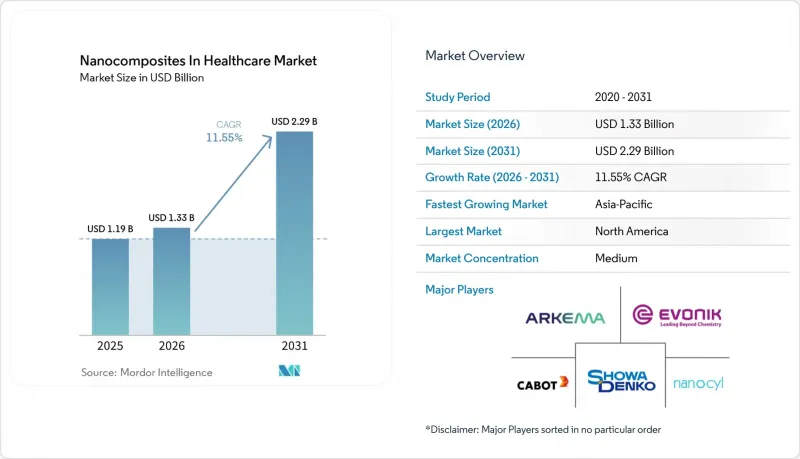
본 보고서는 재료 유형별(폴리머, 탄소계, 금속 산화물, 세라믹, 하이브리드 나노 복합재), 용도별(의료용 임플란트, 약물 전달, 상처 치료, 진단, 조직 공학, 기타), 최종 사용자별(의료기기 제조업체, 제약 기업, 병원, 연구 기관, 기타), 지역별(북미, 유럽, 아시아태평양, 기타)로 분류되어 있습니다. 시장 전망치는 금액(달러)으로 표시되어 있습니다.
세계의 헬스케어 분야 나노복합재 시장 동향 및 인사이트
의료기기에서 항균성 나노 복합 코팅의 활용 확대
헬스케어 분야 나노복합재 시장에서는 항균성 의료기기 코팅에 대한 수요가 증가하고 있습니다. 이는 2025년에는 인공관절 감염증이 전체 인공관절 치환술의 1%에서 3%를 차지하였고, 전체 재치환 수술의 13%에서 31%를 차지한 것으로 평가되었기 때문입니다. 티타늄 합금 및 코발트·크롬·몰리브덴 임플란트 표면에 적용된 은 나노입자 다층 코팅은 황색포도상구균 및 녹농균에 대해 강력한 항균 활성을 나타낼 뿐만 아니라, 3개월 후에도 생체 내 생체적합성을 유지하며 미세혈관 밀도 증가가 관찰되었고, 전신성 염증 반응도 관찰되지 않았습니다. 또한, 마그네슘 임플란트에 적용된 질화붕소 나노시트로 보강된 키토산 코팅 역시 항균 내성을 유발하지 않으면서 생물막 형성을 억제하는 것으로 밝혀졌으며, 이를 통해 항생제를 사용하지 않는 감염 관리가 더욱 신뢰할 수 있는 임상적 선택지가 되고 있습니다. 병원 내 감염 감소를 요구하는 압력도 더해지면서, 의료 분야의 나노 복합재 시장은 세균의 pH 변화에 따라 항균 물질을 방출하는 스마트 카테터 코팅으로 발전하고 있습니다. 이에 따라 비뇨기계 및 혈관용 의료기기에 대한 조달 수요도 변화하고 있습니다. 이러한 변화가 중요한 이유는 헬스케어 분야 나노복합재 시장이 수동적인 표면 보호에서 능동적인 감염 관리로 전환되고 있으며, 생물막과 관련된 의료기기의 과제에 대한 최근 연구 결과가 이러한 설계 방침의 변화를 뒷받침하고 있기 때문입니다.
임플란트 및 웨어러블 기기에서 가볍고 강도가 높은 소재에 대한 수요
헬스케어 분야 나노복합재 시장은 조직과 같은 유연성과 장기적인 기계적 강도 사이의 균형을 더 잘 맞출 수 있는 임플란트 재료에 대한 수요 덕분에 혜택을 보고 있습니다. 하이드록시아파타이트와 나노 구조 티타니아를 결합한 티타늄계 나노 복합재는 뛰어난 내식성, 더욱 강력한 골유착 가능성, 그리고 측정 가능한 항균 성능을 보여주고 있으며, 이는 여러 임상적 문제를 동시에 해결할 수 있음을 의미합니다. 티타늄 표면에 그린 일렉트로스피닝법을 이용하여 형성된 PLA 및 나노하이드록시아파타이트 복합 코팅은 골 재생을 위한 생체활성 나노섬유 표면을 생성하며, 본 연구를 통해 충진제의 통합 및 제어된 분해 거동이 성공적으로 확인되었습니다. 웨어러블 기기 분야에서는 탄소 복합재료와 나노 구조 하이드로겔이 센서의 적합성과 생체 적합성을 향상시키고 있는 한편, 만성 질환의 지속적인 모니터링을 목적으로 이러한 센싱 시스템에 머신러닝이 점점 더 많이 통합되고 있습니다. 헬스케어 분야 나노복합재 시장은 특히 연골이나 신경과의 경계면에서 기존 임플란트 재료와 천연 조직의 강성 차이가 여전히 해결되지 않았기 때문에 앞으로도 개발 투자가 계속 몰릴 것으로 보입니다.
GMP 준수 제조 및 분산 제어에 따른 높은 비용
헬스케어 분야 나노복합재 시장은 여전히 비용 장벽에 직면해 있습니다. GMP 기준에 따른 제조를 위해서는 실험실에서의 합성을 성공적으로 수행하는 것만으로는 충분하지 않기 때문입니다. 나노 규모에서 로트 간 편차를 해소하기 위해서는 21 CFR 820 및 이에 상응하는 EU 품질 관리 기준에 따른 품질 시스템 요건을 충족하기 위해 제조 공정 전반에 걸친 광범위한 분석 모니터링이 필요합니다. 입자 직경이나 약제 함유량의 미세한 차이만으로도 부적합 통지나 재작업의 원인이 될 수 있습니다. 이는 실험실 규모의 나노 침전법이나 유화법에서 효과적인 프로토콜이 대부분의 경우 상업용 장비에 직접 적용할 수 없기 때문입니다. 폴리머 매트릭스에 은 나노입자를 도입한 사례는 이 문제를 여실히 보여주고 있습니다. 응집으로 인해 항균 성능이 저하되는 한편, 은의 사용량이 많고 화학 환원제를 사용함으로써 정제 공정이 복잡해지고 단위 비용이 증가하기 때문입니다. 따라서 헬스케어 분야 나노복합재 시장을 양산화하는 것은 임상 단계에 있는 소규모 기업에게는 어려운 일입니다. GMP 인증으로 인해 제품 개발 프로그램에 12-24개월의 추가 기간이 필요할 수 있기 때문입니다.
부문별 분석
2025년, 헬스케어 분야 나노복합재 시장 점유율 중 43.31%를 폴리머 나노복합재가 차지했으며, 계속해서 주요 소재로서의 위상을 유지했습니다. 이러한 우위는 PLGA, PEEK, 폴리카프로락톤, 키토산 등의 생체적합성 고분자 매트릭스가 오랫동안 임상에서 사용되어 온 데 기인합니다. 헬스케어 분야 나노복합재 시장에서는 여전히 폴리머가 선호되고 있습니다. 이는 이러한 원료에 대해서는 동료 심사를 거친 근거 자료가 더 풍부하고, 승인된 제품에 대한 FDA의 선례가 더 명확하기 때문입니다. 은 나노입자 기반 폴리머 나노복합재 역시 상처 치료, 의료용 코팅, 조직 공학 분야에서 계속해서 주목받고 있으며, 최근의 친환경 합성 관련 연구를 통해 입자 형태 및 매트릭스 내 분산 제어 능력이 향상되었습니다. 탄소계 나노복합재는 2026-2031년 연평균 성장률(CAGR) 12.38%를 기록하며 성장할 것으로 예상되며, 헬스케어 분야 나노복합재 시장에서 가장 빠르게 성장하는 소재 부문이 될 전망입니다.
이러한 추세는 탄소나노튜브와 그래핀 유도체가 전기 전도성과 구조적 보강 기능을 모두 갖추고 있다는 사실을 반영한 것으로, 이는 신경 스캐폴드, 골 시멘트, 전기화학적 바이오센서 분야에서 점점 더 중요해지고 있습니다. 호쿠리쿠 첨단과학기술대학원대학교(JAIST)의 조사에 따르면, 산화 그래핀과 세균 성분이 결합된 하이브리드 나노복합재가 암 모델에서 광·열·화학·면역 요법의 시너지 효과를 가져온다는 사실이 밝혀졌으며, 이를 통해 탄소계 플랫폼의 가치는 단순한 구조적 역할에 그치지 않는 것으로 확대되었습니다. 금속 산화물 나노복합재는 여전히 항균성 표면 기능화나 영상 진단용 조영제로서의 용도에 집중되어 있지만, 세라믹 나노복합재는 폴리머로는 동등한 기계적 임계값을 충족할 수 없는 하중을 지탱해야 하는 정형외과 및 치과 분야에서 활용되고 있습니다. 하이브리드 및 다기능 나노복합재의 중요성이 커지고 있습니다. 이는 헬스케어 분야 나노복합재 시장에서 단일 설계 내에서 검출, 전달 및 조직 지지 기능을 모두 수행할 수 있는 플랫폼이 점점 더 중요시되고 있기 때문입니다. 또한, EU의 MDR(의료기기 규정) 준수 및 ISO 10993의 생체적합성 요건 역시, 이미 상세한 안전성 데이터가 마련되어 있는 폴리머 및 세라믹 시스템의 입지를 더욱 공고히 하고 있습니다.
지역별 분석
2025년, 북미는 헬스케어 분야 나노복합재 시장 점유율 35.22%를 차지하며 최대 지역 시장이 되었습니다. 이 지역은 성숙한 규제 체계, 의료기기 제조업체가 밀집해 있는 기반, 강력한 특수 소재 공급 체계, 그리고 이식형 의료기기 및 첨단 진단 기기에 대한 막대한 투자와 같은 이점을 누리고 있습니다. 또한 미국에서는 심사 기준이 여전히 엄격하지만, 510(k), PMA 및 기타 기존 절차를 통해 나노 복합재를 포함한 의료기기 및 의약품에 대해 비교적 확립된 심사 경로가 제공되고 있습니다. 듀폰사가 2026년 2월에 의료용 'Liveo C6-8XX USP Class VI' 액체 실리콘 고무 시리즈를 출시한 것은 북미 의료용 소재 시장에서 상업 활동이 지속되고 있음을 시사합니다. 또한, 2026년 4월에는 바이오의약품의 유체 처리를 위해 'Liveo Pharma TPE 오버몰딩 어셈블리'를 출시하고 있으며, 이는 이러한 추세를 뒷받침하는 동시에 관련 의료 제조 수요 전반에 걸친 적극적인 제품 확장을 보여주고 있습니다.
2025년, 유럽은 헬스케어 분야 나노복합재 시장에서 2위의 점유율을 차지했습니다. 독일, 영국, 프랑스는 학술 연구 역량, 정형외과 및 순환기용 의료기기의 거대한 시장 기반, 그리고 EU MDR에 따른 규정 준수 투자 증가를 모두 갖추고 있어 여전히 주요 수요 거점으로 자리 잡고 있습니다. BASF는 2026년 3월, 의료 기술용 바이오물질 수지형 PPSU 등급 'Ultrason P 3010 BMB'를 추가하여 Ultrason 포트폴리오를 확대했습니다. 이는 이 지역에서 지속가능성 기준이 고성능 의료용 소재 선정에 영향을 미치기 시작했음을 보여줍니다. 또한, 유럽이 두드러지는 이유로는 규칙 19를 준수함에 따라 다른 많은 지역보다 업스트림 공정에서의 인증 비용 지출이 가속화되고 있다는 점을 들 수 있습니다. 이로 인해 단기적인 비용은 증가하겠지만, 장래의 진입 장벽도 높아지게 될 것입니다. 스칸디나비아와 동유럽의 의료 기술 허브를 비롯한 유럽의 다른 지역에서는 제조 역량이 기존의 서유럽 거점을 넘어 확대됨에 따라 그 중요성이 점차 커지고 있습니다.
아시아태평양은 2026-2031년 연평균 성장률(CAGR) 12.65%를 나타낼 것으로 예측되며, 헬스케어 분야 나노복합재 시장에서 가장 빠르게 성장하는 지역 부문이 될 전망입니다. 중국, 일본, 한국, 인도가 주요 성장 동력으로 작용하고 있습니다. 중국의 나노기술 전략은 이미 전 세계 나노 특허의 43%를 차지했으며, 생의학이 우선 분야로 꼽히고 있는 만큼, 나노 복합재 중간체의 지역 기반 공급 생태계 구축에 기여하고 있습니다. 일본 학계 및 산업계의 연구개발 파이프라인도 활발히 진행되고 있는 가운데, JAIST 연구진은 2025년, 광열 암 면역요법을 위한 세균 보조제를 포함한 액체 금속 나노복합재에 대해 보고했으며, 생쥐 대장암 모델에서 근적외선 조사를 단 한 번 실시한 것만으로 종양을 완전히 제거하는 데 성공했습니다. 인도와 한국은 서로를 보완하는 성장 시장으로서 발전을 이어가고 있지만, 중동 및 아프리카 및 남미는 여전히 초기 단계에 있는 지역으로, 수요는 상처 관리, 감염 관리 및 약물 전달 경로에 집중되어 있습니다.
기타 혜택 :
- 엑셀 형식 시장 예측(ME) 시트
- 3개월간의 애널리스트 지원
자주 묻는 질문
목차
제1장 서론
제2장 조사 방법
제3장 주요 요약
제4장 시장 구도
제5장 시장 규모 및 성장 예측
제6장 경쟁 구도
제7장 시장 기회 및 향후 전망
AJY 26.07.07According to Mordor Intelligence, the nanocomposites in healthcare market size is projected to be USD 1.19 billion in 2025, USD 1.33 billion in 2026, and reach USD 2.29 billion by 2031, growing at a CAGR of 11.55% from 2026 to 2031.
This report is Segmented by Material Type (Polymer, Carbon-Based, Metal Oxide, Ceramic, Hybrid Nanocomposites), Application (Medical Implants, Drug Delivery, Wound Care, Diagnostics, Tissue Engineering, Others), End User (Device Manufacturers, Pharma, Hospitals, Research Institutes, Others), and Geography (North America, Europe, Asia-Pacific, and More). Market Forecasts are in Value (USD).
Global Nanocomposites In Healthcare Market Trends and Insights
Rising Use of Antimicrobial Nanocomposite Coatings in Medical Devices
The nanocomposites in healthcare market is seeing stronger demand for antimicrobial device coatings because prosthetic joint infections affected 1% to 3% of total joint replacement procedures and represented 13% to 31% of all revision surgeries in 2025. Silver nanoparticle multilayer coatings on titanium alloy and cobalt-chromium-molybdenum implant surfaces showed strong antibacterial activity against Staphylococcus aureus and Pseudomonas aeruginosa while maintaining in vivo biocompatibility after 3 months, with higher microvessel density and no systemic inflammatory response. Boron nitride nanosheet reinforced chitosan coatings on magnesium implants also showed suppression of biofilm formation without creating antimicrobial resistance, which gives antibiotic-free infection management a more credible clinical route. Pressure to reduce hospital-acquired infections is also pushing the nanocomposites in healthcare market toward smart catheter coatings that release antimicrobials in response to bacterial pH shifts, which changes procurement expectations for urological and vascular devices. This shift matters because the nanocomposites in healthcare market is moving from passive surface protection to dynamic infection control, and recent work on biofilm-related device challenges supports that change in design direction.
Demand for Lightweight, High-Strength Materials in Implants and Wearables
The nanocomposites in healthcare market is also benefiting from the need for implant materials that can better balance tissue-like compliance with long-term mechanical strength. Ti-based nanocomposites that combine hydroxyapatite and nanostructured titania showed better corrosion resistance, stronger osseointegration potential, and measurable antimicrobial performance, which means they solve multiple clinical problems at the same time. PLA and nano-hydroxyapatite composite coatings made through green electrospinning on titanium created a bioactive nanofibrous surface for bone regeneration, and the work confirmed successful filler integration and controlled degradation behavior. In wearables, carbon composites and nanostructured hydrogels are improving sensor conformability and biocompatibility, while machine learning is increasingly being layered onto those sensing systems for continuous chronic disease monitoring. The nanocomposites in healthcare market is likely to keep attracting development spending here because the mismatch between existing implant materials and natural tissue stiffness remains unresolved, especially at cartilage and neural interfaces.
High Cost of GMP-Grade Manufacturing and Dispersion Control
The nanocomposites in healthcare market continues to face a cost barrier because GMP-compliant production requires much more than successful lab synthesis. Batch-to-batch variability at the nanoscale demands extensive in-process analytical monitoring to satisfy quality system requirements under 21 CFR 820 and comparable EU quality management standards. Small differences in particle size or drug loading can force deficiency letters and rework because protocols that work in lab-scale nanoprecipitation or emulsification often do not translate directly to commercial equipment. Silver nanoparticle integration into polymer matrices shows the problem clearly because agglomeration lowers antimicrobial performance, while high silver use and chemical reducing agents raise purification complexity and unit cost. This makes the nanocomposites in healthcare market harder for smaller clinical-stage companies to scale because GMP qualification can add 12 to 24 months to product development programs.
Other drivers and restraints analyzed in the detailed report include:
- Growth in Precision Drug Delivery and Targeted Therapeutics
- Expansion of Biosensors and Point-of-Care Diagnostics
- Regulatory Uncertainty Around Nanotoxicology and Long-Term Biocompatibility
For complete list of drivers and restraints, kindly check the Table Of Contents.
Segment Analysis
Polymer nanocomposites accounted for 43.31% of the nanocomposites in healthcare market share in 2025, which kept them in the leading material position. That lead came from long clinical use of biocompatible polymer matrices such as PLGA, PEEK, polycaprolactone, and chitosan. The nanocomposites in healthcare market still favors polymers because these materials have a stronger body of peer-reviewed evidence and clearer FDA precedent across approved products. Silver nanoparticle based polymer nanocomposites also kept attracting interest in wound care, medical coatings, and tissue engineering, and recent work on green synthesis improved control over particle morphology and matrix dispersion. Carbon-based nanocomposites are projected to grow at a 12.38% CAGR from 2026 to 2031, making them the fastest-growing material category in the nanocomposites in healthcare market.
That momentum reflects the fact that carbon nanotube and graphene derivatives combine electrical conductivity with structural reinforcement, which is increasingly important in neural scaffolds, bone cements, and electrochemical biosensors. Research from JAIST showed that graphene oxide and bacterial component hybrid nanocomposites produced synergistic photothermo-chemo-immunotherapy outcomes in cancer models, which broadened the value of carbon platforms beyond structural roles alone. Metal oxide nanocomposites remain concentrated in antimicrobial surface functionalization and imaging contrast use, while ceramic nanocomposites serve load-bearing orthopedic and dental applications where polymers cannot meet the same mechanical threshold. Hybrid and multifunctional nanocomposites are becoming more important because the nanocomposites in healthcare market increasingly values platforms that can sense, deliver, and support tissue within a single design. EU MDR compliance and ISO 10993 biocompatibility requirements also strengthen the position of polymer and ceramic systems that already carry better characterized safety data packages.
Complete Report Scope:
- By Material Type
- Polymer Nanocomposites
- Carbon-Based Nanocomposites
- Metal Oxide Nanocomposites
- Ceramic Nanocomposites
- Hybrid and Multifunctional Nanocomposites
- By Application
- Medical Implants and Prosthetics
- Drug Delivery Systems
- Wound Care and Antimicrobial Dressings
- Diagnostic Devices and Biosensors
- Tissue Engineering and Regenerative Medicine
- Other Applications
- By End User
- Medical Device Manufacturers
- Pharmaceutical and Biotechnology Companies
- Hospitals and Clinics
- Research and Academic Institutes
- Other End Users
- By Geography
- North America
- United States
- Canada
- Mexico
- Europe
- Germany
- United Kingdom
- France
- Italy
- Spain
- Rest of Europe
- Asia-Pacific
- China
- Japan
- India
- Australia
- South Korea
- Rest of Asia-Pacific
- Middle East and Africa
- GCC
- South Africa
- Rest of Middle East and Africa
- South America
- Brazil
- Argentina
- Rest of South America
- North America
Geography Analysis
North America held 35.22% of the nanocomposites in healthcare market share in 2025, which made it the largest regional market. The region benefits from mature regulatory systems, a dense base of medical device manufacturers, strong specialty material supply, and high spending on implantable devices and advanced diagnostics. The United States also provides relatively established review pathways for nanocomposite-containing devices and drug products through 510(k), PMA, and other existing routes, even though review standards remain demanding. DuPont's February 2026 launch of the Liveo C6-8XX USP Class VI liquid silicone rubber series for healthcare applications points to continued commercial activity in North American medical materials. DuPont's April 2026 launch of Liveo Pharma TPE Overmolded Assemblies for biopharmaceutical fluid handling adds to that pattern and shows active product positioning across adjacent healthcare manufacturing needs.
Europe held the second-largest share in the nanocomposites in healthcare market in 2025. Germany, the United Kingdom, and France remain the key demand centers because they combine academic research strength, a large orthopedic and cardiovascular device base, and rising compliance investment under EU MDR. BASF expanded its Ultrason portfolio in March 2026 with the biomass-balanced PPSU grade Ultrason P 3010 BMB for medical technology, which shows that sustainability criteria are beginning to influence high-performance medical material decisions in the region. Europe also stands out because Rule 19 compliance is forcing upstream qualification spending faster than in many other regions, which raises near-term cost but also increases future entry barriers. The rest of Europe, including Scandinavia and Eastern European medtech hubs, is gaining gradual importance as manufacturing capacity broadens beyond the traditional Western European base.
Asia-Pacific is projected to grow at a 12.65% CAGR from 2026 to 2031, making it the fastest-growing regional segment in the nanocomposites in healthcare market. China, Japan, South Korea, and India are the main growth contributors. China's nanotechnology strategy has already translated into 43% of global nanopatents, with biomedicine listed as a priority domain, and that is helping build a more local supply ecosystem for nanocomposite intermediates. Japan's academic and industry pipeline is also advanced, and JAIST researchers reported bacterial-adjuvant liquid metal nanocomposites for photothermal cancer immunotherapy in 2025 with complete tumor elimination in murine colorectal cancer models after a single near-infrared irradiation cycle. India and South Korea continue to develop as complementary growth markets, while the Middle East and Africa and South America remain earlier-stage regions where demand is more concentrated in wound care, infection control, and drug delivery channels.
- Arkema Group
- BASF
- Cabot Corporation
- DSM-Firmenich
- DuPont
- Evonik Industries
- GE Healthcare Technologies Inc.
- Johnson & Johnson
- Nanocyl SA
- Nanophase Technologies Corporation
- NanoSonic, Inc.
- Nanosonics Limited
- Pfizer
- PlasmaChem GmbH
- Showa Denko Materials Co., Ltd.
- Solventum Corporation
- Teva Pharmaceutical Industries
- ZyVex Technologies
Additional Benefits:
- The market estimate (ME) sheet in Excel format
- 3 months of analyst support
TABLE OF CONTENTS
1 Introduction
- 1.1 Study Assumptions & Market Definition
- 1.2 Scope of the Study
2 Research Methodology
3 Executive Summary
4 Market Landscape
- 4.1 Market Overview
- 4.2 Market Drivers
- 4.2.1 Rising Use of Antimicrobial Nanocomposite Coatings in Medical Devices
- 4.2.2 Demand for Lightweight, High-Strength Materials in Implants and Wearables
- 4.2.3 Growth in Precision Drug Delivery and Targeted Therapeutics
- 4.2.4 Expansion of Biosensors and Point-of-Care Diagnostics
- 4.2.5 Rising Hospital Focus on Infection Control and Surface Functionalization
- 4.2.6 Scale-Up of Biocompatible Polymer and Hybrid Nanocomposite Platforms
- 4.3 Market Restraints
- 4.3.1 High Cost of GMP-Grade Manufacturing and Dispersion Control
- 4.3.2 Regulatory Uncertainty Around Nanotoxicology and Long-Term Biocompatibility
- 4.3.3 Limited Clinical Evidence and Slow Translation from Lab to Device Approval
- 4.3.4 Reproducibility Challenges Across Batches and Sterilization Cycles
- 4.4 Supply Chain Analysis
- 4.5 Regulatory Landscape
- 4.6 Technological Outlook
- 4.7 Porter's Five Forces Analysis
- 4.7.1 Bargaining Power of Suppliers
- 4.7.2 Bargaining Power of Buyers
- 4.7.3 Threat of New Entrants
- 4.7.4 Threat of Substitutes
- 4.7.5 Industry Rivalry
5 Market Size & Growth Forecasts (Value, USD)
- 5.1 By Material Type
- 5.1.1 Polymer Nanocomposites
- 5.1.2 Carbon-Based Nanocomposites
- 5.1.3 Metal Oxide Nanocomposites
- 5.1.4 Ceramic Nanocomposites
- 5.1.5 Hybrid and Multifunctional Nanocomposites
- 5.2 By Application
- 5.2.1 Medical Implants and Prosthetics
- 5.2.2 Drug Delivery Systems
- 5.2.3 Wound Care and Antimicrobial Dressings
- 5.2.4 Diagnostic Devices and Biosensors
- 5.2.5 Tissue Engineering and Regenerative Medicine
- 5.2.6 Other Applications
- 5.3 By End User
- 5.3.1 Medical Device Manufacturers
- 5.3.2 Pharmaceutical and Biotechnology Companies
- 5.3.3 Hospitals and Clinics
- 5.3.4 Research and Academic Institutes
- 5.3.5 Other End Users
- 5.4 By Geography
- 5.4.1 North America
- 5.4.1.1 United States
- 5.4.1.2 Canada
- 5.4.1.3 Mexico
- 5.4.2 Europe
- 5.4.2.1 Germany
- 5.4.2.2 United Kingdom
- 5.4.2.3 France
- 5.4.2.4 Italy
- 5.4.2.5 Spain
- 5.4.2.6 Rest of Europe
- 5.4.3 Asia-Pacific
- 5.4.3.1 China
- 5.4.3.2 Japan
- 5.4.3.3 India
- 5.4.3.4 Australia
- 5.4.3.5 South Korea
- 5.4.3.6 Rest of Asia-Pacific
- 5.4.4 Middle East and Africa
- 5.4.4.1 GCC
- 5.4.4.2 South Africa
- 5.4.4.3 Rest of Middle East and Africa
- 5.4.5 South America
- 5.4.5.1 Brazil
- 5.4.5.2 Argentina
- 5.4.5.3 Rest of South America
- 5.4.1 North America
6 Competitive Landscape
- 6.1 Market Concentration
- 6.2 Market Share Analysis
- 6.3 Company Profiles (includes Global Level Overview, Market Level Overview, Core Segments, Financials as available, Strategic Information, Market Rank/Share, Products and Services, Recent Developments)
- 6.3.1 Arkema Group
- 6.3.2 BASF SE
- 6.3.3 Cabot Corporation
- 6.3.4 DSM-Firmenich
- 6.3.5 DuPont de Nemours, Inc.
- 6.3.6 Evonik Industries AG
- 6.3.7 GE Healthcare Technologies Inc.
- 6.3.8 Johnson and Johnson
- 6.3.9 Nanocyl SA
- 6.3.10 Nanophase Technologies Corporation
- 6.3.11 NanoSonic, Inc.
- 6.3.12 Nanosonics Limited
- 6.3.13 Pfizer Inc.
- 6.3.14 PlasmaChem GmbH
- 6.3.15 Showa Denko Materials Co., Ltd.
- 6.3.16 Solventum Corporation
- 6.3.17 Teva Pharmaceutical Industries Limited
- 6.3.18 ZyVex Technologies
7 Market Opportunities & Future Outlook
- 7.1 White-Space and Unmet-Need Assessment


