

|
시장보고서
상품코드
2072962
이식용 HLA 타이핑 시장 : 시장 점유율 분석, 업계 동향 및 통계, 성장 예측(2026-2031년)HLA Typing For Transplant - Market Share Analysis, Industry Trends & Statistics, Growth Forecasts (2026 - 2031) |
||||||
 Mordor Intelligence
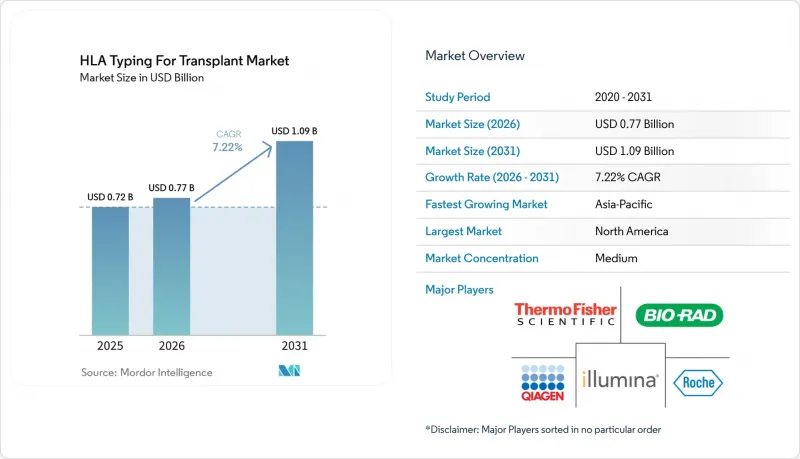
Mordor Intelligence에 의하면, 이식용 HLA 타이핑 시장 규모는 2025년 7억 2,000만 달러로 평가되었고, 2026년 7억 7,000만 달러로 추정되고, 2031년까지 10억 9,000만 달러로 확대될 것으로 예측되며, 2026-2031년 연평균 복합 성장률(CAGR)은 7.22%를 나타낼 전망입니다.
본 보고서는 제품 및 서비스별(시약 및 소모품, 기기, 소프트웨어 및 서비스), 기술별(PCR 기반, NGS 기반, 상거법, 기타), 이식 유형별(고형 장기, 조혈모세포 이식(HSCT)), 최종 사용자별(검사 기관, 병원 및 이식 센터, 연구소), 지역별(북미, 유럽, 기타)로 분류되어 있습니다. 시장 전망은 금액(달러) 기준으로 제시되어 있습니다.
세계의 이식용 HLA 타이핑 동향 및 인사이트
장기 이식 건수 증가
이식용 HLA 유형 분석 시장은 주요 장기 부문에서 이식 수술이 꾸준히 확대됨에 따라, 수술 건수 증가에 힘입어 계속해서 성장세를 보이고 있습니다. 2024년 전 세계 고형 장기 이식 건수는 17만 3,727건에 달했으며, 이는 '세계 장기 기증 및 이식 관측소(Global Observatory on Donation and Transplantation)'가 기록한 사상 최고 수준을 기록했습니다. 2024년 신장 이식은 11만 467건, 간 이식은 4만 2,497건, 폐 이식은 8,236건, 심장 이식은 1만 287건에 달했으며, 이러한 각 수술에서는 이식 전에 적합성 검사가 필요했습니다. 또한 2024년에는 심정지로 인한 사후 장기 기증이 17% 증가했고, 시간적 제약이 있는 사망 기증자의 유전자형 판정 비율이 높아짐에 따라 검사실은 더욱 신속한 업무 흐름을 구축해야만 했습니다. 2025년에 개정된 일본의 심장 이식 지침에서는 심장 이식 수혜자에 대한 HLA 매칭의 임상적 역할이 더욱 강화되었으며, 검사 건수에 제약이 있는 품질 중시 환경 속에서 고부가가치 검사가 새로운 분야로 추가되었습니다. 그 결과, 이식용 HLA 유형 분석 시장에서는 단위당 수요가 증가하는 동시에 신속하고 고해상도의 검사법에 대한 수요도 높아지고 있습니다.
기증자와 수혜자 간의 정밀한 매칭으로의 전환
이식용 HLA 타이핑 시장은 기본적인 적합성 확인에 그치지 않고, 보다 정밀한 기증자·수혜자 평가로 전환되고 있습니다. 이식 센터에서는 에피토프에 기반한 매칭이나 분자 수준의 불일치 점수 산정이 점점 더 자주 채택되고 있습니다. 이는 이러한 기법이 항체 매개 거부 반응 및 감작 현상의 감소에 기여하기 때문입니다. 2026년에 발표된 연구에 따르면, rSSO로 정의된 HLA 대립유전자 문자열을 이용한 실시간 분자 불일치 추정은 장기 이식 지연을 초래하지 않으면서 사망 기증자 배정 워크플로우에 적용될 수 있는 것으로 나타났습니다. 이러한 변화로 인해, 검사실에서는 특히 재이식 후보자나 감작 환자에 대해 PCR-SSP 결과를 풀필드 NGS 데이터로 보완하거나 대체할 것을 요구받고 있습니다. 또한, 이식 적합성을 판단하는 데 사용되는 데이터 포인트가 증가함에 따라, 각 이식 전 검사의 임상적 적용 범위도 확대되고 있습니다. 이러한 변화로 인해, 이식용 HLA 유형 분석 시장에서는 프리미엄 검사법과 더욱 정교한 분석 소프트웨어에 대한 수요가 증가하고 있습니다.
NGS 기반 HLA 유형 분석 워크플로우의 높은 비용
이식용 HLA 유형 분석 시장에서 검사 기관들이 기존의 시퀀싱 기반 방식에서 NGS로 전환할 때 여전히 큰 비용 장벽에 직면하고 있습니다. 2024년에 발표된 비교 연구에 따르면, 워크플로가 완전히 최적화되지 않은 경우, 이러한 전환으로 인해 처리 단계가 증가하고, 수작업 부담이 커지며, 처리 시간이 길어질 위험이 있는 것으로 나타났습니다. 또한, 검사 기관은 유지 관리 비용, 생물정보학 인프라, 검증 요건 및 장기적인 데이터 보존 의무에 따른 비용을 부담해야 합니다. 미국에서는 고형 장기 이식용 HLA 타이핑이 별도로 청구 가능한 검사 서비스가 아니라, 메디케어의 MolDX 프레임워크 내 장기 확보 비용의 일부로 취급되고 있기 때문에 NGS 특유의 비용을 직접 회수하는 데 제한이 있습니다. 이러한 비용 격차는 대규모 중앙집권형 참조 네트워크에 비해, 소규모 공공 프로그램이나 검사 건수가 적은 이식 센터에서 더욱 두드러집니다. 이러한 제약으로 인해, 이식용 HLA 유형 분석 시장은 플랫폼 및 규정 준수 비용을 더 광범위한 검사 건수로 분산할 수 있는 검사 기관에 유리한 상황이 지속되고 있습니다.
부문별 분석
2025년, 이식용 HLA 유형 검사 시장 규모 중 시약 및 소모품이 70.31%의 점유율을 차지했으며, 이 부문은 매출액 기준 1위를 유지했습니다. 이 점유율은 분자 이식 진단에 특유한 지속적인 구매 패턴을 반영한 것입니다. 이 분야에서는 각 검사마다 유형 검사, 교차 적합성 검사 준비, 그리고 항체 관련 검사 전반에 걸쳐 매번 새로운 시약이 필요하기 때문입니다. 따라서 이식용 HLA 유형 분석 시장에서는 검사 기관이 장비 업그레이드를 미룰 수는 있더라도 일상적인 소모품 사용을 피할 수는 없기 때문에 시약 수요는 장비에 비해 더 안정적인 추세를 보이고 있습니다. 또한, 더 광범위하고 고해상도의 NGS 분석으로의 전환에 따라, 일상적인 워크플로우에서 타이핑되는 유전자좌가 늘어나고 더 복잡한 적합성 문제가 다루어지게 됨에 따라, 건당 시약 가치도 상승하고 있습니다. 롱 리드 플랫폼의 등장은 이식용 HLA 타이핑 시장에서 프리미엄 가격을 책정할 수 있는 키트의 범위를 확대함으로써 이러한 추세를 더욱 강화하고 있습니다.
소프트웨어 및 서비스 분야는 2031년까지 연평균 성장률(CAGR) 9.38%를 나타낼 것으로 예측되며, 이식용 HLA 유형 분석 업계에서 가장 빠르게 성장하는 하위 부문으로 꼽히고 있습니다. NGS의 보급으로 인해 소프트웨어가 단순한 검사실 업무 지원에 그치지 않고 상업적 제안의 핵심이 되면서, 분석법을 통한 가치 창출과 정보학을 통한 가치 창출 사이에 기존에 존재하던 격차는 점차 줄어들고 있습니다. 현재 분석 도구는 공급업체 선정, 워크플로우 속도, 데이터 분석 및 플랫폼에 대한 정착도를 좌우하는 요인이 되고 있습니다. 검사실에서 통합된 보고서 작성, 시퀀싱, 알레르콜, 최종 검토 단계 간의 인수인계 횟수를 줄이기를 요구함에 따라, 이러한 변화는 점점 더 중요해지고 있습니다. 2026년 4월 EuroBio Scientific이 CareDx의 이식 검사 제품 부문을 인수하기로 합의한 것은 이러한 광범위한 통합을 뒷받침하는 사례입니다. 이는 분석 키트 및 관련 워크플로우 자원이 GenDx의 상업적 구조 하에서 통합되고 있기 때문입니다. 따라서, 이식용 HLA 유형 분석 시장에서는 각 공급업체들이 '검체에서 보고서까지'의 과정에서 주도권을 놓고 경쟁하는 가운데, 소프트웨어 및 서비스가 수익 구조에서 더 큰 비중을 차지하게 되었습니다.
2025년, Molecular Assay Technologies는 매출 점유율의 80.24%를 차지했으며, 이 부문은 이식용 HLA 유형 분석 시장의 중심적인 위치를 유지했습니다. 이러한 광범위한 분류에는 PCR법, NGS법 및 샌거 시퀀싱이 포함되지만, 현재 내부 성장 균형은 NGS 쪽으로 더욱 명확하게 이동하고 있습니다. NGS 기반 HLA 타이핑 시장은 2031년까지 연평균 성장률(CAGR) 10.52%로 확대될 것으로 예상되며, 이에 따라 이 하위 부문 내 이식용 HLA 타이핑 시장 규모는 전체 시장의 성장률을 상회하게 될 것입니다. 그 주된 이유는 보다 적절한 기증자 선정을 지원하고 재검사의 필요성을 줄일 수 있는 고해상도 대립유전자 판정에 대한 임상적 수요에 있습니다. PCR 기반 접근법은 신속한 검사나 선별을 주된 목적으로 하는 워크플로우에서 여전히 가치를 지니고 있지만, 이식용 HLA 타이핑 시장에서는 고해상도 분석을 완전히 대체하는 수단이라기보다는 시퀀싱을 보완하는 수단으로 사용되는 사례가 늘고 있습니다.
장거리 염기서열 분석 또한 연구 및 검증의 영역에서 더욱 두드러진 임상적 위상으로 전환되고 있습니다. GenDx사는 3곳의 독립적인 임상 실험실에서 실시한 검증에서 일루미나(Illumina) 및 옥스포드 나노포어(Oxford Nanopore) 두 플랫폼을 사용하여 혈액 및 구강 점막 면봉 검체로부터 신뢰할 수 있는 고해상도 결과를 얻었습니다고 보고했으며, 이는 플랫폼에 구애받지 않는 상업적 환경을 뒷받침하는 것입니다. Werfen사가 2026년 5월에 CE-IVD 제품으로 'NanoTYPE HLA-11 Plus'를 출시한 것은 규제 측면에서 중요한 진전이었습니다. 이는 11개의 고전적 HLA 유전자 전부를 대상으로 한 최초의 CE-IVD 전체 유전자 HLA 타이핑 키트로 자리매김했기 때문입니다. PacBio사도 이러한 변화 속에서 여전히 중요한 역할을 하고 있습니다. 이 회사의 HiFi 시퀀싱 제품은 고전적 HLA 유전자좌에서 99.9%의 정확도와 4필드의 대립유전자 분해능을 실현한다는 점을 주요 장점으로 내세우고 있기 때문입니다. Sanger법에 기반한 타이핑 및 비분자생물학적 기법은 인프라가 잘 갖춰지지 않은 환경에서는 여전히 일정한 입지를 유지하고 있지만, 이식용 HLA 타이핑 시장에서는 전체 유전자 해상도와 더욱 강력한 검증 지원을 제공하는 워크플로우가 점점 더 중요시되고 있습니다.
지역별 분석
2025년, 북미는 이식용 HLA 타이핑 시장 규모의 45.22%를 차지하며 지역별 1위를 유지했습니다. 미국이 여전히 주요 기여국으로 남아 있는 이유는 미국의 이식 생태계가 장기 조달 기관, 이식 센터, 그리고 ASHI 인증 조직적합성 검사실을 체계적으로 연결하고 있기 때문입니다. 또한, 메디케어 규정에 따라 고형 장기 이식 시 HLA 유형 검사 비용이 장기 확보 비용 패키지에 포함되어 있으므로, 보상 체계 역시 장기 조달 업무의 지속성을 뒷받침하고 있습니다. 이 제도 덕분에 가격 측면의 압박이 완전히 해소되는 것은 아니지만, 다른 많은 지역에 비해 검사실의 수익 전망을 예측하기가 더 쉬워졌습니다. 캐나다는 고해상도 타이핑 기술에 대한 지속적인 투자를 통해 지역 내 수요를 확대하고 있는 반면, 멕시코는 발전의 초기 단계에 있으며, 민간 부문의 이식 기반은 규모는 작지만 꾸준히 성장하고 있습니다.
유럽은 이식용 HLA 유형 분석 시장에서 여전히 2위 지역 블록을 차지했으며, 독일, 영국, 프랑스가 검사 기술의 수준과 기관의 체계 면에서 주도적인 역할을 하고 있습니다. 베를린 샤리테, 마인츠 대학 의료센터, 라이프치히 대학병원 등 독일의 대학병원 검사실은 임상 현장에서의 고해상도 HLA 유형 분석을 지원하는 인증을 받은 이식 면역학 서비스를 운영하고 있습니다. 또한, 각 공급업체들이 IVDR에 따른 규제 전환을 대비해 제품 포트폴리오를 정비함에 따라 이 지역의 제품 사이클도 활발해지고 있으며, 2026년 5월 Werfen사가 CE-IVD 인증을 받은 롱 리드 제품을 출시한 것은 이러한 추세를 여실히 보여주는 좋은 사례입니다. 모든 이식 센터가 인증 기준을 충족하는 규모로 병원 내 NGS 운영을 유지할 수 있는 것은 아니기 때문에 이탈리아, 스페인 및 기타 유럽 국가에서 고해상도 서비스의 외부 위탁이 점점 더 중요해지고 있습니다.
아시아태평양은 2031년까지 연평균 성장률(CAGR) 8.65%를 나타낼 것으로 예측되며, 이식용 HLA 유형 분석 시장에서 가장 두드러진 성장세를 보이는 지역입니다. 2024년 중국에서는 뇌사 기증자로부터의 신장 및 간 이식이 총 1만 5,387건 기록됨에 따라, 중국은 이러한 확대의 주요 원동력이 되고 있습니다. 일본 역시 이식 면역 유전학의 틀과 HLA 매칭 시 고려 사항 등을 포함하는 2025년 개정판 심장 이식 지침을 통해, 건당 높은 가치를 뒷받침하고 있습니다. 인도와 한국은 이식 역량을 급속히 확대하고 있으며, 외부 위탁을 통한 분자 유형 분석에 대한 수요를 높이고 있습니다. 한편, 남미와 중동 및 아프리카는 여전히 규모가 작은 지역 시장이지만, 브라질과 GCC 국가들이 체계적인 투자의 주요 거점으로 자리 잡고 있습니다.
기타 혜택 :
- 엑셀 형식 시장 예측(ME) 시트
- 3개월간의 애널리스트 지원
자주 묻는 질문
목차
제1장 서론
제2장 조사 방법
제3장 주요 요약
제4장 시장 구도
제5장 시장 규모 및 성장 예측
제6장 경쟁 구도
제7장 시장 기회 및 향후 전망
AJY 26.07.07According to Mordor Intelligence, the HLA typing for transplant market size is projected to expand from USD 0.72 billion in 2025 and USD 0.77 billion in 2026 to USD 1.09 billion by 2031, registering a CAGR of 7.22% between 2026 to 2031.
This report is Segmented by Products and Services (Reagents & Consumables, Instruments, Software & Services), Technology (PCR-Based, NGS-Based, Sanger, Other), Transplant Type (Solid Organ, HSCT), End User (Reference Laboratories, Hospitals & Transplant Centers, Research Institutes), and Geography (North America, Europe, and More). The Market Forecasts are Provided in Terms of Value (USD).
Global HLA Typing For Transplant Market Trends and Insights
Rising Organ Transplant Volumes
The HLA Typing for Transplant market continues to gain volume support from the steady expansion of transplant procedures across major organ categories. Global solid organ transplants reached 173,727 procedures in 2024, which marked the highest level recorded by the Global Observatory on Donation and Transplantation. Kidney transplants reached 110,467, liver transplants reached 42,497, lung transplants reached 8,236, and heart transplants reached 10,287 in 2024, and each of these procedures required compatibility testing before transplantation. Donation after circulatory determination of death also expanded by 17% in 2024, which increased the share of time-sensitive deceased-donor typing events and pushed laboratories toward faster workflows. Japan's revised 2025 heart transplantation guidelines further reinforced the clinical role of HLA matching for cardiac recipients, which added another high-value testing layer in a volume-constrained but quality-driven setting. As a result, the HLA Typing for Transplant market is seeing both higher unit demand and a stronger case for rapid, high-resolution assays.
Shift Toward Precise Donor-Recipient Matching
The HLA Typing for Transplant market is moving beyond basic compatibility and toward more precise donor-recipient evaluation. Transplant centers are using epitope-based matching and molecular mismatch scoring more often because these methods support the reduction of antibody-mediated rejection and sensitization events. Research published in 2026 showed that real-time molecular mismatch estimation using rSSO-defined HLA allele strings can be applied in deceased-donor allocation workflows without delaying organ placement. This change is pushing laboratories to supplement or replace PCR-SSP outputs with full-field NGS data, especially for retransplant candidates and sensitized patients. It is also widening the clinical scope of each pre-transplant workup because more data points are being used to judge transplant suitability. That shift is giving the HLA Typing for Transplant market a stronger pull toward premium assays and more advanced interpretation software.
High Cost of NGS-Based HLA Typing Workflows
The HLA Typing for Transplant market still faces a meaningful cost barrier when laboratories move from older sequence-based methods to NGS. Comparative research published in 2024 showed that the transition brings more processing steps, more manual workload, and longer turnaround risk if workflows are not fully optimized. Laboratories also need to absorb maintenance expense, bioinformatics infrastructure, validation requirements, and long-term data retention obligations. In the United States, HLA typing for solid organ transplantation is treated under organ acquisition cost bundles in the Medicare MolDX framework rather than as a separately billable laboratory service, which limits direct recovery of NGS-specific costs. The cost gap remains more visible in smaller public-sector programs and lower-volume transplant centers than in large centralized reference networks. This restraint keeps the HLA Typing for Transplant market tilted toward laboratories that can spread platform and compliance costs across broader testing volumes.
Other drivers and restraints analyzed in the detailed report include:
- Expansion of Molecular HLA Testing Adoption
- Workflow Automation in High-Throughput Transplant Labs
- Interoperability Gaps Between LIS, HLA Software, and Hospital Systems
For complete list of drivers and restraints, kindly check the Table Of Contents.
Segment Analysis
Reagents and Consumables accounted for 70.31% share of the HLA Typing for Transplant market size in 2025, which kept this category in the leading revenue position. That share reflected the recurring purchasing pattern attached to molecular transplant diagnostics, where every workup requires fresh assay inputs across typing, crossmatch preparation, and antibody-related testing. The HLA Typing for Transplant market therefore gives reagents a more stable demand profile than instruments, because laboratories can postpone equipment upgrades but cannot avoid daily consumable use. The move toward broader and higher-resolution NGS assays is also lifting per-event reagent value because more loci are being typed and more complex compatibility questions are being addressed in routine workflows. Long-read platform launches are reinforcing that pattern because they expand the range of kits that can command premium pricing in the HLA Typing for Transplant market.
Software and Services is projected to grow at 9.38% CAGR through 2031, which makes it the fastest-growing sub-segment in this part of the HLA Typing for Transplant industry. The traditional gap between assay value capture and informatics value capture is narrowing because NGS has made software central to the commercial proposition and not just to laboratory enablement. Analysis tools now help shape vendor choice, workflow speed, data interpretation, and platform stickiness. That shift is becoming more important as laboratories ask for integrated reporting and fewer handoffs between sequencing, allele calling, and final review. EuroBio Scientific's April 2026 agreement to acquire CareDx's transplant lab products division points to that broader convergence, because assay kits and related workflow assets are being consolidated under the GenDx commercial structure. The HLA Typing for Transplant market is therefore giving software and services a larger role in revenue mix as vendors compete to own more of the sample-to-report path.
Molecular Assay Technologies held 80.24% revenue share in 2025, which kept this category at the center of the HLA Typing for Transplant market. That broad grouping includes PCR-based methods, NGS-based methods, and Sanger sequencing, but the internal growth balance is now shifting more clearly toward NGS. NGS-based HLA typing is projected to expand at 10.52% CAGR through 2031, which places the HLA Typing for Transplant market size for this sub-segment above the overall market growth rate. The main reason is clinical demand for high-resolution allele calls that can support better donor selection and reduce the need for retesting. PCR-based approaches still hold value in rapid or screening-oriented workflows, yet they are increasingly being used as complements to sequencing rather than as full substitutes for high-resolution analysis in the HLA Typing for Transplant market.
Long-read sequencing is also moving from research and validation settings into more visible clinical positioning. GenDx reported robust high-resolution results from blood and buccal swab samples across both Illumina and Oxford Nanopore platforms in 3 independent clinical laboratory validations, which supports a more platform-agnostic commercial environment. Werfen's May 2026 launch of NanoTYPE HLA-11 Plus as a CE-IVD product marked an important regulatory step because it was presented as the first CE-IVD full-gene HLA typing kit across all 11 classical HLA genes. PacBio also remains relevant in this shift because its HiFi sequencing offering is being positioned around 99.9% accuracy and four-field allele resolution across classical HLA loci. Sanger-based typing and non-molecular methods still retain some presence in lower-infrastructure settings, but the HLA Typing for Transplant market is increasingly rewarding workflows that deliver full-gene resolution and stronger validation support.
Complete Report Scope:
- By Products and Services
- Reagents and Consumables
- Instruments
- Software and Services
- By Technology
- Molecular Assay Technologies
- PCR Based HLA Typing
- Next Generation Sequencing Based HLA Typing
- Sanger Sequencing Based HLA Typing
- Other Technologies
- By Transplant Type
- Solid Organ Transplantation
- Kidney Transplantation
- Liver Transplantation
- Heart Transplantation
- Lung Transplantation
- Hematopoietic Stem Cell Transplantation
- By End User
- Independent Reference Laboratories
- Hospitals and Transplant Centers
- Research Laboratories and Academic Institutes
- By Geography
- North America
- United States
- Canada
- Mexico
- Europe
- Germany
- United Kingdom
- France
- Italy
- Spain
- Rest of Europe
- Asia-Pacific
- China
- Japan
- India
- Australia
- South Korea
- Rest of Asia-Pacific
- Middle East and Africa
- GCC
- South Africa
- Rest of Middle East and Africa
- South America
- Brazil
- Argentina
- Rest of South America
- North America
Geography Analysis
North America held 45.22% share of the HLA Typing for Transplant market size in 2025, which kept it in the leading regional position. The United States remains the main contributor because its transplant ecosystem links organ procurement organizations, transplant centers, and ASHI-accredited histocompatibility laboratories in a structured way. The reimbursement framework also supports procurement continuity because HLA typing costs for solid organ transplantation are embedded within organ acquisition cost bundles under Medicare rules. That structure does not remove all pricing pressure, but it gives laboratories more visibility than in many other regions. Canada is adding to regional demand through continued investment in high-resolution typing capacity, while Mexico remains earlier in development with a smaller but growing private-sector transplant base.
Europe remained the second-largest regional block in the HLA Typing for Transplant market, with Germany, the United Kingdom, and France leading by testing sophistication and institutional depth. German university hospital laboratories such as Charite Berlin, University Medical Center Mainz, and University Hospital Leipzig operate accredited transplant immunology services that support high-resolution HLA typing in clinical practice. The regional product cycle is also becoming more active as vendors position their portfolios for the regulatory transition under IVDR, and Werfen's CE-IVD long-read launch in May 2026 is a clear example of that push. Italy, Spain, and the wider Rest of Europe are increasingly important for outsourced high-resolution services because not every transplant center can sustain in-house NGS operations at accredited scale.
Asia-Pacific is projected to grow at 8.65% CAGR through 2031, which makes it the fastest-growing geography in the HLA Typing for Transplant market. China is a major part of that expansion because 15,387 combined kidney and liver transplants from deceased donors were recorded there in 2024. Japan also supports high per-procedure value through its transplant immunogenetics framework and its revised 2025 heart transplantation guidelines that include HLA matching considerations. India and South Korea are expanding transplant capacity quickly and are creating stronger demand for outsourced molecular typing, while South America and Middle East and Africa remain smaller regional pools with Brazil and GCC countries acting as the main points of structured investment.
- Abbott Laboratories
- BAG Health Care GmbH
- Beckton Dickinson
- Bio-Rad Laboratories
- CareDx, Inc.
- DiaSorin
- Eurofins
- Roche
- GenDx
- HistoGenetics, LLC
- Illumina
- Immucor
- Omixon
- PacBio
- QIAGEN
- Takara Bio
- TBG Diagnostics
- Thermo Fisher Scientific
Additional Benefits:
- The market estimate (ME) sheet in Excel format
- 3 months of analyst support
TABLE OF CONTENTS
1 Introduction
- 1.1 Study Assumptions & Market Definition
- 1.2 Scope of the Study
2 Research Methodology
3 Executive Summary
4 Market Landscape
- 4.1 Market Overview
- 4.2 Market Drivers
- 4.2.1 Rising Organ Transplant Volumes
- 4.2.2 Shift Toward Precise Donor Recipient Matching
- 4.2.3 Expansion of Molecular HLA Testing Adoption
- 4.2.4 Growth in Personalized Medicine and Immunogenomics
- 4.2.5 Workflow Automation in High Throughput Transplant Labs
- 4.2.6 Rising Clinical Use of Post Transplant Monitoring Panels
- 4.3 Market Restraints
- 4.3.1 High Cost of NGS Based HLA Typing Workflows
- 4.3.2 Uneven Reimbursement and Procurement Cycles Across Regions
- 4.3.3 Limited Donor Typing Infrastructure in Emerging Markets
- 4.3.4 Interoperability Gaps Between LIS, HLA Software, and Hospital Systems
- 4.4 Regulatory Landscape
- 4.5 Technological Outlook
- 4.6 Porter's Five Forces Analysis
- 4.6.1 Threat of New Entrants
- 4.6.2 Bargaining Power of Suppliers
- 4.6.3 Bargaining Power of Buyers
- 4.6.4 Threat of Substitutes
- 4.6.5 Industry Rivalry
5 Market Size & Growth Forecasts (Value, USD)
- 5.1 By Products and Services
- 5.1.1 Reagents and Consumables
- 5.1.2 Instruments
- 5.1.3 Software and Services
- 5.2 By Technology
- 5.2.1 Molecular Assay Technologies
- 5.2.2 PCR Based HLA Typing
- 5.2.3 Next Generation Sequencing Based HLA Typing
- 5.2.4 Sanger Sequencing Based HLA Typing
- 5.2.5 Other Technologies
- 5.3 By Transplant Type
- 5.3.1 Solid Organ Transplantation
- 5.3.2 Kidney Transplantation
- 5.3.3 Liver Transplantation
- 5.3.4 Heart Transplantation
- 5.3.5 Lung Transplantation
- 5.3.6 Hematopoietic Stem Cell Transplantation
- 5.4 By End User
- 5.4.1 Independent Reference Laboratories
- 5.4.2 Hospitals and Transplant Centers
- 5.4.3 Research Laboratories and Academic Institutes
- 5.5 By Geography
- 5.5.1 North America
- 5.5.1.1 United States
- 5.5.1.2 Canada
- 5.5.1.3 Mexico
- 5.5.2 Europe
- 5.5.2.1 Germany
- 5.5.2.2 United Kingdom
- 5.5.2.3 France
- 5.5.2.4 Italy
- 5.5.2.5 Spain
- 5.5.2.6 Rest of Europe
- 5.5.3 Asia-Pacific
- 5.5.3.1 China
- 5.5.3.2 Japan
- 5.5.3.3 India
- 5.5.3.4 Australia
- 5.5.3.5 South Korea
- 5.5.3.6 Rest of Asia-Pacific
- 5.5.4 Middle East and Africa
- 5.5.4.1 GCC
- 5.5.4.2 South Africa
- 5.5.4.3 Rest of Middle East and Africa
- 5.5.5 South America
- 5.5.5.1 Brazil
- 5.5.5.2 Argentina
- 5.5.5.3 Rest of South America
- 5.5.1 North America
6 Competitive Landscape
- 6.1 Market Concentration
- 6.2 Market Share Analysis
- 6.3 Company Profiles (includes Global Level Overview, Market Level Overview, Core Segments, Financials as available, Strategic Information, Market Rank/Share, Products and Services, Recent Developments)
- 6.3.1 Abbott
- 6.3.2 BAG Health Care GmbH
- 6.3.3 Becton, Dickinson and Company
- 6.3.4 Bio-Rad Laboratories, Inc.
- 6.3.5 CareDx, Inc.
- 6.3.6 DiaSorin S.p.A.
- 6.3.7 Eurofins Scientific SE
- 6.3.8 F. Hoffmann-La Roche Ltd
- 6.3.9 GenDx
- 6.3.10 HistoGenetics, LLC
- 6.3.11 Illumina, Inc.
- 6.3.12 Immucor, Inc.
- 6.3.13 Omixon Inc.
- 6.3.14 PacBio
- 6.3.15 QIAGEN N.V.
- 6.3.16 Takara Bio Inc.
- 6.3.17 TBG Diagnostics Limited
- 6.3.18 Thermo Fisher Scientific Inc.
7 Market Opportunities & Future Outlook
- 7.1 White-Space and Unmet-Need Assessment


