

|
시장보고서
상품코드
2072978
보호 재배용 종자 시장 : 점유율 분석, 업계 동향과 통계, 성장 예측(2026-2031년)Protected Cultivation Seeds - Market Share Analysis, Industry Trends & Statistics, Growth Forecasts (2026 - 2031) |
||||||
 Mordor Intelligence
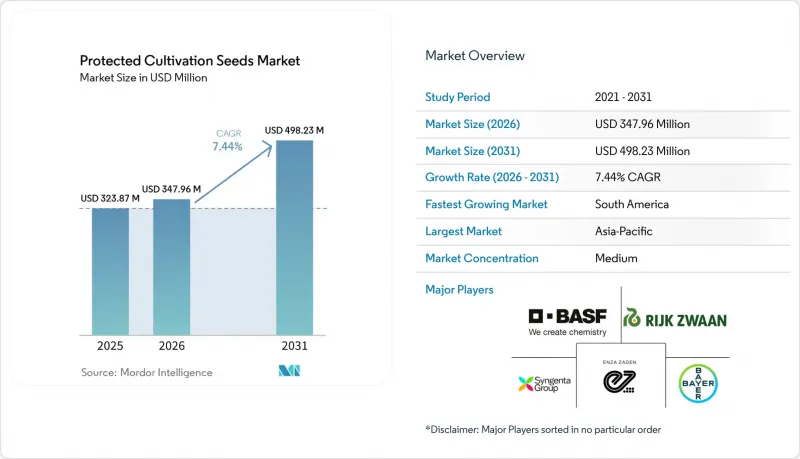
Mordor Intelligence에 의하면, 보호 재배용 종자 시장은 2025년에 3억 2,387만 달러 규모가 되어, 2026년 3억 4,796만 달러에서 2031년까지 4억 9,823만 달러로 성장하여 2026년부터 2031년까지 CAGR 7.44%를 나타낼 것으로 예측됩니다.
본 보고서는 작물 유형(십자화과, 박과, 뿌리채소·구근류, 가지과 및 미분류 채소)와 지역(북미, 남미, 유럽, 아시아태평양, 중동 및 아프리카)별로 분류되어 있습니다. 시장 전망은 금액(달러) 및 수량(메트릭 톤) 단위로 제시되어 있습니다.
세계 보호 재배용 종자 시장 동향 및 인사이트
온실 및 네트하우스 재배 면적 확대
보호 재배용 종자 시장은 온실 및 기타 보호 재배 면적의 확대에 직접적인 영향을 받고 있습니다. 보호 재배 면적이 1헥타르 증가할 때마다 고성능 종자에 대한 안정적인 수요가 발생합니다. 캐나다 통계청에 따르면, 캐나다의 온실 총 면적은 2025년에 2024년 대비 1.4% 증가하여 3,590만 제곱미터에 달했습니다. 이는 제어 환경 농업에 대한 지속적인 투자를 반영한 것입니다. 온실 재배 면적이 확대됨에 따라, 생산자들은 하이브리드 품종이나 보호 재배 전용 종자 품종을 점점 더 많이 도입하고 있습니다. 이러한 종자는 통제된 환경에서 수확량 증대, 작물 품질의 균일화, 생산 주기의 연장 등의 이점을 가져다줍니다. 이러한 추세는 종자 수요량과 현대적인 보호 재배 시스템에서 헥타르당 종자 사용량을 모두 증가시킴으로써, 보호 재배용 종자 시장의 지속적인 성장을 이끌고 있습니다.
일년내내 지속되는 고품질 채소에 대한 수요
보호 재배용 종자 시장은 안정적인 공급과 균일한 품질을 필요로 하는 소매업체 및 외식업계의 연중 꾸준한 신선 채소 수요에 힘입어 성장하고 있습니다. 미국 농무부에 따르면, 2024년 노지 재배를 통한 생토마토 생산량은 전년 대비 9% 감소했으며, 시장 공급을 유지하기 위해 온실 재배 토마토에 대한 의존도가 높아지고 있음이 드러났습니다. 소매업체의 안정적인 공급에 대한 수요에 부응하기 위해, 생산자들은 통제된 환경에서 과실의 품질 균일성, 안정적인 수확량 및 생산 주기의 연장을 보장하는 보호 재배용 종자 품종을 점점 더 많이 도입하고 있습니다. 이러한 변화로 인해 고성능 보호 재배용 종자에 대한 수요가 증가하면서 시장 성장에 기여하고 있습니다.
하이브리드 종자 및 병해 저항성 종자의 프리미엄 가격
보호 재배용 종자 시장은 기존 품종에 비해 첨단 하이브리드 품종이나 내병성 품종의 가격이 현저히 높기 때문에 성장이 제약을 받고 있습니다. 온실 재배용으로 설계된 여러 형질을 결합한 하이브리드 품종은 육종, 병해 스크리닝, 규제 준수에 막대한 투자가 필요하기 때문에 시판 종자의 비용을 상승시키고 있습니다. 이러한 품종은 병해 저항성 향상, 수확량 안정성, 제품의 균일성 등의 장점을 제공하지만, 초기 비용이 높다는 점이 특히 중소규모 생산자들에게는 도입에 있어 걸림돌이 되고 있습니다. 이 문제는 자금 조달 및 위험 분담 체계에 대한 접근이 종종 제한되는 개발도상국 시장에서 특히 두드러집니다. 그 결과, 하이브리드 종자나 내병성 종자의 높은 가격 책정이 비용에 민감한 보호 재배 시스템 시장에서 이러한 종자들 시장 침투를 계속해서 저해하고 있습니다.
부문별 분석
2025년, 비닐하우스 재배용 종자 시장에서 가지과 부문이 40.6%로 가장 큰 점유율을 차지했습니다. 이러한 우위는 토마토, 피망, 가지와 같은 고부가가치 작물이 온실이나 비닐하우스 등 통제된 환경에서 광범위하게 재배되고 있기 때문인 것으로 보입니다. 이러한 작물들은 시장 수요가 활발하고, 통제된 조건 하에서 생산성이 높으며, 첨단 하이브리드 종자 기술과 잘 어울리기 때문에 상업적 생산자들에게 선호되고 있습니다. 또한, 수확량의 안정성과 작물 품질 향상을 목적으로 한 보호 재배 시스템의 도입 확대가 가지과 종자에 대한 수요를 지속적으로 견인하고 있으며, 이로 인해 해당 부문 시장에서 주도적인 입지를 공고히 하고 있습니다.
가지과 작물의 보호 재배용 종자 시장은 2026년부터 2031년까지 연평균 성장률(CAGR) 8.0%로 가장 높은 성장률을 보일 것으로 전망됩니다. 이러한 성장을 주도하고 있는 것은 토마토, 고추, 가지용 온실 전용 하이브리드 품종으로, 이 품종들은 수확량, 균일한 결실성, 병해 저항성을 모두 갖추고 있어 노지 재배 품종에 비해 3-5배 높은 가격에 거래되고 있습니다. 또한, 콜리플라워와 브로콜리를 겸용할 수 있는 품종이 수출 시장에서 점차 받아들여지고 있습니다. 박과 작물, 특히 단과성, 절간이 짧고 흰가루병에 대한 내성을 갖도록 육종된 온실용 오이 및 가킨 품종은 보호 재배 분야에서 가장 가치가 높은 종자 카테고리 중 하나로 계속해서 자리매김하고 있습니다.
지역별 분석
2025년에는 아시아태평양이 63.9%라는 가장 높은 시장 점유율을 차지하며, 보호 재배용 종자 수요 측면에서 가장 규모가 큰 지역 시장이 되었습니다. 이러한 우위는 중국, 인도, 일본, 한국 등 여러 국가에서 온실, 폴리하우스, 네트하우스가 널리 보급된 데 기인합니다. 채소 소비량 증가, 경작지에 가해지는 압박의 심화, 그리고 환경 제어형 농업을 지원하는 정부의 이니셔티브와 같은 요인들이 보호 재배 시스템에 대한 투자를 촉진하고 있습니다. 또한, 해당 지역의 생산자들 사이에서는 생산성 향상, 병해 저항성, 품질 특성 향상을 모두 갖춘 종자 품종에 대한 수요가 점점 더 높아지고 있습니다. 이러한 요소들이 결합되어, 이 지역이 보호 재배, 종자 소비 및 품종 개발 분야에서 차지하는 선도적 지위를 더욱 공고히 하고 있습니다.
남미는 가장 빠르게 성장하고 있는 지역으로, 2026년부터 2031년까지 연평균 성장률(CAGR) 9.0%를 나타낼 것으로 전망됩니다. 이러한 성장은 보호 농업에 대한 투자에 힘입어 이루어지고 있으며, 특히 브라질 상파울루 주의 온실 벨트 지역, 아르헨티나 멘도사 주 및 코르도바 주의 채소 협동조합, 그리고 가지과 작물과 잎채소의 생산 시즌을 연장하고 있는 파타고니아의 시범 클러스터 등이 대표적입니다. 브라질 농업·축산·식량공급부(MAPA)는 상업용 종자 등록에 관한 식물검역 인증 기준의 시행을 계속하고 있습니다. 이러한 노력을 통해 정식 공급망에서 인증되지 않은 식재 자재가 점차 배제되면서, 등록된 잡종 품종 시장이 확대되고 있습니다. 또한, 브라질 농업·축산 연구공사(EMBRAPA)는 보호 재배 분야에서 하이브리드 품종의 도입을 가속화하기 위해 지역별 품종 시험을 실시했습니다.
북미는 온실의 현대화, 자동화 및 제어 환경 농업에 대한 투자의 뒷받침을 받아 여전히 보호 재배용 종자의 중요한 시장으로 자리 잡고 있습니다. 미국 농무부 국립농업통계국에 따르면, 2024년 미국의 원예 사업 매출액은 183억 달러에 달했습니다. 이는 첨단 종자 품종에 대한 수요를 뒷받침하는 상업용 온실 및 특산 작물의 대규모 생산 실태를 여실히 보여주고 있습니다. 또한, 이 지역에서는 연중 내내 신선한 농산물에 대한 소매 수요가 견조한 데다, 정밀 재배 기술의 도입이 진전되고 있는 점도 호재로 작용하고 있습니다. 반면, 중동, 남미, 아프리카에서는 식량 안보 강화와 공급 안정화를 도모하기 위해 보호 재배를 통한 채소 생산을 확대되고 있습니다.
기타 혜택:
- 엑셀 형식 시장 예측(ME) 시트
- 3개월간의 애널리스트 지원
자주 묻는 질문
목차
제1장 서론
제2장 개 보고서의 내용
제3장 주요 요약 및 주요 조사 결과
제4장 주요 업계 동향
제5장 시장 규모와 성장 예측
제6장 경쟁 구도
제7장 CEO에 대한 주요 전략적 질문
JHS 26.07.03According to Mordor Intelligence, the protected cultivation seeds market was valued at USD 323.87 million in 2025 and is projected to grow from USD 347.96 million in 2026 to USD 498.23 million by 2031, registering a CAGR of 7.44% from 2026 to 2031.
This report is Segmented by Crop Type (Brassicas, Cucurbits, Roots and Bulbs, Solanaceae, and Unclassified Vegetables) and by Geography (North America, South America, Europe, Asia-Pacific, Middle East, and Africa). The Market Forecasts are Provided in Terms of Value (USD) and Volume (Metric Tons).
Global Protected Cultivation Seeds Market Trends and Insights
Greenhouse and Net-House Acreage Expansion
The protected cultivation seeds market is directly influenced by the growth of greenhouse and other covered cultivation areas. Each additional hectare of protected production creates a consistent demand for high-performance seeds. According to Statistics Canada, Canada's total greenhouse area increased by 1.4% in 2025 compared to 2024, reaching 35.9 million square meters. This reflects continued investment in controlled-environment agriculture. As greenhouse acreage expands, growers are increasingly adopting hybrid and protected-cultivation-specific seed varieties. These seeds offer benefits such as higher yields, uniform crop quality, and extended production cycles under controlled conditions. This trend drives sustained growth in the protected cultivation seeds market by increasing both the volume of seed demand and the value of seeds utilized per hectare in modern protected farming systems.
Year-Round Premium Vegetable Demand
The protected cultivation seeds market is driven by the consistent year-round demand for fresh vegetables from retailers and food service channels, which require a steady supply and uniform quality. According to the United States Department of Agriculture, field-grown fresh tomato production decreased by 9% in 2024 compared to the previous year, underscoring the growing reliance on greenhouse-grown tomatoes to maintain market supply. To meet retailer demands for consistent availability, growers are increasingly adopting protected cultivation seed varieties that ensure uniform fruit quality, stable yields, and extended production cycles in controlled environments. This shift is boosting the demand for high-performance protected cultivation seeds and contributing to the market's growth.
Premium Pricing of Hybrid and Resistant Seeds
The protected cultivation seeds market encounters growth limitations due to the significantly higher prices of advanced hybrid and disease-resistant seed varieties compared to conventional options. Trait-stacked hybrids designed for greenhouse production involve considerable investments in breeding, disease screening, and regulatory compliance, which drive up the cost of commercial seeds. Although these varieties provide advantages such as enhanced disease resistance, yield stability, and product uniformity, their elevated initial cost poses a challenge for adoption, especially among small and medium-sized growers. This issue is particularly pronounced in developing markets, where access to financing and risk-sharing mechanisms is often constrained. Consequently, the premium pricing of hybrid and resistant seeds continues to hinder wider market penetration in cost-sensitive protected cultivation systems.
Other drivers and restraints analyzed in the detailed report include:
- Hybrid Penetration in Intensive Vegetable Systems
- Trait-Stacked Resistance to Fast-Moving Greenhouse Pathogens
- Variety Registration and Phytosanitary Compliance Burden
For complete list of drivers and restraints, kindly check the Table Of Contents.
Segment Analysis
The protected seeds cultivation market share for the Solanaceae segment held the largest 40.6% in 2025. This dominance is attributed to the extensive cultivation of high-value crops such as tomatoes, peppers, and eggplants in controlled environments like greenhouses and polyhouses. These crops are preferred by commercial growers due to their strong market demand, high productivity under controlled conditions, and compatibility with advanced hybrid seed technologies. Furthermore, the growing adoption of protected cultivation systems to enhance yield consistency and crop quality continues to drive demand for Solanaceae seeds, solidifying the segment's leading position in the market.
The protected cultivation seeds market for Solanaceae crops is projected to grow at the fastest CAGR of 8.0% from 2026 to 2031. This growth is driven by greenhouse-specific hybrid varieties of tomato, chili, and eggplant, which command prices 3 to 5 times higher than their open-field counterparts due to their combination of yield performance, uniform fruit set, and pathogen tolerance. Additionally, dual-use cauliflower and broccoli varieties are gaining acceptance in export markets. Cucurbits, particularly greenhouse cucumber and gherkin varieties bred for parthenocarpy, compact internodes, and resistance to powdery mildew, continue to rank among the highest-value seed categories in protected cultivation.
Complete Report Scope:
- By Crop Type
- Brassicas
- Cabbage
- Cauliflower and Broccoli
- Other Brassicas
- Cucurbits
- Cucumber and Gherkin
- Pumpkin and Squash
- Other Cucurbits
- Roots and Bulbs
- Garlic
- Onion
- Potato
- Other Roots and Bulbs
- Solanaceae
- Chilli
- Eggplant
- Tomato
- Other Solanaceae
- Unclassified Vegetables
- Asparagus
- Lettuce
- Okra
- Peas
- Spinach
- Other Unclassified Vegetables
- Brassicas
- By Geography
- North America
- United States
- Canada
- Mexico
- Rest of North America
- South America
- Brazil
- Argentina
- Rest of South America
- Europe
- Germany
- France
- Italy
- Spain
- United Kingdom
- Russia
- Rest of Europe
- Asia-Pacific
- China
- India
- Japan
- Thailand
- Philippines
- Indonesia
- Australia
- Rest of Asia-Pacific
- Middle East
- Iran
- Turkey
- Saudi Arabia
- Rest of Middle East
- Africa
- South Africa
- Tanzania
- Nigeria
- Rest of Africa
- North America
Geography Analysis
The Asia-Pacific market share led with the largest 63.9% share in 2025, making it the largest regional market for protected cultivation seed demand. This dominance is attributed to the widespread adoption of greenhouses, polyhouses, and net-houses in countries such as China, India, Japan, and South Korea. Factors such as high vegetable consumption, increasing pressure on arable land, and government initiatives supporting controlled-environment agriculture drive investments in protected cultivation systems. Additionally, growers in the region are increasingly demanding seed varieties that offer higher productivity, disease resistance, and enhanced quality traits. These elements collectively reinforce the region's leadership in protected cultivation, seed consumption, and variety development.
South America is the fastest-growing region, with a 9.0% CAGR projected from 2026 to 2031. This growth is driven by investments in protected agriculture, particularly in Brazil's Sao Paulo greenhouse corridors, vegetable cooperatives in Argentina's Mendoza and Cordoba provinces, and pilot clusters in Patagonia that are extending the production season for Solanaceae and leafy greens. Brazil's Ministry of Agriculture, Livestock and Food Supply (MAPA) continues to enforce phytosanitary certification standards for commercial seed registration. This initiative is gradually eliminating uncertified planting material from the formal supply chain and expanding the market for registered hybrid programs. Additionally, Empresa Brasileira de Pesquisa Agropecuaria (EMBRAPA) is conducting local varietal trials to accelerate hybrid adoption in protected cultivation segments.
North America remains a important market for protected cultivation seeds, driven by investments in greenhouse modernization, automation, and controlled-environment agriculture. According to the United States Department of Agriculture National Agricultural Statistics Service, horticultural operations in the United States generated USD 18.3 billion in sales in 2024. This highlights the scale of commercial greenhouse and specialty crop production, which supports the demand for advanced seed varieties. The region also benefits from strong retail demand for year-round fresh produce and the growing adoption of precision cultivation technologies. In contrast, the Middle East, South America, and Africa are expanding protected vegetable production to enhance food security and ensure supply stability.
- Bayer AG
- BASF SE
- Syngenta AG
- Rijk Zwaan Zaadteelt en Zaadhandel B.V.
- Enza Zaden Beheer B.V.
- Limagrain (Societe Cooperative Agricole Limagrain)
- Yuan Longping High-Tech Agriculture Co., Ltd. (CITIC Agriculture Technology Co., Ltd.)
- Gansu Dunhuang Seed Industry Group Co., Ltd.
- Sakata Seed Corporation
- Takii & Co., Ltd.
- Bejo Zaden B.V.
- East-West Seed International Ltd. (EW Group)
- Namdhari Seeds Pvt. Ltd.
- UPL Limited
- NongWoo Bio Co., Ltd. (NongHyup Agribusiness Group Inc.)
Additional Benefits:
- The market estimate (ME) sheet in Excel format
- 3 months of analyst support
TABLE OF CONTENTS
1 INTRODUCTION
- 1.1 Study Assumptions and Market Definition
- 1.2 Scope of the Study
- 1.3 Research Methodology
2 REPORT OFFERS
3 EXECUTIVE SUMMARY & KEY FINDINGS
4 KEY INDUSTRY TRENDS
- 4.1 Area Under Cultivation
- 4.1.1 Vegetables
- 4.2 Most Popular Traits
- 4.2.1 Cabbage and Onion
- 4.2.2 Rice and Corn
- 4.2.3 Tomato and Chilli
- 4.2.4 Wheat and Cotton
- 4.3 Breeding Techniques
- 4.3.1 Vegetables
- 4.4 Regulatory Framework
- 4.5 Value Chain and Distribution Channel Analysis
- 4.6 Market Drivers
- 4.6.1 Greenhouse and net-house acreage expansion
- 4.6.2 Year-round premium vegetable demand
- 4.6.3 Hybrid penetration in intensive vegetable systems
- 4.6.4 Water-efficient controlled-environment farming
- 4.6.5 Trait-stacked resistance to fast-moving greenhouse pathogens
- 4.6.6 Multi-cycle indoor production increasing seed turns
- 4.7 Market Restraints
- 4.7.1 Premium pricing of hybrid and resistant seeds
- 4.7.2 Variety registration and phytosanitary compliance burden
- 4.7.3 Energy-cost volatility in heated protected systems
- 4.7.4 Pollination and hybrid seed production complexity
5 MARKET SIZE AND GROWTH FORECASTS (VALUE AND VOLUME)
- 5.1 By Crop Type
- 5.1.1 Brassicas
- 5.1.1.1 Cabbage
- 5.1.1.2 Cauliflower and Broccoli
- 5.1.1.3 Other Brassicas
- 5.1.2 Cucurbits
- 5.1.2.1 Cucumber and Gherkin
- 5.1.2.2 Pumpkin and Squash
- 5.1.2.3 Other Cucurbits
- 5.1.3 Roots and Bulbs
- 5.1.3.1 Garlic
- 5.1.3.2 Onion
- 5.1.3.3 Potato
- 5.1.3.4 Other Roots and Bulbs
- 5.1.4 Solanaceae
- 5.1.4.1 Chilli
- 5.1.4.2 Eggplant
- 5.1.4.3 Tomato
- 5.1.4.4 Other Solanaceae
- 5.1.5 Unclassified Vegetables
- 5.1.5.1 Asparagus
- 5.1.5.2 Lettuce
- 5.1.5.3 Okra
- 5.1.5.4 Peas
- 5.1.5.5 Spinach
- 5.1.5.6 Other Unclassified Vegetables
- 5.1.1 Brassicas
- 5.2 By Geography
- 5.2.1 North America
- 5.2.1.1 United States
- 5.2.1.2 Canada
- 5.2.1.3 Mexico
- 5.2.1.4 Rest of North America
- 5.2.2 South America
- 5.2.2.1 Brazil
- 5.2.2.2 Argentina
- 5.2.2.3 Rest of South America
- 5.2.3 Europe
- 5.2.3.1 Germany
- 5.2.3.2 France
- 5.2.3.3 Italy
- 5.2.3.4 Spain
- 5.2.3.5 United Kingdom
- 5.2.3.6 Russia
- 5.2.3.7 Rest of Europe
- 5.2.4 Asia-Pacific
- 5.2.4.1 China
- 5.2.4.2 India
- 5.2.4.3 Japan
- 5.2.4.4 Thailand
- 5.2.4.5 Philippines
- 5.2.4.6 Indonesia
- 5.2.4.7 Australia
- 5.2.4.8 Rest of Asia-Pacific
- 5.2.5 Middle East
- 5.2.5.1 Iran
- 5.2.5.2 Turkey
- 5.2.5.3 Saudi Arabia
- 5.2.5.4 Rest of Middle East
- 5.2.6 Africa
- 5.2.6.1 South Africa
- 5.2.6.2 Tanzania
- 5.2.6.3 Nigeria
- 5.2.6.4 Rest of Africa
- 5.2.1 North America
6 COMPETITIVE LANDSCAPE
- 6.1 Market Concentration
- 6.2 Strategic Moves
- 6.3 Market Share Analysis
- 6.4 Company Profiles (Includes Global Level Overview, Market Level Overview, Core Segments, Financials as Available, Strategic Information, Market Rank/Share for Key Companies, Products and Services, and Recent Developments)
- 6.4.1 Bayer AG
- 6.4.2 BASF SE
- 6.4.3 Syngenta AG
- 6.4.4 Rijk Zwaan Zaadteelt en Zaadhandel B.V.
- 6.4.5 Enza Zaden Beheer B.V.
- 6.4.6 Limagrain (Societe Cooperative Agricole Limagrain)
- 6.4.7 Yuan Longping High-Tech Agriculture Co., Ltd. (CITIC Agriculture Technology Co., Ltd.)
- 6.4.8 Gansu Dunhuang Seed Industry Group Co., Ltd.
- 6.4.9 Sakata Seed Corporation
- 6.4.10 Takii & Co., Ltd.
- 6.4.11 Bejo Zaden B.V.
- 6.4.12 East-West Seed International Ltd. (EW Group)
- 6.4.13 Namdhari Seeds Pvt. Ltd.
- 6.4.14 UPL Limited
- 6.4.15 NongWoo Bio Co., Ltd. (NongHyup Agribusiness Group Inc.)


