

|
시장보고서
상품코드
2072983
누트로픽 시장 : 시장 점유율 분석, 업계 동향 및 통계, 성장 예측(2026-2031년)Nootropics - Market Share Analysis, Industry Trends & Statistics, Growth Forecasts (2026 - 2031) |
||||||
 Mordor Intelligence
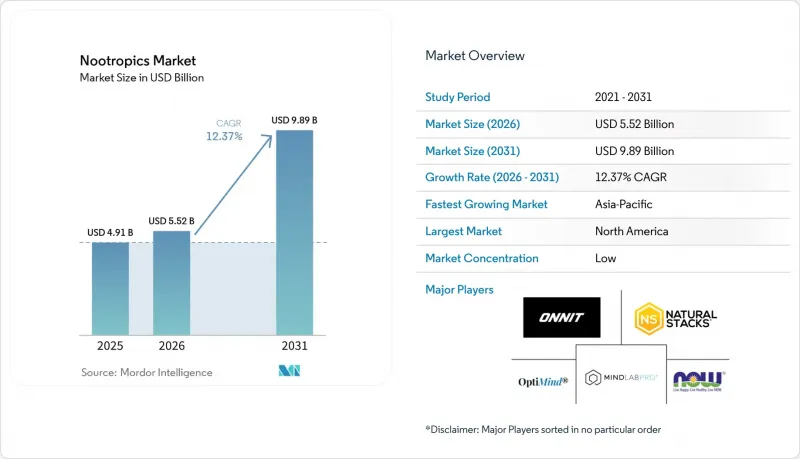
Mordor Intelligence에 의하면, 누트로픽 시장 규모는 2025년 49억 1,000만 달러로 평가되었고, 2026년에는 55억 2,000만 달러로 추정되고, 2026-2031년 CAGR 12.37%로 성장을 지속할 전망이며, 2031년에는 98억 9,000만 달러에 이를 것으로 예측됩니다.
본 보고서는 제품 유형별(천연 및 합성 누트로픽), 제형별(캡슐 및 정제, 분말 등), 기능별(기억력 향상 등), 최종 사용자별(18-44세 성인 등), 유통 채널별(약국 및 드럭스토어 등), 지역별(북미, 유럽, 아시아태평양, 남미, 중동 및 아프리카)로 분류되어 있습니다. 시장 전망은 금액(달러) 기준으로 제시되어 있습니다.
세계의 누트로픽 시장 동향 및 인사이트
인지 기능의 건강과 뇌 기능에 대한 소비자들의 관심이 높아지고 있습니다.
인지 기능의 건강 유지와 정신적 수행 능력 향상에 대한 관심이 높아지면서, 누트로픽 시장의 확대에 크게 기여하고 있습니다. 기억력, 집중력, 주의 지속 시간, 정신적 피로에 대한 우려가 커지는 가운데, 소비자들은 뇌 건강을 지원하는 데 더욱 적극적인 태도를 보이고 있습니다. 빠르게 변화하는 직장 환경, 치열한 경쟁 환경, 멀티태스킹이 일상화된 라이프스타일로 인해 높아진 요구 사항이, 인지 기능을 최적화하는 데 도움이 되는 제품을 찾는 사람들을 부추기고 있습니다. 누트로픽은 생산성, 학습 능력, 정신적 회복력을 향상시키고자 하는 학생, 전문가, 기업이, 그리고 고령층 사이에서 인기를 끌고 있습니다. 또한, 예방 중심의 건강 관리로 전환됨에 따라, 장기적인 뇌 건강을 돕는 건강기능식품에 대한 관심이 높아지고 있습니다.
스트레스, 불안, 정신적 피로 증가
스트레스, 불안, 정신적 피로의 확산은 누트로픽 시장의 주요 촉진요인으로 부상하고 있습니다. 가혹한 근무 일정, 경제적 불확실성, 정보 과부하, 그리고 항상 온라인 상태에 있어야 하는 현대의 생활 방식은 정신 건강에 큰 부담을 주고 있습니다. 그 결과, 소비자들은 집중력 향상, 인지적 피로 완화, 그리고 전반적인 정신적 수행 능력 유지에 도움이 되는 건강기능식품을 적극적으로 찾고 있습니다. 직장과 관련된 스트레스는 여전히 이러한 추세의 주요 요인으로 작용하고 있습니다. 미국심리학회에 따르면, 2025년 미국 근로자의 54%가 고용 불안정이 자신의 스트레스 수준에 큰 영향을 미치고 있다고 보고했습니다. 이러한 정신적 부담 증가로 인해, 집중력, 생산성, 그리고 회복력을 높이는 것을 목적으로 하는 일상적인 웰니스 습관의 일환으로 누트로픽의 도입이 확대되고 있습니다. 또한, 만성적인 스트레스가 인지 기능의 건강에 미치는 장기적인 영향에 대한 인식이 높아지면서 소비자들이 뇌 건강을 지원하는 제품에 투자하게 되었고, 이로 인해 시장 성장이 촉진되고 있습니다.
많은 인지 기능 개선 성분의 효능을 뒷받침하는 임상적 증거가 제한적입니다.
많은 누트로픽 성분의 효능을 뒷받침하는 임상적 증거가 제한적이라는 점은 누트로픽 시장에 있어 여전히 큰 과제로 남아 있습니다. 수많은 제품이 기억력, 집중력, 사고의 명료성, 인지 능력 향상을 내세우고 있지만, 이러한 효능의 대부분은 대규모의 장기 임상시험이 아닌 예비 연구를 통해 입증된 것에 불과합니다. 일부 허브 추출물, 아미노산 및 새롭게 주목받고 있는 누트로픽 화합물에 관한 과학적 증거는 그 질, 일관성, 재현성 측면에서 종종 편차를 보입니다. 이러한 확고한 임상적 검증의 부재는 제품의 효능에 대해 소비자, 의료 종사자, 규제 당국 사이에서 회의적인 시각을 불러일으킬 가능성이 있습니다. 게다가, 조사 방법의 편차나 성분 함량의 차이로 인해 제품 간에 표준화된 효능에 대한 주장을 확립하기가 어려워지고 있습니다. 소비자들의 지식이 깊어지고, 과학적 근거에 기반한 건강 솔루션을 요구하는 목소리가 높아짐에 따라, 제조업체들은 신뢰할 수 있는 과학적 연구를 통해 자사의 주장을 뒷받침해야 한다는 압박을 점점 더 강하게 받고 있습니다.
부문별 분석
2025년, 천연 노화 방지제는 세계 시장 규모의 67.61%를 차지했으며, 노화 방지제 시장에서 가장 큰 점유율을 기록했습니다. 이 결과는 합성 대체품보다 안전하고 이해하기 쉽다고 여겨지는 친숙한 성분, 식물 유래 성분, 그리고 웰빙 지향적인 제품 형태에 대한 소비자들의 강한 선호도를 반영하고 있습니다. 라이온스맨, 바코파, 아슈와간다, 은행잎, 로디올라는 클린 라벨에 대한 기대에 부응하면서도 인지 기능 및 스트레스와 관련된 다양한 효과를 지원하기 위해, 많은 제품 처방의 핵심 성분으로 계속해서 채택되고 있습니다. 이러한 성분들의 매력은 단순한 감정적 차원에 그치지 않을 뿐만 아니라, 공급업체들도 가격 책정이나 매장 진열 공간을 확보하기 위해 이 성분들에 대한 과학적 근거를 강화하고 있습니다.
천연 누트로픽 제품도 가장 빠르게 성장하고 있는 제품 유형으로, 2031년까지 연평균 성장률(CAGR)이 13.56%를 나타낼 것으로 전망됩니다. 이는 누트로픽 시장이 현재 단순히 천연 성분을 선호하고 있을 뿐만 아니라, 예측 기간 동안 그 수요가 계속 확대될 가능성이 높다는 점을 뒷받침합니다. 이러한 성장 양상은 천연 성분이 함유된 제품에 '현재 규모'와 '미래의 성장세'라는 이중의 우위를 가져다주며, 브랜드에 대한 추가 투자를 촉진한다는 점에서 중요합니다. 합성 누트로픽은 특히 사용자가 더 강력한 효능이나 더 표적화된 유효 성분을 원할 때 등, 고성능 용도나 의료 관련 용도에서 여전히 일정한 위치를 차지하고 있습니다. 그렇긴 하지만, 안전하지 않거나 미승인된 합성 화합물에 대한 FDA의 감시가 강화되면서 이 분야를 건전하게 확장하기가 어려워지고 있으며, 순수한 합성 제품이라는 점에 대한 소비자들의 경계심도 커지고 있습니다.
2025년, 캡슐 및 정제는 누트로픽 시장 규모의 41.76%를 차지했으며, 매출 기준 여전히 주요 제형으로서의 지위를 유지했습니다. 이러한 지위는 보충제에 대한 친숙한 사용 습관, 복용량 관리의 용이성, 그리고 다양한 성분을 조밀하고 안정적인 형태로 비교적 쉽게 배합할 수 있다는 점에 기반을 두고 있습니다. 이미 비타민이나 일상적인 건강 보조제를 섭취하고 있는 소비자들은 새로운 복용 방법에 대한 설명 없이도 캡슐이나 정제를 받아들이는 경향이 강합니다. 이에 따라, 일관성, 휴대성, 그리고 습관화가 중요한 구독 모델에서 이 제형은 실용적인 이점을 가지고 있습니다. 누트로픽 시장의 브랜드들에게 캡슐은 더 투명한 라벨 표시와 엄격한 투여 관리를 갖춘, 과학적 근거에 기반한 제품을 출시하기 위한 효율적인 수단으로 계속해서 자리 잡고 있습니다.
음료 시장은 2031년까지 연평균 성장률(CAGR) 13.89%를 나타낼 것으로 예측되며, 누트로픽 시장에서 가장 빠르게 성장하는 형태로 자리매김하고 있습니다. 이러한 성장은 소비 행태에 나타난 보다 광범위한 변화를 반영하고 있습니다. 왜냐하면 인지 기능 지원은 단순히 알약 형태의 보충제를 섭취하는 습관에 그치는 것이 아니라, 언제든지 이용할 수 있는 웰니스 선택지로 인식되고 있기 때문입니다. 즉석 섭취형 제품은 캡슐로는 쉽게 대응하기 어려운 사무실 휴식 시간, 출퇴근길, 헬스장에서의 이용, 사교 모임에서의 섭취와 같은 상황에도 대응할 수 있습니다. 분말 제품과 구미 제품도 이 카테고리 시장 점유율을 확대하고 있으며, 분말 제품은 다양한 조합을 원하는 소비자들에게 어필하고, 구미 제품은 편의성, 맛, 섭취 용이성을 중시하는 젊은 층과 고령층 소비자들의 선호를 얻고 있습니다. 이 모든 요소를 종합해 보면, 캡슐 이외의 제형은 누트로픽 시장을 더욱 폭넓은 일상 습관으로 확장시키고 있으며, 그 결과 이용 빈도는 사용자 기반의 규모만큼이나 중요해지고 있습니다.
지역별 분석
2025년, 북미는 누트로픽 시장을 주도하며 전 세계 매출의 38.45%를 차지했습니다. 이 지역의 선도적 지위는 인지 기능 건강, 정신적 수행 능력, 예방적 웰니스에 대한 소비자들의 높은 인식에 힘입고 있습니다. 학생, 전문직 종사자, 운동선수, 고령층 사이에서 영양 보조제, 기능성 음료, 뇌 건강 제품에 대한 높은 보급률이 계속해서 시장 수요를 견인하고 있습니다. 미국은 최대 기여국이며, 성숙한 건강기능식품 산업, 높은 연구 역량, 그리고 소매점 및 온라인 채널을 통해 누트로픽 제품을 널리 구할 수 있다는 장점에 힘입고 있습니다. 또한, 직장에서의 생산성 향상에 대한 요구가 높아지고 건강한 노화에 대한 관심이 증가함에 따라, 소비자들은 집중력, 기억력, 인지 기능을 돕는 제품을 찾고 있습니다.
아시아태평양은 2031년까지 연평균 성장률(CAGR)이 14.83%에 달할 것으로 예측되며, 누트로픽 시장에서 가장 빠르게 성장하는 지역이 될 것으로 전망됩니다. 급속한 도시화, 가처분 소득 증가, 그리고 정신 건강에 대한 인식 제고가 이 지역의 성장을 뒷받침하는 주요 요인으로 작용하고 있습니다. 도시화는 아시아태평양에서 매우 중요한 거대 추세로 두드러지고 있습니다. 현재 아시아에는 전 세계 도시 인구의 54%가 거주하고 있으며, 이는 22억 명 이상에 해당합니다. 예측에 따르면, 2050년까지 아시아의 도시 인구는 12억 명 더 증가하여 50%의 성장률을 보일 것으로 전망됩니다. 중국, 일본, 인도, 한국, 호주 등 각국의 소비자들은 인지 기능 건강과 예방적 영양 섭취에 대해 더욱 적극적인 태도를 보이기 시작하고 있습니다. 인지 기능에 유익한 기능성 식품, 뉴트라슈티컬, 전통 허브 성분의 인기가 높아지는 것도 시장 확대에 기여하고 있습니다.
유럽은 건강한 고령화, 인지 기능 건강 유지, 과학적으로 입증된 영양 보조제에 대한 소비자의 관심이 높아지는 추세에 힘입어, 누트로픽 업계에 있어 중요한 시장으로 자리매김하고 있습니다. 독일, 영국, 프랑스 등에서는 특히 고령층을 중심으로 천연 유래 또는 식물 유래의 인지 기능 건강 제품에 대한 수요가 증가하고 있습니다. 남미에서는 브라질과 아르헨티나 등 여러 국가에서 건강에 대한 인식이 높아지고 영양 보충제에 대한 접근성이 확대됨에 따라 시장이 서서히 성장하고 있습니다. 한편, 중동 및 아프리카은 여전히 발전 단계에 있지만, 도시화의 진전, 가처분 소득 증가, 그리고 웰빙을 중시하는 라이프스타일에 대한 관심의 고조로 인해 큰 성장 잠재력을 지니고 있습니다.
기타 혜택 :
- 엑셀 형식 시장 예측(ME) 시트
- 3개월간의 애널리스트 지원
자주 묻는 질문
목차
제1장 서론
제2장 조사 방법
제3장 주요 요약
제4장 시장 구도
제5장 시장 규모 및 성장 예측
제6장 경쟁 구도
제7장 시장 기회 및 향후 전망
AJY 26.07.07According to Mordor Intelligence, the nootropics market size is expected to grow from USD 4.91 billion in 2025 to USD 5.52 billion in 2026 and is forecast to reach USD 9.89 billion by 2031 at 12.37% CAGR over 2026-2031.
This report is Segmented by Product Type (Natural and Synthetic Nootropics), Form (Capsules & Tablets, Powders, and More), Function (Memory Enhancement, and More), End User (Adults 18-44 Years, and More), Distribution Channel (Pharmacies & Drug Stores, and More), and Geography (North America, Europe, Asia-Pacific, South America, Middle East and Africa). The Market Forecasts are Provided in Terms of Value (USD).
Global Nootropics Market Trends and Insights
Rising consumer focus on cognitive health and brain performance
The growing emphasis on maintaining cognitive wellness and enhancing mental performance is significantly contributing to the expansion of the nootropics market. Consumers are becoming more proactive about supporting brain health, driven by increasing concerns related to memory, focus, attention span, and mental fatigue. The rising demands of fast-paced work environments, competitive education systems, and multitasking lifestyles have encouraged individuals to seek products that can help optimize cognitive function. Nootropics are gaining popularity among students, professionals, entrepreneurs, and aging populations looking to improve productivity, learning capabilities, and mental resilience. Furthermore, the shift toward preventive health management has increased interest in supplements that support long-term brain health.
Increasing prevalence of stress, anxiety, and mental fatigue
The increasing prevalence of stress, anxiety, and mental fatigue is emerging as a significant driver of the nootropics market. Modern lifestyles characterized by demanding work schedules, financial uncertainties, information overload, and constant connectivity are placing greater pressure on mental well-being. As a result, consumers are actively seeking supplements that can help improve focus, reduce cognitive exhaustion, and support overall mental performance. Workplace-related stress remains a key contributor to this trend; according to the American Psychological Association, 54% of U.S. workers in 2025 reported that job insecurity had a significant impact on their stress levels. This growing mental burden is encouraging the adoption of nootropics as part of daily wellness routines aimed at enhancing concentration, productivity, and resilience. In addition, rising awareness of the long-term effects of chronic stress on cognitive health is prompting consumers to invest in brain-supporting products, thereby fueling market growth.
Limited clinical evidence supporting efficacy of many nootropic ingredients
Limited clinical evidence supporting the efficacy of many nootropic ingredients remains a significant challenge for the nootropics market. While numerous products claim to enhance memory, focus, mental clarity, and cognitive performance, many of these benefits are supported by preliminary studies rather than large-scale, long-term clinical trials. The scientific evidence for several herbal extracts, amino acids, and emerging nootropic compounds often varies in quality, consistency, and reproducibility. This lack of robust clinical validation can create skepticism among consumers, healthcare professionals, and regulatory authorities regarding product effectiveness. Additionally, varying study methodologies and differences in ingredient dosages make it difficult to establish standardized efficacy claims across products. As consumers become more informed and demand evidence-based health solutions, manufacturers face increasing pressure to substantiate their claims with credible scientific research.
Other drivers and restraints analyzed in the detailed report include:
- Growing demand for memory enhancement and concentration support products
- Rising aging population seeking support for cognitive decline prevention
- Stringent regulatory scrutiny of cognitive enhancement claims
For complete list of drivers and restraints, kindly check the Table Of Contents.
Segment Analysis
Natural nootropics accounted for 67.61% of global value in 2025, which gave them the largest share of the Nootropics market size. That lead reflects a strong consumer preference for ingredient familiarity, plant origin, and wellness formats that feel safer and easier to understand than synthetic alternatives. Lion's mane, bacopa, ashwagandha, ginkgo biloba, and rhodiola continue to anchor many formulas because they fit clean-label expectations while also supporting multiple cognitive and stress-related positions. The appeal of these ingredients is not only emotional, because suppliers are also building stronger science around them to defend pricing and shelf space.
Natural nootropics are also the fastest-growing product type, with a 13.56% CAGR through 2031, which confirms that the Nootropics market is not simply favoring them today but is likely to keep building on them through the forecast period. This growth pattern matters because it gives natural formulations a dual advantage, with both current scale and future momentum supporting deeper brand investment. Synthetic nootropics still hold a place in higher-performance and medical-adjacent use cases, especially where users want stronger perceived potency or more targeted actives. Even so, FDA attention on unsafe or unapproved synthetic compounds has made that lane harder to expand cleanly and has reinforced consumer caution around purely synthetic positioning.
Capsules and tablets held 41.76% of the Nootropics market size in 2025, which kept them as the leading format by revenue. Their position still rests on familiar supplement behavior, easy dosage control, and the relative ease of building multi-ingredient formulas in a compact and stable form. Consumers who already take vitamins or daily wellness supplements are also more likely to accept capsules and tablets without needing education around a new usage habit. This gives the format a practical advantage in subscription models, where consistency, portability, and routine all matter. For brands in the Nootropics market, capsules also remain an efficient way to launch evidence-focused products with cleaner label presentation and tighter dose discipline.
Drinks and beverages are forecast to grow at a 13.89% CAGR through 2031, making them the fastest-growing format in the Nootropics market. That growth reflects a wider change in consumption behavior, because cognitive support is increasingly being treated like an anytime wellness choice rather than only a pill-based supplement ritual. Ready-to-drink formats can reach office breaks, commuting, gym visits, and social consumption occasions that capsules cannot serve as easily. Powders and gummies also widen the category's reach, with powders appealing to users who want stack customization and gummies helping younger and older consumers who care more about convenience, taste, or swallowability. Taken together, these non-capsule forms are pushing the Nootropics market into a broader set of daily habits, which makes frequency of use just as important as the size of the user base.
Complete Report Scope:
- By Product Type
- Natural Nootropics
- Synthetic Nootropics
- By Form
- Capsules & Tablets
- Powders
- Drinks & Beverages
- Gummies
- Others
- By Function
- Memory Enhancement
- Attention & Focus
- Mood & Stress Management
- Sleep & Recovery
- Cognitive Health & Brain Aging
- Energy & Mental Performance
- Other Functions
- By End User
- Adults (18-44 Years)
- Middle-aged Adults (45-64 Years)
- Elderly Population (65 Years and Above)
- By Distribution Channel
- Pharmacies & Drug Stores
- Health & Wellness Stores
- Online Retail Stores
- Supermarkets & Hypermarkets
- Other Distribution Channels
- By Geography
- North America
- United States
- Canada
- Mexico
- Rest of North America
- Europe
- Germany
- United Kingdom
- Italy
- France
- Spain
- Netherlands
- Poland
- Belgium
- Sweden
- Rest of Europe
- Asia-Pacific
- China
- India
- Japan
- Australia
- Indonesia
- South Korea
- Thailand
- Singapore
- Rest of Asia-Pacific
- South America
- Brazil
- Argentina
- Colombia
- Chile
- Peru
- Rest of South America
- Middle East and Africa
- South Africa
- Saudi Arabia
- United Arab Emirates
- Nigeria
- Egypt
- Morocco
- Turkey
- North America
Geography Analysis
North America dominated the nootropics market in 2025, accounting for 38.45% of global revenue. The region's leadership is supported by strong consumer awareness regarding cognitive health, mental performance, and preventive wellness. High adoption of dietary supplements, functional beverages, and brain health products among students, professionals, athletes, and aging populations continues to drive market demand. The United States represents the largest contributor, benefiting from a mature supplement industry, advanced research capabilities, and widespread availability of nootropic products across retail and online channels. In addition, increasing workplace productivity demands and growing interest in healthy aging have encouraged consumers to seek products that support focus, memory, and cognitive function.
Asia-Pacific is projected to be the fastest-growing region in the nootropics market, registering a CAGR of 14.83% through 2031. Rapid urbanization, rising disposable incomes, and increasing awareness of mental wellness are key factors supporting regional growth. Urbanization stands out as a pivotal megatrend in the Asia-Pacific. Currently, Asia is home to 54% of the global urban populace, translating to over 2.2 billion individuals. Projections indicate that by 2050, Asia's urban demographic will swell by another 1.2 billion, marking a 50% increase.Consumers across countries such as China, Japan, India, South Korea, and Australia are becoming more proactive about cognitive health and preventive nutrition. The growing popularity of functional foods, nutraceuticals, and traditional herbal ingredients with cognitive benefits is also contributing to market expansion.
Europe represents a significant market for nootropics, supported by growing consumer interest in healthy aging, cognitive wellness, and scientifically validated nutritional supplements. Countries such as Germany, the United Kingdom, and France are witnessing increased demand for natural and plant-based cognitive health products, particularly among aging populations. South America is experiencing gradual market growth, driven by rising health awareness and expanding access to dietary supplements in countries such as Brazil and Argentina. Meanwhile, the Middle East and Africa region remains at an emerging stage but offers considerable growth potential due to increasing urbanization, rising disposable incomes, and growing interest in wellness-focused lifestyles.
- Onnit Labs, Inc.
- Natural Stacks, Inc.
- Mind Lab Pro Ltd.
- AlternaScript LLC (OptiMind)
- Thesis, Inc.
- Neurohacker Collective, LLC
- HVMN Inc.
- Purelife Bioscience Co., Ltd.
- Teva Pharmaceutical Industries Ltd.
- Kyowa Hakko Bio Co., Ltd.
- PLT Health Solutions, Inc.
- Cognizin (Kyowa Hakko Bio Co., Ltd.)
- Nature's Bounty Co.
- NOW Health Group, Inc.
- Jarrow Formulas, Inc.
- Life Extension Foundation Buyers Club, Inc.
- Gaia Herbs, Inc.
- Amway Corp.
- Natrol, LLC
- Nootropics Depot LLC
Additional Benefits:
- The market estimate (ME) sheet in Excel format
- 3 months of analyst support
TABLE OF CONTENTS
1 INTRODUCTION
- 1.1 Study Assumptions and Market Definition
- 1.2 Scope of the Study
2 RESEARCH METHODOLOGY
3 EXECUTIVE SUMMARY
4 MARKET LANDSCAPE
- 4.1 Market Overview
- 4.2 Market Drivers
- 4.2.1 Rising consumer focus on cognitive health and brain performance
- 4.2.2 Increasing prevalence of stress, anxiety, and mental fatigue
- 4.2.3 Growing demand for memory enhancement and concentration support products
- 4.2.4 Expanding adoption of nootropics among students and working professionals
- 4.2.5 Rising aging population seeking support for cognitive decline prevention
- 4.2.6 Increasing popularity of natural and plant-based nootropic ingredients
- 4.3 Market Restraints
- 4.3.1 Limited clinical evidence supporting efficacy of many nootropic ingredients
- 4.3.2 Stringent regulatory scrutiny of cognitive enhancement claims
- 4.3.3 Consumer skepticism regarding product effectiveness and safety
- 4.3.4 Potential side effects and adverse reactions from certain synthetic nootropics
- 4.4 Consumer Behavior Analysis
- 4.5 Regulatory Outlook
- 4.6 Porter's Five Forces
- 4.6.1 Threat of New Entrants
- 4.6.2 Bargaining Power of Buyers/Consumers
- 4.6.3 Bargaining Power of Suppliers
- 4.6.4 Threat of Substitute Products
- 4.6.5 Intensity of Competitive Rivalry
5 MARKET SIZE AND GROWTH FORECASTS (VALUE)
- 5.1 By Product Type
- 5.1.1 Natural Nootropics
- 5.1.2 Synthetic Nootropics
- 5.2 By Form
- 5.2.1 Capsules & Tablets
- 5.2.2 Powders
- 5.2.3 Drinks & Beverages
- 5.2.4 Gummies
- 5.2.5 Others
- 5.3 By Function
- 5.3.1 Memory Enhancement
- 5.3.2 Attention & Focus
- 5.3.3 Mood & Stress Management
- 5.3.4 Sleep & Recovery
- 5.3.5 Cognitive Health & Brain Aging
- 5.3.6 Energy & Mental Performance
- 5.3.7 Other Functions
- 5.4 By End User
- 5.4.1 Adults (18-44 Years)
- 5.4.2 Middle-aged Adults (45-64 Years)
- 5.4.3 Elderly Population (65 Years and Above)
- 5.5 By Distribution Channel
- 5.5.1 Pharmacies & Drug Stores
- 5.5.2 Health & Wellness Stores
- 5.5.3 Online Retail Stores
- 5.5.4 Supermarkets & Hypermarkets
- 5.5.5 Other Distribution Channels
- 5.6 By Geography
- 5.6.1 North America
- 5.6.1.1 United States
- 5.6.1.2 Canada
- 5.6.1.3 Mexico
- 5.6.1.4 Rest of North America
- 5.6.2 Europe
- 5.6.2.1 Germany
- 5.6.2.2 United Kingdom
- 5.6.2.3 Italy
- 5.6.2.4 France
- 5.6.2.5 Spain
- 5.6.2.6 Netherlands
- 5.6.2.7 Poland
- 5.6.2.8 Belgium
- 5.6.2.9 Sweden
- 5.6.2.10 Rest of Europe
- 5.6.3 Asia-Pacific
- 5.6.3.1 China
- 5.6.3.2 India
- 5.6.3.3 Japan
- 5.6.3.4 Australia
- 5.6.3.5 Indonesia
- 5.6.3.6 South Korea
- 5.6.3.7 Thailand
- 5.6.3.8 Singapore
- 5.6.3.9 Rest of Asia-Pacific
- 5.6.4 South America
- 5.6.4.1 Brazil
- 5.6.4.2 Argentina
- 5.6.4.3 Colombia
- 5.6.4.4 Chile
- 5.6.4.5 Peru
- 5.6.4.6 Rest of South America
- 5.6.5 Middle East and Africa
- 5.6.5.1 South Africa
- 5.6.5.2 Saudi Arabia
- 5.6.5.3 United Arab Emirates
- 5.6.5.4 Nigeria
- 5.6.5.5 Egypt
- 5.6.5.6 Morocco
- 5.6.5.7 Turkey
- 5.6.1 North America
6 COMPETITIVE LANDSCAPE
- 6.1 Market Concentration
- 6.2 Strategic Moves
- 6.3 Market Ranking Analysis
- 6.4 Company Profiles (includes Global-level Overview, Market-level Overview, Core Segments, Financials (if available), Strategic Information, Market Rank/Share, Products and Services, Recent Developments)
- 6.4.1 Onnit Labs, Inc.
- 6.4.2 Natural Stacks, Inc.
- 6.4.3 Mind Lab Pro Ltd.
- 6.4.4 AlternaScript LLC (OptiMind)
- 6.4.5 Thesis, Inc.
- 6.4.6 Neurohacker Collective, LLC
- 6.4.7 HVMN Inc.
- 6.4.8 Purelife Bioscience Co., Ltd.
- 6.4.9 Teva Pharmaceutical Industries Ltd.
- 6.4.10 Kyowa Hakko Bio Co., Ltd.
- 6.4.11 PLT Health Solutions, Inc.
- 6.4.12 Cognizin (Kyowa Hakko Bio Co., Ltd.)
- 6.4.13 Nature's Bounty Co.
- 6.4.14 NOW Health Group, Inc.
- 6.4.15 Jarrow Formulas, Inc.
- 6.4.16 Life Extension Foundation Buyers Club, Inc.
- 6.4.17 Gaia Herbs, Inc.
- 6.4.18 Amway Corp.
- 6.4.19 Natrol, LLC
- 6.4.20 Nootropics Depot LLC


