

|
시장보고서
상품코드
2072988
세균 및 바이러스 검체 채취 시장 : 시장 점유율 분석, 업계 동향 및 통계, 성장 예측(2026-2031년)Bacterial and Viral Specimen Collection - Market Share Analysis, Industry Trends & Statistics, Growth Forecasts (2026 - 2031) |
||||||
 Mordor Intelligence
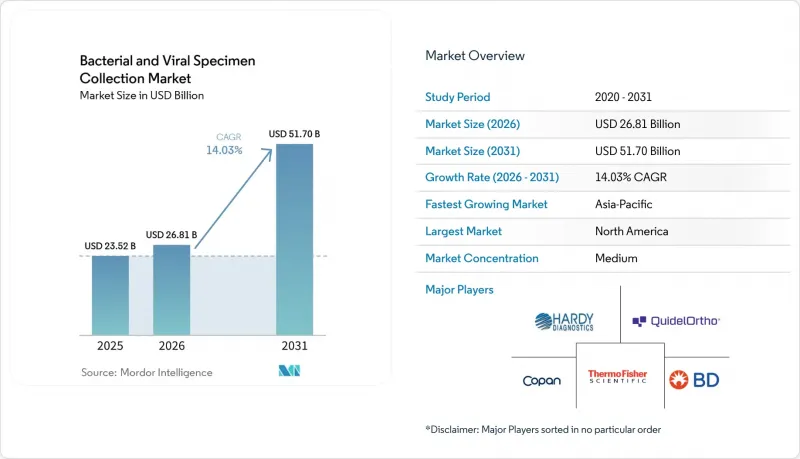
Mordor Intelligence에 의하면, 세균 및 바이러스 검체 채취 시장 규모는 2025년에 235억 2,000만 달러로 평가되었고, 2026년 268억 1,000만 달러로 추정되고, 2031년까지 517억 달러에 이를 것으로 예측되며, 예측 기간(2026-2031년) CAGR은 14.03%를 나타낼 전망입니다.
본 보고서는 제품 유형별(세균, 바이러스 검체 채취), 검체 유형별(호흡기, 혈액, 소변 등), 용도별(진단, 조사, 기타), 최종 사용자별(병원 및 진료소 등), 기술별(수동, 자동, 디지털 검체 추적), 지역별(북미, 유럽, 아시아태평양 등)로 분류되어 있습니다. 시장 전망은 금액(달러) 기준으로 제시되어 있습니다.
세계의 세균 및 바이러스 검체 채취 시장 동향과 인사이트
감염병 검사 건수 증가가 구조적인 수요를 뒷받침하고 있습니다.
감염병 검사 증가에 힘입어, 세균 및 바이러스 검체 채취 시장은 호황을 누리고 있습니다. 이러한 급증은 호흡기 병원체, 혈류 감염증 및 광범위한 감시 활동에까지 미치고 있습니다. 일상적인 의료 현장에서는 풍토병성 호흡기 감염증으로 인해 검체 수가 증가하고 있습니다. 한편, 균혈증 감시 및 항생제 내성 대책 프로그램에 따라 표준화된 세균 검체 채취에 대한 수요가 증가하고 있습니다. 각국의 감시 체계가 더욱 체계화됨에 따라 조달 동향에서도 뚜렷한 변화가 나타나고 있습니다. 즉, 범용 저가 제품에서 벗어나 인증된 키트로의 전환이 진행되고 있습니다. 이러한 변화는 매우 중요합니다. 검체 채취 프로토콜이 표준화되면, 재고 보충 시 재량에 따른 구매가 아니라 승인된 형식을 따르는 경향이 강해지기 때문입니다.
분자진단의 확대와 PCR의 보급이 검체 채취 기준을 높입니다.
임상검사실에서의 RT-PCR, 멀티플렉스 PCR, 차세대 염기서열 분석의 도입을 배경으로, 세균 및 바이러스 검체 채취 시장이 확대되고 있습니다. 이러한 첨단 플랫폼에서는 분석 전 변수에 대한 엄격한 관리가 필수적입니다. 그 결과, 기존의 조사 방법과 비교했을 때, 면봉 재질, 운반 배지의 조성, 보관 조건과 같은 요소들의 중요성이 더욱 부각되고 있습니다. 이러한 진화로 인해 분자진단에 적합한 검체 채취 제품의 가치가 높아졌으며, 첨단 검사실에서는 기본적인 범용 형식의 중요성이 줄어들고 있습니다. 또한, 검체 채취부터 검사 수행에 이르기까지 전체 워크플로우를 검증할 수 있는 공급업체의 입지가 강화되고 있습니다. BD사는 Certest Biotec사와의 제휴를 통해 2025년 12월 IVDR 인증을 획득한 VIASURE 분석법을 BD MAX 시스템의 검사 항목에 추가했습니다.
범용 면봉 및 운송 배지의 가격 민감도가 높아지면서 이익률이 압박받고 있습니다.
세균 및 바이러스 검체 채취 시장에서는 범용 제품 부문에서 큰 가격 압박에 직면해 있습니다. 표준 면봉이나 기존의 운송 배지는 대개 대규모 입찰을 통해 조달되기 때문에 규모가 크거나 저비용 생산이 가능한 공급업체가 유리합니다. 북미와 유럽의 공동구매 조직은 범용 제품의 가격 인하를 추진하는 데 중요한 역할을 하고 있습니다. 이러한 환경에서는 중견 제조업체가 차별화된 소재나 워크플로우를 제공하지 않는 한, 이익률을 유지하기 어렵습니다. 2025년, Puritan Medical Products사는 관세 관련 동향 속에서 안정적인 공급 수단으로서 국내 생산을 중시했으나, 프리미엄 가격 책정은 단위 비용 최소화에 중점을 둔 조달 시스템과의 경쟁에 계속해서 직면하고 있습니다. 시장은 검증된 프리미엄 제품과 가격 경쟁에 제약을 받는 범용 제품군 사이에서 양극화된 상태가 지속되고 있습니다.
부문별 분석
2025년, 바이러스 검체 채취는 매출의 57.45%를 차지했으며, 호흡기 바이러스에 대한 일상적인 검사 건수가 많기 때문에 시장에서 중심적인 역할을 유지하고 있습니다. 인플루엔자, RSV, SARS-CoV-2 검사는 병원, 진료소, 공중보건 시스템 전반에서 여전히 주류를 이루고 있습니다. 이 부문의 매출을 주도하고 있는 것은 폭넓은 검사법과 호환성이 뛰어나며 안정적인 검체 품질을 제공하는 바이러스 수송 배지 및 플록드 면봉입니다. COPAN사의 'UTM 유니버설 전송 매체'는 호흡기 계통 검사의 워크플로우를 뒷받침하는 핵심 제품으로 자리매김하고 있습니다.
세균 검체 채취 시장은 항생제 내성 감시의 확대에 힘입어 2031년까지 연평균 성장률(CAGR) 15.99%로 성장할 것으로 전망됩니다. 세균 검사용 제품에 대한 수요는 혈류 감염 검사, 상처 배양 검체 채취, 그리고 항생제 적정 사용과 관련된 검체 채취 프로그램에 힘입어 증가하고 있습니다. COPAN사는 2026년 5월, 칸디다 아우리스(Candida auris) 감시를 위해 'LBM CABroth'를 출시한 것은 세균 검체 채취 제품 포트폴리오가 다양해지고 있음을 보여줍니다. 세균 검사는 임상적 판단에 필수적이기 때문에 소변 채취 용기, 배양 배지, 조직 채취 키트도 중요한 역할을 하고 있습니다.
2025년에는 호흡기 검체가 시장 점유율의 42.35%를 차지했으며, 계절성 감염병 검사 및 집단 감염 대응 측면에서 그 우위를 보여주고 있습니다. 국가의 감시 시스템과 임상 워크플로는 인플루엔자, 코로나19, A군 연쇄상구균 등의 진단에 있어 비인두 및 인두에서 검체를 채취하는 데 크게 의존하고 있습니다. 호흡기 검체 채취 키트의 지속적인 소비로 인해 안정적인 수요가 확보되고 있습니다.
타액 검체는 비침습적 검사에 대한 선호, 자가 채취의 용이성, 그리고 소비자 직접 판매(DTC) 및 원격 조사 프로그램의 부상으로 인해 2031년까지 연평균 성장률(CAGR) 17.95%를 기록하며 성장할 것으로 예측됩니다. 2025년 10월, Salimetrics사가 'Participant Sampling Packs'를 출시한 것은 원격 채취와 검체의 무결성을 뒷받침하는 것입니다. 혈액 검체는 여전히 조사에서 필수적이지만, 대변, 상처, 조직 검체는 전문적인 검사 분야의 요구를 충족시키고 있습니다.
지역별 분석
2025년, 북미는 세균 및 바이러스 검체 채취 시장의 매출의 42.55%를 차지했습니다. 이는 해당 지역의 광범위한 검사 기관 네트워크와 체계 구축을 위한 지속적인 투자가 원동력이 되고 있습니다. 이 지역의 탄탄한 분자진단 기반은 검증된 검체 채취 방법과 통합된 워크플로우에 대한 수요를 뒷받침하고 있습니다. 미국은 주요 검사 시장으로서, 또한 재택 및 분산형 검체 채취 모델을 조기에 도입한 국가로서 주도적인 역할을 수행하고 있습니다. BD사가 가정용 'Onclarity HPV' 자가 채취법에 대해 FDA에 신청을 제출한 점과, Puritan사가 2025년에 'PurSafe Plus'를 출시한 것은 상온 보관 및 비임상 검체의 물류 분야에서 북미의 영향력을 여실히 보여주고 있습니다. 캐나다에서는 각 주가 주도하는 공적 검사 기관 시스템이 표준화 및 자동화된 전분석 처리 방식으로 전환됨에 따라 이러한 성장을 뒷받침하고 있습니다.
유럽은 여전히 세균 및 바이러스 검체 채취 시장에서 중요한 지역이며, 인증 요건이 제품 포트폴리오의 다양성과 공급업체의 전략을 좌우하고 있습니다. IVDR의 전면 시행에 따라 면봉, 운송 배지, 검체 키트의 재인증 과정에서 발생하는 과제가 증가하고 있으며, 규정 준수 대응 능력이 뛰어난 제조업체가 유리한 입지를 점하고 있습니다. 독일과 영국은 공중보건 감시 및 병원 미생물학 네트워크 분야에서 표준화된 검체 채취 프로토콜이 요구되고 있기 때문에 중요한 시장으로 자리 잡고 있습니다. 2025년에 BD가 IVDR 인증을 받은 VIASURE 분석법을 탑재한 BD MAX 시스템을 확충한 것은 유럽이 분석 시스템과 채취 도구의 상호운용성을 추진하고 있음을 반영합니다.
아시아태평양은 2031년까지 연평균 성장률(CAGR) 16.26%를 기록하며 성장할 것으로 예상되며, 세균 및 바이러스 검체 채취 시장에서 가장 빠르게 성장하는 지역이 될 전망입니다. 이러한 성장을 주도하고 있는 것은 중국의 병원 검사실 확대, 인도의 감염병 감시, 그리고 한국의 분자진단 제조 거점입니다. 일본과 호주는 높은 검사 실시율과 자동화 대응 형식의 조기 도입을 통해 기여하고 있습니다. 남미에서는 브라질과 아르헨티나가 주도적인 역할을 하고 있으며, 이들 국가에서는 공적 검사 기관 네트워크와 민간 진단 체인이 표준화된 검사 키트를 도입하고 있습니다.
기타 혜택 :
- 엑셀 형식 시장 예측(ME) 시트
- 3개월간의 애널리스트 지원
자주 묻는 질문
목차
제1장 서론
제2장 조사 방법
제3장 주요 요약
제4장 시장 구도
제5장 시장 규모 및 성장 예측
제6장 경쟁 구도
제7장 시장 기회 및 향후 전망
AJY 26.07.07According to Mordor Intelligence, the bacterial and viral specimen collection market size was valued at USD 23.52 billion in 2025 and is estimated to grow from USD 26.81 billion in 2026 to reach USD 51.70 billion by 2031, at a CAGR of 14.03% during the forecast period (2026-2031).
This report is Segmented by Product Type (Bacterial, Viral Specimen Collection), Specimen Type (Respiratory, Blood, Uand More), Application (Diagnostics, Research, Others), End User (Hospitals and Clinics, and More), Technology (Manual, Automated, Digital Sample Tracking), and Geography (North America, Europe, Asia-Pacific, and More). The Market Forecasts are Provided in Terms of Value (USD).
Global Bacterial and Viral Specimen Collection Market Trends and Insights
Rising Infectious Disease Testing Volume Sustains Structural Demand
The market for bacterial and viral specimen collection is thriving, driven by an uptick in testing for infectious diseases. This surge spans respiratory pathogens, bloodstream infections, and extensive surveillance initiatives. Routine care sees elevated specimen volumes due to endemic respiratory infections. Meanwhile, heightened demand for standardized bacterial collection arises from bacteremia surveillance and antimicrobial resistance programs. As national surveillance frameworks become more structured, there's a noticeable shift in procurement: a move towards certified kits, distancing from generic low-cost products. This shift is significant; once protocols for collection are standardized, replacements tend to adhere to these approved formats rather than being subject to discretionary purchases.
Expanding Molecular Diagnostics And PCR Adoption Elevates Collection Standards
The market for bacterial and viral specimen collection is on the rise, propelled by the adoption of RT-PCR, multiplex PCR, and next-generation sequencing in clinical labs. These advanced platforms necessitate stringent control over pre-analytical variables. As a result, factors like swab material, transport media composition, and storage conditions have gained prominence compared to older testing methodologies. This evolution amplifies the value of molecularly compatible collection products, diminishing the relevance of basic commodity formats in sophisticated labs. Furthermore, it bolsters suppliers capable of validating the entire workflow, from collection to assay performance. BD expanded its BD MAX System menu in December 2025 with IVDR-certified VIASURE assays through its collaboration with Certest Biotec.
Price Sensitivity In Commodity Swabs And Transport Media Compresses Margins
The bacterial and viral specimen collection market faces significant pricing pressure in its commodity segment. Standard swabs and traditional transport media are often procured through large tenders, favoring suppliers with scale or low-cost manufacturing. Group purchasing organizations in North America and Europe play a key role in driving down prices for routine products. This environment challenges mid-sized manufacturers to maintain margins unless they offer differentiated materials or workflows. In 2025, Puritan Medical Products emphasized domestic manufacturing as a stable supply option amidst tariff-related dynamics, though premium pricing continues to compete with procurement systems focused on minimizing unit costs. The market remains divided between premium validated products and a commodity tier constrained by price competition.
Other drivers and restraints analyzed in the detailed report include:
- Decentralized Testing, Home Collection, And DTC Sampling Reshape Collection Economics
- Ambient-Stable Transport Media Adoption Expands Market Access In Resource-Limited Settings
- Regulatory Burden For Validation, Shelf-Life, And Compatibility Testing Creates Entry Barriers
For complete list of drivers and restraints, kindly check the Table Of Contents.
Segment Analysis
In 2025, viral specimen collection accounted for 57.45% of revenue, maintaining its central role in the market due to high routine testing volumes for respiratory viruses. Influenza, RSV, and SARS-CoV-2 testing continue to dominate across hospitals, clinics, and public health systems. Viral transport media and flocked swabs drive revenue in this segment, offering broad assay compatibility and stable specimen integrity. COPAN's UTM Universal Transport Medium remains a key product supporting respiratory testing workflows.
Bacterial specimen collection is projected to grow at a 15.99% CAGR through 2031, driven by expanding antimicrobial resistance surveillance. Demand for bacterial products is fueled by bloodstream infection testing, wound culture collection, and stewardship-linked sampling programs. COPAN's launch of LBM CABroth in May 2026 for Candida auris surveillance highlights the diversification of bacterial collection portfolios. Urine containers, culture media, and tissue collection kits also play a critical role, as bacterial testing is integral to clinical decision-making.
Respiratory specimens held 42.35% of the market share in 2025, reflecting their dominance in seasonal infection testing and outbreak responses. National surveillance systems and clinical workflows rely heavily on nasopharyngeal and throat collections for diagnostics like influenza, COVID-19, and Group A Streptococcus. Continuous consumption of respiratory collection kits ensures stable demand.
Saliva specimens are expected to grow at a 17.95% CAGR through 2031, driven by non-invasive testing preferences, ease of self-collection, and the rise of direct-to-consumer and remote research programs. Salimetrics' launch of Participant Sampling Packs in October 2025 supports remote collection and sample integrity. Blood specimens remain vital for research, while stool, wound, and tissue samples cater to specialized testing niches.
Complete Report Scope:
- By Product Type
- Bacterial Specimen Collection
- Swabs
- Transport Media
- Blood Collection Kits
- Culture Plates and Media
- Biopsy and Tissue Collection Kits
- Urine Collection Containers
- Other Specialized Bacterial Collection Devices
- Viral Specimen Collection
- Viral Transport Media
- Swabs
- Blood Collection Tubes
- Saliva Collection Kits
- Sputum Collection Containers
- Stool Collection Kits
- Other Specialized Viral Collection Devices
- Bacterial Specimen Collection
- By Specimen Type
- Respiratory Specimens
- Blood Specimens
- Urine Specimens
- Wound and Tissue Specimens
- Saliva Specimens
- Stool Specimens
- Other Specimen Types
- By Application
- Diagnostics
- Research
- Others
- By End User
- Hospitals and Clinics
- Diagnostic Laboratories
- Academic and Research Institutions
- Clinical Research Organizations
- Others
- By Technology
- Manual Collection Systems
- Automated Collection Systems
- Digital Sample Tracking And Traceability
- By Geography
- North America
- United States
- Canada
- Mexico
- Europe
- Germany
- United Kingdom
- France
- Italy
- Spain
- Rest of Europe
- Asia-Pacific
- China
- India
- Japan
- Australia
- South Korea
- Rest of Asia-Pacific
- Middle East and Africa
- GCC
- South Africa
- Rest of Middle East and Africa
- South America
- Brazil
- Argentina
- Rest of South America
- North America
Geography Analysis
In 2025, North America accounted for 42.55% of the revenue in the bacterial and viral specimen collection market, driven by its extensive reference laboratory network and consistent investments in preparedness. The region's strong molecular diagnostics base boosts demand for validated collection methods and integrated workflows. The United States leads as a major testing market and an early adopter of home and decentralized collection models. BD's FDA submission for its at-home Onclarity HPV self-collection method and Puritan's PurSafe Plus launch in 2025 highlight North America's influence on room-temperature and non-clinical specimen logistics. Canada supports this growth through province-led public laboratory systems moving toward standardized and automated pre-analytical handling.
Europe remains a key region in the bacterial and viral specimen collection market, with certification requirements shaping portfolio diversity and supplier strategies. Full IVDR enforcement has increased recertification challenges for swabs, transport media, and specimen kits, favoring manufacturers with strong compliance capabilities. Germany and the UK are significant markets due to their public health surveillance and hospital microbiology networks requiring standardized collection protocols. BD's expansion of its BD MAX system with IVDR-certified VIASURE assays in 2025 reflects Europe's push for alignment between assay systems and collection tools.
Asia-Pacific is projected to grow at a 16.26% CAGR through 2031, making it the fastest-growing region in the bacterial and viral specimen collection market. Growth is driven by China's hospital laboratory expansion, India's infectious disease surveillance, and South Korea's molecular diagnostics manufacturing base. Japan and Australia contribute with high testing intensity and early adoption of automation-compatible formats. South America is advancing through Brazil and Argentina, where public laboratory networks and private diagnostic chains are adopting standardized kit procurement.
- Beckton Dickinson
- bioMerieux
- Cardinal Health
- COPAN Diagnostics Inc.
- DiaSorin
- Roche
- Greiner Bio One International
- Hardy Diagnostics
- HiMedia Laboratories Pvt. Ltd.
- Longhorn Vaccines and Diagnostics, LLC
- Medical Wire and Equipment Co. Ltd.
- Medline Industries
- Pretium Packaging, L.L.C.
- Puritan Medical Products Company I, LP
- QuidelOrtho
- Spectrum Solutions, LLC
- Thermo Fisher Scientific
- Titan Biotech Ltd.
- Trinity Biotech plc
Additional Benefits:
- The market estimate (ME) sheet in Excel format
- 3 months of analyst support
TABLE OF CONTENTS
1 INTRODUCTION
- 1.1 Study Assumptions and Market Definition
- 1.2 Scope of the Study
2 RESEARCH METHODOLOGY
3 EXECUTIVE SUMMARY
4 MARKET LANDSCAPE
- 4.1 Market Overview
- 4.2 Market Drivers
- 4.2.1 Rising Infectious Disease Testing Volume
- 4.2.2 Expanding Molecular Diagnostics and PCR Adoption
- 4.2.3 Stringent Specimen Integrity and Transport Standards
- 4.2.4 Decentralized Testing, Home Collection, and DTC Sampling
- 4.2.5 Ambient-Stable Transport Media Adoption in Remote and Low-Connectivity Settings
- 4.2.6 Sustainability Pressure on Plastic-Intensive Single-Use Collection Systems
- 4.3 Market Restraints
- 4.3.1 Price Sensitivity in Commodity Swabs and Transport Media
- 4.3.2 Regulatory Burden for Validation, Shelf-Life, and Compatibility Testing
- 4.3.3 Supply Risk for Synthetic Fibers, Polymers, and Reagent Inputs
- 4.3.4 Limited Reimbursement for Non-Hospital Specimen Collection Pathways
- 4.4 Value Chain Analysis
- 4.5 Regulatory Landscape
- 4.6 Technological Outlook
- 4.7 Porter's Five Forces Analysis
- 4.7.1 Threat of New Entrants
- 4.7.2 Bargaining Power of Suppliers
- 4.7.3 Bargaining Power of Buyers
- 4.7.4 Threat of Substitutes
- 4.7.5 Competitive Rivalry
5 MARKET SIZE AND GROWTH FORECASTS (VALUE, USD)
- 5.1 By Product Type
- 5.1.1 Bacterial Specimen Collection
- 5.1.1.1 Swabs
- 5.1.1.2 Transport Media
- 5.1.1.3 Blood Collection Kits
- 5.1.1.4 Culture Plates and Media
- 5.1.1.5 Biopsy and Tissue Collection Kits
- 5.1.1.6 Urine Collection Containers
- 5.1.1.7 Other Specialized Bacterial Collection Devices
- 5.1.2 Viral Specimen Collection
- 5.1.2.1 Viral Transport Media
- 5.1.2.2 Swabs
- 5.1.2.3 Blood Collection Tubes
- 5.1.2.4 Saliva Collection Kits
- 5.1.2.5 Sputum Collection Containers
- 5.1.2.6 Stool Collection Kits
- 5.1.2.7 Other Specialized Viral Collection Devices
- 5.1.1 Bacterial Specimen Collection
- 5.2 By Specimen Type
- 5.2.1 Respiratory Specimens
- 5.2.2 Blood Specimens
- 5.2.3 Urine Specimens
- 5.2.4 Wound and Tissue Specimens
- 5.2.5 Saliva Specimens
- 5.2.6 Stool Specimens
- 5.2.7 Other Specimen Types
- 5.3 By Application
- 5.3.1 Diagnostics
- 5.3.2 Research
- 5.3.3 Others
- 5.4 By End User
- 5.4.1 Hospitals and Clinics
- 5.4.2 Diagnostic Laboratories
- 5.4.3 Academic and Research Institutions
- 5.4.4 Clinical Research Organizations
- 5.4.5 Others
- 5.5 By Technology
- 5.5.1 Manual Collection Systems
- 5.5.2 Automated Collection Systems
- 5.5.3 Digital Sample Tracking And Traceability
- 5.6 By Geography
- 5.6.1 North America
- 5.6.1.1 United States
- 5.6.1.2 Canada
- 5.6.1.3 Mexico
- 5.6.2 Europe
- 5.6.2.1 Germany
- 5.6.2.2 United Kingdom
- 5.6.2.3 France
- 5.6.2.4 Italy
- 5.6.2.5 Spain
- 5.6.2.6 Rest of Europe
- 5.6.3 Asia-Pacific
- 5.6.3.1 China
- 5.6.3.2 India
- 5.6.3.3 Japan
- 5.6.3.4 Australia
- 5.6.3.5 South Korea
- 5.6.3.6 Rest of Asia-Pacific
- 5.6.4 Middle East and Africa
- 5.6.4.1 GCC
- 5.6.4.2 South Africa
- 5.6.4.3 Rest of Middle East and Africa
- 5.6.5 South America
- 5.6.5.1 Brazil
- 5.6.5.2 Argentina
- 5.6.5.3 Rest of South America
- 5.6.1 North America
6 COMPETITIVE LANDSCAPE
- 6.1 Market Concentration
- 6.2 Market Share Analysis
- 6.3 Company Profiles (includes Global Level Overview, Market Level Overview, Core Segments, Financials as available, Strategic Information, Market Rank/Share, Products and Services, Recent Developments)
- 6.3.1 Becton, Dickinson and Company
- 6.3.2 bioMerieux SA
- 6.3.3 Cardinal Health, Inc.
- 6.3.4 COPAN Diagnostics Inc.
- 6.3.5 DiaSorin S.p.A.
- 6.3.6 F. Hoffmann-La Roche AG
- 6.3.7 Greiner Bio-One International GmbH
- 6.3.8 Hardy Diagnostics
- 6.3.9 HiMedia Laboratories Pvt. Ltd.
- 6.3.10 Longhorn Vaccines and Diagnostics, LLC
- 6.3.11 Medical Wire and Equipment Co. Ltd.
- 6.3.12 Medline Industries, LP
- 6.3.13 Pretium Packaging, L.L.C.
- 6.3.14 Puritan Medical Products Company I, LP
- 6.3.15 QuidelOrtho Corporation
- 6.3.16 Spectrum Solutions, LLC
- 6.3.17 Thermo Fisher Scientific Inc.
- 6.3.18 Titan Biotech Ltd.
- 6.3.19 Trinity Biotech plc
7 MARKET OPPORTUNITIES AND FUTURE OUTLOOK
- 7.1 White-space and Unmet-Need Assessment


