

|
시장보고서
상품코드
2073020
음성 텍스트 변환 API 시장 : 시장 점유율 분석, 업계 동향 및 통계, 성장 예측(2026-2031년)Speech-to-Text API - Market Share Analysis, Industry Trends & Statistics, Growth Forecasts (2026 - 2031) |
||||||
 Mordor Intelligence
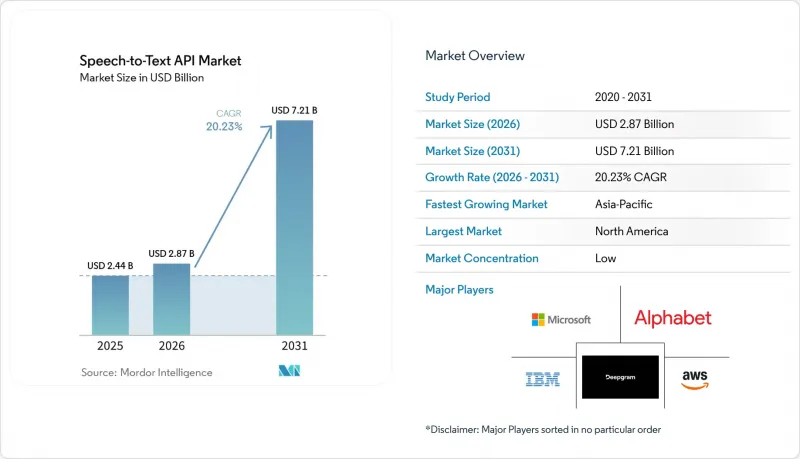
Mordor Intelligence에 의하면, 음성 텍스트 변환 API 시장 규모는 2025년에 24억 4,000만 달러로 평가되었고, 2026년 28억 7,000만 달러로 추정되고, 2031년까지 72억 1,000만 달러에 이를 것으로 예측되며, 예측 기간(2026-2031년) CAGR은 20.23%를 나타낼 전망입니다.
본 보고서는 구성 요소별(소프트웨어 및 서비스), 배포 모델별(클라우드 기반, 온프레미스형 등), 조직 규모별(대기업 및 중소기업), 용도별(컨텐츠 트랜스크립션, 자막 및 캡션 생성 등), 최종 사용자 산업별(은행, 금융서비스 및 보험(BFSI), 소매 및 전자상거래 등), 지역별로 분류되어 있습니다. 시장 전망은 금액(달러) 기준으로 제시되어 있습니다.
세계의 음성 텍스트 변환 API 시장 동향 및 인사이트
기업 내 대화형 AI 및 음성 에이전트의 도입 확대
기업의 지출은 실험 단계를 넘어섰으며, 이러한 변화가 음성 텍스트 변환 API 시장을 직접 뒷받침하고 있습니다. Rasa가 2026년 2월에 실시한 조사에 따르면, 기업의 의사결정권자 중 67%가 금융, 의료, 소매, 정부, 통신 등의 분야에서 대화형 AI 프로그램을 적극적으로 확대하거나 규모를 늘리고 있는 것으로 나타났습니다. 이는 음성 지원 시스템의 도입 주기가 가속화되고 있음을 시사합니다. 이 보고서에서는 맥킨지의 데이터도 인용되었는데, 기업의 88%가 적어도 하나의 업무 기능에서 생성형 AI를 정기적으로 활용하고 있으며, 이는 전년 대비 10포인트 증가한 수치입니다. 이는 AI를 활용한 워크플로우에 대한 소프트웨어 예산 배분이 확대되고 있음을 뒷받침합니다. 이러한 전환 과정에서 음성 에이전트는 표준적인 도입 방식으로 자리 잡고 있습니다. 왜냐하면 음성 인식은 음성 인식에서 텍스트 변환 API 시장 내의 라우팅, 요약, 액션 실행 시스템의 출발점이 되고 있기 때문입니다. 또한, 단일 음성 레이어를 표준화하는 기업은 음성 인식에서 텍스트 변환 API 시장에 이르기까지 오케스트레이션, 모니터링, 규정 준수 워크플로우에 이르기까지 선택의 폭을 넓히는 경우가 많기 때문에 전환 비용도 증가합니다. 2026년 2월에 발표된 Deepgram과 IBM의 제휴는 서비스 제공업체가 음성 인식 서비스를 독립된 유틸리티로 판매하는 대신, 기업의 에이전트 플랫폼 내에 음성 기능을 직접 통합함으로써 지속적인 보급을 도모하고 있음을 보여줍니다.
컨택트 센터 및 회의에서 실시간 속기록 작성에 대한 수요 증가
음성 텍스트 변환 API 시장이 성장하고 있는 또 다른 이유는 실시간 속기 서비스가 콜센터나 기업 회의에서 핵심적인 운영 도구로 자리 잡고 있기 때문입니다. 실시간 녹취 기능은 대화가 진행되는 동안 상담원에게 지침을 제공하고, 자동화된 품질 점검, 규정 준수 모니터링 및 통화 후 요약 작성을 지원하기 때문에 구매자들은 더 이상 사후 통화 검토에만 집중하지 않습니다. 이러한 변화가 중요한 이유는 실시간 처리를 통해 텍스트 변환의 상업적 가치가 백오피스 기록에서 음성 텍스트 변환 API 시장의 라이브 워크플로우 제어 계층으로 변화하고 있기 때문입니다. 회의 워크플로우도 같은 방향으로 진화하고 있으며, 회의록은 단순한 회의 메모가 아니라 검색 가능한 조직의 기억을 구축하는 데 활용되고 있습니다. Otter.ai가 2026년 4월에 출시한 'Conversational Knowledge Engine'은 음성 데이터가 어떻게 구조화된 기업 컨텍스트로 변환되어 다른 업무 도구와 연동함으로써, 기록된 각 상호작용의 가치를 확대하고 있는지를 보여줍니다. 그 결과, 실시간 스트리밍 성능이 부족한 업체들은 음성 텍스트 변환 API 시장에서 점유율을 잃어가고 있습니다. 왜냐하면 기업의 도입 과정에서 저지연 속기 서비스가 더 이상 고급 기능이 아니라 기본 요건으로 간주되고 있기 때문입니다.
악센트, 코드 전환, 노이즈, 크로스 토크로 인한 정확도 저하
정확도의 격차는 특히 선명한 영어 음성 환경 이외의 경우, 음성 텍스트 변환 API 시장에서 현실적인 제약 요인으로 남아 있습니다. 2026년 EACL 프로시딩스에 AfriVox 벤치마크를 통해 발표된 연구에 따르면, 인도 및 아프리카 억양을 포함한 다양한 억양의 평가 데이터셋에서는 단어 오류율이 급격히 상승하는 것으로 나타났습니다. 이는 실제 성능이 공급업체가 주장하는 벤치마크 결과와 크게 차이가 날 수 있음을 뒷받침합니다. 코드 전환은 더 큰 어려움을 초래합니다. 또한, 중국어와 영어가 혼재된 음성에 대한 arXiv의 조사에 따르면, Whisper 계열 모델은 단일 언어 음성에서는 우수한 성능을 보였더라도 벤치마크 과제에서는 여전히 60% 이상의 혼합 오류율을 기록할 가능성이 있는 것으로 나타났습니다. 인도, 동남아시아, 중동 및 아프리카의 기업들에게 있어, 이는 실제 트래픽에 비표준 억양, 여러 화자의 목소리가 겹치는 경우, 또는 문장 도중 언어 변경이 포함될 경우, 음성 텍스트 변환 API 시장에는 여전히 실행상의 위험이 따름을 의미합니다. 이러한 과제로 인해 구매자는 사람이 직접 리뷰하거나 후처리 단계를 추가하거나, 도입 범위를 축소할 수밖에 없는 경우가 많으며, 그 결과 음성 텍스트 변환 API 시장에서의 대규모 도입에 대한 비용 대비 효과의 근거가 약화됩니다. 다국어 지원 및 악센트에 대한 내성이 보다 일관되게 향상될 때까지는 이러한 제약이 공급업체의 평가와 구매자의 신뢰도에 계속 영향을 미칠 것입니다.
부문별 분석
2025년에는 솔루션이 매출의 70.23%를 차지했으며, 이는 모델 추론 API, SDK 라이선싱 및 플랫폼 구독이 음성 텍스트 변환 API 시장의 주요 수익원으로 계속 자리 잡고 있음을 보여줍니다. 이러한 우위는 기업 예산의 상당 부분이 여전히 이러한 분야에 배정되고 있음을 반영합니다. 왜냐하면 기업은 보다 고도화된 구현 작업으로 확대하기 전에, 먼저 인식 모델, 스트리밍 엔드포인트 및 핵심 플랫폼 기능에 대한 액세스 권한을 구매하기 때문입니다. 솔루션 계층은 재이용의 이점도 누리고 있습니다. 회의, 컨택 센터, 워크플로우 자동화 등 모든 운영 환경의 워크로드가 음성 텍스트 변환 API 시장에서 지속적인 API 이용을 창출하기 때문입니다. 마이크로소프트가 2026년 4월에 'MAI-Transcribe-1'를 발매한 것은 이 점을 뒷받침하는 것이었습니다. 이 서비스는 25개 언어에 걸친 평균 오류율이 낮고, 시간당 단가가 인하되었으며, 기존의 'Azure Fast' 방식보다 빠른 일괄 처리 속도를 강조하고 있으며, 이를 통해 대량의 녹취 작업의 비용 효율성이 향상되고 있습니다. 모델의 효율성이 향상됨에 따라, 서비스 제공업체는 단가를 낮추면서도 음성 텍스트 변환 API 시장에서 상업적으로 매력적인 이용 사례의 수를 확대할 수 있습니다.
서비스 시장은 2031년까지 연평균 성장률(CAGR) 21.78%로 확대될 것으로 예상되며, 이는 핵심 API에 대한 접근이 용이해지는 반면, 기업의 업무 복잡성은 증가하고 있음을 보여줍니다. 이러한 성장은 규제 대응 방안 도입, 도메인별 튜닝, 가동 시간 보장, 규정 준수 문서, 아키텍처 지원과 같은 요소들과 밀접한 관련이 있으며, 이 모든 것은 기본적인 API 제공 범위를 넘어섭니다. 실제로, 현장 환경에 도입할 때는 어휘 적용, 보안 설정, 워크플로우 통합, 거버넌스 설계 등이 포함되는 경우가 많기 때문에 많은 구매자들은 이 기술을 둘러싼 서비스 래퍼를 필요로 합니다. Speechmatics가 2026년 1월 Sully.ai와 체결한 의료 분야에 특화된 자율형 스크리빙에 관한 제휴는 매니지드 서비스가 음성 엔진 위에 위치하며 온프레미스나 프라이빗 클라우드 등 다양한 도입 방식으로 임상 워크플로를 제공할 수 있음을 보여줍니다. 이는 음성 텍스트 변환 API 업계가 솔루션 그 자체에서 멀어지고 있는 것이 아니라, 실패 비용이 높은 도입 환경에서 더 많은 서비스 가치를 더하고 있음을 의미합니다.
2025년에는 클라우드 기반 도입이 매출의 59.11%를 차지한 것으로 평가되었으며, 이러한 우위는 음성 텍스트 변환 API 시장의 확장을 뒷받침한 통합의 용이성, 종량제 요금제, 그리고 개발자들의 접근 용이성을 반영한 것입니다. 퍼블릭 클라우드는 독자적인 음성 인프라를 구축하지 않고 신속하게 도입하고자 하는 구매자에게 여전히 가장 간편한 진입로 역할을 하고 있습니다. 또한, 낮은 수준의 약정으로도 실험을 진행할 수 있도록 지원하며, 이는 음성 텍스트 변환 API 시장에 진출하는 제품 팀이나 디지털 비즈니스에 있어 중요한 요소가 되고 있습니다. 그렇긴 하지만, 하이브리드 클라우드와 소버린 클라우드는 2031년까지 연평균 성장률(CAGR) 22.43%라는 더 빠른 속도로 성장할 것으로 예측되며, 프로덕션 환경에서의 활용이 확대됨에 따라 도입 추세가 변화하고 있는 것으로 나타났습니다. Rasa사의 2026년 기업 설문조사에 따르면, AI 리더의 63%가 하이브리드 아키텍처를 선호하는 반면, 완전한 클라우드 기반 도입을 선호하는 비율은 17%에 불과한 것으로 나타났으며, 이는 기밀성이 높은 워크로드에 대한 통제권을 원하는 구매자 수요가 증가하고 있다는 점과 일치합니다.
데이터 현지화, 내부 보안 정책 또는 업계 규제로 인해 공유 인프라의 사용이 제한되는 경우, 온프레미스 및 프라이빗 클라우드는 여전히 전략적으로 중요한 위치를 차지하고 있습니다. 이러한 환경에서는 음성 텍스트 변환 API 시장에서 도입 모델이 판매 후의 기술적 세부 사항이 아니라 구매 결정의 한 요소가 됩니다. 마이크로소프트의 유럽 내 주권 클라우드 확대와 AWS의 'European Sovereign Cloud'가 이니셔티브는 인프라 제공업체들이 그동안 퍼블릭 클라우드 음성 서비스를 쉽게 도입하지 못했던 정부 및 주요 부문 수요를 창출하기 위해 투자하고 있음을 보여줍니다. 이러한 추세는 음성 텍스트 변환 API 시장의 더 광범위한 변화를 촉진하고 있습니다. 이 시장에서 클라우드의 규모는 여전히 중요하지만, 도입의 유연성을 확보할 수 있는지 여부가 더욱 강력한 경쟁적 차별화 요소로 부상하고 있습니다. 규제 준수 감시가 강화되는 가운데, 퍼블릭 클라우드, 하이브리드, 프라이빗 환경 모두를 지원할 수 있는 벤더는 규제가 엄격한 각 업계에서 계속해서 유리한 입지를 유지할 수 있을 것입니다.
지역별 분석
2025년, 북미는 전 세계 매출의 32.44%를 차지했으며, 음성 텍스트 변환 API 시장에서 가장 규모가 큰 지역 점유율을 확보했습니다. 이 지역은 API 제공업체와 기업 소프트웨어 구매자가 밀집해 있고, 의료 기술 도입이 활발히 진행되고 있으며, AI가 탑재된 커뮤니케이션 도구가 조기에 실제 운영 단계로 전환되고 있는 등의 혜택을 누리고 있습니다. 주요 업체들이 잇달아 새로운 음성 모델과 스트리밍 제품을 출시함에 따라 가격 경쟁이 특히 두드러졌으며, 이로 인해 구매자의 선택지는 넓어졌지만, 이익률에 대한 압박도 커졌습니다. 2026년 5월, OpenAI가 분당 0.017달러에 'GPT-Realtime-Whisper'를 출시한 것은 이러한 가격 경쟁의 압력을 더욱 가중시키는 요인이 되었으며, 음성 텍스트 변환 API 시장에서 번들로 제공되는 음성 서비스가 구매자의 기대에 어떤 영향을 미치고 있는지를 보여주었습니다. 또한, 북미는 임상 현장의 환경 기록 및 기업용 회의 인텔리전스 분야에서 주요 수요 축으로 자리 잡고 있으며, 이는 이용량 유지와 프리미엄 기능에 대한 수요를 모두 뒷받침하고 있습니다.
아시아태평양은 2031년까지 연평균 성장률(CAGR) 22.66%를 기록하며 성장할 것으로 예상되며, 음성 텍스트 변환 API 시장에서 가장 빠르게 성장하는 지역이 될 전망입니다. 이러한 수요는 언어의 다양성, 정부의 디지털화 프로그램, 그리고 인도, 필리핀, 말레이시아 등의 국가에서 이루어지는 대규모 콜센터 아웃소싱에 의해 형성되고 있습니다. 또한, 해당 지역에서는 현지 언어, 다국어가 혼합된 음성, 도입의 유연성이 더욱 중요시되고 있으며, 이로 인해 지역 벤더들은 음성 텍스트 변환 API 시장에서 세계적인 대형 공급업체들과 경쟁할 여지가 생겨나고 있습니다. iFLYTEK이 2026년에 동남아시아에서 추진할 사업 확장(싱가포르의 처리 능력 강화 및 현지 기반 AI 포지셔닝 포함)은 지역에 맞춘 도입 및 언어 지원에 대한 수요가 계속해서 증가하고 있음을 반영하고 있습니다.
유럽은 음성 텍스트 변환 API 시장에서 중요하면서도 더 복잡한 역할을 담당하고 있습니다. 수요는 견조한 반면, 규정 준수에 대한 기대가 계속해서 높아지고 있기 때문입니다. 마이크로소프트와 AWS가 제공하는 주권형 및 지역 관리형 인프라 옵션은 데이터 처리, 데이터 소재지, 조달 관리와 관련된 기업의 우려 사항을 해결하는 데 있어 공급업체를 지원하고 있습니다. 중동 및 아프리카에서는 사우디아라비아와 UAE에서 새로운 기회가 생겨나고 있습니다. 이 지역들에서는 아랍어 AI에 대한 수요와 주권형 도입의 우선순위가 높아지고 있어, 음성 텍스트 변환 API 시장에서 해당 지역 특유의 이용 사례를 강화하고 있습니다. 남미에서도, 특히 콜센터 자동화 및 금융 서비스 워크플로우 분야에서 그 기세가 더욱 거세지고 있습니다. 현지화된 서비스와 지역 파트너십 덕분에 기업 구매자들이 음성 기술을 도입하기가 더 쉬워졌기 때문입니다.
기타 혜택 :
- 엑셀 형식 시장 예측(ME) 시트
- 3개월간의 애널리스트 지원
자주 묻는 질문
목차
제1장 서론
제2장 조사 방법
제3장 주요 요약
제4장 시장 구도
제5장 시장 규모 및 성장 예측(금액 : 달러)
제6장 경쟁 구도
제7장 시장 기회 및 향후 전망
AJY 26.07.07According to Mordor Intelligence, the speech-to-text API market size was valued at USD 2.44 billion in 2025 and estimated to grow from USD 2.87 billion in 2026 to reach USD 7.21 billion by 2031, at a CAGR of 20.23% during the forecast period (2026-2031).
This report is Segmented by Component (Software, and Services), Deployment Model (Cloud-Based, On-Premises, and More), Organization Size (Large Enterprises, and Small and Medium-Sized Enterprises), Application (Content Transcription, Subtitle and Caption Generation, and More), End-User Industry (BFSI, Retail and E-Commerce, and More), and Geography. The Market Forecasts are Provided in Terms of Value (USD).
Global Speech-to-Text API Market Trends and Insights
Rising Enterprise Adoption Of Conversational AI And Voice Agents
Enterprise spending has moved beyond experimentation, and that change is directly supporting the speech-to-text API market. A February 2026 survey by Rasa found that 67% of enterprise decision-makers were actively expanding or scaling conversational AI programs across sectors such as finance, healthcare, retail, government, and telecom, which points to faster production rollout cycles for voice-enabled systems. The same report also cited McKinsey data showing that 88% of enterprises regularly used generative AI for at least 1 business function, up 10 percentage points year over year, which supports a broader software budget shift toward AI-enabled workflows. Within that transition, voice agents are becoming a standard deployment pattern because speech recognition is the starting point for routing, summarization, and action-taking systems in the speech-to-text API market. This also increases switching costs because an enterprise that standardizes on a single speech layer often extends that choice across orchestration, monitoring, and compliance workflows in the speech-to-text API market. The Deepgram and IBM partnership announced in February 2026 shows how providers are seeking durable distribution by embedding speech capabilities directly inside enterprise agent platforms rather than selling transcription as a separate utility.
Growing Need For Real-Time Transcription In Contact Centers And Meetings
The speech-to-text API market is also growing because real-time transcription is becoming a core operating tool in contact centers and enterprise meetings. Buyers are no longer focused only on retrospective call review, because live transcription supports agent guidance, automated quality checks, compliance monitoring, and post-call summarization while the interaction is still active. This shift matters because real-time processing changes the commercial value of transcription from a back-office record to a live workflow control layer within the speech-to-text API market. Meeting workflows are evolving in the same direction, where transcription is being used to build searchable organizational memory rather than simple meeting notes. Otter.ai's April 2026 launch of its Conversational Knowledge Engine shows how speech data is being turned into a structured enterprise context that can connect with other workplace tools and expand the value of each recorded interaction. As a result, vendors that lack real-time streaming performance are losing ground in the speech-to-text API market because enterprise request processes increasingly treat low-latency transcription as a baseline requirement rather than an advanced feature.
Accuracy Degradation Across Accents, Code-Switching, Noise, And Cross-Talk
Accuracy gaps remain a real limit on the speech-to-text API market, especially outside clean English audio conditions. Research presented in the 2026 EACL proceedings through the AfriVox benchmark showed that word error rates rose sharply on accent-diverse evaluation sets, including Indian and African accented English, which confirms that production performance can diverge meaningfully from vendor benchmark claims. Code-switching adds another layer of difficulty, and arXiv research on Mandarin-English mixed speech showed that Whisper-family models could still post mixed error rates above 60% on benchmark tasks even when they performed well on monolingual audio. For enterprises in India, Southeast Asia, the Middle East, and Africa, this means the speech-to-text API market still carries execution risk whenever real traffic contains non-standard accents, overlapping speakers, or mid-sentence language changes. These gaps often force buyers to add human review, post-processing layers, or narrower deployment scopes, which weakens the cost-efficiency case for large-scale rollout in the speech-to-text API market. Until multilingual and accent-robust performance improves more consistently, this restraint will continue to shape vendor evaluation and buyer confidence.
Other drivers and restraints analyzed in the detailed report include:
- Sub-300 Millisecond Latency Requirements For Production Voice Agents
- Expansion Of Multilingual And Domain-Tuned Speech Models
- Voice Data Privacy, Security, And Compliance Burdens
For complete list of drivers and restraints, kindly check the Table Of Contents.
Segment Analysis
Solutions held 70.23% of revenue in 2025, which shows that model inference APIs, SDK licensing, and platform subscriptions remained the primary commercial engine of the speech-to-text API market. This dominance reflects where most buyer budgets still sit, because enterprises first purchase access to recognition models, streaming endpoints, and core platform features before they expand into deeper implementation work. The solutions layer also benefits from repeat usage because every production workload, whether in meetings, contact centers, or workflow automation, generates recurring API consumption inside the speech-to-text API market. Microsoft's April 2026 launch of MAI-Transcribe-1 reinforced that point by highlighting lower average word error rates across 25 languages, lower hourly pricing, and faster batch speed than the earlier Azure Fast approach, which improves the economics of high-volume transcription workloads. As model efficiency improves, providers can push lower unit pricing while expanding the number of use cases that remain commercially attractive in the speech-to-text API market.
Services are projected to expand at a 21.78% CAGR through 2031, which indicates that enterprise complexity is increasing even as core APIs become easier to access. The growth is tied to regulated deployments, domain tuning, uptime commitments, compliance documentation, and architecture support, all of which extend beyond basic API provisioning. In practice, many buyers need a service wrapper around the technology because production deployment often includes vocabulary adaptation, security configuration, workflow integration, and governance design. Speechmatics' January 2026 partnership with Sully.ai for healthcare-focused autonomous scribing illustrates how managed services can sit on top of a speech engine to deliver clinical workflows with different deployment modes, including on-premises and private cloud options. This means the speech-to-text API industry is not shifting away from solutions, but it is attaching more service value to deployments where the cost of failure is high.
Cloud-based deployment captured 59.11% of revenue in 2025, and that lead reflects the ease of integration, usage-based billing, and developer accessibility that helped scale the speech-to-text API market. Public cloud remains the simplest entry point for buyers who want fast deployment without building their own speech infrastructure. It also supports experimentation at lower commitment levels, which has been important for product teams and digital businesses entering the speech-to-text API market. Even so, hybrid and sovereign cloud is projected to grow at a faster 22.43% CAGR through 2031, which shows that deployment preference is shifting as production use expands. Rasa's 2026 enterprise survey found that 63% of AI leaders preferred hybrid architectures, while only 17% preferred fully cloud-based deployment, which aligns with stronger buyer demand for control over sensitive workloads.
On-premises and private cloud remain strategically important wherever data localization, internal security policy, or sector regulation limits the use of shared infrastructure. In those settings, the deployment model becomes part of the buying decision rather than a post-sale technical detail in the speech-to-text API market. Microsoft's sovereign cloud expansion in Europe and AWS's European Sovereign Cloud initiative show that infrastructure providers are investing to unlock demand from government and critical sectors that could not easily adopt public cloud speech services before. That trend supports a broader shift in the speech-to-text API market, where cloud scale still matters, but ownership of deployment flexibility is becoming a stronger competitive differentiator. As compliance scrutiny increases, vendors that can serve public cloud, hybrid, and private environments are likely to stay better positioned across regulated verticals.
Complete Report Scope:
- By Component
- Software
- Services
- Professional Services
- Managed Services
- By Deployment Model
- Cloud-based
- On-premises and Private cloud
- Hybrid and Sovereign Cloud
- By Organization Size
- Large Enterprises
- Small and Medium-sized Enterprises
- By Application
- Content Transcription
- Contact Center and Customer Management
- Subtitle and Caption Generation
- Fraud Detection and Prevention
- Risk and Compliance Management
- Voice-enabled Workflow Automation and Note Generation
- By End-User Industry
- IT and Telecommunications
- BFSI
- Healthcare and Life Sciences
- Media and Entertainment
- Retail and E-commerce
- Government and Defense
- Education
- Travel and Hospitality
- By Geography
- North America
- United States
- Canada
- Mexico
- South America
- Brazil
- Argentina
- Rest of South America
- Europe
- Germany
- United Kingdom
- France
- Italy
- Spain
- Russia
- Rest of Europe
- Asia-Pacific
- China
- Japan
- India
- South Korea
- Australia and New Zealand
- Rest of Asia-Pacific
- Middle East and Africa
- Saudi Arabia
- United Arab Emirates
- Turkey
- South Africa
- Egypt
- Rest of Middle East and Africa
- North America
Geography Analysis
North America held 32.44% of global revenue in 2025, giving it the largest regional position in the speech-to-text API market. The region benefits from a dense concentration of API providers, enterprise software buyers, healthcare technology adoption, and early production deployment of AI-enabled communication tools. Pricing competition is especially visible here because major vendors launched new voice models and streaming products in quick succession, which increased buyer choice and margin pressure at the same time. OpenAI's May 2026 release of GPT-Realtime-Whisper at USD 0.017 per minute added to that pricing pressure and showed how bundled voice offerings are influencing buyer expectations in the speech-to-text API market. North America also remains a major demand anchor for clinical ambient scribing and enterprise meeting intelligence, which helps sustain both usage volume and premium feature demand.
Asia-Pacific is projected to grow at a 22.66% CAGR through 2031, making it the fastest-growing regional block in the speech-to-text API market. Demand is being shaped by linguistic diversity, government digitization programs, and the large-scale contact center outsourcing in countries such as India, the Philippines, and Malaysia. The region also places stronger emphasis on localized languages, mixed-language speech, and deployment flexibility, which gives regional vendors room to compete with larger global providers in the speech-to-text API market. iFLYTEK's 2026 expansion in Southeast Asia, including stronger Singapore capacity and localized sovereign AI positioning, reflects that demand for region-aligned deployments and language support continues to rise.
Europe holds an important but more complex role in the speech-to-text API market because demand remains solid while compliance expectations continue to rise. Sovereign and region-controlled infrastructure options from Microsoft and AWS are helping vendors address enterprise concerns over data handling, residency, and procurement control. Middle East and Africa shows emerging opportunity in Saudi Arabia and the UAE, where Arabic-language AI demand and sovereign deployment priorities are strengthening regional use cases in the speech-to-text API market. South America is also gaining traction, especially in contact center automation and financial service workflows, as localized offerings and regional partnerships make speech deployment easier for enterprise buyers.
- Alphabet Inc.
- Amazon.com, Inc.
- Microsoft Corporation
- International Business Machines Corporation
- Baidu, Inc.
- iFLYTEK Co., Ltd.
- Deepgram, Inc.
- AssemblyAI, Inc.
- Speechmatics Ltd.
- Rev.com, Inc.
- Verint Systems Inc.
- Verbit AI, Inc.
- Trint Limited
- Amberscript Global B.V.
- Otter.ai, Inc.
- Descript, Inc.
- Soniox, Inc.
- Voicegain, Inc.
- Nuance Communications, Inc.
- OpenAI OpCo, LLC
Additional Benefits:
- The market estimate (ME) sheet in Excel format
- 3 months of analyst support
TABLE OF CONTENTS
1 INTRODUCTION
- 1.1 Study Assumptions and Market Definition
- 1.2 Scope of the Study
2 RESEARCH METHODOLOGY
3 EXECUTIVE SUMMARY
4 MARKET LANDSCAPE
- 4.1 Market Overview
- 4.2 Impact of Macroeconomic Factors on the Market
- 4.3 Market Drivers
- 4.3.1 Rising Enterprise Adoption of Conversational AI and Voice Agents
- 4.3.2 Growing Need for Real-Time Transcription in Contact Centers and Meetings
- 4.3.3 Accessibility and Captioning Compliance Across Digital Media
- 4.3.4 Expansion of Multilingual and Domain-Tuned Speech Models
- 4.3.5 Sub-300 Millisecond Latency Requirements for Production Voice Agents
- 4.3.6 Sovereign Cloud and Regional Data Residency Options Unlocking Regulated Demand
- 4.4 Market Restraints
- 4.4.1 Accuracy Degradation Across Accents, Code-Switching, Noise, and Cross-Talk
- 4.4.2 Voice Data Privacy, Security, and Compliance Burdens
- 4.4.3 EU AI Act Limits on Emotion Inference Reducing Speech Analytics Upside
- 4.4.4 GPU and AI Infrastructure Cost Volatility Pressuring API Pricing
- 4.5 Industry Value Chain Analysis
- 4.6 Regulatory Landscape
- 4.7 Technological Outlook
- 4.8 Porter's Five Forces Analysis
- 4.8.1 Threat of New Entrants
- 4.8.2 Bargaining Power of Suppliers
- 4.8.3 Bargaining Power of Buyers
- 4.8.4 Threat of Substitutes
- 4.8.5 Competitive Rivalry
5 MARKET SIZE AND GROWTH FORECASTS, VALUE (USD)
- 5.1 By Component
- 5.1.1 Software
- 5.1.2 Services
- 5.1.2.1 Professional Services
- 5.1.2.2 Managed Services
- 5.2 By Deployment Model
- 5.2.1 Cloud-based
- 5.2.2 On-premises and Private cloud
- 5.2.3 Hybrid and Sovereign Cloud
- 5.3 By Organization Size
- 5.3.1 Large Enterprises
- 5.3.2 Small and Medium-sized Enterprises
- 5.4 By Application
- 5.4.1 Content Transcription
- 5.4.2 Contact Center and Customer Management
- 5.4.3 Subtitle and Caption Generation
- 5.4.4 Fraud Detection and Prevention
- 5.4.5 Risk and Compliance Management
- 5.4.6 Voice-enabled Workflow Automation and Note Generation
- 5.5 By End-User Industry
- 5.5.1 IT and Telecommunications
- 5.5.2 BFSI
- 5.5.3 Healthcare and Life Sciences
- 5.5.4 Media and Entertainment
- 5.5.5 Retail and E-commerce
- 5.5.6 Government and Defense
- 5.5.7 Education
- 5.5.8 Travel and Hospitality
- 5.6 By Geography
- 5.6.1 North America
- 5.6.1.1 United States
- 5.6.1.2 Canada
- 5.6.1.3 Mexico
- 5.6.2 South America
- 5.6.2.1 Brazil
- 5.6.2.2 Argentina
- 5.6.2.3 Rest of South America
- 5.6.3 Europe
- 5.6.3.1 Germany
- 5.6.3.2 United Kingdom
- 5.6.3.3 France
- 5.6.3.4 Italy
- 5.6.3.5 Spain
- 5.6.3.6 Russia
- 5.6.3.7 Rest of Europe
- 5.6.4 Asia-Pacific
- 5.6.4.1 China
- 5.6.4.2 Japan
- 5.6.4.3 India
- 5.6.4.4 South Korea
- 5.6.4.5 Australia and New Zealand
- 5.6.4.6 Rest of Asia-Pacific
- 5.6.5 Middle East and Africa
- 5.6.5.1 Saudi Arabia
- 5.6.5.2 United Arab Emirates
- 5.6.5.3 Turkey
- 5.6.5.4 South Africa
- 5.6.5.5 Egypt
- 5.6.5.6 Rest of Middle East and Africa
- 5.6.1 North America
6 COMPETITIVE LANDSCAPE
- 6.1 Market Concentration
- 6.2 Strategic Moves
- 6.3 Market Share Analysis
- 6.4 Company Profiles (includes Global Level Overview, Market Level Overview, Core Segments, Financials as available, Strategic Information, Market Rank/Share, Products and Services, Recent Developments)
- 6.4.1 Alphabet Inc.
- 6.4.2 Amazon.com, Inc.
- 6.4.3 Microsoft Corporation
- 6.4.4 International Business Machines Corporation
- 6.4.5 Baidu, Inc.
- 6.4.6 iFLYTEK Co., Ltd.
- 6.4.7 Deepgram, Inc.
- 6.4.8 AssemblyAI, Inc.
- 6.4.9 Speechmatics Ltd.
- 6.4.10 Rev.com, Inc.
- 6.4.11 Verint Systems Inc.
- 6.4.12 Verbit AI, Inc.
- 6.4.13 Trint Limited
- 6.4.14 Amberscript Global B.V.
- 6.4.15 Otter.ai, Inc.
- 6.4.16 Descript, Inc.
- 6.4.17 Soniox, Inc.
- 6.4.18 Voicegain, Inc.
- 6.4.19 Nuance Communications, Inc.
- 6.4.20 OpenAI OpCo, LLC
7 MARKET OPPORTUNITIES AND FUTURE OUTLOOK
- 7.1 White-Space and Unmet-Need Assessment


