

|
시장보고서
상품코드
2073040
빌리루빈 검사 시장 : 점유율 분석, 업계 동향과 통계, 성장 예측(2026-2031년)Bilirubin Testing - Market Share Analysis, Industry Trends & Statistics, Growth Forecasts (2026 - 2031) |
||||||
 Mordor Intelligence
Mordor Intelligence에 의하면, 빌리루빈 검사 시장 규모는 2025년 25억 5,000만 달러에서 2026년에는 27억 2,000만 달러로 확대되어 2031년까지 37억 달러에 이를 것으로 예상되고 있어 2026년부터 2031년까지 CAGR 6.38%로 성장할 전망입니다.
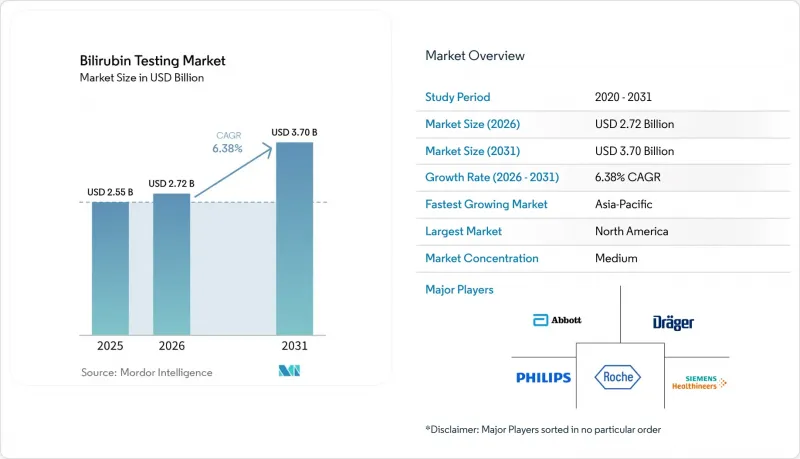
본 보고서는 검사 유형(총 빌리루빈 검사 등), 제품 유형(시약, 교정액, 카트리지, 분석기), 기술(실험실 기반, 현장 진단, 경피), 용도(신생아, 간 기능, 용혈성, 수술 전), 최종 사용자(병원 등), 지역(북미, 유럽 등)별로 분류되어 있습니다. 시장 전망은 금액(달러) 기준으로 제시되어 있습니다.
전 세계 빌리루빈 검사 시장 동향 및 인사이트
신생아 황달 선별 검사 요건의 강화
신생아 관리에서 흔히 나타나는 증상인 신생아 황달은 빌리루빈 모니터링의 중요성을 부각시키고 있으며, 빌리루빈 검사 시장의 확대를 뒷받침하고 있습니다. 공공 의료 제도에서는 공식적인 선별 검사의 대상 범위를 확대하고 있으며, 산과 시설에서의 빌리루빈 검사는 선택적 절차에서 표준 프로토콜로 전환되고 있습니다. 2026년 1월, 뉴사우스웨일스주 보건국(NSW Health)은 신생아 황달 관리 지침을 개정하여, 재태주수 32주인 영아를 대상으로 한 경피 빌리루빈 검사의 보편적 실시를 도입했습니다. 이로 인해, 확립된 의료 시스템 내에서 선별 검사 대상 인구가 확대되었습니다. 마찬가지로, 2025년에는 중국이 일선 의료기관에서 출생 후 48시간 이내의 경피 빌리루빈 모니터링을 의무화하고, 국가 지침을 지방 의료기관의 일상 업무에 반영했습니다. 인도에서는 '미션 ANMOL'이 이니셔티브를 통해 빌리루빈 검사가 종합적인 신생아 선별 검사 체계에 포함됨에 따라, 많은 영아를 수용하는 공공시설에서 수요가 증가하고 있습니다.
비침습적 경피 빌리루빈 모니터링으로의 전환
불쾌감을 최소화하면서도 보다 신속한 선별 검사를 원하는 목소리가 높아짐에 따라, 빌리루빈 검사 시장에서는 비침습적인 경피 측정법이 점점 더 많은 지지를 얻고 있습니다. 이러한 변화는 워크플로우의 속도가 퇴원이나 치료 결정에 영향을 미칠 수 있는 환자 수가 많은 신생아실이나 중환자실에서 특히 중요합니다. 2026년에 실시된 연구에 따르면, 스마트폰 앱 "Picterus Jaundice Pro"가 주목을 받았습니다. 이 앱은 215건의 측정값에서 경피 측정 기준치와 강한 상관관계를 보였으며, 비용 대비 효과가 높은 광학식 도구의 임상적 유용성이 높아지고 있음을 입증하고 있습니다.
치료 임계치 부근에서는 혈청 검사를 통한 확인이 여전히 필수적이지만, 치료 단계를 한 단계 높이기 전에 침습적 검사를 실시해야 할 필요성을 줄일 수 있기 때문에 시장에서는 경피 측정 방식이 점차 활용되고 있습니다.
치료 기준치 부근에서의 혈청 검사를 통한 확인 의무화
빌리루빈 검사 시장에는 치료 기준치 부근에서 비침습적 방법이 혈청 검사를 완전히 대체할 수 없다는 한계가 있습니다. 임상 프로토콜에 따르면, 이러한 경우 총 혈청 빌리루빈 수치를 확인해야 하므로 경피 측정 장치를 사용함으로써 침습적인 채혈 횟수는 줄어들지만, 완전히 배제되는 것은 아닙니다. 신생아 빌리루빈 검사는 검사실 간 편차와 빌리루빈 분획의 차이로 인해 여전히 복잡하며, 이러한 요인들이 안전한 의사 결정에 영향을 미치고 있습니다. 따라서 경피 스크리닝이 확대되고 있음에도 불구하고, 시약, 교정제 및 실험실 내 분석법에 대한 수요는 여전히 지속되고 있습니다. 병원은 선별 검사와 확인을 위한 이중 워크플로를 유지해야 하며, 이로 인해 장비 제조업체의 완전한 대체가 지연되고 있습니다.
부문별 분석
2025년, 총 빌리루빈 검사는 빌리루빈 검사 시장 점유율의 61.68%를 차지하며, 일상적인 진단에서 그 중요한 역할이 부각되고 있습니다. 이 검사는 신생아 황달 관리와 성인의 간 기능 평가에 필수적이며, 다양한 연령층과 의료 현장에서 널리 이용되고 있습니다. 총 빌리루빈 검사는 주요 진료 과정에 포함되어 있을 뿐만 아니라, 표준화된 프로토콜에서 주요 지표로서의 역할을 수행하고 있기 때문에 시장 내 의존도는 여전히 높으며, 신기술이 등장하더라도 이 부문은 견조한 성장세를 유지하고 있습니다.
직접 빌리루빈 검사는 신생아의 결합형 고빌리루빈혈증에 대한 관심이 높아지고, 성인의 종합적인 간담도계 평가 수요가 확대되는 것을 배경으로 2031년까지 연평균 성장률(CAGR) 6.90%를 나타낼 것으로 예측됩니다. 임상병리검사실은 더욱 정교해진 임상적 접근 방식을 반영하여, 2025년 2월에 직접 빌리루빈의 보고 기준 및 기준 범위를 갱신했습니다. 간접 빌리루빈 검사는 특히 유전적 위험 요인이 있는 집단에서 용혈성 질환이나 G6PD 관련 질환을 평가하는 데 있어 여전히 중요합니다. 시장에서는 더 많은 분획 패널이 워크플로우에 통합될 것으로 예상되며, 가격 측면의 압박이 있음에도 불구하고 검체당 검사 건수는 증가할 것으로 전망됩니다.
2025년 기준으로, 시약 및 분석용 소모품은 빌리루빈 검사 시장의 58.23%를 차지하고 있으며, 이는 화학 분석에 기반한 검사의 반복적인 특성을 반영하고 있습니다. 이 부문은 자동 분석기로 처리되는 빌리루빈 검사의 반복 주문 덕분에 안정적인 수익 기반을 제공합니다. 검사 기관은 대개 검증된 시약 생태계 내에서 머무르는 경향이 있으며, 이로 인해 반복 구매가 보장되고 공급업체 변경이 줄어듭니다. 이러한 추세로 인해, 장비 조달 속도가 둔화되는 시기라 하더라도 시약 공급업체의 입지는 확고해졌습니다.
교정제 및 품질 관리 재료 시장은 빌리루빈 검사가 분산형 의료 거점으로 확대되고 있는 것을 배경으로, 2031년까지 연평균 성장률(CAGR) 7.25%를 기록하며 성장할 것으로 예측됩니다. 병상 옆이나 환자 인근에서 실시되는 검사가 증가함에 따라, 새로운 검사 거점이 검증용 재료 수요를 견인하고 있습니다. 검사 카트리지와 스트립은 여전히 현장 진단(PoC) 환경에서 필수적인 요소이며, 중앙 분석 장비와 같이 유지보수가 필요 없는 일회용 검사를 가능하게 함으로써 시장 내에서 균형 잡힌 제품 구성을 형성하고 있습니다.
지역별 분석
2025년, 북미는 빌리루빈 검사 시장에서 39.55%의 점유율을 차지하며 시장을 주도했습니다. 이러한 선도적 지위는 체계화된 신생아 선별 검사 프로그램, 자동화된 화학 분석 플랫폼에 대한 광범위한 접근성, 그리고 병원 내 명확한 빌리루빈 관리 경로의 도입에 의해 뒷받침되고 있습니다. 미국은 소아 의료 지침에 신생아 빌리루빈 검사를 보편적으로 포함시키고, 주요 공급업체들이 검사 플랫폼을 지속적으로 업데이트함에 따라 이 지역에서 여전히 최대 시장을 차지하고 있습니다. 2026년, 로슈와 지멘스는 빌리루빈 관련 화학 분석 기능에 대해 미국 규제 당국으로부터 중요한 승인을 획득하여, 도입 기반을 확대하고 제품 업데이트를 강화했습니다. 캐나다는 통일된 소아 선별 검사 관행에 힘입어 시장을 뒷받침하고 있으며, 멕시코는 산모 및 신생아 관리와 관련된 병원 기반 진단 수요를 통해 시장에 기여하고 있습니다.
아시아태평양은 2031년까지 연평균 성장률(CAGR) 6.76%를 나타낼 것으로 예측되며, 빌리루빈 검사 시장에서 가장 빠르게 성장하는 지역이 될 전망입니다. 중국에서는 2025년 신생아 지침에 따라 경피 빌리루빈 모니터링이 공식적으로 채택됨에 따라, 지방 의료시설에서의 도입이 촉진되고 있습니다. 인도에서는 합리적인 가격으로 진단 서비스를 이용할 수 있도록 하는 공공 의료 프로그램과 신생아 병동 내 현장 진단(Point-of-Care)을 통한 빌리루빈 측정 지원을 위한 현지 검증 활동을 통해 시장이 확대되고 있습니다. 일본, 한국, 호주 등 NICU(신생아 집중치료실) 인프라가 잘 갖춰진 국가들에서도 성장이 지속되고 있으며, 호주의 경우 2026년에 선별 검사 프로토콜의 확대가 추가적인 수요 창출로 이어질 것으로 입증될 전망입니다.
유럽은 체계화된 신생아 관리 체계, 안정적인 공적 보험 환급, 그리고 높은 검사실 품질 기준 덕분에 빌리루빈 검사 시장에서 확고한 입지를 유지하고 있습니다. 해당 지역에서는 경피적 검사와 실험실 검사를 병행하고 있으며, 이로 인해 장비와 소모품 모두에 대한 수요가 유지되고 있습니다. 중동 및 아프리카, 특히 신생아 황달이나 유전성 용혈성 질환의 발생률이 높은 지역에서는 임상적 수요가 크지만, 인프라와 서비스 제공 역량은 여전히 과제로 남아 있습니다. 남미에서는 국가에 따라 접근성이나 구매력에 차이가 있지만, 공적 산과 선별검사 및 일반적인 진단 수요에 힘입어 꾸준한 성장세를 보이고 있습니다.
기타 혜택:
- 엑셀 형식 시장 예측(ME) 시트
- 3개월간의 애널리스트 지원
자주 묻는 질문
목차
제1장 서론
제2장 조사 방법
제3장 주요 요약
제4장 시장 구도
제5장 시장 규모 및 성장 예측(금액, 달러)
제6장 경쟁 구도
제7장 시장 기회와 향후 전망
JHS 26.07.03According to Mordor Intelligence, the bilirubin testing market size is expected to increase from USD 2.55 billion in 2025 to USD 2.72 billion in 2026 and reach USD 3.70 billion by 2031, growing at a CAGR of 6.38% over 2026-2031.
This report is Segmented by Test Type (Total Bilirubin Tests, and More), Product Type (Reagents, Calibrators, Cartridges, Analyzers), Technology (Lab-Based, Point-Of-Care, Transcutaneous), Application (Neonatal, Liver Function, Hemolytic, Pre-Op), End User (Hospitals, and More), and Geography (North America, Europe, and More). The Market Forecasts are Provided in Terms of Value (USD).
Global Bilirubin Testing Market Trends and Insights
Rising Neonatal Jaundice Screening Requirements
Neonatal jaundice, a prevalent condition in newborn care, underscores the importance of bilirubin monitoring, bolstering the market for bilirubin testing. Public health systems are expanding formal screening coverage, transitioning bilirubin testing from an optional procedure to a standard protocol in maternity settings. In January 2026, NSW Health revised its neonatal jaundice management guidelines, introducing universal transcutaneous screening for babies as young as 32 weeks gestation, thereby broadening the screened population in an established care system. Similarly, in 2025, China mandated transcutaneous bilirubin monitoring within 48 hours of birth at grassroots institutions, integrating national guidance into the daily operations of lower-tier facilities. In India, the Mission ANMOL initiative incorporates bilirubin testing into a comprehensive newborn screening framework, bolstering demand in public facilities catering to large infant populations.
Shift Toward Non-Invasive Transcutaneous Bilirubin Monitoring
Due to the desire for quicker screenings with minimal discomfort, the bilirubin testing market is increasingly favoring non-invasive transcutaneous measurements. This shift is particularly significant in high-volume nurseries and intensive care units, where the speed of workflow can influence discharge and treatment decisions. A 2026 study highlighted the Picterus Jaundice Pro smartphone application, which demonstrated a strong correlation with transcutaneous reference measurements across 215 paired readings, underscoring the growing clinical utility of cost-effective optical tools.
While serum confirmation remains essential near treatment thresholds, the market is benefiting from the transcutaneous approach, as it diminishes the need for invasive tests prior to escalation.
Mandatory Serum Confirmation Near Treatment Threshold
The bilirubin testing market faces limitations as non-invasive methods cannot fully replace serum testing near treatment thresholds. Clinical protocols require total serum bilirubin confirmation in such cases, meaning transcutaneous devices reduce but do not eliminate invasive sampling. Neonatal bilirubin testing remains complex due to interlaboratory variations and differences in bilirubin fractions, which impact safe decision-making. This sustains demand for reagents, calibrators, and laboratory assays, even as transcutaneous screening expands. Hospitals must maintain dual workflows for screening and confirmation, slowing full substitution for device manufacturers.
Other drivers and restraints analyzed in the detailed report include:
- Expansion of Point-of-Care Bilirubin Testing in NICUs and Community Settings
- Updated Hyperbilirubinemia Screening Guidelines Mandating Universal Testing
- Cost And Service Burden Of Analyzer Calibration And Uptime Maintenance
For complete list of drivers and restraints, kindly check the Table Of Contents.
Segment Analysis
In 2025, Total Bilirubin Tests held 61.68% of the bilirubin testing market share, highlighting their critical role in routine diagnostics. This test is essential for managing newborn jaundice and assessing liver function in adults, ensuring its widespread use across various age groups and healthcare settings. The market's reliance on total bilirubin remains strong due to its integration into major care pathways and its role as the primary marker in standardized protocols, making the segment resilient even with the emergence of new technologies.
Direct Bilirubin Tests are projected to grow at a 6.90% CAGR through 2031, driven by increased focus on conjugated hyperbilirubinemia in neonates and comprehensive hepatobiliary assessments in adults. Clinical Pathology Laboratories updated reporting and reference ranges for direct bilirubin in February 2025, reflecting a more refined clinical approach. Indirect bilirubin testing remains significant for hemolytic disease and G6PD-related assessments, particularly in populations with hereditary risks. The market is expected to see more fractionated panels integrated into workflows, increasing testing volumes per specimen despite pricing pressures.
Reagents and Assay Consumables accounted for 58.23% of the bilirubin testing market in 2025, reflecting the recurring nature of chemistry-based testing. This segment benefits from repeat bilirubin orders processed on automated analyzers, providing a stable revenue base. Laboratories often remain within validated reagent ecosystems, ensuring repeat purchases and reducing vendor switching. This dynamic secures the position of reagent suppliers even during slower equipment procurement periods.
Calibrators and Quality Controls are expected to grow at a 7.25% CAGR through 2031, supported by the expansion of bilirubin testing into decentralized care points. As bedside and near-patient testing increases, new locations drive demand for verification materials. Test cartridges and strips remain vital in point-of-care settings, enabling single-use testing without the maintenance demands of central analyzers, creating a balanced product structure within the market.
Complete Report Scope:
- By Test Type
- Total Bilirubin Tests
- Direct Bilirubin Tests
- Indirect Bilirubin Tests
- By Product Type
- Reagents and Assay Consumables
- Calibrators and Quality Controls
- Test Cartridges and Strips
- Dedicated Blood Bilirubin Analyzers
- By Technology
- Laboratory-Based Testing
- Point-of-Care Blood Testing
- Transcutaneous Screening Systems
- By Application
- Neonatal Jaundice Screening and Monitoring
- Liver Function Assessment
- Hemolytic Disorder Assessment
- Pre-Operative and Routine Health Screening
- By End User
- Hospitals and NICUs
- Diagnostic Laboratories
- Maternity and Neonatal Clinics
- Outpatient and Ambulatory Care Centers
- By Geography
- North America
- United States
- Canada
- Mexico
- Europe
- Germany
- United Kingdom
- France
- Italy
- Spain
- Rest of Europe
- Asia-Pacific
- China
- India
- Japan
- Australia
- South Korea
- Rest of Asia-Pacific
- Middle East and Africa
- GCC
- South Africa
- Rest of Middle East and Africa
- South America
- Brazil
- Argentina
- Rest of South America
- North America
Geography Analysis
In 2025, North America dominated the bilirubin testing market, holding a 39.55% share. This leadership is driven by structured newborn screening programs, widespread access to automated chemistry platforms, and hospitals' adoption of defined bilirubin care pathways. The U.S. remains the largest market in the region due to the integration of universal newborn bilirubin assessments into pediatric care guidelines and continuous updates to testing platforms by major suppliers. In 2026, Roche and Siemens achieved significant U.S. regulatory milestones for bilirubin-related chemistry capabilities, strengthening the installed base and product updates. Canada supports the market with aligned pediatric screening practices, while Mexico contributes through hospital-based diagnostic demand linked to maternal and newborn care.
Asia-Pacific is projected to grow at a 6.76% CAGR through 2031, making it the fastest-growing region in the bilirubin testing market. China's 2025 neonatal guidelines formalized transcutaneous bilirubin monitoring, driving procurement across lower-tier care sites. India is advancing through public healthcare programs that expand affordable diagnostic access and local validation efforts supporting point-of-care bilirubin use in neonatal wards. Countries like Japan, South Korea, and Australia, with mature NICU infrastructures, continue to grow, with Australia demonstrating in 2026 that broader screening protocols can unlock additional volumes.
Europe maintains a strong position in the bilirubin testing market due to structured neonatal care pathways, stable public reimbursements, and high laboratory quality standards. The region's combined use of transcutaneous and laboratory methods sustains demand for both devices and consumables. In the Middle East and Africa, clinical needs are significant, particularly in areas with high incidences of neonatal jaundice and inherited hemolytic conditions, though infrastructure and service capacity remain challenges. South America shows steady growth, supported by public maternity screenings and general diagnostic demand, despite variations in access and purchasing power across countries.
- Abbott Laboratories
- Beckton Dickinson
- bioMerieux
- Danaher
- DiaSys Diagnostic Systems
- Dragerwerk AG and Co. KGaA
- Elitech Group
- Roche
- HORIBA
- Konica Minolta
- Koninklijke Philips
- Mennen Medical Ltd.
- Mindray Bio-Medical Electronics Co., Ltd.
- Natus Medical
- Nova Biomedical
- QuidelOrtho
- Radiometer Medical ApS
- Randox Laboratories
- Sekisui Diagnostics
- Siemens Healthineers
- Thermo Fisher Scientific
Additional Benefits:
- The market estimate (ME) sheet in Excel format
- 3 months of analyst support
TABLE OF CONTENTS
1 INTRODUCTION
- 1.1 Study Assumptions and Market Definition
- 1.2 Scope of the Study
2 RESEARCH METHODOLOGY
3 EXECUTIVE SUMMARY
4 MARKET LANDSCAPE
- 4.1 Market Drivers
- 4.1.1 Rising Neonatal Jaundice Screening Requirements
- 4.1.2 Shift Toward Non-Invasive Transcutaneous Bilirubinometry
- 4.1.3 Expansion of Point-of-Care Bilirubin Testing in NICUs and Maternity Units
- 4.1.4 Updated Hyperbilirubinemia Screening Guidelines and Earlier Discharge Monitoring
- 4.1.5 EMR-Integrated Bilirubin Workflows for Closed-Loop Newborn Follow-Up
- 4.1.6 Higher Validation Demand for Skin Tone and Phototherapy Interference
- 4.2 Market Restraints
- 4.2.1 Mandatory Serum Confirmation Near Treatment Thresholds
- 4.2.2 Cost and Service Burden of Analyzer Calibration, Uptime, and Consumables
- 4.2.3 Measurement Variability Under Phototherapy and in Highly Pigmented Skin
- 4.2.4 Limited Utilization Outside High-Birth-Volume Care Settings
- 4.3 Value and Supply-Chain Analysis
- 4.4 Regulatory Landscape
- 4.5 Technological Outlook
- 4.6 Porter's Five Forces Analysis
- 4.6.1 Threat of New Entrants
- 4.6.2 Bargaining Power of Suppliers
- 4.6.3 Bargaining Power of Buyers
- 4.6.4 Threat of Substitutes
- 4.6.5 Industry Rivalry
5 MARKET SIZE AND GROWTH FORECASTS (VAALUE, USD)
- 5.1 By Test Type
- 5.1.1 Total Bilirubin Tests
- 5.1.2 Direct Bilirubin Tests
- 5.1.3 Indirect Bilirubin Tests
- 5.2 By Product Type
- 5.2.1 Reagents and Assay Consumables
- 5.2.2 Calibrators and Quality Controls
- 5.2.3 Test Cartridges and Strips
- 5.2.4 Dedicated Blood Bilirubin Analyzers
- 5.3 By Technology
- 5.3.1 Laboratory-Based Testing
- 5.3.2 Point-of-Care Blood Testing
- 5.3.3 Transcutaneous Screening Systems
- 5.4 By Application
- 5.4.1 Neonatal Jaundice Screening and Monitoring
- 5.4.2 Liver Function Assessment
- 5.4.3 Hemolytic Disorder Assessment
- 5.4.4 Pre-Operative and Routine Health Screening
- 5.5 By End User
- 5.5.1 Hospitals and NICUs
- 5.5.2 Diagnostic Laboratories
- 5.5.3 Maternity and Neonatal Clinics
- 5.5.4 Outpatient and Ambulatory Care Centers
- 5.6 By Geography
- 5.6.1 North America
- 5.6.1.1 United States
- 5.6.1.2 Canada
- 5.6.1.3 Mexico
- 5.6.2 Europe
- 5.6.2.1 Germany
- 5.6.2.2 United Kingdom
- 5.6.2.3 France
- 5.6.2.4 Italy
- 5.6.2.5 Spain
- 5.6.2.6 Rest of Europe
- 5.6.3 Asia-Pacific
- 5.6.3.1 China
- 5.6.3.2 India
- 5.6.3.3 Japan
- 5.6.3.4 Australia
- 5.6.3.5 South Korea
- 5.6.3.6 Rest of Asia-Pacific
- 5.6.4 Middle East and Africa
- 5.6.4.1 GCC
- 5.6.4.2 South Africa
- 5.6.4.3 Rest of Middle East and Africa
- 5.6.5 South America
- 5.6.5.1 Brazil
- 5.6.5.2 Argentina
- 5.6.5.3 Rest of South America
- 5.6.1 North America
6 COMPETITIVE LANDSCAPE
- 6.1 Strategic Moves
- 6.2 Market Share Analysis
- 6.3 Company Profiles (includes Global Level Overview, Market Level Overview, Core Segments, Financials as available, Strategic Information, Market Rank/Share, Products and Services, Recent Developments)
- 6.3.1 Abbott Laboratories
- 6.3.2 Beckman Coulter, Inc.
- 6.3.3 bioMerieux SA
- 6.3.4 Danaher Corporation
- 6.3.5 DiaSys Diagnostic Systems GmbH
- 6.3.6 Dragerwerk AG and Co. KGaA
- 6.3.7 ELITechGroup
- 6.3.8 F. Hoffmann-La Roche Ltd
- 6.3.9 HORIBA, Ltd.
- 6.3.10 Konica Minolta, Inc.
- 6.3.11 Koninklijke Philips N.V.
- 6.3.12 Mennen Medical Ltd.
- 6.3.13 Mindray Bio-Medical Electronics Co., Ltd.
- 6.3.14 Natus Medical Incorporated
- 6.3.15 Nova Biomedical Corporation
- 6.3.16 QuidelOrtho Corporation
- 6.3.17 Radiometer Medical ApS
- 6.3.18 Randox Laboratories Ltd.
- 6.3.19 Sekisui Diagnostics, LLC
- 6.3.20 Siemens Healthineers AG
- 6.3.21 Thermo Fisher Scientific Inc.
7 MARKET OPPORTUNITIES and FUTURE OUTLOOK
- 7.1 White-Space and Unmet-Need Assessment


