|
시장보고서
상품코드
2073053
의료용 보호복 시장 : 점유율 분석, 업계 동향과 통계, 성장 예측(2026-2031년)Medical Protective Clothing - Market Share Analysis, Industry Trends & Statistics, Growth Forecasts (2026 - 2031) |
||||||
 Mordor Intelligence
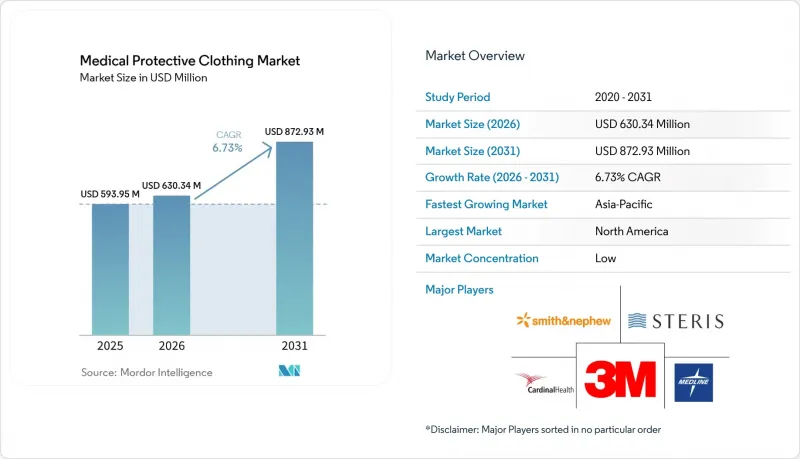
Mordor Intelligence에 의하면, 의료용 보호복 시장 규모는 2025년 5억 9,395만 달러에서 2026년에는 6억 3,034만 달러로 확대되어 2026년부터 2031년까지 CAGR 6.73%로 성장을 지속하여, 2031년에는 8억 7,293만 달러에 이를 것으로 예측됩니다.
본 보고서는 제품 유형(의료용 스크럽, 수술용 가운, 격리용 및 환자용 가운 등), 용도(일회용, 재사용 가능), 최종 사용자(병원 등), 소재(폴리프로필렌 등), 위험 수준(최저 수준 등), 유통 형태(직접 판매 등), 지역(북미, 유럽, 아시아태평양 등)별로 분류되어 있습니다. 시장 전망은 금액(달러) 기준으로 제시되어 있습니다.
세계 의료용 보호복 시장 동향 및 분석
감염 방지 프로토콜 강화: 구조형 가운 수요는 표면상의 수치보다 낮습니다.
의료 관련 감염에 대한 노출은 병원에 있어 일시적인 현상이 아니라, 의료용 보호복 시장에서 가운, 스크럽 및 기타 차단복에 대한 수요를 지속적으로 촉진하고 있습니다. 미국 질병통제예방센터(CDC)에 따르면, 미국의 입원 환자 31명 중 1명은 임의의 날에 적어도 한 건의 의료 관련 감염을 앓고 있으며, 이 때문에 감염 예방은 일상적인 조달 결정의 핵심으로 자리 잡고 있습니다. 이러한 압박은 임상 현장에서 보호복 사용을 문서화하도록 의무화하는 인증 기준 및 운영 기준에 의해 더욱 강화되고 있습니다. 또한 외래수술센터(ASC)도 더 많은 시술 업무를 담당하게 되면서, 이에 따라 보호복 수요는 단순히 병상 수뿐만 아니라 시술 건수와도 밀접한 관련이 있습니다. 이러한 시설의 조달 팀은 특정 처치에 필요한 요구 사항에 맞추어 구성된 표준화된 패키지를 선호하는 경우가 많으며, 이로 인해 공급업체 간의 경쟁은 단순한 단가 경쟁에서 벗어나고 있습니다. 따라서 공급업체가 차단 성능, 규제 준수 여부, 그리고 안정적인 재고 보충 체계를 하나의 제안으로 모두 충족시킬 수 있다면, 의료용 보호복 시장은 그 혜택을 누리게 될 것입니다.
외래 및 당일 수술 건수 증가: 수요의 '성장'이 아니라 "이전"
외래 진료 및 당일 수술로의 전환에 따라, 의료용 보호복 시장에서 보호복을 구매하는처가 변화하고 있습니다. 수요는 입원 시설에서 서로 다른 구매 패턴과 재고 수요를 가진 외래 시설 및 전문 시설로 이동하고 있습니다. 이러한 구매 담당자들은 가운, 드레이프, 부속품을 하나의 주문 가능한 형태로 묶은 시술별 패키지를 선호하는 경우가 많으며, 이로 인해 단가 가시성이 떨어질 뿐만 아니라, 일단 공급업체가 승인되면 전환 비용이 높아질 가능성이 있습니다. 안셀사에 따르면, 이 회사의 클린룸 및 외과용 부문은 26년도 상반기 환율 변동의 영향을 제외한 유기적 성장률에서 2.8%를 기록했습니다. 이는 관리된 환경이나 시술 빈도가 높은 시설에서 처리량이 꾸준히 증가하고 있는 추세와 일치합니다. 이러한 환경에서는 인증 제품과 확실한 리드타임, 그리고 재주문 지원을 모두 제공할 수 있는 공급업체가 유리한 입지를 차지하게 됩니다. 따라서 의료용 보호복 시장은 총 시술 건수가 같은 속도로 증가하지 않더라도 의료 서비스의 전환으로 인해 혜택을 보고 있습니다.
폴리프로필렌 및 면 가격 변동: 제조 단계에서의 이익률 압박
의료용 보호복 시장은 현재 제품 구성의 대부분을 폴리프로필렌과 면이 차지하고 있기 때문에 여전히 원자재 가격 변동의 영향을 받기 쉬운 상황에 놓여 있습니다. 폴리프로필렌은 석유화학제품의 가격 변동과 밀접한 관련이 있어, 일회용 부직포 제품 생산에 크게 의존하고 있는 공급업체들에게는 수익 측면에서 부담이 되고 있습니다. 이 문제는 고정 가격의 기관 대상 계약에서 더욱 심각합니다. 왜냐하면 제조업체는 대개 다음 입찰 주기가 시작될 때까지 비용 상승분을 가격에 반영할 수 없기 때문입니다. 면 소재에 대한 의존도는 세탁 내구성, 착용 시의 편안함, 그리고 섬유 공급 상황에 좌우되는 재사용 가능한 제품 라인에 있어 추가적인 불확실성 요인이 됩니다. 이러한 비용 압박은 폭넓은 제품 포트폴리오를 보유한 공급업체에 유리하게 작용합니다. 왜냐하면, 그들은 일회용 제품 수요와 재사용 가능한 제품, 그리고 혼합 소재 제품 간의 균형을 맞출 수 있기 때문입니다. 따라서 의료용 보호복 시장에서는 소규모의 단일 제품 형태를 취급하는 경쟁사보다, 조달 위험과 소재 조합을 보다 엄격하게 관리하는 제조업체가 우위를 점하게 될 것입니다.
부문별 분석
2025년, 수술 가운은 의료용 보호복 시장 점유율의 33.21%를 차지하고 있으며, 이러한 위상은 무균 수술 환경에서 사용이 필수적이라는 점과 감염 관리 대책과 직접적으로 연관되어 있음을 반영하고 있습니다. 수요는 규제 준수 및 차단 성능이 엄격하게 감시되는 병원이나 수술 건수가 많은 시설에 계속해서 집중되고 있습니다. Medline사는 자사의 수술 가운이 미국 수술실의 40% 이상에서 사용되며, 연간 2,000만 건 이상의 시술을 뒷받침하고 있다고 밝혔는데, 이는 공급업체와의 관계가 얼마나 깊게 구축되어 있는지, 그리고 이것이 해당 부문에서 기존 기업의 입지를 얼마나 공고히 하고 있는지를 보여줍니다. 격리용 가운 및 환자용 가운은 병동, 진단실, 외래 등 다양한 분야에서 사용되고 있으며, 수량은 많지만 단가는 낮은 편이었습니다. 보호 작업복과 위험물 보호복은 보다 전문성이 높은 제품으로, 화학 물질, 생물학적 물질 및 관리 대상인 고위험 환경과 관련이 있었습니다.
압박·지지용 의류는 2031년까지 연평균 7.14%의 성장률이 예상되며, 의료용 보호복 시장에서 가장 빠르게 성장하는 제품 카테고리로 자리매김하고 있습니다. 이러한 확대는 병원 및 장기 요양 시설 전반에 걸쳐 비만외과, 정형외과, 혈관외과 환자를 대상으로 한 표준화된 회복 프로토콜에 의해 뒷받침되고 있습니다. 백의는 진단 및 학술 분야에서의 사용 패턴이 일관되고, 교체 수요도 일상적이었기 때문에 안정적인 추세를 유지했습니다. 모자, 마스크, 신발 커버는 가격 결정력이 제한적인 수량 주도형 조달 채널을 통해 계속해서 유통되었습니다. 클린룸용 작업복은 수량 면에서는 소규모에 그쳤지만, 제약 및 바이오의약품 생산 현장에서는 더욱 엄격한 입자 관리가 요구되기 때문에 단가는 높아졌습니다. 또한, 안셀사는 2026년도 상반기 클린룸 부문에서 환율 변동의 영향을 제외한 유기적 성장률 2.8%를 기록했다고 보고했습니다.
2025년, 일회용 제품은 사용 편의성 부문의 72.83%를 차지했습니다. 이는 감염 관리 업무 흐름의 간소화와 세탁이 필요 없다는 장점이 높이 평가된 것을 반영한 것입니다. 특히 소규모 시설의 경우, 멸균 능력 관리, 섬유 제품의 추적, 외부 위탁에 의한 재처리 계약이 필요하지 않다는 점 때문에 일회용 방식이 선호되었습니다. 한편, 조달 팀이 초기 구매 가격뿐만 아니라 전체 수명 주기에 걸친 비용을 재평가하게 되면서, 재사용 가능한 형식에 대한 관심도 계속해서 높아지고 있습니다. NHS Health Innovation Northwest Cumbria는 2024년, 재사용 가능한 수술 가운이 동등한 일회용 가운에 비해 탄소 발자국이 31%에 불과하며, 1회당 사용 비용을 45% 절감할 수 있다고 보고했습니다. 이를 통해 의료기관 도입을 위한 사업 타당성이 강화되었습니다. 또한, 2024년 BMJ의 분석에 따르면, 재사용 가능한 개인보호장비(PPE) 프로그램을 도입한 미국의 대규모 의료 센터에서는 매립 폐기물을 대폭 줄이는 동시에, 감염률에 측정 가능한 영향을 미치지 않으면서 가운 1벌당 비용을 50% 가까이 절감할 수 있었던 것으로 나타났습니다.
재사용 가능한 제품은 2031년까지 연평균 성장률(CAGR) 8.32%로 확대될 것으로 예상되며, 의료용 보호복 시장에서 가장 빠르게 성장하고 있는 제품군으로 자리매김하고 있습니다. 주요 장애물은 임상적 수용성이 아니라 운영 체계의 정비에 있습니다. 이는 시설이 재사용 프로그램을 확대하기 전에 검증된 처리 체계를 갖추어야 하기 때문입니다. ISO는 2025년에 재사용이 가능한 의료용 섬유 제품의 처리에 관한 지침을 제공하기 위해 ISO/AWI 25199를 마련 중이라고 발표했습니다. 이를 통해 재사용 프로그램을 검토하는 조달 팀의 불확실성이 완화될 가능성이 있습니다. 2025년에 134개국 수술 전후 의료 종사자를 대상으로 실시한 조사 결과, 재사용 가능한 가운의 보호 성능에 대한 오해가 여전히 도입의 큰 걸림돌로 작용하고 있는 것으로 밝혀졌습니다. 이는 인프라 구축과 더불어 교육도 여전히 중요하다는 것을 보여줍니다. 따라서 의료용 보호복 시장이 일회용 제품에서 단번에 전환되고 있는 것은 아니지만, 검증된 재사용 공정에 대한 여지가 분명히 확대되고 있습니다.
지역별 분석
2025년, 북미는 의료용 보호복 시장 점유율의 38.41%를 차지하며, 지역별로는 가장 큰 기여도를 보였습니다. 이 지역의 위상은 높은 의료비 지출, 성숙한 조달 시스템, 그리고 ANSI/AAMI PB70 및 FDA 규제 절차와 연계된 확립된 가운 분류 기준에 의해 뒷받침되었습니다. 미국은 수술 건수, 병원의 구매력, 그리고 공식 제품 인증이 집중되어 있었기 때문에 해당 지역에서 계속해서 최대의 국가별 시장으로 자리매김했습니다. 캐나다와 멕시코는 규모는 작지만 안정적인 수요를 창출하고 있었으며, 이러한 수요는 병원의 현대화와 외래 진료의 꾸준한 확장에 힘입어 뒷받침되고 있었습니다. CDC(미국 질병통제예방센터)의 감염 관리 지침은 의료 시스템 전반에 걸쳐 시술 시 보호복 사용을 계속 권장하고 있으며, 이것이 안정적인 교체 수요를 뒷받침했습니다.
유럽은 의료용 보호복 시장에서 여전히 2위 지역 블록이며, 독일, 영국, 프랑스, 이탈리아가 주요 수요 거점입니다. 독일은 높은 의료비 지출과 고령화 인구의 혜택을 누리고 있으며, Destatis의 보고서에 따르면 2025년에는 인구의 21.5%가 65세 이상이 될 것으로 전망됩니다. 영국에서는 재사용 가능한 가운의 도입이 계속해서 두드러지고 있으며, NHS Health Innovation Northwest Cumbria의 보고서에 따르면 2024년에는 일회용 제품에 비해 가운 1벌당 비용을 45% 절감하고 탄소 발자국을 69% 줄일 수 있었습니다고 합니다. 또한, 개정된 폐기물 기본 지침은 유럽의 섬유 제조업체들에게 새로운 불확실성을 안겨주었으며, 폐기 책임 및 제품 분류에 대해 더욱 엄격한 재검토가 요구되었습니다.
아시아태평양은 2031년까지 연평균 성장률(CAGR) 6.87%로 확대될 것으로 전망되며, 의료용 보호복 시장에서 가장 빠르게 성장하는 지역으로 꼽히고 있습니다. 중국은 여전히 해당 지역에서 가장 큰 제조 및 수요 거점이며, 한편 인도는 3차 의료 수용 능력을 지속적으로 확대하고 있으며, 의료용 섬유 제품에 대한 기준을 계속해서 강화하고 있습니다. 일본은 고령화에 따라 견고한 수요 기반을 구축했으며, 통계청 보고서에 따르면 2024년에는 고령자가 인구의 28%를 차지했습니다. 한국은 선진적인 의료 기술의 활용과 수준 높은 돌봄 환경을 통해 지역 수요를 뒷받침했습니다. 남미는 브라질과 아르헨티나를 필두로 하는 개발도상국 지역 시장으로서의 위상을 유지하고 있으며, 팬데믹 이후의 조달 체계는 점차 체계화되고 있습니다. 중동 및 아프리카 수요는 GCC(걸프협력회의) 국가들의 의료 인프라 투자가 주도한 반면, 남아프리카는 사하라 이남 아프리카의 조달 패턴에서 핵심 시장으로서의 역할을 수행했습니다.
기타 혜택:
- 엑셀 형식 시장 예측(ME) 시트
- 3개월간의 애널리스트 지원
자주 묻는 질문
목차
제1장 서론
제2장 조사 방법
제3장 주요 요약
제4장 시장 구도
제5장 시장 규모와 성장 예측
제6장 경쟁 구도
제7장 시장 기회와 향후 전망
JHS 26.07.03According to Mordor Intelligence, the medical protective clothing market size is expected to grow from USD 593.95 million in 2025 to USD 630.34 million in 2026 and is forecast to reach USD 872.93 million by 2031 at 6.73% CAGR over 2026-2031.
This report is Segmented by Product Type (Medical Scrubs, Surgical Gowns, Isolation and Patient Gowns, and More), Usability (Disposable, Reusable), End User (Hospitals, and More), Material (Polypropylene, and More), Risk Level (Minimal, and More), Distribution (Direct, and More), and Geography (North America, Europe, Asia-Pacific, and More). The Market Forecasts are Provided in Terms of Value (USD).
Global Medical Protective Clothing Market Trends and Insights
Rising Infection Control Protocols: Structural Gown Demand Below the Headline
Healthcare-associated infection exposure is not a temporary event for hospitals, and it continues to renew demand for gowns, scrubs, and other barrier apparel within the medical protective clothing market. The CDC stated that 1 in 31 hospital patients in the United States had at least 1 healthcare-associated infection on any given day, which keeps infection prevention at the center of routine purchasing decisions. This pressure is reinforced by accreditation and operating standards that require documented protective clothing use in clinical settings. Ambulatory surgical centers are also absorbing more procedural work, and that keeps protective garment demand tied closely to procedure counts rather than only to bed capacity. Procurement teams in these settings often prefer standardized packs built around the needs of specific procedures, which shifts supplier competition away from simple unit pricing. The medical protective clothing market therefore benefits when suppliers can match barrier performance, regulatory fit, and dependable replenishment in the same offer.
Expansion of Outpatient and Same-Day Surgical Volumes: Demand Migration, Not Demand Growth
The shift toward outpatient and same-day care is changing where protective garments are purchased within the medical protective clothing market. Demand is moving from inpatient hospitals into ambulatory sites and specialty facilities that operate with different buying patterns and different inventory needs. These buyers often favor procedure-specific packs that bundle gowns, drapes, and accessories into a single orderable format, which can lower per-unit visibility but raise switching costs once a vendor is approved. Ansell reported that its cleanroom and surgical segment posted 2.8% organic constant currency growth in the first half of FY26, which aligns with steady volume expansion in controlled and procedure-heavy settings. This setting rewards vendors that can combine credentialed products with reliable lead times and repeat ordering support. The medical protective clothing market is therefore gaining from care migration even when the total number of procedures does not rise at the same pace.
Polypropylene and Cotton Price Volatility: Margin Compression at the Manufacturing Layer
The medical protective clothing market remains exposed to input swings because polypropylene and cotton still anchor a large share of current product formats. Polypropylene is tied to petrochemical cost movements, and that creates earnings pressure for suppliers that depend heavily on disposable nonwoven output. The problem is sharper in fixed-price institutional contracts because manufacturers often cannot pass cost increases through until the next tender cycle. Cotton exposure adds a second layer of uncertainty for reusable lines that rely on wash durability, wearer comfort, and fiber availability. This cost pressure favors suppliers with broader portfolios because they can balance disposable demand with reusable products and mixed-material offerings. The medical protective clothing market therefore rewards manufacturers that manage procurement risk and material mix with more discipline than smaller single-format competitors.
Other drivers and restraints analyzed in the detailed report include:
- Demand for Fluid-Impervious and Antimicrobial Textile Structures: Beyond Barrier Performance
- Growth of Adaptive Garments for Geriatric and Bariatric Care: The Underwritten Demographic Dividend
- Disposal Compliance and Medical Textile Waste Scrutiny: A Regulatory Gray Zone Narrowing
For complete list of drivers and restraints, kindly check the Table Of Contents.
Segment Analysis
Surgical gowns held 33.21% of the medical protective clothing market share in 2025, and that position reflected their required use in sterile operating environments and their direct link to infection control practice. Demand remained concentrated in hospitals and procedure-heavy settings where regulatory compliance and barrier performance are closely monitored. Medline stated that its surgical gowns were used in over 40% of U.S. operating rooms and supported more than 20 million procedures annually, which shows how deep supplier relationships can reinforce incumbent positions in this category. Isolation and patient gowns served broader ward, diagnostic, and outpatient use cases where volumes were high but unit value was lower. Protective coveralls and hazmat suits remained more specialized and were tied to chemical, biological, and controlled high-risk environments.
Compression and support garments are projected to grow at 7.14% through 2031, which makes them the fastest-growing product category in the medical protective clothing market. Their expansion is being supported by standardized recovery protocols for bariatric, orthopedic, and vascular patients across hospitals and longer-term care settings. Lab coats remained stable because diagnostic and academic use patterns were consistent and replacement needs were routine. Caps, masks, and shoe covers continued to move through volume-led procurement channels where pricing power was limited. Cleanroom apparel stayed smaller in volume, but it carried higher unit values because pharmaceutical and biopharma production sites require stricter particle control, and Ansell reported 2.8% organic constant currency growth in its cleanroom segment in FY26 H1.
Disposable products accounted for 72.83% of the usability segment in 2025, which reflected the appeal of simplified infection control workflows and the absence of laundering requirements. Smaller facilities especially favored disposable formats because they did not need to manage sterilization capacity, textile tracking, or outsourced reprocessing contracts. Reusable formats still gained more attention because procurement teams were reassessing total lifecycle cost instead of looking only at first-purchase price. NHS Health Innovation Northwest Cumbria reported in 2024 that reusable surgical gowns had 31% of the carbon footprint of comparable single-use gowns and delivered 45% cost savings per use, which strengthened the business case for institutional adoption. A 2024 BMJ analysis also stated that large U.S. medical centers using reusable PPE programs diverted substantial landfill waste while achieving nearly 50% per-gown cost savings with no measurable impact on infection rates.
Reusable products are projected to expand at an 8.32% CAGR through 2031, which makes them the fastest-growing usability option in the medical protective clothing market. The main barrier is not clinical acceptability, but operational readiness, because facilities need validated processing arrangements before they can scale reuse programs. ISO stated in 2025 that ISO/AWI 25199 was under development to provide guidelines for processing multiple-use healthcare textiles, which could reduce uncertainty for procurement teams reviewing reusable programs. A 2025 study of peri-operative professionals across 134 countries found that misconceptions about the protective performance of reusable gowns remained a major adoption barrier, which shows that education still matters alongside infrastructure. The medical protective clothing market is therefore not moving away from disposables all at once, but it is clearly opening more room for validated reusable pathways.
Complete Report Scope:
- By Product Type
- Medical Scrubs
- Surgical Gowns
- Isolation and Patient Gowns
- Protective Coveralls and Hazmat Suits
- Lab Coats
- Caps, Masks and Shoe Covers
- Compression and Support Garments
- Adaptive and Patient Clothing
- Cleanroom Apparel
- By Usability
- Disposable
- Reusable
- By End User
- Hospitals
- Ambulatory Surgical Centers
- Out-Patient Clinics
- Diagnostic and Imaging Labs
- Home Health and Long-Term Care
- Dental and Veterinary Clinics
- Research and Academic Institutes
- By Material
- Cotton
- Polyester and Blends
- Polypropylene (SMS and SMMS)
- Polyethylene
- Aramid and High-Performance Blends
- Antimicrobial-Treated Textiles
- Smart and Sensor-Integrated Textiles
- By Risk Level
- Minimal
- Low
- Moderate
- High
- By Distribution Channel
- Direct Institutional Procurement
- Distributors and Wholesalers
- Retail Stores
- E-Commerce and B2B Platforms
- By Geography
- North America
- United States
- Canada
- Mexico
- Europe
- Germany
- United Kingdom
- France
- Italy
- Spain
- Rest of Europe
- Asia-Pacific
- China
- Japan
- India
- Australia
- South Korea
- Rest of Asia-Pacific
- Middle East & Africa
- GCC
- South Africa
- Rest of Middle East & Africa
- South America
- Brazil
- Argentina
- Rest of South America
- North America
Geography Analysis
North America held 38.41% of the medical protective clothing market share in 2025, which made it the largest regional contributor. The region's position rested on high healthcare spending, mature procurement systems, and established gown classification standards tied to ANSI/AAMI PB70 and FDA regulatory pathways. The United States remained the largest country-level market in the region because it concentrated procedure volumes, hospital purchasing power, and formal product credentialing. Canada and Mexico contributed smaller but stable volumes, with demand supported by hospital modernization and steady outpatient expansion. CDC infection control guidance continued to reinforce procedural use of protective apparel across the care system, which supported consistent replacement demand.
Europe remained the second-largest regional block in the medical protective clothing market, with Germany, the United Kingdom, France, and Italy as the main demand centers. Germany benefited from high healthcare spending and an older population, and Destatis reported that 21.5% of the population was aged 65 and above in 2025. The United Kingdom continued to stand out in reusable gown adoption, and NHS Health Innovation Northwest Cumbria documented 45% per-gown cost savings and a 69% carbon footprint reduction versus disposables in 2024. The revised Waste Framework Directive also introduced a new layer of uncertainty for textile producers in Europe, which kept disposal responsibility and product classification under closer review.
Asia-Pacific is projected to expand at a 6.87% CAGR through 2031, which makes it the fastest-growing geography in the medical protective clothing market. China remained the largest manufacturing and demand center within the region, while India continued to expand tertiary care capacity and tighten standards for medical textiles. Japan added a strong demand base through its aging population, and the Statistics Bureau of Japan reported that seniors accounted for 28% of the population in 2024. South Korea supported regional demand through advanced healthcare technology use and a high-quality care environment. South America remained a developing regional opportunity led by Brazil and Argentina, where procurement is becoming more structured after the pandemic period. Middle East and Africa demand was led by GCC healthcare infrastructure investment, while South Africa acted as an anchor market for Sub-Saharan procurement patterns.
- 3M
- Ahlstrom Oyj
- Ansell
- Careismatic Brands, Inc.
- Cardinal Health
- Cintas Corporation
- DuPont
- FIGS, Inc.
- Herculite Products, Inc.
- Hubei Medlink Healthcare Group
- Kimberly-Clark Worldwide
- Lakeland Industries, Inc.
- Landau Uniforms
- Medline Industries
- Molnlycke Health Care
- O and M Halyard, Inc.
- Owens and Minor, Inc.
- Smiths Group
- STERIS
- Superior Group of Companies, Inc.
Additional Benefits:
- The market estimate (ME) sheet in Excel format
- 3 months of analyst support
TABLE OF CONTENTS
1 Introduction
- 1.1 Study Assumptions & Market Definition
- 1.2 Scope of the Study
2 Research Methodology
3 Executive Summary
4 Market Landscape
- 4.1 Market Overview
- 4.2 Market Drivers
- 4.2.1 Rising Infection Control Protocols in Hospitals and Ambulatory Care
- 4.2.2 Expansion of Outpatient and Same-Day Surgical Volumes
- 4.2.3 Demand for Fluid-Impervious and Antimicrobial Textile Structures
- 4.2.4 Hospital Shift Toward B2B E-Procurement and Vendor-Managed Inventory
- 4.2.5 Growth of Adaptive Garments for Geriatric and Bariatric Care
- 4.2.6 Take-Back and Circular Textile Contracts in Large Health Systems
- 4.3 Market Restraints
- 4.3.1 Polypropylene and Cotton Price Volatility
- 4.3.2 Disposal Compliance and Medical Textile Waste Scrutiny
- 4.3.3 High Certification and Validation Cost for SME Entrants
- 4.3.4 Counterfeit and Non-Compliant PPE Diluting Buyer Confidence
- 4.4 Value / Supply-Chain Analysis
- 4.5 Regulatory Landscape
- 4.6 Technological Outlook
- 4.7 Porter's Five Forces Analysis
- 4.7.1 Threat of New Entrants
- 4.7.2 Bargaining Power of Suppliers
- 4.7.3 Bargaining Power of Buyers
- 4.7.4 Threat of Substitutes
- 4.7.5 Industry Rivalry
5 Market Size & Growth Forecasts
- 5.1 By Product Type
- 5.1.1 Medical Scrubs
- 5.1.2 Surgical Gowns
- 5.1.3 Isolation and Patient Gowns
- 5.1.4 Protective Coveralls and Hazmat Suits
- 5.1.5 Lab Coats
- 5.1.6 Caps, Masks and Shoe Covers
- 5.1.7 Compression and Support Garments
- 5.1.8 Adaptive and Patient Clothing
- 5.1.9 Cleanroom Apparel
- 5.2 By Usability
- 5.2.1 Disposable
- 5.2.2 Reusable
- 5.3 By End User
- 5.3.1 Hospitals
- 5.3.2 Ambulatory Surgical Centers
- 5.3.3 Out-Patient Clinics
- 5.3.4 Diagnostic and Imaging Labs
- 5.3.5 Home Health and Long-Term Care
- 5.3.6 Dental and Veterinary Clinics
- 5.3.7 Research and Academic Institutes
- 5.4 By Material
- 5.4.1 Cotton
- 5.4.2 Polyester and Blends
- 5.4.3 Polypropylene (SMS and SMMS)
- 5.4.4 Polyethylene
- 5.4.5 Aramid and High-Performance Blends
- 5.4.6 Antimicrobial-Treated Textiles
- 5.4.7 Smart and Sensor-Integrated Textiles
- 5.5 By Risk Level
- 5.5.1 Minimal
- 5.5.2 Low
- 5.5.3 Moderate
- 5.5.4 High
- 5.6 By Distribution Channel
- 5.6.1 Direct Institutional Procurement
- 5.6.2 Distributors and Wholesalers
- 5.6.3 Retail Stores
- 5.6.4 E-Commerce and B2B Platforms
- 5.7 By Geography
- 5.7.1 North America
- 5.7.1.1 United States
- 5.7.1.2 Canada
- 5.7.1.3 Mexico
- 5.7.2 Europe
- 5.7.2.1 Germany
- 5.7.2.2 United Kingdom
- 5.7.2.3 France
- 5.7.2.4 Italy
- 5.7.2.5 Spain
- 5.7.2.6 Rest of Europe
- 5.7.3 Asia-Pacific
- 5.7.3.1 China
- 5.7.3.2 Japan
- 5.7.3.3 India
- 5.7.3.4 Australia
- 5.7.3.5 South Korea
- 5.7.3.6 Rest of Asia-Pacific
- 5.7.4 Middle East & Africa
- 5.7.4.1 GCC
- 5.7.4.2 South Africa
- 5.7.4.3 Rest of Middle East & Africa
- 5.7.5 South America
- 5.7.5.1 Brazil
- 5.7.5.2 Argentina
- 5.7.5.3 Rest of South America
- 5.7.1 North America
6 Competitive Landscape
- 6.1 Market Concentration
- 6.2 Market Share Analysis
- 6.3 Company Profiles (includes Global level Overview, Market-level Overview, Core Segments, Financials, Strategic Information, Market Rank/Share, Products & Services, Recent Developments)
- 6.3.1 3M
- 6.3.2 Ahlstrom Oyj
- 6.3.3 Ansell Limited
- 6.3.4 Careismatic Brands, Inc.
- 6.3.5 Cardinal Health, Inc.
- 6.3.6 Cintas Corporation
- 6.3.7 DuPont de Nemours, Inc.
- 6.3.8 FIGS, Inc.
- 6.3.9 Herculite Products, Inc.
- 6.3.10 Hubei Medlink Healthcare Group
- 6.3.11 Kimberly-Clark Corporation
- 6.3.12 Lakeland Industries, Inc.
- 6.3.13 Landau Uniforms
- 6.3.14 Medline Industries, LP
- 6.3.15 Molnlycke Health Care AB
- 6.3.16 O and M Halyard, Inc.
- 6.3.17 Owens and Minor, Inc.
- 6.3.18 Smith and Nephew plc
- 6.3.19 STERIS plc
- 6.3.20 Superior Group of Companies, Inc.
7 Market Opportunities & Future Outlook
- 7.1 White-space & Unmet-need Assessment