
|
시장보고서
상품코드
2073082
의료 사기 분석 시장 : 점유율 분석, 업계 동향과 통계, 성장 예측(2026-2031년)Healthcare Fraud Analytics - Market Share Analysis, Industry Trends & Statistics, Growth Forecasts (2026 - 2031) |
||||||
 Mordor Intelligence
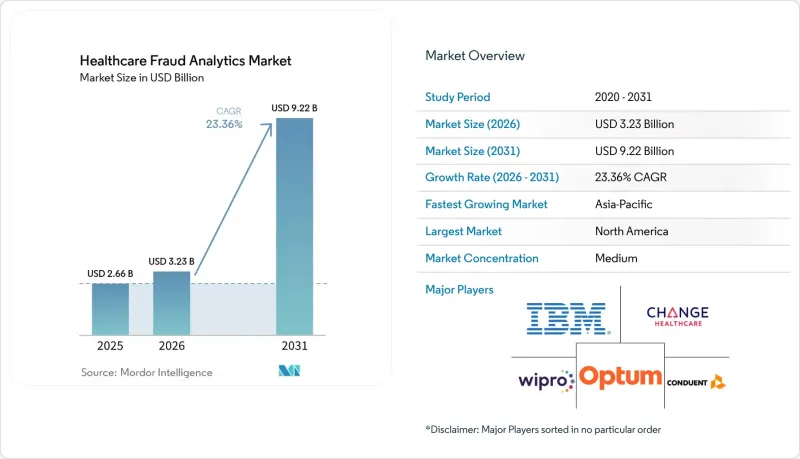
Mordor Intelligence에 의하면, 의료 사기 분석 시장 규모는 2025년 26억 6,000만 달러, 2026년 32억 3,000만 달러에서 2031년까지 92억 2,000만 달러로 확대한다고 예측되고 있어 2026-2031년까지 연평균 복합 성장률(CAGR)은 23.36%를 나타낼 전망입니다.
본 보고서는 솔루션 유형(기술형, 예측형, 처방형), 도입 형태(On-Premise, 클라우드 기반), 용도(청구 심사, 지급 후, 지급 전, 약국 청구, 지급 적정성), 최종 사용자(의료 제공업체, 보험사, 정부, 제3자 기관), 지역(북미, 유럽, 기타)별로 분류되어 있습니다. 시장 전망치는 금액(달러)으로 표시되어 있습니다.
전 세계 의료 사기 분석 시장 동향 및 인사이트
청구 및 지급 워크플로우 전반에 걸친 부정 행위의 복잡화
의료 사기 분석 시장이 확대되고 있는 배경에는 부정 행위가 더 이상 단일하고 고립된 청구 사건에 그치지 않고, 청구 및 결제 채널, 의료 제공업체, 약국 거래의 범위를 넘어 확산되고 있다는 점이 있습니다. CMS(미국 의료보험·의료보조 서비스 센터)에 따르면, 2025년에 사기 방지 운영 센터는 부정 의혹이 있는 메디케어 결제액 중 57억 달러를 보류하고, 37억 달러 상당의 청구와 관련된 372건의 조회를 실시했습니다. 이는 현재의 사기 수법이 얼마나 광범위하고 서로 밀접하게 연관되어 있는지를 보여줍니다. 2025년 『Scientific Reports』지에 게재된 논문에 따르면, 이종 그래프 신경망 모델을 활용함으로써 의료 청구 내의 활동 수준에서 부정행위를 감지할 수 있음이 밝혀졌습니다. 이는 단순히 명세 항목의 이상 여부를 검사하는 데 그치지 않고, 상호 관계를 추적할 필요성이 높아지고 있음을 반영하고 있습니다. 이 점은 중요합니다. 왜냐하면 보험사는 더 이상 고립된 코딩 오류나 단순한 과다 청구 행위만을 다루고 있는 것이 아니기 때문입니다. 보험사는 개별 청구를 단독으로 볼 때 정상적으로 보일 수 있는 의료 제공업체, 환자, 서비스, 제출 경로에 걸쳐 있는 조직적인 활동을 면밀히 조사했습니다. 그 결과, 의료 사기 분석 시장은 수동 규칙 라이브러리나 정적 모니터링 목록보다 신속하게 대응할 수 있는 지속적으로 업데이트되는 모델과 보다 광범위한 데이터 연동으로 전환되고 있습니다.
의료 결제 부문에서 AI 기반 이상 감지 기술의 확대
또한, AI 기반 이상 감지 기술이 일상적인 지급 심사 및 조사 워크플로우에 실용화됨에 따라 의료 사기 분석 시장도 성장세를 보이고 있습니다. 『Journal of Big Data』 저널의 2025년 리뷰에 따르면, 고도화된 머신러닝 접근법은 의료 사기 감지 과제에서 많은 구식 분류기보다 뛰어난 성능을 보여주고 있으며, 이는 기본적인 규칙 엔진에만 의존하던 방식에서 점차 벗어나고 있음을 뒷받침합니다. 2025년 『Information』지에 게재된 논문에서는 페더레이티드 러닝(분산 학습)을 통해 원시 환자 데이터를 공개하지 않고도 분산된 보험사 데이터셋 전체를 활용해 모델 훈련을 확장할 수 있음이 밝혀졌습니다. 이는 규제가 엄격한 의료 및 보험 환경에서 중요한 사항입니다. 또한, 『Artificial Intelligence in Medicine』지에 게재된 2024년 체계적 문헌고찰에 따르면, 라벨링된 부정 사례의 수가 제한적이라는 점이 여전히 모델 보정에 제약을 주고 있으며, 이로 인해 검증의 질이 플랫폼 선정에 있어 여전히 중요한 요소임이 밝혀졌습니다. 이러한 인사이트은 정적인 경보 라이브러리에 대한 의존도를 낮추고, 범위가 좁은 사후 감사를 줄이기 위해 의료 부정 분석 시장에서 AI의 보다 광범위한 활용을 촉진할 것입니다. 이상 감지, 설명 가능한 출력, 조사 담당자의 워크플로우 지원, 안정적인 모델 거버넌스를 결합할 수 있는 공급업체는 단순한 감지 점수만을 제공하는 공급업체보다 더 신속하게 구매자의 신뢰를 얻을 수 있을 것으로 보입니다.
청구 데이터, EHR, 약국 데이터 간의 상호운용성 격차
상호 운용성은 의료 사기 분석 시장에서 여전히 큰 걸림돌로 남아 있습니다. 이는 청구 데이터, 임상 데이터, 조제 데이터가 대부분의 경우 별도의 시스템에 저장되어 있어, 완전한 사기 심사를 수행하기에는 충분한 연동이 이루어지지 않았기 때문입니다. 아시아개발은행의 조사에 따르면, 조사 대상인 아시아태평양 보험사의 90%가 보다 상세한 부정 분석에 필요한 ICD 코드나 DRG 코드를 수집하지 않고 있으며, 이로 인해 모델 훈련 및 벤치마킹의 깊이가 현저히 제한되고 있습니다. 이러한 격차로 인해, 특히 디지털 기록이 아직 불완전한 시장에서 의료 제공업체, 치료법, 지불 유형 간의 행동을 비교하는 능력이 약화되고 있습니다. 독일 법정보험자연합은 단일 보험사만으로는 여러 지급 주체에 걸쳐 있는 체계적인 패턴을 쉽게 파악할 수 없기 때문에 청구 데이터의 보다 광범위한 공유를 추진하고 있습니다. 기록이 부문화된 상태로 남아 있으면, 분석가는 파일 통합에 많은 시간을 소비하게 되어, 의심스러운 활동을 검증하는 데 할애할 시간이 줄어들게 됩니다. 이로 인해 의료 부정 분석 시장에서의 도입이 지연되면서, 이미 광범위한 벤치마크 데이터와 강력한 데이터 통합 도구를 보유하고 있는 벤더에게 구조적인 우위가 주어지게 됩니다.
부문별 분석
2025년, 서술적 분석은 의료 사기 분석 시장 점유율의 61.17%를 차지하며, 시장에서 가장 큰 솔루션 유형으로서의 입지를 유지했습니다. 이러한 지위는 지급 기관이나 공공 프로그램의 감사 환경에서 수년 동안 사후 청구 심사, 지급 패턴 분석, 청구 이상 점검에 활용되어 온 데 기인합니다. 많은 조직은 재현 가능한 보고서 작성, 과거 데이터와의 비교, 수년에 걸쳐 구축된 조사 담당자의 업무 흐름을 지원하는 기술적 도구에 여전히 의존하고 있습니다. 예측 분석 시장은 2031년까지 연평균 성장률(CAGR) 24.37%로 성장할 것으로 전망되며, 보험사들이 청구 건이 전체 결제 주기를 거치기 전에 비정상적인 행동을 감지할 수 있는 조기 경보 신호를 요구함에 따라 이 솔루션의 의료 사기 분석 시장 규모는 확대되고 있습니다. 처방 분석은 여전히 가장 작은 부문이지만, 플랫폼이 심사 워크플로우 내에서 청구 보류, 결제 중지, 사례 배정 조치를 권장할 수 있는 환경에서 점차 주목을 받고 있습니다.
『Journal of Big Data』지의 조사에 따르면, 딥러닝 및 메타러닝 접근법은 부정 감지 과제에서 많은 기존 모델보다 뛰어난 성능을 발휘하는 것으로 밝혀졌으며, 이는 예측 기능으로의 지속적인 전환을 뒷받침하는 것입니다. MDPI는 또한 연방 학습(federated learning)을 통해 원시 환자 데이터를 공유하지 않고도 보험사 간에 모델 훈련을 확대할 수 있다고 지적하고 있으며, 이는 개인정보 보호가 중시되는 의료 시스템에서 중요한 사항입니다. 이러한 동향은 의료 사기 분석 업계에서 기술적 심사에서 예측적 조치로의 전환을 촉진하고 있습니다. 특히, 설명 가능성을 저해하지 않으면서 지급 전 관리를 강화하고 싶어 하는 지급자에게는 중요합니다. 많은 구매자들은 보다 자동화된 개입 모델로 전환하기 전에 여전히 명확한 과거의 증거 기반을 필요로 하기 때문에 기술적 도구의 중요성은 앞으로도 지속될 것으로 보입니다. 솔루션 유형 간의 단기적 균형은 급격한 교체가 아닌 단계적인 현대화를 시사하며, 이는 의료 사기 분석 시장 전체에 걸쳐 꾸준한 업데이트 수요를 뒷받침하고 있습니다.
2025년에는 On-Premise형 도입이 54.68%의 점유율을 차지하며, 의료 사기 분석 시장 전체에서 클라우드 기반 모델을 앞질렀습니다. 감사 기록, 보안 심사, 조달 규정이 엄격한 경우, 정부 프로그램, 연방 정부 계약업체, 대규모 지급 기관은 여전히 더 엄격한 내부 관리를 선호합니다. 대규모 기관의 경우, 사기 방지 시스템을 이미 사내에서 호스팅되고 있는 보다 광범위한 결제 및 청구 관리 환경에 연결하는 경우가 많기 때문에 기존 인프라 투자 역시 이러한 추세를 뒷받침하고 있습니다. 클라우드 기반 도입은 2031년까지 연평균 성장률(CAGR) 26.06%를 나타낼 것으로 예측되며, 이러한 성장세는 보다 신속한 도입과 인프라 부담 완화를 원하는 중규모 지급 기관, 관리 기관 및 지역 보험사 수요를 반영한 것입니다. 이러한 성장 격차는 구매자들이 긴 사내 개발 주기를 기다리지 않고 AI 기능을 요구함에 따라, 도입의 유연성이 점점 더 중요해지고 있음을 보여줍니다.
코그니전트에 따르면, Bupa Hong Kong은 2025년 12월, 청구 처리 자동화, 부정·낭비·남용 감지, 규정 준수 도구를 클라우드 중심의 제공 체계로 통합한 AI 기반 BPaaS 모델을 도입했습니다. 이 사례는 시장에서 분석, 프로세스 혁신, 운영 관리가 하나의 계약으로 통합되는 경향이 강해지고 있음을 보여줍니다. 또한, 모델 훈련이나 실시간 스코어링을 위해 유연한 컴퓨팅 성능이 필요하지만, 유지보수를 위해 대규모 사내 팀을 관리하고 싶지 않은 구매자층 역시 클라우드의 성장을 뒷받침하고 있습니다. On-Premise형 시스템은 대규모 정부 프로그램이나 규제가 엄격한 환경에서는 여전히 중요하게 여겨지겠지만, 클라우드 도입의 성장세가 계속해서 견조할 것으로 보입니다. 이에 따라 의료 사기 분석 업계에서는 단일하고 획일적인 전환이 아닌 다양한 도입 경로가 예상되며, 예측 기간 동안 두 호스팅 모델 모두 상업적으로 중요한 위치를 계속 차지할 것으로 보입니다.
지역별 분석
2025년, 북미는 의료 사기 분석 시장의 43.64%를 차지하며, 해당 시장에서 가장 규모가 큰 지역 거점으로서의 위상을 유지했습니다. CMS(미국 의료보험서비스센터)에 따르면, 2025년 중 “사기 방지 운영 센터(Fraud Defense Operations Center)”는 메디케어 부정 청구 의혹이 있는 57억 달러 규모의 결제를 중단하고, 37억 달러 상당의 청구와 관련된 372건의 조사 요청을 발부했다고 합니다. 이는 해당 지역의 강력한 단속 체계와 데이터 기반 모니터링 모델을 뒷받침하는 것입니다. 이러한 철저한 단속 체제를 통해 미국은 의료 사기 분석 시장에서 해당 지역에서 확고한 선두 위치를 차지하고 있습니다. 이는 공공 프로그램과 민간 보험사 모두 더 강력한 감지 및 감사 지원이 필요하기 때문입니다. 캐나다와 멕시코는 여전히 소규모 시장이지만, 보험사의 디지털화와 공공 부문의 현대화가 진행되고 있어 청구 심사 및 지급 관리와 관련된 특정 업무 프로세스에 대한 도입이 계속해서 촉진되고 있습니다. 북미의 조달 활동은 규정 준수, 감사 대응 체계, 사후 회수 노력에만 의존하는 것이 아니라, 결제 전에 의심스러운 청구에 대처할 필요성과 밀접한 관련이 있습니다.
유럽은 이미 체계적인 부정 방지 대책과 공식적인 심사 체계를 도입한 각국의 보험 제도에 힘입어, 의료 사기 분석 시장에서 여전히 2위의 규모를 유지하고 있습니다. 프랑스에서는 2025년에 적발 및 예방된 건강보험 사기 건수가 증가했다고 보고되었으며, 이는 공적 보험 기관들이 분석을 통한 모니터링과 전용 부정 방지 활동을 확대하고 있음을 보여줍니다. 독일 역시 추적된 청구 사기 총액이 사상 최고치를 기록했다고 보고했으며, 보험사 간 횡단적 감지 능력을 향상시키기 위해 보다 광범위한 데이터 공유 방안을 모색하고 있습니다. 이는 분산된 지불자 구조 전반에 걸친 가시성 공유가 지역 전체에서 더욱 광범위하게 요구되고 있음을 시사합니다. 중동 및 아프리카와 남미는 여전히 초기 단계 시장이지만, 걸프 지역 국가들의 의료 시스템 디지털화와 브라질의 민간 보험 발전이 단계적 도입을 위한 실질적인 기반을 마련해 가고 있습니다. 이 지역들은 현재로서는 규모가 작지만, 디지털 청구 관리의 개선과 부정 방지 대책의 체계화가 진행됨에 따라 의료 부정 분석 시장으로의 진입 경로는 점점 더 명확해지고 있습니다.
아시아태평양은 2031년까지 연평균 성장률(CAGR) 25.66%를 기록하며 성장할 것으로 예상되며, 해당 지역의 의료 부정 행위 분석 시장 규모는 조사 기간 동안 다른 어느 지역보다 빠르게 확대되고 있습니다. 아시아개발은행(ADB)에 따르면, 아시아태평양 전체 건강보험 청구 비용의 30-40%가 부정, 낭비, 남용에서 비롯되는 반면, 조사 대상 보험사의 90%는 ICD 코드나 DRG 코드를 수집하지 않고 있는 것으로 나타났습니다. 이는 문제의 규모와 데이터 공백의 심각성을 보여줍니다. 『Nature』지는 중국이 “사회 전체를 아우르는 접근 방식”를 통해 디지털 헬스 거버넌스를 추진하고 있으며, 의료 데이터 인프라 간의 연동이 진전됨에 따라 보험금 청구 모니터링 및 감사 시스템에서 AI의 보다 광범위한 활용이 촉진되고 있다고 보도했습니다. 이 지역의 성장 요인으로는 보험 가입자 수 증가, 공공 디지털 헬스 프로그램, 그리고 대규모 피보험자 집단 전체에 적용 가능한 확장 가능한 분석 기법으로의 전환을 요구하는 강력한 압력 등이 꼽힙니다.
기타 혜택
- 엑셀 형식 시장 예측(ME) 시트
- 3개월간의 애널리스트 지원
자주 묻는 질문
목차
제1장 서론
제2장 조사 방법
제3장 주요 요약
제4장 시장 구도
제5장 시장 규모와 성장 예측
제6장 경쟁 구도
제7장 시장 기회와 향후 전망
JHS 26.07.07According to Mordor Intelligence, the healthcare fraud analytics market size is projected to expand from USD 2.66 billion in 2025 and USD 3.23 billion in 2026 to USD 9.22 billion by 2031, registering a CAGR of 23.36% between 2026 to 2031.
This report is Segmented by Solution Type (Descriptive, Predictive, Prescriptive), Deployment Mode (On-Premises, Cloud-Based), Application (Claims Review, Postpayment, Prepayment, Pharmacy Billing, Payment Integrity), End User (Providers, Insurance Companies, Government, Third-Party Providers), and Geography (North America, Europe, and More). The Market Forecasts are Provided in Value (USD).
Global Healthcare Fraud Analytics Market Trends and Insights
Rising Fraud Complexity Across Claims and Payment Workflows
The healthcare fraud analytics market is expanding because fraudulent behavior now moves across claims, payment channels, provider entities, and pharmacy transactions instead of staying inside one isolated billing event. CMS said the Fraud Defense Operations Center suspended USD 5.7 billion in suspected fraudulent Medicare payments and generated 372 referrals tied to USD 3.7 billion in billing during 2025, which shows how broad and connected current fraud patterns have become. A 2025 Scientific Reports paper showed that heterogeneous graph neural network models can detect fraud at the activity level within medical claims, which reflects the growing need to trace relationships rather than only inspect line-item anomalies. That matters because payers are no longer dealing only with isolated coding mistakes or simple overbilling behavior. They are reviewing coordinated activity across providers, patients, services, and submission paths that can look normal when each claim is viewed on its own. As a result, the healthcare fraud analytics market is moving toward continuously updated models and broader data linkages that can adapt faster than manual rule libraries and static watch lists.
Expansion of AI-Based Anomaly Detection in Healthcare Payments
The healthcare fraud analytics market is also gaining momentum as AI-based anomaly detection becomes more practical in daily payment review and investigative workflows. A 2025 review in the Journal of Big Data found that advanced machine learning approaches outperformed many older classifiers in healthcare fraud detection tasks, which supports the ongoing move away from basic rule engines alone. A 2025 paper in Information said federated learning can expand model training across decentralized insurer datasets without exposing raw patient data, which is important in heavily regulated care and insurance environments. A 2024 systematic review in Artificial Intelligence in Medicine also found that limited labeled fraud outcomes still constrain model calibration, which keeps validation quality central to platform selection. These findings support broader use of AI in the healthcare fraud analytics market because they reduce dependence on static alert libraries and narrow retrospective audits. Vendors that can pair anomaly detection with explainable outputs, investigator workflow support, and stable model governance are likely to gain buyer trust more quickly than vendors offering detection scores alone.
Interoperability Gaps Between Claims, EHR, and Pharmacy Data
Interoperability remains a major brake on the healthcare fraud analytics market because claims, clinical, and pharmacy data often sit in separate systems that do not connect well enough for full fraud review. The Asian Development Bank found that 90% of surveyed Asia-Pacific insurers do not collect the ICD or DRG codes needed for deeper fraud analysis, which sharply limits model training and benchmarking depth. That gap weakens the ability to compare behavior across providers, treatments, and payment types, especially in markets where digital records are still incomplete. Germany's statutory insurer federation has pushed for broader billing data pooling because single insurers cannot easily see organized patterns that spread across multiple payers. When records remain fragmented, analysts spend more time stitching files together and less time validating suspicious activity. This slows deployment in the healthcare fraud analytics market and gives a structural advantage to vendors that already hold wider benchmark data and stronger data-integration tools.
Other drivers and restraints analyzed in the detailed report include:
- Growth in Real-Time Prepayment Controls by Payers
- Regulatory Pressure for Program Integrity and Audit Readiness
- High Tuning Burden for False Positive Reduction
For complete list of drivers and restraints, kindly check the Table Of Contents.
Segment Analysis
Descriptive analytics held 61.17% of healthcare fraud analytics market share in 2025, which kept it as the largest solution type in the market. Its position came from long use in retrospective claims review, payment pattern analysis, and billing anomaly checks across payer and public program audit settings. Many organizations still depend on descriptive tools because they support repeatable reporting, historical comparisons, and investigator workflows that have been built over many years. Predictive analytics is projected to grow at 24.37% CAGR through 2031, and the healthcare fraud analytics market size for this solution is rising as payers look for earlier warning signals that can surface abnormal behavior before claims move through full payment cycles. Prescriptive analytics remained the smallest segment, but it is gaining attention in environments where platforms can recommend claim holds, payment pauses, and case routing actions inside the review workflow.
Research in the Journal of Big Data found that deep learning and meta-learning approaches can outperform many legacy models in fraud detection tasks, which supports continued movement toward predictive capability. MDPI also noted that federated learning could widen model training across insurers without requiring raw patient data to be shared, which is important in privacy-sensitive health systems. These developments support the shift from descriptive review toward predictive action in the healthcare fraud analytics industry, especially where payers want stronger prepayment controls without losing explainability. Even so, descriptive tools should remain important because many buyers still need a clear historical evidence base before they expand into more automated intervention models. The near-term balance across solution types suggests gradual modernization rather than abrupt replacement, which supports steady renewal demand across the healthcare fraud analytics market.
On-premises deployment held 54.68% share in 2025, which kept it ahead of cloud-based models across the healthcare fraud analytics market. Government programs, federal contractors, and large payer organizations still prefer tighter local control when audit trails, security reviews, and procurement rules are strict. Existing infrastructure investments also support this position because large institutions often connect fraud systems to broader payment and claims administration environments that are already hosted internally. Cloud-based deployment is forecast to grow at 26.06% CAGR through 2031, and this pace reflects demand from mid-sized payers, administrators, and regional insurers that want faster rollout and lower infrastructure burden. The growth gap shows that deployment flexibility is becoming more important as buyers seek AI capability without waiting for long internal build cycles.
Cognizant said Bupa Hong Kong selected an AI-driven BPaaS model in December 2025 that combines claims automation, fraud, waste, and abuse detection, and compliance tooling in a cloud-led delivery structure. That example shows how the market is increasingly packaging analytics, process change, and managed operations into one contract. Cloud growth is also supported by buyers who need elastic computing power for model training and live scoring, but do not want to manage large internal teams for maintenance. On-premises systems should remain relevant in large government programs and tightly regulated environments, but growth is likely to stay stronger in cloud deployments. This leaves the healthcare fraud analytics industry with a mixed deployment path rather than a single uniform shift, which should keep both hosting models commercially relevant through the forecast period.
Complete Report Scope:
- By Solution Type
- Descriptive Analytics
- Predictive Analytics
- Prescriptive Analytics
- By Deployment Mode
- On-Premises
- Cloud-Based
- By Application
- Insurance Claims Review
- Postpayment Review
- Prepayment Review
- Pharmacy Billing Misuse
- Payment Integrity
- Other Applications
- By End User
- Healthcare Providers
- Insurance Companies
- Government Organizations
- Third-Party Service Providers
- By Geography
- North America
- United States
- Canada
- Mexico
- Europe
- Germany
- United Kingdom
- France
- Italy
- Spain
- Rest of Europe
- Asia-Pacific
- China
- Japan
- India
- Australia
- South Korea
- Rest of Asia-Pacific
- Middle East & Africa
- GCC
- South Africa
- Rest of Middle East & Africa
- South America
- Brazil
- Argentina
- Rest of South America
- North America
Geography Analysis
North America held 43.64% of the healthcare fraud analytics market share in 2025, which kept it as the largest regional base in the market. CMS said the Fraud Defense Operations Center suspended USD 5.7 billion in suspected fraudulent Medicare payments and generated 372 referrals tied to USD 3.7 billion in billing during 2025, underscoring the region's strong enforcement intensity and data-driven oversight model. This enforcement depth gives the United States the region's clear lead in the healthcare fraud analytics market because public programs and private payers both need stronger detection and audit support. Canada and Mexico remain smaller markets, but payer digitization and public sector modernization continue to support adoption in specific workflows tied to claims review and payment control. Procurement in North America is closely linked to compliance, audit readiness, and the need to act on suspicious claims before payment rather than relying only on later recovery efforts.
Europe remained the second-largest regional base in the healthcare fraud analytics market, supported by national insurance systems that already use structured fraud controls and formal review frameworks. France reported a higher level of detected and prevented health insurance fraud in 2025, which shows that public payers are expanding analytical oversight and dedicated anti-fraud activity. Germany also reported its highest tracked billing fraud total and is seeking broader data pooling to improve cross-insurer detection, which points to a wider regional need for shared visibility across fragmented payer structures. The Middle East, Africa, and South America are still early-stage markets, but health system digitization in the Gulf and private insurance development in Brazil are creating a practical base for gradual adoption. These regions are smaller today, yet their path into the healthcare fraud analytics market is becoming clearer as digital claims administration improves and fraud controls become more formalized.
Asia-Pacific is projected to grow at 25.66% CAGR through 2031, and the healthcare fraud analytics market size in the region is rising faster than in any other geography in the study period. The Asian Development Bank said fraud, waste, and abuse account for 30-40% of health insurance claims costs across Asia-Pacific, while 90% of surveyed insurers do not collect ICD or DRG codes, which shows both the scale of the problem and the depth of the data gap. Nature reported that China is advancing digital health governance through a whole-of-society approach, which supports broader use of AI in claims oversight and audit systems as health data infrastructure becomes more coordinated. Growth in this region comes from expanding insurance pools, public digital health programs, and strong pressure to replace manual review with scalable analytics that can work across large beneficiary populations.
- Change Healthcare
- Codoxo
- Conduent Incorporated
- Cotiviti, Inc.
- DXC Technology Company
- Exl Service
- Fair Isaac Corporation
- FRAUDLENS INC.
- FRISS International B.V.
- H2O.ai
- HCL Technologies Limited
- Healthcare Fraud Shield
- IBM
- LexisNexis Risk Solutions
- MultiPlan Corporation
- Optum
- Pondera Solutions
- Qlarant Commercial Solutions Inc.
- SAS Institute
- Wipro
Additional Benefits:
- The market estimate (ME) sheet in Excel format
- 3 months of analyst support
TABLE OF CONTENTS
1 Introduction
- 1.1 Study Assumptions & Market Definition
- 1.2 Scope of the Study
2 Research Methodology
3 Executive Summary
4 Market Landscape
- 4.1 Market Overview
- 4.2 Market Drivers
- 4.2.1 Rising Fraud Complexity Across Claims and Payment Workflows
- 4.2.2 Expansion of AI-Based Anomaly Detection in Healthcare Payments
- 4.2.3 Growth in Real-Time Prepayment Controls by Payers
- 4.2.4 Regulatory Pressure for Program Integrity and Audit Readiness
- 4.2.5 Underreported, Cross-Channel Fraud Linkage Across Pharmacy and Medical Claims
- 4.2.6 Underreported, Demand for Graph-Based Provider-Patient-Network Intelligence
- 4.3 Market Restraints
- 4.3.1 Interoperability Gaps Between Claims, EHR, and Pharmacy Data
- 4.3.2 High Tuning Burden for False Positive Reduction
- 4.3.3 Privacy, Data Residency, and Model Governance Constraints
- 4.3.4 Underreported, Limited Access to Labeled Fraud Outcomes for Model Training
- 4.4 Value / Supply-Chain Analysis
- 4.5 Regulatory Landscape
- 4.6 Technological Outlook
- 4.7 Porter's Five Forces Analysis
- 4.7.1 Threat of New Entrants
- 4.7.2 Bargaining Power of Suppliers
- 4.7.3 Bargaining Power of Buyers
- 4.7.4 Threat of Substitutes
- 4.7.5 Industry Rivalry
5 Market Size & Growth Forecasts
- 5.1 By Solution Type
- 5.1.1 Descriptive Analytics
- 5.1.2 Predictive Analytics
- 5.1.3 Prescriptive Analytics
- 5.2 By Deployment Mode
- 5.2.1 On-Premises
- 5.2.2 Cloud-Based
- 5.3 By Application
- 5.3.1 Insurance Claims Review
- 5.3.2 Postpayment Review
- 5.3.3 Prepayment Review
- 5.3.4 Pharmacy Billing Misuse
- 5.3.5 Payment Integrity
- 5.3.6 Other Applications
- 5.4 By End User
- 5.4.1 Healthcare Providers
- 5.4.2 Insurance Companies
- 5.4.3 Government Organizations
- 5.4.4 Third-Party Service Providers
- 5.5 By Geography
- 5.5.1 North America
- 5.5.1.1 United States
- 5.5.1.2 Canada
- 5.5.1.3 Mexico
- 5.5.2 Europe
- 5.5.2.1 Germany
- 5.5.2.2 United Kingdom
- 5.5.2.3 France
- 5.5.2.4 Italy
- 5.5.2.5 Spain
- 5.5.2.6 Rest of Europe
- 5.5.3 Asia-Pacific
- 5.5.3.1 China
- 5.5.3.2 Japan
- 5.5.3.3 India
- 5.5.3.4 Australia
- 5.5.3.5 South Korea
- 5.5.3.6 Rest of Asia-Pacific
- 5.5.4 Middle East & Africa
- 5.5.4.1 GCC
- 5.5.4.2 South Africa
- 5.5.4.3 Rest of Middle East & Africa
- 5.5.5 South America
- 5.5.5.1 Brazil
- 5.5.5.2 Argentina
- 5.5.5.3 Rest of South America
- 5.5.1 North America
6 Competitive Landscape
- 6.1 Market Concentration
- 6.2 Market Share Analysis
- 6.3 Company Profiles (includes Global Level Overview, Market-level Overview, Core Segments, Financials, Strategic Information, Market Rank/Share, Products & Services, Recent Developments)
- 6.3.1 Change Healthcare
- 6.3.2 Codoxo
- 6.3.3 Conduent Incorporated
- 6.3.4 Cotiviti, Inc.
- 6.3.5 DXC Technology Company
- 6.3.6 ExlService Holdings, Inc.
- 6.3.7 Fair Isaac Corporation
- 6.3.8 FRAUDLENS INC.
- 6.3.9 FRISS International B.V.
- 6.3.10 H2O.ai
- 6.3.11 HCL Technologies Limited
- 6.3.12 Healthcare Fraud Shield
- 6.3.13 IBM Corporation
- 6.3.14 LexisNexis Risk Solutions
- 6.3.15 MultiPlan Corporation
- 6.3.16 Optum Inc.
- 6.3.17 Pondera Solutions
- 6.3.18 Qlarant Commercial Solutions Inc.
- 6.3.19 SAS Institute Inc.
- 6.3.20 Wipro Limited
7 Market Opportunities & Future Outlook
- 7.1 White-space & Unmet-need Assessment