|
시장보고서
상품코드
2073111
인도의 올레오케미컬 시장 시장 : 점유율 분석, 업계 동향과 통계, 성장 예측(2026-2031년)India Oleochemicals - Market Share Analysis, Industry Trends & Statistics, Growth Forecasts (2026 - 2031) |
||||||
 Mordor Intelligence
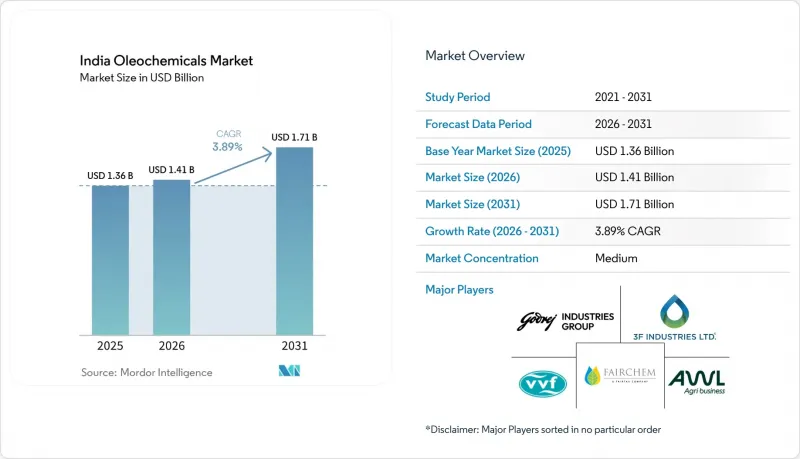
Mordor Intelligence에 의하면, 인도 올레오케미컬 시장 규모는 2025년에 13억 6,000만 달러로 평가되었고 2026년 14억 1,000만 달러에서 2031년까지 17억 1,000만 달러에 이를 것으로 예측되며, 예측 기간(2026-2031년) CAGR은 3.89%를 나타낼 전망입니다.
본 보고서는 제품별(지방산 메틸에스테르, 지방알코올, 글리세린, 지방산, 기타), 용도별(의약품·퍼스널케어, 비누 및 세제, 식품 및 음료, 폴리머, 기타), 원료별(팜유계, 대두유 및 그 유도체, 피마자유계, 동물성 수지)로 분류되어 있습니다. 시장 전망은 금액(달러) 기준으로 제시되어 있습니다.
인도 올레오케미컬 시장 동향 및 인사이트
개인 위생 용품 수요의 급증
퍼스널케어 시장의 확대에 따라, 제형 개발자들이 클린 라벨 요건을 충족하기 위해 황산염계 성분을 대체하는 움직임이 확산되면서 C12-C14 지방알코올에 대한 새로운 수요가 발생하고 있습니다. 인도 표준국(BIS)은 2025년에 IS 4707을 개정하여 중금속 함유량에 상한선을 설정하고 pH 범위를 더욱 엄격하게 규정했습니다. 이로 인해 중소 브랜드들은 RSPO 기준을 충족하는 원료를 사용해야만 하는 상황에 처해 있습니다. 2026년 3월에 가동을 시작한 쿠로다 인디아의 다헤지 공장은 EXCiPACT 인증을 획득한 에스테르를 공급하고 있으며, 이 제품들은 15-20%의 프리미엄 가격에 판매되고 있습니다. 이는 고품질 원료에 대한 수요가 지속되고 있음을 보여줍니다. 2·3급 도시에서 가처분 소득이 증가함에 따라 1인당 소비가 늘어나는 한편, 국제 브랜드들은 인도의 비용 경쟁력을 활용하여 인증을 받은 오레오케미컬을 수출하고 있습니다. 따라서 인도의 올레오케미컬 시장은 규정 준수 등급 제품이 범용 원료를 대체함에 따라 수량 면뿐만 아니라 금액 면에서도 확대되고 있으며, 이는 중기 연평균 성장률(CAGR)을 0.8포인트 끌어올리는 요인이 되고 있습니다.
바이오디젤 및 재생 가능 화학물질에 대한 의무화
2026년 4월에는 E20 에탄올 혼합 연료의 운용이 시작됩니다. 이로 인해 지방산 메틸에스테르는 계면활성제 용도에서 바이오디젤 용도로 전환되게 됩니다. 유니버설 바이오퓨얼스(Universal Biofuels)는 카키나다에서 연간 8,000만 갤런의 생산 능력을 갖춘 공장을 이미 가동 중이며, 2024년 석유 판매사에 납품할 물량으로 1억 300만 달러 규모의 수주를 확보했습니다. 2025년부터 2026년까지는 더 많은 공급이 예정되어 있습니다. 바이오디젤 사용률이 1퍼센트 포인트 상승할 때마다 약 5만-6만 톤의 메틸에스테르가 시장에서 흡수되며, 그로 인해 발생하는 가격 차이가 세제 분야에서 지방알코올의 대체를 촉진합니다. 이러한 단기적인 공급 부족으로 인해 인도의 올리오케미칼 시장의 연평균 성장률(CAGR)은 1.2% 상승할 것이며, 메틸 에스테르와 지방산 생산을 유연하게 전환할 수 있는 통합 정제업체에 이익이 될 것입니다.
팜유 가격 변동
2025년, 팜유계 유지의 원료 점유율은 56.41%를 차지했으나, 말레이시아와 인도네시아가 공급을 자국 내 바이오디젤용으로 전환함에 따라 수입량은 710만 톤으로 감소하여 15년 만에 최저 수준을 기록했습니다. 팜유 유래 원료에 의존하는 비누 및 세제 제조업체들은 2025년부터 2026년에 걸친 가격 급등기에 EBITDA 마진이 200-300 베이시스 포인트(bps) 축소되었습니다. 대두유를 대체하는 것은 어느 정도 위험을 분산시키는 효과가 있지만, 아르헨티나의 수출 정책과 남미의 기상 상황이 새로운 변동 요인으로 작용하고 있습니다. 이러한 부정적 영향으로 인해 인도 올리오케미칼 시장의 연평균 성장률(CAGR)은 0.3% 하락할 것으로 예측됩니다.
부문별 분석
2025년 시점에서 지방산 메틸에스테르는 인도 올리오케미칼 시장 규모의 34.76%를 차지했으나, 세제 제조업체들이 미드컷의 배합 비율을 10% 인상함에 따라, 예측 기간(2026-2031년) 동안 지방알코올 시장 규모는 연평균 성장률(CAGR) 4.66%로 더욱 빠르게 확대될 전망입니다. 고드레지(Godrej)사의 750 카롤 루피(약 9,000만 달러) 규모의 확장으로 인해, 지방알코올 생산량은 2배로, 특수 제품 생산 능력은 4배로 확대되었으며, 15-20%의 프리미엄 가격대의 황산염 무첨가 샴푸 시장을 목표로 하고 있습니다. VVF사의 타로자 공장(아시아 최대 규모)은 90개국으로의 수출을 통해 인도 올리오케미칼 시장에서의 점유율을 강화하고 있습니다.
중국산 글리세린이 톤당 620-680달러에 시장에 유입되면서 범용 글리세린은 공급 과잉에 직면해 있는 가운데, 고드레지사는 가격 차이가 여전히 큰 USP 등급 제품으로의 전환을 모색하고 있습니다. 페어켐사가 산성유 폐기물을 가공하여 생산하는 다이머나 이소스테아르산 등의 특수 지방산은 50-100%의 프리미엄 가격을 받고 있어, 팜유 가격 변동으로부터 이익률을 지켜내고 있습니다.
기타 혜택:
- 엑셀 형식 시장 예측(ME) 시트
- 3개월간의 애널리스트 지원
자주 묻는 질문
목차
제1장 서론
제2장 조사 방법
제3장 주요 요약
제4장 시장 구도
제5장 시장 규모와 성장 예측
제6장 경쟁 구도
제7장 시장 기회와 향후 전망
JHS 26.07.09According to Mordor Intelligence, the india oleochemicals market size was valued at USD 1.36 billion in 2025 and is estimated to grow from USD 1.41 billion in 2026 to reach USD 1.71 billion by 2031, at a CAGR of 3.89% during the forecast period (2026-2031).
This report is Segmented by Product (Fatty Acid Methyl Esters, Fatty Alcohol, Glycerin, Fatty Acid, and Others), Application (Pharmaceuticals and Personal Care, Soap and Detergents, Food and Beverages, Polymers, and Others), and Feedstock (Palm-Based Oils, Soybean Oil and Derivatives, Castor-Based Oils, and Animal Tallow). The Market Forecasts are Provided in Terms of Value (USD).
India Oleochemicals Market Trends and Insights
Personal-Care Demand Surge
The personal-care upswing channels new volumes into C12-C14 fatty alcohols as formulators replace sulfates to meet clean-label claims. The Bureau of Indian Standards updated IS 4707 in 2025, capping heavy metals and tightening pH ranges, which forces smaller brands to qualify RSPO-compliant inputs. Croda India's Dahej facility, opened in March 2026, supplies EXCiPACT-certified esters that sell at 15-20% premiums, signaling sustained appetite for high-grade inputs. Rising disposable income in tier-2 and tier-3 cities lifts per-capita consumption, while international brands leverage India's cost base to export certified oleochemicals. The India oleochemicals market, therefore, expands not only in volume but in value as compliant grades displace commodity inputs, reinforcing a medium-term CAGR lift of 0.8 percentage points.
Biodiesel and Renewable-Chemicals Mandates
April 2026 marks the operational start of E20 ethanol blending, which diverts fatty acid methyl esters away from surfactant pools into biodiesel. Universal Biofuels already runs an 80-million-gallon-per-year plant at Kakinada and has booked USD 103 million in 2024 deliveries to oil marketing companies, with higher volumes scheduled for 2025-2026. Each 1-percentage-point rise in biodiesel use removes roughly 50,000-60,000 tons of methyl esters, prompting price spreads that encourage fatty alcohol substitution in detergents. The short-term squeeze adds 1.2 percentage points to the India oleochemicals market CAGR, rewarding integrated refiners that can swing between methyl esters and fatty acids.
Palm-Oil Price Volatility
Palm-based oils held 56.41% feedstock share in 2025, yet imports fell to a 7.1 million-ton, 15-year low as Malaysia and Indonesia diverted supply to domestic biodiesel. Soap and detergent makers reliant on palm derivatives saw EBITDA margins compress 200-300 basis points (bps) during 2025-2026 spikes. Substituting soybean oil provides some hedge, but Argentine export policies and South American weather add fresh volatility. The net drag slices 0.3 percentage points from the India oleochemicals market CAGR.
Other drivers and restraints analyzed in the detailed report include:
- Expanding Packaged-Food Processing
- Integrated Domestic Vegetable-Oil Refining
- Cost-Competitive Petrochemical Substitutes
For complete list of drivers and restraints, kindly check the Table Of Contents.
Segment Analysis
Fatty acid methyl esters commanded 34.76% share of India oleochemicals market size in 2025, yet fatty alcohol value will rise faster at a 4.66% CAGR during the forecast period (2026-2031) as detergent makers increase mid-cut loading by 10%. Godrej's INR 750 crore (approximately USD 90 million) expansion doubles fatty alcohol output and quadruples specialty capacity, targeting sulfate-free shampoos priced at 15-20% premiums. VVF's Taloja plant, Asia's largest, strengthens India oleochemicals market share in exports across 90 countries.
Commodity glycerin faces oversupply as Chinese cargoes land at USD 620-680/ton, so Godrej pivots to USP-grade units where price spreads remain strong. Specialty fatty acids such as dimer and isostearic, processed by Fairchem from acid-oil waste, earn 50-100% premiums and insulate margins from palm volatility.
Complete Report Scope:
- By Product
- Fatty Acid Methyl Esters
- Fatty Alcohol
- Glycerin
- Fatty Acid
- Others
- By Application
- Pharmaceuticals and Personal Care
- Soap and Detergents
- Food and Beverages
- Polymers
- Others
- By Feedstock
- Palm-based Oils
- Soybean Oil and Derivatives
- Castor-based Oils
- Animal Tallow
List of Companies Covered in this Report:
- South India Krishna Oil & Fats Pvt. Ltd. (SIKOF)
- 3F Industries LTD
- AAK
- Adani Wilmar Ltd (AWL)
- Croda India Ltd.
- Emery Oleochemicals
- Fairchem Organics Limited
- Fine Organic Industries Limited.
- Godrej Industries Limited
- India Glycols Ltd (IGL)
- Jocil Limited.
- KLK OLEO
- Muez Hest
- Oleon NV
- Pan Oleo
- Patanjali Foods Ltd
- SPIC
- Universal Biofuels Private Limited
- VVF Ltd.
Additional Benefits:
- The market estimate (ME) sheet in Excel format
- 3 months of analyst support
TABLE OF CONTENTS
1 Introduction
- 1.1 Study Assumptions and Market Definition
- 1.2 Scope of the Study
2 Research Methodology
3 Executive Summary
4 Market Landscape
- 4.1 Market Overview
- 4.2 Market Drivers
- 4.2.1 Personal-care demand surge
- 4.2.2 Biodiesel and renewable-chemicals mandates
- 4.2.3 Expanding packaged-food processing
- 4.2.4 Integrated domestic vegetable-oil refining
- 4.2.5 China-plus-one sourcing shift into India
- 4.3 Market Restraints
- 4.3.1 Palm-oil price volatility
- 4.3.2 Cost-competitive petrochemical substitutes
- 4.3.3 Import dependence on high-purity specialty esters
- 4.4 Value Chain Analysis
- 4.5 Porter's Five Forces
- 4.5.1 Threat of New Entrants
- 4.5.2 Bargaining Power of Suppliers
- 4.5.3 Bargaining Power of Buyers
- 4.5.4 Threat of Substitutes
- 4.5.5 Competitive Rivalry
5 Market Size and Growth Forecasts (Value)
- 5.1 By Product
- 5.1.1 Fatty Acid Methyl Esters
- 5.1.2 Fatty Alcohol
- 5.1.3 Glycerin
- 5.1.4 Fatty Acid
- 5.1.5 Others
- 5.2 By Application
- 5.2.1 Pharmaceuticals and Personal Care
- 5.2.2 Soap and Detergents
- 5.2.3 Food and Beverages
- 5.2.4 Polymers
- 5.2.5 Others
- 5.3 By Feedstock
- 5.3.1 Palm-based Oils
- 5.3.2 Soybean Oil and Derivatives
- 5.3.3 Castor-based Oils
- 5.3.4 Animal Tallow
6 Competitive Landscape
- 6.1 Market Concentration
- 6.2 Strategic Moves
- 6.3 Market Share(%)/Ranking Analysis
- 6.4 Company Profiles (includes Global Overview, Market Overview, Core Segments, Financials, Strategic Information, Products and Services, and Recent Developments)
- 6.4.1 South India Krishna Oil & Fats Pvt. Ltd. (SIKOF)
- 6.4.2 3F Industries LTD
- 6.4.3 AAK
- 6.4.4 Adani Wilmar Ltd (AWL)
- 6.4.5 Croda India Ltd.
- 6.4.6 Emery Oleochemicals
- 6.4.7 Fairchem Organics Limited
- 6.4.8 Fine Organic Industries Limited.
- 6.4.9 Godrej Industries Limited
- 6.4.10 India Glycols Ltd (IGL)
- 6.4.11 Jocil Limited.
- 6.4.12 KLK OLEO
- 6.4.13 Muez Hest
- 6.4.14 Oleon NV
- 6.4.15 Pan Oleo
- 6.4.16 Patanjali Foods Ltd
- 6.4.17 SPIC
- 6.4.18 Universal Biofuels Private Limited
- 6.4.19 VVF Ltd.
7 Market Opportunities and Future Outlook
- 7.1 White-Space and Unmet-Need Assessment