

|
시장보고서
상품코드
2073121
파이프라인 모니터링 시스템 시장 : 점유율 분석, 업계 동향과 통계, 성장 예측(2026-2031년)Pipeline Monitoring System - Market Share Analysis, Industry Trends & Statistics, Growth Forecasts (2026 - 2031) |
||||||
 Mordor Intelligence
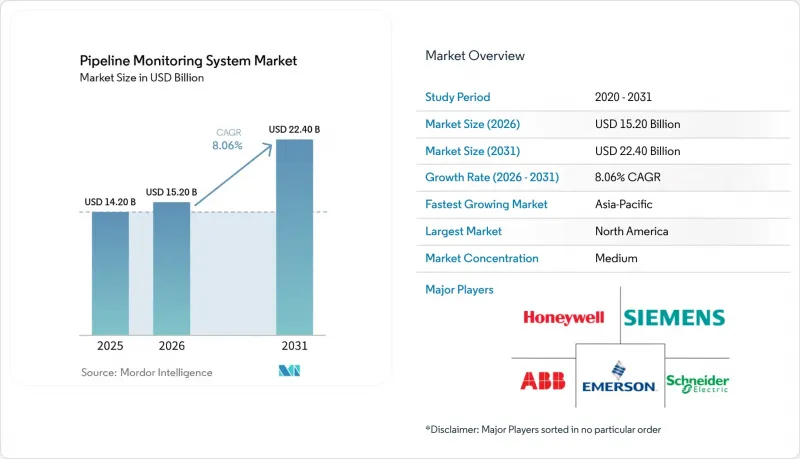
Mordor Intelligence에 의하면, 파이프라인 모니터링 시스템 시장 규모는 2025년에 142억 달러, 2026년에 152억 달러되어, 2031년까지 224억 달러에 이를 것으로 예측되며, 2026년부터 2031년까지 CAGR 8.06%로 성장할 전망입니다.
본 보고서는 기술별(광섬유, 음향, 기타), 구성 요소별(하드웨어, 소프트웨어, 서비스), 용도별(누출 감지, 운영 모니터링, 기타), 파이프라인 유형별(석유, 가스, 기타), 도입 형태별(육상, 해상), 지역별(북미, 아시아태평양, 유럽, 기타)로 분류되어 있습니다. 시장 전망은 금액(달러) 및 수량(톤) 단위로 제시되어 있습니다.
전 세계 파이프라인 모니터링 시스템 시장 동향 및 인사이트
전 세계적으로 증가하는 원유 및 천연가스 파이프라인 확장 프로젝트
파이프라인 확장은 파이프라인 모니터링 시스템 시장에 있어 가장 뚜렷한 단기 수요 견인 요인입니다. 이는 모든 신규 파이프라인에서 시운전 이후 계측 장비가 필요하기 때문입니다. 미국 에너지정보청(EIA)은 2026년, 미국 내에서 12건의 신규 또는 확장 천연가스 파이프라인 프로젝트가 올해 안에 완공될 예정이며, 이로 인해 하루 약 18 Bcf의 수송 능력이 추가될 것이라고 발표했습니다. 이는 2008년 이후 가장 큰 연간 증가폭입니다. 또한, INGAA 재단은 2025년 미드스트림 인프라 보고서에서 2052년까지 총 1조 달러를 넘는 미드스트림 분야에 대한 설비 투자가 필요할 것으로 전망하고 있으며, 여기에는 미국 내 가스 수송 파이프라인을 최소 37,000마일 증설하는 것이 포함됩니다. 캐나다에서는 엠브리지사가 2026년 4월, 서부 해안 파이프라인 시스템에 대한 40억 달러 규모의 '선라이즈 확장 프로그램'에 대해 연방 정부의 승인을 획득했으며, 2026년 7월에 착공할 예정입니다. 파이프라인 모니터링 시스템 시장도 수요 기반을 확대해 나가고 있습니다. 이는 2025년 미국에서 증설된 수송 능력의 65% 가까이를 주 내 파이프라인 증설이 차지한 점으로 미루어 볼 때, 감독 방식의 선택이 단일한 규제 경로를 따르는 것이 아니라 연방 규정, 주 정부의 감독, 그리고 사업자의 판단이 복합적으로 작용하여 결정되고 있음을 시사합니다.
파이프라인 운영에서 AI, IoT, 예측 분석의 통합이 진전되고 있습니다.
파이프라인 모니터링 시스템 시장에서 기술 주도형 주요 성장 경로는 정기 점검에서 AI 및 연결된 센서를 기반으로 한 상태 기반 유지보수로의 전환입니다. 2026년 『npj materials degradation』지에 발표된 동료 심사를 거친 연구에서는 멀티 센서를 활용한 인라인 검사 데이터에 머신러닝을 적용하는 것이 방대한 데이터를 예측 유지보수 조치로 전환하기 위한 중요한 단계라고 설명하며, 현재는 하드웨어의 한계가 아니라 신호의 복잡성이 주요 과제로 대두되고 있다고 지적하고 있습니다. 또한, 석유기술자협회(SPE)는 2025년에 해상 파이프라인의 건전성 관리에 AI를 적용함으로써, 과거 사업자가 주로 정기 점검에 의존하던 분야에서도 실시간 상태 모니터링이 가능해졌다는 점을 강조했습니다. 파이프라인 모니터링 시스템 시장에서는 이에 따라 이상 현상에 점수를 매기고, 디지털 트윈을 지원하며, 점검 간 검출 간격을 단축할 수 있는 소프트웨어 계층으로 가치가 이동하고 있습니다. 또한, 더 강력한 데이터 모델과 오랜 운영 실적을 갖춘 벤더가 하드웨어만 판매하는 기업보다 유리한 입장에 있기 때문에 조달 방식도 변화하고 있습니다. 그 결과, 파이프라인 모니터링 시스템 시장에서는 정기적인 소프트웨어 및 분석 수익으로의 전환이 서서히 진행되고 있습니다.
첨단 감시 시스템의 높은 도입 및 통합 비용
자본 집약성은 파이프라인 모니터링 시스템 시장에서 여전히 가장 뚜렷한 도입 장벽으로 남아 있으며, 특히 예산이 빠듯한 상황에서 사업자가 운영을 수행할 때 더욱 두드러집니다. 장거리 파이프라인용 분산형 광섬유 모니터링에는 고품질 케이블, 판독 장치 및 기존 SCADA 시스템과의 통합이 필요하며, 지형이 험준한 지역이나 해저 구간에서는 비용이 더욱 높아집니다. 중규모 사업자나 남미 및 사하라 이남 아프리카의 많은 국영 기업의 경우, 비용 부담으로 인해 완전한 디지털 감시보다는 여전히 기존의 정기 점검을 선택하는 경향이 있습니다. 가동 중인 네트워크에서는 업그레이드에 원격 단말기 교체, 라이선스 발급, 검증 작업, 그리고 긴 시운전 주기가 필요하기 때문에 과제는 더욱 커집니다. 센서 가격 하락과 클라우드 분석으로 인해 On-Premise형 인프라의 필요성이 줄어들고 있는 만큼, 파이프라인 모니터링 시스템 시장에서는 다소 개선된 모습을 보이고 있습니다. 그렇긴 하지만, 그 개선 정도는 지역에 따라 차이가 있으며, 단기 자금 조달의 장벽을 없애주는 것은 아닙니다. 그 결과, 구매 전에는 수명 주기 비용 절감 효과가 인식되는 경우가 많지만, 최종 승인을 앞당기기에는 반드시 충분하다고만 할 수는 없습니다.
부문별 분석
2025년, 음향 및 초음파 방식은 파이프라인 모니터링 시스템 시장 점유율의 25.2%를 차지했으며, 이 기술군은 계속해서 주도적인 위치를 유지했습니다. 이러한 선도적인 위상은 누출 감지 및 부식 평가 분야에서 폭넓게 활용되고 있을 뿐만 아니라, 육상 및 해상 파이프라인 구성에 관계없이 호환성이 뛰어나기 때문입니다. 음향 방출 시스템은 균열의 진행이나 국부적인 누출로 인해 발생하는 응력파 신호를 포착하기 때문에 수동적이고 지속적인 모니터링에 유용합니다. 벽 관통형 및 도파형 초음파 검사를 포함한 초음파 검사는 액체로 채워진 배관에서 매우 높은 해상도로 두께 감소를 정량화할 수 있기 때문에 여전히 중요한 위치를 차지하고 있습니다.
파이프라인 모니터링 시스템 시장에서는 현재 스마트 PIG 솔루션을 통한 성장이 가속화되고 있습니다. 이는 사업자가 중대한 영향을 미칠 가능성이 있는 운송 노선에서 보다 빈번하고 상세한 인라인 검사가 필요하기 때문입니다. 각 공급업체들이 자속 누설, 초음파 캘리퍼 도구, 관성 측정 시스템을 한 번의 검사 주행에 통합함에 따라, 스마트 PIG 플랫폼의 기능은 점점 더 고도화되고 있습니다. 2026년 『npj Materials Degradation』지에 발표된 동료 심사를 거친 리뷰 논문에서는 머신러닝을 활용한 신호 처리를 통해 방대한 양의 인라인 검사 데이터를 예측 유지보수 조치로 전환하는 것이 가능해졌으며, 이로 인해 이러한 도구의 실용적 가치가 높아지고 있다고 언급하고 있습니다. 또한, 파이프라인 모니터링 시스템 시장에서는 광섬유 감시 기술도 점차 보급되고 있습니다. 특히 장거리 가스 네트워크의 경우, 분산형 음향 감지(DAS)를 통해 외부 설치 방식만으로는 감시가 어려운 구간의 감지 정확도를 높일 수 있습니다. 많은 운영 환경에서 자속 누설법은 여전히 가장 널리 도입된 인라인 검사 기법이지만, 기존의 고자기장 장비로는 충분히 식별할 수 없는 결함에 대해서는 저자기장형 변형 방식이 주목받고 있습니다. ISO 13623 및 DNV-ST-F101과 같은 국제적 기준 체계는 특히 국내 규제가 아직 발전 단계에 있는 지역에서 기술 선정의 지침으로 계속해서 활용되고 있습니다.
2025년 파이프라인 모니터링 시스템 시장에서 하드웨어가 가장 큰 점유율을 차지했습니다. 이는 감시 대상이 되는 모든 파이프라인에 여전히 물리적 현장 장치가 필요하기 때문입니다. 여기에는 제어 시스템, 원격 단말 장치(RTU), 유량 계산기, 압력 변환기, 그리고 장거리에 배치된 음향 또는 초음파 센서 어레이가 포함됩니다. 신규 건설 파이프라인은 가동 첫날부터 계장 설비가 필요하기 때문에 하드웨어 수요 증가를 지속적으로 견인하고 있습니다. 또한, 구형 장비가 최신 누출 감지 기준이나 성능 기준을 충족하지 못하게 되면서 교체 수요도 증가하고 있습니다.
소프트웨어는 파이프라인 모니터링 시스템 시장에서 가장 빠르게 성장하고 있는 분야로, 2026년부터 2031년까지 연평균 성장률(CAGR) 10.3%를 나타낼 것으로 전망됩니다. 이러한 성장은 클라우드 호스팅형 SCADA 환경, 분석 서비스 구독, 그리고 멀티 센서 데이터를 거의 실시간으로 처리하는 디지털 트윈 도구와 밀접한 관련이 있습니다. 센서 하드웨어의 표준화가 진행됨에 따라, 상업적 가치는 현장 데이터를 경보, 유지보수 우선순위, 운영상의 의사결정으로 변환하는 해석 계층으로 이동하고 있습니다. 이러한 변화로 인해, 기본적인 현장 계측 기기의 차별화가 점차 희미해지고 있는 파이프라인 모니터링 시스템 업계의 일부에서는 하드웨어의 가격 결정력도 약화되고 있습니다. 이 서비스는 여전히 중요한 수익원입니다. 왜냐하면 시운전, 교정, 체계적인 점검 및 장기적인 유지보수 지원은 많은 사업자에게 여전히 사내에서 관리하기 어렵기 때문입니다. 따라서, 더 강력한 소프트웨어 라이브러리와 더 긴 데이터 이력을 보유한 공급업체는 하드웨어만 제공하는 경쟁사들에 비해 뚜렷한 우위를 점하고 있습니다.
지역별 분석
2025년, 북미는 파이프라인 모니터링 시스템 시장에서 28.3%의 점유율을 차지하며 지역으로서의 주도적 위치를 유지했습니다. 이 지역은 매우 대규모의 규제 대상 파이프라인 인프라, 연방 정부의 강력한 감독, 그리고 새로운 가스 수송 능력 확충 주기의 혜택을 누리고 있습니다. 미국 에너지정보청(EIA)에 따르면, 2026년에 12건의 천연가스 파이프라인 프로젝트가 완공될 예정이며, 이로 인해 하루 약 18 Bcf의 수송 능력이 추가되어 2008년 이후 최대 규모의 연간 확장 규모가 될 전망입니다. 2025년 1월에 최종 확정된 PHMSA의 누출 감지 규정과, 2025년 5월에 발효되는 TSA의 보안 지침 "Pipeline-2021-02F" 또한, 천연가스 및 위험 액체 사업자에게 요구되는 규정 준수 요건을 더욱 강화하고 있습니다. 캐나다에서는 2026년 4월에 엠브리지사의 '선라이즈 확장 계획'이 계획이 승인됨에 따라 이러한 기반이 더욱 강화되는 한편, 멕시코에서는 수입 파이프라인 네트워크의 확장으로 인해 오랫동안 사업을 전개해 온 사업자 외에도 지역적인 비즈니스 기회가 확대되고 있습니다.
아시아태평양은 파이프라인 모니터링 시스템 분야에서 가장 빠르게 성장하고 있는 지역 시장이며, 2031년까지 연평균 성장률(CAGR)은 10.2%를 나타낼 것으로 전망됩니다. 자그디슈푸르-할디아-보카로-담라 파이프라인이 2026년 9월 완공을 목표로 하고 있을 뿐만 아니라, 그 밖의 대규모 원유·가스 수송 회랑 프로젝트들도 가동을 향해 진행되고 있어, 인도는 계속해서 그 성장의 중심적인 역할을 수행하고 있습니다. 중국에서는 2026년에 중앙아시아-중국 시스템의 새로운 제4회선 계약을 통해 수송 능력을 확대하고 있을 뿐만 아니라, 산업용 및 주거용 수요를 충족시키기 위해 국내 가스 네트워크의 규모도 지속적으로 확대되고 있습니다. 또한, 인도네시아, 베트남, 말레이시아가 국내 전력 및 산업용으로 해상 가스 인프라를 확충하고 있는 만큼, 동남아시아도 감시 수요의 주요 공급원이 되어가고 있습니다. 따라서 이 지역의 파이프라인 모니터링 시스템 시장은 육상 수송의 성장과 해상 감시 수요 모두로부터 혜택을 받고 있습니다.
유럽은 규제 체계가 점차 강화되고 해상 인프라 개발이 지속되고 있는 것을 배경으로, 파이프라인 모니터링 시스템에 있어 여전히 전략적으로 중요한 시장입니다. EU의 메탄 규제(2024/1787)는 석유 및 가스 인프라 전반에 걸쳐 준수해야 할 요건을 규정함으로써, 첨단 누출 감지 및 복구 솔루션에 대한 수요를 촉진했습니다. 또한, 루마니아의 '넵튠 딥' 프로젝트는 파이프라인 건설 및 이후 운영 과정에서 고사양 모니터링 시스템에 대한 추가적인 수요를 창출할 것으로 예측됩니다. 중동 및 아프리카에서는 대규모 파이프라인망, 확대되는 에너지 인프라, 그리고 중대한 영향을 수반하는 위험에의 노출로 인해 지속적인 디지털 부식 모니터링 및 건전성 관리 솔루션의 도입 확대가 촉진되고 있습니다. 또한, 이 지역에서는 업스트림 부문의 석유 및 가스 투자 증가가 새로운 육상 및 해상 파이프라인 개발을 뒷받침할 것으로 예상되며, 자산 수명 주기 전반에 걸쳐 모니터링 기술에 대한 지속적인 수요가 발생할 것으로 보아 장기적인 성장 잠재력도 지니고 있습니다.
기타 혜택:
- 엑셀 형식 시장 예측(ME) 시트
- 3개월간의 애널리스트 지원
자주 묻는 질문
목차
제1장 서론
제2장 조사 방법
제3장 주요 요약
제4장 시장 구도
제5장 시장 규모 및 성장 예측(금액 : 달러, 수량 : 톤)
제6장 지역에 의한 분류
제7장 경쟁 구도
제8장 시장 기회와 향후 전망
JHS 26.07.03According to Mordor Intelligence, the pipeline monitoring system market size is projected to be USD 14.20 billion in 2025, USD 15.20 billion in 2026, and reach USD 22.40 billion by 2031, growing at a CAGR of 8.06% from 2026 to 2031.
This report is Segmented by Technology (Fiber Optic, Acoustic, and More), by Component (Hardware, Software, Services), by Application (Leak Detection, Operational Monitoring, and More), by Pipeline Type (Oil, Gas, and More), by Deployment (Onshore, Offshore), by Geography (North America, Asia-Pacific, Europe, and More). The Market Forecasts are Provided in Terms of Value (USD) and Volume (Tons).
Global Pipeline Monitoring System Market Trends and Insights
Increasing Crude Oil and Natural Gas Pipeline Expansion Projects Globally
Pipeline expansion is the clearest near-term demand driver for the pipeline monitoring system market because every new line requires instrumentation from commissioning onward. The United States Energy Information Administration stated in 2026 that 12 new or expanded United States natural gas pipeline projects were scheduled for completion this year, adding close to 18 Bcf/d of capacity, the largest annual addition since 2008. The INGAA Foundation also projected in its 2025 midstream infrastructure report that more than USD 1 trillion in total midstream capital investment will be required through 2052, including at least 37,000 additional miles of United States gas transmission pipelines. In Canada, Enbridge received federal approval in April 2026 for the USD 4 billion Sunrise Expansion Program on the West Coast pipeline system, with construction set to begin in July 2026. The pipeline monitoring system market is also gaining a broader demand base because intrastate pipeline additions accounted for close to 65% of United States capacity added in 2025, indicating that monitoring choices are shaped by a mix of federal rules, state oversight, and operator judgment rather than a single regulatory path.
Increasing Integration of AI, IoT, and Predictive Analytics in Pipeline Operations
The main technology-led growth path in the pipeline monitoring system market is the shift from periodic inspection toward condition-based maintenance supported by AI and connected sensors. A 2026 peer-reviewed study in npj materials degradation described machine learning applied to multi-sensor in-line inspection data as a key step in turning high data volumes into predictive maintenance actions and noted that signal complexity, rather than hardware limitations, is now the main challenge. The Society of Petroleum Engineers also highlighted in 2025 that AI applications for offshore pipeline integrity are enabling real-time condition monitoring in locations where operators once relied mainly on periodic inspection runs. In the pipeline monitoring system market, this is shifting value toward software layers that can score anomalies, support digital twins, and shorten the detection gap between inspections. It is also changing procurement behavior because vendors with stronger data models and longer operating histories are in a better position than firms that sell hardware alone. As a result, the pipeline monitoring system market is seeing a gradual shift toward recurring software and analytics revenue.
High Installation and Integration Costs of Advanced Monitoring Systems
Capital intensity remains the clearest adoption barrier for the pipeline monitoring system market, especially where operators work under tight budgets. Distributed fiber-optic monitoring for long-haul pipelines requires high-grade cable, interrogation units, and integration with existing SCADA systems, and costs rise further in difficult terrain or subsea routes. For mid-sized operators and many state-owned entities in South America and Sub-Saharan Africa, that cost burden still favors legacy periodic inspection over fully digital monitoring. The challenge is greater on live networks because upgrades often require replacing remote terminal units, software licensing, validation work, and long commissioning cycles. The pipeline monitoring system market is gaining some relief as sensor prices fall and cloud analytics reduce the need for on-premises infrastructure. Still, that improvement is uneven across regions and does not remove the near-term funding hurdle. As a result, lifecycle savings are often acknowledged before purchase, but not always enough to accelerate final approvals.
Other drivers and restraints analyzed in the detailed report include:
- Rising Incidents of Pipeline Leaks and Corrosion Failures
- Stringent Environmental and Pipeline Safety Regulations
- Cybersecurity Risks Associated with Connected Pipeline Monitoring Networks
For complete list of drivers and restraints, kindly check the Table Of Contents.
Segment Analysis
Acoustic and ultrasonic methods accounted for 25.2% of the pipeline monitoring system market share in 2025, maintaining this technology group in the leading position. That leadership reflects broad use across leak detection and corrosion assessment, as well as compatibility across onshore and offshore pipeline configurations. Acoustic emission systems capture stress-wave signals from crack growth and localized leaks, making them useful for passive, continuous surveillance. Ultrasonic testing, including through-wall and guided-wave variants, remains important because it can quantify wall loss with very high resolution on liquid-filled lines.
The pipeline monitoring system market is now seeing faster growth from Smart PIG solutions, as operators need more frequent and more detailed inline inspection on high-consequence transmission lines. Smart PIG platforms are becoming more capable as vendors combine magnetic flux leakage, ultrasonic caliper tools, and inertial measurement systems into a single inspection run. A 2026 peer-reviewed review in npj Materials Degradation stated that machine learning-assisted signal processing is helping convert dense in-line inspection data into predictive maintenance actions, thereby increasing the practical value of these tools. Fiber-optic monitoring is also gaining ground in the pipeline monitoring system market, especially on long-haul gas networks, where distributed acoustic sensing can improve detectability in sections that are difficult to monitor with external installation methods alone. Magnetic flux leakage remains the most widely deployed in-line inspection method in many operating environments, while lower-field variants are attracting attention for defects that conventional high-field tools do not isolate as well. International framework standards such as ISO 13623 and DNV-ST-F101 continue to shape technology selection, especially where domestic rules are still evolving.
Hardware accounted for the largest share of the pipeline monitoring system market in 2025, as every monitored pipeline still requires physical field devices. That includes control systems, remote terminal units, flow computers, pressure transducers, and acoustic or ultrasonic sensor arrays deployed over long distances. New-build pipelines continue to drive incremental hardware demand because instrumentation is required from the first day of operation. Replacement demand is also rising as legacy devices no longer meet updated leak-detection and performance standards.
Software is the fastest-growing component in the pipeline monitoring system market and is projected to grow at a 10.3% CAGR from 2026 to 2031. This growth is tied to cloud-hosted SCADA environments, analytics subscriptions, and digital twin tools that process multi-sensor data in near real time. As sensor hardware becomes more standardized, commercial value is shifting toward interpretation layers that convert field data into alarms, maintenance priorities, and operational decisions. That change is also compressing hardware pricing power in parts of the pipeline monitoring system industry where basic field instrumentation is becoming less differentiated. Services remain an important revenue layer because commissioning, calibration, managed inspection, and long-term maintenance support are still difficult for many operators to manage internally. Vendors with stronger software libraries and longer data histories, therefore, have a clear edge over hardware-only challengers.
Complete Report Scope:
- By Technology
- Fiber Optic Monitoring
- Acoustic Monitoring
- Ultrasonic Monitoring
- Magnetic Flux Leakage (MFL)
- Smart PIG Monitoring
- Others
- By Component
- Hardware
- Software
- Services
- By Application
- Leak Detection
- Corrosion & Integrity Monitoring
- Operational Monitoring
- Real-Time Data Analytics
- By Pipeline Type
- Oil Pipelines
- Gas Pipelines
- Water & Wastewater Pipelines
- Chemical Pipelines
- By Deployment
- Onshore
- Offshore
Geography Analysis
North America held a 28.3% share of the pipeline monitoring system market in 2025, maintaining its leading regional position. The region benefits from a very large regulated pipeline base, strong federal oversight, and a new gas capacity buildout cycle. In the United States, the EIA said 12 natural gas pipeline projects were scheduled for completion in 2026, adding close to 18 Bcf/d of capacity, making this the largest annual buildout since 2008. The PHMSA leak detection rule, finalized in January 2025, and the TSA Security Directive Pipeline-2021-02F, effective in May 2025, have also tightened compliance expectations for gas and hazardous liquid operators. Canada adds to this base through Enbridge's Sunrise Expansion approval in April 2026, while Mexico's growing import pipeline network broadens the regional opportunity beyond long-established operators.
Asia-Pacific is the fastest-growing regional market for pipeline monitoring systems, with a 10.2% CAGR forecast through 2031. India remains central to that growth because the Jagdishpur-Haldia-Bokaro-Dhamra pipeline is targeting completion in September 2026, while other large crude and gas corridor projects are also moving toward commissioning. China is expanding transmission capacity through a new fourth-line contract on the Central Asia-China system in 2026, while domestic gas networks continue to scale to meet industrial and residential demand. Southeast Asia is also becoming a more visible source of monitoring demand as Indonesia, Vietnam, and Malaysia expand offshore gas infrastructure for domestic power and industrial use. The pipeline monitoring system market in this region, therefore, benefits from both onshore transmission growth and offshore surveillance needs.
Europe remains a strategically important market for pipeline monitoring systems, supported by an increasingly stringent regulatory framework and ongoing offshore infrastructure development. The EU Methane Regulation 2024/1787 has strengthened demand for advanced leak detection and repair solutions by establishing mandatory compliance requirements across oil and gas infrastructure, while Romania's Neptun Deep project is expected to generate additional demand for high-specification monitoring systems during pipeline construction and subsequent operations. In the Middle East and Africa, large pipeline networks, expanding energy infrastructure, and high consequence exposure are driving greater adoption of continuous digital corrosion monitoring and integrity management solutions. The region also offers long-term growth potential as increasing upstream oil and gas investment is expected to support new onshore and offshore pipeline developments, creating sustained demand for monitoring technologies throughout the asset lifecycle.
- Honeywell International Inc.
- Siemens AG
- ABB Ltd.
- Emerson Electric Co.
- Schneider Electric SE
- Yokogawa Electric Corporation
- Huawei Technologies Co. Ltd.
- PSI Software SE
- KROHNE Group
- Pure Technologies Ltd.
- Pentair plc
- Orbcomm Inc.
- Synodon Inc.
- Atmos International
- TTK Leak Detection
- Future Fibre Technologies
- Perma-Pipe International Holdings Inc.
- ClampOn AS
- Baker Hughes Company
- ROSEN Group
Additional Benefits:
- The market estimate (ME) sheet in Excel format
- 3 months of analyst support
TABLE OF CONTENTS
1 Introduction
- 1.1 Study Assumptions & Market Definition
- 1.2 Scope of the Study
2 Research Methodology
3 Executive Summary
4 Market Landscape
- 4.1 Market Overview
- 4.2 Market Drivers
- 4.2.1 Increasing Crude Oil and Natural Gas Pipeline Expansion Projects Globally
- 4.2.2 Rising Incidents of Pipeline Leaks and Corrosion Failures
- 4.2.3 Growing Adoption of Fiber Optic Monitoring in Long-Distance Pipelines
- 4.2.4 Stringent Environmental and Pipeline Safety Regulations
- 4.2.5 Increasing Integration of AI, IoT, and Predictive Analytics in Pipeline Operations
- 4.2.6 Rising Offshore Pipeline Installations and Deepwater Energy Projects
- 4.3 Market Restraints
- 4.3.1 High Installation and Integration Costs of Advanced Monitoring Systems
- 4.3.2 Operational Challenges in Retrofitting Aging Pipeline Infrastructure
- 4.3.3 Limited Monitoring Efficiency in Remote and Harsh Environments
- 4.3.4 Cybersecurity Risks Associated with Connected Pipeline Monitoring Networks
- 4.4 Value / Supply-Chain Analysis
- 4.5 Regulatory Landscape
- 4.6 Technological Outlook
- 4.7 Porter's Five Forces
- 4.7.1 Threat of New Entrants
- 4.7.2 Bargaining Power of Suppliers
- 4.7.3 Bargaining Power of Buyers
- 4.7.4 Threat of Substitutes
- 4.7.5 Industry Rivalry
- 4.8 Impact of Geopolitical Events on the market
5 Market Size & Growth Forecasts (Value in USD & Volume in Tons)
- 5.1 By Technology
- 5.1.1 Fiber Optic Monitoring
- 5.1.2 Acoustic Monitoring
- 5.1.3 Ultrasonic Monitoring
- 5.1.4 Magnetic Flux Leakage (MFL)
- 5.1.5 Smart PIG Monitoring
- 5.1.6 Others
- 5.2 By Component
- 5.2.1 Hardware
- 5.2.2 Software
- 5.2.3 Services
- 5.3 By Application
- 5.3.1 Leak Detection
- 5.3.2 Corrosion & Integrity Monitoring
- 5.3.3 Operational Monitoring
- 5.3.4 Real-Time Data Analytics
- 5.4 By Pipeline Type
- 5.4.1 Oil Pipelines
- 5.4.2 Gas Pipelines
- 5.4.3 Water & Wastewater Pipelines
- 5.4.4 Chemical Pipelines
- 5.5 By Deployment
- 5.5.1 Onshore
- 5.5.2 Offshore
6 By Geography
- 6.1 North America
- 6.1.1 United States
- 6.1.2 Canada
- 6.1.3 Mexico
- 6.2 South America
- 6.2.1 Brazil
- 6.2.2 Argentina
- 6.2.3 Chile
- 6.2.4 Rest of South America
- 6.3 Europe
- 6.3.1 Germany
- 6.3.2 United Kingdom
- 6.3.3 France
- 6.3.4 Italy
- 6.3.5 Spain
- 6.3.6 Russia
- 6.3.7 BENELUX (Belgium, Netherlands, and Luxembourg)
- 6.3.8 NORDICS (Denmark, Finland, Iceland, Norway, and Sweden)
- 6.3.9 Rest of Europe
- 6.4 Asia-Pacific
- 6.4.1 China
- 6.4.2 India
- 6.4.3 Japan
- 6.4.4 South Korea
- 6.4.5 Australia
- 6.4.6 Southeast Asia (Indonesia, Vietnam, Thailand, Malaysia, Philippines)
- 6.4.7 Rest of Asia-Pacific
- 6.5 Middle East & Africa
- 6.5.1 United Arab Emirates
- 6.5.2 Saudi Arabia
- 6.5.3 Turkey
- 6.5.4 Qatar
- 6.5.5 South Africa
- 6.5.6 Egypt
- 6.5.7 Nigeria
- 6.5.8 Rest of Middle East & Africa
7 Competitive Landscape
- 7.1 Market Concentration
- 7.2 Strategic Moves
- 7.3 Market Share Analysis
- 7.4 Company Profiles {(Includes Global Level Overview, Market Level Overview, Core Segments, Financials as Available, Strategic Information, Products & Services, and Recent Developments)}
- 7.4.1 Honeywell International Inc.
- 7.4.2 Siemens AG
- 7.4.3 ABB Ltd.
- 7.4.4 Emerson Electric Co.
- 7.4.5 Schneider Electric SE
- 7.4.6 Yokogawa Electric Corporation
- 7.4.7 Huawei Technologies Co. Ltd.
- 7.4.8 PSI Software SE
- 7.4.9 KROHNE Group
- 7.4.10 Pure Technologies Ltd.
- 7.4.11 Pentair plc
- 7.4.12 Orbcomm Inc.
- 7.4.13 Synodon Inc.
- 7.4.14 Atmos International
- 7.4.15 TTK Leak Detection
- 7.4.16 Future Fibre Technologies
- 7.4.17 Perma-Pipe International Holdings Inc.
- 7.4.18 ClampOn AS
- 7.4.19 Baker Hughes Company
- 7.4.20 ROSEN Group
8 Market Opportunities & Future Outlook
- 8.1 White-Space & Unmet-Need Assessment


