|
시장보고서
상품코드
2073123
영상 저장 전송 시스템 시장 : 점유율 분석, 업계 동향과 통계, 성장 예측(2026-2031년)Picture Archiving Communications Systems - Market Share Analysis, Industry Trends & Statistics, Growth Forecasts (2026 - 2031) |
||||||
 Mordor Intelligence
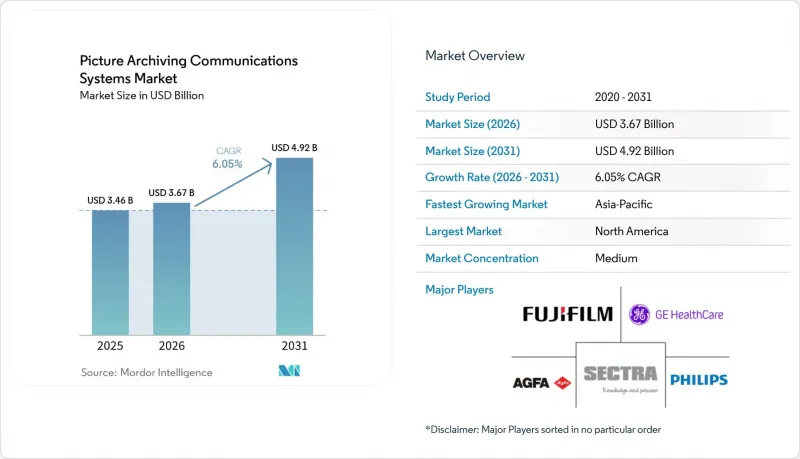
Mordor Intelligence에 의하면, 영상 저장 전송 시스템(PACS) 시장 규모는 2025년 34억 6,000만 달러에서 2026년에는 36억 7,000만 달러로 확대되어 2031년까지 49억 2,000만 달러에 이를 것으로 예상되고 있어 2026년부터 2031년까지 CAGR 6.05%로 성장할 전망입니다.
본 보고서는 구성 요소(소프트웨어, 하드웨어, 서비스), 도입 형태(On-Premise, 클라우드 기반, 웹형, 하이브리드), 용도(방사선과, 순환기내과, 종양내과, 정형외과 등), 최종 사용자(병원, 영상진단센터, 외래진료센터, 기타), 지역(북미, 유럽 등)별로 분류되어 있습니다. 시장 전망은 금액(달러) 기준으로 제시되어 있습니다.
전 세계 영상 저장 전송 시스템(PACS) 시장 동향과 인사이트
인프라 부담을 줄이고 원격 영상 판독을 가능하게 하는 클라우드 전환
PACS 시장에서는 공급업체들이 On-Premise형 시스템에서 지점 간 확장이 용이한 클라우드 기반 플랫폼으로 전환함에 따라, 도입 형태 측면에서 가장 뚜렷한 변화가 나타나고 있습니다. 이 시장에서 클라우드 소프트웨어는 초기 하드웨어 투자 비용을 절감하고, 서버 교체 주기를 반복할 필요를 없애며, 백업 및 복구를 장기간에 걸친 사내 프로젝트가 아닌 관리형 서비스로 전환합니다. PACS 시장은 여러 병원에 걸친 시스템 통합의 이점도 누리고 있습니다. 이는 인수한 시설을 클라우드 아키텍처에 통합하는 것이 각 거점에서 개별적인 로컬 인프라를 구축하는 것보다 대부분의 경우 더 간편하기 때문입니다. Philips는 2025년 2월 유럽 13개 시장으로 서비스를 확대하기 전에, 이미 북미 및 라틴아메리카에서 150개 이상의 거점을 아마존 웹 서비스(Amazon Web Services)상의 ‘HealthSuite Imaging”로 전환하고 있으며, 이 회사는 이러한 확장을 인력 부족의 압박과 AI를 활용한 업무 흐름 개선과 연결 지어 보고 있습니다. 이러한 경향은 PACS 시장에 있어 중요한 의미를 지닙니다. 왜냐하면 클라우드 도입을 단순한 스토리지뿐만 아니라 인력과 네트워크 관리와도 연계하고 있기 때문입니다. 또한, 의료 제공업체들이 시간적 제약이 있는 영상 판독 기능은 현지의 업무 흐름에 가까운 곳에 유지하면서, 장기 보관 및 고도의 처리를 우선적으로 이전하는 경우가 많기 때문에 하이브리드 모델이 급속히 보급되고 있는 이유도 이를 통해 설명할 수 있습니다.
AI를 활용한 트리아지, 라우팅 및 작업 목록 최적화
이미지 저장 전송 시스템(PACS) 시장의 성장은 워크플로우 인텔리전스와 점점 더 밀접하게 연결되어 있습니다. 이는 AI가 단순한 독립형 애드온에서 이미지 라우팅 및 판독 우선순위 결정의 핵심으로 자리 잡아가고 있기 때문입니다. 62개 병원과 220만 건의 방사선 검사 데이터를 대상으로 한 조사에 따르면, 규칙 기반 워크리스트는 응급 환자에 대해 17.7분의 지연을 초래했으며, 병원 네트워크 1곳당 연간 210만-420만 달러의 비용을 발생시켰습니다. 따라서 자동화는 단순한 시험적 기능이 아니라, 실질적인 구매 과제가 되고 있습니다. 이미지 저장 전송 시스템(PACS) 시장의 각 벤더들은 현재 AI를 활용하여 긴급도, 방사선과 전문의의 전문 분야, 실시간 업무 부하, 증례의 복잡도에 따라 검사를 배정하고 있습니다. 이를 통해 영상 판독 팀이 여러 거점에 분산되어 있는 경우에도 처리 능력이 향상됩니다. 또한, 미국의 4,640만 건의 방사선 검사를 대상으로 한 대규모 동료 심사 분석에 따르면, 2024년까지 검사 건수가 많은 방사선과 의사의 판독 업무 부담이 크게 증가할 것으로 나타났으며, 이는 엔터프라이즈 영상 환경에서 업무 부담 분산 도구에 대한 수요를 뒷받침하는 것입니다. 이 점은 PACS 시장에서 중요한 의미를 지닙니다. 왜냐하면 의료기관은 영상 판독의 우선순위 결정 속도를 높일 뿐만 아니라, 네트워크 전체에서 업무를 보다 고르게 분산시키는 것 또한 목표로 하고 있기 때문입니다. 이러한 기능이 성숙해짐에 따라, PACS 선정 시에는 단순한 영상 저장 기능뿐만 아니라 오케스트레이션의 품질을 더욱 중시하게 될 것입니다.
사이버 보안, 개인정보 보호 및 데이터 저장 위치와 관련된 규정 준수 부담
PACS 시장에서는 임상 현장에서 가장 기밀성이 높은 환자 데이터 중 일부가 다루어지기 때문에 규정 준수 요건은 제품 선정 및 도입 시기에 있어 매우 중요한 요소가 됩니다. 미국 보건복지부는 2024년 12월 27일, HIPAA 보안 규정 개정안을 발표했습니다. 이에 따르면, 저장 중 및 전송 중인 전자 보호 의료 정보의 암호화, 다단계 인증, 정기적인 취약점 스캔, 그리고 네트워크 분할이 의무화됩니다. PACS 시장에 있어 이는 과거에는 보다 유연하게 처리되던 많은 보안 업그레이드를 의료 기관들이 더 이상 미룰 수 없게 된다는 것을 의미합니다. 유럽에서는 데이터 주권과 관련된 의무가 또 다른 과제로 대두되고 있습니다. 벤더는 지역별 호스팅이나 국가별 처리 체계를 필요로 하는 경우가 많기 때문에 클라우드 설계가 더욱 복잡해지기 때문입니다. 이러한 부담은 IT 보안 담당자의 수가 제한적이고, 법적·기술적 심사가 늘어남에 따라 조달 주기가 장기화되는 중규모 의료기관에서 PACS 시장에 미치는 영향이 가장 두드러집니다. 또한, 컴플라이언스 지원을 매니지드 이미징 플랫폼의 일부로 제공할 수 있는 벤더의 경쟁 우위를 더욱 강화하는 결과로 이어질 것입니다.
부문별 분석
2025년에는 소프트웨어가 매출의 54.31%를 차지하며, PACS 시장에서 가장 큰 점유율을 기록했습니다. 이는 벤더가 구독 서비스, 분석 모듈, AI 기능 및 엔터프라이즈 워크플로 도구로 가치의 중점을 옮겼기 때문입니다. PACS 시장은 하드웨어 중심의 구조에서 벗어나고 있으며, 현재는 클라우드 네이티브 벤더들이 물리적 인프라보다 지속적인 플랫폼 이용료에서 더 많은 수익을 창출하고 있습니다. 이러한 전환은 GE 헬스케어가 2026년 3월에 Intelerad에 대해 공개한 내용에서도 분명히 드러납니다. 그곳에서는 인수된 사업의 연간 매출액이 약 2억 7,000만 달러이며, 그 중 90% 이상이 지속적 수익이고, EBITDA 마진은 30% 이상이라고 설명되어 있습니다. 고처리량 워크스테이션이나 영상 진단 기기에서는 하드웨어가 여전히 중요하지만, 브라우저 기반의 영상 열람 및 원격 액세스 도구가 발전함에 따라 PACS 시장에서 하드웨어의 역할은 점점 더 보조적인 성격으로 변하고 있습니다. 이로 인해 소프트웨어는 여전히 차별화의 핵심으로 자리 잡고 있습니다. 왜냐하면, 이미지 관리만으로는 더 이상 공급업체의 가치를 정의할 수 없기 때문입니다.
이 서비스는 2031년까지 연평균 성장률(CAGR)이 7.38%로 가장 빠르게 성장하고 있는 분야이며, 도입, 통합, 전환 및 관리형 운영에 대해 외부 지원을 요청하는 공급업체가 늘어남에 따라 PACS 시장의 이 분야는 확대되고 있습니다. 장기적인 엔터프라이즈 이미징 프로그램을 통해, 특히 방사선과, 순환기과 및 기타 부서가 공통 플랫폼으로 통합되는 경우, 일회성 도입 작업이 수년에 걸친 서비스 수익으로 전환되고 있습니다. PACS 업계에서 서비스 제공은 벤더에 대한 고객 충성도를 높이는 역할도 하고 있습니다. 그 이유는 업무의 상당 부분이 여러 거점에 걸쳐 있는 PACS와 EHR, RIS, VNA, AI 도구의 연동을 수반하기 때문입니다. 즉, 서비스 계약은 가동 시작 시의 활동을 지원할 뿐만 아니라, 그 이후의 워크플로우 변경이나 아카이브 확장의 성패에도 영향을 미칩니다. 기업 내 도입 범위가 확대되고 복잡해짐에 따라, 이 서비스는 수익원으로서뿐만 아니라 고객 유지 수단으로서도 그 중요성이 점점 더 커질 것입니다.
2025년에는 클라우드 기반 솔루션의 도입이 매출의 56.24%를 차지하며, PACS 시장 규모에서도 가장 큰 점유율을 기록했습니다. 이는 SaaS를 통한 제공이 하드웨어 구매의 장벽을 낮추고, 분산형 판독 모델을 지원했기 때문입니다. PACS 시장에서는 서비스 제공업체들이 자동 업그레이드, 보안 패치 적용, 규정 준수 대응, 그리고 시설 간 손쉬운 확장을 원하기 때문에 클라우드 도입이 선호되고 있습니다. Philips는 자사의 ‘HealthSuite Imaging”라고 이 모델을 정의하며, 이 서비스가 매니지드 서비스의 일환으로 지속적인 업데이트와 보안상의 요구 사항을 충족시킨다는 점을 강조하고 있습니다. 영상진단 부문 책임자가 인력 부족과 노후화된 서버 환경을 해결해 나가는 과정에서 이 제안의 중요성은 점점 더 커지고 있습니다. 따라서 PACS 시장에서 클라우드가 차지하는 주도적 위상은 단순히 호스팅 장소의 변화뿐만 아니라, 재무적 측면과 운영적 측면 모두의 선호도를 반영한다고 할 수 있습니다.
하이브리드는 2031년까지 연평균 성장률(CAGR)이 8.52%로 가장 빠르게 성장하고 있는 도입 형태이며, 이러한 성장은 의료 기관들이 새로운 클라우드 도구와 기존의 On-Premise 투자 간에 어떻게 균형을 맞추고 있는지를 보여줍니다. PACS 시장에서 하이브리드 모델을 통해 의료 기관은 장기 아카이빙 및 AI 처리를 클라우드로 이전하는 동시에, 우선순위가 높은 검사에 대해서는 On-Premise에서 저지연 판독 흐름을 유지할 수 있습니다. 이 접근 방식은 이미 유용한 인프라를 보유하고 있으며, 한 번에 대규모 전환을 진행하기보다는 단계적인 전환 과정을 희망하는 여러 병원으로 구성된 네트워크에 적합합니다. On-Premise 배포는 일부 학술 기관, 국방 기관 및 국가 의료 환경 등 엄격한 주권 규제가 적용되는 환경에서는 여전히 남아 있지만, 예측 기간 동안 그 점유율은 감소하고 있습니다. 또한, 웹 기반 접근 방식도 PACS 시장에서 가교 역할을 하고 있습니다. 이는 워크스테이션의 전체 라이선스가 필요 없이, 보다 광범위한 임상 시스템을 통해 임상의가 가벼운 이미지 열람에 접근할 수 있기 때문입니다.
지역별 분석
2025년, 북미는 매출의 40.22%를 차지하며, 영상 저장 전송 시스템(PACS) 시장에서 가장 규모가 큰 지역 점유율을 기록했습니다. 이는 해당 지역이 성숙한 보험자 시스템, 대규모 통합 의료 제공 네트워크, 그리고 뛰어난 클라우드 도입 역량을 모두 갖추고 있기 때문입니다. 또한, 북미의 PACS 시장은 여러 병원의 통합이 진행됨에 따라 더욱 활성화되고 있습니다. 이는 인수된 지역 의료기관이 더 대규모의 기업형 영상진단 계획에 임베디드되는 경우가 많기 때문입니다. 섹트라사는 2026년 6월, 온타리오주의 4개 의료 제공 기관(16개 거점, 추정 360만 건의 영상 검사)과 5년간의 ‘Sectra One Cloud”기업용 영상 진단 계약을 체결했습니다. 이는 도시 전체나 지역 차원의 표준화 모델이 현재 더 대규모의 네트워크 환경으로 전환되고 있음을 보여줍니다. 또한, 미국 방사선학회(ACR)는 2026년 3월, FHIR의 “ImagingStudy” 및 “ImagingSelection”이 리소스를 핵심적인 상호운용성 도구로 취급할 것을 강력히 요청했습니다. 이는 영상 진단 시스템과 전자건강기록(EHR) 환경 간의 보다 긴밀한 통합을 촉진하는 것입니다. 이러한 상황으로 인해 북미는 PACS 시장에서 가장 확고한 입지를 차지하고 있지만, 여전히 장비 교체 주기와 기업 내 더 광범위한 도입 여지가 남아 있습니다.
아시아태평양은 2031년까지 연평균 성장률(CAGR)이 7.15%로 가장 빠르게 성장하고 있는 지역이며, 예측 기간 동안 의료 영상 저장 전송 시스템(PACS) 시장의 주요 성장 동력으로 작용하고 있습니다. 이 지역은 중국의 병원 디지털화, 인도의 진단센터 네트워크의 급속한 확대, 그리고 규정 준수 및 시스템 통합의 필요성과 더욱 밀접하게 연계된 일본의 업데이트 주기에 힘입어 성장하고 있습니다. PACS 시장에서 이러한 시장 성장 촉진요인들은 다단계 도입, 원격 관리, 그리고 여러 공급업체가 혼재된 환경 전반에 걸쳐 인프라 부담을 경감할 수 있는 벤더에게 유리하게 작용합니다. 또한, 아시아태평양에서는 많은 서비스 제공업체들이 이미지 네트워크 구축 및 업그레이드를 추진하고 있는 반면, 인프라의 어느 정도를 On-Premise로 유지하고 어느 정도를 관리형 환경으로 전환해야 할지 아직 검토 중인 단계라는 점에서도 두드러집니다.
유럽에서는 병원 현대화 프로그램과 기업급 영상 플랫폼에 우선순위를 두는 조달 체계에 힘입어, PACS 시장에서 안정적인 성장이 예상됩니다. 또한, 해당 지역은 규정 준수 요건이 더 엄격하기 때문에 규제 대응 및 호스팅 역량이 뛰어난 대형 벤더에게 유리한 경향이 있습니다. 중동 및 아프리카는 의료 관광에 대한 투자, 국경을 초월한 의료 서비스 제공에 대한 의지, 그리고 방사선과 전문의 부족 등의 요인이 복합적으로 작용하여 클라우드 기반 영상 공유 및 원격 방사선 진단 지원의 가치를 높이고 있으므로, PACS 시장에서 새로운 기회를 내포하고 있습니다. 남아프리카 및 일부 서아프리카 시장에서는 분산된 네트워크 전반에 걸친 접근성을 개선하기 위해 클라우드 PACS가 도입되고 있으며, 이는 다른 지역에서 이전에 관찰되었던 원격 방사선 진단 중심의 도입 양상을 반영하고 있습니다. 브라질과 아르헨티나를 비롯한 남미 지역에서도 민간 병원 그룹들이 기존의 영상 진단 환경을 업그레이드함에 따라 진전이 보이고 있지만, 환율 변동과 수입 비용으로 인해 경우에 따라 투자 속도가 둔화되고 있는 상황입니다.
기타 혜택:
- 엑셀 형식 시장 예측(ME) 시트
- 3개월간의 애널리스트 지원
자주 묻는 질문
목차
제1장 서론
제2장 조사 방법
제3장 주요 요약
제4장 시장 구도
제5장 시장 규모와 성장 예측
제6장 경쟁 구도
제7장 시장 기회와 향후 전망
JHS 26.07.09According to Mordor Intelligence, the picture archiving communications systems market size is expected to increase from USD 3.46 billion in 2025 to USD 3.67 billion in 2026 and reach USD 4.92 billion by 2031, growing at a CAGR of 6.05% over 2026-2031.
This report is Segmented by Component (Software, Hardware, Services), Deployment Mode (On-Premise, Cloud-Based, Web-Based, Hybrid), Application (Radiology, Cardiology, Oncology, Orthopedics, and More), End User (Hospitals, Imaging Centers, Ambulatory Centers, Others), and Geography (North America, Europe, and More). Market Forecasts are Provided in Terms of Value (USD).
Global Picture Archiving Communications Systems Market Trends and Insights
Cloud Migration To Reduce Infrastructure Burden And Enable Remote Reading
The Picture Archiving Communications Systems market is seeing its clearest shift in deployment, as providers move from on-premise systems to cloud-delivered platforms that are easier to scale across locations. In this market, cloud software reduces upfront hardware spending, avoids repeated server refresh cycles, and turns backup and recovery into a managed service instead of a long internal project. The Picture Archiving Communications Systems market is also benefiting from consolidation across multihospital systems, because adding acquired facilities to a cloud architecture is often simpler than building separate local infrastructure at each site. Philips had already migrated more than 150 sites in North America and Latin America to HealthSuite Imaging on Amazon Web Services before it extended the service across 13 European markets in February 2025, and the company tied that expansion to staffing pressure and AI-enabled workflow improvement. That pattern matters for the Picture Archiving Communications Systems market because it links cloud adoption to workforce and network management rather than to storage alone. It also explains why hybrid models are rising quickly, since providers often move long-term archive and advanced processing first while keeping time-sensitive reading functions close to local workflows.
AI-Assisted Triage, Routing, And Worklist Optimization
The Picture Archiving Communications Systems market is increasingly tying growth to workflow intelligence, because AI is moving from a stand-alone add-on into the core of image routing and reading prioritization. Research covering 62 hospitals and 2.2 million radiology studies found that rule-based worklists created 17.7-minute delays for expedited cases and generated annual costs of USD 2.1 million to USD 4.2 million per hospital network, which makes automation a practical purchasing issue rather than a trial feature. Vendors in the Picture Archiving Communications Systems market are now using AI to direct studies by urgency, radiologist specialty, live workload, and case complexity, which improves throughput where reading teams are spread across sites. A large peer-reviewed analysis of 46.4 million U.S. radiology examinations also showed that high-volume radiologists were carrying much heavier reading loads by 2024, which supports demand for workload balancing tools within enterprise imaging environments. That detail matters in the Picture Archiving Communications Systems market because providers are not only seeking faster triage, they are also trying to distribute work more evenly across networks. As those capabilities mature, PACS selection is likely to depend more on orchestration quality and less on image storage alone.
Cybersecurity, Privacy, And Data Residency Compliance Burden
The Picture Archiving Communications Systems market handles some of the most sensitive patient data in the clinical setting, so compliance requirements carry real weight in product selection and rollout timing. The U.S. Department of Health and Human Services issued a proposed HIPAA Security Rule amendment on December 27, 2024, that would require encryption of electronic protected health information at rest and in transit, multifactor authentication, regular vulnerability scanning, and network segmentation. For the Picture Archiving Communications Systems market, that means providers can no longer delay many security upgrades that were once treated with more flexibility. In Europe, data sovereignty obligations add another layer because vendors often need regional hosting and country-specific processing arrangements, which makes cloud design more complex. These burdens slow the Picture Archiving Communications Systems market most in mid-sized providers, where IT security staffing is limited and procurement cycles stretch when legal and technical reviews grow. They also reinforce the advantage of vendors that can package compliance support as part of a managed imaging platform.
Other drivers and restraints analyzed in the detailed report include:
- Growing Imaging Volumes From Chronic Disease And Aging Populations
- Rising Enterprise Imaging And Cross-Department Workflow Standardization
- High Cost Of Data Egress, Archival Storage, And Long-Term Retention
For complete list of drivers and restraints, kindly check the Table Of Contents.
Segment Analysis
Software commanded 54.31% of revenue in 2025, and it represented the largest share of the Picture Archiving Communications Systems market share because vendors have shifted value toward subscriptions, analytics modules, AI functions, and enterprise workflow tools. The Picture Archiving Communications Systems market has moved away from hardware-led setups, and cloud-native vendors now generate more revenue from recurring platform access than from physical infrastructure. That transition is visible in GE HealthCare's March 2026 disclosure on Intelerad, where the acquired business was described as having approximately USD 270 million in annual revenue with more than 90% recurring revenue and more than 30% EBITDA margin. Hardware still matters for high-throughput workstations and modality-adjacent devices, but its role is more supportive in the Picture Archiving Communications Systems market as browser-based viewing and remote access tools improve. This keeps software at the center of differentiation, because image management alone no longer defines vendor value.
Services is the fastest-growing component at a 7.38% CAGR through 2031, and that part of the Picture Archiving Communications Systems market is expanding as providers seek outside help for implementation, integration, migration, and managed operations. Longer enterprise imaging programs have turned one-time deployment work into multiyear service revenue, especially where radiology, cardiology, and other departments are being brought onto a common platform. In the Picture Archiving Communications Systems industry, services also deepen vendor stickiness because much of the work involves linking PACS with EHR, RIS, VNA, and AI tools across several sites. That means service contracts do more than support go-live activities, they also shape the success of later workflow changes and archive expansion. As enterprise rollouts become broader and more complex, services should keep gaining importance as both a revenue stream and a retention tool.
Cloud-based deployment captured 56.24% of revenue in 2025, and it accounted for the largest share of the Picture Archiving Communications Systems market size because SaaS delivery reduced hardware buying friction and supported distributed reading models. The Picture Archiving Communications Systems market has favored cloud deployment where providers want automatic upgrades, security patching, compliance support, and easier expansion across facilities. Philips positioned its HealthSuite Imaging model in that way, noting that the service handles ongoing updates and security needs as part of the managed offering. That proposition has become more relevant as imaging directors deal with staff shortages and older server environments. Cloud leadership in the Picture Archiving Communications Systems market therefore reflects both financial and operational preferences, not just a change in hosting location.
Hybrid is the fastest-growing deployment mode at an 8.52% CAGR through 2031, and that growth shows how providers are balancing newer cloud tools with existing local investments. In the Picture Archiving Communications Systems market, hybrid models let health systems move long-term archive and AI processing into the cloud while retaining low-latency reading flows for high-priority studies on site. This approach fits multihospital networks that already own useful infrastructure and want a gradual migration path instead of a single large cutover. On-premise deployments still remain in settings with strict sovereignty rules, including some academic, defense, and national healthcare environments, though their share is declining across the forecast period. Web-based access also plays a bridging role in the Picture Archiving Communications Systems market because it gives clinicians lighter image review access through broader clinical systems without requiring full workstation licensing.
Complete Report Scope:
- By Component
- Software
- Hardware
- Services
- By Deployment Mode
- On-Premise
- Cloud-Based
- Web-Based
- Hybrid
- By Application
- Radiology
- Cardiology
- Oncology
- Orthopedics
- Ophthalmology
- Veterinary Medicine
- By End User
- Hospitals and Clinics
- Diagnostic Imaging Centers
- Ambulatory Surgery Centers
- Other End Users
- By Geography
- North America
- United States
- Canada
- Mexico
- Europe
- Germany
- United Kingdom
- France
- Italy
- Spain
- Rest of Europe
- Asia-Pacific
- China
- Japan
- India
- Australia
- South Korea
- Rest of Asia-Pacific
- Middle East and Africa
- GCC
- South Africa
- Rest of Middle East and Africa
- South America
- Brazil
- Argentina
- Rest of South America
- North America
Geography Analysis
North America held 40.22% of revenue in 2025, and it accounted for the largest regional share of the Picture Archiving Communications Systems market share because the region combines mature payer systems, large integrated delivery networks, and strong cloud adoption capacity. The Picture Archiving Communications Systems market in North America is also being pushed by multihospital consolidation, since acquired community facilities are often folded into larger enterprise imaging plans. Sectra signed a five-year Sectra One Cloud enterprise imaging contract in June 2026 with four Ontario healthcare providers across 16 sites and an estimated 3.6 million imaging exams, which shows how city-wide and regional standardization models are now moving into larger network settings. The American College of Radiology also pressed in March 2026 for FHIR ImagingStudy and ImagingSelection resources to be treated as core interoperability tools, which supports deeper integration between imaging systems and EHR environments. These conditions make North America the most established region in the Picture Archiving Communications Systems market, while still leaving room for replacement cycles and broader enterprise rollouts.
Asia-Pacific is the fastest-growing region at a 7.15% CAGR through 2031, and it is the main growth engine for the Picture Archiving Communications Systems market over the forecast period. The region is being supported by hospital digitization in China, rapid scaling of diagnostic center networks in India, and a replacement cycle in Japan that is tied more closely to compliance and system integration needs. In the Picture Archiving Communications Systems market, these drivers favor vendors that can support multistage deployment, remote administration, and lower infrastructure burden across mixed provider environments. Asia-Pacific also stands out because many providers are building or upgrading imaging networks while still deciding how much infrastructure to keep local and how much to shift into managed environments.
Europe is positioned for stable growth in the Picture Archiving Communications Systems market, supported by hospital modernization programs and procurement structures that can favor enterprise-scale imaging platforms. The region also has a tougher compliance setting, and that tends to benefit larger vendors with stronger regulatory and hosting capabilities. The Middle East and Africa represent an emerging opportunity in the Picture Archiving Communications Systems market because medical tourism investment, cross-border care ambitions, and radiologist shortages all raise the value of cloud-enabled image sharing and teleradiology support. South Africa and select West African markets are adopting cloud PACS to improve access across dispersed networks, which mirrors earlier teleradiology-led adoption patterns seen in other regions. South America, led by Brazil and Argentina, is also moving forward as private hospital groups upgrade legacy imaging environments, though currency volatility and import costs continue to slow the pace of investment in some cases.
- AdvaHealth
- Agfa-Gevaert
- Canon
- Carestream Health
- Change Healthcare
- DeepHealth, Inc.
- FUJIFILM
- GE HealthCare Technologies Inc.
- Hyland Software, Inc.
- IMAGE Information Systems
- INFINITT Healthcare Co., Ltd.
- Intelerad Medical Systems
- Koninklijke Philips
- Merative
- Novarad
- OnePACS
- Optum
- Ram Soft
- ScImage, LLC
- Sectra
- Siemens Healthineers
- Visage Imaging
Additional Benefits:
- The market estimate (ME) sheet in Excel format
- 3 months of analyst support
TABLE OF CONTENTS
1 Introduction
- 1.1 Study Assumptions & Market Definition
- 1.2 Scope of the Study
2 Research Methodology
3 Executive Summary
4 Market Landscape
- 4.1 Market Overview
- 4.2 Market Drivers
- 4.2.1 Rising Enterprise Imaging and Cross-Department Workflow Standardization
- 4.2.2 Cloud Migration to Reduce Infrastructure Burden and Enable Remote Reading
- 4.2.3 Growing Imaging Volumes From Chronic Disease and Aging Populations
- 4.2.4 Interoperability Demand Across RIS, EHR, VNA, and AI Tools
- 4.2.5 AI-Assisted Triage, Routing, and Worklist Optimization
- 4.2.6 Rising Teleradiology and Multi-Site Health System Consolidation
- 4.3 Market Restraints
- 4.3.1 High Cost of Data Egress, Archival Storage, and Long-Term Retention
- 4.3.2 Legacy DICOM, HL7, and Workflow Integration Friction
- 4.3.3 Cybersecurity, Privacy, and Data Residency Compliance Burden
- 4.3.4 Cloud Vendor Lock-In and Migration Complexity
- 4.4 Supply Chain Analysis
- 4.5 Regulatory Landscape
- 4.6 Technological Outlook
- 4.7 Porter's Five Forces Analysis
- 4.7.1 Bargaining Power of Buyers
- 4.7.2 Bargaining Power of Suppliers
- 4.7.3 Threat of New Entrants
- 4.7.4 Threat of Substitutes
- 4.7.5 Competitive Rivalry
5 Market Size & Growth Forecasts (Value, USD)
- 5.1 By Component
- 5.1.1 Software
- 5.1.2 Hardware
- 5.1.3 Services
- 5.2 By Deployment Mode
- 5.2.1 On-Premise
- 5.2.2 Cloud-Based
- 5.2.3 Web-Based
- 5.2.4 Hybrid
- 5.3 By Application
- 5.3.1 Radiology
- 5.3.2 Cardiology
- 5.3.3 Oncology
- 5.3.4 Orthopedics
- 5.3.5 Ophthalmology
- 5.3.6 Veterinary Medicine
- 5.4 By End User
- 5.4.1 Hospitals and Clinics
- 5.4.2 Diagnostic Imaging Centers
- 5.4.3 Ambulatory Surgery Centers
- 5.4.4 Other End Users
- 5.5 By Geography
- 5.5.1 North America
- 5.5.1.1 United States
- 5.5.1.2 Canada
- 5.5.1.3 Mexico
- 5.5.2 Europe
- 5.5.2.1 Germany
- 5.5.2.2 United Kingdom
- 5.5.2.3 France
- 5.5.2.4 Italy
- 5.5.2.5 Spain
- 5.5.2.6 Rest of Europe
- 5.5.3 Asia-Pacific
- 5.5.3.1 China
- 5.5.3.2 Japan
- 5.5.3.3 India
- 5.5.3.4 Australia
- 5.5.3.5 South Korea
- 5.5.3.6 Rest of Asia-Pacific
- 5.5.4 Middle East and Africa
- 5.5.4.1 GCC
- 5.5.4.2 South Africa
- 5.5.4.3 Rest of Middle East and Africa
- 5.5.5 South America
- 5.5.5.1 Brazil
- 5.5.5.2 Argentina
- 5.5.5.3 Rest of South America
- 5.5.1 North America
6 Competitive Landscape
- 6.1 Market Concentration
- 6.2 Market Share Analysis
- 6.3 Company Profiles (includes Global Level Overview, Market Level Overview, Core Segments, Financials as available, Strategic Information, Market Rank/Share, Products and Services, Recent Developments)
- 6.3.1 AdvaHealth
- 6.3.2 Agfa-Gevaert Group
- 6.3.3 Canon Medical Systems Corporation
- 6.3.4 Carestream Health
- 6.3.5 Change Healthcare
- 6.3.6 DeepHealth, Inc.
- 6.3.7 FUJIFILM Holdings Corporation
- 6.3.8 GE HealthCare Technologies Inc.
- 6.3.9 Hyland Software, Inc.
- 6.3.10 IMAGE Information Systems
- 6.3.11 INFINITT Healthcare Co., Ltd.
- 6.3.12 Intelerad Medical Systems Incorporated
- 6.3.13 Koninklijke Philips N.V.
- 6.3.14 Merative
- 6.3.15 Novarad Corporation
- 6.3.16 OnePACS
- 6.3.17 Optum, Inc.
- 6.3.18 RamSoft Inc.
- 6.3.19 ScImage, LLC
- 6.3.20 Sectra AB
- 6.3.21 Siemens Healthineers AG
- 6.3.22 Visage Imaging
7 Market Opportunities & Future Outlook
- 7.1 White-Space and Unmet-Need Assessment