

|
시장보고서
상품코드
2073131
가상 데스크톱 인프라(VDI) 엔드포인트 시장 : 점유율 분석, 업계 동향과 통계, 성장 예측(2026-2031년)Virtual Desktop Infrastructure (VDI) Endpoint - Market Share Analysis, Industry Trends & Statistics, Growth Forecasts (2026 - 2031) |
||||||
 Mordor Intelligence
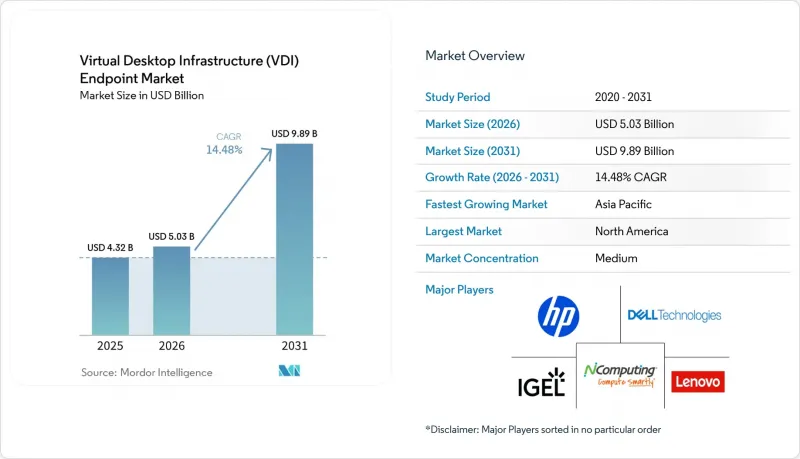
Mordor Intelligence에 의하면, 가상 데스크톱 인프라(VDI) 엔드포인트 시장 규모는 2025년에 43억 2,000만 달러로 평가되었고 2026년 50억 3,000만 달러에서 2031년까지 98억 9,000만 달러에 이를 것으로 예측되며, 예측 기간(2026-2031년) CAGR은 14.48%를 나타낼 전망입니다.
본 보고서는 엔드포인트 유형(씬 클라이언트, 제로 클라이언트, 스마트 기기/PC 등), 도입 형태(On-Premise, 클라우드 호스팅형, 하이브리드), 기업 규모(중소기업, 대기업), 업종(IT 및 통신, 은행, 금융서비스 및 보험(BFSI), 의료, 정부 기관 등) 및 지역별로 분류되어 있습니다. 시장 전망은 금액(달러) 기준으로 제시되어 있습니다.
전 세계 가상 데스크톱 인프라(VDI) 엔드포인트 시장 동향 및 인사이트
하이브리드 근무 환경으로의 전환이 가속화되고 있습니다.
하이브리드 근무 방식이 업무의 표준으로 자리 잡으면서, IT 팀은 재택, 지사 및 제3자 거점에서 번갈아 근무하는 직원들에게 동일하고 안전한 데스크톱 환경을 제공해야 합니다. 가상 데스크톱에서는 용도, 데이터 및 정책이 데이터센터 내에 머무르기 때문에 PC 배송에 따른 물류상의 문제나 보안 위험을 제거할 수 있습니다. 마이크로소프트는 2025년 10월, Azure Virtual Desktop용 임시 OS 디스크를 도입했습니다. 이를 통해 세션 호스트는 로그오프할 때마다 깨끗한 기본 상태로 재설정되어, 악성코드의 지속적인 위험을 줄이는 동시에 조직 내 이미지 관리를 간소화합니다. 임시 OS 디스크 등의 플랫폼 기능이 강화됨에 따라, 관리자는 로그오프 시 시스템을 초기 상태로 재설정할 수 있게 되어, 악성코드의 지속성을 줄이고 이미지 유지 관리를 간소화할 수 있습니다. 협업 성능도 향상되었습니다. 최적화된 코덱 덕분에 미디어 처리가 엔드포인트로 오프로드되므로, 가정용 광대역 회선에서도 화상 회의가 원활하게 작동합니다. 공유 풀을 통해 다수의 계약직 직원을 순환 배치하는 컨택 센터, 현장 서비스 팀, 컨설팅 회사 등은 하이브리드 근무 모델의 직접적인 이점으로 온보딩 과정의 신속화와 헬프데스크 문의 건수 감소를 꼽고 있습니다.
제로 트러스트 아키텍처에서 안전한 엔드포인트에 대한 수요
제로 트러스트 전략에서는 사용자의 신원과 기기의 상태를 지속적으로 검증해야 하므로, 로컬 스토리지는 위험 요인이 됩니다. 데스크톱 전체를 관리되는 환경으로 전환함으로써, 가상 데스크톱 인프라(VDI)는 기밀 정보가 기업 경계 내에 머물게 하고 모든 작업이 일원적으로 기록되도록 보장합니다. 연결 브로커와 ID 및 액세스 관리(IAM) 서비스의 연동을 통해 상황에 맞는 정책이 적용되어, 규정 준수 요건을 충족하지 않는 기기나 위험도가 높은 네트워크에서 발생하는 세션을 실시간으로 차단할 수 있게 되었습니다. 금융 서비스 기업과 공공기관이 조기에 도입을 추진하고 있는 이유는 가상 데스크톱이 엄격한 규제 요건을 충족하는 변조 방지형 감사 추적을 제공하기 때문입니다. 의료, 에너지, 중요 인프라 분야의 규제 당국이 제로 트러스트 아키텍처를 규정함에 따라, 가상 데스크톱 인프라의 엔드포인트 시장은 의무화된 업그레이드의 혜택을 누리고 있습니다.
초기 인프라 비용의 높음
On-Premise 가상 데스크톱 환경을 구축하려면, 첫 번째 사용자가 로그인하기 전에 서버, 스토리지 어레이, 네트워크 장비 및 하이퍼바이저 라이선스가 필요합니다. 이는 가격에 민감한 구매자들에게 큰 걸림돌이 됩니다. 일반적인 500명 규모의 VDI 클러스터의 경우, 초기 하드웨어 및 소프트웨어 비용으로 20만-40만 달러가 소요될 뿐만 아니라, 하이퍼바이저 지원, 스토리지 확장, 데이터센터의 전력 및 냉방에 드는 지속적인 비용도 발생합니다. 클라우드 구독 계약에서는 지출이 운영비로 전환되지만, 조직의 직원 구성이 안정적이고 재직 기간이 긴 경우,월이용료가 On-Premise 환경의 상각 완료된 비용을 초과할 가능성이 있습니다. 퍼블릭 클라우드에서 컴퓨팅, 스토리지, 대역폭의 변동하는 사용량을 예측하는 것은 여전히 복잡한 문제이며, 리소스 규모를 잘못 설정하면 예상치 못한 요금이 청구되어 기대했던 비용 절감 효과가 저해되는 경우가 종종 있습니다. 따라서 중소기업들은 서비스 제공업체들이 가상 데스크톱을 정액제 번들 형태로 제공하기 시작할 때까지 개념 검증(PoC)의 시범 단계를 넘어서는 것을 주저하고 있습니다. 자금 조달 프로그램, 종량제 데이터센터 어플라이언스, 관리형 서비스 등은 초기 투자 부담을 줄이는 것을 목적으로 하고 있지만, 신흥 시장에서의 도입은 여전히 더딘 실정입니다.
부문별 분석
소프트웨어 기반 엔드포인트 시장은 2026년부터 2031년까지 연평균 성장률(CAGR) 15.48%를 나타낼 것으로 예측되며, 이는 기업들이 새로운 하드웨어를 구매하기보다는 기존 노트북이나 데스크톱을 가상 데스크톱으로 전환하는 것을 선호하는 추세를 뒷받침하고 있습니다. 2025년에도 씬 클라이언트는 가상 데스크톱 인프라(VDI) 엔드포인트 시장 점유율의 47.87%를 차지하고 있으며, 그 배경으로는 팬리스 설계와 광범위한 내열성을 중시하는 콜센터, 의료 현장의 간호사 스테이션, 공장의 키오스크 단말기 등을 들 수 있습니다. 변환 유틸리티를 도입한 기업들은 Windows 및 macOS가 탑재된 노트북의 사용 수명을 최대 7년까지 연장함으로써, 조달 지연을 방지하는 동시에 전자 폐기물을 줄이고 있습니다. 리눅스 기반 엔드포인트 OS에 대한 이해가 깊어짐에 따라, 사용자의 수용 장벽은 낮아지고 있으며, 통합된 패치 적용을 통해 보안에 대한 우려도 완화되고 있습니다. 제로 클라이언트는 여전히 틈새 시장 제품으로 남아 있으며, 로컬 OS 사용을 금지하는 방위 기관에서 선호하고 있지만, 주변 기기 지원이 제한적이라는 점이 성장의 걸림돌이 되고 있습니다. 모바일 씬 클라이언트 노트북이나 내구성이 뛰어난 태블릿은 고정된 책상에서 벗어나 VDI에 접속해야 하는 현장 검사원이나 긴급 대응 요원들에게 새로운 역할을 열어주고 있습니다. 10ZiG사의 7500qTAA 시리즈 등은 책상에 얽매이지 않고 VDI 접속이 필요한 현장 기술자나 출장이 잦은 경영진을 대상으로 하며, 휴대성과 미국 연방 조달에 관한 무역협정법(Trade Agreements Act) 준수를 모두 충족시키고 있습니다. 조직들이 하드웨어 예산을 엄격히 관리하고 지속가능성 관련 요건이 정착됨에 따라, 소프트웨어 정의 디바이스용 가상 데스크톱 인프라(VDI) 엔드포인트 시장 규모는 예측 기간 동안 2배로 증가할 것으로 전망됩니다.
각 씬 클라이언트 공급업체들은 설치 공간 축소, 멀티미디어 오프로드 기능 향상, 그리고 하드웨어와 소프트웨어 솔루션의 경계를 모호하게 만드는 통합 브라우저 컨테이너 제공을 통해 이러한 수요에 대응하고 있습니다. 프린터 자동 리디렉션, 웹캠 패스스루, 다단계 인증 모듈이 표준 기능으로 탑재되면서, 전용 기기와 용도를 변경한 PC 간의 기능적 격차가 줄어들고 있습니다. 엔드포인트 관리 콘솔은 두 범주 모두를 감지하고 등록하며, 업데이트 프로그램을 배포함으로써 관리자에게 통합된 환경의 전체적인 현황을 제공합니다. 이러한 발전 덕분에 하드웨어와 소프트웨어를 병행하는 전략에서도 지원 프로세스가 단절되지 않을 것이라는 구매자의 신뢰가 높아지면서, 가상 데스크톱 인프라(VDI) 엔드포인트 시장의 잠재 고객층이 더욱 확대되고 있습니다.
2025년에는 On-Premise 배포가 매출의 58.21%를 차지했습니다. 이는 주로 금융 서비스, 제조 운영, 그리고 지연 시간에 민감한 산업용 제어 워크로드가 여전히 로컬 데이터센터에 의존하고 있기 때문입니다. 그러나 클라우드 호스팅형 데스크톱은 2031년까지 연평균 성장률(CAGR) 15.08%로 확대될 것으로 예상되며, 사내에 가상화 전문 인력이 부족한 기업들에게 종량제 요금제가 매력적이기 때문에 두 방식의 비중 차이는 점차 줄어들 것으로 보입니다. 각 하이퍼스케일러 기업들은 ID 관리, 파일 서비스, 보안 분석 기능을 하나로 묶어 제공함으로써, 소규모 팀이라도 몇 시간 만에 시범 환경을 구축할 수 있도록 하고 있습니다. 클라우드 구독형 가상 데스크톱 인프라(VDI) 엔드포인트 시장은 계절적 또는 프로젝트 기반 수요 급증을 겪는 소매 체인, 디자인 스튜디오, 전문 서비스 기업에서 가장 빠르게 성장하고 있습니다.
하이브리드 아키텍처에서는 일반적인 안정적인 부하에 대응하는 On-Premise 클러스터와 수요가 급증하는 기간을 대비한 클라우드 버스트를 결합함으로써, 비용과 규정 준수를 모두 최적화하고 있습니다. 통합된 제어 플레인은 사이트 간에 이미지의 수명 주기, 사용자 할당, 텔레메트리 정보를 조정하며, 이기종 인프라를 투명하게 처리합니다. 데이터를 국내에 보관하도록 의무화하는 법적 규제로 인해, 일부 조직은 멀티 클라우드 토폴로지로의 전환을 추진하고 있습니다. 이 토폴로지에서는 북미의 직원들은 국내 리전에서 가상 데스크톱을 실행하는 반면, 유럽 및 아시아의 동료들은 각국의 관할 하에 있는 인스턴스에 연결합니다. 이러한 분산화로 인해, 공급자별 세부 사항을 추상화하는 정책 엔진에 대한 수요가 증가하고 있으며, 이는 가상 데스크톱 인프라(VDI) 엔드포인트 시장의 혁신을 더욱 촉진하고 있습니다.
지역별 분석
아시아태평양은 2026년부터 2031년까지 15.26%라는 지역별 최고 연평균 성장률(CAGR)을 보일 것으로 전망됩니다. 이것은 “디지털 인디아”, 중국의 “사이버 보안법”, 그리고 정부 예산을 주권 클라우드 및 제로 트러스트 아키텍처에 재할당하는 “만안협력회의(GCC) 비전 2030”와 같은 이니셔티브에 힘입은 결과입니다. 2026년 하반기에 개설될 예정인 마이크로소프트의 사우디아라비아 동부 시설을 비롯한 새로운 로컬 클라우드 리전을 통해, 기업들은 지연 시간에 민감한 워크로드를 국내에서 실행할 수 있게 되며, 에너지, 공공 부문, 금융 서비스 등 각 산업 분야에서 엔드포인트 업그레이드가 촉진될 것입니다. 현지의 씬 클라이언트 조립 업체 및 소프트웨어 재판매 업체들은 공공 입찰에 포함된 ‘현지 조달 조항”의 혜택을 받아, 가상 데스크톱 인프라(VDI) 엔드포인트 시장에 경쟁의 활력을 불어넣고 있습니다.
2025년 매출의 36.43%를 차지한 북미는 하이퍼스케일러가 밀집된 거점 네트워크, 성숙한 채널 파트너, 그리고 산업 전반에 걸친 조기 도입을 통해 기술적 리더십의 위상을 유지하고 있습니다. 뉴욕의 금융 기관에서는 시장 시나리오 모델링을 위해 GPU 지원 가상 데스크톱을 도입하고 있는 반면, 연방 정부 기관에서는 보안 시설을 위해 “통상협정법”를 준수하는 엔드포인트를 의무화하고 있습니다. 도입 증가세는 눈부시다기보다는 꾸준한 편이지만, 지속적인 업데이트 주기로 인해 절대적인 지출액은 높은 수준을 유지하고 있습니다.
유럽의 일반 데이터 보호 규정(GDPR(EU 개인정보보호규정))은 국경을 넘는 데이터 전송을 피하기 위해 하이브리드 및 On-Premise 도입을 권장하고 있지만, 독일, 프랑스, 북유럽 국가들에서 클라우드 리전 구축이 가속화되고 있어 기업들은 호스팅형 데스크톱으로의 전환을 서둘러야 하는 상황에 놓여 있습니다. 한편, 남미와 아프리카에서는 통신 인프라의 미비나 하드웨어에 대한 높은 수입 관세로 인해 도입 속도가 둔화되고 있지만, 각국의 광대역 계획과 디지털 정부 프로그램이 가상 데스크톱 인프라(VDI) 엔드포인트 시장의 향후 확대를 위한 기반을 마련해 나가고 있습니다.
기타 혜택:
- 엑셀 형식 시장 예측(ME) 시트
- 3개월간의 애널리스트 지원
자주 묻는 질문
목차
제1장 서론
제2장 조사 방법
제3장 주요 요약
제4장 시장 구도
제5장 시장 규모와 성장 예측
제6장 경쟁 구도
제7장 시장 기회와 향후 전망
JHS 26.07.09According to Mordor Intelligence, the virtual desktop infrastructure endpoint market size was valued at USD 4.32 billion in 2025 and is estimated to grow from USD 5.03 billion in 2026 to reach USD 9.89 billion by 2031, at a CAGR of 14.48% during the forecast period (2026-2031).
This report is Segmented by Endpoint Type (Thin Client, Zero Client, Smart Device/PC, and More), Deployment Mode (On-Premises, Cloud-Hosted, and Hybrid), Enterprise Size (Small and Medium Enterprises, and Large Enterprises), Industry Vertical (IT and Telecom, BFSI, Healthcare, Government, and More), and Geography. The Market Forecasts are Provided in Terms of Value (USD).
Global Virtual Desktop Infrastructure (VDI) Endpoint Market Trends and Insights
Accelerated Shift to Hybrid Work Environments
Hybrid schedules have become an entrenched operating norm, compelling information-technology teams to deliver identical, secure desktops to employees working alternately from home, branch offices, and third-party locations. Virtual desktops eliminate the logistics and security risks of shipping PCs, as applications, data, and policies remain in the data center. Microsoft introduced ephemeral operating-system disks for Azure Virtual Desktop in October 2025, allowing session hosts to reset to a clean baseline after each logoff, reducing persistent malware risk and simplifying image management for organizations. Platform enhancements, such as ephemeral operating-system disks, let administrators reset machines to a pristine state at log-off, reducing malware persistence and simplifying image maintenance. Collaboration performance has also improved; optimized codecs offload media to endpoints, enabling videoconferencing to function smoothly even over residential broadband. Contact centers, field service teams, and consultancies that rotate large numbers of contractors through shared pools cite faster onboarding and lower help-desk volumes as direct benefits of the hybrid-work model.
Demand for Secure Endpoints in Zero Trust Architectures
Zero-trust strategies require continuous verification of user identity and device posture, making local storage a liability. By shifting the entire desktop to a controlled environment, virtual desktop infrastructure ensures that sensitive information remains within the corporate perimeter and that every action is logged centrally. Integration between connection brokers and identity-and-access-management services now allows contextual policies that block sessions from non-compliant devices or risky networks in real time. Financial services firms and public agencies are early adopters because virtual desktops provide tamper-proof audit trails that meet stringent regulatory requirements. As regulators in healthcare, energy, and critical infrastructure specify zero-trust architectures, the virtual desktop infrastructure endpoint market gains from mandated upgrades.
Higher Up-Front Infrastructure Costs
Building an on-premises virtual desktop environment requires servers, storage arrays, networking gear, and hypervisor licenses before the first user signs in, a hurdle that weighs heavily on cost-sensitive buyers. A typical 500-seat VDI cluster requires USD 200,000 to USD 400,000 in initial hardware and software costs, plus ongoing costs for hypervisor support, storage expansion, and datacenter power and cooling.Although cloud subscriptions shift spending to operating expenditure, monthly fees can outpace amortized on-premises costs when organizations have stable, long-tenure workforces. Predicting variable compute, storage, and bandwidth consumption in public clouds remains complex, and mis-sizing often triggers unplanned bills that erode projected savings. Smaller businesses, therefore, hesitate to move past proof-of-concept pilots until service providers package virtual desktops as fixed-price bundles. Financing programs, pay-per-use data center appliances, and managed service offerings aim to smooth the capital hump, yet adoption in emerging markets still lags.
Other drivers and restraints analyzed in the detailed report include:
- Cost Savings From Centralised Desktop Management
- Mainstream Adoption of GPU-Enabled Virtual Desktops
- Bandwidth Limitations in Emerging Economies
For complete list of drivers and restraints, kindly check the Table Of Contents.
Segment Analysis
Software-based endpoints are forecast to grow at a 15.48% CAGR between 2026 and 2031, reinforcing the narrative that organizations prefer converting existing laptops and desktops rather than purchasing new hardware. In 2025, thin clients still commanded 47.87% of the virtual desktop infrastructure endpoint market share, underpinned by call centers, healthcare nursing stations, and factory kiosks that value fanless designs and extended temperature tolerance. Enterprises deploying conversion utilities extend a Windows or macOS laptop's usable life by up to 7 years, sidestepping procurement queues and reducing electronic waste. Growing familiarity with Linux-based endpoint operating systems has lowered user-acceptance barriers, while centralized patching allays security concerns. Zero clients remain niche, favored by defense agencies that forbid local operating systems, though limited peripheral support constrains growth. Mobile thin-client laptops and rugged tablets are carving out roles for field inspectors and emergency responders who need VDI access away from fixed desks. such as 10ZiG's 7500qTAA series, address field technicians and traveling executives who require VDI access without tethering to a desk, combining portability with Trade Agreements Act compliance for United States federal procurement. The virtual desktop infrastructure endpoint market size for software-converted devices is expected to double over the forecast period as organizations tighten hardware budgets and sustainability mandates take hold.
Thin-client vendors are responding with lighter footprints, improved multimedia off-load and integrated browser containers that blur the line between hardware and software solutions. Automatic printer redirection, webcam passthrough, and multi-factor authentication modules now ship as standard, reducing the functional gap between dedicated appliances and repurposed PCs.Endpoint management consoles detect, enroll,l and push updates to both categories, giving administrators a homogeneous fleet view. These advances reinforce buyer confidence that a mixed hardware-software strategy will not fracture support processes, further expanding the addressable pool for the virtual desktop infrastructure endpoint market.
On-premises deployments accounted for 58.21% of revenue in 2025, primarily because financial services, manufacturing execution, and latency-sensitive industrial control workloads remain tied to local data centers. However, cloud-hosted desktops are projected to expand at a 15.08% CAGR through 2031, narrowing the split as consumption-based pricing appeals to businesses lacking internal virtualization talent. Hyperscalers bundle identity management, file services, and security analytics, letting small teams spin up pilots in hours. The virtual desktop infrastructure endpoint market for cloud subscriptions is growing fastest in retail chains, design studios, and professional services firms that experience seasonal or project-based peaks.
Hybrid architectures combine local clusters for baseline steady-state loads with cloud bursting for high-demand periods, optimizing both cost and compliance. Unified control planes orchestrate image lifecycle, user assignments, and telemetry across sites, masking infrastructure heterogeneity. Legal mandates requiring data to remain within national borders are steering some organizations toward multi-cloud topologies, where North American employees run virtual desktops in domestic regions while colleagues in Europe or Asia connect to sovereign instances. Such fragmentation drives demand for policy engines that abstract from provider-specific details, further fueling innovation in the virtual desktop infrastructure endpoint market.
Complete Report Scope:
- By Endpoint Type
- Thin Client
- Zero Client
- Smart Device/PC
- Mobile Thin Client
- Software-based Endpoint
- By Deployment-Mode
- On-premises
- Cloud-hosted
- Hybrid
- By Enterprise Size
- Small and Medium Enterprises
- Large Enterprises
- By Industry Vertical
- IT and Telecom
- BFSI
- Healthcare
- Government
- Education
- Manufacturing
- Retail
- Other Industry Verticals
- By Geography
- North America
- United States
- Canada
- Mexico
- South America
- Brazil
- Argentina
- Rest of South America
- Europe
- United Kingdom
- Germany
- France
- Italy
- Spain
- Rest of Europe
- Asia-Pacific
- China
- Japan
- India
- South Korea
- Rest of Asia-Pacific
- Middle East and Africa
- Middle East
- United Arab Emirates
- Saudi Arabia
- Rest of Middle East
- Africa
- South Africa
- Egypt
- Rest of Africa
- Middle East
- North America
Geography Analysis
Asia-Pacific is projected to register the highest regional CAGR at 15.26% from 2026 to 2031, fueled by Digital India, China's Cybersecurity Law, and Gulf Cooperation Council Vision 2030 initiatives that channel government budgets into sovereign clouds and zero-trust architectures. New local cloud regions, including Microsoft's Saudi Arabia East facility slated for late 2026, will let enterprises run latency-sensitive workloads domestically, spurring endpoint upgrades across energy, public sector, and financial services verticals. Local thin-client assemblers and software resellers benefit from buy-local clauses embedded in public tenders, adding competitive dynamism to the virtual desktop infrastructure endpoint market.
North America, which captured 36.43% of 2025 revenue, maintains a technology leadership position thanks to dense hyperscaler footprints, mature channel partners, and early cross-industry adoption. Financial houses in New York deploy GPU-enabled virtual desktops to model market scenarios, while federal agencies mandate Trade Agreements Act-compliant endpoints for secure facilities. Adoption growth is steadier than spectacular, yet continual refresh cycles keep absolute spending high.
Europe's General Data Protection Regulation encourages hybrid and on-premises deployments to avoid cross-border data transfers, though accelerated cloud region launches in Germany, France, and the Nordics are nudging enterprises toward hosted desktops. Meanwhile, South America and Africa face slower uptake due to under-provisioned connectivity and higher import tariffs on hardware, but targeted national broadband plans and digital government programs are planting the seeds for future expansion in the virtual desktop infrastructure endpoint market.
- Acer Inc.
- Advantech Co., Ltd.
- Amulet Hotkey Ltd.
- Atrust Computer Corp.
- Centerm Information Co., Ltd.
- ClearCube Technology, Inc.
- Dell Technologies Inc.
- Fujitsu Limited
- HP Inc.
- IGEL Technology GmbH
- Lenovo Group Limited
- LG Electronics Inc.
- NComputing Co., Ltd.
- 10ZiG Technology Inc.
- Parallels International GmbH
- Samsung Electronics Co., Ltd.
- Stratodesk Corporation
- Teradici Corporation
- ThinPrint GmbH
- VXL Instruments Limited
Additional Benefits:
- The market estimate (ME) sheet in Excel format
- 3 months of analyst support
TABLE OF CONTENTS
1 INTRODUCTION
- 1.1 Study Assumptions and Market Definition
- 1.2 Scope of the Study
2 RESEARCH METHODOLOGY
3 EXECUTIVE SUMMARY
4 MARKET LANDSCAPE
- 4.1 Market Overview
- 4.2 Market Drivers
- 4.2.1 Accelerated Shift to Hybrid Work Environments
- 4.2.2 Demand for Secure Endpoints in Zero Trust Architectures
- 4.2.3 Cost Savings From Centralised Desktop Management
- 4.2.4 Mainstream Adoption of GPU-enabled Virtual Desktops
- 4.2.5 Government Mandates on Data Localisation
- 4.2.6 Rise of ARM-based Thin Clients for Energy Efficiency
- 4.3 Market Restraints
- 4.3.1 Higher Up-front Infrastructure Costs
- 4.3.2 Bandwidth Limitations in Emerging Economies
- 4.3.3 Limited Peripheral Compatibility in Zero Clients
- 4.3.4 Skills Gap in VDI Endpoint Management
- 4.4 Impact of Macroeconomic Factors on the Market
- 4.5 Industry Value Chain Analysis
- 4.6 Regulatory Landscape
- 4.7 Technological Outlook
- 4.8 Porter's Five Forces Analysis
- 4.8.1 Bargaining Power of Suppliers
- 4.8.2 Bargaining Power of Buyers
- 4.8.3 Threat of New Entrants
- 4.8.4 Threat of Substitutes
- 4.8.5 Intensity of Competitive Rivalry
5 MARKET SIZE AND GROWTH FORECASTS (VALUE)
- 5.1 By Endpoint Type
- 5.1.1 Thin Client
- 5.1.2 Zero Client
- 5.1.3 Smart Device/PC
- 5.1.4 Mobile Thin Client
- 5.1.5 Software-based Endpoint
- 5.2 By Deployment-Mode
- 5.2.1 On-premises
- 5.2.2 Cloud-hosted
- 5.2.3 Hybrid
- 5.3 By Enterprise Size
- 5.3.1 Small and Medium Enterprises
- 5.3.2 Large Enterprises
- 5.4 By Industry Vertical
- 5.4.1 IT and Telecom
- 5.4.2 BFSI
- 5.4.3 Healthcare
- 5.4.4 Government
- 5.4.5 Education
- 5.4.6 Manufacturing
- 5.4.7 Retail
- 5.4.8 Other Industry Verticals
- 5.5 By Geography
- 5.5.1 North America
- 5.5.1.1 United States
- 5.5.1.2 Canada
- 5.5.1.3 Mexico
- 5.5.2 South America
- 5.5.2.1 Brazil
- 5.5.2.2 Argentina
- 5.5.2.3 Rest of South America
- 5.5.3 Europe
- 5.5.3.1 United Kingdom
- 5.5.3.2 Germany
- 5.5.3.3 France
- 5.5.3.4 Italy
- 5.5.3.5 Spain
- 5.5.3.6 Rest of Europe
- 5.5.4 Asia-Pacific
- 5.5.4.1 China
- 5.5.4.2 Japan
- 5.5.4.3 India
- 5.5.4.4 South Korea
- 5.5.4.5 Rest of Asia-Pacific
- 5.5.5 Middle East and Africa
- 5.5.5.1 Middle East
- 5.5.5.1.1 United Arab Emirates
- 5.5.5.1.2 Saudi Arabia
- 5.5.5.1.3 Rest of Middle East
- 5.5.5.2 Africa
- 5.5.5.2.1 South Africa
- 5.5.5.2.2 Egypt
- 5.5.5.2.3 Rest of Africa
- 5.5.5.1 Middle East
- 5.5.1 North America
6 COMPETITIVE LANDSCAPE
- 6.1 Market Concentration
- 6.2 Strategic Moves
- 6.3 Market Share Analysis
- 6.4 Company Profiles (includes Global Level Overview, Market Level Overview, Core Segments, Financials as available, Strategic Information, Market Rank/Share, Products and Services, Recent Developments)
- 6.4.1 Acer Inc.
- 6.4.2 Advantech Co., Ltd.
- 6.4.3 Amulet Hotkey Ltd.
- 6.4.4 Atrust Computer Corp.
- 6.4.5 Centerm Information Co., Ltd.
- 6.4.6 ClearCube Technology, Inc.
- 6.4.7 Dell Technologies Inc.
- 6.4.8 Fujitsu Limited
- 6.4.9 HP Inc.
- 6.4.10 IGEL Technology GmbH
- 6.4.11 Lenovo Group Limited
- 6.4.12 LG Electronics Inc.
- 6.4.13 NComputing Co., Ltd.
- 6.4.14 10ZiG Technology Inc.
- 6.4.15 Parallels International GmbH
- 6.4.16 Samsung Electronics Co., Ltd.
- 6.4.17 Stratodesk Corporation
- 6.4.18 Teradici Corporation
- 6.4.19 ThinPrint GmbH
- 6.4.20 VXL Instruments Limited
7 MARKET OPPORTUNITIES AND FUTURE OUTLOOK
- 7.1 White-Space and Unmet-Need Assessment


