|
시장보고서
상품코드
2073160
식품 가공 및 취급 장비 : 시장 점유율 분석, 업계 동향 및 통계, 성장 예측(2026-2031년)Food Processing and Handling Equipment - Market Share Analysis, Industry Trends & Statistics, Growth Forecasts (2026 - 2031) |
||||||
 Mordor Intelligence
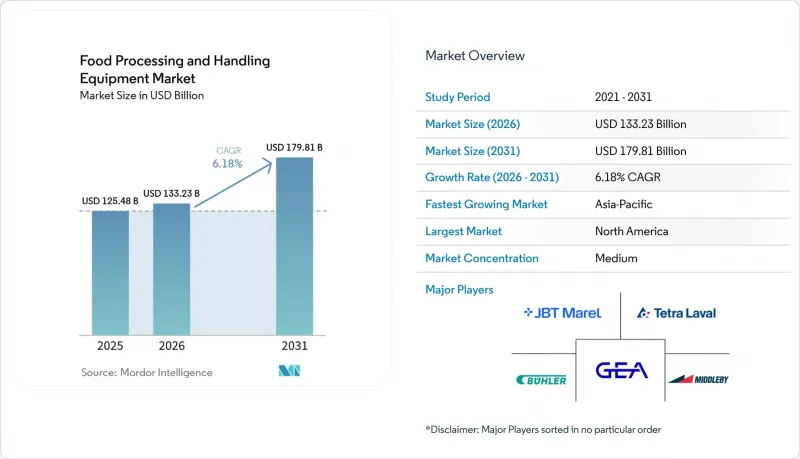
Mordor Intelligence에 의하면, 식품 가공 및 취급 장비 시장은 2025년 1,254억 8,000만 달러로 평가되었습니다. 2026년에는 1,332억 3,000만 달러로 확대되어 2031년까지 1,798억 1,000만 달러에 이를 것으로 예측되며, 2026년부터 2031년까지 연평균 복합 성장률(CAGR)은 6.2%를 나타낼 전망입니다.
본 보고서는 장비 유형(식품 가공 장비, 식품 포장 장비), 최종 제품의 형태(고체, 액체, 반고체), 용도(육류·가금류, 제빵 및 제과, 유제품, 음료, 기타), 지역(북미, 유럽, 아시아태평양, 남미, 중동 및 아프리카)별로 분류되어 있습니다. 시장 전망은 금액(달러) 기준으로 제시되어 있습니다.
세계의 식품 가공 및 취급 장비 시장 동향 및 인사이트
가공식품, 포장식품, 부가가치 식품에 대한 수요 증가
식품 가공 및 취급 장비 시장은 선진국과 신흥 시장에서 포장 식품 및 부가가치 식품에 대한 수요가 증가함에 따라 지속적인 성장을 이어가고 있습니다. 2025년, 전 세계 포장 식품 시장은 성장을 거듭했으며, 아시아태평양이 큰 점유율을 차지했습니다. 이는 해당 지역의 생산 능력 확대와 장비 수요 증가를 반영한 것입니다. 기능성 식품, 식물성 단백질, 프리미엄 레디밀 등의 분야에서는 취급, 혼합, 열처리, 충진을 위한 첨단 시스템이 필요하기 때문에 초점은 단순한 생산량을 넘어 변화하고 있습니다. 구형 생산 라인은 기계적으로는 정상적으로 작동하고 있지만, 성능이 점차 저하되고 있어 시장에서의 교체 주기가 단축되고 있습니다. 현재 투자는 동일한 공장 부지 내에서 빈번한 생산 전환, 더욱 엄격한 품질 관리, 그리고 복잡한 제품 요구 사항에 대응할 수 있는 유연한 플랫폼에 집중되고 있습니다.
식품 제조 분야의 자동화와 로봇 공학의 통합
현재 식품 제조업체들은 노동 효율성과 생산 라인의 일관성을 단순한 개선 목표가 아닌 필수적인 운영 요건으로 우선시하고 있으며, 이것이 식품 가공 및 취급 장비 시장의 성장을 견인하고 있습니다. PMMI와 FPSA는 2026년까지 AI를 활용한 검사, HMI를 통한 지식 전수, 디지털 도구 도입이 미국 식품 및 음료 가공업체들에게 주요 투자 분야가 될 것이라고 지적하고 있습니다. 가공 업체들은 더 이상 로봇 기술을 단독으로 구매할 대상으로 보지 않고, 검사, 데이터 수집, 기계 반응 및 생산 품질을 연계하는 시스템에 자동화를 통합하고 있습니다. 이러한 접근 방식을 통해, 특히 인력 부족이나 숙련된 운영 인력이 제한적인 지역에서 자동화 프로젝트의 투자 회수 기간이 단축됩니다. 투자 회수 기간이 단축됨에 따라 식품 가공 및 취급 장비에 대한 수요가 확대되고 있으며, 현재는 중규모 가공업체도 그 대상에 포함되고 있습니다.
엄격한 식품 안전 규제와 규정 준수 비용
식품 가공 및 취급 장비 시장은 기준이 강화된 덕분에 혜택을 보고 있지만, 해당 기준을 충족하기 위한 비용은 여전히 소규모 가공업체들에게 제약 요인으로 작용하고 있습니다. 규정 준수 대응에는 대부분의 경우 장비 재설계, 추가 검증, 보다 체계적인 변경 관리 및 보다 광범위한 문서화가 필요하며, 이로 인해 조달 주기가 길어지고 성능 향상을 위한 재량적 지출이 제한됩니다. 대규모 가공업체는 생산량 증가를 통해 이러한 비용을 분산시킬 수 있지만, 중소규모 사업자는 식품 가공 및 취급 장비 시장의 설비 교체 결정에 있어 이익 마진이 좁다는 문제에 직면해 있습니다. 이로 인해 OEM 제조업체의 경우 수주 패턴에 편차가 발생하게 됩니다. 일부 고객은 생산 라인의 현대화를 신속하게 추진하는 반면, 다른 고객은 구매를 미루고 최소한의 개보수에만 집중하기 때문입니다. 그 결과, 규제가 장기적인 갱신 수요를 뒷받침하는 한편, 단기적으로는 관심에서 확정 주문으로의 전환을 지연시킬 가능성도 있는 시장 상황이 조성되고 있습니다.
부문별 분석
2025년, 식품 가공 장비는 식품 가공 및 취급 장비 시장에서 48.21%의 점유율을 차지했습니다. 이러한 압도적인 시장 점유율은 제품 가공에 필수적인 절단, 분쇄, 혼합, 열처리 등 주요 공정의 중요성을 여실히 보여주고 있습니다. 이러한 공정은 다른 장비 범주와 비교했을 때 도입 대수가 많으며, 교체 수요도 높습니다. 또한, 위생, 자동화, 생산성 향상을 위한 노력은 대개 1차 가공 공정에서 시작되어, 이후 공장의 다른 기능으로 확대되어 나갑니다.
2026년부터 2031년에 걸쳐 식품 포장 장비 부문은 연평균 성장률(CAGR) 6.7%를 나타낼 것으로 예측됩니다. 이러한 성장은 제조업체들이 재활용 가능한 소재를 채택하고, 제품 형태를 다양화하며, 생산 로트를 축소함에 따라 유연한 충전, 밀봉, 라벨링 및 최종 공정 시스템에 대한 수요가 증가하고 있는 것이 원동력이 되고 있습니다. Krones AG는 2025년 매출이 56억 6,380만 유로로, 2024년의 52억 9,360만 유로 대비 7.0% 증가했다고 보고했으며, 이는 포장 기술에 대한 견조한 수요를 반영한 것입니다. VDMA의 보고서에 따르면, 2025년 독일 식품 기계 수출 중 포장 기계가 70% 가까이 차지하고 있어, 이 분야의 세계적 중요성이 부각되고 있습니다. 그 결과, 포장 라인은 전략적 자산으로 발전하여 신제품 출시 속도, 소재 적응성 및 노동 효율 향상에 기여하고 있습니다.
지역별 분석
2025년, 북미는 식품 가공 및 취급 장비 시장의 32.11%를 차지했습니다. 이 지역에서는 미국이 주도적인 역할을 수행했으며, 식품 및 음료 기계 출하액은 62억 달러에 달하고, 2024년 대비 3.2% 증가했습니다. 초점은 신규 공장 건설에서 기존 설비의 업그레이드로 옮겨가고 있으며, 이는 자동화, 추적성 및 처리 능력 향상에 대한 수요를 견인하고 있습니다. 기존 생산 라인의 개조, 디지털 추적성 강화 및 노동 효율성 향상을 전문으로 하는 공급업체들이 혜택을 보고 있습니다. 생산 운영상의 압박으로 인한 교체 수요가 북미 시장의 성장을 뒷받침하고 있습니다.
유럽은 여전히 2위 시장이며, 식품 가공·포장 기계의 주요 수출 거점입니다. 독일의 식품·포장 기계 부문은 2025년에 170억 유로에 달했으며, 그중 84%에 해당하는 110억 유로가 수출되었습니다. 유럽공급업체들은 전 세계 설비 투자 동향과 밀접한 관련이 있습니다. “그린 딜"이나 “EXQUISHEAT" 프로그램과 같은 정책으로 인해, 에너지 효율이 높은 시스템과 최적화된 공정 레이아웃에 대한 수요가 증가하고 있습니다. 시장에서는 에너지 효율성, 위생 관리 대응 능력, 규제 준수의 지속성을 갖춘 프리미엄 시스템이 지지를 받고 있으며, 높은 초기 비용도 정당화되고 있습니다.
아시아태평양은 가장 빠르게 성장하는 지역으로, 2026년부터 2031년까지 연평균 성장률(CAGR) 8.34%를 나타낼 것으로 전망됩니다. 이러한 성장은 가공식품 생산 증가, 수출 활동 확대, 그리고 콜드체인에 대한 투자에 힘입어 중국, 인도, 동남아시아에 집중되어 있습니다. 인도 식품가공산업부는 2026년 3월까지의 기간 동안 PMKSY(총리 식품가공 지원 계획)에 따라 콜드체인 및 가치사슬 인프라에 6,520카롤 루피(7억 8,500만 달러)를 배정했습니다. 2025년 9월 푸네에 문을 연 JBT Marel의 세계 생산 센터는 이 지역에서 제조업의 중요성이 커지고 있음을 보여줍니다. 남미와 중동 및 아프리카의 점유율은 낮지만, 라틴아메리카는 전 세계 식품 수출의 25%를 차지하고 있습니다. 2026년 5월에 체결된 아부다비 푸드 허브의 3만 7,000제곱미터 규모 콜드체인 인프라 계약은 식품 가공 및 취급 장비 시장의 잠재력이 확대되고 있음을 시사합니다.
기타 혜택 :
- 엑셀 형식 시장 예측(ME) 시트
- 3개월간의 애널리스트 지원
자주 묻는 질문
목차
제1장 서론
제2장 조사 방법
제3장 주요 요약
제4장 시장 구도
제5장 시장 규모 및 성장 예측
제6장 경쟁 구도
제7장 시장 기회 및 향후 전망
KTH 26.07.08According to Mordor Intelligence, the food processing and handling equipment market is projected to grow from USD 125.48 billion in 2025 to USD 133.23 billion in 2026 and reach USD 179.81 billion by 2031, with a CAGR of 6.2% during 2026-2031.
This report is Segmented by Equipment Type (Food Processing Equipment, Food Packaging Equipment), End-Product Form (Solid, Liquid, Semi-Solid), Application (Meat and Poultry, Bakery and Confectionery, Dairy Products, Beverages, Others), and Geography (North America, Europe, Asia-Pacific, South America, Middle East and Africa). The Market Forecasts are Provided in Terms of Value (USD).
Global Food Processing and Handling Equipment Market Trends and Insights
Rising Demand for Processed, Packaged, and Value-Added Food Products
The food processing and handling equipment market is growing alongside the rising demand for packaged and value-added foods in developed and emerging markets. In 2025, the global packaged food market experienced growth, with the Asia-Pacific region holding a significant share. This reflects the regions expanding manufacturing capacities and increasing equipment demand. The focus is shifting beyond volume, as categories like functional foods, plant-based proteins, and premium ready meals require advanced systems for handling, mixing, thermal treatment, and filling. Older production lines, though mechanically functional, are becoming less suitable, shortening replacement cycles in the market. Investments are now directed toward flexible platforms that support frequent changeovers, stricter quality controls, and complex product requirements within the same plant footprint.
Integration of Automation and Robotics in Food Manufacturing
Food manufacturers now prioritize labor efficiency and line consistency as essential operational needs rather than improvement goals, driving growth in the food processing and handling equipment market. By 2026, PMMI and FPSA identified AI-assisted inspection, HMI knowledge transfer, and digital tool adoption as key investment areas for U.S. food and beverage processors. Processors no longer view robotics as standalone purchases but integrate automation into systems connecting inspection, data capture, machine response, and output quality. This approach shortens the return window on automation projects, especially in regions with labor shortages and limited skilled operators. As payback periods shrink, demand for food processing and handling equipment is expanding, now including more mid-sized processors.
Stringent Food Safety Regulations and Compliance Costs
The food processing and handling equipment market benefits from stricter standards, but the cost of meeting them still acts as a restraint for smaller processors. Compliance work often requires equipment redesign, additional validation, more structured change control, and broader documentation, which stretches procurement cycles and limits discretionary spending on performance upgrades. Large processors can spread those costs across higher output volumes, while small and mid-sized operators face a narrower margin for replacement decisions in the food processing and handling equipment market. This creates uneven order patterns for OEMs because some customers move quickly to replace lines, while others delay purchases and focus on minimum viable retrofits. The result is a market where regulation supports long-term replacement demand but can also slow short-term conversion of interest into finalized orders.
Other drivers and restraints analyzed in the detailed report include:
- Increasing Focus on Food Safety and Hygiene Regulations
- Emphasis on Sustainability and Energy Efficiency in Food Processing
- Supply Chain Disruptions and Raw Material Price Volatility
For complete list of drivers and restraints, kindly check the Table Of Contents.
Segment Analysis
In 2025, food processing equipment held a 48.21% share of the food processing and handling equipment market. This dominance highlights essential operations like cutting, grinding, mixing, and thermal treatment, which are crucial for product transformation. These processes result in a larger installed base and higher replacement needs compared to other equipment categories. Additionally, hygiene, automation, and productivity upgrades often start in primary processing before extending to other plant functions.
Between 2026 and 2031, the food packaging equipment segment is expected to grow at a 6.7% CAGR. This growth is driven by rising demand for flexible filling, sealing, labeling, and end-of-line systems as manufacturers adopt recyclable materials, diversify formats, and shorten production runs. Krones AG reported EUR 5,663.8 million in revenue in 2025, a 7.0% increase from EUR 5,293.6 million in 2024, reflecting strong demand for packaging technology. VDMA reported that packaging machines accounted for nearly 70% of Germany's food machinery exports in 2025, emphasizing their global importance. As a result, packaging lines are evolving into strategic assets, improving launch speeds, material adaptability, and labor efficiency.
Complete Report Scope:
- By Equipment Type
- Food Processing Equipment
- Cutting and slicing equipment
- Grinding and milling equipment
- Mixing and blending equipment
- Homogenizers
- Extruders
- Cooking and heating equipment
- Pasteurization and sterilization equipment
- Drying and dehydration equipment
- Evaporators and concentrators
- Fermentation equipment
- Food Packaging Equipement
- Food Processing Equipment
- By End-Product Form
- Solid
- Liquid
- Semi-solid
- By Application
- Bakery and Confectionery
- Meat and Poultry
- Fish and Seafood
- Dairy Products
- Alcoholic Beverages
- Non-alcoholic Beverages
- Other Applications
- By Geography
- North America
- United States
- Canada
- Mexico
- Rest of North America
- Europe
- Germany
- United Kingdom
- Italy
- France
- Spain
- Netherlands
- Poland
- Belgium
- Sweden
- Rest of Europe
- Asia-Pacific
- China
- India
- Japan
- Australia
- Indonesia
- South Korea
- Thailand
- Singapore
- Rest of Asia-Pacific
- South America
- Brazil
- Argentina
- Colombia
- Chile
- Peru
- Rest of South America
- Middle East and Africa
- South Africa
- Saudi Arabia
- United Arab Emirates
- Nigeria
- Egypt
- Morocco
- Turkey
- Rest of Middle East and Africa
- North America
Geography Analysis
In 2025, North America accounted for 32.11% of the food processing and handling equipment market. The U.S. led the region, with food and beverage machinery shipments reaching USD 6.2 billion, a 3.2% increase from 2024. The focus has shifted to brownfield upgrades over new plant construction, driving demand for automation, traceability, and throughput improvements. Suppliers specializing in retrofitting existing lines, enhancing digital traceability, and improving labor efficiency are benefiting. Replacement demand, driven by operational pressures, sustains North America's market growth.
Europe remains the second-largest market and a key export hub for food processing and packaging machinery. Germany's food and packaging machinery sector reached EUR 17 billion in 2025, with 84% exported, totaling EUR 11 billion. European suppliers are closely tied to global capital spending trends. Policies like the Green Deal and EXQUISHEAT program are boosting demand for energy-efficient systems and optimized process layouts. The market leans toward premium systems offering energy savings, hygiene readiness, and compliance durability, justifying higher upfront costs.
Asia-Pacific is the fastest-growing region, projected to grow at an 8.34% CAGR from 2026 to 2031. Growth is concentrated in China, India, and Southeast Asia, driven by rising processed food production, export activities, and cold chain investments. India's Ministry of Food Processing Industries allocated INR 6,520 crore (USD 785 million) for cold chain and value addition infrastructure under PMKSY through March 2026. JBT Marel's Global Production Center, launched in Pune in September 2025, highlights the region's growing manufacturing importance. While South America and the Middle East & Africa hold smaller shares, Latin America contributes 25% to global food exports. Abu Dhabi Food Hub's 37,000 sqm cold chain infrastructure deal in May 2026 signals expanding market potential for food processing and handling equipment.
- BAADER Group
- JBT Marel
- Buhler AG
- GEA Group Aktiengesellschaft
- Tetra Laval International S.A.
- The Middleby Corporation
- Krones AG
- Alfa Laval AB
- SPX Flow, Inc.
- The Huppmann Group
- Marel hf.
- Heat and Control, Inc.
- FENCO Food Machinery S.r.l.
- Bigtem Makine A.S.
- TNA Australia Pty Limited
- Foodmate B.V.
- LEHUI Equipamientos Carnicos, S.L.
- Provisur Technologies, Inc.
- JBT Corporation
- Paul Mueller Company, Inc.
Additional Benefits:
- The market estimate (ME) sheet in Excel format
- 3 months of analyst support
TABLE OF CONTENTS
1 INTRODUCTION
- 1.1 Study Assumptions and Market Definition
- 1.2 Scope of the Study
2 RESEARCH METHODOLOGY
3 EXECUTIVE SUMMARY
4 MARKET LANDSCAPE
- 4.1 Market Overview
- 4.2 Market Drivers
- 4.2.1 Rising demand for processed, packaged, and value-added food products
- 4.2.2 Integration of automation and robotics in food manufacturing
- 4.2.3 Increasing focus on food safety and hygiene regulations
- 4.2.4 Emphasis on sustainability and energy efficiency in food processing
- 4.2.5 Expansion of cold chain infrastructure and refrigerated logistics
- 4.2.6 Technological innovation in processing and packaging equipment
- 4.3 Market Restraints
- 4.3.1 Stringent food safety regulations and compliance costs
- 4.3.2 Equipment maintenance complexities
- 4.3.3 High maintenance and operational costs
- 4.3.4 Supply chain disruptions and raw material price volatility
- 4.4 Supply Chain Analysis
- 4.5 Regulatory Landscape
- 4.6 Technological Outlook
- 4.7 Porter's Five Forces
- 4.7.1 Bargaining Power of Suppliers
- 4.7.2 Bargaining Power of Buyers
- 4.7.3 Threat of New Entrants
- 4.7.4 Threat of Substitutes
- 4.7.5 Competitive Rivalry
5 MARKET SIZE AND GROWTH FORECASTS (VALUE)
- 5.1 By Equipment Type
- 5.1.1 Food Processing Equipment
- 5.1.1.1 Cutting and slicing equipment
- 5.1.1.2 Grinding and milling equipment
- 5.1.1.3 Mixing and blending equipment
- 5.1.1.4 Homogenizers
- 5.1.1.5 Extruders
- 5.1.1.6 Cooking and heating equipment
- 5.1.1.7 Pasteurization and sterilization equipment
- 5.1.1.8 Drying and dehydration equipment
- 5.1.1.9 Evaporators and concentrators
- 5.1.1.10 Fermentation equipment
- 5.1.2 Food Packaging Equipement
- 5.1.1 Food Processing Equipment
- 5.2 By End-Product Form
- 5.2.1 Solid
- 5.2.2 Liquid
- 5.2.3 Semi-solid
- 5.3 By Application
- 5.3.1 Bakery and Confectionery
- 5.3.2 Meat and Poultry
- 5.3.3 Fish and Seafood
- 5.3.4 Dairy Products
- 5.3.5 Alcoholic Beverages
- 5.3.6 Non-alcoholic Beverages
- 5.3.7 Other Applications
- 5.4 By Geography
- 5.4.1 North America
- 5.4.1.1 United States
- 5.4.1.2 Canada
- 5.4.1.3 Mexico
- 5.4.1.4 Rest of North America
- 5.4.2 Europe
- 5.4.2.1 Germany
- 5.4.2.2 United Kingdom
- 5.4.2.3 Italy
- 5.4.2.4 France
- 5.4.2.5 Spain
- 5.4.2.6 Netherlands
- 5.4.2.7 Poland
- 5.4.2.8 Belgium
- 5.4.2.9 Sweden
- 5.4.2.10 Rest of Europe
- 5.4.3 Asia-Pacific
- 5.4.3.1 China
- 5.4.3.2 India
- 5.4.3.3 Japan
- 5.4.3.4 Australia
- 5.4.3.5 Indonesia
- 5.4.3.6 South Korea
- 5.4.3.7 Thailand
- 5.4.3.8 Singapore
- 5.4.3.9 Rest of Asia-Pacific
- 5.4.4 South America
- 5.4.4.1 Brazil
- 5.4.4.2 Argentina
- 5.4.4.3 Colombia
- 5.4.4.4 Chile
- 5.4.4.5 Peru
- 5.4.4.6 Rest of South America
- 5.4.5 Middle East and Africa
- 5.4.5.1 South Africa
- 5.4.5.2 Saudi Arabia
- 5.4.5.3 United Arab Emirates
- 5.4.5.4 Nigeria
- 5.4.5.5 Egypt
- 5.4.5.6 Morocco
- 5.4.5.7 Turkey
- 5.4.5.8 Rest of Middle East and Africa
- 5.4.1 North America
6 COMPETITIVE LANDSCAPE
- 6.1 Market Concentration
- 6.2 Strategic Moves
- 6.3 Market Share Analysis
- 6.4 Company Profiles (includes Global level Overview, Market level overview, Core Segments, Financials (if available), Strategic Information, Products, Recent Developments)
- 6.4.1 BAADER Group
- 6.4.2 JBT Marel
- 6.4.3 Buhler AG
- 6.4.4 GEA Group Aktiengesellschaft
- 6.4.5 Tetra Laval International S.A.
- 6.4.6 The Middleby Corporation
- 6.4.7 Krones AG
- 6.4.8 Alfa Laval AB
- 6.4.9 SPX Flow, Inc.
- 6.4.10 The Huppmann Group
- 6.4.11 Marel hf.
- 6.4.12 Heat and Control, Inc.
- 6.4.13 FENCO Food Machinery S.r.l.
- 6.4.14 Bigtem Makine A.S.
- 6.4.15 TNA Australia Pty Limited
- 6.4.16 Foodmate B.V.
- 6.4.17 LEHUI Equipamientos Carnicos, S.L.
- 6.4.18 Provisur Technologies, Inc.
- 6.4.19 JBT Corporation
- 6.4.20 Paul Mueller Company, Inc.