

|
시장보고서
상품코드
2073298
기술 기반 채용 플랫폼 : 시장 점유율 분석, 업계 동향 및 통계, 성장 예측(2026-2031년)Skills-Based Hiring Platform - Market Share Analysis, Industry Trends & Statistics, Growth Forecasts (2026 - 2031) |
||||||
 Mordor Intelligence
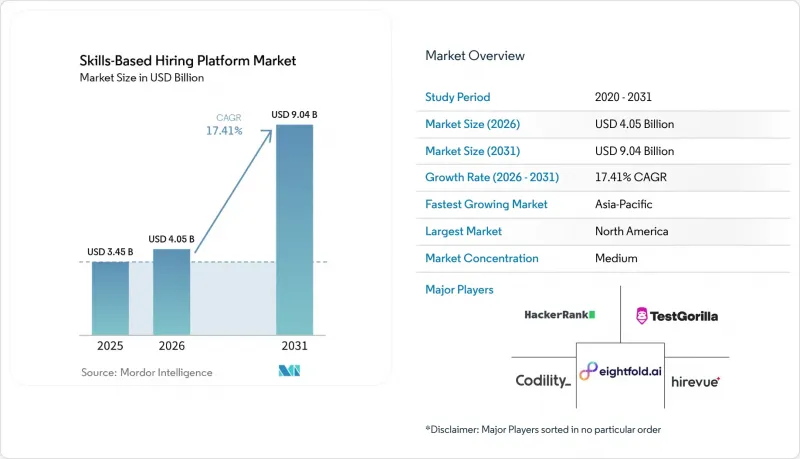
Mordor Intelligence에 의하면, 기술 기반 채용 플랫폼 시장 규모는 2025년에 34억 5,000만 달러로 평가되었습니다. 2026년 40억 5,000만 달러에서 2031년까지 90억 4,000만 달러에 이를 것으로 예상되며, 예측 기간(2026-2031년) CAGR은 17.4%를 나타낼 전망입니다.
본 보고서는 플랫폼 유형(독립형 스킬 기반 플랫폼, 통합형 ATS 모듈, 스킬 평가 API 제공업체 등), 도입 형태(클라우드 기반, On-Premise형), 조직 규모(중소기업(SME), 대기업), 최종 이용 산업(IT 및 통신 등) 및 지역별로 분류되어 있습니다. 시장 전망은 금액(달러) 기준으로 제시되어 있습니다.
세계의 기술 기반 채용 플랫폼 시장 동향 및 인사이트
편향을 줄이기 위한 역량 기반 채용으로의 전환
2025년에는 고용주의 27%가 채용 공고에서 학사 학위 요건을 삭제했으며, 이는 2020년에 비해 크게 증가한 수치로, 자격 요건에 따른 선별이 검증된 평가로 대체되고 있음을 뒷받침합니다. 워싱턴주의 행정명령 24-04에 따라, 역량 기반 채용을 위한 공공 부문용 템플릿이 마련되었으며, 이미 미국의 다른 주에서도 유사한 움직임이 나타나고 있습니다. 편향 대시보드와 부정적 영향 계산 도구를 통합한 플랫폼은 규정 준수 위험이 가장 높은 규제 대상 부문에서 계약을 수주하고 있습니다.
AI와 분석의 통합을 통한 인재 매칭 강화
뉴욕시 지방법 제144호, 일리노이주 하원 법안 제3773호, 그리고 곧 시행될 EU AI법은 자동화된 채용 절차에 대해 편향성 감사 및 공개 의무를 부과하고 있으며, 각 공급업체들은 실시간 설명 가능성 모듈을 추가하도록 요구받고 있습니다. 맥킨지의 2026년 '조직의 현황' 조사에 따르면, 인간 중심의 AI를 활용하는 기업은 ROI 목표를 달성할 가능성이 1.6배 더 높으며, 규정 준수를 바탕으로 한 분석의 효과가 입증되었습니다. 재정적 여력이 있는 공급업체들은 이러한 비용을 감당하고, 실시간 평가 생성을 통해 제품의 차별화를 꾀함으로써, 소규모 경쟁사들이 규정 준수라는 장벽을 넘기 위해 고군분투하는 와중에도 경쟁 우위를 더욱 공고히 하고 있습니다.
기존 HRIS 및 ATS 시스템과의 통합의 한계
대부분의 인사 정보 시스템은 표준화된 역량 프로파일이 아닌 이력서 파일을 중심으로 구축되어 있기 때문에 데이터 모델의 불일치로 인해 도입 기간이 길어지고 총 소유 비용(TCO)이 증가하고 있습니다. 구매 기업은 맞춤형 커넥터에 자금을 투자할지, 아니면 파편화된 워크플로우를 수용할지 둘 중 하나를 선택할 수밖에 없어, 비용에 민감한 중견 기업들의 도입이 지연되고 있습니다. 스킬 온톨로지를 레거시 시스템의 필드 구조로 변환하는 턴키 통합 솔루션 및 미들웨어를 제공하는 벤더는 이러한 장벽을 완화하고 수익화를 가속화합니다.
부문별 분석
2025년 기준으로, 스킬 기반 채용 플랫폼 시장 점유율의 39.45%를 독립형 시스템이 차지했으나, 고용주들이 더 높은 완료율과 더 심층적인 행동적 인사이트를 요구함에 따라 게임화형 평가 플랫폼은 연평균 성장률(CAGR) 19.34%로 성장하고 있습니다. 『The Future of Jobs 2025』 보고서에서는 창의적 사고, 회복탄력성, 호기심이 가장 빠르게 부상하고 있는 역량으로 꼽혔으며, 이러한 특성은 정적인 설문조사보다 상호작용형 시나리오를 통해 측정하는 것이 더 적합합니다.
기술 평가 API 공급업체는 기업이 자사 포털에 테스트를 통합할 수 있도록 지원하지만, 접근성 및 현지화 관련 부담을 구매자에게 전가하고 있으며, 이는 중견 기업의 인사팀이 과소평가하기 쉬운 상충 관계입니다. IMF의 조사에 따르면, 뉴 이코노미에 필요한 역량을 요구하는 기업들은 일반적으로 설립된 지 얼마 되지 않았으며, 더 혁신적인 경향을 보이는 것으로 나타났는데, 이는 기술적 성숙도와 API 도입 사이에 상관관계가 있음을 시사합니다.
2025년, On-Premise형 도입은 67.14%의 시장 점유율을 차지했으며, 그 대부분은 규정 준수 및 데이터 보안에 대한 우려가 도입을 촉진한 규제 대상 부문이었습니다. 그러나 클라우드 구독 서비스는 연간 20% 이상 증가율을 기록하며 눈부신 성장을 이루고 있습니다. 이러한 성장은 지연이나 규제 요건에 대응하기 위해 공급업체들이 지역별로 데이터센터를 설립하고 있다는 점과, “BYOK(Bring-Your-Own-Key) 암호화와 같은 고급 보안 기능을 제공한다는 점이 원동력이 되고 있습니다.
직원 수가 50명 미만인 기업의 클라우드 기반 HR 도구 도입률은 2020년부터 상승세를 보이고 있으며, 이는 클라우드 기반 솔루션에 대한 선호도가 높아지고 있음을 보여줍니다. 데이터를 로컬에 보관하면서 계산 처리에는 벤더의 클라우드를 활용하는 하이브리드 모델은 데이터 주권과 확장성 사이의 균형을 맞출 수 있다는 점에서 지지를 넓혀가고 있습니다. 그러나 비용 비교 측면에서 보면 완전한 SaaS 솔루션이 점점 더 유리한 입지를 차지하고 있어, 기존의 On-Premise형 제공업체들은 혁신을 꾀하지 않으면 시장 점유율을 잃을 위험에 직면해 있습니다.
지역별 분석
2025년, 북미는 전 세계 매출의 36.76%를 차지했습니다. 이는 뉴욕시의 감사법과 신속한 제품 주기를 촉진하는 탄탄한 벤처 캐피털 생태계에 힘입은 결과입니다. 바이애스 감사와 관련된 지역 규제로 인해 각 플랫폼에서 기능 업그레이드가 진행되고 있습니다. 이러한 감사는 플랫폼이 고유한 편향 없이 운영되도록 보장하며, 운영상의 공정성과 포용성을 증진시킵니다. 동시에, 견조한 벤처 캐피털 환경이 전 세계에 파급 효과를 가져오는 기술적 진보를 뒷받침하고 있습니다. 이 생태계는 자금을 지원하는 것뿐만 아니라, 스타트업과 기존 기업을 육성하고 혁신의 한계를 넓혀가고 있습니다. 유럽의 엄격한 데이터 보호 조치와 시행이 임박한 AI 법안으로 인해, 규정 준수 관련 과제는 더욱 커지고 있습니다.
AI법은 AI 도입과 관련된 엄격한 지침을 마련하여 투명성, 설명 책임 및 윤리적 활용을 보장합니다. 그러나 이러한 장벽은 동시에 벤치마크 역할도 하여, 투자 의욕이 낮은 업체들을 도태시키고 품질을 중시하는 경쟁 환경을 조성합니다. 가장 빠른 성장세를 보이고 있는 아시아태평양은 2031년까지 연평균 성장률(CAGR) 18.91%로 성장할 전망입니다. 이러한 급속한 성장은 기술 개발을 표준화하고 노동력의 실무 능력을 높이는 '국가 기술 자격 프레임워크'인도의 이러한 노력에 힘입어 주도되고 있습니다. 일본에서는 고령화되는 노동력에 대응하기 위한 정책의 일환으로, 생산성을 유지하기 위해 기술 도입과 재교육 노력을 통합하는 것을 목표로 하고 있습니다.
남미, 중동 및 아프리카는 여전히 뒤처져 있지만, 그 격차를 빠르게 좁혀가고 있습니다. 오프라인 지원 평가 도구나 경량화된 웹 클라이언트와 같은 혁신이 인프라 측면의 과제를 극복하는 데 한몫하고 있습니다. 오프라인 지원 평가 도구는 인터넷 연결이 제한된 지역에서도 작동하며, 경량화된 웹 클라이언트를 통해 저대역폭 네트워크에서도 안정적으로 접속할 수 있습니다. 지역별 데이터센터의 전략적 배치, 다양한 언어를 지원하는 문제 은행, 그리고 정부 기준의 역량 매핑 준수는 이러한 급성장 시장에서 공급업체의 성공을 좌우하는 중요한 요소가 될 것입니다.
기타 혜택 :
- 엑셀 형식 시장 예측(ME) 시트
- 3개월간의 애널리스트 지원
자주 묻는 질문
목차
제1장 서론
제2장 조사 방법
제3장 주요 요약
제4장 시장 구도
제5장 시장 규모 및 성장 예측
제6장 경쟁 구도
제7장 시장 기회 및 향후 전망
KTH 26.07.07According to Mordor Intelligence, the skills-based hiring platform market size was valued at USD 3.45 billion in 2025 and estimated to grow from USD 4.05 billion in 2026 to reach USD 9.04 billion by 2031, at a CAGR of 17.4% during the forecast period (2026-2031).
This report is Segmented by Platform Type (Standalone Skills-Based Hiring Platforms, Integrated ATS Modules, Skill Assessment API Providers, and More), Deployment Mode (Cloud-Based, and On-Premises), Organization Size (Small and Medium Enterprises [SMEs], and Large Enterprises), End-Use Industry (IT and Telecom, and More), and Geography. The Market Forecasts are Provided in Terms of Value (USD).
Global Skills-Based Hiring Platform Market Trends and Insights
Shift Toward Competency-Based Recruitment to Reduce Bias
Twenty-seven percent of employers removed bachelor's-degree requirements from job postings in 2025, up sharply from 2020, confirming that credential screens are being replaced by validated assessments. Washington State's Executive Order 24-04 created a public-sector template for competency hiring and has already been echoed by other U.S. states. Platforms embedding bias dashboards and adverse-impact calculators now win regulated-sector contracts where compliance risk is greatest.
Integration of AI And Analytics to Enhance Talent Matching
New York City Local Law 144, Illinois HB 3773, and the soon-to-be-enforced EU AI Act impose bias-audit and disclosure mandates on automated hiring, driving vendors to add real-time explainability modules.McKinsey's 2026 "State of Organizations" survey shows firms using human-centric AI are 1.6 times more likely to hit ROI targets, reinforcing the payoff from compliant analytics. Well-capitalized providers absorb these costs and widen product gaps via real-time assessment generation, reinforcing competitive moats even as smaller peers struggle to clear compliance hurdles.
Limited Integration with Legacy HRIS and ATS Systems
Most human-resource information systems were built around resume files, not normalized skill profiles, so data-model misalignment inflates implementation timelines and pushes total cost of ownership higher. Buyers either fund bespoke connectors or accept fragmented workflows, delaying adoption among cost-sensitive mid-market firms. Vendors offering turnkey integrations and middleware that translate skills ontologies into legacy field structures mitigate this drag and accelerate revenue conversion.
Other drivers and restraints analyzed in the detailed report include:
- Growing Adoption of Remote Hiring Practices Post-Pandemic
- Increasing Demand for Faster Time-to-Hire Metrics
- Data Privacy and Compliance Challenges Under Global Regulations
For complete list of drivers and restraints, kindly check the Table Of Contents.
Segment Analysis
Standalone systems accounted for 39.45% of the skills-based hiring platform market share in 2025, yet gamified assessment platforms are growing at a 19.34% CAGR as employers seek higher completion rates and richer behavioral insight. The Future of Jobs 2025 report ranks creative thinking, resilience, and curiosity among the fastest-rising skills, traits better measured through interactive scenarios than static surveys.
Skill-assessment API vendors let enterprises embed tests into proprietary portals, but they off-load accessibility and localization burdens onto buyers, a trade-off some mid-market HR teams underestimate. IMF research shows that firms advertising new-economy skills tend to be younger and more innovative, implying a correlation between technical maturity and API adoption.
In 2025, on-premises deployments commanded a 67.14% market share, predominantly in regulated sectors where compliance and data security concerns drive adoption. However, cloud subscriptions are experiencing significant growth, with an annual increase exceeding 20%. This growth is fueled by vendors establishing regional data centers to address latency and regulatory requirements, as well as offering advanced security features like bring-your-own-key encryption.
Cloud HR tool adoption among firms with fewer than 50 employees rose from 2020, showcasing the growing preference for cloud-based solutions. Hybrid models, which retain data locally while leveraging vendor clouds for computation, are gaining traction due to their ability to balance data sovereignty with scalability. However, cost comparisons increasingly favor full SaaS solutions, putting pressure on traditional on-premises providers to innovate or risk losing market share.
Complete Report Scope:
- By Platform Type
- Standalone Skills-Based Hiring Platforms
- Integrated ATS Modules
- Skill Assessment API Providers
- Gamified Assessment Platforms
- Other Platform Types
- By Deployment Mode
- Cloud-Based
- On-Premises
- By Organization Size
- Small and Medium Enterprises (SMEs)
- Large Enterprises
- By End-Use Industry
- IT and Telecom
- BFSI
- Healthcare
- Manufacturing
- Retail and E-Commerce
- Government
- Other End-Use Industries
- By Geography
- North America
- United States
- Canada
- Mexico
- South America
- Brazil
- Argentina
- Rest of South America
- Europe
- Germany
- United Kingdom
- France
- Italy
- Spain
- Russia
- Rest of Europe
- Asia-Pacific
- China
- India
- Japan
- South Korea
- Australia and New Zealand
- Rest of Asia-Pacific
- Middle East
- Saudi Arabia
- United Arab Emirates
- Turkey
- Rest of Middle East
- Africa
- South Africa
- Nigeria
- Rest of Africa
- North America
Geography Analysis
North America delivered 36.76% of global revenue in 2025, propelled by New York City's audit law and a dense venture-capital ecosystem driving rapid product cycles. Local mandates on bias audits are prompting upgrades across platforms. These audits ensure that platforms operate without inherent biases, fostering fairness and inclusivity in their operations. Simultaneously, a robust venture-capital landscape is fueling technological advancements with global repercussions. This ecosystem not only provides funding but also nurtures startups and established firms to push the boundaries of innovation. Europe's rigorous data protection measures, alongside the impending AI Act, elevate compliance challenges.
The AI Act introduces stringent guidelines for AI deployment, ensuring transparency, accountability, and ethical usage. However, these hurdles also establish a benchmark, filtering out less-invested players and promoting a competitive environment focused on quality. Asia-Pacific, charting the fastest growth trajectory, is set to expand at an 18.91% CAGR through 2031. This surge is driven by India's alignment with the National Skills Qualifications Framework, which standardizes skill development and enhances workforce readiness. Japan's policies addressing its aging workforce aim to integrate technology and reskilling initiatives to maintain productivity.
While South America, the Middle East, and Africa lag behind, they're rapidly closing the gap. Innovations like offline-capable assessments and streamlined web clients are helping them navigate infrastructural challenges. Offline-capable assessments enable functionality in areas with limited internet access, while lighter web clients ensure accessibility on low-bandwidth networks. The strategic placement of regional data centers, diverse language item banks, and adherence to government-standard competency mapping will play pivotal roles in determining vendor success across these burgeoning markets.
- HireVue Inc.
- SHL Group Ltd.
- HackerRank Inc.
- TestGorilla B.V.
- Codility Ltd.
- Harver B.V.
- Mercer LLC (Mercer Mettl)
- iMocha
- Pymetrics Inc.
- Vervoe
- TalentSorter (Fit First Technologies Inc.)
- Arctic Shores Ltd.
- Traitify by Paradox, LLC
- Plum Inc.
- Talview Inc.
- Applied Ltd.
- SkillSurvey Inc.
- AssessFirst SA
- Bryq P.C.
- Eightfold AI Inc.
Additional Benefits:
- The market estimate (ME) sheet in Excel format
- 3 months of analyst support
TABLE OF CONTENTS
1 INTRODUCTION
- 1.1 Study Assumptions and Market Definition
- 1.2 Scope of the Study
2 RESEARCH METHODOLOGY
3 EXECUTIVE SUMMARY
4 MARKET LANDSCAPE
- 4.1 Market Overview
- 4.2 Market Drivers
- 4.2.1 Shift Toward Competency-Based Recruitment to Reduce Bias
- 4.2.2 Growing Adoption of Remote Hiring Practices Post-Pandemic
- 4.2.3 Increasing Demand for Faster Time-to-Hire Metrics
- 4.2.4 Integration of AI and Analytics to Enhance Talent Matching
- 4.2.5 Emerging Government Skills Taxonomies Driving Platform Standardization
- 4.2.6 Rise of Micro-credential Verification via Blockchain
- 4.3 Market Restraints
- 4.3.1 Limited Integration With Legacy HRIS and ATS Systems
- 4.3.2 Data Privacy and Compliance Challenges Under Global Regulations
- 4.3.3 Skepticism From Hiring Managers Lacking Assessment Literacy
- 4.3.4 Shortage of High-Quality Skill Assessment Content in Niche Domains
- 4.4 Industry Value Chain Analysis
- 4.5 Regulatory Landscape
- 4.6 Technological Outlook
- 4.7 Impact of Macroeconomic Factors on the Market
- 4.8 Porter's Five Forces Analysis
- 4.8.1 Threat of New Entrants
- 4.8.2 Bargaining Power of Suppliers
- 4.8.3 Bargaining Power of Buyers
- 4.8.4 Threat of Substitutes
- 4.8.5 Competitive Rivalry
5 MARKET SIZE AND GROWTH FORECASTS (VALUE)
- 5.1 By Platform Type
- 5.1.1 Standalone Skills-Based Hiring Platforms
- 5.1.2 Integrated ATS Modules
- 5.1.3 Skill Assessment API Providers
- 5.1.4 Gamified Assessment Platforms
- 5.1.5 Other Platform Types
- 5.2 By Deployment Mode
- 5.2.1 Cloud-Based
- 5.2.2 On-Premises
- 5.3 By Organization Size
- 5.3.1 Small and Medium Enterprises (SMEs)
- 5.3.2 Large Enterprises
- 5.4 By End-Use Industry
- 5.4.1 IT and Telecom
- 5.4.2 BFSI
- 5.4.3 Healthcare
- 5.4.4 Manufacturing
- 5.4.5 Retail and E-Commerce
- 5.4.6 Government
- 5.4.7 Other End-Use Industries
- 5.5 By Geography
- 5.5.1 North America
- 5.5.1.1 United States
- 5.5.1.2 Canada
- 5.5.1.3 Mexico
- 5.5.2 South America
- 5.5.2.1 Brazil
- 5.5.2.2 Argentina
- 5.5.2.3 Rest of South America
- 5.5.3 Europe
- 5.5.3.1 Germany
- 5.5.3.2 United Kingdom
- 5.5.3.3 France
- 5.5.3.4 Italy
- 5.5.3.5 Spain
- 5.5.3.6 Russia
- 5.5.3.7 Rest of Europe
- 5.5.4 Asia-Pacific
- 5.5.4.1 China
- 5.5.4.2 India
- 5.5.4.3 Japan
- 5.5.4.4 South Korea
- 5.5.4.5 Australia and New Zealand
- 5.5.4.6 Rest of Asia-Pacific
- 5.5.5 Middle East
- 5.5.5.1 Saudi Arabia
- 5.5.5.2 United Arab Emirates
- 5.5.5.3 Turkey
- 5.5.5.4 Rest of Middle East
- 5.5.6 Africa
- 5.5.6.1 South Africa
- 5.5.6.2 Nigeria
- 5.5.6.3 Rest of Africa
- 5.5.1 North America
6 COMPETITIVE LANDSCAPE
- 6.1 Market Concentration
- 6.2 Strategic Moves
- 6.3 Market Share Analysis
- 6.4 Company Profiles (includes Global Level Overview, Market Level Overview, Core Segments, Financials as available, Strategic Information, Market Rank/Share, Products and Services, Recent Developments)
- 6.4.1 HireVue Inc.
- 6.4.2 SHL Group Ltd.
- 6.4.3 HackerRank Inc.
- 6.4.4 TestGorilla B.V.
- 6.4.5 Codility Ltd.
- 6.4.6 Harver B.V.
- 6.4.7 Mercer LLC (Mercer Mettl)
- 6.4.8 iMocha
- 6.4.9 Pymetrics Inc.
- 6.4.10 Vervoe
- 6.4.11 TalentSorter (Fit First Technologies Inc.)
- 6.4.12 Arctic Shores Ltd.
- 6.4.13 Traitify by Paradox, LLC
- 6.4.14 Plum Inc.
- 6.4.15 Talview Inc.
- 6.4.16 Applied Ltd.
- 6.4.17 SkillSurvey Inc.
- 6.4.18 AssessFirst SA
- 6.4.19 Bryq P.C.
- 6.4.20 Eightfold AI Inc.
7 MARKET OPPORTUNITIES AND FUTURE OUTLOOK
- 7.1 White-Space and Unmet-Need Assessment


