|
시장보고서
상품코드
2073322
알파카 의류 및 액세서리 : 시장 점유율 분석, 업계 동향 및 통계, 성장 예측(2026-2031년)Alpaca Apparel and Accessories - Market Share Analysis, Industry Trends & Statistics, Growth Forecasts (2026 - 2031) |
||||||
 Mordor Intelligence
Mordor Intelligence에 의하면, 알파카 의류 및 액세서리 시장은 대폭적인 성장이 전망되고 있어 시장 규모는 2025년 7억 7,000만 달러로 평가되었습니다. 2026년에는 8억 2,000만 달러로 확대되어 2031년까지 11억 8,000만 달러에 이를 것으로 예상됩니다.
이는 2026년부터 2031년까지의 예측 기간 동안 7.55%라는 견실한 연평균 성장률(CAGR)을 나타낼 전망입니다.
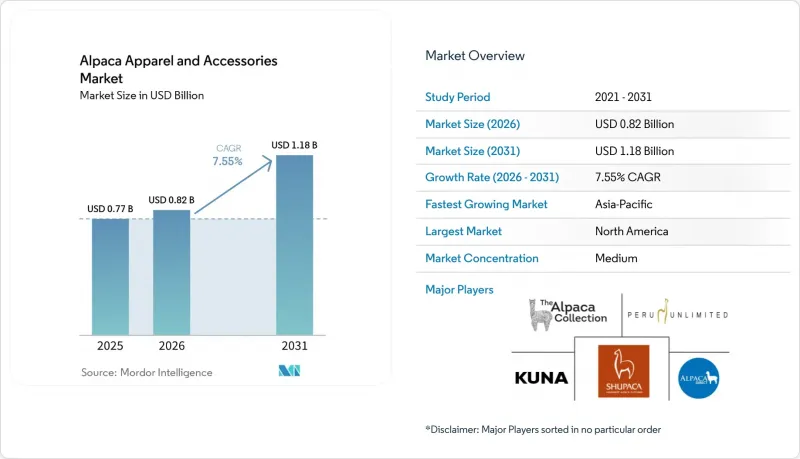
본 보고서는 제품 유형(의류 및 액세서리), 최종 사용자(남성, 여성, 기타), 유통 채널(온라인 스토어 및 오프라인 스토어), 지역(북미, 유럽, 아시아태평양, 남미, 중동 및 아프리카)별로 분류되어 있습니다. 시장 전망치는 금액(달러)으로 표시되어 있습니다.
세계의 알파카 의류 및 액세서리 시장 동향 및 인사이트
보온성이 뛰어난 천연섬유로 만든 의류 및 액세서리에 대한 수요 증가
알파카 의류 및 액세서리 시장은 뛰어난 보온성과 착용감을 겸비한 지속 가능한 천연섬유 의류에 대한 소비자 수요가 증가함에 따라 눈부신 성장을 이루고 있습니다. 부드러움, 보온성, 가벼움으로 잘 알려진 알파카 섬유는 기존의 양모나 합성 소재를 대신해 점점 더 선호되고 있습니다. 지속가능성은 구매 결정에 영향을 미치는 중요한 요소로 부상하고 있으며, 산림인증추진기구(PEFC) 인터내셔널이 2024년 6월에 발표한 보고서에 따르면, 유럽 소비자의 60% 이상이 의류를 구매할 때 지속가능성과 관련된 라벨을 고려하고 있는 것으로 나타났습니다. 이러한 추세를 반영하여, PAKA와 같은 기업들은 공급망의 투명성과 추적성을 높이기 위해 적극적인 노력을 기울이고 있습니다. 예를 들어, 2024년 11월, PAKA는 “Traceable Alpaca Program(추적 가능한 알파카 프로그램)"를 모든 제품 라인으로 확대하여, 고객이 QR 코드를 스캔하면 각 의류에 사용된 알파카 섬유의 원산지를 추적할 수 있도록 했습니다.
디자이너 브랜드 및 럭셔리 패션 컬렉션에서 알파카 섬유의 보급 확대
디자이너 브랜드와 럭셔리 패션 컬렉션에서 알파카 섬유의 사용이 확대되면서, 전 세계 알파카 의류 및 액세서리 시장의 눈부신 성장을 이끌고 있습니다. 럭셔리 패션 브랜드들은 고품질이면서 지속 가능하고 윤리적으로 조달된 소재를 원하는 소비자들 수요 증가에 부응하기 위해, 이 프리미엄 천연섬유를 제품 라인에 적극적으로 도입하고 있습니다. 이러한 동향은 “페루 모다 데코 & 알파카 피에스타 2024"에서 뚜렷이 드러났습니다. 이 행사에서는 크리스찬 디올, 발망, 프라다, MM 라플뢰르와 같은 유명 패션 하우스들이 페루의 알파카 공급업체들과 적극적으로 협업했습니다. 이러한 협업은 조달 파트너십을 강화하고 혁신적인 제품 개발 기회를 모색하기 위한 것으로, 럭셔리 분야에서 알파카 섬유의 입지를 더욱 공고히 하고 있습니다. 이러한 하이엔드 브랜드들의 진출은 알파카 섬유의 세계적 인지도를 높일 뿐만 아니라, 그 가치에 대한 평가도 높여 다양한 고급 의류 및 액세서리 분야에서 알파카 섬유의 사용을 촉진하고 있습니다.
캐시미어나 메리노 울과 같은 정평이 나 있는 고급 섬유와의 경쟁
캐시미어나 메리노 울과 같이 이미 자리 잡은 고급 섬유와의 경쟁은 알파카 의류 및 액세서리 시장에 있어 여전히 큰 과제로 남아 있습니다. 이러한 섬유는 구하기 쉬우며, 품질이 안정적이고, 뛰어난 착용감과 고급스러운 느낌을 선사한다는 평판에 힘입어 수십 년에 걸쳐 소비자들의 확고한 신뢰를 쌓아왔습니다. 특히 캐시미어는 프리미엄 의류 시장을 휩쓸고 있는 반면, 메리노 울은 흡습·발산성 및 통기성과 같은 기능적 장점이 인정받아 기능성 의류 및 아웃도어 의류 분야에서 확고한 입지를 다지고 있습니다. 알파카 섬유는 지속가능성, 탁월한 부드러움, 가벼움, 뛰어난 보온성 등 고유한 장점을 갖추고 있음에도 불구하고, 그 보급은 여전히 더딘 임베디드니다. 이러한 보급 지연은 소비자들의 인지도가 낮은 데다, 알파카 브랜드가 시장에서 확고한 입지를 다지고 있는 캐시미어 및 메리노 울과 경쟁해야 한다는 점도 한 원인이 되고 있습니다. 이러한 과제를 극복하기 위해서는 알파카 제조업체들이 알파카 섬유의 뛰어난 특성을 부각시키기 위해 마케팅, 소비자 교육, 브랜드 포지셔닝에 막대한 투자를 해야 합니다.
부문별 분석
2025년, 의류 부문은 알파카 의류 및 액세서리 시장의 72.54%를 차지했습니다. 이러한 높은 시장 점유율은 부드러움, 보온성, 내구성이 높이 평가받는 알파카 소재의 스웨터, 가디건, 코트, 판초 등의 의류에 대한 높은 수요에 힘입은 것입니다. 천연 소재와 지속 가능한 섬유에 대한 소비자의 선호도가 높아지면서, 특히 프리미엄 및 럭셔리 패션 분야에서 알파카 의류의 보급이 더욱 가속화되고 있습니다. 친환경 패션 트렌드의 부상과 온라인 소매 플랫폼의 영향력 확대가 전 세계 매출을 끌어올리고 있습니다. 또한, 각 제조업체는 소비자의 변화하는 취향에 부응하기 위해 혁신적인 디자인과 컬렉션 도입에 주력하고 있으며, 이를 통해 이 부문의 지속적인 성장을 확보하고 있습니다.
액세서리 분야는 2031년까지 연평균 성장률(CAGR)이 8.47%에 달하고, 가장 빠른 성장이 예상됩니다. 이러한 성장은 스카프, 장갑, 모자, 숄, 양말 등 고품질 알파카 액세서리에 대한 수요 증가에 힘입은 것입니다. 소비자들은 가볍고 착용감이 좋으며 친환경적인 패션 제품에 점점 더 매력을 느끼고 있으며, 이로 인해 알파카 소재 액세서리의 인기가 높아지고 있습니다. 또한, 이 부문은 선물 수요 증가와 고급 패션 아이템에 대한 지출 증가라는 추세의 수혜를 입고 있습니다. 또한, 제품 라인업의 다양화와 전자상거래 플랫폼을 통한 알파카 액세서리의 접근성 향상으로 인해, 향후 몇 년간 꾸준한 성장이 예상됩니다.
지역별 분석
2025년, 북미는 알파카 의류 및 액세서리 시장을 주도하며 시장 총매출의 32.68%를 차지했습니다. 이 지역의 성장은 특히 미국에서 고품질이면서 지속 가능한 천연섬유 제품에 대한 강한 선호에 힘입어 이루어지고 있습니다. 고급 의류에 대한 인기가 높아지고 친환경 패션에 대한 선호도가 확대되면서 수요가 크게 증가했습니다. 또한, 소비자를 대상으로 한 직접 판매 채널의 확대도 시장 성장을 더욱 뒷받침하고 있습니다. 예를 들어, 2025년 3월, PAKA사는 미국의 대형 소매업체와 제휴를 맺어 알파카 섬유 의류의 접근성을 높이고, 소비자들이 지속 가능한 의류를 보다 손쉽게 구매할 수 있도록 했습니다. 남녀를 불문하고 알파카 제품의 사용이 확대되고 있는 것이, 해당 지역 시장 내 입지를 더욱 공고히 하고 있습니다.
아시아태평양은 알파카 의류 및 액세서리 시장에서 가장 빠른 성장세를 보일 것으로 예상되며, 2031년까지 연평균 성장률(CAGR)은 8.52%를 나타낼 것으로 전망됩니다. 이 지역의 성장은 가처분 소득 증가, 지속 가능한 패션에 대한 인식 제고, 그리고 고급 의류에 대한 수요 증가에 힘입어 이루어지고 있습니다. 중국, 일본, 한국, 호주 등에서는 고급 천연섬유 제품에 대한 관심이 급증하고 있어, 시장 관계자들에게 수익성이 높은 기회가 생겨나고 있습니다. 또한, 세계적 동향의 영향과 전자상거래 플랫폼의 급속한 확장이 시장 침투를 뒷받침하고 있습니다. 소비자들이 고품질이면서 친환경적인 섬유 제품을 점점 더 중요하게 여기는 가운데, 아시아태평양은 이 시장의 주요 성장 거점으로 부상할 것으로 예측됩니다.
유럽은 지속 가능한 방식으로 조달된 고품질 섬유 제품에 대한 강력한 수요에 힘입어, 알파카 소재 의류 및 액세서리 시장에 있어 여전히 중요한 시장으로 자리 잡고 있습니다. 유럽 주요국의 소비자들은 착용감, 내구성, 그리고 환경적 이점 등을 이유로 고급 천연섬유를 높이 평가했습니다. 이 지역에 자리 잡은 럭셔리 패션 산업과 탄탄한 섬유 제조 인프라는 알파카 제품에 대한 수요를 유지하는 데 있어 매우 중요한 역할을 하고 있습니다. 지속가능성, 추적 가능성, 그리고 윤리적인 조달 관행에 대한 관심이 높아지면서 알파카 의류의 보급이 확대되고 있습니다. 한편, 남미는 여전히 알파카 섬유의 주요 생산 거점으로서의 역할을 수행하고 있으며, 중동 및 아프리카에서는 고급 패션 소매 네트워크의 확대와 소비자 인식의 제고에 힘입어 유망한 시장으로 서서히 부상하고 있습니다.
기타 혜택 :
- 엑셀 형식 시장 예측(ME) 시트
- 3개월간의 애널리스트 지원
자주 묻는 질문
목차
제1장 서론
제2장 조사 방법
제3장 주요 요약
제4장 시장 구도
제5장 시장 규모 및 성장 예측
제6장 경쟁 구도
제7장 시장 기회 및 향후 전망
KTH 26.07.08According to Mordor Intelligence, the alpaca apparel and accessories market is projected to grow significantly, with its size anticipated to rise from USD 0.77 billion in 2025 to USD 0.82 billion in 2026, eventually reaching USD 1.18 billion by 2031, reflecting a robust CAGR of 7.55% during the forecast period of 2026-2031.
This report is Segmented by Product Type (Apparel and Accessories), End User (Men, Women, and More), Distribution Channel (Online Stores and Offline Stores), and Geography (North America, Europe, Asia-Pacific, South America, and the Middle East and Africa). The Market Forecasts are Provided in Terms of Value (USD).
Global Alpaca Apparel and Accessories Market Trends and Insights
Increasing demand for thermally efficient natural-fiber apparel and accessories
The alpaca apparel and accessories market is witnessing significant growth, driven by rising consumer demand for sustainable, natural-fiber clothing that offers superior thermal efficiency and comfort. Alpaca fiber, known for its softness, warmth, and lightweight properties, is increasingly being preferred over traditional wool and synthetic materials. Sustainability has emerged as a critical factor influencing purchasing decisions, with a June 2024 report by Program for the Endorsement of Forest Certification (PEFC) International indicating that over 60% of European consumers consider sustainability labels when buying clothing. In response to this trend, companies like PAKA have taken proactive steps to enhance transparency and traceability in their supply chains. For instance, in November 2024, PAKA expanded its Traceable Alpaca Program across its entire product range, allowing customers to scan QR codes and trace the origin of the alpaca fiber used in each garment.
Growing penetration of alpaca fiber in designer and luxury fashion collections
The growing use of alpaca fiber in designer and luxury fashion collections is driving significant growth in the global alpaca apparel and accessories market. Luxury fashion brands are increasingly integrating this premium natural fiber into their product lines to meet rising consumer demand for high-quality, sustainable, and ethically sourced materials. This trend was prominently showcased at Peru Moda Deco & Alpaca Fiesta 2024, where renowned fashion houses such as Christian Dior, Balmain, Prada, and MM LaFleur actively collaborated with Peruvian alpaca suppliers. These collaborations aimed to strengthen sourcing partnerships and explore innovative product opportunities, further solidifying alpaca fiber's position in the luxury segment. The involvement of these high-end brands not only enhances the global visibility of alpaca fiber but also elevates its perceived value, driving its adoption across various premium apparel and accessory categories.
Competition from established luxury fibers such as cashmere and merino wool
Competition from well-established luxury fibers such as cashmere and Merino wool continues to pose a significant challenge for the alpaca apparel and accessories market. These fibers have built strong consumer trust over decades, supported by their widespread availability, consistent quality, and reputation for offering superior comfort and luxury. Cashmere, in particular, dominates the premium apparel segment, while Merino wool has carved a niche in performance and outdoor wear due to its recognized functional benefits, such as moisture-wicking and breathability. Despite alpaca fiber's unique advantages, including its sustainability, exceptional softness, lightweight nature, and superior thermal insulation, its adoption remains gradual. This slow uptake is partly due to limited consumer awareness and the need for alpaca brands to compete against the entrenched market presence of cashmere and Merino wool. To overcome these challenges, alpaca manufacturers must invest significantly in marketing, consumer education, and brand positioning to highlight the distinctive qualities of alpaca fiber.
Other drivers and restraints analyzed in the detailed report include:
- Awareness of hypoallergenic and skin-friendly textile products
- Tourism demand for authentic alpaca-based fashion and souvenir products
- High product prices compared to conventional wool and synthetic alternatives
For complete list of drivers and restraints, kindly check the Table Of Contents.
Segment Analysis
In 2025, apparel accounted for 72.54% of the alpaca apparel and accessories market. This significant share is driven by high demand for alpaca-based garments, such as sweaters, cardigans, coats, and ponchos, valued for their softness, warmth, and durability. The increasing consumer preference for natural and sustainable fibers has further propelled the adoption of alpaca apparel, particularly in premium and luxury fashion segments. The rise of eco-conscious fashion trends and the growing influence of online retail platforms have bolstered global sales. Manufacturers are also focusing on introducing innovative designs and collections to meet consumers' evolving tastes, ensuring sustained growth in this segment.
The accessories segment is projected to grow the fastest, with a CAGR of 8.47% through 2031. This growth is fueled by rising demand for high-quality alpaca accessories, including scarves, gloves, hats, shawls, and socks. Consumers are increasingly drawn to lightweight, comfortable, and environmentally friendly fashion products, enhancing the appeal of alpaca accessories. The segment also benefits from the growing trend of gifting and increased spending on luxury fashion items. Furthermore, the diversification of product offerings and the widespread availability of alpaca accessories through e-commerce platforms are expected to drive consistent growth in the coming years.
Complete Report Scope:
- By Product Type
- Apparel
- Sweaters and Cardigans
- Jackets and Coats
- T-Shirts and Tops
- Socks
- Scarves and Shawls
- Ponchos and Capes
- Others
- Accessories
- Hats
- Bags/Handbags
- Gloves/Mittens
- Belts
- Others
- Apparel
- By End User
- Men
- Women
- Children
- By Distribution Channel
- Online Stores
- Offline Stores
- Single-Brand Stores
- Multi-Brand Stores
- Other Offline Channels (Artisan Stores, etc.)
- By Geography
- North America
- United States
- Canada
- Mexico
- Rest of North America
- Europe
- Germany
- United Kingdom
- Italy
- France
- Spain
- Poland
- Belgium
- Sweden
- Rest of Europe
- Asia-Pacific
- China
- Japan
- India
- Australia
- Indonesia
- South Korea
- Thailand
- Singapore
- Rest of Asia-Pacific
- South America
- Brazil
- Argentina
- Colombia
- Chile
- Peru
- Rest of South America
- Middle East and Africa
- South Africa
- Saudi Arabia
- United Arab Emirates
- Nigeria
- Egypt
- Morocco
- Turkey
- Rest of Middle East and Africa
- North America
Geography Analysis
North America dominated the alpaca apparel and accessories market in 2025, accounting for 32.68% of total market revenue. The region's growth is driven by a strong preference for premium and sustainable natural-fiber products, particularly in the United States. The increasing popularity of luxury apparel, coupled with a growing inclination toward eco-friendly fashion, has significantly boosted demand. Additionally, the expansion of direct-to-consumer sales channels has further fueled market growth. For instance, in March 2025, PAKA partnered with major United States retailers to enhance the availability of its alpaca-fiber apparel, making sustainable clothing more accessible to consumers. The rising adoption of alpaca-based products among both men and women continues to strengthen the region's market position.
Asia-Pacific is anticipated to be the fastest-growing region in the alpaca apparel and accessories market, with a projected CAGR of 8.52% through 2031. The region's growth is supported by increasing disposable incomes, heightened awareness of sustainable fashion, and a rising demand for premium apparel. Countries such as China, Japan, South Korea, and Australia are witnessing a surge in interest in luxury natural-fiber products, creating lucrative opportunities for market players. Furthermore, the influence of global fashion trends and the rapid expansion of e-commerce platforms are driving market penetration. As consumers increasingly prioritize high-quality and eco-friendly textiles, Asia-Pacific is expected to emerge as a critical growth hub for the market.
Europe remains a significant market for alpaca apparel and accessories, driven by strong demand for sustainably sourced and high-quality textile products. Consumers in key European countries value premium natural fibers for their comfort, durability, and environmental advantages. The region's well-established luxury fashion industry and robust textile manufacturing infrastructure play a pivotal role in sustaining demand for alpaca-based products. The growing focus on sustainability, traceability, and ethical sourcing practices is encouraging the adoption of alpaca apparel. Meanwhile, South America continues to serve as a vital production hub for alpaca fiber, while the Middle East and Africa are gradually emerging as promising markets due to expanding premium fashion retail networks and increasing consumer awareness.
- Alpaca Direct, LLC
- Peruvian Connection
- Michell Group
- Ayni
- Apu Kuntur
- Incalpaca TPX
- Mary Maxim Inc.
- Cuyana
- Peru Unlimited
- Alqo Wasi
- KUNA
- Sol Alpaca
- Alpaca Collections
- Purely Alpaca
- Spirit of the Andes
- Grupo Inca (Pacomarca)
- Inkanti
- H&M Group
- Paka
- Shupaca
Additional Benefits:
- The market estimate (ME) sheet in Excel format
- 3 months of analyst support
TABLE OF CONTENTS
1 INTRODUCTION
- 1.1 Study Assumptions and Market Definition
- 1.2 Scope of the Study
2 RESEARCH METHODOLOGY
3 EXECUTIVE SUMMARY
4 MARKET LANDSCAPE
- 4.1 Market Overview
- 4.2 Market Drivers
- 4.2.1 Increasing demand for thermally efficient natural-fiber apparel and accessories
- 4.2.2 Growing penetration of alpaca fiber in designer and luxury fashion collections
- 4.2.3 Expanding adoption of ethical and traceable fashion products
- 4.2.4 Awareness of hypoallergenic and skin-friendly textile products
- 4.2.5 Tourism demand for authentic alpaca-based fashion and souvenir products
- 4.2.6 Product innovation in contemporary alpaca apparel and accessory designs
- 4.3 Market Restraints
- 4.3.1 High product prices compared to conventional wool and synthetic alternatives
- 4.3.2 Competition from established luxury fibers such as cashmere and merino wool
- 4.3.3 Counterfeit and misleading fiber labeling practices
- 4.3.4 Supply chain dependence on specific geographic regions
- 4.4 Consumer Behavior Analysis
- 4.5 Regulatory Outlook
- 4.6 Porter's Five Forces
- 4.6.1 Threat of New Entrants
- 4.6.2 Bargaining Power of Buyers
- 4.6.3 Bargaining Power of Suppliers
- 4.6.4 Threat of Substitute Products
- 4.6.5 Intensity of Competitive Rivalry
5 MARKET SIZE AND GROWTH FORECASTS (VALUE)
- 5.1 By Product Type
- 5.1.1 Apparel
- 5.1.1.1 Sweaters and Cardigans
- 5.1.1.2 Jackets and Coats
- 5.1.1.3 T-Shirts and Tops
- 5.1.1.4 Socks
- 5.1.1.5 Scarves and Shawls
- 5.1.1.6 Ponchos and Capes
- 5.1.1.7 Others
- 5.1.2 Accessories
- 5.1.2.1 Hats
- 5.1.2.2 Bags/Handbags
- 5.1.2.3 Gloves/Mittens
- 5.1.2.4 Belts
- 5.1.2.5 Others
- 5.1.1 Apparel
- 5.2 By End User
- 5.2.1 Men
- 5.2.2 Women
- 5.2.3 Children
- 5.3 By Distribution Channel
- 5.3.1 Online Stores
- 5.3.2 Offline Stores
- 5.3.2.1 Single-Brand Stores
- 5.3.2.2 Multi-Brand Stores
- 5.3.2.3 Other Offline Channels (Artisan Stores, etc.)
- 5.4 By Geography
- 5.4.1 North America
- 5.4.1.1 United States
- 5.4.1.2 Canada
- 5.4.1.3 Mexico
- 5.4.1.4 Rest of North America
- 5.4.2 Europe
- 5.4.2.1 Germany
- 5.4.2.2 United Kingdom
- 5.4.2.3 Italy
- 5.4.2.4 France
- 5.4.2.5 Spain
- 5.4.2.6 Poland
- 5.4.2.7 Belgium
- 5.4.2.8 Sweden
- 5.4.2.9 Rest of Europe
- 5.4.3 Asia-Pacific
- 5.4.3.1 China
- 5.4.3.2 Japan
- 5.4.3.3 India
- 5.4.3.4 Australia
- 5.4.3.5 Indonesia
- 5.4.3.6 South Korea
- 5.4.3.7 Thailand
- 5.4.3.8 Singapore
- 5.4.3.9 Rest of Asia-Pacific
- 5.4.4 South America
- 5.4.4.1 Brazil
- 5.4.4.2 Argentina
- 5.4.4.3 Colombia
- 5.4.4.4 Chile
- 5.4.4.5 Peru
- 5.4.4.6 Rest of South America
- 5.4.5 Middle East and Africa
- 5.4.5.1 South Africa
- 5.4.5.2 Saudi Arabia
- 5.4.5.3 United Arab Emirates
- 5.4.5.4 Nigeria
- 5.4.5.5 Egypt
- 5.4.5.6 Morocco
- 5.4.5.7 Turkey
- 5.4.5.8 Rest of Middle East and Africa
- 5.4.1 North America
6 COMPETITIVE LANDSCAPE
- 6.1 Market Concentration
- 6.2 Strategic Moves
- 6.3 Market Share Analysis
- 6.4 Company Profiles (includes Global-level Overview, Market-level Overview, Core Segments, Financials (if available), Strategic Information, Market Rank/Share, Products and Services, Recent Developments)
- 6.4.1 Alpaca Direct, LLC
- 6.4.2 Peruvian Connection
- 6.4.3 Michell Group
- 6.4.4 Ayni
- 6.4.5 Apu Kuntur
- 6.4.6 Incalpaca TPX
- 6.4.7 Mary Maxim Inc.
- 6.4.8 Cuyana
- 6.4.9 Peru Unlimited
- 6.4.10 Alqo Wasi
- 6.4.11 KUNA
- 6.4.12 Sol Alpaca
- 6.4.13 Alpaca Collections
- 6.4.14 Purely Alpaca
- 6.4.15 Spirit of the Andes
- 6.4.16 Grupo Inca (Pacomarca)
- 6.4.17 Inkanti
- 6.4.18 H&M Group
- 6.4.19 Paka
- 6.4.20 Shupaca