|
시장보고서
상품코드
2073333
상업용 SPC 바닥재 : 시장 점유율 분석, 업계 동향 및 통계, 성장 예측(2026-2031년)Commercial Stone Plastic Composite (SPC) Flooring - Market Share Analysis, Industry Trends & Statistics, Growth Forecasts (2026 - 2031) |
||||||
 Mordor Intelligence
Mordor Intelligence에 의하면, 상업용 SPC 바닥재 시장 규모는 2025년에 69억 8,000만 달러로 평가되었습니다. 2026년 75억 6,000만 달러에서 2031년까지 118억 8,000만 달러에 이를 것으로 예상되며, 예측 기간(2026-2031년) CAGR은 9.45%를 나타낼 전망입니다.
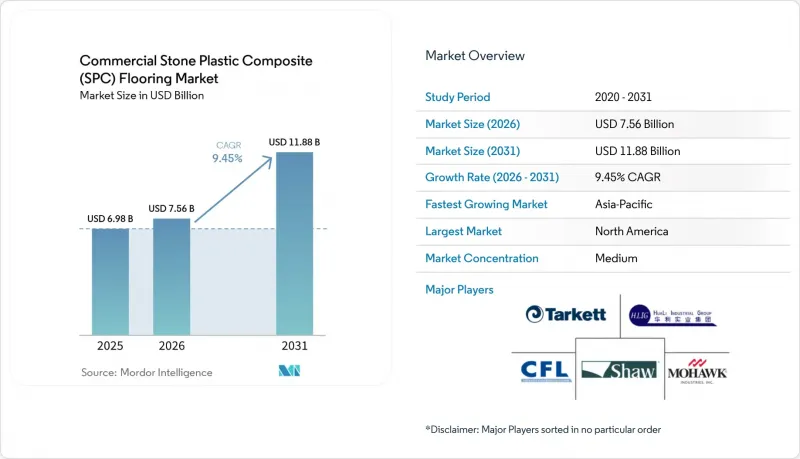
본 보고서는 제품 유형(타일, 플랭크), 두께(4.0-5.0 mm, 5.1-6.0 mm, 6.1-6.5 mm, 6.5 mm 초과), 시공 방법(자체 접착식, 접착제 시공, 클릭락식, 기타), 유통 채널(직접 판매/시공 업체, 도매업체, 소매, 전자상거래), 지역(북미, 남미, 아시아태평양, 기타)별로 분류되어 있습니다. 시장 전망치는 금액(달러)으로 표시되어 있습니다.
세계의 상업용 SPC 바닥재 시장 동향 및 분석
상업시설의 인테리어 분야에서 리모델링 수요를 배경으로 시공이 신속하고 가동 중단 시간이 짧은 리지드 코어에 대한 수요가 증가하고 있습니다.
프로젝트 소유주는 공사 구역별로 순차적으로 진행하면서도 시설의 가동을 유지할 수 있는 개보수 일정에서 SPC 리지드 코어를 선호하여 채택하고 있습니다. 공급업체의 시공 가이드에 따르면, 클릭락 시스템을 통해 접착 시공에 비해 훨씬 신속한 플로팅 시공이 가능해집니다. 시공 직후부터 보행이 가능하며, 24-48시간의 접착제 경화 시간이 필요하지 않기 때문에 운영 중인 호텔이나 사무 공간에서 인건비 절감과 업무 중단 시간 최소화에 기여합니다. 이 플로팅 구조는 대규모 바탕 처리가 필요 없이 바탕의 미세한 요철을 보정할 수 있기 때문에 접착제 경화 시간이 오래 걸리고 보다 세심한 바탕 처리가 필요한 접착 시공에 비해 재시공 발생률을 낮춥니다. 공공시설의 경우, 개보수 후 조속한 재사용을 촉진하기 위해 저배출 가스 인증이 우선적으로 적용됩니다. 따라서, 캘리포니아주 섹션 01350의 VOC(휘발성 유기 화합물) 제한치를 기준으로 시험을 실시하는 “FloorScore"는 LEED, WELL 또는 CHPS 인증 취득을 목표로 하는 의료·교육 시설의 조달 기준으로 활용되고 있습니다. 공급업체의 시공 실적을 통해 시공의 청결성, 매일 물걸레질이나 액체 유출에도 견디는 방수 코어, 그리고 상업시설 인테리어에서 습기로 인한 공사 지연 위험이 낮다는 점이 강조되고 있습니다.
내구성과 방수성을 겸비한 리지드 코어(SPC)가 LVT 시장에서 점유율을 확대되고 있습니다.
리지드 코어 SPC 구조는 기존의 플렉서블 LVT보다 치수 안정성 문제를 더욱 효과적으로 해결합니다. 제조업체의 사양 및 제품 비교에서는 낮은 팽창률(일반적으로 0.05% 이하, 일부에서는 0.02% 이하의 수축률을 보고함)과 온도 변화 하에서도 안정적인 성능이 강조되고 있으며, 고밀도 코어와 두꺼운 상업용 마모층(0.5 mm/20밀 이상)을 갖추고 있어, 캐스터가 달린 의자 시험(90kg 하중에서 2만 5,000 사이클을 통과하는 경우가 많음)을 견디며, 복도나 로비 등 구름 하중이 크고 유동 인구가 많은 구역에 적합합니다. SPC의 방수 코어는 의료시설의 멸균실, 주방, 공중화장실 등에서 매일 이루어지는 물세척 청소나 액체 유출로 인한 팽창 및 표면 변형을 방지합니다. 반면, 플렉서블 LVT는 가장자리 주변이 장시간 습기에 노출될 경우 영향을 받을 수 있습니다. 이 제품은 광범위한 영역에서 일관된 잠금 성능과 재현성 있는 품질을 보장하기 위해, 정식 라이선스 계약에 따라 클릭 시스템이 포함된 형태로 공급되는 경우가 많습니다. 이러한 제품 특성들이 복합적으로 작용하여, 2026년에는 상업 분야에서 유연한 비닐 제품에서 경질 코어 제품으로의 대체가 진행되고 있습니다.
PVC 수지 및 첨가제의 가격 변동이 입찰 경쟁력에 영향을 미침
SPC는 탄산칼슘 외에도 PVC 수지를 주원료로 사용하고 있으며, 여러 제조업체들은 수지 및 첨가제의 가격 변동을 리드타임이 긴 프로젝트의 이익률을 압박하는 가격 리스크로 지적하고 있습니다. 제조업체의 배합 및 생산 자료에 따르면, 코어 재료 중 PVC 수지는 일반적으로 25-30%를 차지하고, 석회석(탄산칼슘)은 60-75%를 차지합니다. 이 가격은 세계 원유 및 원자재 가격의 변동과 밀접한 관련이 있으며, 예를 들어 2026년 초에는 PVC 수지 가격이 파운드당 3-5센트 상승한 것으로 기록되어 있습니다. 석유화학 시장 보고서에서는 업스트림 부문의 경기 사이클이 수지 가격 변동에 어떻게 반영되며, 그 영향이 시차를 두고 바닥재 견적 가격에 파급되어 입찰 및 조달을 복잡하게 만들고 있는지에 대해 설명하고 있습니다. 지역별 가격 차이 또한 해당 연도의 조달처 선정에 영향을 미치며, 구매자들은 수지 가격이 저렴한 지역과 무역 조치 및 물류 리스크 간의 균형을 신중하게 검토해야 하는 상황에 놓여 있습니다. 많은 도매업체와 수입업체는 원자재 가격이 급등할 때에도 공급의 연속성을 유지하기 위해, 적시 생산 방식에서 여유를 둔 재고 관리 방식으로 전환하고 있습니다. 석회석 함량이 높기 때문에 SPC는 유연한 비닐 제품에 비해 가격 변동의 영향을 부분적으로 완화할 수는 있지만, 가격 변동 자체를 완전히 없앨 수는 없습니다. 다만, PVC에 전적으로 의존하는 구조와 비교하면 위험을 줄일 수 있습니다.
부문별 분석
2025년, SPC 플랑크는 68.30%의 시장 점유율을 차지했습니다. 이는 대형 디자인, 사실적인 나뭇결 무늬, 그리고 효율적인 시공 덕분에 복도, 객실, 오픈 오피스 등 광범위한 공간에서 채택될 수 있었기 때문입니다. 디자이너는 이음매의 빈도를 줄이고, 광활한 공간 전체에 걸쳐 시선이 끊기지 않는 연속성을 구현하면서도, 상업시설에 요구되는 내구성을 유지하기 위해 긴 판재를 선택하는 경우가 많습니다. SPC 타일은 로비, 리셉션 구역, 브랜드화된 공용 공간에서 모듈식 패턴과 기하학적 무늬에 대한 관심이 높아지는 것을 배경으로, 2031년까지 연평균 성장률(CAGR) 9.82%를 기록하며 가장 빠르게 성장하는 제품 형태로 부상하고 있습니다. 각 회사의 디자인 가이드에서는 헤링본, 셰브론, 대형 석재 느낌의 디자인이, 패턴화된 시공에서 정확한 위치 정렬을 가능하게 하는 라이선스를 취득한 잠금 시스템을 활용하여 채택되고 있습니다. 플랑크와 타일의 기능적 성능은 동등합니다. 이는 두 형식 모두 방수 기능이 있는 경질 코어와 상업용 내마모층을 갖추고 있기 때문이며, 따라서 선택의 결정적 요인은 근본적인 차이가 아니라 디자인 컨셉이나 시공 워크플로우가 됩니다.
미적 요소가 중시되는 프로젝트에서 세라믹 소재에 비해 유지보수 용이성, 미끄럼 방지 성능, 경량화가 우선시되는 상황에서 대형 석재 느낌의 SPC 타일이 주목받고 있습니다. 각 공급업체는 기존의 세라믹용 시공 자재와 비교하여, 클릭 잠금식 조립 방식이 무늬가 들어간 제품이나 대형 디자인 시공 현장에서 발생하는 복잡성을 어떻게 줄여주는지 설명하고 있습니다. 조달 팀이 상업용 SPC 바닥재 시장에서 실내 공기질(IAQ) 및 환경 제품 선언(EPD) 문서를 표준화해 나가면서, 특정한 구역에 타일을 적용하는 것은 배경이나 동선 공간에서 판재의 폭넓은 실용성을 보완하는 역할을 하고 있습니다. 타일과 플랭크 두 가지 형식을 모두 사용하는 단일 시리즈를 채택한 사양 담당자는 일관된 유지보수 절차를 유지하면서 색상, 질감, 마감 세부 사항을 통일할 수 있습니다. 2026년의 의사결정 과정에서 디자인 의도와 예측 가능한 성능이 융합됨에 따라, 이러한 조합은 상업용 SPC 바닥재 시장 전반에 걸쳐 균형 잡힌 판매량 전략을 뒷받침하고 있습니다.
2025년 수요 중 5.1-6.0 mm 두께 구간이 42.75%를 차지했습니다. 이는 구매자가 사용 빈도가 낮거나 중간 정도인 복도나 다목적실에서 단가와 상업용 성능의 균형을 고려했기 때문입니다. 이러한 중간 두께의 구조물에 공장에서 부착된 방음 폼은 많은 건축 기준에서 요구하는 기본 충격 차단 목표 달성을 돕고, 별도의 바탕재를 사용하는 경우와 비교하여 조달 및 조정에 드는 수고를 줄여줍니다. 6.5 mm를 초과하는 제품의 경우, 2031년까지 연평균 성장률(CAGR) 9.65%를 나타낼 것으로 예측되며, 이는 공동주택 및 고령자 주거 공간에서 더욱 엄격해진 방음 기준과 거주자의 쾌적성에 대한 기대를 반영한 것입니다. 공급업체의 자료에 따르면, IIC 및 STC 값이 높은 두꺼운 코어를 채택함으로써, 다양한 시공 방식에서 2차 방음 매트의 비용과 복잡성을 피하면서도 방수 성능과 상업용 마모층을 유지할 수 있는 것으로 나타났습니다. 이러한 추세는 장기적인 수명 주기 비용이나 보증 위험이 초기 자재비 절감 효과를 상회하는 경우, 상업용 SPC 바닥재 시장에서 고품질 시공으로의 전환을 촉진하고 있습니다.
계속해서 얇은 사양의 제품을 지정하는 구매자는 대개 예산이 제한된 리모델링 공사나, 구름 하중 및 소음 전달이 최소화되어 부하가 적은 소매점이나 사무실 용도를 염두에 두고 있습니다. 건축 기준이나 브랜드 기준에 따라 높은 음향 성능이 요구되는 경우, 발포층을 일체화한 두꺼운 구조는 프로젝트 전체에 걸쳐 별도의 시공 방법을 도입하지 않고도 측정 가능한 성능상의 이점을 제공합니다. 또한, 상업용 SPC 바닥재 업계에서는 클릭 접합부의 강도를 높이고, 널찍한 오픈 플로어에서 조립하기 쉽도록 더 두꺼운 프로파일을 채택하는 추세입니다. 이를 통해 시공 일정을 단축하고, 재시공의 위험을 줄일 수 있습니다. 이러한 장점들은 현재 공공기관의 조달팀이 인테리어 공사나 개보수 공사를 위해 배포하는 많은 표준 사양서 양식에도 반영되어 있습니다. 따라서, 더 두꺼운 프로파일의 매력은 음향 성능에 그치지 않고, 상업용 SPC 바닥재 업계가 직면한 가혹한 마모 환경에서의 안정성에 대한 보다 일반적인 요구를 반영하고 있다고 할 수 있습니다.
지역별 분석
2025년, 북미는 상업용 SPC 바닥재 세계 시장 점유율의 32.90%를 차지했습니다. 이는 접객, 의료, 교육 분야의 기관 및 시설 리노베이션이 주도한 결과입니다. 미국 및 캐나다의 바이어들은 실내 공기질(IAQ) 관련 인증 및 환경 성능에 대한 공개 문서를 중요하게 여기고 있으며, 이로 인해 LEED, WELL 및 관련 프레임워크와 연계된 공식 인증의 중요성이 더욱 커지고 있습니다. 제조업체와 인증 기관은 배출 기준을 충족하고 유효한 인증을 유지하고 있는 SPC 제품을 공개적으로 목록화하고 있으며, 이를 통해 조달 팀과 설계자에게 규정 준수와 관련된 공통 기준을 제공합니다. 또한, 이 지역에서는 프로젝트 일정과 재고 계획에 대응하기 위해 지역 내 및 해외 공급을 결합한 다양한 조달 전략의 이점도 누리고 있습니다. 그 결과, 2026년 사양 수립에 있어서는 명확한 문서화, 견고한 잠금 시스템, 그리고 기준이 되는 차음 목표를 충족하거나 이를 상회하는 방음 패키지를 갖춘 SPC 제품 라인이 선호되는 추세입니다.
유럽에서는 성숙한 리모델링 활동과 환경 및 건강 관련 문서화에 대한 높은 기준이 결합되어 있으며, 이것이 브랜드의 제품 구성과 규정 준수에 대한 투자를 형성하고 있습니다. 업계 단체는 이에 대응하여 건축가 및 종합건설사의 문서 작성 절차를 간소화하기 위해, 비닐 소재 SPC 바닥재를 대상으로 검증된 EPD(환경 제품 선언)를 작성하고 있습니다. 또한, 유럽의 제품 라인업에서는 프탈레이트 에스테르를 사용하지 않은 가소제나 지역 인증 제도에 따라 검증된 배출량 분류가 중시되고 있으며, 이러한 사항은 감사하기 쉬운 기업의 지속가능성 정보를 통해 뒷받침되고 있습니다. 현지 창고 보관 및 신속한 서비스 대응을 통해 까다로운 건설 일정을 지원하고 있으며, 각사는 유럽 내 지원팀을 운영하여 조달 기준 및 언어적 측면에서 기대에 부응하고 있습니다. 이러한 노력은 2026년의 상업용 구매자들이 대규모 리모델링 예산을 주도하는 광범위한 탈탄소화 및 건강 관련 우선 과제에 비추어 디자인, 성능, 규정 준수를 조화시키는 데 도움이 될 것입니다.
아시아태평양은 도시화 추세와 다양한 리지드 코어 생산 능력의 지속적인 확충에 힘입어, 2031년까지 연평균 성장률(CAGR)이 10.47%에 달하며 가장 빠르게 성장하고 있는 지역입니다. 베트남은 수출과 내수 수요를 모두 충족하기 위해 심수항 인근에 대규모 공장 투자를 단행하여, 세계 SPC 공급의 중요한 거점으로 자리매김하고 있습니다. 각사의 공시 정보에 따르면, 이들 공장에서는 미국과 중국의 생산 능력을 보완하는 고도의 방음 성능을 갖춘 SPC 및 내스크래치성 제품이 생산되고 있으며, 견고한 다중 거점 네트워크를 형성하고 있습니다. 지역 공급업체별 비교 지침에서는 북미 및 유럽과의 무역 협정과 운송 프로파일을 포함하여, 중국과 베트남에서의 SPC 조달과 관련된 실무적 고려 사항이 개괄적으로 설명되어 있습니다. 이러한 요인들로 인해 아시아태평양은 상업용 SPC 바닥재 시장에서 제조 거점일 뿐만 아니라, 수요가 확대되는 중심지로서의 입지를 확고히 하고 있습니다.
기타 혜택 :
- 엑셀 형식 시장 예측(ME) 시트
- 3개월간의 애널리스트 지원
자주 묻는 질문
목차
제1장 서론
제2장 조사 방법
제3장 주요 요약
제4장 시장 구도
제5장 시장 규모 및 성장 예측
제6장 경쟁 구도
제7장 시장 기회 및 향후 전망
KTH 26.07.08According to Mordor Intelligence, the commercial stone plastic composite flooring Market size was valued at USD 6.98 billion in 2025 and is estimated to grow from USD 7.56 billion in 2026 to reach USD 11.88 billion by 2031, at a CAGR of 9.45% during the forecast period (2026-2031).
This report is Segmented by Product Type (Tiles, Planks), Thickness (4. 0-5. 0 Mm, 5. 1-6. 0 Mm, 6. 1-6. 5 Mm, >6. 5 Mm), Installation Method (Self Adhesive, Glue Down, Click Lock, Others), Distribution Channel (Direct/Contractors, Distributors, Retail, E Commerce), and Geography (North America, South America, Asia-Pacific, and More). Market Forecasts are in Value (USD).
Global Commercial Stone Plastic Composite (SPC) Flooring Market Trends and Insights
Renovation Driven Demand for Fast, Low Downtime Rigid Core in Commercial Interiors
Project owners favor SPC rigid core for renovation schedules that keep facilities operational while construction moves zone by zone. According to supplier installation guides, click lock systems enable floating installation that is significantly faster than glue-down alternatives, with immediate walk-on access and no 24-48 hour adhesive curing time, resulting in reduced labor and minimal business downtime in occupied hospitality and office spaces. These floating assemblies bridge minor subfloor irregularities without extensive surface preparation, lowering callbacks compared with glue-down options that require longer adhesive curing and more intensive prep work. Institutional environments prioritize low-emission certifications to speed re-occupancy after renovation, which is why FloorScore, testing to California Section 01350 VOC limits, has become standard for procurement in healthcare and education facilities seeking LEED, WELL, or CHPS compliance. Suppliers' renovation references highlight cleaner execution, waterproof cores that tolerate daily wet cleaning and spills, and lower risk of moisture-related delays in commercial interiors.
Rigid Core (SPC) Gaining Share Within LVT for Durability and Waterproofing
Rigid core SPC constructions address dimensional stability issues more effectively than traditional flexible LVT. Manufacturer specifications and product comparisons emphasize low expansion rates (typically <=0.05%, with some reporting shrinkage <=0.02%) and stable performance in temperature swings, with high-density cores and thicker commercial wear layers (0.5 mm / 20 mil or more) supporting castor chair tests (often passing 25,000 cycles under 90 kg load) for rolling loads and high footfall zones such as corridors and lobbies. SPC's waterproof core eliminates swelling and surface deformation after daily wet cleaning and spills in healthcare sterile processing, kitchens, and public restrooms, unlike flexible LVT, which can be affected by prolonged moisture exposure around edges. The format is often delivered with click systems under formal license agreements for consistent locking integrity and repeatable quality across large footprints. These product attributes, together, are driving substitution from flexible vinyl toward rigid-core choices within the commercial segment in 2026.
PVC Resin and Additive Price Volatility Impacting Bid Competitiveness
SPC relies on PVC resin alongside calcium carbonate, and several producers flag resin and additive volatility as pricing risks that compress margins on long-lead projects. According to manufacturer formulations and production references, PVC resin typically accounts for 25-30% of the core, while limestone (calcium carbonate) accounts for 60-75%, with prices closely linked to global oil and feedstock fluctuations, such as the documented 3-5¢/lb increases in PVC resin in early 2026. Petrochemical market reports explain how upstream cycles translate into resin price changes that flow through flooring price quotes with timing lags that complicate bidding and procurement. Regional differentials also shape sourcing choices in a given year, prompting buyers to weigh lower-resin-price zones against trade actions and logistics exposures. Many wholesalers and importers have shifted from just-in-time to more buffered inventories to sustain supply continuity during feedstock spikes. The partial mitigation of SPC versus flexible vinyl, due to its higher limestone content, does not eliminate volatility but can moderate exposure relative to fully PVC-dependent constructions.
Other drivers and restraints analyzed in the detailed report include:
- IAQ Certified Low Emitting SPC Easing Specs in Healthcare and Education
- Expanding Commercial Adoption Across Office, Hospitality, Healthcare, Education
- End of Life Recycling Limits and PVC Scrutiny in Specifications
For complete list of drivers and restraints, kindly check the Table Of Contents.
Segment Analysis
SPC planks captured 68.30% share in 2025, as large-format visuals, realistic wood textures, and efficient installation supported scale across corridors, guest rooms, and open offices. Designers often select long boards to reduce seam frequency and to deliver continuous lines of sight across expansive spaces while maintaining commercial durability. SPC tiles are advancing as the fastest-growing format, with a 9.82% CAGR through 2031, driven by increased interest in modular and geometric patterns for lobbies, reception areas, and branded public spaces. Company design guides show herringbone, chevron, and large-format stone looks implemented via licensed locking systems that support reliable alignment across patterned installations. The functional performance of planks and tiles is comparable because both formats share waterproof rigid cores and commercial wear layers, so selection pivots on design language and installation workflows rather than core differences.
In projects with high aesthetic stakes, stone-look SPC tiles in larger dimensions are gaining traction where maintenance, slip performance, and weight reduction are priorities relative to ceramics. Vendors outline how click-lock assemblies reduce job-site complexity for patterned or large-format designs compared with traditional ceramic-setting materials. As procurement teams standardize on IAQ and Environmental Product Declaration (EPD) documentation for the commercial stone plastic composite flooring market, the adoption of tiles in signature zones complements the broad utility of planks in background and circulation spaces. Specifiers who rely on a single family across both tile and plank formats can consolidate colorways, textures, and trim details while preserving consistent maintenance protocols. This mix supports a balanced volume strategy across the commercial stone plastic composite flooring market as 2026 decisions blend design intent with predictable performance.
The 5.1-6.0 mm band accounted for 42.75% of 2025 demand as buyers balanced unit costs with commercial performance in light-to-mid-duty corridors and multipurpose rooms. Factory-attached acoustic foams in these mid-thickness builds help projects meet baseline impact-isolation targets in many codes, reducing procurement and coordination steps compared with separate underlayment. Above 6.5 mm, products are projected to grow at a 9.65% CAGR through 2031, reflecting tighter acoustic targets and occupant comfort expectations in multifamily and senior living spaces. Supplier documentation points to thicker cores with higher IIC and STC ratings that can avoid the cost and complexity of secondary sound mats in many assemblies, while maintaining waterproof performance and commercial wear layers. These dynamics support a tilt toward premium construction in the commercial stone plastic composite flooring market when long-term lifecycle costs and warranty risk outweigh initial material savings.
Buyers who continue to specify thinner formats usually do so for budget-constrained refreshes or lighter-duty retail and office applications where rolling loads and acoustic transmission are minimal. Where code or brand standards direct higher acoustic values, thicker constructions with integrated foam layers deliver measurable performance benefits without introducing different installation methods across a project. The commercial stone plastic composite flooring industry has also adopted thicker profiles to increase click-joint strength and ease fit-up on large, open floors, thereby shortening installation schedules and reducing rework risk. These advantages now appear in many standard spec templates that institutional procurement teams distribute for fit-outs and renovations. The appeal of thicker profiles, therefore, extends beyond acoustics and reflects a more general desire for stability in heavy wear environments served by the commercial stone plastic composite flooring industry.
Complete Report Scope:
- By Product Type
- SPC Tiles
- SPC Planks
- By Product Thickness
- 4.0-5.0 mm
- 5.1-6.0 mm
- 6.1-6.5 mm
- Above 6.5 mm
- By Installation Method
- Self-Adhesive
- Glue-Down
- Interlocking/Click-lock
- Others
- By Commercial End Users
- Hospitality
- Healthcare Facilities
- Educational Institutes
- Retail (malls, showrooms, stores)
- Offices & Corporate Workspaces
- Other Commercial End Users
- By Distribution Channel
- Direct Sales
- Offline Direct to Projects/Contractors
- Online D2C
- Indirect/Dealers
- Distributors/Wholesalers
- Specialty Retail & Home Improvement
- E-commerce/B2B Marketplaces
- Direct Sales
- By Geography
- North America
- Canada
- United States
- Mexico
- South America
- Brazil
- Peru
- Chile
- Argentina
- Rest of South America
- Europe
- United Kingdom
- Germany
- France
- Spain
- Italy
- BENELUX (Belgium, Netherlands, Luxembourg)
- NORDICS (Denmark, Finland, Iceland, Norway, Sweden)
- Rest of Europe
- Asia-Pacific
- India
- China
- Japan
- Australia
- South Korea
- South-East Asia
- Rest of Asia-Pacific
- Middle East & Africa
- United Arab Emirates
- Saudi Arabia
- South Africa
- Nigeria
- Rest of Middle East & Africa
- North America
Geography Analysis
North America accounted for 32.90% of the global market share for commercial stone plastic composite flooring in 2025, driven by institutional renovations in hospitality, healthcare, and education. U.S. and Canadian buyers give weight to IAQ credentials and public documentation of environmental performance, which has reinforced the importance of formal certifications linked to LEED, WELL, and related frameworks. Manufacturers and certification bodies publicly list SPC products that meet emissions standards and maintain active certificates, providing procurement teams and designers with a common language for compliance. This region also benefits from diversified sourcing strategies that combine regional and overseas supply to address project schedules and inventory planning. As a result, specification flow in 2026 favors SPC lines with clear documentation, strong locking systems, and acoustic packages that meet or exceed baseline isolation targets.
Europe combines mature renovation activity with a high bar for environmental and health documentation, which shapes brand assortments and compliance investments. Industry associations have responded by producing verified EPDs that cover vinyl SPC floor coverings to simplify documentation for architects and general contractors. European portfolios also emphasize phthalate-free stabilizers and emission classifications validated under regional schemes, supported by corporate sustainability content that is readily auditable. Localized warehousing and faster service responses support tight construction timelines, and firms maintain European support teams to align with procurement norms and language expectations. These moves help commercial buyers in 2026 align design, performance, and compliance against the broader decarbonization and health priorities that drive large renovation budgets.
Asia-Pacific is the fastest-growing region, with a 10.47% CAGR through 2031, driven by urbanization dynamics and the continued buildout of diversified rigid-core capacity. Vietnam has become a pivotal node in global SPC supply with large factory investments near deepwater ports to serve both exports and domestic demand. Company disclosures indicate that these factories produce advanced acoustic SPC and scratch-resistant variants that complement capacity in the U.S. and China, forming resilient multi-site networks. Comparative guidance from regional suppliers outlines the practical considerations of sourcing SPC from China versus Vietnam, including trade agreements and shipping profiles into North America and Europe. These factors position Asia-Pacific as both a manufacturing anchor and an expanding demand center for the commercial stone plastic composite flooring market.
- CFL Flooring
- Huali Group (Huali Floors)
- Novalis Innovative Flooring (AVA)
- Mohawk Industries (SolidTech)
- Shaw Industries (Floorte Pro)
- Tarkett (ProGen)
- Mannington Mills (ADURA Rigid)
- Karndean Designflooring (Korlok/Art Select Rigid)
- AHF Products (AHF Contract)
- Gerflor (Creation 55 Rigid Acoustic)
- BerryAlloc (Rigid/SPC LVT)
- Metroflor / HMTX (Inception SPC
- Aspecta Contract)
- LX Hausys (HFLOR PRESTG DECORIGID 55)
- Zhejiang Kingdom Plastics (SPC OEM)
- Decno Group (SPC OEM)
- Beauflor / Beaulieu International Group (Rigid LVT)
- NOX Corporation (Rigid Core LVT)
- Power Dekor (Rigid Core SPC)
- Zhejiang Walrus New Material (SPC)
- Zhejiang GIMIG Technology (SPC)
Additional Benefits:
- The market estimate (ME) sheet in Excel format
- 3 months of analyst support
TABLE OF CONTENTS
1 Introduction
- 1.1 Study Assumptions & Market Definition
- 1.2 Scope of the Study
2 Research Methodology
3 Executive Summary
4 Market Landscape
- 4.1 Market Overview
- 4.2 Market Drivers
- 4.2.1 Renovation-driven demand for fast, low-downtime rigid core in commercial interiors
- 4.2.2 Rigid core (SPC) gaining share within LVT for durability and waterproofing
- 4.2.3 IAQ-certified low-emitting SPC (FloorScore/Greenguard Gold) easing specs in healthcare and education
- 4.2.4 Expanding commercial adoption across office, hospitality, healthcare, education
- 4.2.5 Acoustic and lightweight core innovations enabling code compliance and occupant comfort
- 4.2.6 Nearshoring/regional SPC plants reducing tariff and lead-time risk
- 4.3 Market Restraints
- 4.3.1 PVC resin and additive price volatility impacting bid competitiveness
- 4.3.2 End-of-life recycling limits and PVC scrutiny in specifications
- 4.3.3 Floating click joints under heavy rolling loads prompting glue-down specs in some applications
- 4.3.4 IP/trade enforcement on click systems raising compliance/import risks
- 4.4 Industry Value Chain Analysis
- 4.5 Porter's Five Forces Analysis
- 4.5.1 Threat of New Entrants
- 4.5.2 Bargaining Power of Suppliers
- 4.5.3 Bargaining Power of Buyers
- 4.5.4 Threat of Substitutes
- 4.5.5 Competitive Rivalry
- 4.6 Insights into the Latest Trends and Innovations in the Industry
- 4.7 Insights on Recent Developments (New Product Launches, Strategic Initiatives, Investments, Partnerships, JVs, Expansion, M&As, etc.) in the Industry
5 Market Size & Growth Forecasts (Value in USD Billion)
- 5.1 By Product Type
- 5.1.1 SPC Tiles
- 5.1.2 SPC Planks
- 5.2 By Product Thickness
- 5.2.1 4.0-5.0 mm
- 5.2.2 5.1-6.0 mm
- 5.2.3 6.1-6.5 mm
- 5.2.4 Above 6.5 mm
- 5.3 By Installation Method
- 5.3.1 Self-Adhesive
- 5.3.2 Glue-Down
- 5.3.3 Interlocking/Click-lock
- 5.3.4 Others
- 5.4 By Commercial End Users
- 5.4.1 Hospitality
- 5.4.2 Healthcare Facilities
- 5.4.3 Educational Institutes
- 5.4.4 Retail (malls, showrooms, stores)
- 5.4.5 Offices & Corporate Workspaces
- 5.4.6 Other Commercial End Users
- 5.5 By Distribution Channel
- 5.5.1 Direct Sales
- 5.5.1.1 Offline Direct to Projects/Contractors
- 5.5.1.2 Online D2C
- 5.5.2 Indirect/Dealers
- 5.5.2.1 Distributors/Wholesalers
- 5.5.2.2 Specialty Retail & Home Improvement
- 5.5.2.3 E-commerce/B2B Marketplaces
- 5.5.1 Direct Sales
- 5.6 By Geography
- 5.6.1 North America
- 5.6.1.1 Canada
- 5.6.1.2 United States
- 5.6.1.3 Mexico
- 5.6.2 South America
- 5.6.2.1 Brazil
- 5.6.2.2 Peru
- 5.6.2.3 Chile
- 5.6.2.4 Argentina
- 5.6.2.5 Rest of South America
- 5.6.3 Europe
- 5.6.3.1 United Kingdom
- 5.6.3.2 Germany
- 5.6.3.3 France
- 5.6.3.4 Spain
- 5.6.3.5 Italy
- 5.6.3.6 BENELUX (Belgium, Netherlands, Luxembourg)
- 5.6.3.7 NORDICS (Denmark, Finland, Iceland, Norway, Sweden)
- 5.6.3.8 Rest of Europe
- 5.6.4 Asia-Pacific
- 5.6.4.1 India
- 5.6.4.2 China
- 5.6.4.3 Japan
- 5.6.4.4 Australia
- 5.6.4.5 South Korea
- 5.6.4.6 South-East Asia
- 5.6.4.7 Rest of Asia-Pacific
- 5.6.5 Middle East & Africa
- 5.6.5.1 United Arab Emirates
- 5.6.5.2 Saudi Arabia
- 5.6.5.3 South Africa
- 5.6.5.4 Nigeria
- 5.6.5.5 Rest of Middle East & Africa
- 5.6.1 North America
6 Competitive Landscape
- 6.1 Market Concentration
- 6.2 Strategic Moves
- 6.3 Market Share Analysis
- 6.4 Company Profiles (includes Global level Overview, Market level overview, Core Segments, Financials as available, Strategic Information, Market Rank/Share for key companies, Products & Services, and Recent Developments)
- 6.4.1 CFL Flooring
- 6.4.2 Huali Group (Huali Floors)
- 6.4.3 Novalis Innovative Flooring (AVA)
- 6.4.4 Mohawk Industries (SolidTech)
- 6.4.5 Shaw Industries (Floorte Pro)
- 6.4.6 Tarkett (ProGen)
- 6.4.7 Mannington Mills (ADURA Rigid)
- 6.4.8 Karndean Designflooring (Korlok/Art Select Rigid)
- 6.4.9 AHF Products (AHF Contract)
- 6.4.10 Gerflor (Creation 55 Rigid Acoustic)
- 6.4.11 BerryAlloc (Rigid/SPC LVT)
- 6.4.12 Metroflor / HMTX (Inception SPC; Aspecta Contract)
- 6.4.13 LX Hausys (HFLOR PRESTG DECORIGID 55)
- 6.4.14 Zhejiang Kingdom Plastics (SPC OEM)
- 6.4.15 Decno Group (SPC OEM)
- 6.4.16 Beauflor / Beaulieu International Group (Rigid LVT)
- 6.4.17 NOX Corporation (Rigid Core LVT)
- 6.4.18 Power Dekor (Rigid Core SPC)
- 6.4.19 Zhejiang Walrus New Material (SPC)
- 6.4.20 Zhejiang GIMIG Technology (SPC)
7 Market Opportunities & Future Outlook
- 7.1 Spec-grade SPC with verified acoustic assemblies (E90/E492) for office and multifamily
- 7.2 Circular SPC (EPD-backed, take-back) aligned to LEED v5 procurement